AI Generated Exam Paper
Secondary 1 Science Practice Paper 1
Free AI-Generated Secondary 1 Science Practice Paper 1 practice paper with questions and answers for Singapore students. This page is rendered as a direct URL so the questions and answers can be discovered without pressing in-page buttons.
These static practice materials are generated from the site's syllabus and paper-generation workflow, with source and model context shown so students and parents can evaluate the material before use.
Questions
TuitionGoWhere Practice Paper - Science Secondary 1
TuitionGoWhere Practice Paper (AI)
Subject: Science
Level: Secondary 1
Paper: Physical Sciences Focus
Duration: 1 hour 30 minutes
Total Marks: 80 marks
Name: _________________________ Class: _________ Date: _______________
Instructions to Candidates
- This paper consists of Section A and Section B.
- Answer all questions in both sections.
- Write your answers in the spaces provided.
- Show all working clearly for calculations.
- The number of marks for each question is shown in brackets [ ].
- Use appropriate scientific terminology and units.
Section A [40 marks]
1. A student conducts an experiment to investigate how the surface area of a solid affects the rate of dissolving.
(a) State a suitable hypothesis for this investigation. [1]
(b) In this experiment, identify the:
(i) Independent variable: _________________________________________ [1]
(ii) Dependent variable: __________________________________________ [1]
(iii) One controlled variable: ____________________________________ [1]
(c) Describe how the student can ensure this is a fair test. [2]
2. The diagram shows a simple lever system used to lift a heavy load.
Effort (150 N)
↓
←─── 2.0 m ───→ ←─ 0.5 m ─→
________________▲________________
Pivot Load (600 N)
↓
(a) Calculate the moment of the effort force about the pivot. [2]
Working:
Answer: _________________ N⋅m
(b) Calculate the moment of the load about the pivot. [2]
Working:
Answer: _________________ N⋅m
(c) State whether this lever system is balanced. Give a reason for your answer. [2]
3. A student investigates the reflection of light using different surfaces.
(a) Complete the ray diagram below to show the reflection of light from a plane mirror. Include the normal and label the angle of incidence (i) and angle of reflection (r). [3]
Incident ray
\
\
_______\_______ (plane mirror)
(b) The student then shines the same light ray onto a sheet of rough white paper.
(i) Name the type of reflection that occurs. [1]
(ii) Explain why this type of reflection occurs. [2]
4. The table shows the properties of four substances at room temperature.
| Substance | State | Electrical Conductivity | Solubility in Water |
|---|---|---|---|
| P | Solid | Good | Insoluble |
| Q | Liquid | Poor | Miscible |
| R | Gas | Poor | Slightly soluble |
| S | Solid | Poor | Soluble |
(a) Which substance is most likely to be a metal? [1]
(b) Give two reasons for your answer in part (a). [2]
Reason 1: ________________________________________________________
Reason 2: ________________________________________________________
(c) A mixture contains substances P and S. Describe how you would separate this mixture to obtain pure samples of both substances. [3]
5. A student uses a microscope to observe onion cells.
(a) The microscope has a 15× eyepiece lens and a 40× objective lens.
Calculate the total magnification. [1]
Working:
Answer: _________________×
(b) Under this magnification, a cell appears to be 3.0 mm long.
Calculate the actual length of the cell in micrometers (μm). [2]
Working:
Answer: _________________ μm
(c) The student wants to see more detail in the cell structure.
(i) What should the student do to achieve higher magnification? [1]
(ii) State one disadvantage of using higher magnification. [1]
6. A chemical bottle has the hazard symbols shown below.
[Symbols: Flammable and Corrosive]
(a) State what each hazard symbol means:
(i) Flammable: _________________________________________________ [1]
(ii) Corrosive: ________________________________________________ [1]
(b) List three safety precautions that should be taken when handling this chemical. [3]
Section B [40 marks]
7. A student investigates the factors affecting the pressure exerted by liquids.
The student sets up the apparatus shown below and measures the pressure at different depths in water.
[Diagram showing a tall cylinder of water with pressure sensor at different depths]
(a) State the relationship between depth and liquid pressure. [1]
(b) The student records the following results:
| Depth (cm) | Pressure (Pa) |
|---|---|
| 10 | 1100 |
| 20 | 1200 |
| 30 | 1300 |
| 40 | 1400 |
(i) Plot a graph of pressure (y-axis) against depth (x-axis) on the grid below. [3]
[Grid provided for graph]
(ii) Describe the relationship shown by your graph. [1]
(iii) Use your graph to predict the pressure at a depth of 25 cm. [1]
Answer: _________________ Pa
(c) The student repeats the experiment using cooking oil instead of water.
Predict how the results would differ and explain your prediction. [3]
8. A student uses paper chromatography to analyze the dyes in different colored sweets.
The chromatogram below shows the results:
[Chromatogram showing:
- Sweet A: 3 spots (red, yellow, blue)
- Sweet B: 2 spots (red, blue)
- Sweet C: 1 spot (yellow)
- Reference dyes: Individual spots for red, yellow, blue dyes]
(a) How many different dyes are present in Sweet A? [1]
(b) Which sweet contains only one type of dye? [1]
(c) Explain how chromatography separates the different dyes. [3]
(d) The student wants to improve the separation of the dyes.
Suggest two modifications to the experimental method. [2]
(e) State one advantage of using chromatography to analyze food dyes. [1]
9. A student investigates energy conversions in different situations.
(a) A 2 kg ball is dropped from a height of 5 m.
(i) Calculate the gravitational potential energy of the ball before it is dropped. (Take g = 10 m/s²) [2]
Working:
Answer: _________________ J
(ii) State the energy conversion that occurs as the ball falls. [1]
(iii) Calculate the kinetic energy of the ball just before it hits the ground, assuming no energy is lost to air resistance. [1]
Answer: _________________ J
(b) The student then rolls the same ball along a rough horizontal surface.
(i) State the energy conversion that occurs as the ball slows down. [1]
(ii) Explain why the ball eventually stops moving. [2]
10. A student designs an experiment to investigate how temperature affects the rate of a chemical reaction.
The student adds magnesium ribbon to hydrochloric acid at different temperatures and measures the time taken for the magnesium to completely dissolve.
(a) Write a suitable hypothesis for this investigation. [1]
(b) List the apparatus needed for this experiment. [3]
(c) Describe the method the student should follow. [4]
(d) State two variables that must be controlled in this experiment. [2]
(e) The student obtains the following results:
| Temperature (°C) | Time for reaction (s) |
|---|---|
| 20 | 120 |
| 30 | 80 |
| 40 | 50 |
| 50 | 35 |
(i) What conclusion can be drawn from these results? [2]
(ii) Explain this conclusion using particle theory. [3]
END OF PAPER
Answers
TuitionGoWhere Practice Paper - Science Secondary 1 (Answer Key)
Total Marks: 80
Section A [40 marks]
1. (a) If the surface area of the solid increases, then the rate of dissolving will increase [1] (Accept: Larger surface area leads to faster dissolving)
(b) (i) Surface area of the solid [1] (ii) Rate of dissolving/time taken to dissolve completely [1] (iii) Temperature/volume of solvent/concentration of solvent/amount of solid/stirring [1]
(c) Keep all other variables constant except the one being investigated [1]. Use the same amount of solid, same volume and temperature of solvent, same stirring rate [1].
2. (a) Moment = Force × Distance [1] = 150 N × 2.0 m = 300 N⋅m [1]
(b) Moment = Force × Distance [1] = 600 N × 0.5 m = 300 N⋅m [1]
(c) Yes, the lever system is balanced [1] because the clockwise moment equals the anticlockwise moment (both 300 N⋅m) [1].
3. (a) [Diagram showing: normal line perpendicular to mirror, reflected ray with angle of reflection equal to angle of incidence, both angles clearly labeled] [3 marks: 1 for normal, 1 for correct reflected ray, 1 for correct labeling]
(b) (i) Diffuse reflection/irregular reflection [1] (ii) The rough surface has many small surfaces at different angles [1], so light rays are reflected in many different directions [1].
4. (a) Substance P [1]
(b) Reason 1: It is a solid at room temperature [1] Reason 2: It has good electrical conductivity [1] (Accept: It is insoluble in water - typical of metals)
(c) Add water to dissolve substance S [1]. Filter to separate insoluble P from the solution [1]. Evaporate the filtrate to obtain pure S crystals [1].
5. (a) Total magnification = 15× × 40× = 600× [1]
(b) Actual length = Image length ÷ Magnification [1] = 3.0 mm ÷ 600 = 0.005 mm = 5 μm [1]
(c) (i) Use a higher power objective lens [1] (ii) Field of view becomes smaller/image becomes dimmer/harder to focus [1]
6. (a) (i) Can catch fire easily/burns easily [1] (ii) Can cause burns to skin/can damage materials [1]
(b) Any three from: - Keep away from flames/heat sources [1] - Wear protective gloves [1] - Wear eye protection/safety goggles [1] - Use in well-ventilated area [1] - Use water bath instead of direct heating [1]
Section B [40 marks]
7. (a) As depth increases, liquid pressure increases [1] (Accept: Pressure is directly proportional to depth)
(b) (i) [Graph showing linear relationship with pressure on y-axis (1000-1500 Pa) and depth on x-axis (0-50 cm), points plotted correctly and line of best fit drawn] [3 marks: 1 for correct axes and scale, 1 for correct plotting, 1 for line of best fit]
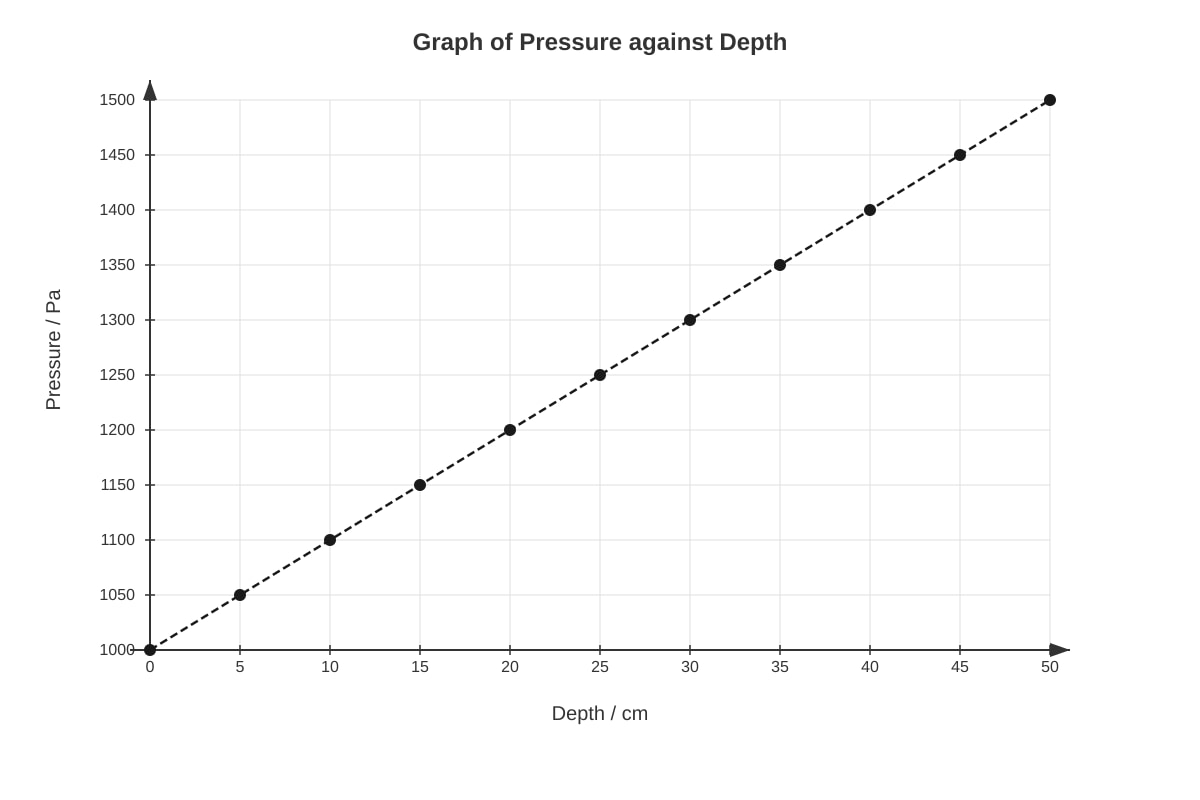
(ii) Linear relationship/directly proportional/as depth increases, pressure increases at a constant rate [1]
(iii) 1250 Pa [1] (accept 1240-1260 Pa)
(c) The pressure would be lower at each depth [1] because oil has a lower density than water [1]. The graph would have the same shape but with lower pressure values [1].
8. (a) Three [1]
(b) Sweet C [1]
(c) Different dyes have different solubilities in the solvent [1]. The more soluble dyes travel further up the paper [1] while less soluble dyes travel shorter distances, causing separation [1].
(d) Any two from: - Use a different solvent [1] - Use longer chromatography paper [1] - Allow more time for development [1] - Use a mixture of solvents [1]
(e) Can identify multiple dyes in one test/quick and simple/requires small sample/can compare with known standards [1]
9. (a) (i) GPE = mgh [1] = 2 kg × 10 m/s² × 5 m = 100 J [1]
(ii) Gravitational potential energy is converted to kinetic energy [1]
(iii) 100 J [1] (by conservation of energy)
(b) (i) Kinetic energy is converted to thermal energy/heat [1]
(ii) Friction between the ball and surface opposes motion [1]. Kinetic energy is converted to thermal energy until all kinetic energy is lost [1].
10. (a) If temperature increases, then the rate of reaction will increase/the time for reaction will decrease [1]
(b) Any three from: - Magnesium ribbon [1] - Hydrochloric acid [1] - Beakers/conical flasks [1] - Thermometer [1] - Stopwatch [1] - Water bath/Bunsen burner [1] - Measuring cylinder [1]
(c) Measure equal lengths of magnesium ribbon [1]. Heat hydrochloric acid to the required temperature using water bath [1]. Add magnesium to acid and start timing [1]. Stop timing when magnesium completely dissolves and record time [1].
(d) Any two from: - Length/mass of magnesium ribbon [1] - Volume of hydrochloric acid [1] - Concentration of hydrochloric acid [1] - Stirring [1]
(e) (i) As temperature increases, the time for reaction decreases [1]. Higher temperature increases the rate of reaction [1].
(ii) At higher temperatures, particles have more kinetic energy [1] and move faster [1]. This leads to more frequent collisions between reactant particles and more successful collisions, increasing the reaction rate [1].
Marking Guidelines:
- Award marks for correct scientific terminology
- Accept equivalent answers that demonstrate understanding
- For calculations, award partial marks for correct method even if final answer is wrong
- Deduct marks for missing units where specified
- Be flexible with wording as long as scientific meaning is correct