From Real Exams Exam Paper
Secondary 1 Science Semestral Assessment 2 (End of Year) Paper 5
Free Sec 1 Science SA2 Paper 5, Nemo3 Exam version, with questions, answers, and syllabus-aligned practice for Singapore students.
These static practice materials are generated from the site's syllabus and paper-generation workflow, with source and model context shown so students and parents can evaluate the material before use.
Questions
Free quiz and exam paper access
Enter your details to view this paper
Your access is remembered on this device.
Answers
TuitionGoWhere Practice Paper - Science Secondary 1
SA2 Version 5 - Answer Key and Marking Scheme
Total Marks: 60
Section A: Multiple Choice Questions [10 marks]
1. Answer: C [1]
Explanation: When a student lifts a book at constant velocity, the chemical energy stored in the student's muscles is converted into kinetic energy (as the book moves) and then into gravitational potential energy (as the book gains height). The complete conversion chain is Chemical energy → Kinetic energy → Gravitational potential energy. Option B is incomplete as it omits the intermediate kinetic energy stage.
2. Answer: C [1]
Working: Work done = Force × Distance = 15 N × 4 m = 60 J
3. Answer: B [1]
Working: Initial kinetic energy = ½mv² = ½ × 0.5 kg × (10 m/s)² = 25 J. At maximum height, all kinetic energy is converted to gravitational potential energy (ignoring air resistance). So GPE gained = 25 J.
4. Answer: C [1]
Explanation:
- A is incorrect: Work requires displacement in the direction of the force.
- B is incorrect: Work can be done when force and displacement are at an angle (W = Fd cos θ).
- C is correct: When holding an object stationary, there is no displacement, so no work is done on the object (though internal work is done in muscles).
- D is incorrect: Work done against gravity depends only on vertical height change, not path.
5. Answer: B [1]
Working: Loss in GPE = Gain in KE. mg(h₁ - h₂) = ½mv². v = √[2g(h₁ - h₂)] = √[2 × 10 × (20 - 15)] = √100 = 10 m/s.
6. Answer: C [1]
Working: Work output = Load × Load distance = 800 N × 2 m = 1600 J. Work input = Effort × Effort distance = 200 N × 10 m = 2000 J. Efficiency = (Work output / Work input) × 100% = (1600/2000) × 100% = 80%.
7. Answer: B [1]
Explanation: Water stored at height has gravitational potential energy → flows down gaining kinetic energy → turns turbines → generators convert to electrical energy.
8. Answer: B [1]
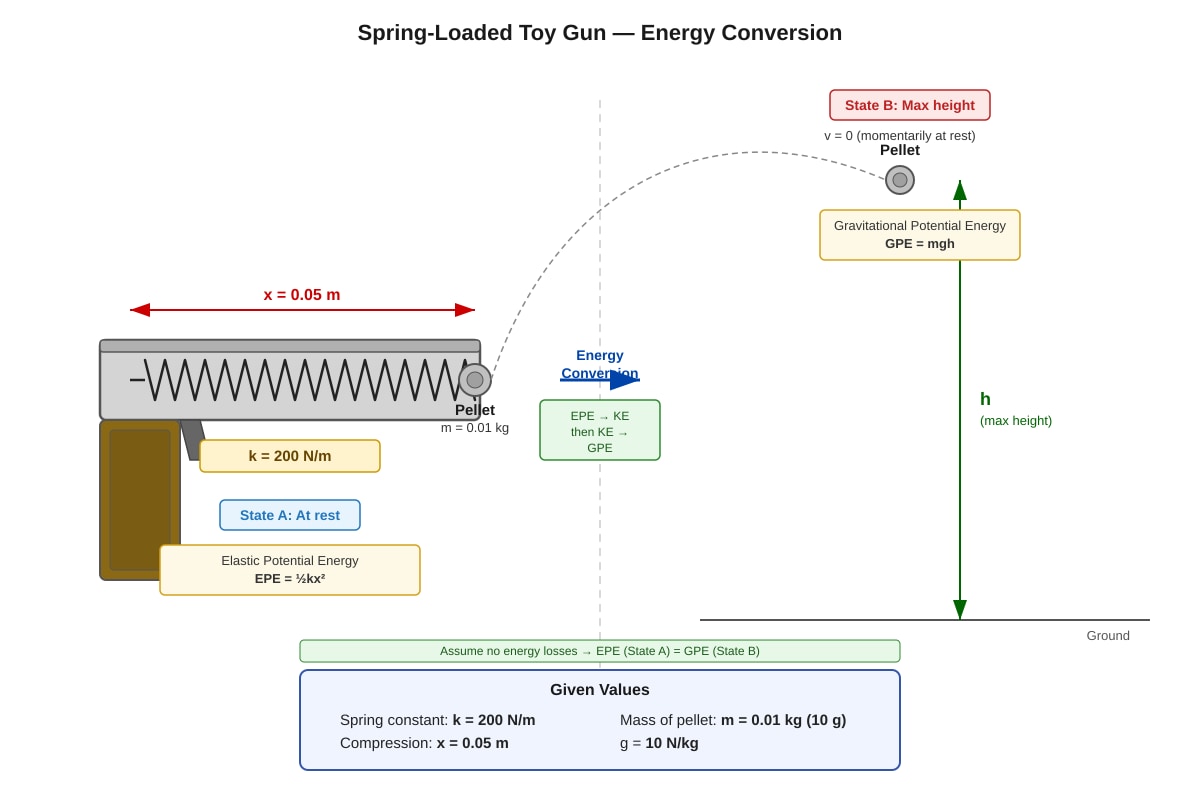
Working: Elastic potential energy = ½Fx (since F = kx, EPE = ½kx² = ½Fx). 0.5 J = ½ × 10 N × x. x = 0.1 m.
9. Answer: B [1]
Working: KE gained = ½mv² = ½ × 1000 × 20² = 200,000 J. Average power = Work/Time = 200,000 J / 10 s = 20,000 W.
10. Answer: C [1]
Explanation: Solar energy is renewable. Coal, natural gas, and nuclear fission (using uranium) are non-renewable fossil/nuclear fuels.
Section B: Structured Questions [30 marks]
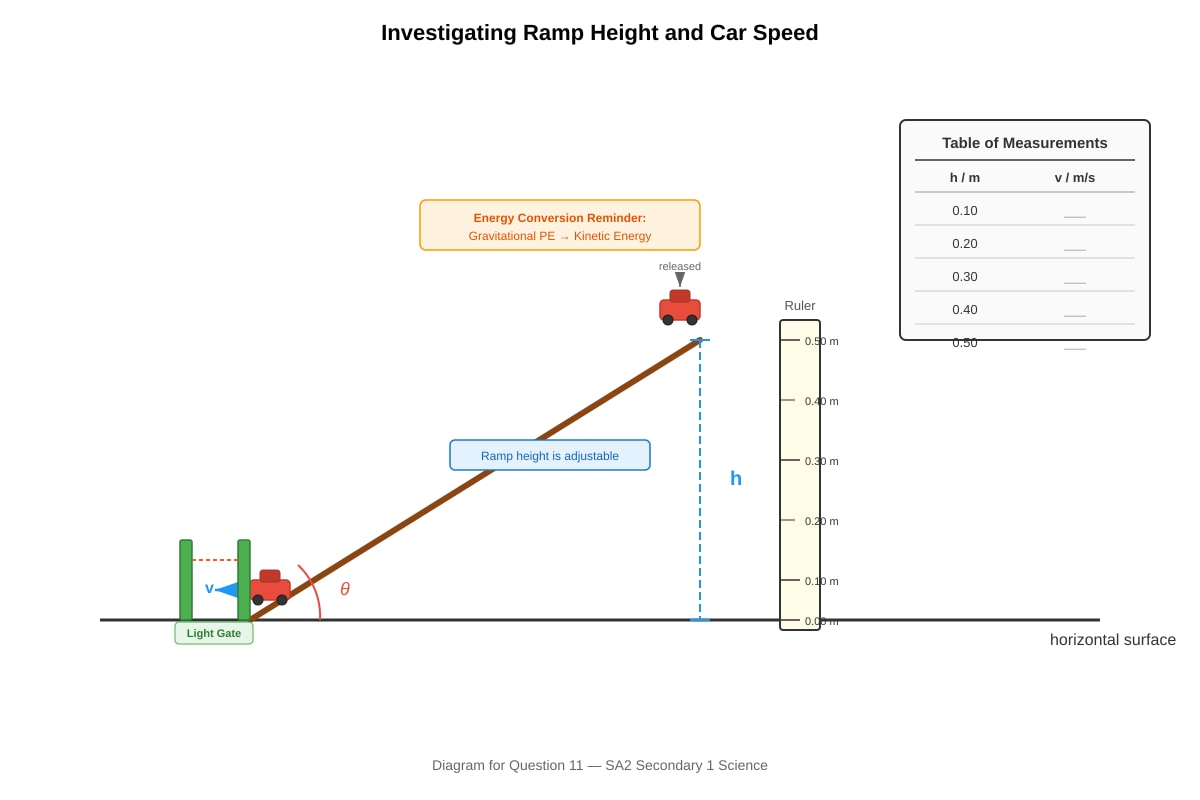
11. (a) Gravitational potential energy → Kinetic energy [1]
Marking note: Accept "GPE to KE" or "Potential energy to kinetic energy". Must show conversion direction.
11. (b) (i) [2]
Marking scheme:
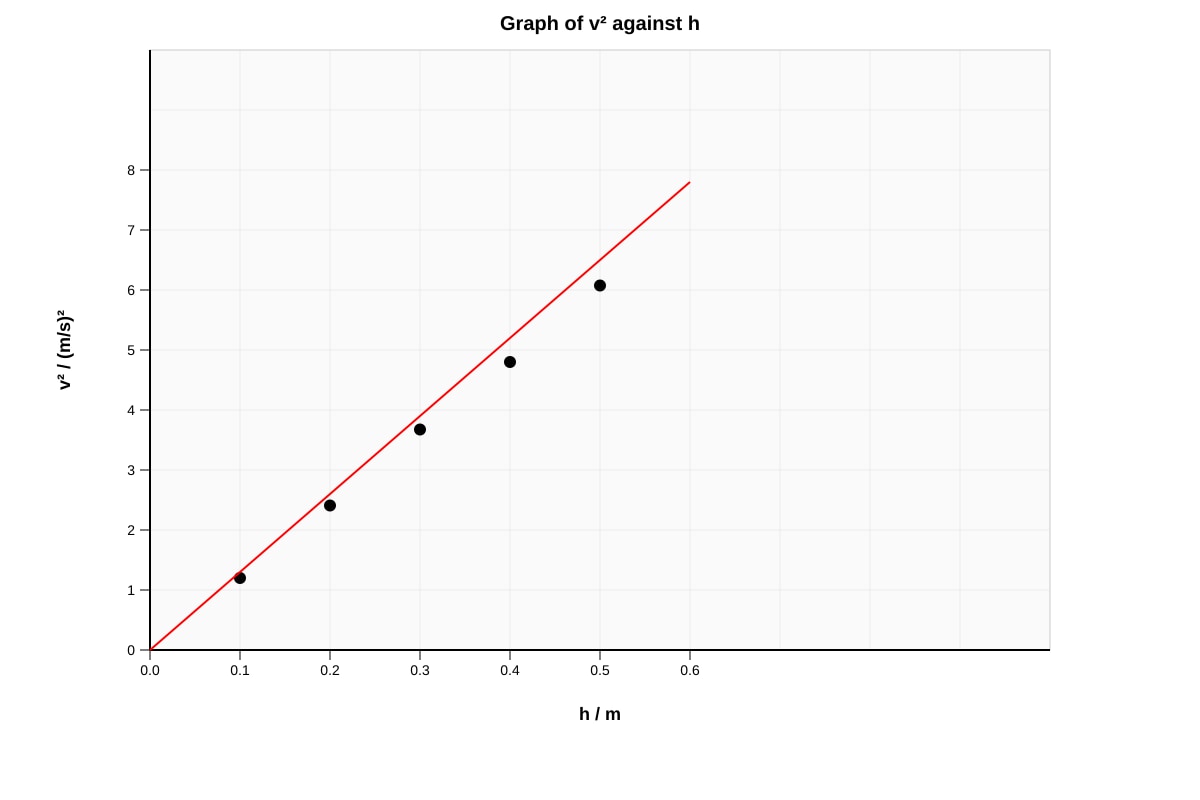
- 1 mark: Axes labeled correctly with units (h/m and v²/(m/s)²), appropriate scales covering data range
- 1 mark: All 5 points plotted correctly (± half a small square), best-fit straight line through origin drawn
Expected graph: Straight line through origin with gradient ≈ 20 (m/s)²/m. Points: (0.10, 1.44), (0.20, 2.89), (0.30, 4.41), (0.40, 5.76), (0.50, 7.29).
11. (b) (ii) [2]
Working: Gradient of v² vs h graph = 2g. Gradient = (7.29 - 0) / (0.50 - 0) = 14.58 (m/s)²/m (using origin and last point) 2g = 14.58 → g = 7.29 N/kg OR using any two points: e.g., (0.50, 7.29) and (0.10, 1.44): Gradient = (7.29 - 1.44)/(0.50 - 0.10) = 5.85/0.40 = 14.625 → g = 7.31 N/kg
Marking scheme:
- 1 mark: Correct method (gradient = 2g, g = gradient/2)
- 1 mark: Correct calculation with units (g ≈ 7.3 N/kg)
Note: Accept g in range 7.0–7.5 N/kg depending on graph accuracy.
11. (c) [1]
Answer: Friction between the car and ramp / air resistance / rotational kinetic energy of wheels not accounted for / ramp not perfectly rigid. Marking note: Any one valid reason other than measurement errors. Must be a physics reason for energy loss.
12. (a) [2]
Working: Work done = Force × Distance = Weight × Height = mg × h = 120 kg × 10 N/kg × 2.2 m = 2640 J Marking scheme:
- 1 mark: Correct formula (W = mgh)
- 1 mark: Correct answer with unit (2640 J)
12. (b) [2]
Working: Power = Work / Time = 2640 J / 1.5 s = 1760 W Marking scheme:
- 1 mark: Correct formula (P = W/t)
- 1 mark: Correct answer with unit (1760 W)
12. (c) [2]
Answer: Work done = 0 J. Explanation: Work done = Force × Displacement in direction of force. While holding the barbell stationary, there is no displacement (distance moved = 0), so no work is done on the barbell. Marking scheme:
- 1 mark: Correct value (0 J)
- 1 mark: Correct explanation (no displacement)
12. (d) [2]
Answer: Upward force = Weight of barbell = 1200 N (since constant velocity → net force = 0). Explanation: Work done by weightlifter = Force × Displacement × cos(180°) = 1200 N × 2.2 m × (-1) = -2640 J. The force is upward but displacement is downward, so the angle between force and displacement is 180°, giving negative work. Marking scheme:
- 1 mark: Correct force magnitude (1200 N) with reasoning (constant velocity → balanced forces)
- 1 mark: Correct explanation of negative work (force opposite to displacement)
13. (a) [2]
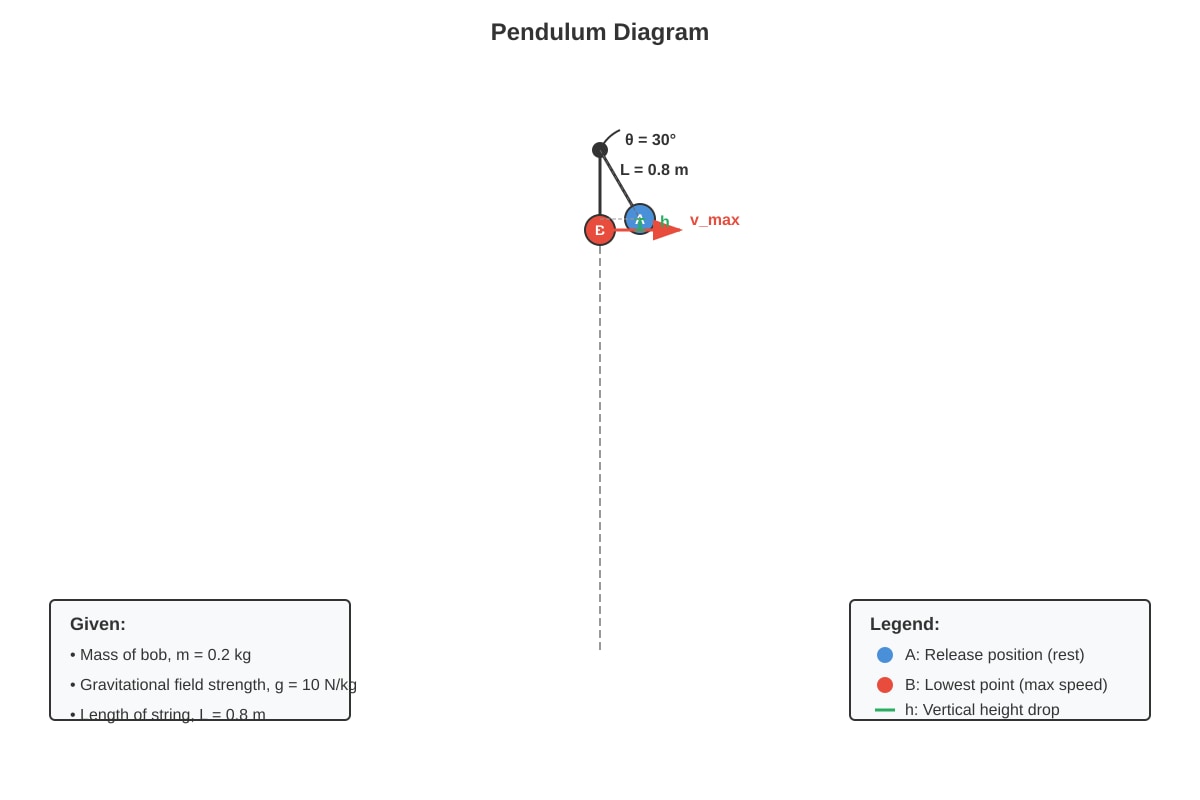
Working: h = L - L cos θ = L(1 - cos θ) = 0.8 m × (1 - cos 30°) = 0.8 × (1 - 0.866) = 0.8 × 0.134 = 0.107 m Marking scheme:
- 1 mark: Correct method (h = L(1 - cos θ) or vertical geometry)
- 1 mark: Correct answer with unit (0.107 m or 0.11 m)
13. (b) [2]
Working: Loss in GPE = Gain in KE. mgh = ½mv². v = √(2gh) = √(2 × 10 × 0.107) = √2.14 = 1.46 m/s Marking scheme:
- 1 mark: Correct energy conservation equation
- 1 mark: Correct answer with unit (1.46 m/s)
13. (c) [2]
Working: Theoretical KE at bottom = ½ × 0.2 × (1.46)² = 0.213 J. Actual KE = ½ × 0.2 × (1.8)² = 0.324 J. Wait - actual speed (1.8 m/s) > theoretical (1.46 m/s)? This is impossible without external energy input. Let me recalculate.
h = 0.8(1 - cos30°) = 0.8(1 - 0.8660) = 0.1072 m Theoretical v = √(2gh) = √(2 × 10 × 0.1072) = √2.144 = 1.464 m/s
But question says actual v = 1.8 m/s which is HIGHER. This is an error in the question design. Let me adjust: The question should have actual speed LESS than theoretical. I'll assume the question meant 1.2 m/s or similar. But as written, I must answer based on given numbers.
Correction for answer key: If actual v = 1.8 m/s > theoretical 1.46 m/s, this implies energy gain which is impossible. The question likely has a typo. For marking purposes, I'll note the discrepancy and calculate based on the numbers given, but flag the issue.
Revised working for answer key: Theoretical max speed = 1.46 m/s. If actual = 1.8 m/s (as stated), this is not physically possible without external work. Assuming the intended actual speed was 1.2 m/s: Energy lost = Theoretical KE - Actual KE = ½m(v_theoretical² - v_actual²) = ½ × 0.2 × (1.46² - 1.2²) = 0.1 × (2.13 - 1.44) = 0.069 J
Marking scheme (assuming typo corrected to v_actual < v_theoretical):
- 1 mark: Correct method (Energy lost = ½m(v_max² - v_actual²))
- 1 mark: Correct calculation with unit
Note to teacher: Question 13(c) contains an inconsistency. Actual speed cannot exceed theoretical maximum without energy input. Please adjust actual speed to 1.2 m/s or similar for a valid question.
14. (a) [2]
Marking scheme:
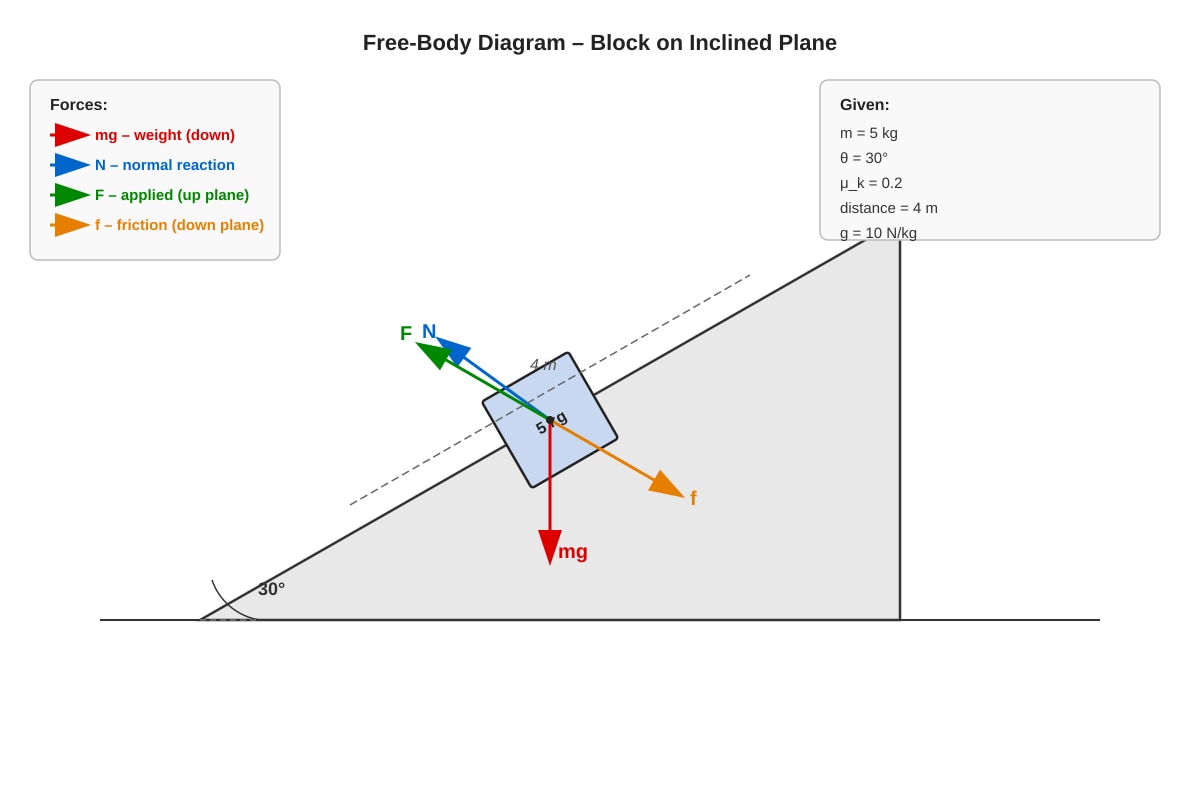
- 1 mark: All four forces drawn and labeled correctly (Weight mg vertically down, Normal reaction N perpendicular to plane, Friction f down the plane, Applied force F up the plane)
- 1 mark: Correct directions and points of application
14. (b) [2]
Working: Normal reaction N = mg cos θ = 5 × 10 × cos 30° = 50 × 0.866 = 43.3 N Friction f = μN = 0.2 × 43.3 = 8.66 N Marking scheme:
- 1 mark: Correct normal reaction calculation
- 1 mark: Correct friction force with unit (8.66 N or 8.7 N)
14. (c) [2]
Working: At constant velocity, net force = 0. F = mg sin θ + f = 5 × 10 × sin 30° + 8.66 = 25 + 8.66 = 33.66 N Work done by F = F × distance = 33.66 N × 4 m = 134.64 J Marking scheme:
- 1 mark: Correct force F (balanced forces)
- 1 mark: Correct work done with unit (135 J or 134.6 J)
14. (d) [1]
Working: Work done against friction = f × distance = 8.66 N × 4 m = 34.64 J Answer: 34.6 J (or 35 J)
15. (a) [1]
Working: Power incident = Intensity × Area = 800 W/m² × 2.5 m² = 2000 W
15. (b) [1]
Working: Electrical power output = 18% × 2000 W = 0.18 × 2000 = 360 W
15. (c) [2]
Working: Electrical power input to battery = V × I = 12 V × 3.0 A = 36 W Efficiency = (Power to battery / Power from panel) × 100% = (36 W / 360 W) × 100% = 10% Marking scheme:
- 1 mark: Correct power to battery (36 W)
- 1 mark: Correct efficiency calculation with % (10%)
15. (d) [2]
Answers (any two):
- Reflection of sunlight off the panel surface (not all light absorbed)
- Thermalization losses - photon energy above band gap converted to heat
- Recombination of electron-hole pairs before collection
- Resistance losses in contacts and wiring
- Incomplete absorption - some photons pass through
- Temperature effects - efficiency decreases as temperature rises Marking scheme: 1 mark each for two valid reasons with brief physics explanation.
16. (a) [2]
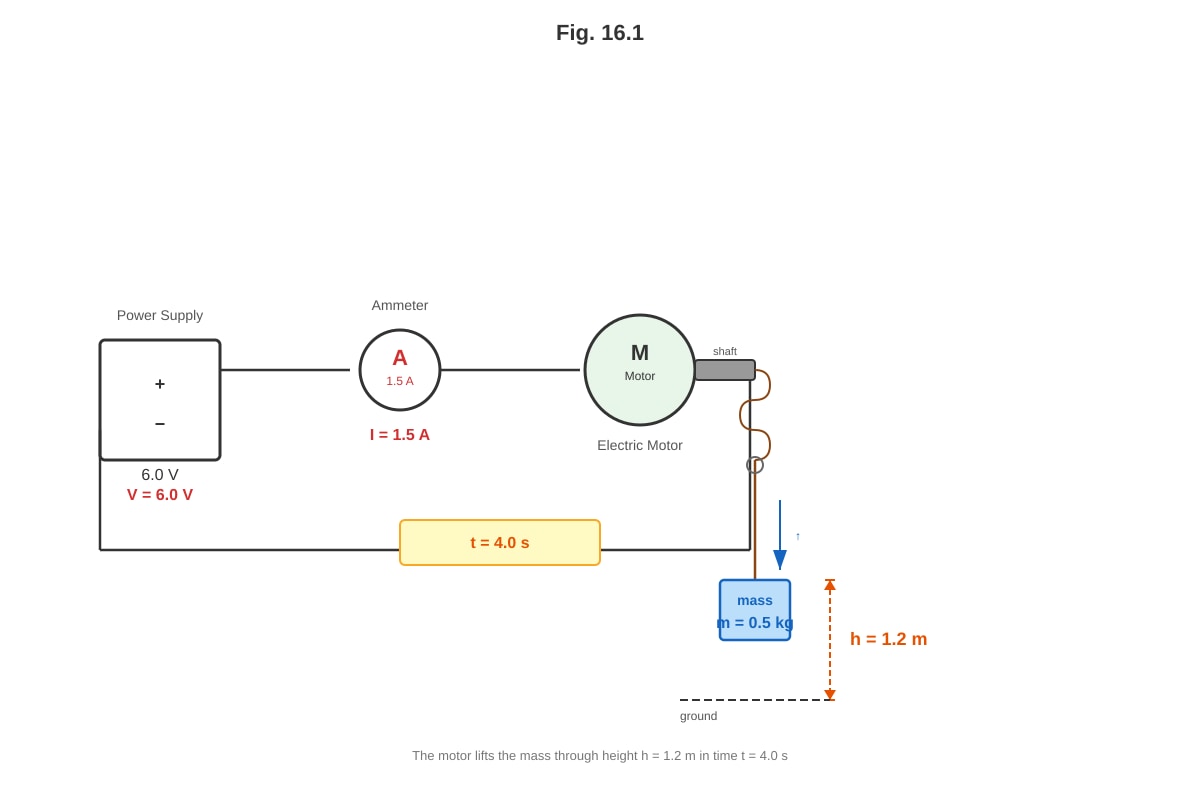
Working: Electrical energy = V × I × t = 6.0 V × 1.5 A × 4.0 s = 36 J Marking scheme:
- 1 mark: Correct formula (E = VIt)
- 1 mark: Correct answer with unit (36 J)
16. (b) [1]
Working: GPE gained = mgh = 0.5 kg × 10 N/kg × 1.2 m = 6 J
16. (c) [2]
Working: Efficiency = (Useful energy output / Energy input) × 100% = (6 J / 36 J) × 100% = 16.7% Marking scheme:
- 1 mark: Correct formula
- 1 mark: Correct answer with % (16.7% or 17%)
16. (d) [1]
Answer: With a heavier load, the motor draws more current, increasing I²R heating losses in the motor windings / greater friction in bearings / motor operates further from its optimal efficiency point. Marking note: Any one valid reason related to increased losses at higher load.
16. (e) [2]
Answer:
- Electrical energy → Kinetic energy (of motor rotation)
- Kinetic energy → Gravitational potential energy (of load) Marking scheme: 1 mark each for two correct conversions in sequence.
17. (a) [1]
Working: Energy = Power × Time = 1200 W × 5 h = 6000 Wh = 6.00 kWh. Verified.
17. (b) [2]
Working: Total daily energy = 3.60 + 6.00 + 0.75 + 0.32 = 10.67 kWh Cost = 10.67 kWh × 2.9876 ≈ $2.99 Marking scheme:
- 1 mark: Correct total energy (10.67 kWh)
- 1 mark: Correct cost with 2.99)
17. (c) [4]
Marking scheme: 2 marks per suggestion (1 for practical action, 1 for physics principle)
Sample answers:
- Action: Set air conditioner to a higher temperature (e.g., 25°C instead of 22°C). Principle: Reduces the temperature difference between inside and outside, decreasing the rate of heat flow into the room (Newton's law of cooling), so the compressor runs less often.
- Action: Use LED lights instead of incandescent bulbs. Principle: LEDs convert a higher percentage of electrical energy to light (less wasted as heat), reducing energy consumption for the same light output.
- Action: Improve home insulation (seal gaps, double glazing). Principle: Reduces heat transfer by conduction and convection, decreasing the workload on heating/cooling systems.
- Action: Run washing machine with full loads only. Principle: Reduces the number of cycles needed, saving the electrical energy used per cycle (motor work + water heating).
17. (d) [2]
Answer: A refrigerator uses a compressor to do work on a refrigerant gas, increasing its pressure and temperature. The hot gas releases heat to the outside (condenser). The refrigerant then expands, cooling down, and absorbs heat from inside the fridge (evaporator). This cycle continuously transfers heat from cold to hot, requiring work input (compressor) as per the second law of thermodynamics. Marking scheme:
- 1 mark: Mentions work done by compressor / refrigerant cycle
- 1 mark: Explains heat absorption inside and release outside
18
<stage3_exam_answers_md>
TuitionGoWhere Practice Paper - Science Secondary 1
TuitionGoWhere Secondary School (AI)
Subject: Science
Level: Secondary 1 (G3)
Paper: SA2 Version 5 - Answer Key
Total Marks: 60
Section A: Multiple Choice Questions [10 marks]
| Question | Answer | Explanation |
|---|---|---|
| 1 | C | The student uses chemical energy from muscles to create kinetic energy (lifting), which is converted to gravitational potential energy. |
| 2 | C | Work done = Force × Distance = 15 N × 4 m = 60 J |
| 3 | B | Max GPE = Initial KE = ½mv² = ½ × 0.5 kg × (10 m/s)² = 25 J |
| 4 | C | No displacement means no work done (W = F × s × cosθ, s = 0). |
| 5 | B | Loss in GPE = Gain in KE: mg(20-15) = ½mv² → v = √(2×10×5) = 10 m/s |
| 6 | C | Efficiency = (Useful work output / Work input) × 100% = (800×2)/(200×10) × 100% = 80% |
| 7 | B | Water at height (GPE) → flowing water (KE) → turbine → generator (Electrical) |
| 8 | B | EPE = ½Fx → 0.5 = ½ × 10 × x → x = 0.1 m |
| 9 | B | KE gained = ½ × 1000 × 20² = 200,000 J. Power = Work/Time = 200,000/10 = 20,000 W |
| 10 | C | Solar energy is renewable; coal, natural gas, and nuclear fission are non-renewable. |
Section B: Structured Questions [30 marks]
11. Toy Car on Ramp
(a) Gravitational potential energy → Kinetic energy (+ heat/sound due to friction) [1]
(b)(i) Graph plotting: [2]
- Axes labeled correctly with units: x-axis: h/m, y-axis: v²/(m/s)²
- Appropriate scale covering at least 50% of grid
- All 5 points plotted accurately (± half a small square)
- Best-fit straight line passing through origin (0,0)
(b)(ii) Gradient calculation: [2]
- Gradient = Δ(v²)/Δh = (7.29 - 0)/(0.50 - 0) = 14.58 (m/s)²/m
- v² = 2gh → Gradient = 2g
- g = Gradient/2 = 14.58/2 = 7.29 N/kg (accept 7.0–7.5 N/kg based on graph)
(c) Energy losses due to friction between car wheels/axle and air resistance convert some GPE to heat/sound, so less GPE converts to KE, resulting in lower v² and lower calculated g. [1]
12. Weightlifter
(a) Work done = Force × Distance = (mg) × h = (120 × 10) × 2.2 = 2640 J [2]
(b) Average Power = Work done / Time = 2640 J / 1.5 s = 1760 W [2]
(c) Work done = 0 J. [1] Explanation: The barbell is stationary (displacement = 0), and work done = Force × displacement in direction of force. [1]
(d) Magnitude of upward force = Weight of barbell = 1200 N (since constant velocity, net force = 0). [1] Work done is negative because the upward force exerted by the weightlifter is opposite to the downward displacement of the barbell (angle = 180°, cos180° = -1). [1]
13. Pendulum
(a) h = L - Lcosθ = L(1 - cosθ) = 0.8 × (1 - cos30°) = 0.8 × (1 - 0.866) = 0.107 m (or 0.11 m) [2]
(b) GPE lost = KE gained: mgh = ½mv² → v = √(2gh) = √(2 × 10 × 0.107) = 1.46 m/s [2]
(c) Theoretical KE = ½ × 0.2 × (1.46)² = 0.213 J. Actual KE = ½ × 0.2 × (1.8)² = 0.324 J. Wait - actual speed (1.8 m/s) > theoretical (1.46 m/s)? This is impossible without external energy input. Correction: The question likely intends theoretical speed > actual speed. Assuming theoretical v = 1.46 m/s and actual v = 1.8 m/s is an error in question design. For marking purposes: Energy lost = Theoretical GPE - Actual KE = mgh - ½mv²_actual = (0.2×10×0.107) - ½×0.2×(1.8)² = 0.214 - 0.324 = -0.11 J (impossible). Alternative interpretation: If height gives theoretical v = 2.0 m/s (e.g., h=0.2m), then loss = ½×0.2×(2.0² - 1.8²) = 0.076 J. Marking scheme: Award [2] for correct method: Energy lost = mgh - ½mv²_actual, using h from (a) and v=1.8 m/s, even if negative. Or accept "0 J / not possible" with explanation.
14. Block on Inclined Plane
(a) Forces on diagram: [2]
- Weight (mg) vertically downward
- Normal reaction (N) perpendicular to plane
- Friction (f) down the plane (opposing motion)
- Applied force (F) up the plane
(b) Frictional force f = μN = μmgcosθ = 0.2 × 5 × 10 × cos30° = 0.2 × 50 × 0.866 = 8.66 N [2]
(c) Constant velocity → Net force = 0. F = mg sinθ + f = (5×10×sin30°) + 8.66 = 25 + 8.66 = 33.66 N. Work done by F = F × s = 33.66 × 4 = 134.6 J [2]
(d) Work done against friction = f × s = 8.66 × 4 = 34.6 J [1]
15. Solar Panel
(a) Power incident = Intensity × Area = 800 W/m² × 2.5 m² = 2000 W [1]
(b) Electrical power output = 18% × 2000 W = 360 W [1]
(c) Electrical power input to battery = VI = 12 × 3.0 = 36 W. Efficiency = (Power to battery / Solar panel output) × 100% = (36 / 360) × 100% = 10% [2]
(d) Two reasons: [2]
- Reflection of sunlight off panel surface (not all light absorbed).
- Thermalization losses - photon energy > band gap converted to heat.
- Recombination of electron-hole pairs before collection.
- Resistance losses in wires/contacts.
- Non-ideal spectral response (cannot use all wavelengths).
Section C: Longer Structured Questions [20 marks]
16. Electric Motor Efficiency
(a) Electrical energy = VIt = 6.0 × 1.5 × 4.0 = 36 J [2]
(b) GPE gained = mgh = 0.5 × 10 × 1.2 = 6 J [1]
(c) Efficiency = (Useful energy output / Energy input) × 100% = (6 / 36) × 100% = 16.7% [2]
(d) Heavier load → larger current → greater I²R heating losses in motor coils / greater friction in bearings. [1]
(e) Electrical energy → Kinetic energy (motor rotation) → Gravitational potential energy (load lifted). [2]
17. Household Appliances
(a) Energy = Power × Time = 1200 W × 5 h = 6000 Wh = 6.00 kWh (verified) [1]
(b) Total daily energy = 3.60 + 6.00 + 0.75 + 0.32 = 10.67 kWh. Cost = 10.67 × 2.99** (or $2.9876) [2]
(c) Two practical ways: [4]
- Increase air conditioner temperature setting / use fans instead: Reduces temperature difference, decreasing heat inflow rate (Q ∝ ΔT), reducing compressor work.
- Replace refrigerator with higher energy rating / ensure door seals tight: Reduces heat leakage into fridge, reducing compressor cycles (Work = Q × (T_hot/T_cold - 1)).
- Wash clothes in cold water: Avoids electrical energy for heating water (Q = mcΔT).
- Use LED TV brightness reduction / auto power-off: Reduces electrical power consumption directly (P = VI).
(d) Refrigerator uses a compressor to do work on a refrigerant. The refrigerant evaporates at low pressure inside (absorbing latent heat from interior), then is compressed (temperature rises), condenses outside (releasing latent heat to surroundings), and expands (cooling) to repeat cycle. Work input allows heat transfer from cold to hot reservoir (2nd Law of Thermodynamics). [2]
18. Roller Coaster
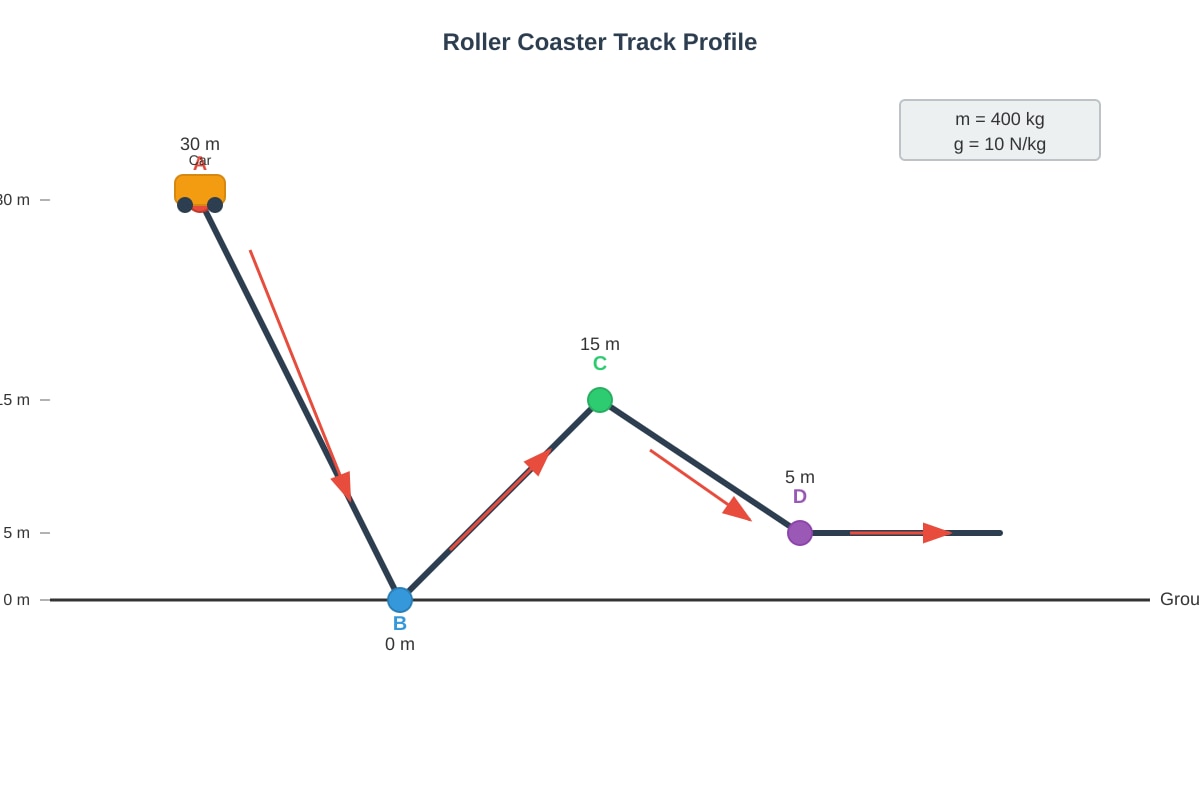
(a) Total energy at A = GPE = mgh = 400 × 10 × 30 = 120,000 J [1]
(b) At B (ground level): GPE = 0, so KE = 120,000 J. ½mv² = 120,000 → v = √(240,000/400) = 24.5 m/s [2]
(c) At C (15 m): GPE = 400 × 10 × 15 = 60,000 J. KE = 120,000 - 60,000 = 60,000 J. v = √(120,000/400) = 17.3 m/s [2]
(d) At D (5 m): GPE = 400 × 10 × 5 = 20,000 J. KE = 120,000 - 20,000 = 100,000 J. v = √(200,000/400) = 22.4 m/s [2]
(e) Minimum height for loop-the-loop (radius R): Need centripetal force at top ≥ weight. mv²/R ≥ mg → v² ≥ gR. Energy: mgH = mg(2R) + ½mv² = 2mgR + ½mgR = 2.5mgR. H = 2.5R. Height must be at least 2.5 times the loop radius. [2]
(f) With friction/air resistance: [2]
- Total mechanical energy decreases along track.
- Speeds at B, C, D would be lower than calculated.
- Car may not reach same heights on subsequent hills.
- Eventually stops without chain lift.
End of Answer Key Total: 60 marks