From Real Exams Exam Paper

Secondary 1 Science Semestral Assessment 2 (End of Year) Paper 5

Free Kimi AI-generated Sec 1 Science SA2 Paper 5 with questions, answers, and syllabus-aligned practice for Singapore students preparing for exams.

These static practice materials are generated from the site's syllabus and paper-generation workflow, with source and model context shown so students and parents can evaluate the material before use.

Secondary 1 Science From Real Exams Generated by Kimi K2.6 Free Updated 2026-06-09

Questions

<!-- TuitionGoWhere generation metadata: stage=3-1; model=moonshotai/kimi-k2.6:free; model_label=Kimi K2.6 Free; generated=2026-06-07; Sources: Stage 2-1 real exam-derived templates and Stage 2-2 exam-enriched syllabus. -->

TuitionGoWhere Practice Paper - Science Secondary 1

TuitionGoWhere Exam Practice (AI)

Subject:Science
Level:Secondary 1 (G3)
Paper:SA2 Physical Sciences
Duration:1 hour 15 minutes
Total Marks:60
Version:5 of 5

Name: _________________________________ Class: _________________ Date: _________________

Instructions:

  • Write your answers in the spaces provided.
  • Show all working clearly for calculation questions.
  • Use appropriate units where required.
  • Diagrams should be drawn with a pencil and ruler where possible.
  • The total estimated time includes a short review buffer.

Section A: Multiple Choice [10 marks]

Answer all questions. Each question carries 1 mark.

Time estimate: 12 minutes


1. A student lifts a 5 kg box vertically upwards through a height of 2 m at constant speed. Which energy conversion occurs?

AChemical energy → Kinetic energy → Sound energy
BChemical energy → Gravitational potential energy
CKinetic energy → Gravitational potential energy
DGravitational potential energy → Kinetic energy

Answer: _____


2. A ball is thrown upwards. At the highest point of its motion, which statement is correct?

AThe ball has maximum kinetic energy and zero gravitational potential energy
BThe ball has zero kinetic energy and maximum gravitational potential energy
CThe ball has equal kinetic and gravitational potential energy
DThe ball has zero energy at the highest point

Answer: _____


3. Which situation involves doing work in the scientific sense?

AA man holds a heavy suitcase while standing still at a bus stop
BA teacher pushes against a wall that does not move
CA girl carries a stack of books horizontally across a room
DA boy lifts a school bag from the floor onto a table

Answer: _____


4. An object of mass 2 kg is moving with a velocity of 6 m/s. What is its kinetic energy?

A6 J
B12 J
C18 J
D36 J

Answer: _____


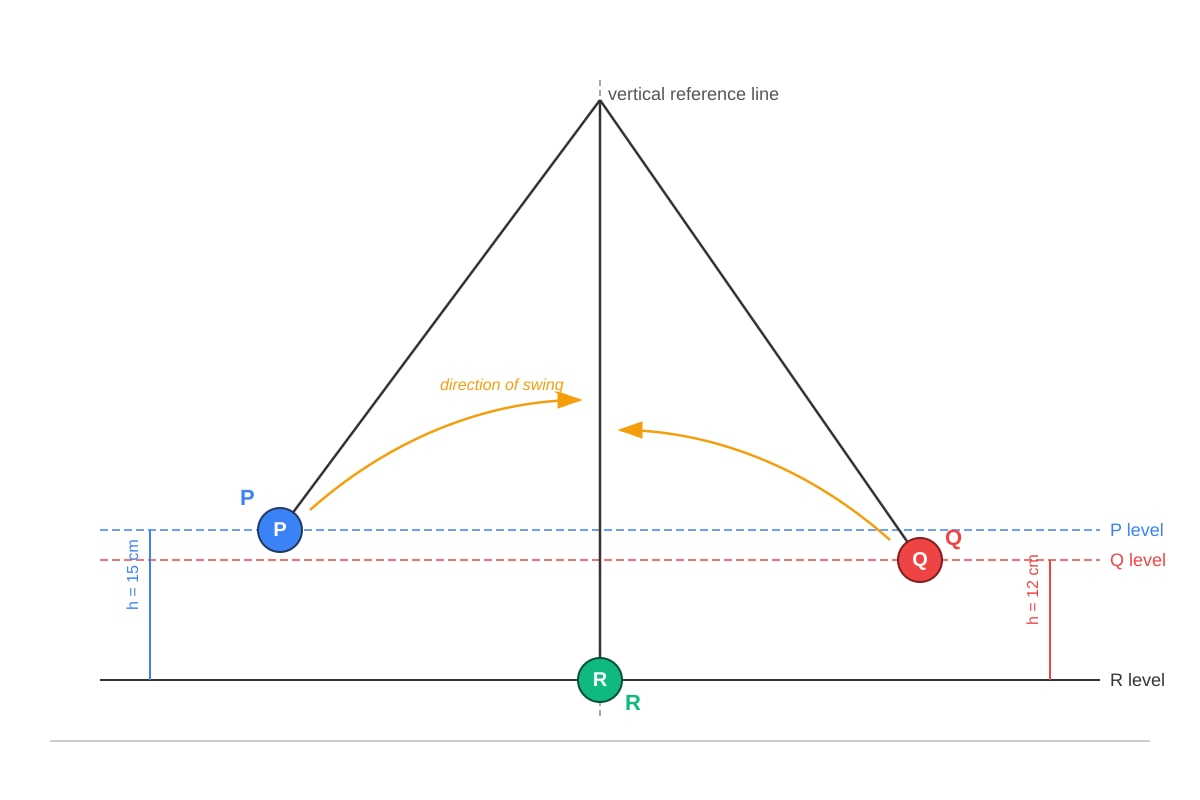
5. The diagram below shows a simple pendulum swinging from position P to Q.

<image_placeholder> id: Q5-fig1 type: diagram linked_question: Q5 description: A simple pendulum showing positions P (highest left), R (lowest), and Q (highest right). The bob is shown at each position with height lines. labels: P, R, Q, height h at P, height h at Q, vertical reference line values: Height at P = 15 cm above R; height at Q = 12 cm above R must_show: The pendulum bob at three positions; clear height differences; labels P, R, Q; direction of swing arrow </image_placeholder>

At which position does the pendulum bob have the most kinetic energy?

AP (highest point on left)
BR (lowest point)
CQ (highest point on right)
DThe kinetic energy is the same at all positions

Answer: _____


6. A freezer transfers thermal energy from the food inside to the surroundings. This process involves:

AConduction and convection only
BConvection and radiation only
CAll three heat transfer mechanisms
DConduction through the freezer walls only

Answer: _____


7. Two blocks of iron, one dark grey and one painted shiny silver, are left in the sun for 30 minutes. Both have the same mass and initial temperature. Which statement is correct?

AThe dark grey block absorbs more radiation and reaches a higher temperature
BThe shiny silver block absorbs more radiation due to its colour
CBoth blocks absorb the same amount of radiation regardless of surface
DThe colour of a surface does not affect heat absorption by radiation

Answer: _____


8. A student investigates how the type of surface affects friction. She pulls a wooden block across different surfaces with the same force and measures the distance moved in 5 seconds. Which surface likely shows the greatest distance?

ARough sandpaper
BRubber mat
CPolished marble
DCarpet

Answer: _____


9. A 60 W light bulb is switched on for 20 seconds. How much energy is transferred?

A3 J
B40 J
C1200 J
D1200 W

Answer: _____


10. Which of the following correctly describes the energy change in a microphone?

ASound energy → Electrical energy
BElectrical energy → Sound energy
CKinetic energy → Electrical energy
DSound energy → Kinetic energy

Answer: _____


Section B: Structured Response [28 marks]

Answer all questions. Write your answers in the spaces provided.

Time estimate: 32 minutes


11. A man pushes a trolley with a constant force of 40 N through a distance of 15 m in a straight line along a supermarket aisle.

(a) State the formula used to calculate work done. [1]


(b) Calculate the work done by the man on the trolley. Show your working. [2]


(c) The man then holds the trolley stationary for 2 minutes while waiting for someone. Explain why he does no work on the trolley during this time, despite feeling tired. [2]


12. An electric kettle has a power rating of 2000 W.

(a) Define power in terms of work done and time. [1]


(b) Calculate the electrical energy transferred by the kettle in 45 seconds. Show your working and include units. [2]


(c) The kettle takes 3 minutes to boil 1.5 kg of water from 25°C. Suggest one way to reduce the time taken to boil the same amount of water, explaining your answer in terms of energy transfer. [2]


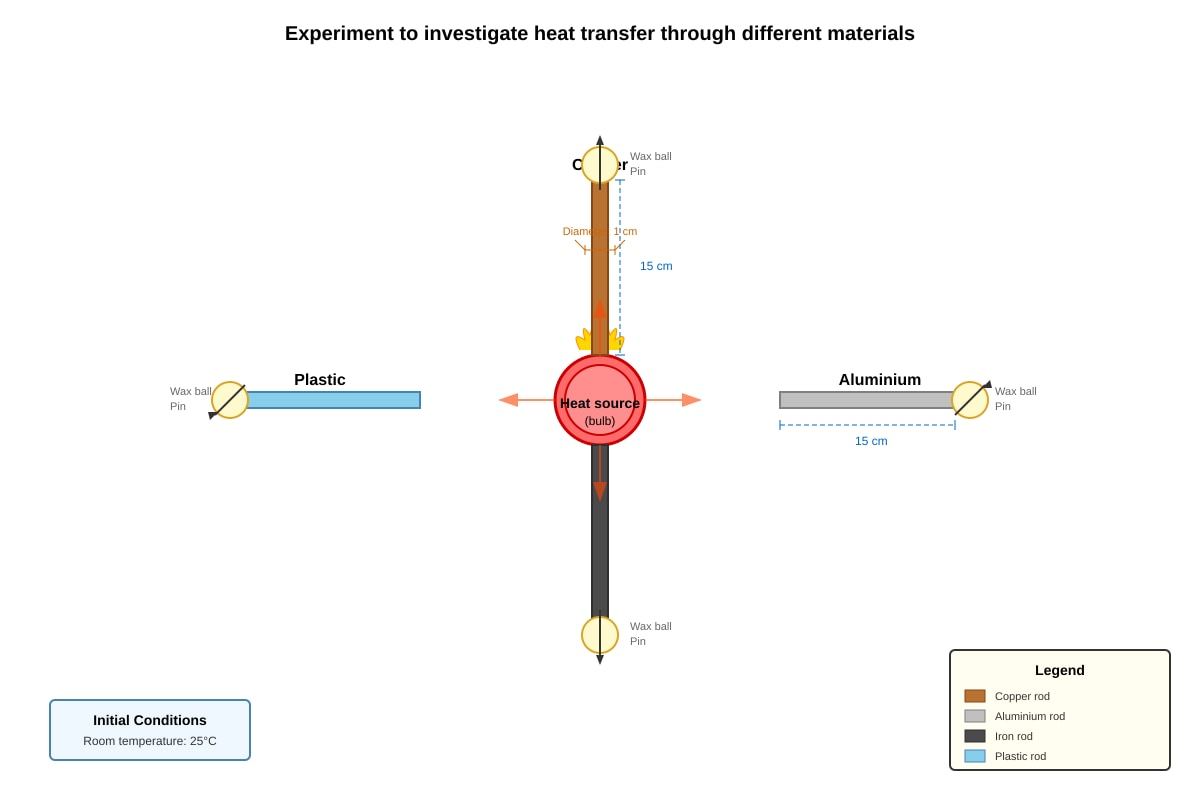
13. A student sets up an experiment to investigate heat transfer through different materials.

<image_placeholder> id: Q13-fig1 type: experimental_setup linked_question: Q13 description: Four identical metal rods (copper, aluminium, iron, and plastic) arranged radially from a central heated metal bulb. Each rod has a small wax ball at its far end and a pin stuck through the wax. The rods are equal length (15 cm) and diameter (1 cm). labels: Copper, Aluminium, Iron, Plastic, Heat source (bulb), Wax balls, Pins, 15 cm values: Rod length: 15 cm; rod diameter: 1 cm; initial temperature: room temperature ~25°C must_show: Four labelled rods in star pattern from central bulb; wax balls and pins at outer ends; clear material labels; equal lengths apparent </image_placeholder>

(a) State the independent variable in this investigation. [1]


(b) State two control variables that must be kept constant for a fair test. [2]


(c) Explain how the student can determine which material is the best conductor of heat. [2]


(d) The plastic rod is changed to a copper rod of twice the diameter (2 cm) but the same length. Predict whether the wax on this larger copper rod would melt faster or slower than on the original copper rod. Explain your answer. [2]


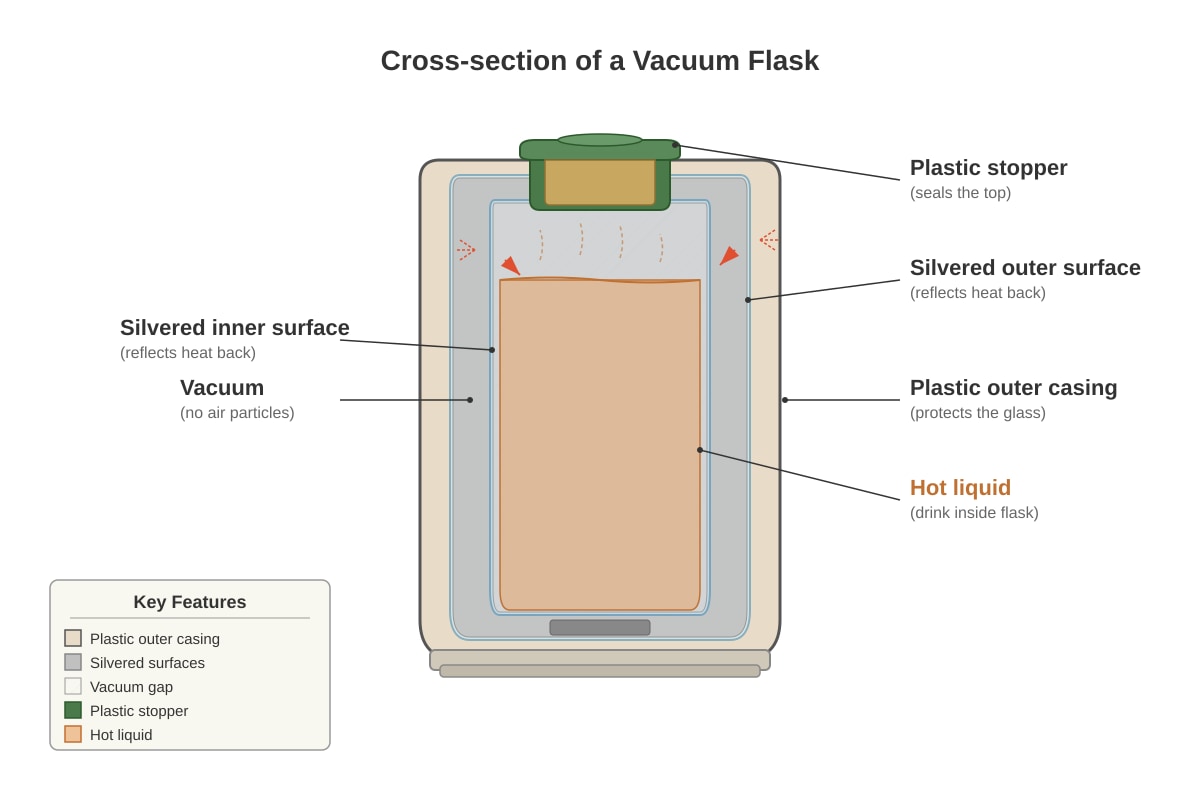
14. The diagram below shows a cross-section of a vacuum flask designed to keep drinks hot.

<image_placeholder> id: Q14-fig1 type: diagram linked_question: Q14 description: Cross-section of a vacuum flask showing double-walled glass container with silvered surfaces, vacuum gap, plastic stopper, and plastic outer casing. Labels point to key features. labels: Silvered inner surface, Silvered outer surface, Vacuum, Plastic stopper, Plastic outer casing, Hot liquid must_show: Double-walled construction; silvered surfaces facing inward; vacuum gap between walls; stopper sealing the top; plastic shell exterior; labels with leader lines </image_placeholder>

(a) Explain how the vacuum between the glass walls reduces heat loss by conduction and convection. [2]


(b) Explain why the inner surfaces are silvered. [2]


(c) A student notices that a hot drink in the flask eventually cools down after several hours. Suggest one reason why the flask cannot keep the drink hot indefinitely. [1]


15. A wind turbine generates electricity for a small community. On a particular day, the wind supplies 48 000 J of kinetic energy to the turbine blades, but only 14 400 J of electrical energy is produced.

(a) Calculate the efficiency of the wind turbine. Show your working. [2]


(b) Explain why the efficiency is less than 100%. Suggest two forms of energy that the "wasted" energy might be converted into. [3]


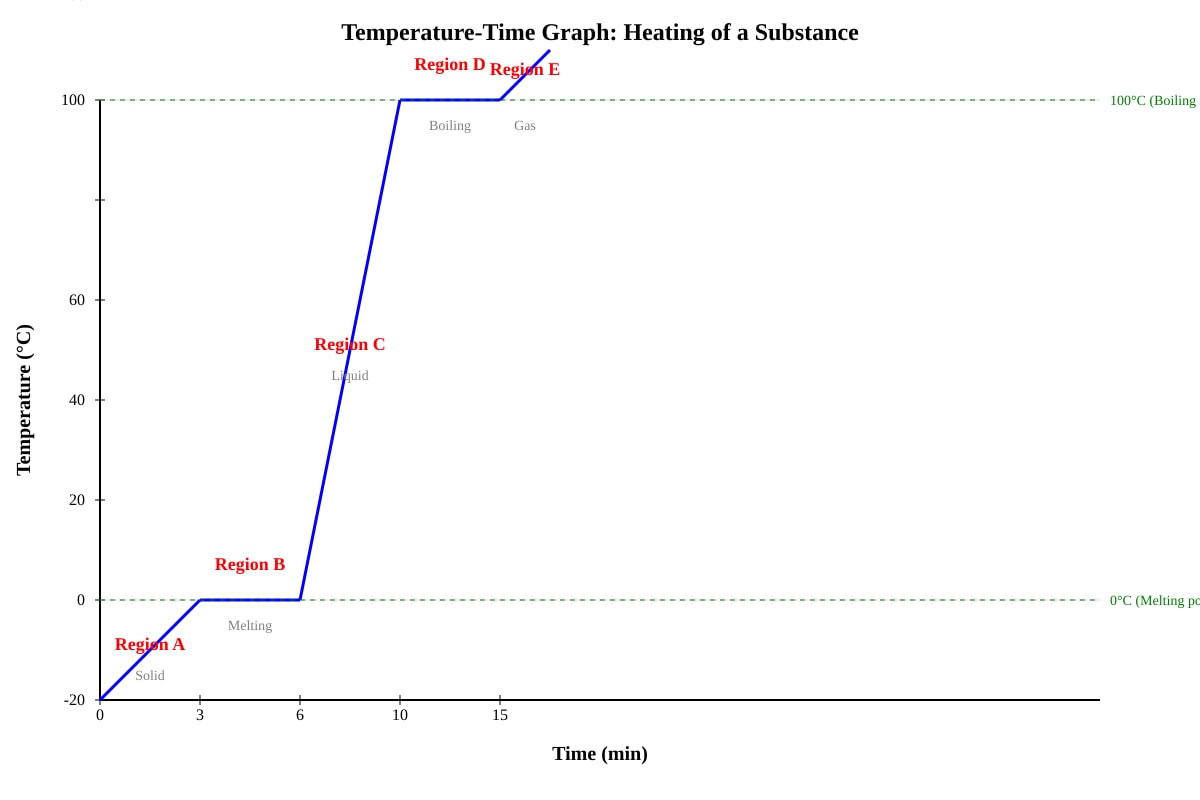
16. The graph below shows how the temperature of a substance changes as it is heated steadily over time.

<image_placeholder> id: Q16-fig1 type: graph linked_question: Q16 description: A temperature-time graph showing heating of a substance from solid to gas. X-axis: Time (min) from 0 to 15. Y-axis: Temperature (°C) from -20 to 120. The graph has plateaus at 0°C and 100°C with rising slopes between and after. labels: Time (min), Temperature (°C), Region A, Region B, Region C, Region D, Region E values: Starts at -20°C at t=0; rises to 0°C at t=3; plateau at 0°C until t=6; rises to 100°C at t=10; plateau at 100°C until t=15 must_show: Labelled axes with units; five distinct regions (A: heating solid, B: melting, C: heating liquid, D: boiling, E: heating gas); clear plateaus with horizontal lines; rising slopes; region labels </image_placeholder>

(a) State the melting point of the substance. [1]


(b) Explain what is happening to the substance in Region B in terms of particle arrangement and energy. [3]


(c) Why does the temperature remain constant in Region D even though heating continues? [2]


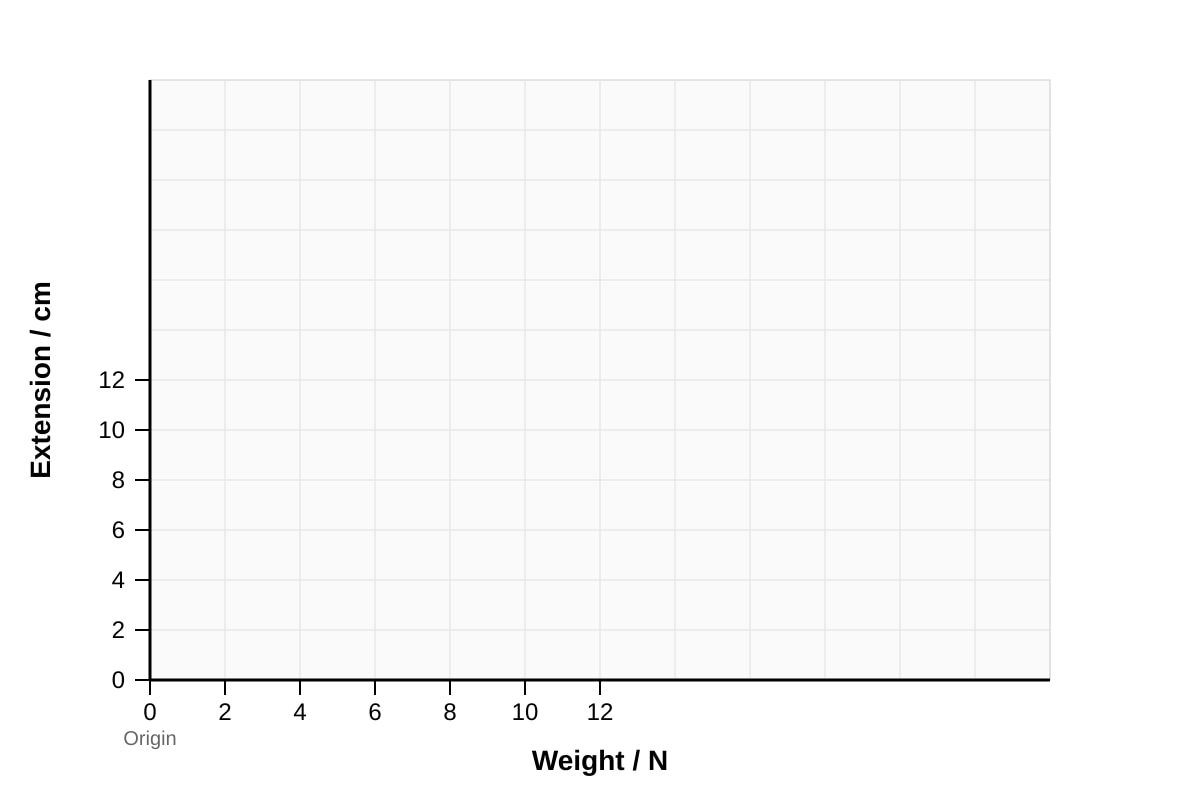
17. A student investigates the relationship between the weight of an object and the extension of a spring.

(a) State what is meant by the limit of proportionality of a spring. [1]


(b) The student's results are shown in the table below.

Weight (N)0246810
Extension (cm)01.53.04.57.010.0

Plot a graph of extension against weight using the grid below. [3]

<image_placeholder> id: Q17-fig1 type: graph linked_question: Q17 description: A blank graph grid for plotting extension against weight. X-axis: Weight (N) from 0 to 12. Y-axis: Extension (cm) from 0 to 12. Grid lines every 1 unit. labels: Weight / N, Extension / cm values: X-axis: 0, 2, 4, 6, 8, 10, 12; Y-axis: 0, 2, 4, 6, 8, 10, 12 must_show: Square grid with labelled axes; regular intervals; clear origin; sufficient space for all data points from the table </image_placeholder>

(c) Use your graph to determine the weight that would produce an extension of 5.0 cm. Show how you obtained your answer. [2]


(d) Explain how you can tell from the graph that the spring exceeded its limit of proportionality during the investigation. [2]


Section C: Data Analysis and Extended Response [22 marks]

Answer all questions.

Time estimate: 26 minutes


18. The table below shows data for four different light bulbs. All four bulbs produce the same useful light output of 800 lumens.

Bulb TypePower Rating (W)Lifespan (hours)Cost per bulb ($)
Incandescent601 0002.00
Halogen422 0003.50
CFL (Compact Fluorescent)148 0006.00
LED1025 00015.00

(a) Calculate the electrical energy, in kilowatt-hours (kWh), used by the incandescent bulb over its entire lifespan. Show your working. [2]


(b) A family needs lighting for 800 lumens continuously for 25 000 hours. Calculate the total cost (bulbs + electricity) for using LED bulbs over this period. Assume electricity costs $0.20 per kWh. Show all working clearly. [4]


(c) Using calculations or clear reasoning, compare the total cost of using CFL bulbs versus LED bulbs over the same 25 000 hour period. State which option is more economical overall. [3]


(d) Suggest one reason, other than cost, why a government might encourage citizens to use LED bulbs rather than incandescent bulbs. [1]


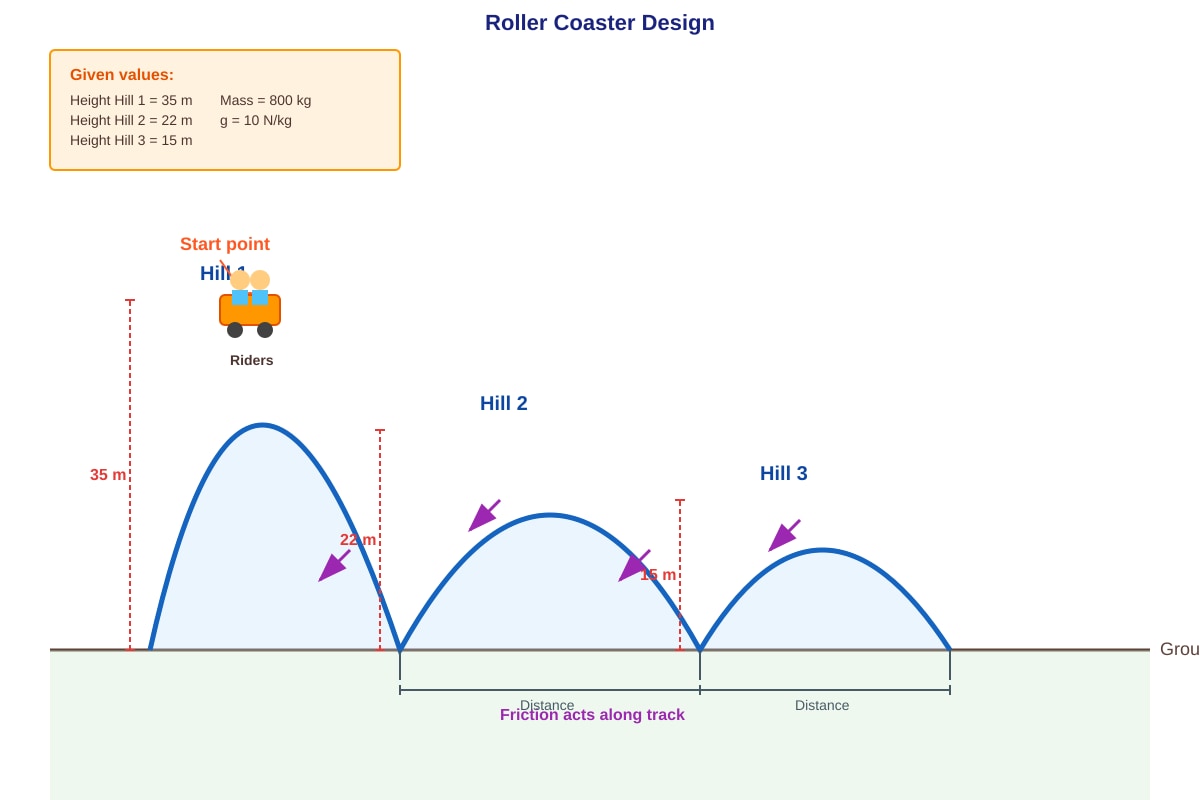
19. A company designs roller coasters. The diagram below shows a proposed design for a new ride.

<image_placeholder> id: Q19-fig1 type: diagram linked_question: Q19 description: Side view of a roller coaster track with three hills. The first hill is the tallest at 35 m, the second hill is 22 m, and the third hill is 15 m. The track starts from rest at the top of hill 1. Distances between hills are shown. labels: Hill 1 (35 m), Hill 2 (22 m), Hill 3 (15 m), Ground level, Start point, Riders, Friction acts along track values: Height Hill 1 = 35 m; Height Hill 2 = 22 m; Height Hill 3 = 15 m; mass of coaster + riders = 800 kg; g = 10 N/kg must_show: Three labelled hills with heights; start at highest point; ground level reference; friction arrow along track; rider figure in coaster car; all numerical values labelled </image_placeholder>

(a) Calculate the gravitational potential energy gained by the coaster when it is raised from ground level to the top of Hill 1. Use the formula: GPE = m × g × h. [2]


(b) The coaster starts from rest at the top of Hill 1. Assuming no friction, calculate the maximum speed the coaster would reach at the bottom of Hill 1. Show your working. (Hint: use GPE = KE, and KE = ½mv²) [3]


(c) In reality, friction acts on the coaster along the entire track. Explain why the coaster might not reach the top of Hill 3, even though Hill 3 (15 m) is lower than Hill 1 (35 m). [2]


(d) The designers want to ensure the coaster can complete the full course including reaching Hill 3. Suggest two modifications to the design and explain how each would help. [4]


20. Read the following information about a solar water heater system installed in a Singapore housing estate.

A solar water heater consists of flat black collector panels mounted on the roof, connected to an insulated storage tank. Water circulates through the panels during the day. The estate management claims this reduces electricity use by 60% compared to conventional electric water heaters.

(a) Explain why the collector panels are painted black rather than white or silver. [2]


(b) Explain how the process of convection helps to circulate water through the system from the collector panels to the storage tank. Use the term "density" in your answer. [3]


(c) The estate management's claim of 60% electricity reduction is based on annual averages. Suggest why the actual savings might be less than 60% on some particular days, and more than 60% on others. [3]


[END OF PAPER]

Total marks for Section A: 10 Total marks for Section B: 28 Total marks for Section C: 22 GRAND TOTAL: 60 marks


Please check that you have answered all questions before handing in your paper.

Answers

<!-- TuitionGoWhere generation metadata: stage=3-1; model=moonshotai/kimi-k2.6:free; model_label=Kimi K2.6 Free; generated=2026-06-07; Sources: Stage 2-1 real exam-derived templates and Stage 2-2 exam-enriched syllabus. -->

TuitionGoWhere Practice Paper - Science Secondary 1 (Version 5 of 5)

Answer Key and Marking Scheme

SA2 Physical Sciences Total Marks: 60


Section A: Multiple Choice [10 marks]

QuestionAnswerExplanation
1BThe man uses chemical energy from food/muscles to lift the box. At constant speed (no acceleration), there is no change in kinetic energy. The energy is converted to gravitational potential energy of the box. Common mistake: Choosing C — kinetic energy only increases if speed changes, but here speed is constant.
2BAt the highest point, the ball momentarily stops moving (velocity = 0), so kinetic energy = 0. It is at maximum height, so gravitational potential energy is at its maximum. The total mechanical energy (KE + GPE) is conserved (ignoring air resistance).
3DWork done = force × distance moved in the direction of the force. Only in D is there a force (upward) and movement in the same direction (upward). In A and B, there is no displacement. In C, force is upward (to support books) but movement is horizontal — force and displacement are perpendicular.
4DKE = ½mv² = ½ × 2 kg × (6 m/s)² = ½ × 2 × 36 = 36 J. Working must show: substitution of values and calculation.
5BKinetic energy is greatest where speed is greatest. At R (lowest point), all GPE has converted to KE, so speed is maximum. At P and Q, the bob momentarily stops (changing direction), so KE = 0.
6CA freezer uses: (1) Conduction through walls and materials; (2) Convection internally for air circulation; (3) Radiation — all objects emit thermal radiation. The compressor also transfers heat via these mechanisms.
7ADark, matte surfaces are good absorbers of infrared radiation; shiny, light surfaces are good reflectors. The dark grey block absorbs more radiant heat, so its temperature rises more.
8CFriction opposes motion. Polished marble has the smoothest surface, so friction is least. With the same applied force and less opposing friction, the block accelerates more and travels the greatest distance in the same time.
9CEnergy = Power × Time = 60 W × 20 s = 1200 J. Note: W (watts) is not a unit of energy.
10AA microphone converts sound energy (vibrations from voice) into electrical energy (varying voltage/current). This is the reverse of a loudspeaker.

Section B: Structured Response [28 marks]


11. Work done with trolley [5 marks]

(a) Work done = force × distance (moved in direction of force) [1]

(b) Working:

  • Work done = F × d = 40 N × 15 m [1]
  • = 600 J [1]

(c) No work is done because:

  • The trolley does not move (no displacement) [1]
  • Work done requires both force AND distance moved in the direction of the force; holding stationary involves force but zero displacement [1]
  • Note: The man feels tired because his muscles are contracting and using chemical energy, but this energy is converted to heat internally, not work on the trolley.

12. Electric kettle [5 marks]

(a) Power is the rate of doing work / rate of energy transfer; or Power = work done ÷ time [1]

(b) Working:

  • Energy = Power × Time = 2000 W × 45 s [1]
  • = 90 000 J (or 90 kJ) [1]
  • Unit must be stated for full marks

(c) Suggested improvement:

  • Reduce mass of water / Use water at higher initial temperature / Use a kettle with higher power rating [1]
  • Explanation: Less energy required to raise temperature to boiling point (E = mcΔθ) OR greater power means faster energy transfer for same energy requirement [1]

13. Heat conduction experiment [7 marks]

(a) The material/type of material (of the rod) [1]

(b) Any two from: [2]

  • Length of rods (all 15 cm)
  • Diameter/thickness of rods (all 1 cm)
  • Initial temperature / room temperature
  • Same heat source / same bulb temperature
  • Same wax material and size
  • Same pin material and mass
  • Environmental conditions (e.g., no drafts)

(c) The best conductor transfers heat fastest along the rod [1]

  • The wax on that rod will melt first, causing the pin to drop first [1]
  • Time measurement of pin drop allows comparison

(d) The wax would melt faster [1]

  • Greater cross-sectional area means more particles/vibrations can pass heat energy along the rod per unit time [1]
  • Or: Thicker rod has more conducting material in parallel, reducing thermal resistance

14. Vacuum flask design [5 marks]

(a) Conduction requires particles/medium to pass energy; convection requires fluid movement [1]

  • A vacuum contains no particles/medium, so neither conduction nor convection can occur [1]

(b) Shiny surfaces are poor emitters of thermal radiation [1]

  • This reduces heat loss by radiation from the hot liquid to the surroundings [1]
  • Also: shiny surfaces reflect radiant heat back towards the liquid

(c) Any one from: [1]

  • Heat still escapes through the stopper (conduction through plastic, air gaps)
  • Some radiation may escape if silvering is imperfect
  • Heat gains from surroundings through the opening/stopper
  • Thermal energy transfers through any solid supports connecting inner to outer wall

15. Wind turbine efficiency [5 marks]

(a) Working:

  • Efficiency = (useful energy output ÷ total energy input) × 100% [1]
  • = (14 400 J ÷ 48 000 J) × 100% = 30% [1]

(b) Efficiency < 100% due to energy losses: [1]

  • Wasted energy forms: thermal energy (heat due to friction in bearings/generator), sound energy (noise from blades), kinetic energy of moving air that escapes, strain/elastic energy in blade deformation [2 marks for any two valid forms]

16. Heating curve analysis [6 marks]

(a) 0°C [1]

(b) In Region B, melting occurs: [3]

  • Particles gain sufficient kinetic energy to overcome fixed lattice forces/structure [1]
  • Particles break free from fixed positions; arrangement changes from ordered/regular (solid) to disordered/able to move past one another (liquid) [1]
  • Temperature stays constant because incoming thermal energy is used to overcome interparticle forces (latent heat of fusion), not to increase kinetic energy of particles [1]

(c) Temperature remains constant during boiling (Region D) because: [2]

  • All incoming thermal energy is used as latent heat of vaporisation [1]
  • Energy overcomes attractions between liquid particles to form gas; no energy increases particle kinetic energy, so temperature stays at boiling point (100°C) [1]

17. Spring extension investigation [8 marks]

(a) The limit of proportionality is the maximum force (or extension) beyond which the spring no longer extends in direct proportion to the applied force / the point where Hooke's Law ceases to apply [1]

(b) Graph plotting [3 marks]:

  • Axes correct and labelled with units: x-axis Weight/N, y-axis Extension/cm [1]
  • Correct scale chosen to use most of grid; all points plot within ±½ small square [1]
  • All six points correctly plotted with smooth line of best fit (initially straight, then curving after 6 N) [1]

(c) From graph (reading at extension = 5.0 cm): [2]

  • Method: Find 5.0 cm on y-axis, trace across to line then down to x-axis [1]
  • Expected answer: approximately 6.7 N (acceptable range 6.5–7.0 N depending on line drawn) [1]

(d) The graph is a straight line through origin initially, then curves/bends away from the straight line at higher weights [2]

  • Specifically: Points at 8 N and 10 N do not fall on the straight line through (0,0), (2, 1.5), (4, 3.0), (6, 4.5); the extension increases disproportionately more at higher forces [1]
  • This non-linear region indicates the spring has exceeded its limit of proportionality [1]

Section C: Data Analysis and Extended Response [22 marks]


18. Light bulb comparison [10 marks]

(a) Working: [2]

  • Energy = Power × Time = 60 W × 1 000 h = 60 000 Wh = 60 kWh [1 for correct method, 1 for correct answer with unit]
  • Or: 0.060 kW × 1 000 h = 60 kWh

(b) LED calculation over 25 000 hours: [4]

Bulb costs:

  • Lifespan = 25 000 hours, so 1 LED bulb needed
  • Bulb cost = $15.00 [1]

Electricity cost:

  • Energy = 10 W × 25 000 h = 250 000 Wh = 250 kWh [1]
  • Cost = 250 kWh × 0.20/kWh=0.20/kWh = **50.00** [1]

Total cost = 15.00+15.00 + 50.00 = $65.00 [1]

(c) CFL versus LED over 25 000 hours: [3]

CFL costs:

  • Bulbs needed: 25 000 ÷ 8 000 = 3.125 → round up to 4 bulbs (since can't buy partial; or 3 bulbs cover 24 000 h, need partial 4th)

  • Or accept: 3 bulbs if assuming 24 000 h acceptable; or exact calculation with 3.125

  • Using exact: Bulb cost = 3.125 × 6.00=6.00 = **18.75** (or 4 × 6=6 = 24 if rounding up)

  • Energy = 14 W × 25 000 h = 350 000 Wh = 350 kWh

  • Electricity cost = 350 × 0.20=0.20 = **70.00**

  • CFL total = 18.75+18.75 + 70.00 = **88.75(or88.75** (or 94 with 4 bulbs)

Comparison:

  • LED (65.00)ischeaperthanCFL(65.00) is **cheaper** than CFL (88.75 or $94) [1 for correct comparison]
  • Even though LED bulb costs more initially, its much lower power and longer lifespan save electricity and replacement costs [1 for clear reasoning]
  • Conclusion: LED is more economical overall [1]

(Accept method marks for correct approach even if arithmetic slips; award conclusion mark only if supported by working)

(d) Any valid reason: [1]

  • Reduced carbon dioxide emissions / environmental impact
  • Less waste (fewer bulbs discarded)
  • Less heat produced (safety/comfort in homes)
  • Longer lifespan means less maintenance/access difficulty

19. Roller coaster energy [11 marks]

(a) Working: [2]

  • GPE = m × g × h = 800 kg × 10 N/kg × 35 m [1]
  • = 280 000 J (or 280 kJ) [1]

(b) Working: [3]

  • By conservation: GPE at top = KE at bottom (assuming no friction, no air resistance)
  • 280 000 J = ½mv² = ½ × 800 kg × v² [1]
  • 280 000 = 400 × v² [1]
  • v² = 700; v = √700 = 26.5 m/s (accept 26.4–26.5 m/s) [1]

Alternative working shown clearly also accepted

(c) Explanation: [2]

  • Friction does work against motion, converting some mechanical energy to thermal energy / heat [1]
  • This means not all GPE from Hill 1 converts to GPE at Hill 3; some is "lost" (dissipated), so the coaster may not have enough energy to reach 15 m [1]
  • At Hill 3 height of 15 m, required GPE = 800 × 10 × 15 = 120 000 J. If energy losses exceed 160 000 J, the coaster cannot reach Hill 3.

(d) Two modifications with explanations: [4]

Modification 1: Increase the height of Hill 1 (or use a motor/powered launch)

  • Explanation: More initial GPE provides more total mechanical energy to overcome friction losses and still reach Hill 3 [2]

Modification 2: Reduce friction (smoother wheels, smoother track, lubrication, streamline shape)

  • Explanation: Less energy dissipated as heat, so more mechanical energy conserved for reaching Hill 3 [2]

Or: Decrease height of Hill 3 (changes requirements but valid design change) Or: Add a powered booster section between hills


20. Solar water heater [6 marks]

(a) Black surfaces are good absorbers of infrared/thermal radiation [1]

  • Dark/matte surfaces absorb more radiant heat energy than shiny or light-coloured surfaces, heating water more efficiently [1]

(b) Convection circulation: [3]

  • Water heated in panels becomes warmer and less dense than cooler water [1]
  • This less dense, heated water rises to the storage tank due to buoyancy [1]
  • Cooler, denser water from the tank sinks to replace the heated water, creating a continuous convection current that circulates water without a pump [1]

(c) Variation explanation: [3]

Less than 60% savings when:

  • Cloudy/rainy days with less solar radiation intensity [1]
  • More hot water used, requiring backup electric heating

More than 60% savings when:

  • Very sunny days with high solar radiation intensity exceeding average [1]
  • Less hot water demand, so stored solar-heated water sufficient without any electric backup [1]

Need both directions for full marks; accept other valid weather/usage factors


Summary of Mark Allocation

SectionMarks
A (MCQ, Q1–10)10
B (Structured, Q11–17)28
C (Extended, Q18–20)22
TOTAL60

Marking notes: Award method marks (M) for correct physics even if arithmetic slips. Award independent of follow-through where appropriate. Units penalties: deduct ½ mark per question (max once per question) for missing or incorrect units where required.