From Real Exams Exam Paper
Secondary 1 Science Semestral Assessment 2 (End of Year) Paper 4
Free Exam-Derived NVIDIA Nemotron 3 Ultra 550B A55B Free Secondary 1 Science Semestral Assessment 2 (End of Year) Paper 4 practice paper with questions and answers for Singapore students. This page is rendered as a direct URL so the questions and answers can be discovered without pressing in-page buttons.
These static practice materials are generated from the site's syllabus and paper-generation workflow, with source and model context shown so students and parents can evaluate the material before use.
Questions
TuitionGoWhere Practice Paper - Science Secondary 1
TuitionGoWhere Secondary School (AI)
Subject: Science
Level: Secondary 1 (G3)
Paper: SA2 Version 4
Duration: 1 hour 30 minutes
Total Marks: 60
Name: ________________________
Class: ________________________
Date: ________________________
Instructions to Candidates
- Write your name, class, and date in the spaces provided above.
- Answer all questions in the spaces provided.
- The number of marks is given in brackets [ ] at the end of each question or part question.
- The total marks for this paper is 60.
- You may use a calculator.
- For questions requiring diagrams, draw clearly and label all parts.
- Show all working for calculation questions.
Section A: Multiple Choice Questions [15 marks]
Answer all questions. For each question, choose the correct answer and write the letter (A, B, C, or D) in the box provided.
Question 1 [1 mark]
A student holds a 20 N book stationary at a height of 1.5 m above the ground for 10 seconds. How much work is done by the student on the book?
A. 0 J
B. 30 J
C. 200 J
D. 300 J
Answer: □
Question 2 [1 mark]
Which of the following energy conversions takes place when a battery-powered toy car moves across the floor?
A. Chemical energy → Kinetic energy + Sound energy
B. Electrical energy → Chemical energy + Heat energy
C. Kinetic energy → Chemical energy + Sound energy
D. Heat energy → Electrical energy + Kinetic energy
Answer: □
Question 3 [1 mark]
A force of 15 N is applied to push a box 4 m across a horizontal floor at constant velocity. The frictional force acting on the box is 15 N. What is the net work done on the box?
A. 0 J
B. 60 J
C. 120 J
D. 240 J
Answer: □
Question 4 [1 mark]
The diagram below shows a simple pendulum swinging from position P to Q to R.
<image_placeholder> id: Q4-fig1 type: diagram linked_question: Q4 description: Simple pendulum at three positions - P (highest left), Q (lowest centre), R (highest right). Labels: P, Q, R. Arrow showing swing direction P→Q→R. labels: P (maximum height left), Q (lowest point), R (maximum height right) values: Length of string = 1.0 m, mass of bob = 0.2 kg, height difference between P/Q and Q = 0.1 m must_show: Pendulum bob at three positions, string, pivot point, height labels, direction of swing </image_placeholder>
At which position does the bob have the maximum kinetic energy?
A. P only
B. Q only
C. R only
D. P and R
Answer: □
Question 5 [1 mark]
A 2 kg object is lifted vertically through a height of 3 m. Taking g = 10 N/kg, what is the gain in gravitational potential energy of the object?
A. 6 J
B. 20 J
C. 60 J
D. 600 J
Answer: □
Question 6 [1 mark]
Which of the following statements about work is correct?
A. Work is done when a force is applied to an object, regardless of whether the object moves.
B. Work is done only when the force and displacement are in the same direction.
C. Work is a vector quantity.
D. No work is done when a force acts at right angles to the direction of motion.
Answer: □
Question 7 [1 mark]
A crane lifts a 500 kg load through a height of 10 m in 20 seconds. Taking g = 10 N/kg, what is the power developed by the crane?
A. 250 W
B. 2500 W
C. 5000 W
D. 25000 W
Answer: □
Question 8 [1 mark]
A ball is thrown vertically upwards. As it rises, its kinetic energy decreases while its gravitational potential energy increases. Which principle does this illustrate?
A. Principle of Conservation of Energy
B. Newton's First Law of Motion
C. Principle of Moments
D. Hooke's Law
Answer: □
Question 9 [1 mark]
A student pulls a 5 kg block 6 m along a rough horizontal surface using a constant force of 30 N at an angle of 30° to the horizontal. The frictional force is 10 N. What is the work done by the applied force?
A. 90 J
B. 156 J
C. 180 J
D. 216 J
Answer: □
Question 10 [1 mark]
Which energy conversion occurs in a hydroelectric power station?
A. Gravitational potential energy → Electrical energy
B. Chemical energy → Electrical energy
C. Nuclear energy → Electrical energy
D. Kinetic energy → Chemical energy
Answer: □
Question 11 [1 mark]
A 0.5 kg toy car moves at 4 m/s. It then climbs a frictionless slope. What is the maximum vertical height it can reach? (Take g = 10 N/kg)
A. 0.4 m
B. 0.8 m
C. 1.6 m
D. 3.2 m
Answer: □
Question 12 [1 mark]
In which of the following situations is NO work done by the force mentioned?
A. A weightlifter lifting a barbell
B. A person pushing a wall that does not move
C. A car braking to a stop
D. A book falling under gravity
Answer: □
Question 13 [1 mark]
A spring is compressed by a force of 20 N. The compression is 0.1 m. What is the elastic potential energy stored in the spring?
A. 0.5 J
B. 1.0 J
C. 2.0 J
D. 4.0 J
Answer: □
Question 14 [1 mark]
A machine has an efficiency of 80%. If the input energy is 500 J, what is the useful output energy?
A. 100 J
B. 400 J
C. 500 J
D. 625 J
Answer: □
Question 15 [1 mark]
A roller coaster car starts from rest at the top of a 30 m high hill. Assuming no energy losses, what is its speed at the bottom of the hill? (Take g = 10 N/kg)
A. 17.3 m/s
B. 24.5 m/s
C. 30.0 m/s
D. 600 m/s
Answer: □
Section B: Structured Questions [30 marks]
Answer all questions in the spaces provided.
Question 16 [4 marks]
A student investigates the relationship between the height of a ramp and the speed of a toy car at the bottom of the ramp. The car is released from rest at the top of the ramp each time.
<image_placeholder> id: Q16-fig1 type: experimental_setup linked_question: Q16 description: Ramp with adjustable height, toy car at top, light gates at bottom to measure speed. Ramp length fixed at 1.5 m. Height marked at 0.2 m, 0.4 m, 0.6 m, 0.8 m. labels: Ramp, toy car, light gate, height markings (h), length (L = 1.5 m), start position, finish line values: Ramp length = 1.5 m, heights tested = 0.2 m, 0.4 m, 0.6 m, 0.8 m, mass of car = 0.1 kg must_show: Adjustable ramp with height markings, toy car at top, light gate at bottom, ruler for height measurement </image_placeholder>
(a) State the energy conversion that takes place as the car moves down the ramp. [1]
(b) The student measures the speed of the car at the bottom for each height. The results are shown below.
| Height of ramp (m) | Speed at bottom (m/s) |
|---|---|
| 0.2 | 1.8 |
| 0.4 | 2.6 |
| 0.6 | 3.2 |
| 0.8 | 3.7 |
(i) Calculate the kinetic energy of the car at the bottom when the ramp height is 0.6 m. [1]
(ii) Calculate the gravitational potential energy lost by the car when the ramp height is 0.6 m. (Take g = 10 N/kg) [1]
(iii) Explain why the kinetic energy gained is less than the gravitational potential energy lost. [1]
Question 17 [5 marks]
A 60 kg student runs up a flight of stairs. The vertical height of the stairs is 4.0 m. The student takes 8.0 seconds to run up the stairs. (Take g = 10 N/kg)
(a) Calculate the work done by the student against gravity. [2]
(b) Calculate the power developed by the student. [2]
(c) The student's actual power output is higher than the value calculated in (b). Explain why. [1]
Question 18 [4 marks]
A block of mass 3 kg is pulled 5 m along a rough horizontal surface by a horizontal force of 20 N. The frictional force between the block and the surface is 8 N.
(a) Calculate the work done by the applied force. [1]
(b) Calculate the work done against friction. [1]
(c) Calculate the net work done on the block. [1]
(d) If the block started from rest, calculate its final speed. [1]
Question 19 [5 marks]
A pendulum consists of a 0.2 kg bob attached to a string of length 1.0 m. The bob is pulled aside until the string makes an angle of 30° with the vertical, then released from rest.
<image_placeholder> id: Q19-fig1 type: diagram linked_question: Q19 description: Pendulum pulled to 30° from vertical. Labels: string length L = 1.0 m, angle θ = 30°, vertical height difference h, bob mass m = 0.2 kg. labels: Pivot point, string (L = 1.0 m), bob (m = 0.2 kg), angle θ = 30°, vertical height difference h, lowest position reference line values: L = 1.0 m, m = 0.2 kg, θ = 30°, g = 10 N/kg must_show: Pendulum at 30° displacement, vertical reference line, height difference h labelled, angle labelled, string length labelled </image_placeholder>
(a) Calculate the vertical height h through which the bob is raised. [2]
(b) Calculate the gravitational potential energy gained by the bob at this position. [1]
(c) Assuming no air resistance, calculate the maximum speed of the bob as it passes through the lowest point. [2]
Question 20 [6 marks]
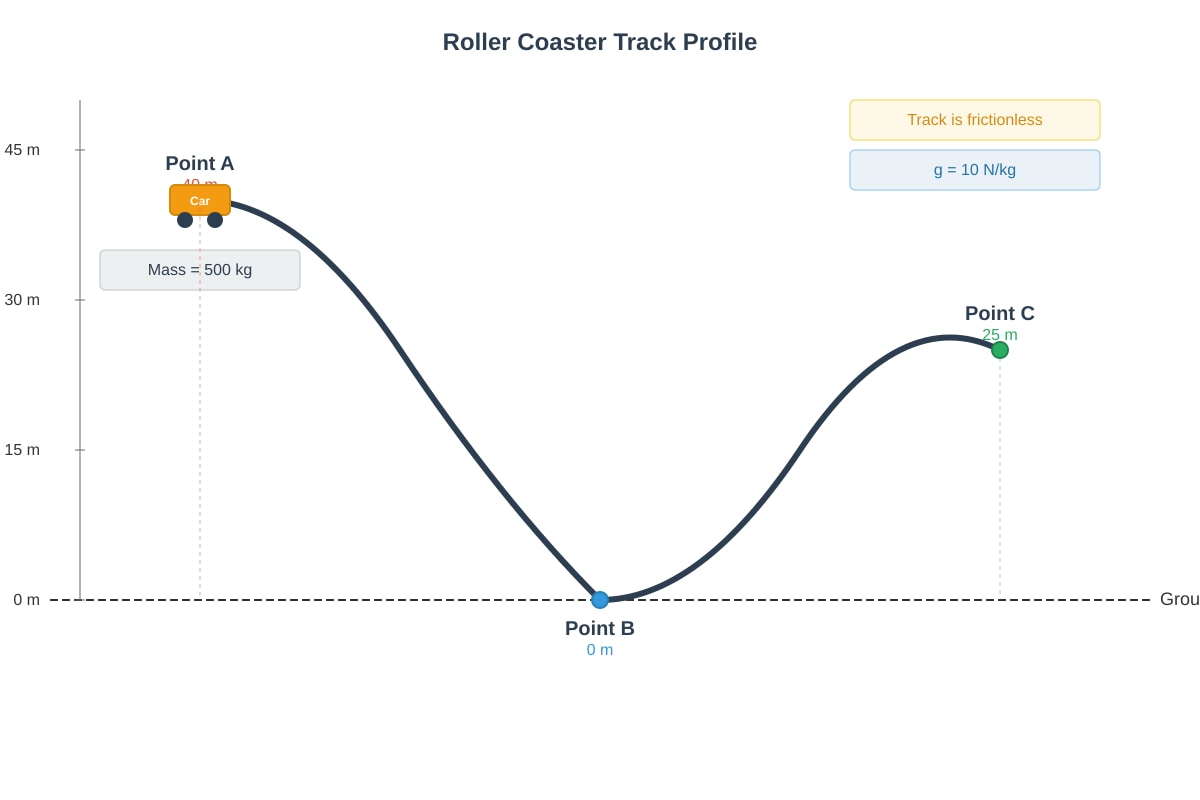
A roller coaster track has the following profile: The car starts from rest at point A (height 40 m), descends to point B (ground level), rises to point C (height 25 m), descends to point D (ground level), and finally rises to point E (height 15 m) where it stops. The mass of the car with passengers is 500 kg. Assume g = 10 N/kg.
<image_placeholder> id: Q20-fig1 type: diagram linked_question: Q20 description: Roller coaster track profile showing points A (40 m), B (0 m), C (25 m), D (0 m), E (15 m). Car at A initially. labels: Point A (h = 40 m), Point B (h = 0 m), Point C (h = 25 m), Point D (h = 0 m), Point E (h = 15 m), car mass = 500 kg values: h_A = 40 m, h_B = 0 m, h_C = 25 m, h_D = 0 m, h_E = 15 m, m = 500 kg, g = 10 N/kg must_show: Track profile with labelled heights at A, B, C, D, E, car at starting position A, horizontal ground reference line </image_placeholder>
(a) Calculate the total mechanical energy of the car at point A. [1]
(b) Calculate the speed of the car at point B, assuming no energy losses. [2]
(c) In reality, the car reaches point C with a speed of 12 m/s. Calculate the energy lost due to friction and air resistance between points A and C. [2]
(d) The car barely reaches point E and stops. Explain why the car cannot go higher than point E on a subsequent climb. [1]
Section C: Data-Based and Extended Response Questions [15 marks]
Answer all questions in the spaces provided.
Question 21 [7 marks]
A student conducts an experiment to investigate the efficiency of a pulley system. The student uses a pulley system to lift a load of 50 N through a vertical height of 2.0 m. The effort applied is 20 N and the effort moves a distance of 6.0 m.
<image_placeholder> id: Q21-fig1 type: experimental_setup linked_question: Q21 description: Pulley system with load of 50 N, effort of 20 N. Load rises 2.0 m, effort moves 6.0 m. Pulley system has 3 movable pulleys. labels: Load (50 N), Effort (20 N), Load distance (2.0 m), Effort distance (6.0 m), Pulley system (3 movable pulleys), Support values: Load = 50 N, Effort = 20 N, Load distance = 2.0 m, Effort distance = 6.0 m, Number of movable pulleys = 3 must_show: Pulley system with 3 movable pulleys, load and effort labelled with forces and distances, direction of motion arrows </image_placeholder>
(a) Calculate the work done on the load (useful work output). [1]
(b) Calculate the work done by the effort (work input). [1]
(c) Calculate the efficiency of the pulley system. [1]
(d) The theoretical mechanical advantage of this pulley system is 6. Calculate the actual mechanical advantage. [1]
(e) Explain why the actual mechanical advantage is less than the theoretical mechanical advantage. [1]
(f) Suggest one modification to the pulley system that could improve its efficiency. [1]
(g) If the student repeats the experiment with a heavier load of 80 N using the same effort of 20 N, state whether the efficiency would increase, decrease, or remain the same. Explain your answer. [1]
Question 22 [8 marks]
The diagram below shows a Sankey diagram for a car engine.
<image_placeholder> id: Q22-fig1 type: diagram linked_question: Q22 description: Sankey diagram for car engine. Input: Chemical energy from fuel (1000 J). Outputs: Kinetic energy (300 J), Heat energy (600 J), Sound energy (100 J). Arrow widths proportional to energy values. labels: Input arrow: Chemical energy from fuel = 1000 J. Output arrows: Kinetic energy = 300 J, Heat energy = 600 J, Sound energy = 100 J values: Chemical energy input = 1000 J, Kinetic energy output = 300 J, Heat energy output = 600 J, Sound energy output = 100 J must_show: Sankey diagram with input arrow labelled "Chemical energy from fuel 1000 J", three output arrows labelled with energy types and values, arrow widths proportional to values </image_placeholder>
(a) State the principle illustrated by the Sankey diagram. [1]
(b) Calculate the efficiency of the car engine. [2]
(c) Explain why the heat energy output is the largest. [1]
(d) Modern car engines have efficiencies of around 40%. Suggest two design features that help improve engine efficiency compared to older engines. [2]
(e) A hybrid car uses both a petrol engine and an electric motor. The electric motor has an efficiency of 90%. Explain why the overall efficiency of a hybrid car is higher than a conventional petrol car, even though the petrol engine efficiency remains the same. [2]
End of Paper
Total Marks: 60
Answers
TuitionGoWhere Practice Paper - Science Secondary 1 (SA2 Version 4) - Answer Key
Subject: Science
Level: Secondary 1 (G3)
Paper: SA2 Version 4
Total Marks: 60
Section A: Multiple Choice Questions [15 marks]
Question 1 [1 mark]
Answer: A
Explanation: Work done = Force × Distance moved in the direction of the force. The student holds the book stationary, so the distance moved is 0 m. Therefore, work done = 20 N × 0 m = 0 J. Holding an object stationary requires a force but does no work on the object because there is no displacement.
Common mistake: Students often confuse "effort" with "work" and calculate 20 N × 1.5 m = 30 J (option B) or 20 N × 10 s = 200 J (option C). Remember: no displacement = no work done.
Question 2 [1 mark]
Answer: A
Explanation: A battery stores chemical energy. When the toy car operates, the chemical energy in the battery is converted to electrical energy, which then powers the motor to produce kinetic energy (movement) and sound energy (from the motor and wheels). Some energy is also dissipated as heat.
Question 3 [1 mark]
Answer: A
Explanation: Net work done = Net force × Distance. The applied force (15 N) and frictional force (15 N) are equal and opposite, so the net force = 0 N. Net work done = 0 N × 4 m = 0 J. The box moves at constant velocity, meaning no net force and no change in kinetic energy (Work-Energy Theorem).
Key concept: Work done by applied force = 60 J, work done against friction = -60 J, net work = 0 J.
Question 4 [1 mark]
Answer: B
Explanation: At position Q (the lowest point), the bob has minimum gravitational potential energy and maximum kinetic energy. At positions P and R (maximum height), the bob momentarily stops, so kinetic energy is zero and gravitational potential energy is maximum. By conservation of energy, kinetic energy is maximum where potential energy is minimum.
Question 5 [1 mark]
Answer: C
Explanation: Gain in GPE = mgh = 2 kg × 10 N/kg × 3 m = 60 J.
Formula: ΔGPE = mgΔh
Question 6 [1 mark]
Answer: D
Explanation: Work done = Force × Displacement × cos(θ). When force acts at right angles to displacement (θ = 90°), cos(90°) = 0, so no work is done.
- A is incorrect: Work requires displacement.
- B is incorrect: Work can be done when force has a component in the direction of displacement (not necessarily exactly the same direction).
- C is incorrect: Work is a scalar quantity (has magnitude only, no direction).
Question 7 [1 mark]
Answer: B
Explanation: Work done = Force × Distance = (mg) × h = (500 kg × 10 N/kg) × 10 m = 50,000 J.
Power = Work done / Time = 50,000 J / 20 s = 2,500 W.
Question 8 [1 mark]
Answer: A
Explanation: As the ball rises, kinetic energy converts to gravitational potential energy. The total mechanical energy (KE + GPE) remains constant (ignoring air resistance). This illustrates the Principle of Conservation of Energy: energy cannot be created or destroyed, only converted from one form to another.
Question 9 [1 mark]
Answer: B
Explanation: Work done by applied force = F × d × cos(θ) = 30 N × 6 m × cos(30°) = 180 × 0.866 = 155.88 J ≈ 156 J.
Note: The frictional force and angle are distractors for this specific question asking only for work done by the applied force.
Question 10 [1 mark]
Answer: A
Explanation: In a hydroelectric power station, water stored at a height has gravitational potential energy. As it falls, this converts to kinetic energy, which turns turbines connected to generators to produce electrical energy. The overall conversion is GPE → Electrical energy (with intermediate steps).
Question 11 [1 mark]
Answer: B
Explanation: Initial KE = ½mv² = ½ × 0.5 kg × (4 m/s)² = 4 J.
At maximum height, all KE converts to GPE: mgh = 4 J.
h = 4 J / (0.5 kg × 10 N/kg) = 4 / 5 = 0.8 m.
Question 12 [1 mark]
Answer: B
Explanation: Work done = Force × Distance moved in direction of force. When a person pushes a wall that does not move, the displacement is zero, so work done = 0 J. In all other options, there is displacement in the direction of the force (or a component of it).
Question 13 [1 mark]
Answer: B
Explanation: For a spring, elastic potential energy = ½ × Force × Extension (or compression) = ½ × 20 N × 0.1 m = 1.0 J.
Alternatively: EPE = ½kx², where k = F/x = 20/0.1 = 200 N/m, so EPE = ½ × 200 × (0.1)² = 1.0 J.
Question 14 [1 mark]
Answer: B
Explanation: Efficiency = Useful output energy / Input energy × 100%.
Useful output energy = Efficiency × Input energy = 0.80 × 500 J = 400 J.
Question 15 [1 mark]
Answer: A
Explanation: By conservation of energy: GPE at top = KE at bottom.
mgh = ½mv² → v = √(2gh) = √(2 × 10 × 30) = √600 = 24.49 m/s ≈ 24.5 m/s.
Wait, let me recalculate: √(2 × 10 × 30) = √600 = 24.49 m/s. But option A is 17.3 m/s and B is 24.5 m/s. Let me check: √600 = 24.49, so B is correct.
Correction: Answer is B (24.5 m/s). My initial reading of option A (17.3 m/s) would be √300, which corresponds to h = 15 m.
Section B: Structured Questions [30 marks]
Question 16 [4 marks]
(a) [1 mark]
Answer: Gravitational potential energy → Kinetic energy (+ Heat energy + Sound energy due to friction)
Accept: Gravitational potential energy is converted to kinetic energy.
(b)(i) [1 mark]
Answer: KE = ½mv² = ½ × 0.1 kg × (3.2 m/s)² = 0.512 J
Accept: 0.51 J or 0.5 J (with correct working)
(b)(ii) [1 mark]
Answer: GPE lost = mgh = 0.1 kg × 10 N/kg × 0.6 m = 0.6 J
(b)(iii) [1 mark]
Answer: Some gravitational potential energy is converted to heat energy and sound energy due to friction between the car and ramp, and air resistance. / Not all GPE is converted to KE due to energy losses (friction, air resistance).
Teaching note: This demonstrates that real systems have energy losses. The "missing" energy (0.6 - 0.512 = 0.088 J) is dissipated as heat and sound.
Question 17 [5 marks]
(a) [2 marks]
Answer: Work done against gravity = Force × Distance = Weight × Vertical height
= (60 kg × 10 N/kg) × 4.0 m = 600 N × 4.0 m = 2400 J
Mark breakdown: 1 mark for correct weight (600 N), 1 mark for correct final answer with unit.
(b) [2 marks]
Answer: Power = Work done / Time = 2400 J / 8.0 s = 300 W
Mark breakdown: 1 mark for correct formula/substitution, 1 mark for correct answer with unit.
(c) [1 mark]
Answer: The student also does work to overcome internal friction in muscles, move limbs, accelerate/decelerate body parts, and overcome air resistance. / The calculated power only accounts for work against gravity, but the student expends additional energy for body movements and overcoming resistances.
Question 18 [4 marks]
(a) [1 mark]
Answer: Work done by applied force = F × d = 20 N × 5 m = 100 J
(b) [1 mark]
Answer: Work done against friction = Friction × Distance = 8 N × 5 m = 40 J
(Or: Work done by friction = -40 J)
(c) [1 mark]
Answer: Net work done = Work by applied force + Work by friction = 100 J + (-40 J) = 60 J
(Or: Net force = 20 - 8 = 12 N; Net work = 12 N × 5 m = 60 J)
(d) [1 mark]
Answer: By Work-Energy Theorem: Net work done = Change in kinetic energy
60 J = ½mv² - 0 (started from rest)
60 = ½ × 3 × v²
v² = 40
v = √40 = 6.32 m/s ≈ 6.3 m/s
Question 19 [5 marks]
(a) [2 marks]
Answer: Vertical height h = L - L cos θ = L(1 - cos θ)
= 1.0 m × (1 - cos 30°) = 1.0 × (1 - 0.866) = 0.134 m
Mark breakdown: 1 mark for correct method (h = L(1 - cos θ) or equivalent), 1 mark for correct calculation.
Alternative method: h = L sin²(θ/2) × 2? No, simpler: cos 30° = adjacent/hypotenuse = (L - h)/L → h = L(1 - cos 30°).
(b) [1 mark]
Answer: GPE gained = mgh = 0.2 kg × 10 N/kg × 0.134 m = 0.268 J
(c) [2 marks]
Answer: By conservation of energy: GPE at max height = KE at lowest point
mgh = ½mv²
v = √(2gh) = √(2 × 10 × 0.134) = √2.68 = 1.637 m/s ≈ 1.6 m/s
Mark breakdown: 1 mark for correct principle/formula, 1 mark for correct calculation with unit.
Question 20 [6 marks]
(a) [1 mark]
Answer: Total mechanical energy at A = GPE at A (since KE = 0, starts from rest)
= mgh = 500 kg × 10 N/kg × 40 m = 200,000 J (or 200 kJ)
(b) [2 marks]
Answer: At B, h = 0, so all energy is kinetic (assuming no losses).
GPE at A = KE at B
200,000 J = ½ × 500 × v²
v² = 800
v = √800 = 28.28 m/s ≈ 28.3 m/s
Mark breakdown: 1 mark for conservation of energy principle, 1 mark for correct calculation with unit.
(c) [2 marks]
Answer: Energy at C = GPE at C + KE at C
GPE at C = mgh = 500 × 10 × 25 = 125,000 J
KE at C = ½mv² = ½ × 500 × (12)² = 250 × 144 = 36,000 J
Total energy at C = 125,000 + 36,000 = 161,000 J
Energy lost = Energy at A - Energy at C = 200,000 - 161,000 = 39,000 J
Mark breakdown: 1 mark for calculating energy at C correctly, 1 mark for correct energy lost.
(d) [1 mark]
Answer: Energy is continuously lost to friction and air resistance as the car moves. The total mechanical energy decreases with each cycle, so the car cannot regain the height of previous peaks. At point E, the remaining mechanical energy is only enough to reach 15 m. On a subsequent climb, even more energy would be lost, so the maximum height would be lower than 15 m.
Section C: Data-Based and Extended Response Questions [15 marks]
Question 21 [7 marks]
(a) [1 mark]
Answer: Useful work output = Load × Load distance = 50 N × 2.0 m = 100 J
(b) [1 mark]
Answer: Work input = Effort × Effort distance = 20 N × 6.0 m = 120 J
(c) [1 mark]
Answer: Efficiency = (Useful work output / Work input) × 100% = (100 J / 120 J) × 100% = 83.3%
(d) [1 mark]
Answer: Actual Mechanical Advantage (AMA) = Load / Effort = 50 N / 20 N = 2.5
(e) [1 mark]
Answer: Friction in the pulley bearings, weight of the movable pulleys, and stiffness of the rope reduce the actual mechanical advantage below the theoretical value. / Energy losses due to friction and the weight of moving parts mean more effort is needed than theoretically predicted.
(f) [1 mark]
Answer: Use ball bearings in pulleys to reduce friction / Use lighter pulleys / Use a more flexible rope / Lubricate the pulley axles. (Any one valid modification)
(g) [1 mark]
Answer: Efficiency would increase.
Explanation: With a heavier load (80 N) and same effort (20 N), the actual mechanical advantage increases (AMA = 80/20 = 4). The frictional losses (which are relatively constant) become a smaller proportion of the total work, so efficiency improves. / The fixed losses (friction, pulley weight) are spread over a larger useful output.
Question 22 [8 marks]
(a) [1 mark]
Answer: Principle of Conservation of Energy / Energy cannot be created or destroyed, only converted from one form to another.
(b) [2 marks]
Answer: Efficiency = (Useful energy output / Total energy input) × 100%
Useful output = Kinetic energy = 300 J
Total input = Chemical energy = 1000 J
Efficiency = (300 / 1000) × 100% = 30%
Mark breakdown: 1 mark for identifying useful output and total input, 1 mark for correct calculation with %.
(c) [1 mark]
Answer: Most of the chemical energy from fuel is converted to heat energy due to the combustion process and friction in engine components. Internal combustion engines are inherently limited by thermodynamics (Carnot efficiency) and practical losses (friction, incomplete combustion, cooling losses).
(d) [2 marks]
Answer (any two):
- Turbocharging/supercharging to increase air intake and improve combustion efficiency
- Direct fuel injection for more precise fuel-air mixing
- Variable valve timing to optimise engine breathing at different speeds
- Higher compression ratios
- Cylinder deactivation at low loads
- Start-stop technology to reduce idling losses
- Improved materials reducing friction (e.g., low-friction coatings)
- Hybrid systems recovering braking energy (regenerative braking)
Mark breakdown: 1 mark per valid design feature with brief explanation.
(e) [2 marks]
Answer: In a hybrid car, the electric motor (90% efficient) handles low-speed driving and acceleration where petrol engines are inefficient. The petrol engine operates mainly at its optimal efficiency range (higher speeds, steady loads). Regenerative braking recovers kinetic energy during deceleration (converting to electrical energy stored in battery) instead of wasting it as heat in brake pads. The engine can also be smaller since the electric motor assists during peak power demands. Overall, more of the fuel's chemical energy is converted to useful kinetic energy across the driving cycle.
Mark breakdown: 1 mark for mentioning regenerative braking / electric motor handling inefficient regimes, 1 mark for explaining how this improves overall efficiency.
End of Answer Key
Total Marks: 60