From Real Exams Exam Paper
Secondary 1 Science Semestral Assessment 2 (End of Year) Paper 4
Free Kimi AI-generated Sec 1 Science SA2 Paper 4 with questions, answers, and syllabus-aligned practice for Singapore students preparing for exams.
These static practice materials are generated from the site's syllabus and paper-generation workflow, with source and model context shown so students and parents can evaluate the material before use.
Questions
TuitionGoWhere Practice Paper - Science Secondary 1
TuitionGoWhere Exam Practice (AI)
| Subject: | Science |
| Level: | Secondary 1 |
| Paper: | SA2 Practice Paper |
| Version: | 4 of 5 |
| Duration: | 1 hour 15 minutes |
| Total Marks: | 60 |
Name: _________________________________ Class: _________________ Date: _________________
INSTRUCTIONS TO CANDIDATES
- Write your name, class, and date in the spaces provided.
- This paper consists of THREE sections: A, B, and C.
- Answer ALL questions.
- Write your answers in the spaces provided. All working should be shown.
- The use of calculators is allowed.
- Marks are awarded for correct units and appropriate significant figures where applicable.
SECTION A: Multiple Choice Questions [10 marks]
Answer ALL questions. For each question, choose the letter corresponding to the best answer and write it in the box provided. Each question carries 1 mark.
1. A student lifts a school bag from the floor to a table. Which energy conversion takes place?
A. Chemical energy → Kinetic energy
B. Chemical energy → Gravitational potential energy
C. Kinetic energy → Gravitational potential energy
D. Gravitational potential energy → Kinetic energy
☐ Answer: [A / B / C / D]
2. Which of the following situations involves no work done by the stated force?
A. A boy pushing against a stationary wall
B. A crane lifting a steel beam vertically upwards
C. A girl pulling a trolley horizontally across the floor
D. A magnet attracting a paperclip towards itself
☐ Answer: [A / B / C / D]
3. A ball is thrown vertically upwards. At the highest point of its motion, which statement is correct?
A. The ball has maximum kinetic energy and zero gravitational potential energy
B. The ball has zero kinetic energy and maximum gravitational potential energy
C. Both kinetic energy and gravitational potential energy are zero
D. Both kinetic energy and gravitational potential energy are at maximum
☐ Answer: [A / B / C / D]
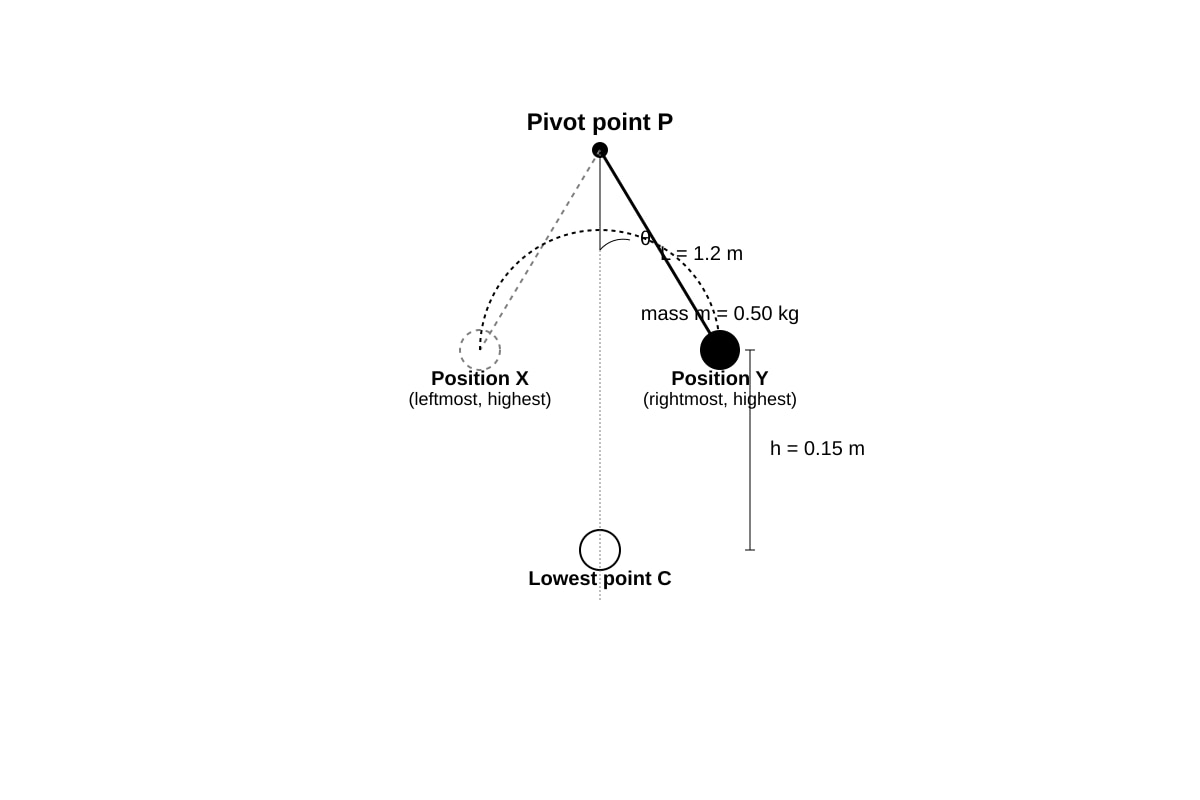
4. The diagram shows a simple pendulum swinging from position X to position Y.
<image_placeholder> id: Q4-fig1 type: diagram linked_question: 4 description: Side view of a simple pendulum with pivot point at top, bob at rightmost position Y, and dotted arc showing path from leftmost position X through lowest point to Y labels: Pivot point P, Bob mass m, String length L, Position X (leftmost, highest), Position Y (rightmost, highest), Lowest point C, Angle θ from vertical at position Y values: Length L = 1.2 m, mass m = 0.50 kg, height difference h = 0.15 m between X/Y and C must_show: Arc path, labelled positions X, C, Y, string, pivot, bob, height difference h </image_placeholder>
Which energy change occurs as the bob moves from X to C?
A. Gravitational potential energy increases; kinetic energy decreases
B. Gravitational potential energy decreases; kinetic energy increases
C. Gravitational potential energy stays constant; kinetic energy increases
D. Both gravitational potential energy and kinetic energy decrease
☐ Answer: [A / B / C / D]
5. A car of mass 1200 kg is travelling at a constant speed of 20 m/s on a level road. The engine provides a forward force of 800 N. What is the total resistive force acting on the car?
A. 0 N
B. 800 N
C. 1600 N
D. 24000 N
☐ Answer: [A / B / C / D]
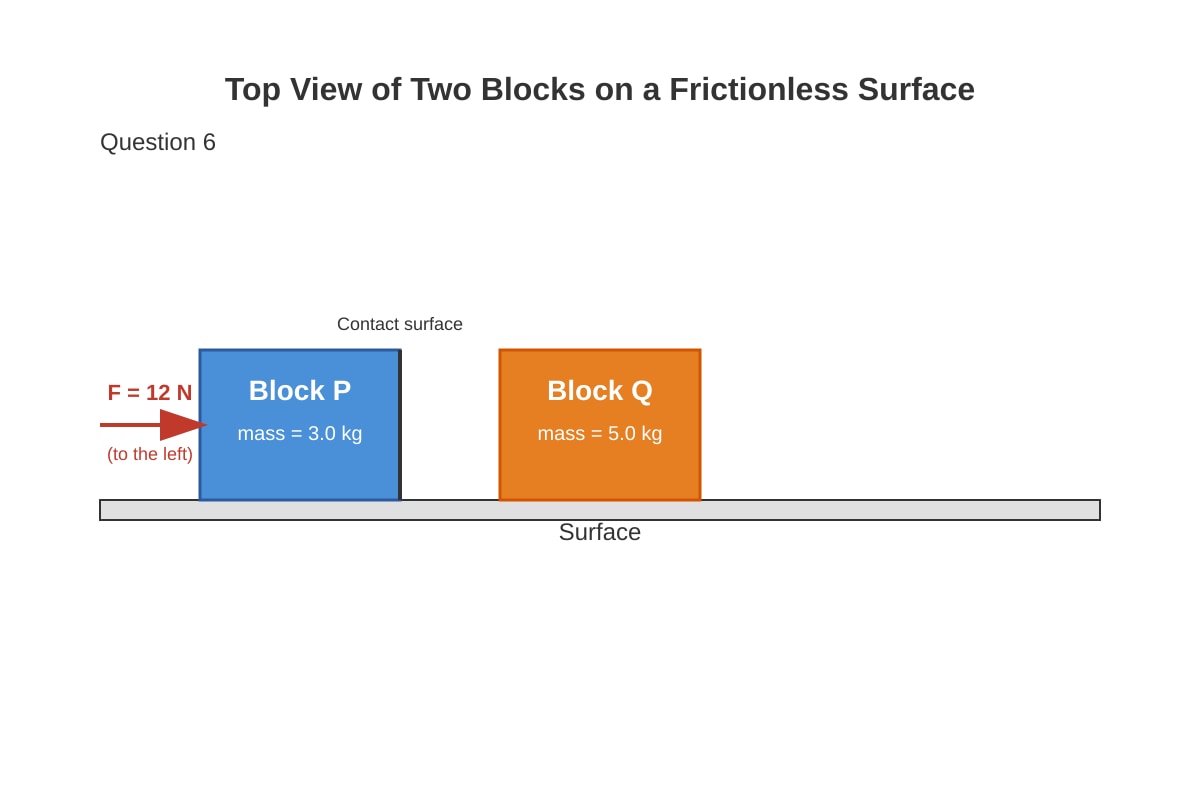
6. Two blocks, P and Q, are placed in contact on a frictionless surface. A force of 12 N is applied to block P as shown.
<image_placeholder> id: Q6-fig1 type: diagram linked_question: 6 description: Top view of two rectangular blocks in contact on a horizontal surface, with arrow showing applied force labels: Block P (mass 3.0 kg, left), Block Q (mass 5.0 kg, right), Surface, Applied force F = 12 N to the left on P, Contact force between P and Q values: Mass P = 3.0 kg, Mass Q = 5.0 kg, Applied force F = 12 N must_show: Both blocks with dimensions, clear labels, force arrow direction, contact surface </image_placeholder>
What is the acceleration of the two blocks?
A. 0.67 m/s²
B. 1.5 m/s²
C. 2.4 m/s²
D. 4.0 m/s²
☐ Answer: [A / B / C / D]
7. Which statement about energy is incorrect?
A. Energy can be transferred from one object to another
B. Energy can be transformed from one form to another
C. Energy can be created in a practical machine
D. The total energy in a closed system remains constant
☐ Answer: [A / B / C / D]
8. A student slides a book across a table and it comes to rest. What happens to the kinetic energy of the book?
A. It is destroyed
B. It is converted to sound and thermal energy
C. It is stored as elastic potential energy in the table
D. It remains as kinetic energy in the stationary book
☐ Answer: [A / B / C / D]
9. The efficiency of a machine is defined as:
A. (Total energy output / Total energy input) × 100%
B. (Useful energy output / Total energy input) × 100%
C. (Total energy input / Useful energy output) × 100%
D. (Wasted energy / Total energy input) × 100%
☐ Answer: [A / B / C / D]
10. A hydroelectric power station converts water stored at a height into electrical energy. Which sequence of energy conversions is correct?
A. Gravitational potential energy → Kinetic energy → Electrical energy
B. Kinetic energy → Gravitational potential energy → Electrical energy
C. Gravitational potential energy → Thermal energy → Electrical energy
D. Chemical energy → Kinetic energy → Electrical energy
☐ Answer: [A / B / C / D]
END OF SECTION A
SECTION B: Structured Questions [30 marks]
Answer ALL questions in the spaces provided. Show all working and state units where appropriate.
11. A coconut of mass 2.0 kg falls from a palm tree from a height of 8.0 m above the ground. Ignore air resistance throughout this question. [g = 10 N/kg]
(a) Calculate the gravitational potential energy of the coconut before it falls.
[2 marks]
(b) State the kinetic energy of the coconut just before it hits the ground. [1 mark]
(c) Calculate the speed of the coconut just before it hits the ground. [3 marks]
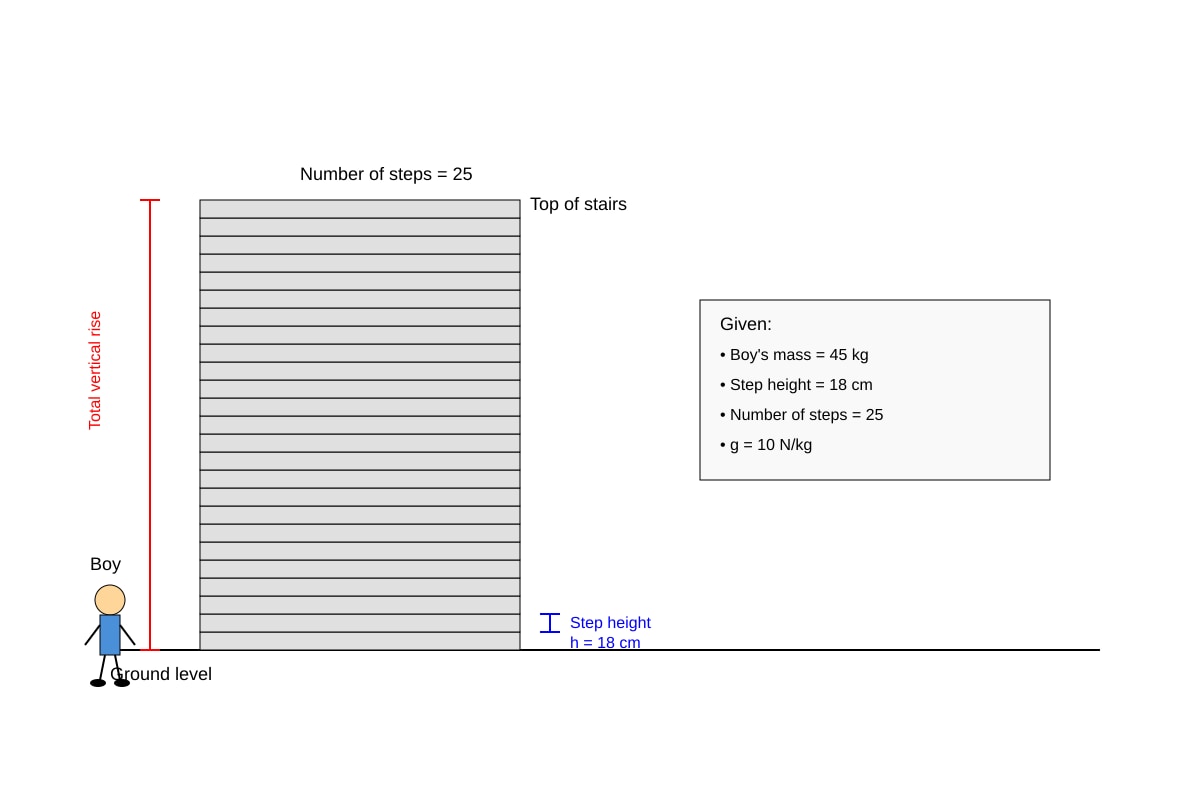
12. A boy of mass 45 kg climbs a flight of stairs. Each step is 18 cm high and there are 25 steps.
<image_placeholder> id: Q12-fig1 type: diagram linked_question: 12 description: Side view of a staircase with boy standing at bottom, showing step dimensions labels: Boy, Ground level, Top of stairs, Step height h = 18 cm, Number of steps = 25 values: Step height = 18 cm, Number of steps = 25, Boy's mass = 45 kg, g = 10 N/kg must_show: Staircase profile, labelled step height, total vertical rise, boy figure for scale </image_placeholder>
(a) Calculate the total vertical height gained by the boy. [1 mark]
(b) Calculate the work done by the boy against gravity. [2 marks]
(c) If the boy takes 50 seconds to climb the stairs, calculate his power output. [2 marks]
(d) In practice, the actual power output of the boy is greater than your answer in (c). Suggest one reason why. [1 mark]
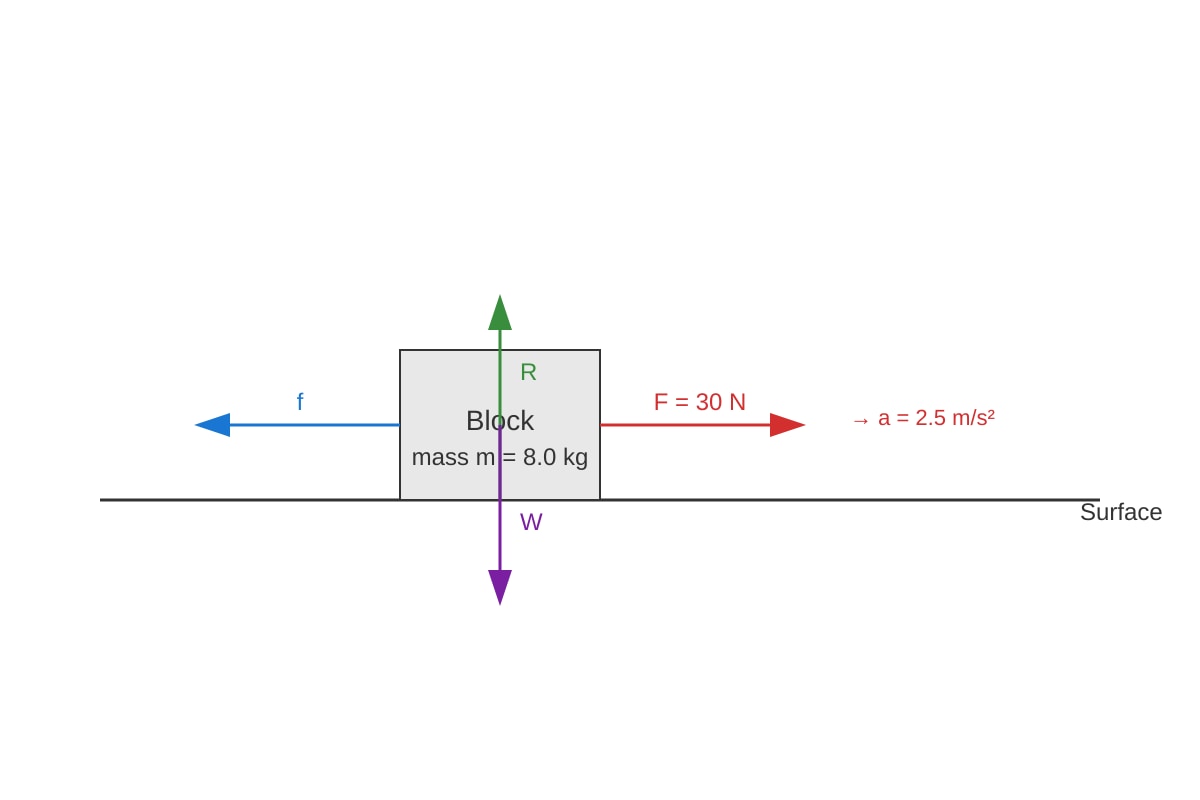
13. The diagram shows a block of mass 8.0 kg being pulled along a rough horizontal surface by a constant force of 30 N. The block accelerates at 2.5 m/s².
<image_placeholder> id: Q13-fig1 type: diagram linked_question: 13 description: Side view of a block on horizontal surface with applied force and friction force shown labels: Block mass m = 8.0 kg, Applied force F = 30 N (horizontal, right), Frictional force f (horizontal, left), Normal reaction R, Weight W, Surface values: Mass = 8.0 kg, Applied force = 30 N, Acceleration a = 2.5 m/s² must_show: All four forces with correct directions and labels, block dimensions, surface line </image_placeholder>
(a) Calculate the net force acting on the block. [2 marks]
(b) Calculate the frictional force acting on the block. [2 marks]
(c) Describe two ways to reduce the frictional force between the block and the surface. [2 marks]
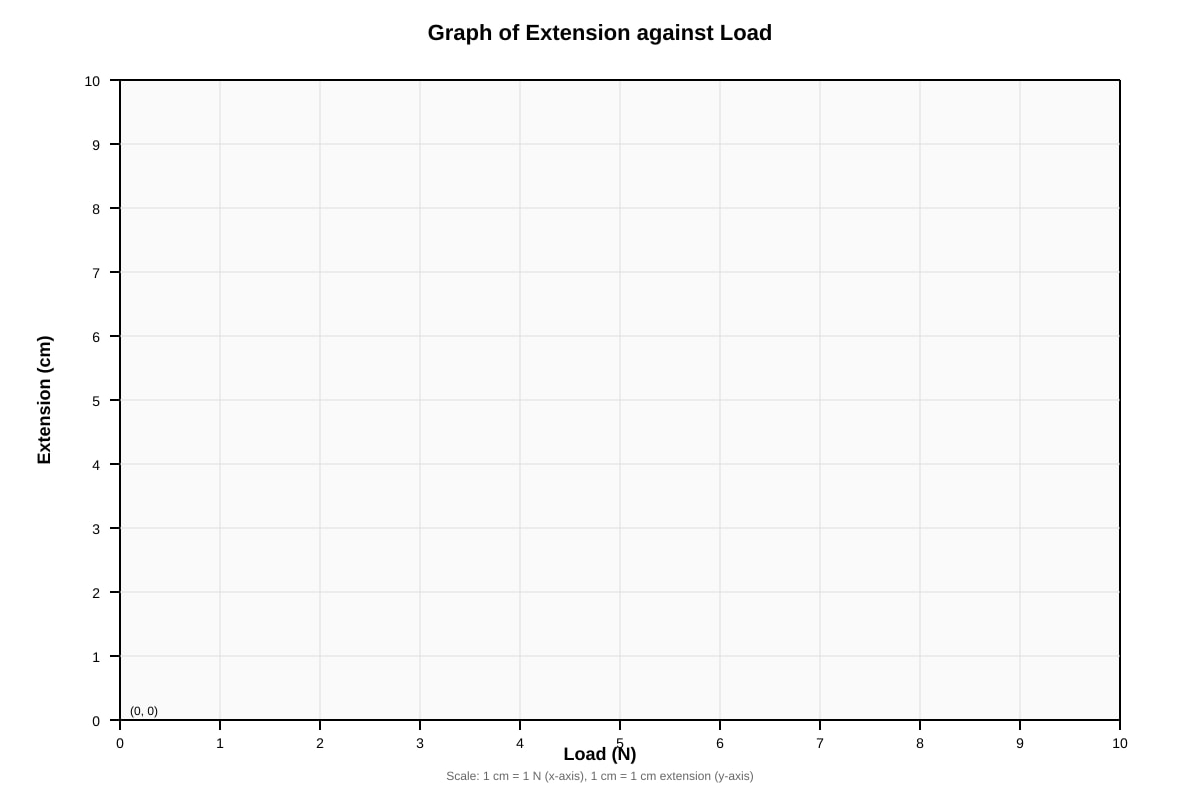
14. A student investigates how the extension of a spring changes with the load applied. The results are shown in the table below.
| Load (N) | 0 | 2.0 | 4.0 | 6.0 | 8.0 | 10.0 | 12.0 |
|---|---|---|---|---|---|---|---|
| Extension (cm) | 0 | 1.5 | 3.0 | 4.5 | 6.0 | 8.5 | 12.0 |
(a) Plot a graph of extension against load using the grid below. [3 marks]
<image_placeholder> id: Q14-fig1 type: graph linked_question: 14 description: Empty graph grid for plotting spring extension vs load with axes drawn labels: x-axis "Load (N)" 0 to 14, y-axis "Extension (cm)" 0 to 14, grid lines every 1 unit values: Scale: x-axis 1 cm = 1 N, y-axis 1 cm = 1 cm extension, origin (0,0) must_show: Clearly labelled axes with units, evenly spaced grid, enough space for all data points </image_placeholder>
(b) Determine the spring constant from your graph for the region where Hooke's Law is obeyed. Show your working clearly. [3 marks]
(c) Explain why the spring does not obey Hooke's Law when the load exceeds a certain value. [2 marks]
15. The diagram shows a pulley system used to lift a load of 500 N to a height of 4.0 m. The effort applied is 150 N and the effort moves through a distance of 16 m.
<image_placeholder> id: Q15-fig1 type: diagram linked_question: 15 description: Block and tackle pulley system with 4 strands supporting the load labels: Load = 500 N, Effort = 150 N, Height lifted h = 4.0 m, Distance effort moves d = 16 m, Fixed pulley at top, Moving pulley with load attached, 4 supporting strands values: Load = 500 N, Effort = 150 N, h = 4.0 m, d = 16 m, Number of supporting strands n = 4 must_show: All pulleys, load, effort direction, supporting strands clearly numbered, dimensions labelled </image_placeholder>
(a) Calculate the useful work output of the pulley system. [2 marks]
(b) Calculate the work input to the pulley system. [2 marks]
(c) Calculate the efficiency of the pulley system. [2 marks]
(d) Suggest two reasons why the efficiency is less than 100%. [2 marks]
END OF SECTION B
SECTION C: Data Analysis and Extended Response [20 marks]
Answer ALL questions.
16. A group of students investigated the braking distance of a bicycle at different speeds. The table shows their results.
| Speed (m/s) | 2.0 | 4.0 | 6.0 | 8.0 | 10.0 |
|---|---|---|---|---|---|
| Braking distance (m) | 0.8 | 3.2 | 7.2 | 12.8 | 20.0 |
| (Speed)² (m²/s²) |
(a) Complete the table by calculating (speed)² for each value. [2 marks]
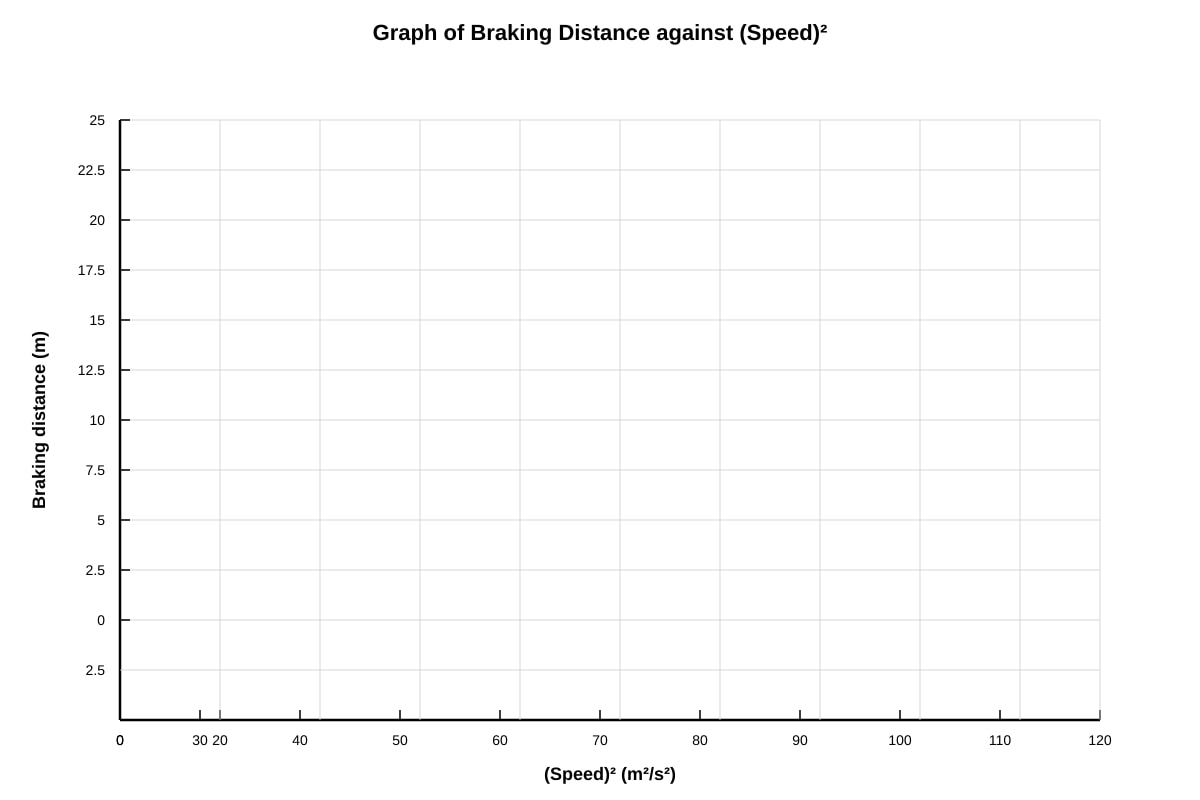
(b) Plot a graph of braking distance against (speed)². [3 marks]
<image_placeholder> id: Q16-fig1 type: graph linked_question: 16 description: Empty graph grid for plotting braking distance vs speed squared labels: x-axis "(Speed)² (m²/s²)" 0 to 120, y-axis "Braking distance (m)" 0 to 25, grid lines values: Scale: x-axis 1 cm = 10 m²/s², y-axis 1 cm = 2.5 m, origin (0,0) must_show: Clearly labelled axes with units, evenly spaced grid, space for all 5 data points </image_placeholder>
(c) Describe the relationship between braking distance and (speed)². [2 marks]
(d) Use your graph to determine the braking distance when the speed is 12 m/s. Show your method clearly. [3 marks]
(e) Explain why a cyclist should ride more slowly in wet conditions. [2 marks]
17. Read the following passage about energy resources.
Singapore relies heavily on imported natural gas to generate electricity. Natural gas is burned in power stations to produce thermal energy, which is used to boil water and produce high-pressure steam. The steam turns turbines connected to generators, producing electrical energy. This process has an efficiency of approximately 45%.
Singapore is increasingly adopting solar energy. Photovoltaic cells convert sunlight directly into electrical energy with efficiencies ranging from 15% to 22%. However, solar energy production is intermittent—it depends on weather conditions and does not work at night.
(a) State the main energy conversion that takes place in a natural gas power station. [1 mark]
(b) For every 1000 MJ of energy supplied by burning natural gas, calculate how much electrical energy is produced. [2 marks]
(c) Explain why the efficiency of a natural gas power station is less than 100%. [2 marks]
(d) Suggest one advantage and one disadvantage of using solar energy compared to natural gas for electricity generation in Singapore. [2 marks]
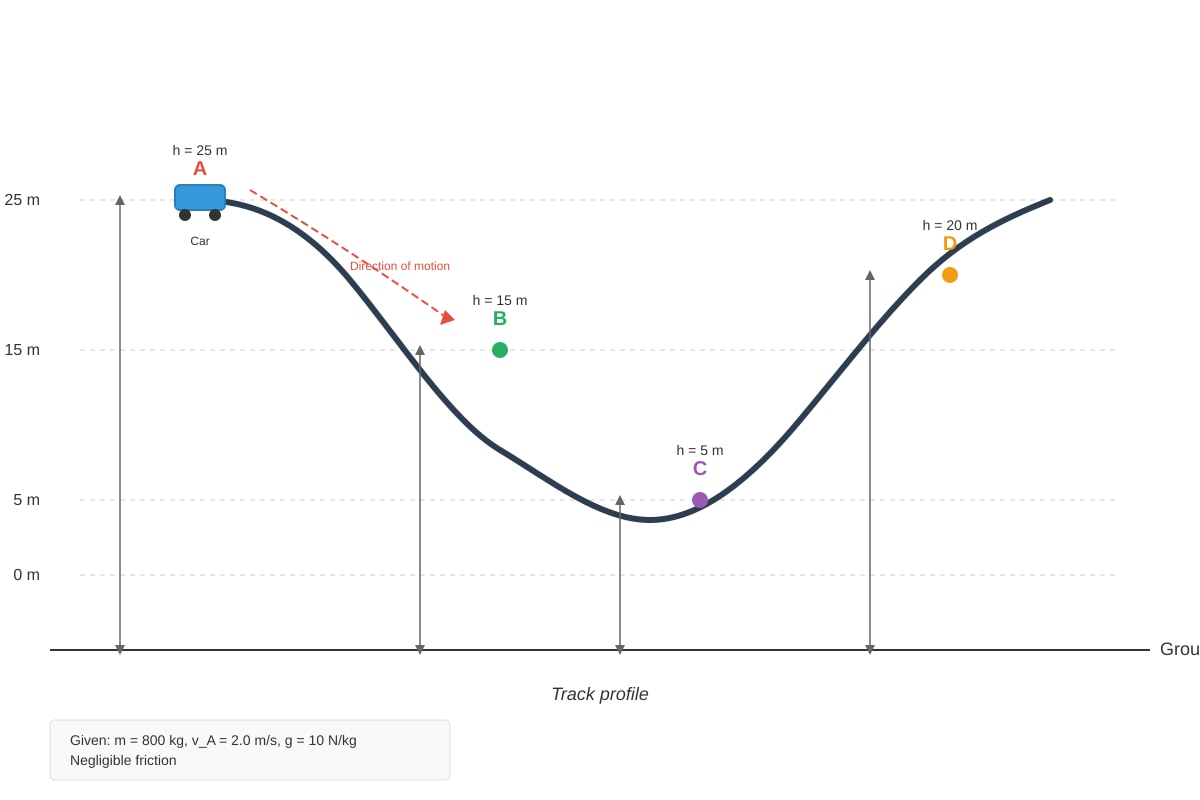
18. The diagram shows a rollercoaster car moving along a track. Point A is the highest point, and point C is the lowest point. The car has a mass of 800 kg and moves with negligible friction.
<image_placeholder> id: Q18-fig1 type: diagram linked_question: 18 description: Side view of rollercoaster track with labelled points A, B, C, D labels: Point A (highest, h_A = 25 m), Point B (intermediate, h_B = 15 m), Point C (lowest, h_C = 5 m), Point D (intermediate, h_D = 20 m), Track profile, Car at point A values: h_A = 25 m, h_B = 15 m, h_C = 5 m, h_D = 20 m, mass m = 800 kg, speed at A = 2.0 m/s, g = 10 N/kg must_show: Smooth track profile with all four labelled points, height labels with arrows, car position at A </image_placeholder>
(a) Calculate the total mechanical energy of the car at point A. [3 marks]
(b) Calculate the speed of the car at point C. [3 marks]
(c) Explain whether the car can reach point D if it momentarily stops at point B, assuming no external energy is supplied. [2 marks]
CHECK YOUR WORK
END OF PAPER
MARK SCHEME SUMMARY
| Section | Marks |
|---|---|
| A | 10 |
| B | 30 |
| C | 20 |
| Total | 60 |
Answers
TuitionGoWhere Practice Paper - Science Secondary 1 (Answer Key)
Version 4 of 5 | SA2 Practice Paper
SECTION A: Multiple Choice Questions [10 marks]
| Question | Answer | Explanation |
|---|---|---|
| 1 | B | When lifting an object, muscles convert chemical energy (from food) into gravitational potential energy of the raised object. The energy stored increases as height increases. Kinetic energy is not the final form since the bag ends at rest on the table. |
| 2 | A | Work done = force × distance moved in direction of force. Pushing a stationary wall means distance = 0, so no work is done. In all other cases, the force causes movement in its direction. |
| 3 | B | At the highest point, vertical velocity is momentarily zero, so kinetic energy = 0. All energy is gravitational potential energy (maximum). This is the key energy transfer in projectile motion. |
| 4 | B | Moving from X (highest) to C (lowest): height decreases → GPE decreases; speed increases → KE increases. Energy converts from GPE to KE. Total mechanical energy stays constant (ignoring air resistance). |
| 5 | B | At constant speed, net force = 0 (Newton's First Law). So forward force = resistive force. Therefore resistive force = 800 N. Students often mistakenly calculate F=ma with mass and speed. |
| 6 | B | Total mass = 3.0 + 5.0 = 8.0 kg. Using F = ma: a = F/m = 12/8.0 = 1.5 m/s². Both blocks move together with the same acceleration. |
| 7 | C | This is the Law of Conservation of Energy: energy cannot be created or destroyed, only transferred or transformed. Statement C violates this fundamental principle. |
| 8 | B | Due to friction, kinetic energy is converted to thermal energy (heat) in the book and table, and a small amount of sound energy. This is why the book warms up and the motion stops. |
| 9 | B | Efficiency = (useful energy output / total energy input) × 100%. "Useful" is critical—total output includes wasted energy. This definition emphasizes practical output versus what we must put in. |
| 10 | A | Water at height has GPE → falls and gains speed (KE) → turns turbines → generators produce electrical energy. The height provides the initial stored energy; falling water provides kinetic energy to drive generators. |
SECTION B: Structured Questions [30 marks]
11. A coconut of mass 2.0 kg falls from 8.0 m. [g = 10 N/kg]
(a) Gravitational potential energy [2 marks]
- Formula: GPE = mgh [1 mark]
- Substitution: GPE = 2.0 × 10 × 8.0 [0.5 mark]
- Answer: GPE = 160 J [0.5 mark]
Teaching note: GPE depends on mass, gravitational field strength, and height. These are the three factors students must always identify.
(b) Kinetic energy just before impact [1 mark]
- GPE at top = KE at bottom (conservation of energy, no air resistance)
- KE = 160 J [1 mark]
(Accept: "Same as answer in (a)" if 160 J stated)
(c) Speed just before impact [3 marks]
| Step | Working | Marks |
|---|---|---|
| 1 | KE = ½mv² | 1 |
| 2 | 160 = ½ × 2.0 × v² → 160 = v² | 1 |
| 3 | v = √160 = 12.6 m/s (or 12.65 m/s, or 4√10 m/s) | 1 |
Common mistake: Using v = gh or v = gt (confusing energy and kinematic methods). Also accept use of v² = u² + 2as with u=0, a=g=10, s=8.0: v² = 2×10×8 = 160, v = 12.6 m/s.
12. Boy of mass 45 kg climbs 25 steps of 18 cm each.
(a) Total vertical height [1 mark]
- Height = 25 × 18 cm = 450 cm = 4.5 m [1 mark]
- (Accept 450 cm with unit, but prefer 4.5 m for consistency with g = 10 N/kg)
(b) Work done against gravity [2 marks]
| Step | Working | Marks |
|---|---|---|
| 1 | Work = mgh = 45 × 10 × 4.5 | 1 |
| 2 | = 2025 J (or 2.025 kJ) | 1 |
Teaching note: "Work done against gravity" means calculating the energy needed to raise the object vertically. The path (steps vs. ramp) doesn't matter—only vertical displacement matters.
(c) Power output [2 marks]
| Step | Working | Marks |
|---|---|---|
| 1 | P = Work/time = 2025/50 | 1 |
| 2 | = 40.5 W (accept 40 W to 41 W) | 1 |
(d) Reason for greater actual power [1 mark]
- Any one valid reason:
- Work is also done against friction/air resistance
- Some energy is converted to thermal energy in the boy's muscles
- Energy is needed to move limbs/body parts (internal work)
- Not all chemical energy is converted to mechanical energy [1 mark]
13. Block of 8.0 kg, force 30 N, acceleration 2.5 m/s².
(a) Net force [2 marks]
| Step | Working | Marks |
|---|---|---|
| 1 | F_net = ma | 1 |
| 2 | F_net = 8.0 × 2.5 = 20 N | 1 |
(b) Frictional force [2 marks]
| Step | Working | Marks |
|---|---|---|
| 1 | F_net = Applied force − Friction | 1 |
| 2 | 20 = 30 − f, so f = 30 − 20 = 10 N | 1 |
Direction: The frictional force acts opposite to the direction of motion (to the left).
(c) Two ways to reduce friction [2 marks]
Any two valid methods [1 mark each]:
- Lubricate the surface (oil, grease, wax)
- Use rollers or wheels (rolling friction < sliding friction)
- Smooth/polish the surfaces
- Use an air cushion (hovercraft principle)
- Reduce the normal force/weight on the block
14. Spring extension data.
(a) Graph plotting [3 marks]
Expected points for marking:
- Correct axes labelled with quantities and units [1 mark]
- Correct scale with even spacing [0.5 mark]
- All 7 points plotted correctly (± half square tolerance) [1.5 marks]
- Points: (0,0), (2,1.5), (4,3.0), (6,4.5), (8,6.0), (10,8.5), (12,12.0)
For Q14-fig1 image: Expected visual shows points forming approximately two straight-line segments—linear from 0 to 8.0 N, then steeper curve beyond.
(b) Spring constant [3 marks]
| Step | Working | Marks |
|---|---|---|
| 1 | Identify linear region: Hooke's Law valid for 0–8.0 N | 1 |
| 2 | k = F/x = 8.0/6.0 = 1.33... N/cm = 8.0/0.060 = 133 N/m (or 1.33 N/cm) | 1 |
| 3 | Method shown: gradient = rise/run = (6.0−0)/(8.0−0) cm/N, inverted | 1 |
Alternative: Use any point in linear region, e.g., k = 4.0/3.0 = 1.33 N/cm. Must show working from graph, not just using table values blindly.
(c) Why Hooke's Law not obeyed at high loads [2 marks]
- Beyond the limit of proportionality (or elastic limit), the spring undergoes permanent deformation [1 mark]
- The spacing between coils changes permanently; spring does not return to original length [1 mark]
- OR: Molecular bonds begin to slip/realign, causing non-proportional extension
15. Pulley system: load 500 N, height 4.0 m, effort 150 N, distance 16 m.
(a) Useful work output [2 marks]
| Step | Working | Marks |
|---|---|---|
| 1 | Useful work = Load × height = 500 × 4.0 | 1 |
| 2 | = 2000 J (or 2.0 kJ) | 1 |
(b) Work input [2 marks]
| Step | Working | Marks |
|---|---|---|
| 1 | Work input = Effort × distance = 150 × 16 | 1 |
| 2 | = 2400 J (or 2.4 kJ) | 1 |
(c) Efficiency [2 marks]
| Step | Working | Marks |
|---|---|---|
| 1 | Efficiency = (useful output / input) × 100% = (2000/2400) × 100% | 1 |
| 2 | = 83.3% (accept 83% or 83.33%) | 1 |
(d) Two reasons for efficiency < 100% [2 marks]
Any two valid reasons [1 mark each]:
- Friction in the pulley bearings/rope
- Weight of the moving pulley and rope must also be lifted
- Rope stretching absorbs some energy
- Air resistance during movement
Teaching note: For any machine, "ideal mechanical advantage" assumes no friction or weight of moving parts. Real machines always have these energy losses.
SECTION C: Data Analysis and Extended Response [20 marks]
16. Braking distance investigation.
(a) Complete (speed)² table [2 marks]
| Speed (m/s) | 2.0 | 4.0 | 6.0 | 8.0 | 10.0 |
|---|---|---|---|---|---|
| (Speed)² (m²/s²) | 4.0 | 16.0 | 36.0 | 64.0 | 100.0 |
- All values correct with unit: [2 marks]
- One error or missing unit: [1 mark]
- More than one error: [0 marks]
(b) Graph plotting [3 marks]
Expected marking:
- Axes labelled with quantity and unit [1 mark]
- Correct scale, even, using most of grid [0.5 mark]
- All 5 points correctly plotted (4, 0.8), (16, 3.2), (36, 7.2), (64, 12.8), (100, 20.0) [1.5 marks]
- ± half square tolerance
(Accept slight variations; line should be straight through origin, showing direct proportionality)
(c) Relationship [2 marks]
- The graph is a straight line through the origin [1 mark]
- Therefore braking distance is directly proportional to (speed)² [1 mark]
- OR: braking distance ∝ (speed)², or braking distance = k × (speed)² where k is constant
Teaching note: This is a crucial safety result—doubling speed quadruples stopping distance.
(d) Braking distance at 12 m/s [3 marks]
| Step | Working | Marks |
|---|---|---|
| 1 | (12)² = 144 m²/s² | 1 |
| 2 | Read from graph or calculate: gradient = 20.0/100 = 0.20 m/(m²/s²) = 0.20 s²/m | 1 |
| 3 | Braking distance = 0.20 × 144 = 28.8 m (accept 28–30 m from graph reading) | 1 |
Alternative using proportion: (12/10)² × 20.0 = 1.44 × 20.0 = 28.8 m
(e) Wet conditions explanation [2 marks]
- Water reduces friction between tyres and road surface [1 mark]
- This increases braking distance (or reduces grip/traction), so slower speed gives more time to stop and reduces risk of skidding [1 mark]
17. Energy resources passage.
(a) Main energy conversion [1 mark]
- Chemical energy → Thermal energy (in natural gas power station)
- Accept: Chemical potential energy → Heat/Internal energy
(b) Electrical energy produced [2 marks]
| Step | Working | Marks |
|---|---|---|
| 1 | Efficiency = (useful output/input) × 100% | 1 |
| 2 | 45% = (output/1000) × 100%, so output = 0.45 × 1000 = 450 MJ | 1 |
(c) Why efficiency < 100% [2 marks]
- Thermal energy is lost to the surroundings (in exhaust gases, cooling water, friction) [1 mark]
- Some energy is converted to sound and not into electrical energy; the generator and turbine themselves have inefficiencies [1 mark]
Teaching note: All heat engines are limited by thermodynamic principles; even perfect engines cannot reach 100% efficiency due to the need to expel waste heat.
(d) Advantage and disadvantage of solar energy [2 marks]
| Advantage [1 mark] | Renewable/less pollution/reduces greenhouse gas emissions/no fuel cost/Singapore has consistent sunlight |
| Disadvantage [1 mark] | Intermittent (weather dependent, night time)/lower efficiency/needs large surface area/initial installation cost high |
18. Rollercoaster energy. Mass 800 kg, g = 10 N/kg, speed at A = 2.0 m/s.
(a) Total mechanical energy at A [3 marks]
| Step | Working | Marks |
|---|---|---|
| 1 | GPE at A: mgh = 800 × 10 × 25 = 200 000 J | 1 |
| 2 | KE at A: ½mv² = ½ × 800 × (2.0)² = 1600 J | 1 |
| 3 | Total ME = 200 000 + 1600 = 201 600 J (or 202 kJ, or 2.016 × 10⁵ J) | 1 |
Teaching note: "Total mechanical energy" means GPE + KE. Students often forget the initial kinetic energy.
(b) Speed at C [3 marks]
| Step | Working | Marks |
|---|---|---|
| 1 | At C: h_C = 5 m, so GPE_C = 800 × 10 × 5 = 40 000 J | 1 |
| 2 | KE_C = Total ME − GPE_C = 201 600 − 40 000 = 161 600 J | 1 |
| 3 | ½ × 800 × v² = 161 600 → v² = 404 → v = 20.1 m/s (accept 20 m/s) | 1 |
Alternative using energy difference: mgh loss = 800×10×(25−5) = 160 000 J; added to initial KE 1600 J gives 161 600 J. Note slight rounding differences.
(c) Can car reach D from rest at B? [2 marks]
| Reasoning | Marks |
|---|---|
| GPE at B: mgh_B = 800 × 10 × 15 = 120 000 J | |
| GPE at D: mgh_D = 800 × 10 × 20 = 160 000 J | |
| No [1 mark] | |
| To reach D from B, needs additional 40 000 J of energy; but with no external energy and assuming no friction, total ME is conserved at 120 000 J (from rest at B), which is less than needed for D [1 mark] |
Alternative: h_D > h_B, so cannot reach higher point without external energy input. If ME conserved from B, max height reachable is 15 m.
TOTAL MARKS: 60
| Section | Max Marks | Awarded |
|---|---|---|
| A | 10 | |
| B | 30 | |
| C | 20 | |
| TOTAL | 60 |