From Real Exams Exam Paper
Secondary 1 Science Semestral Assessment 2 (End of Year) Paper 4
Free Sec 1 Science SA2 Paper 4, HY3 Exam version, with questions, answers, and syllabus-aligned practice for Singapore students.
These static practice materials are generated from the site's syllabus and paper-generation workflow, with source and model context shown so students and parents can evaluate the material before use.
Questions
Free quiz and exam paper access
Enter your details to view this paper
Your access is remembered on this device.
Answers
TuitionGoWhere Exam Practice (AI) — Secondary 1 Science SA2 Practice Paper (Version 4) Answer Key
Total Marks: 60
Section A: Forces and Energy (24 marks)
1. [2 marks]
- Energy conversion: Chemical energy (in boy) → Gravitational potential energy (of book). [1 mark]
- Work done = Force × distance = 20 N × 1.5 m = 30 J. [1 mark]
Teaching note: Work is done when a force moves an object in the direction of the force. Raising at constant speed means all chemical energy becomes stored GPE. Common trap: forgetting units (J).
2. [1 mark]
0 J.
Teaching note: Work = Force × displacement. Held stationary → displacement = 0 → work = 0 J. Common trap: multiplying 10 N × 30 s (that is not work, no distance moved).
3. [2 marks]
A sharp knife has a smaller contact area. [1 mark] For the same applied force, pressure = force ÷ area is larger, so it cuts more easily. [1 mark]
Teaching note: Pressure increases when area decreases (force constant). Blunt knife = larger area = lower pressure.
4. [2 marks]
Weight (force) stays 30 N. [1 mark] Smallest face has smaller contact area, so pressure = 30 N ÷ smaller area is larger than before. [1 mark]
Teaching note: Pressure = F ÷ A. Force unchanged; smaller A → higher pressure.
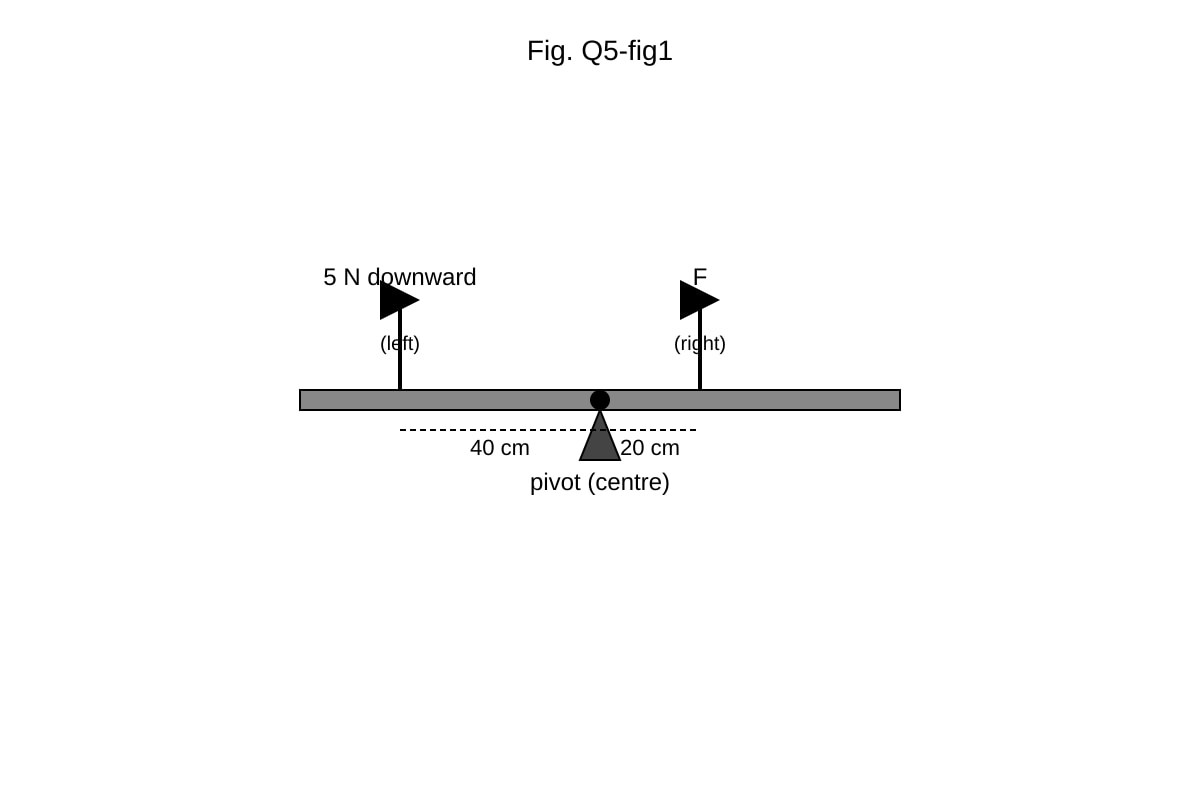
5. [2 marks]
Clockwise moment = 5 N × 40 cm = 200 N·cm.
Anti-clockwise moment = F × 20 cm.
Balance: F × 20 = 200 → F = 10 N. [2 marks]
Teaching note: Moments balance when clockwise = anti-clockwise. Use perpendicular distance from pivot.
6. [1 mark]
Any correct example: seesaw, crowbar, scissors, bottle opener. [1 mark]
7. [3 marks]
Work done = 500 N × 10 m = 5000 J. [2 marks]
Power = Work ÷ time = 5000 J ÷ 20 s = 250 W. [1 mark]
Teaching note: Power is rate of doing work (J/s = W).
8. [2 marks]
Chemical energy (in battery) → Electrical energy → Light energy (+ heat). Any two: electrical, light, chemical, heat. [2 marks, 1 each]
Section B: Heat and Light (18 marks)
9. [1 mark]
higher; lower. [1 mark]
10. [2 marks]
Metal expands when heated. [1 mark] Gaps allow space for expansion so tracks do not buckle. [1 mark]
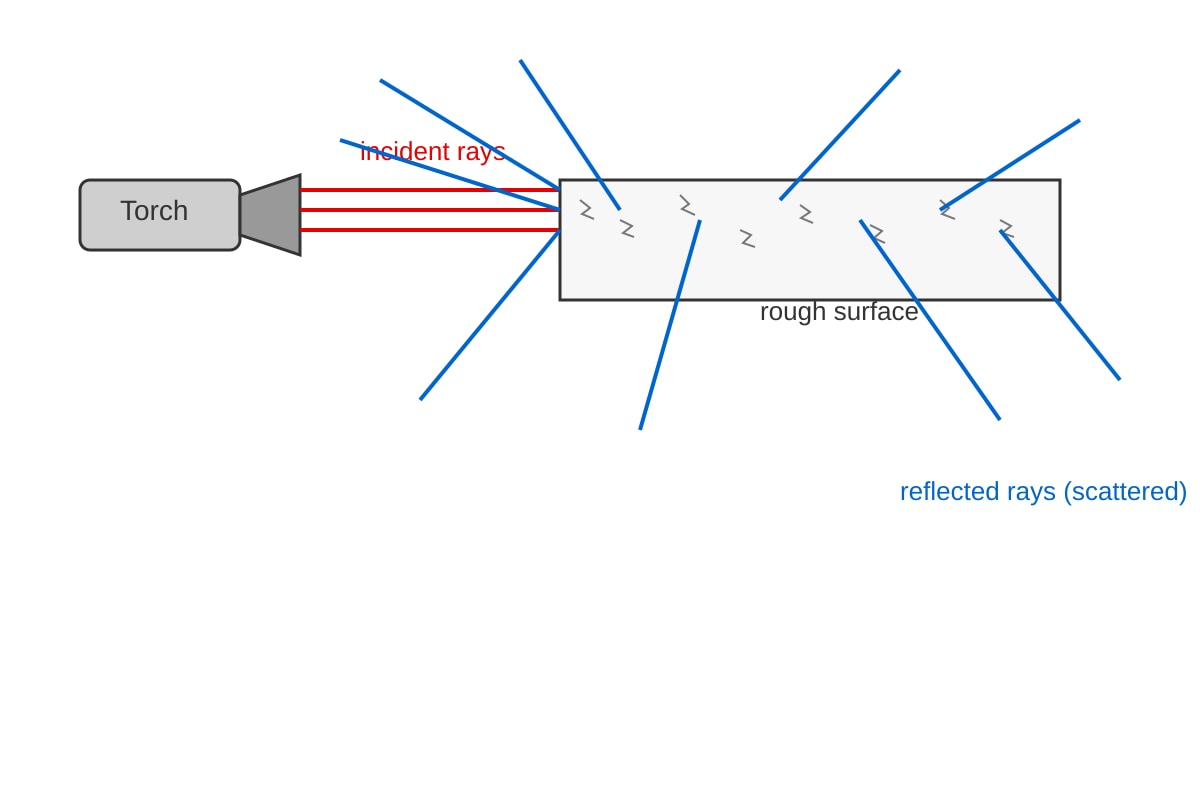
11. [2 marks]
Light undergoes diffuse reflection. [1 mark] Rays scatter in many directions because the surface is rough. [1 mark]
Teaching note: Unlike mirror, rough surface sends rays in different directions.
12. [3 marks]
Particles at heated end vibrate more. [1 mark] They collide with neighbouring particles. [1 mark] Energy transfers along rod as heat conduction. [1 mark]
13. [2 marks]
To maintain a set temperature by switching heating on/off. [2 marks, allow 1–2 marks for partial]
14. [3 marks]
Two metals expand by different amounts. [1 mark] Strip bends when heated. [1 mark] Bending closes a contact to trigger alarm. [1 mark]
Section C: Electricity (18 marks)
15. [1 mark]
230 V. [1 mark]
16. [2 marks]
Correct parallel circuit with cell, switch, two lamps, using standard symbols. [2 marks]
Teaching note: In parallel, both lamps connect across same two points.
17. [2 marks]
Colour: green/yellow. [1 mark] Function: safety path to earth to prevent shock. [1 mark]
18. [3 marks]
Unit: ampere (A). [1 mark] Adding cell in series increases voltage. [1 mark] Current increases (more push). [1 mark]
19. [2 marks]
Fuse, circuit breaker. [2 marks, 1 each]
20. [3 marks]
Power = V × I = 230 V × 2 A = 460 W. [2 marks]
Energy conversion: Electrical → Heat. [1 mark]