From Real Exams Exam Paper
Secondary 1 Science Semestral Assessment 2 (End of Year) Paper 3
Free Sec 1 Science SA2 Paper 3, Nemo3 Exam version, with questions, answers, and syllabus-aligned practice for Singapore students.
These static practice materials are generated from the site's syllabus and paper-generation workflow, with source and model context shown so students and parents can evaluate the material before use.
Questions
Free quiz and exam paper access
Enter your details to view this paper
Your access is remembered on this device.
Answers
TuitionGoWhere Practice Paper - Science Secondary 1
TuitionGoWhere Secondary School (AI)
Subject: Science
Level: Secondary 1 (G3)
Paper: SA2 Version 3
Answer Key and Marking Scheme
Total Marks: 60
Section A: Multiple Choice Questions [15 marks]
1. Answer: B [1]
Explanation: When a student lifts a book at constant speed, the chemical energy stored in the student's muscles is converted directly into gravitational potential energy of the book. The kinetic energy does not change (constant speed), so there is no net conversion to/from kinetic energy.
Common mistake: Choosing C because the book moves. However, at constant velocity, kinetic energy is constant — it is not an intermediate conversion step.
2. Answer: B [1]
Working:
Net force = Applied force – Frictional force = 25 N – 8 N = 17 N
Net work done = Net force × distance = 17 N × 4 m = 68 J
Alternative: Work by applied force = 25 × 4 = 100 J; Work against friction = 8 × 4 = 32 J; Net work = 100 – 32 = 68 J.
3. Answer: C [1]
Working:
Loss in GPE = Gain in KE (conservation of energy)
4. Answer: D [1]
Explanation:
- Statement B: Work = Force × distance moved in the direction of the force. Correct.
- Statement C: When holding an object stationary, there is no displacement, so no work is done on the object. Correct.
- Statement A is false because if the object does not move in the direction of the force, no work is done.
5. Answer: C [1]
Working:
Mechanical Advantage = Load / Effort
Load = MA × Effort = 4 × 50 N = 200 N
6. Answer: A [1]
Working:
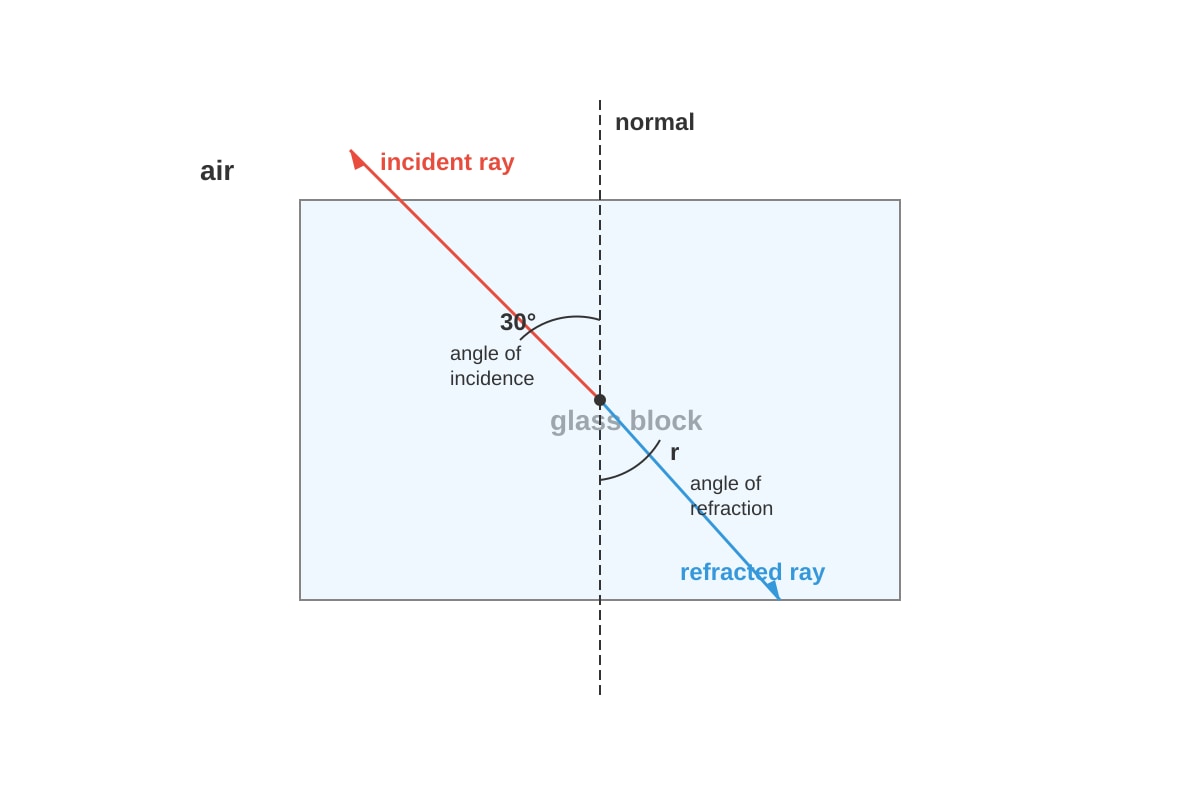
Snell's Law:
7. Answer: C [1]
Explanation: Shorter wavelengths (blue/violet) are deviated more than longer wavelengths (red) when passing through a prism. Blue light has a shorter wavelength than red, green, or yellow, so it is deviated the most.
8. Answer: C [1]
Explanation: For a plane mirror, image distance = object distance. Distance between object and image = 15 cm + 15 cm = 30 cm.
9. Answer: D [1]
Working:
Lens formula:
(positive → real image)
Magnification (diminished, inverted since real)
→ Real, inverted, diminished.
10. Answer: A [1]
Explanation: Electromagnetic spectrum order from longest to shortest wavelength: Radio waves → Microwaves → Infrared → Visible light → Ultraviolet → X-rays → Gamma rays.
11. Answer: B [1]
Working:
Series circuit:
12. Answer: C [1]
Explanation: In a parallel circuit, each bulb receives the full battery voltage. Removing one bulb does not affect the voltage across the others, so their brightness remains unchanged.
13. Answer: B [1]
Working:
14. Answer: B [1]
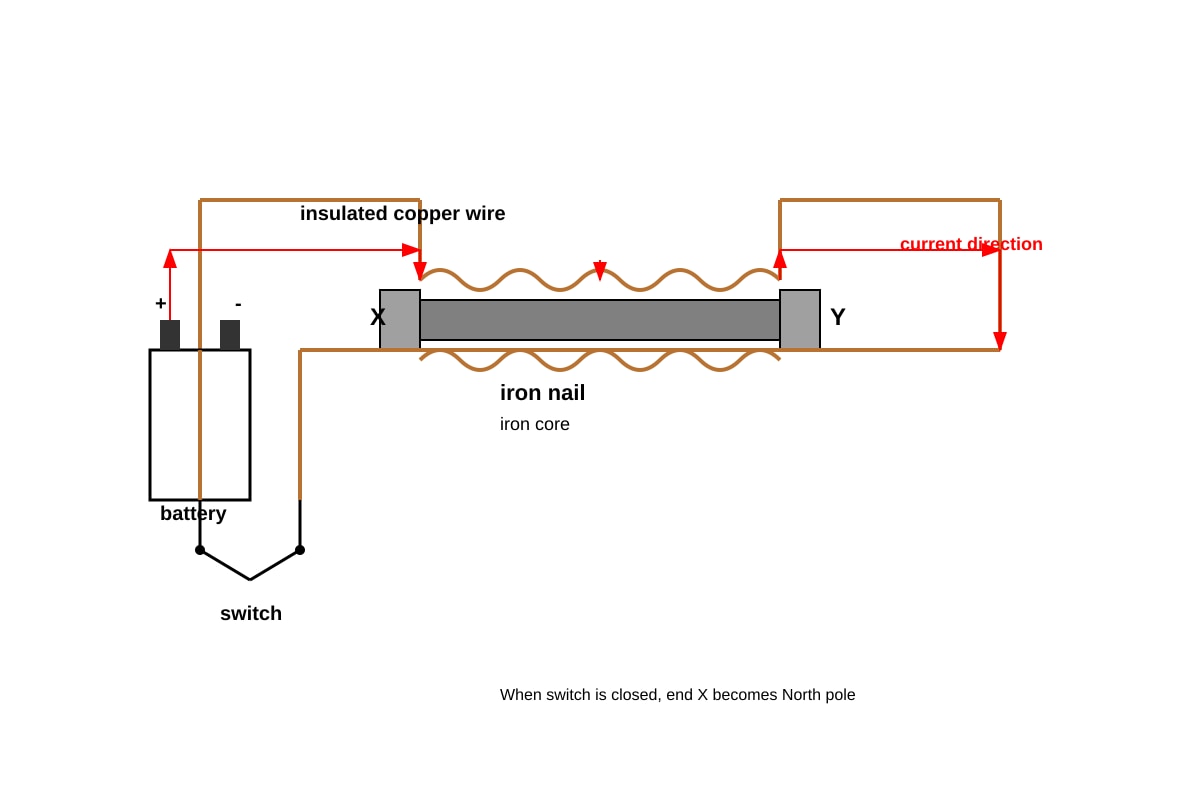
Explanation: Reversing the battery reverses the current direction. The magnetic polarity of an electromagnet depends on current direction (right-hand grip rule). If current reverses, the poles swap: North becomes South.
15. Answer: D [1]
Explanation: Strength of electromagnet increases with: more turns, larger current, softer/larger iron core. Increasing wire length while keeping turns the same means using a larger core or spacing turns out — this does not increase magnetic field strength (which depends on turns per unit length, ).
Section B: Structured Questions [30 marks]
16.
(a) Weight of crate = [1]
(b) Component parallel to plane = [1]
(c) Since constant velocity, net force = 0.
Forces up plane = Forces down plane
Friction = [2]
(1 mark for equilibrium statement, 1 mark for correct value)
(d) Work done by worker = Force × distance = [1]
(e) Vertical height gained =
Gain in GPE = [2]
(1 mark for height calculation, 1 mark for GPE)
(f) Work done by worker (2400 J) > Gain in GPE (1500 J) because part of the work is done against friction (work against friction = ), which is dissipated as heat. Total work = Gain in GPE + Work against friction. [1]
17.
(a) Snell's Law:
[2]
(1 mark for correct substitution, 1 mark for answer)
(b) The speed of light increases as it passes from water (optically denser) into air (optically less dense). [1]
(c) Critical angle :
Since angle of incidence (50°) > critical angle (48.8°), total internal reflection will occur. [2]
(1 mark for critical angle calculation, 1 mark for correct conclusion with comparison)
(d) Optical fibres in telecommunications / endoscopes in medicine / prismatic binoculars / reflectors in cars. (Any one) [1]
18.
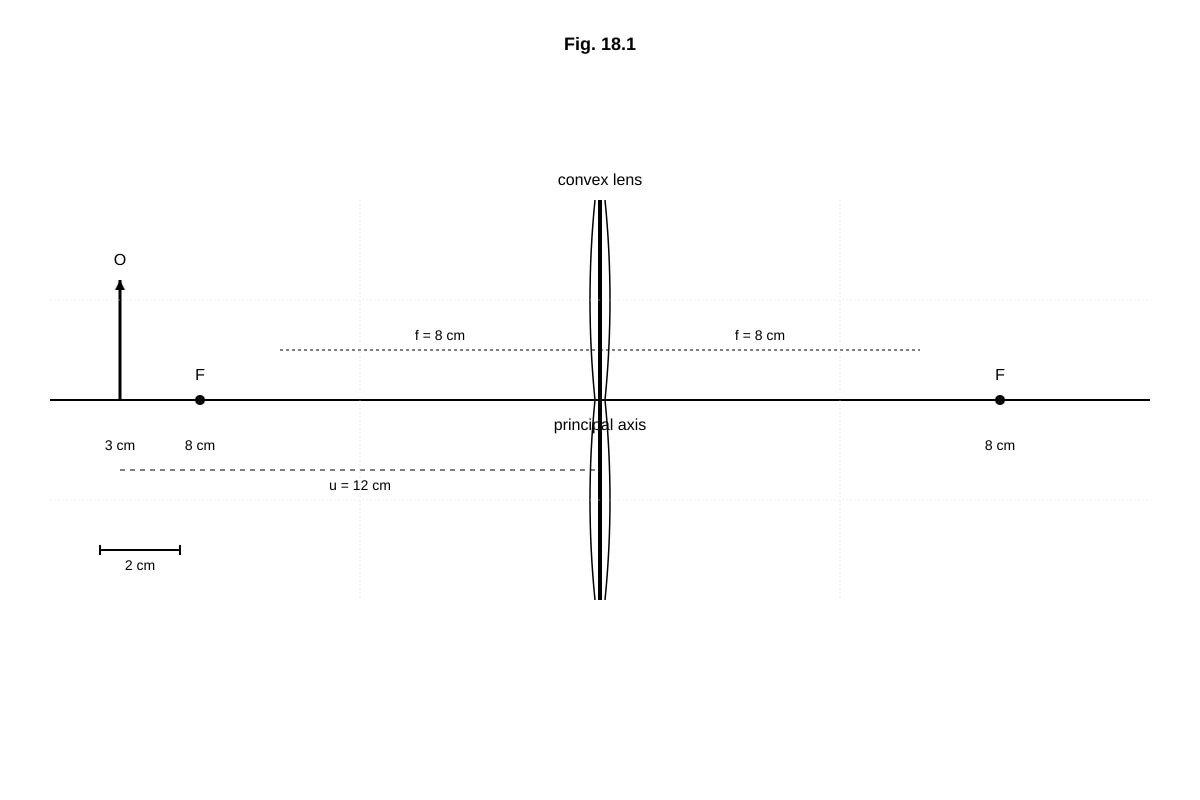
(a) Ray diagram construction: [3]
- Ray 1: From top of object, parallel to principal axis → refracts through focal point F on right side.
- Ray 2: From top of object, through optical centre → continues straight.
- Ray 3: From top of object, through focal point F on left side → refracts parallel to principal axis.
- Intersection of rays on right side gives real, inverted image.
(1 mark each for two correct rays, 1 mark for correct image position and arrow)
Expected image position: ~24 cm on opposite side of lens (calculated in part c).
(b) Nature of image: Real, inverted, magnified. [2]
(1 mark for real/inverted, 1 mark for magnified)
(c) Lens formula:
[2]
(1 mark for correct rearrangement/substitution, 1 mark for answer with unit)
(d) Magnification (image is 2× taller than object) [1]
19.
(a) Parallel combination:
[1]
(b) Total resistance = [1]
(c) Ammeter reading (total current) = [1]
(d) Voltage across parallel combination = Total current ×
Alternative: Voltage divider: [2]
(1 mark for method, 1 mark for answer)
(e) Power in
Alternative: , where , so [1]
20.
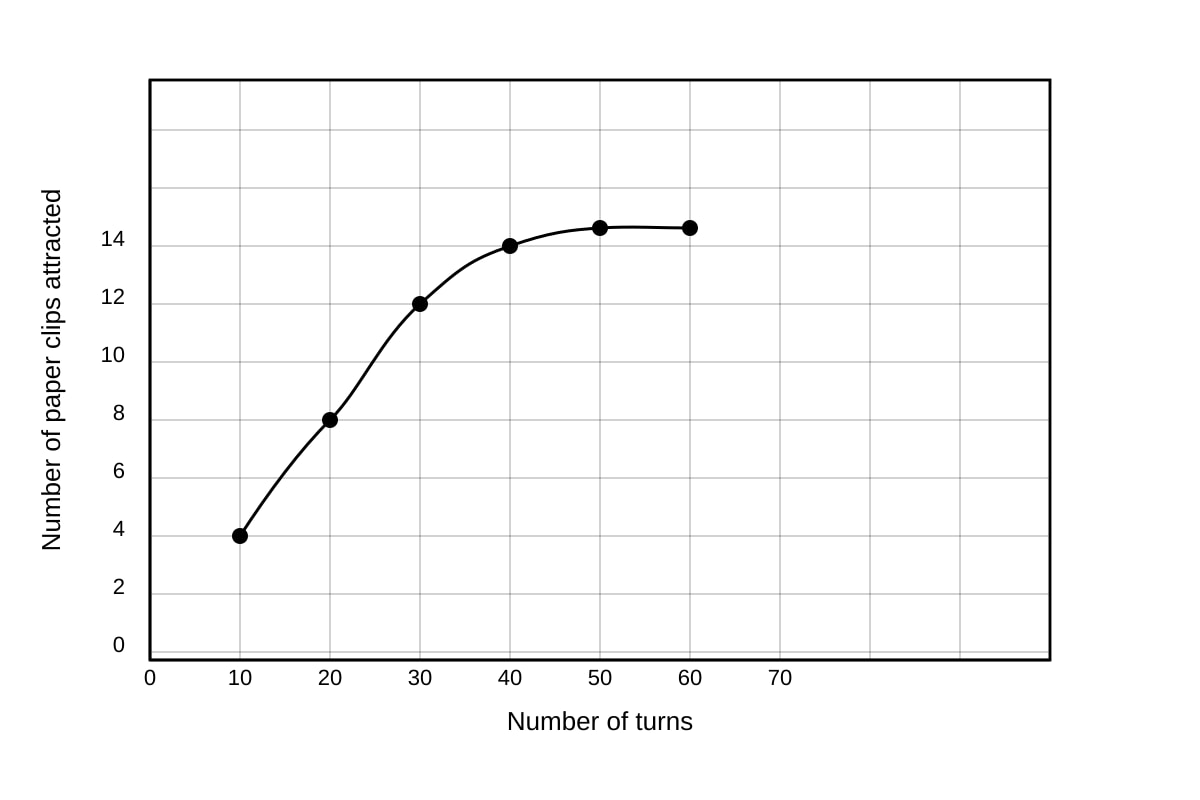
(a) Graph plotting: [2]
- Axes labelled with units, suitable scales (x: 0–70 turns, y: 0–15 clips) [1]
- All 6 points plotted correctly, smooth curve of best fit (rising then plateauing) [1]
(Deduct ½ mark per incorrectly plotted point, max 1 mark deduction)
(b) As the number of turns increases, the strength of the electromagnet (number of paper clips attracted) increases, but the rate of increase slows down and eventually levels off (saturates) after about 50 turns. [1]
(c) After 50 turns, the iron core reaches magnetic saturation — almost all magnetic domains in the iron are aligned. Adding more turns does not significantly increase the magnetic field strength because the core cannot be magnetised further. [2]
(1 mark for identifying saturation, 1 mark for explanation with domains)
(d) Two variables to keep constant:
- Current / voltage of battery
- Type and size of iron core
- Type of wire (thickness, material)
- Paper clips (size, material, mass)
(Any two) [1]
(e) Two ways to increase strength without changing turns:
- Increase the current (e.g., use higher voltage battery or reduce resistance)
- Use a softer/larger iron core
- Use thicker wire (lower resistance → more current for same voltage)
(Any two) [1]
Section C: Free Response / Data-Based Questions [15 marks]
21.
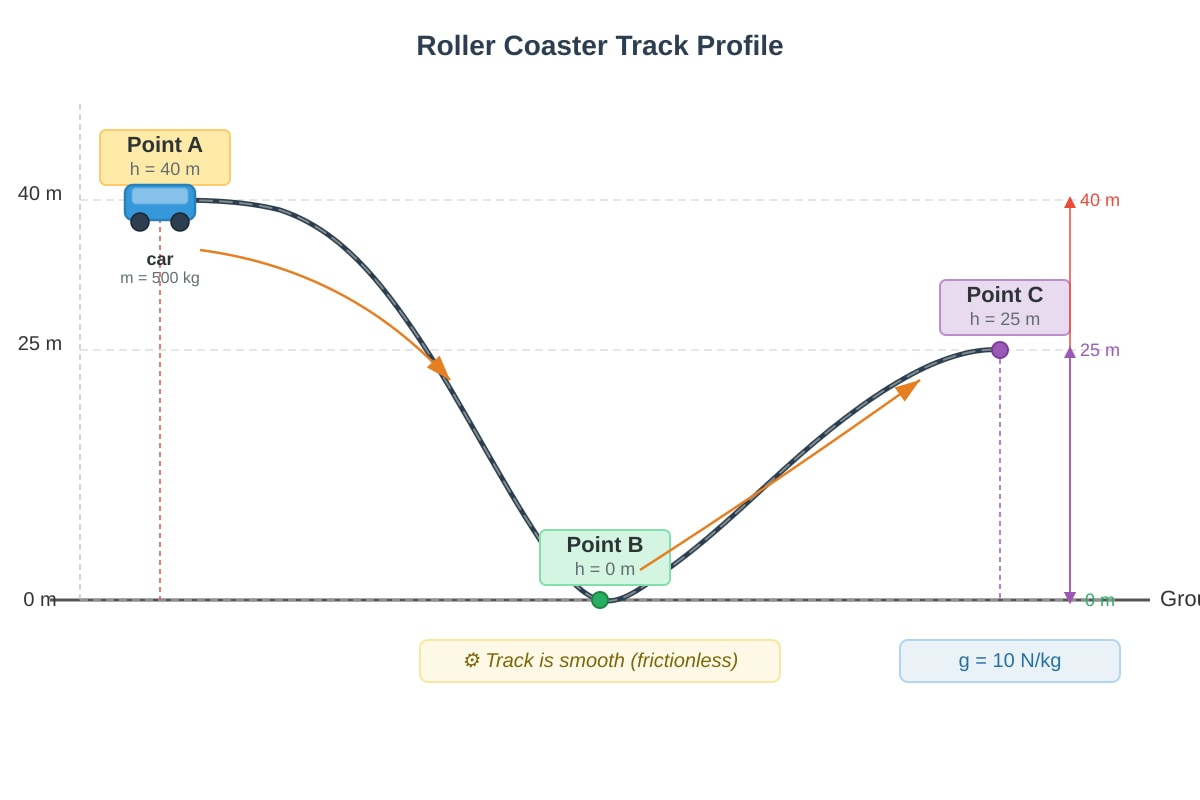
(a) GPE at A = [1]
(b) Total mechanical energy at A = GPE + KE = 200,000 J + 0 = 200,000 J (starts from rest) [1]
(c) At B (ground level), GPE = 0. By conservation of energy (frictionless), KE at B = Total energy = 200,000 J [1]
(d)
[2]
(1 mark for formula/substitution, 1 mark for answer)
(e) At C, height = 25 m. GPE at C =
KE at C = Total energy – GPE at C = 200,000 – 125,000 = 75,000 J [1]
(f) Actual KE at C =
Expected KE (no friction) = 75,000 J
Work done against friction = Energy lost = 75,000 – 56,250 = 18,750 J [3]
(1 mark for actual KE, 1 mark for expected KE, 1 mark for difference)
(g) The total mechanical energy of the system is 200,000 J (conserved on frictionless parts, decreases only due to friction). The maximum GPE the car can have is 200,000 J (when KE = 0). This corresponds to a maximum height of . Without additional energy input, the car cannot exceed its initial total energy, so it cannot reach a height greater than 40 m. [2]
(1 mark for energy conservation principle, 1 mark for height limit explanation)
22.
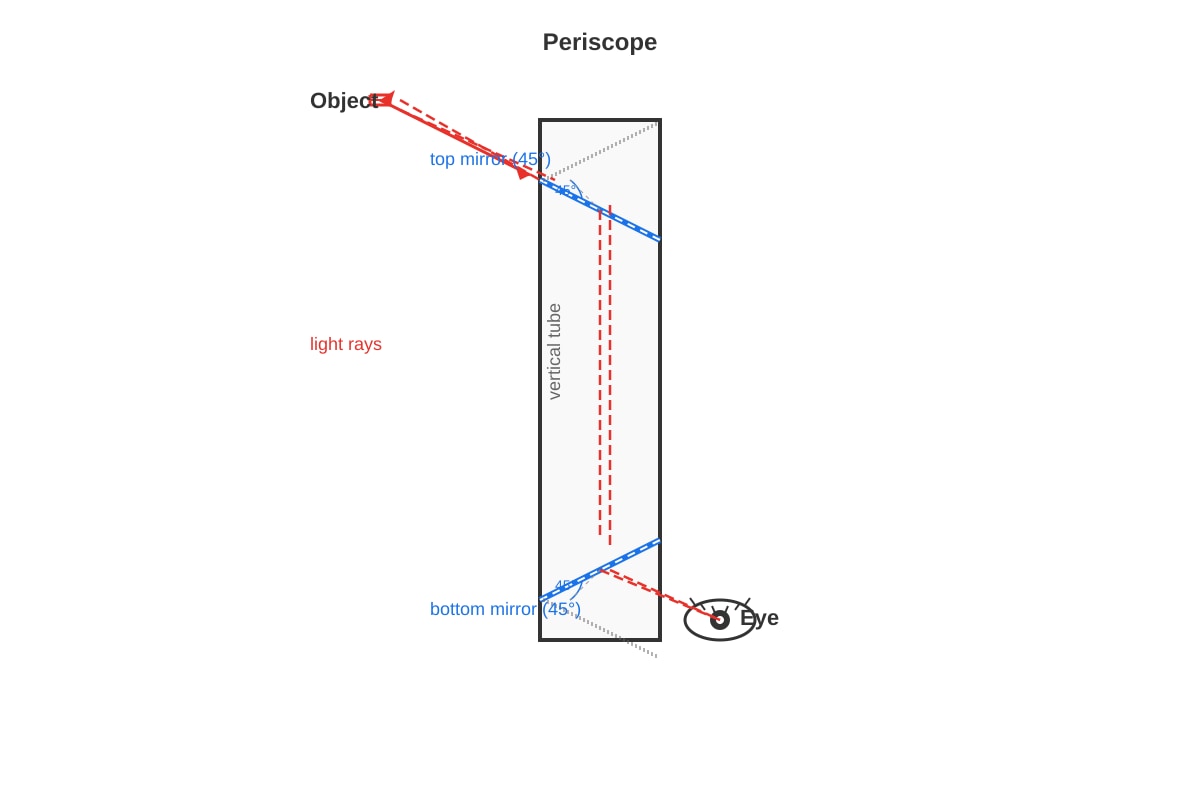
(a) Ray diagram completion: [2]
- Ray from object to top mirror at 45° incidence → reflects 90° downward.
- Ray travels down tube to bottom mirror → reflects 90° horizontally into eye.
- Two rays shown (e.g., from top and bottom of object).
(1 mark for correct reflection at top mirror, 1 mark for correct reflection at bottom mirror reaching eye)
(b) Angle of incidence at each mirror = 45° (mirrors are at 45° to vertical, ray is vertical/horizontal) [1]
(c) Characteristics of final image:
- Virtual
- Upright (same orientation as object)
- Same size as object
- Laterally inverted (left-right reversed)
(Any two) [2]
(d) Plane mirrors produce images that are the same size as the object and upright. Convex mirrors produce diminished images, which would make the viewed object appear smaller and farther away, reducing the effectiveness of the periscope for observation. [2]
(1 mark for plane mirror image characteristics, 1 mark for why convex is unsuitable)
23.
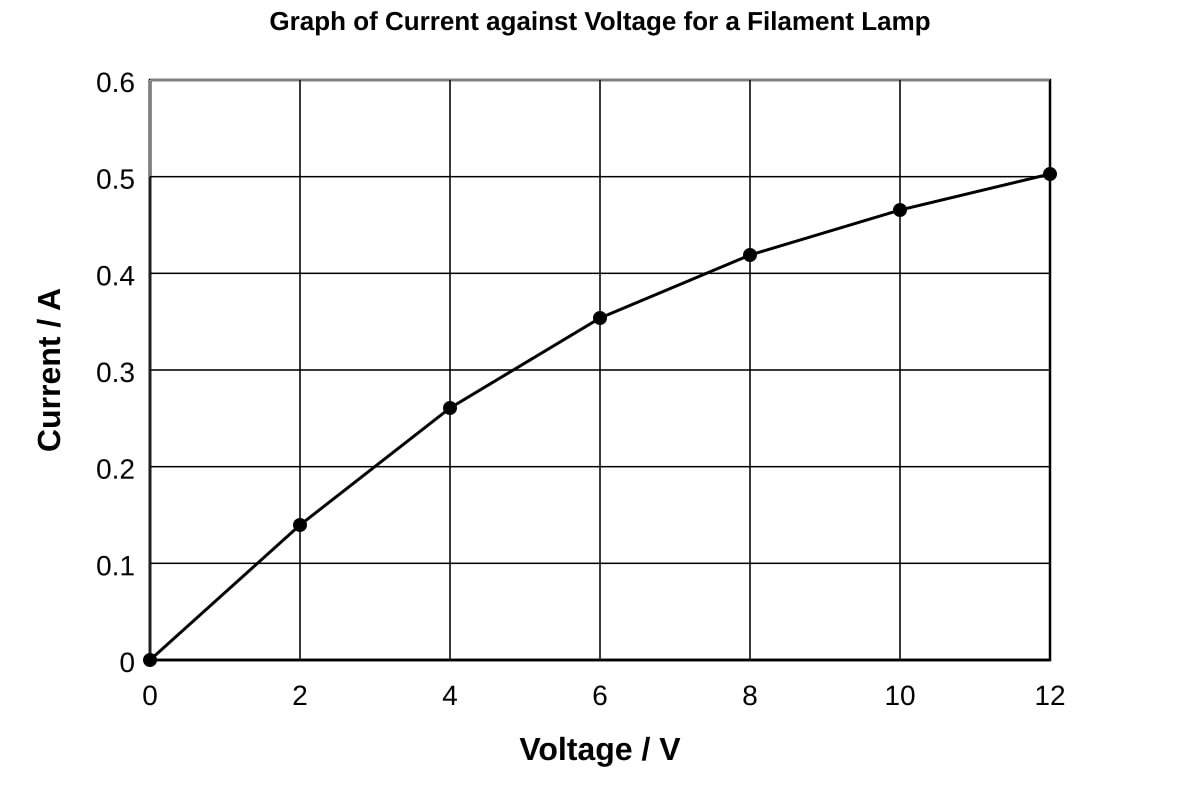
(a) Graph plotting: [2]
- Axes labelled with units, suitable scales (x: 0–12 V, y: 0–0.6 A) [1]
- All 7 points plotted correctly, smooth curve of best fit (increasing but bending over) [1]
(Deduct ½ mark per incorrectly plotted point, max 1 mark deduction)
(b) The graph is a curve that passes through the origin but bends over (gradient decreases as voltage increases). It is not a straight line because the filament lamp is a non-ohmic conductor. As voltage increases, the filament gets hotter, its resistance increases (due to increased lattice vibrations), so the current does not increase proportionally with voltage. [3]
(1 mark for shape description, 1 mark for non-ohmic identification, 1 mark for resistance increase with temperature explanation)
(c) At V = 8.0 V, from graph/table, I = 0.45 A
Resistance [2]
(1 mark for reading current from graph/table, 1 mark for calculation)
**(d) Sketch: Straight line
<stage3_exam_answers_md>
TuitionGoWhere Practice Paper - Science Secondary 1
TuitionGoWhere Secondary School (AI)
Subject: Science
Level: Secondary 1 (G3)
Paper: SA2 Version 3
Duration: 1 hour 30 minutes
Total Marks: 60
Answer Key
Section A: Multiple Choice Questions [15 marks]
| Question | Answer | Explanation |
|---|---|---|
| 1 | C | The student uses chemical energy from muscles to lift the book. This chemical energy is converted to kinetic energy (movement) and then to gravitational potential energy (height gain). |
| 2 | B | Net force = 25 N - 8 N = 17 N. Net work done = Net force × distance = 17 N × 4 m = 68 J. |
| 3 | C | Loss in GPE = Gain in KE. GPE = mgh = 0.5 × 10 × 10 = 50 J. So KE = 50 J. |
| 4 | D | Work requires displacement in the direction of force (B). Holding an object stationary involves no displacement, so no work is done (C). |
| 5 | C | Mechanical Advantage = Load / Effort. Load = MA × Effort = 4 × 50 N = 200 N. |
| 6 | A | Using Snell's Law: n₁sinθ₁ = n₂sinθ₂. 1.0 × sin30° = 1.5 × sin r. sin r = 0.5/1.5 = 1/3. r = sin⁻¹(1/3) ≈ 19.5°. |
| 7 | C | Blue light has the shortest wavelength in the visible spectrum and is deviated (refracted) the most by a prism. |
| 8 | C | Distance between object and image in a plane mirror = 2 × object distance = 2 × 15 cm = 30 cm. |
| 9 | D | Using lens formula: 1/f = 1/u + 1/v. 1/10 = 1/30 + 1/v. 1/v = 1/10 - 1/30 = 2/30 = 1/15. v = 15 cm (positive → real). Magnification = v/u = 15/30 = 0.5 (diminished, inverted). |
| 10 | A | Correct order of EM spectrum from longest to shortest wavelength: Radio → Microwaves → Infrared → Visible → UV → X-rays → Gamma. |
| 11 | B | Total resistance = 4 + 6 = 10 Ω. Current = V/R = 12/10 = 1.2 A. |
| 12 | C | In parallel, each bulb gets the full battery voltage. Removing one bulb doesn't affect voltage across the others, so brightness remains the same. |
| 13 | B | P = VI. I = P/V = 1200/240 = 5.0 A. |
| 14 | B | Reversing battery connections reverses current direction, which reverses the magnetic poles. End X becomes South pole. |
| 15 | D | Increasing wire length while keeping turns the same increases resistance, reducing current, which weakens the electromagnet. |
Section B: Structured Questions [30 marks]
16. Inclined Plane
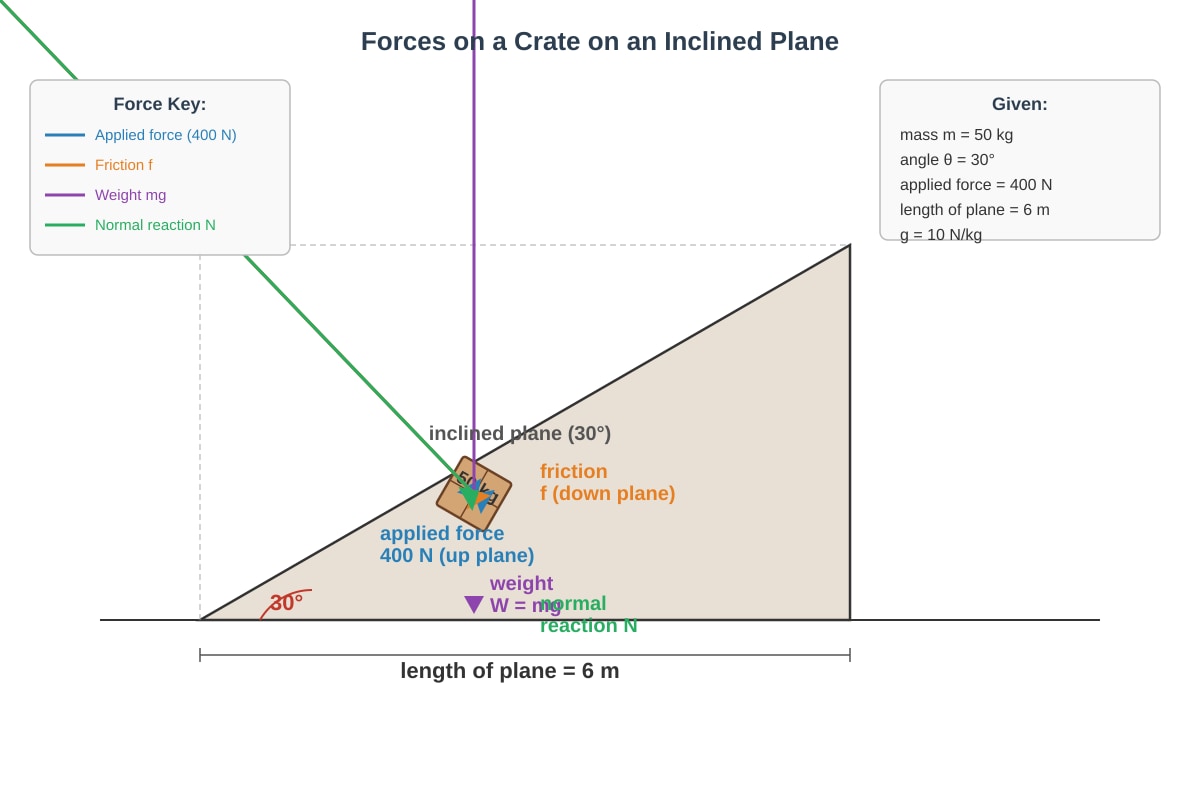
(a) Weight = mg = 50 × 10 = 500 N [1]
(b) Component parallel to plane = mg sinθ = 500 × sin30° = 500 × 0.5 = 250 N [1]
(c) Since constant velocity, net force = 0.
Applied force = Friction + Parallel component of weight
400 = Friction + 250
Friction = 150 N (acting down the plane) [2]
(d) Work done by worker = Force × distance = 400 N × 6 m = 2400 J [1]
(e) Vertical height gained = 6 × sin30° = 6 × 0.5 = 3 m
Gain in GPE = mgh = 50 × 10 × 3 = 1500 J [2]
(f) Work done by worker (2400 J) > Gain in GPE (1500 J) because some work is done against friction (work done against friction = 150 N × 6 m = 900 J), which is converted to heat/sound energy. [1]
17. Refraction and Total Internal Reflection
(a) Using Snell's Law: n₁sinθ₁ = n₂sinθ₂
1.33 × sin40° = 1.00 × sin r
sin r = 1.33 × 0.6428 = 0.8549
r = sin⁻¹(0.8549) = 58.7° (or 58.8°) [2]
(b) The speed of light increases as it passes from water (optically denser) into air (optically less dense). [1]
(c) Critical angle c = sin⁻¹(n₂/n₁) = sin⁻¹(1.00/1.33) = sin⁻¹(0.7519) = 48.8°
Since angle of incidence (50°) > critical angle (48.8°), total internal reflection will occur. [2]
(d) Optical fibres in telecommunications / endoscopes in medicine / prismatic periscopes / diamond cutting (any one). [1]
18. Convex Lens
(a) Ray diagram construction: [3]
- Ray 1: From top of object, parallel to principal axis, refracts through focal point F on right side.
- Ray 2: From top of object, through optical centre, continues straight.
- Ray 3: From top of object, through focal point F on left side, refracts parallel to principal axis.
- Intersection of rays on right side gives real, inverted, magnified image at v = 24 cm.
(b) Nature of image: Real, inverted, magnified [2]
(c) Lens formula: 1/f = 1/u + 1/v
1/8 = 1/12 + 1/v
1/v = 1/8 - 1/12 = 3/24 - 2/24 = 1/24
v = 24 cm [2]
(d) Magnification = v/u = 24/12 = 2 (or image height = 2 × 3 cm = 6 cm) [1]
19. Series-Parallel Circuit
(a) Parallel combination: 1/R_parallel = 1/4 + 1/4 = 2/4 = 1/2
R_parallel = 2 Ω [1]
(b) Total resistance = R₁ + R_parallel = 2 + 2 = 4 Ω [1]
(c) Ammeter reading (total current) = V/R_total = 6/4 = 1.5 A [1]
(d) Voltage across parallel combination = Total current × R_parallel = 1.5 × 2 = 3 V
(Alternatively: Voltage across R₁ = 1.5 × 2 = 3 V, so voltage across parallel = 6 - 3 = 3 V) [2]
(e) Power in R₁ = I²R₁ = (1.5)² × 2 = 2.25 × 2 = 4.5 W [1]
20. Electromagnet Investigation
(a) Graph: [2]
- Axes labelled correctly with units
- Suitable scales (x: 0-70, y: 0-15)
- All 6 points plotted accurately
- Smooth curve/line of best fit showing initial increase then plateau
(b) As the number of turns increases, the number of paper clips attracted (strength of electromagnet) increases, but the rate of increase slows down and eventually levels off / becomes constant after 50 turns. [1]
(c) After 50 turns, the iron core reaches magnetic saturation - all magnetic domains in the iron are aligned. Adding more turns does not increase the magnetic field strength further. [2]
(d) Any two: Current / voltage of battery, thickness/type of wire, size/material of iron core, distance between electromagnet and paper clips, type/size of paper clips. [1]
(e) Any two: Increase the current (e.g., use higher voltage battery), use a softer iron core, decrease resistance in circuit (thicker wire), increase cross-sectional area of core. [1]
Section C: Free Response / Data-Based Questions [15 marks]
21. Roller Coaster Energy
(a) GPE at A = mgh = 500 × 10 × 40 = 200,000 J (or 200 kJ) [1]
(b) Total mechanical energy at A = GPE + KE = 200,000 J + 0 = 200,000 J [1]
(c) At B (ground level), GPE = 0. By conservation of energy (frictionless), KE at B = Total energy = 200,000 J [1]
(d) KE = ½mv²
200,000 = ½ × 500 × v²
200,000 = 250 v²
v² = 800
v = √800 = 28.3 m/s (or 20√2 m/s) [2]
(e) At C, height = 25 m. GPE at C = 500 × 10 × 25 = 125,000 J
KE at C = Total energy - GPE at C = 200,000 - 125,000 = 75,000 J [1]
(f) Actual KE at C = ½ × 500 × 15² = 250 × 225 = 56,250 J
Expected KE at C (no friction) = 75,000 J
Work done against friction = Energy lost = 75,000 - 56,250 = 18,750 J [3]
(g) Total mechanical energy is conserved (200,000 J) if no external work is done. The maximum GPE the car can have is 200,000 J (when KE = 0). Maximum height = 200,000/(500×10) = 40 m. It cannot exceed the initial height of 40 m without additional energy input. [2]
22. Periscope
(a) Ray diagram completion: [2]
- Ray from top of object → hits top mirror at 45° → reflects vertically down
- Ray hits bottom mirror at 45° → reflects horizontally to eye
- Second ray from bottom of object following same path
- Arrows showing direction from object to eye
(b) Angle of incidence at each mirror = 45° [1]
(c) Two characteristics: Virtual, upright, same size as object, laterally inverted, same distance behind mirror as object in front (any two) [2]
(d) Plane mirrors produce images of the same size as the object (magnification = 1) and do not distort the field of view. Convex mirrors produce diminished images, which would make objects appear smaller and farther away, reducing the effectiveness of the periscope for observation. [2]
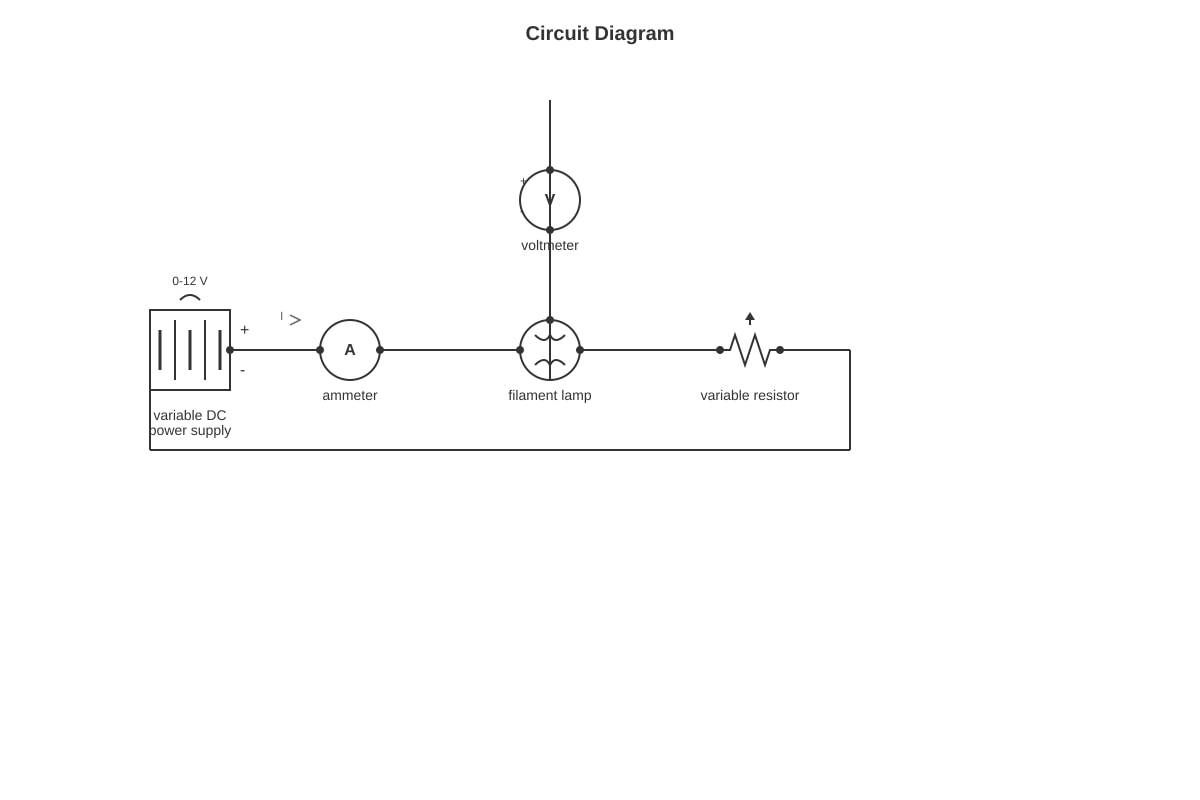
23. Filament Lamp I-V Characteristic
(a) Graph: [2]
- Axes: Voltage (V) on x-axis (0-12 V), Current (A) on y-axis (0-0.6 A)
- Points plotted accurately from table
- Smooth curve showing increasing gradient (curving upward) - not a straight line
(b) The graph is a curve (not a straight line through origin), so the filament lamp does not obey Ohm's Law / is a non-ohmic conductor. [1]
(c) As voltage increases, the filament gets hotter. The resistance of the filament increases with temperature (due to increased lattice vibrations impeding electron flow). This causes the current to increase less rapidly than voltage, so the graph curves. [2]
(d) At 10.0 V, Current = 0.50 A
Resistance = V/I = 10.0 / 0.50 = 20 Ω [1]
(e) The variable resistor (rheostat) is used to vary the current/voltage in the circuit / control the potential difference across the filament lamp so that a range of readings can be obtained. [1]
End of Answer Key
Total Marks: 60