From Real Exams Exam Paper
Secondary 1 Science Semestral Assessment 2 (End of Year) Paper 3
Free Kimi AI-generated Sec 1 Science SA2 Paper 3 with questions, answers, and syllabus-aligned practice for Singapore students preparing for exams.
These static practice materials are generated from the site's syllabus and paper-generation workflow, with source and model context shown so students and parents can evaluate the material before use.
Questions
TuitionGoWhere Practice Paper - Science Secondary 1
SA2 Physical Sciences – Version 3
TuitionGoWhere Exam Practice (AI)
| Subject: | Science |
| Level: | Secondary 1 |
| Paper: | SA2 Physical Sciences |
| Duration: | 60 minutes |
| Total Marks: | 60 |
Name: _________________________ Class: __________ Date: __________
INSTRUCTIONS TO CANDIDATES
- Write your name, class, and date in the spaces provided.
- Answer all questions.
- Write your answers in the spaces provided. Show all working clearly.
- You may use an approved calculator.
- The number of marks available is shown in brackets [ ] at the end of each question or part question.
SECTION A: Multiple Choice and Short Response (Questions 1–10)
Answer all questions. Total: 20 marks.
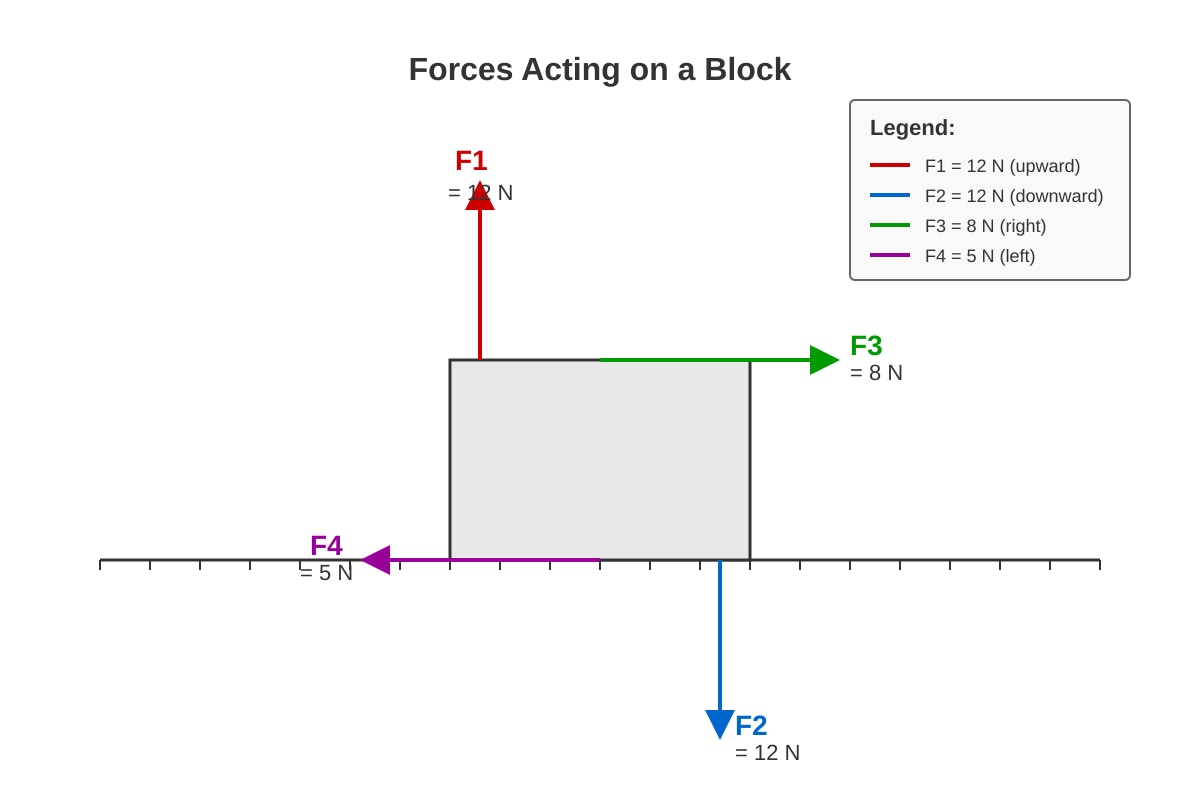
1 The diagram shows four forces acting on a block.
<image_placeholder> id: Q1-fig1 type: diagram linked_question: Q1 description: A rectangular block on a horizontal surface with four labeled force arrows labels: F1 (upward, left side), F2 (downward, right side), F3 (horizontal right, top center), F4 (horizontal left, bottom center) values: F1 = 12 N, F2 = 12 N, F3 = 8 N, F4 = 5 N must_show: All four force arrows with correct directions, relative positions, and labeled magnitudes; block shape clearly visible </image_placeholder>
Which statement about the forces is correct?
A The block accelerates to the left. B The block accelerates to the right. C The block is in equilibrium vertically but not horizontally. D The block is in equilibrium both vertically and horizontally.
Answer: __________ [1]
2 A student stretches a spring by hanging different masses from it. The results are recorded in the table.
| Mass (g) | Extension (cm) |
|---|---|
| 0 | 0 |
| 100 | 2.0 |
| 200 | 4.0 |
| 300 | 6.0 |
| 400 | 8.5 |
Explain whether the student's spring obeys Hooke's Law over the entire range tested.
[2]
3 (a) State the energy conversion that occurs when a student climbs a staircase at constant speed.
___________________________________________________________________________ [1]
(b) Explain why the student's gravitational potential energy increases even though her kinetic energy remains constant.
[2]
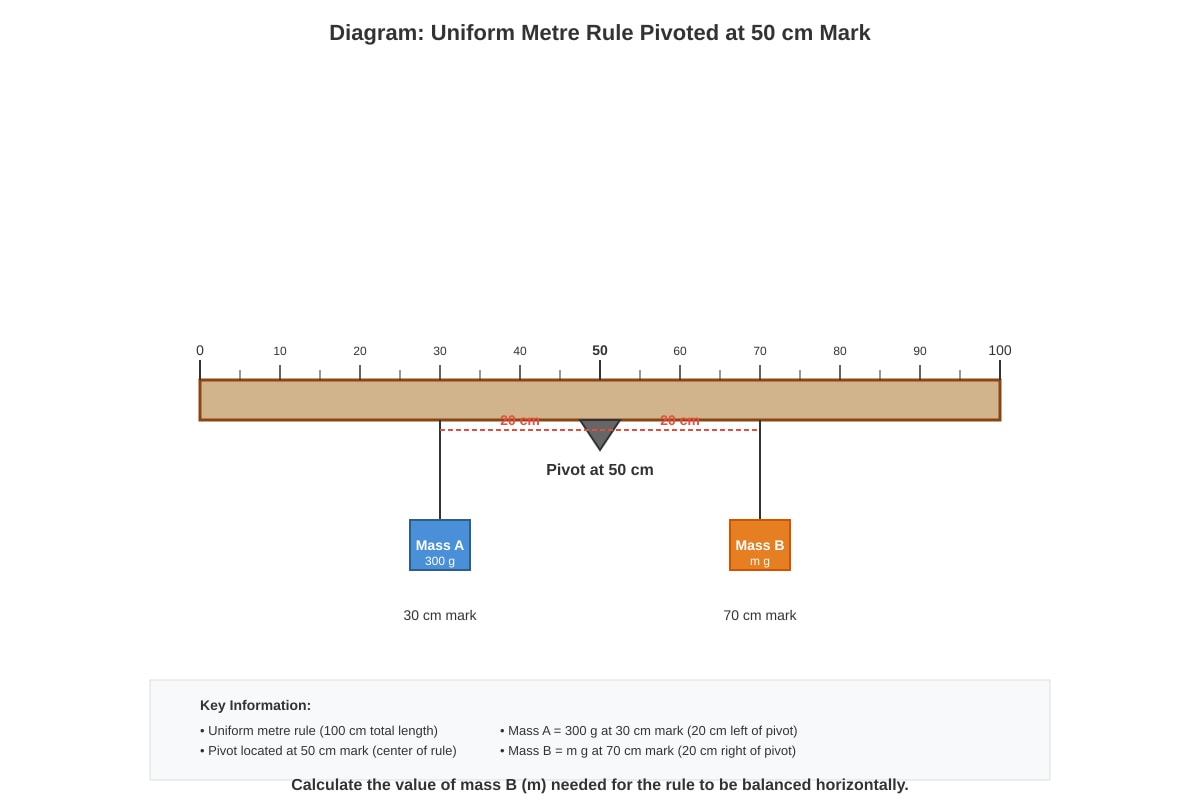
4 The diagram shows a simple moment problem.
<image_placeholder> id: Q4-fig1 type: diagram linked_question: Q4 description: A uniform metre rule pivoted at the 50 cm mark with two masses hanging labels: Pivot at 50 cm; Mass A = 300 g at 30 cm mark; Mass B = m g at 70 cm mark; distances shown from pivot values: Mass A = 300 g at 20 cm from pivot left; Mass B unknown at 20 cm from pivot right must_show: Uniform metre rule with clear cm markings, pivot point, two hanging masses with strings, distances labeled from pivot </image_placeholder>
Calculate the value of mass B needed for the rule to be balanced horizontally.
[3]
5 A car of mass 1200 kg accelerates from rest to 20 m/s in 10 seconds.
(a) Calculate the acceleration of the car.
[2]
(b) Calculate the resultant force acting on the car.
[2]
6 Explain one advantage and one disadvantage of using friction between bicycle brake pads and the wheel rim to slow down a bicycle.
Advantage: ________________________________________________________________
Disadvantage: _____________________________________________________________
[2]
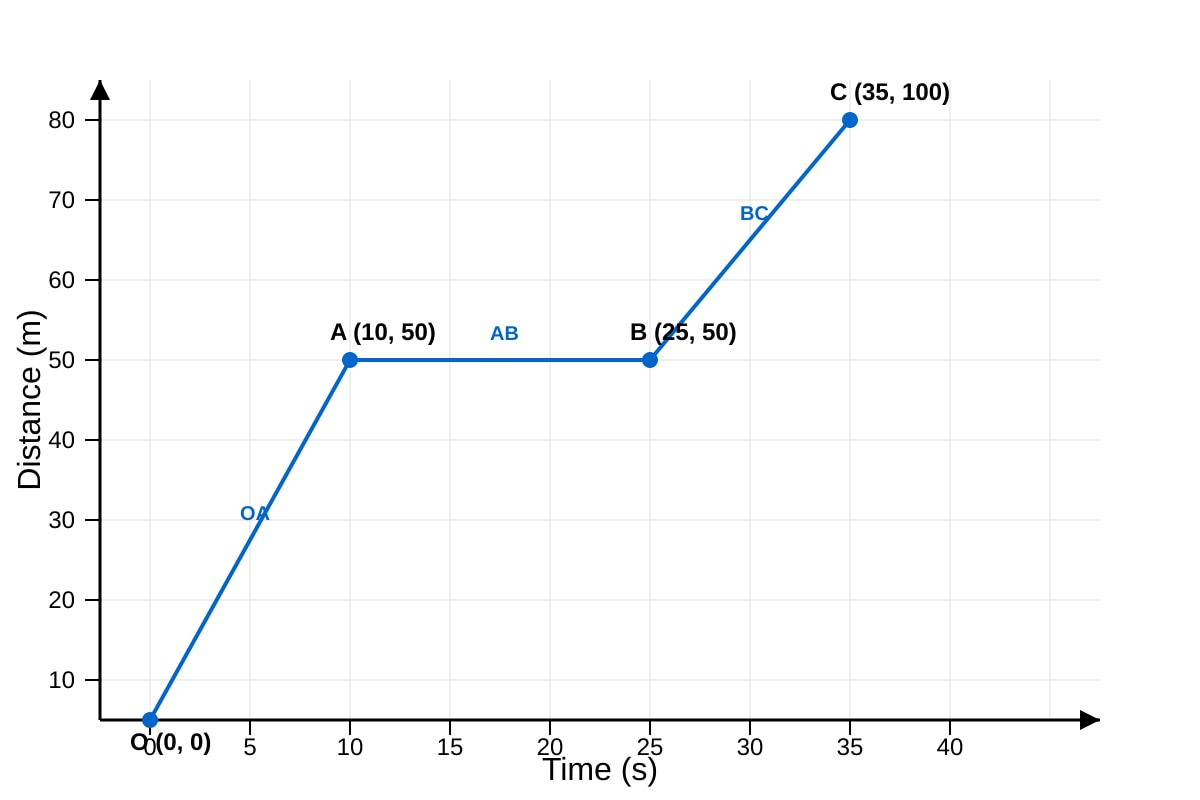
7 The diagram shows a distance-time graph for a cyclist's journey.
<image_placeholder> id: Q7-fig1 type: graph linked_question: Q7 description: Distance-time graph with three distinct segments labels: x-axis: Time (s), y-axis: Distance (m); Point O (0,0), A (10, 50), B (25, 50), C (35, 100) values: OA straight line from (0,0) to (10,50); AB horizontal from (10,50) to (25,50); BC straight line from (25,50) to (35,100) must_show: Axes with units and scales, three labeled segments, key points with coordinates, straight lines only </image_placeholder>
(a) Calculate the speed of the cyclist during the first 10 seconds.
[2]
(b) Describe the motion of the cyclist between points A and B.
[1]
(c) Calculate the average speed for the entire 35-second journey.
[2]
8 An electric heater is rated at 2000 W and operates at 240 V.
(a) Calculate the current drawn by the heater.
[2]
(b) Calculate the energy transferred by the heater in 30 minutes. Give your answer in kilojoules.
[3]
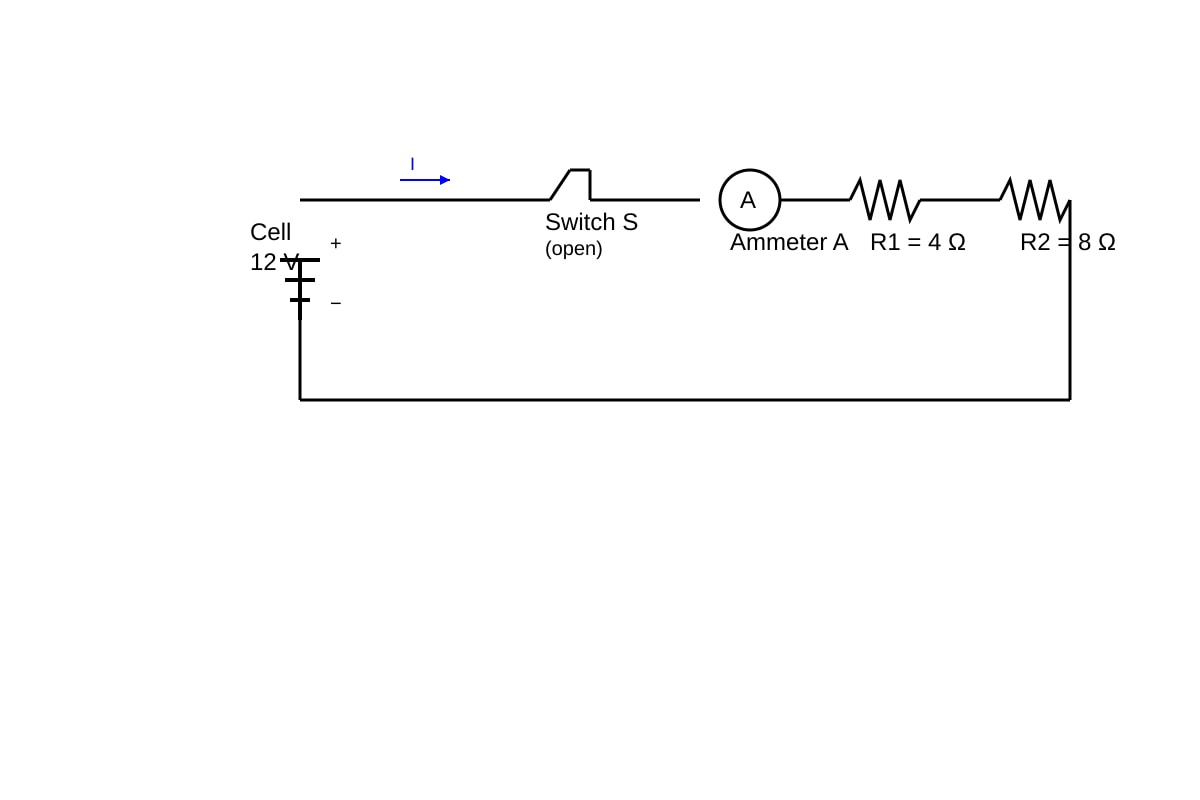
9 The diagram shows a simple circuit.
<image_placeholder> id: Q9-fig1 type: circuit_diagram linked_question: Q9 description: Simple series circuit with battery, ammeter, two resistors, and switch labels: Cell 12 V, Switch S (open), Ammeter A, Resistor R1 = 4 Ω, Resistor R2 = 8 Ω, all in series values: Cell EMF = 12 V; R1 = 4 Ω; R2 = 8 Ω; switch shown open must_show: Complete circuit with all components in single loop, standard circuit symbols, values clearly labeled, switch position clearly shown open </image_placeholder>
Calculate the reading on the ammeter when switch S is closed.
[3]
10 Explain why the element in an electric kettle is placed at the bottom of the kettle, near the base.
[2]
SECTION B: Structured Response (Questions 11–15)
Answer all questions. Total: 25 marks.
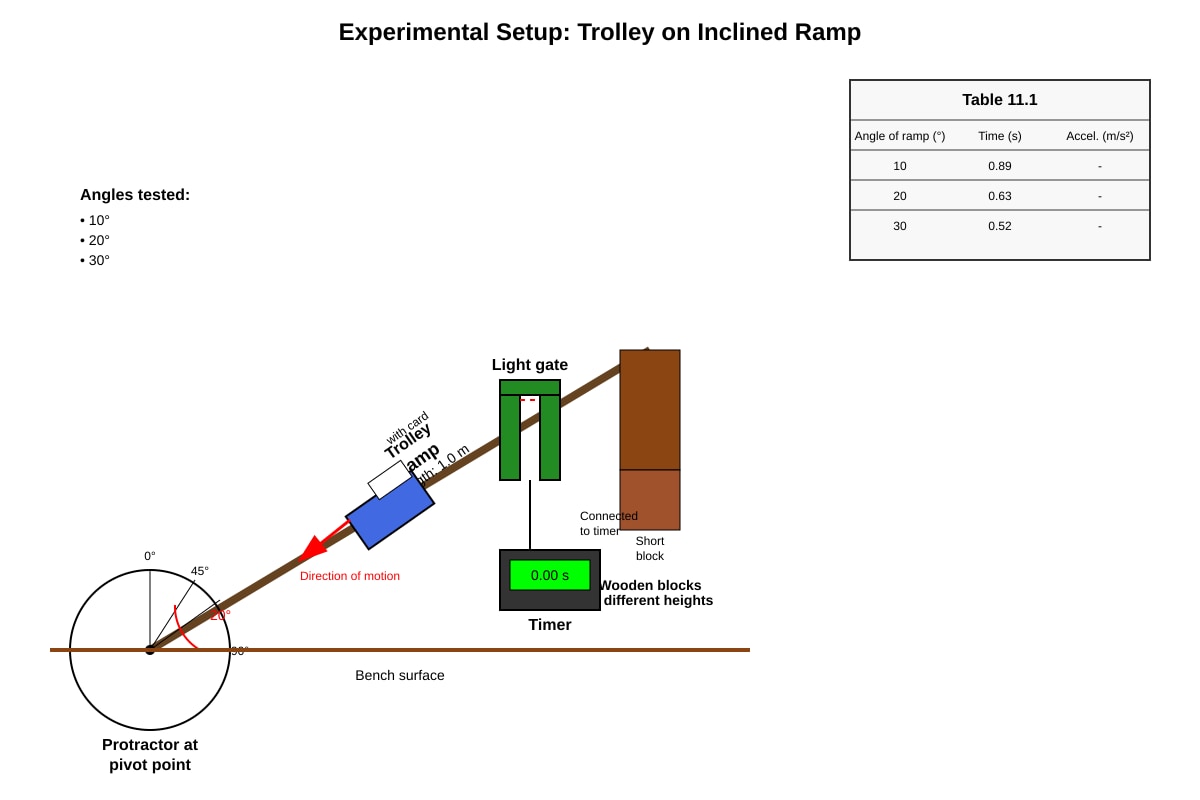
11 A student investigates how the angle of a ramp affects the acceleration of a trolley down the ramp.
<image_placeholder> id: Q11-fig1 type: experimental_setup linked_question: Q11 description: Trolley on inclined ramp with protractor for angle measurement and light gate for timing labels: Ramp, Trolley, Protractor at pivot point, Light gate, Timer, Wooden blocks of different heights values: Ramp length 1.0 m; angles tested: 10°, 20°, 30°; light gate connected to electronic timer must_show: Complete labeled apparatus, trolley with card to interrupt light gate, protractor positioned to measure ramp angle, at least two different support heights visible </image_placeholder>
Table 11.1 shows some of the student's results.
| Angle of ramp (°) | Time to pass light gate (s) | Acceleration (m/s²) |
|---|---|---|
| 10 | 0.89 | |
| 20 | 0.63 | |
| 30 | 0.52 |
The distance from the starting point to the light gate is 0.80 m. The trolley starts from rest.
(a) The student uses the equation to find the acceleration, where is distance and is time. Explain why this equation is appropriate for this experiment.
[2]
(b) Calculate the acceleration for the 20° ramp. Show your working.
[3]
(c) Suggest two ways to improve the accuracy of the time measurement in this experiment.
[2]
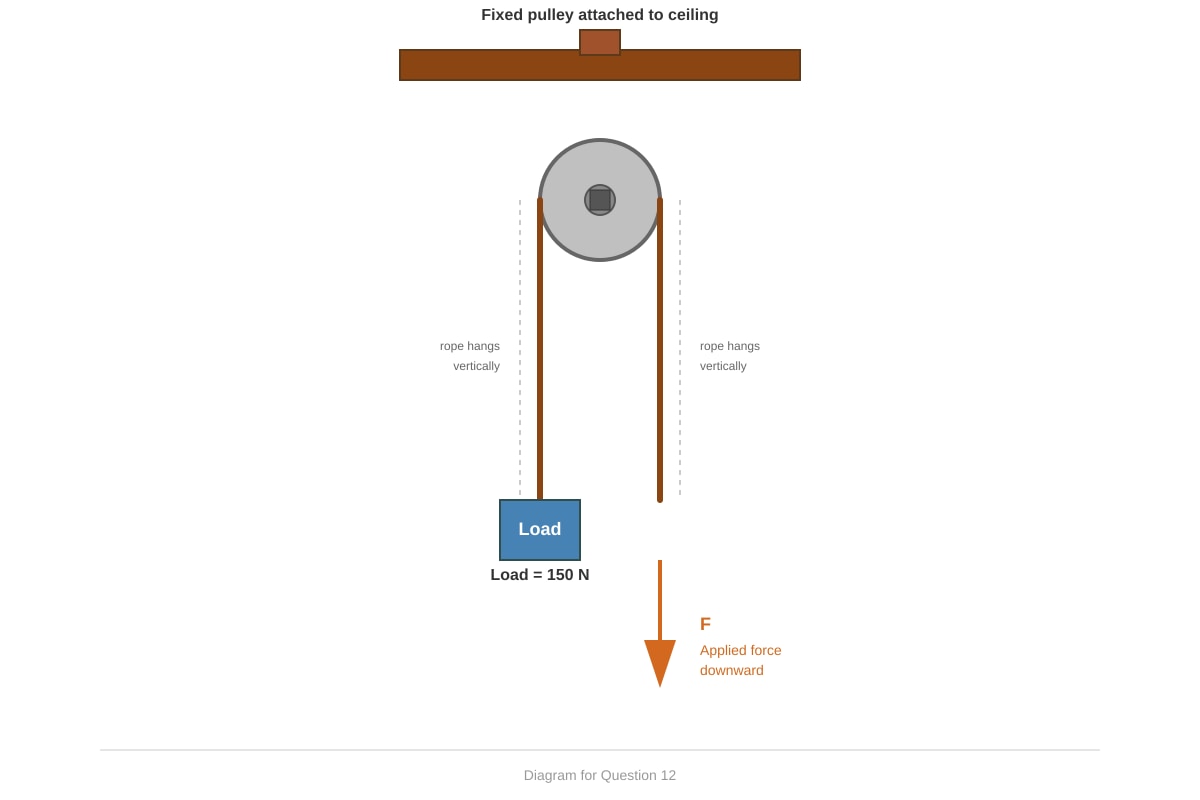
12 The diagram shows a pulley system used to lift a load.
<image_placeholder> id: Q12-fig1 type: diagram linked_question: Q12 description: Single fixed pulley with rope passing over it, load on one end, force applied on other labels: Fixed pulley attached to ceiling; Load = 150 N; Applied force F downward on free end; rope hangs vertically both sides values: Load weight = 150 N; both rope sections vertical must_show: Pulley wheel with axle fixed to support, rope over pulley with load on one side and force arrow F on other, load weight labeled, force direction arrows </image_placeholder>
(a) State the minimum force F needed to lift the load at constant speed using this pulley system.
___________________________________________________________________________ [1]
(b) Explain why this pulley system does not provide any mechanical advantage in terms of force, but is still useful.
[2]
(c) The load is lifted 3.0 m vertically in 5.0 seconds. Calculate the power developed.
[3]
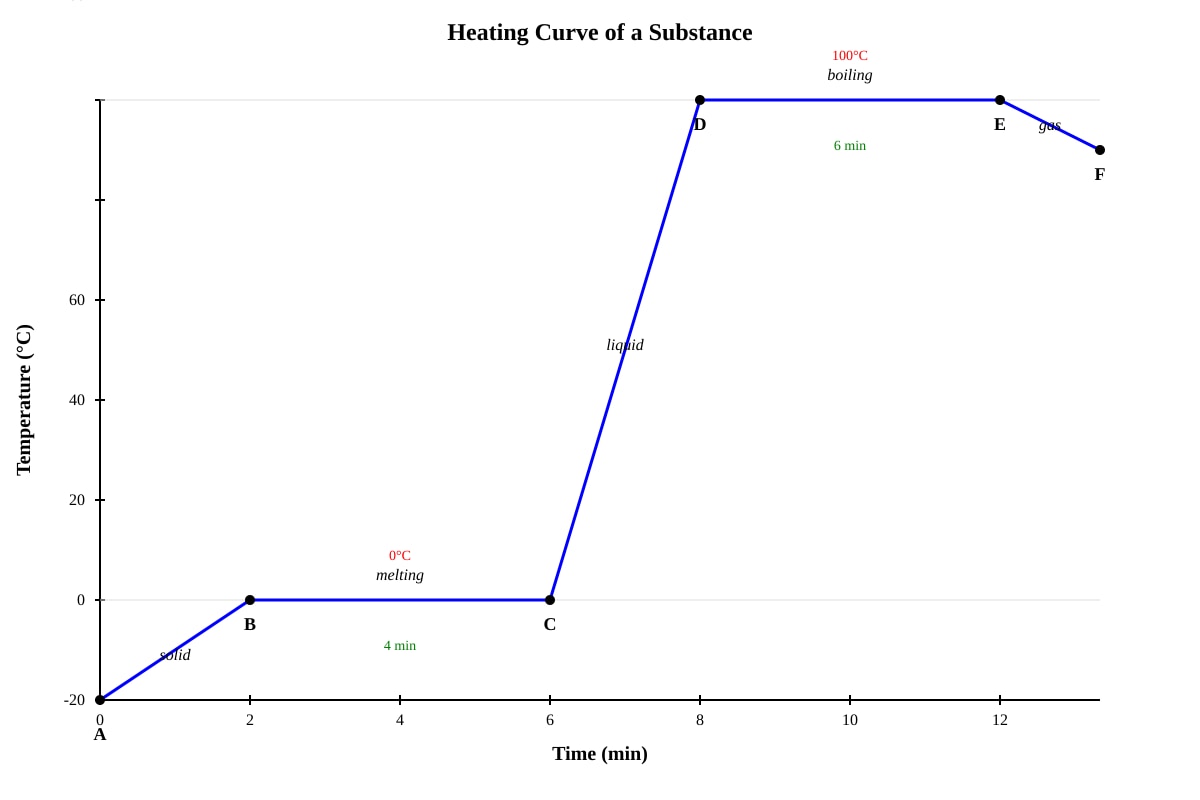
13 The graph shows how the temperature of a substance changes as it is heated steadily from a solid at −20°C.
<image_placeholder> id: Q13-fig1 type: graph linked_question: Q13 description: Heating curve showing temperature against time for a substance melted and boiled labels: x-axis: Time (min), y-axis: Temperature (°C); segments: AB (−20°C to 0°C, rising), BC (0°C flat), CD (0°C to 100°C, rising), DE (100°C flat), EF (above 100°C, rising) values: AB: solid heating; BC: melting at 0°C for 4 min; CD: liquid heating; DE: boiling at 100°C for 6 min; EF: gas heating must_show: Axes with units, five clearly distinct segments with plateau temperatures labeled, time markers on x-axis, state labels (solid, liquid, gas) where appropriate </image_placeholder>
(a) State the melting point of the substance.
___________________________________________________________________________ [1]
(b) Explain what is happening to the substance along section BC. Use the idea of energy transfer in your answer.
[2]
(c) The specific latent heat of fusion of the substance is 334 J/g. Calculate the energy needed to completely melt 200 g of the solid at its melting point.
[3]
(d) Explain why the temperature remains constant during boiling even though heating continues.
[2]
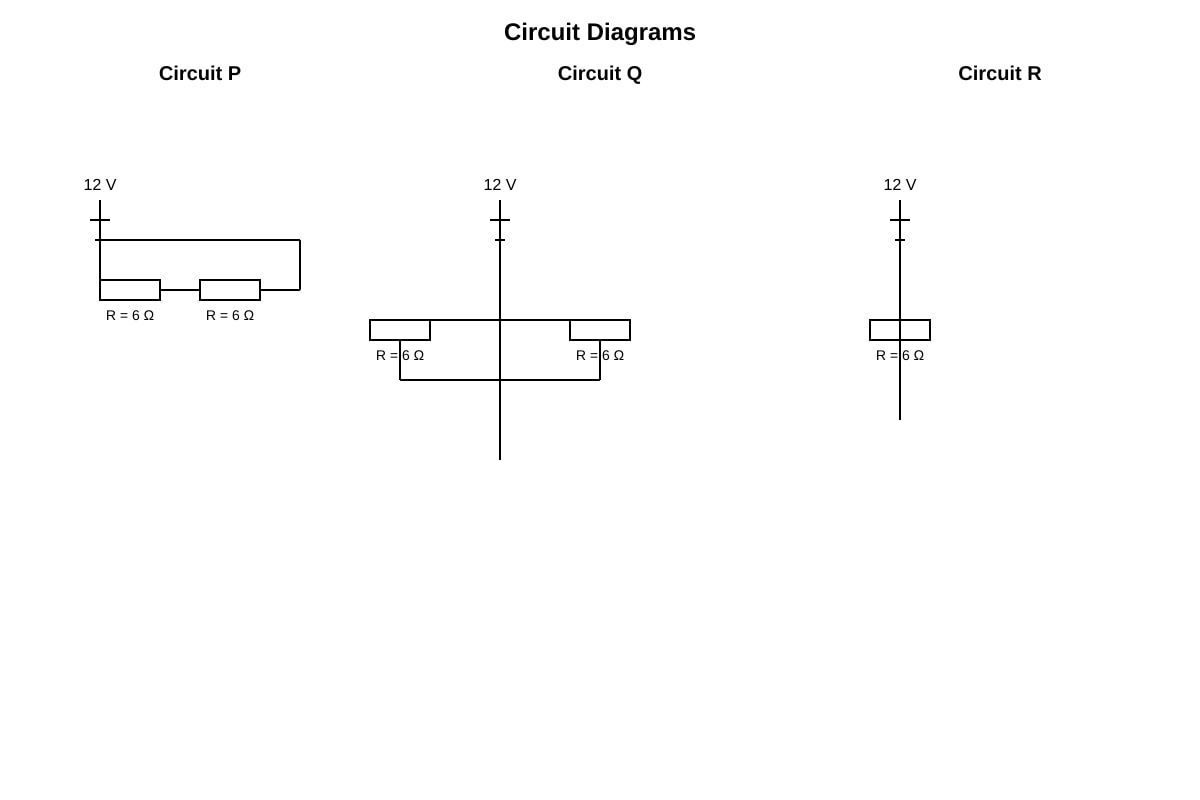
14 A student connects three identical resistors in different circuits as shown.
<image_placeholder> id: Q14-fig1 type: circuit_diagram linked_question: Q14 description: Three separate circuit diagrams labeled P, Q, and R, each with same 12 V cell labels: Circuit P: two resistors in series with cell; Circuit Q: two resistors in parallel with cell; Circuit R: single resistor with cell; all resistors labeled R = 6 Ω values: Cell = 12 V; each resistor R = 6 Ω must_show: Three separate simple circuits with standard symbols, clear labeling of P/Q/R, all resistor values identical, cell voltage identical, clean layout for comparison </image_placeholder>
(a) Calculate the total resistance in circuit P.
[2]
(b) Calculate the total current drawn from the cell in circuit Q.
[3]
(c) Arrange circuits P, Q, and R in order of increasing total power dissipated by the resistors. Explain your reasoning without calculating the exact power values.
[3]
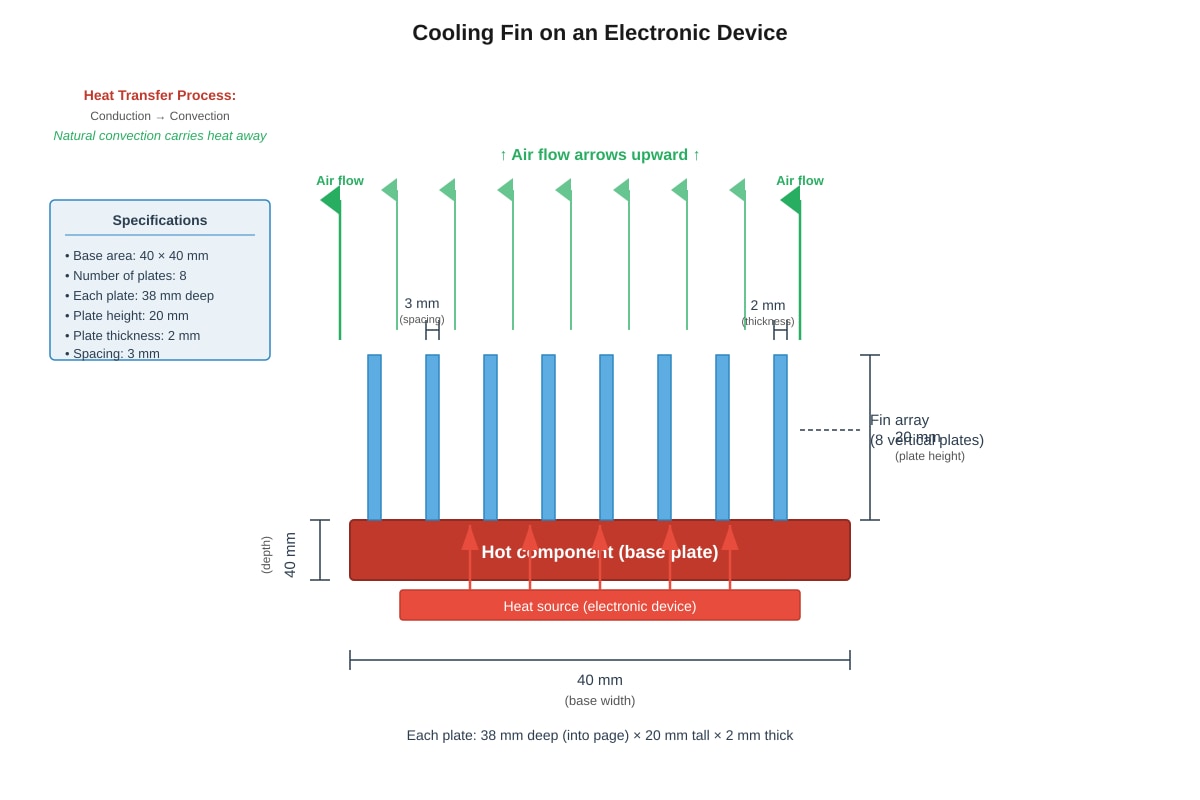
15 The diagram shows a cooling fin on an electronic device, designed to transfer thermal energy away from a hot component.
<image_placeholder> id: Q15-fig1 type: diagram linked_question: Q15 description: Metal cooling fin with multiple thin vertical plates attached to a flat base, with air flow arrows labels: Hot component (base plate), Fin array with 8 vertical plates, Air flow arrows upward, Dimensions: base 40 mm × 40 mm, each plate 20 mm tall, 2 mm thick, 3 mm spacing values: Base area 40 × 40 mm; 8 plates; each plate 20 mm × 38 mm × 2 mm; spacing 3 mm must_show: Cross-sectional or 3D view of fin array, clear plate geometry, air flow pattern, dimension labels, hot source at base </image_placeholder>
(a) Explain how the design of the cooling fin increases the rate of thermal energy transfer to the surroundings. Refer to three design features in your answer.
[4]
(b) The base of the fin reaches a steady temperature of 85°C when the surrounding air is 25°C. The total surface area exposed to air is 0.012 m². The rate of thermal energy transfer is 18 W.
Calculate the temperature difference across the fin surface and explain what would happen to the rate of energy transfer if the surrounding air temperature increased to 35°C while the base temperature stayed at 85°C.
[3]
SECTION C: Data Analysis and Extended Response (Questions 16–20)
Answer all questions. Total: 15 marks.
16 A student investigates the relationship between the pressure of a fixed mass of gas and its volume at constant temperature. The table shows the results.
| Pressure P (kPa) | Volume V (cm³) | 1/V (cm⁻³) | P × V (kPa·cm³) |
|---|---|---|---|
| 100 | 60.0 | 0.0167 | |
| 120 | 50.0 | 0.0200 | |
| 150 | 40.0 | 0.0250 | |
| 200 | 30.0 | 0.0333 | |
| 300 | 20.0 | 0.0500 |
(a) Complete the P × V column in the table. Two values have been done for you:
P × V for 100 kPa: __________
P × V for 300 kPa: __________ [2]
(b) Within experimental error, what relationship does the completed table suggest between pressure and volume of a fixed mass of gas at constant temperature?
[2]
(c) Sketch the shape of the graph you would expect if you plotted P against 1/V.
[2]
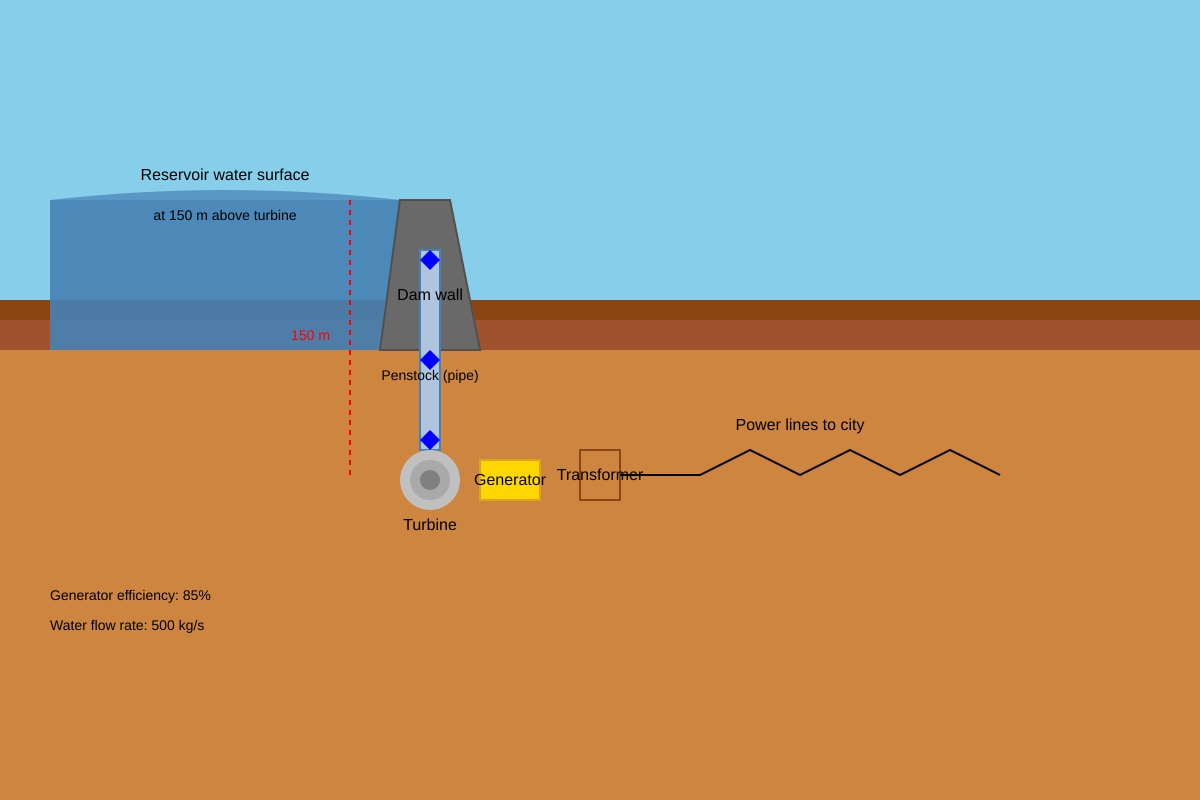
17 The diagram shows a hydroelectric power station.
<image_placeholder> id: Q17-fig1 type: diagram linked_question: Q17 description: Cross-section of hydroelectric dam showing reservoir, dam wall, turbines, generator, and power lines labels: Reservoir water surface at 150 m above turbine; Dam wall; Penstock (pipe); Turbine; Generator; Transformer; Power lines to city values: Water level: 150 m above turbine; generator efficiency 85%; water flow rate 500 kg/s must_show: Elevated reservoir, vertical drop to turbine house, turbine and generator in powerhouse, transformer, transmission lines, height clearly labeled, flow direction arrows </image_placeholder>
(a) Explain why hydroelectric power is considered a renewable energy source.
[1]
(b) Calculate the gravitational potential energy lost by water each second as it falls from the reservoir to the turbine.
()
[2]
(c) Calculate the electrical power output from the generator, given that the system is 85% efficient.
[3]
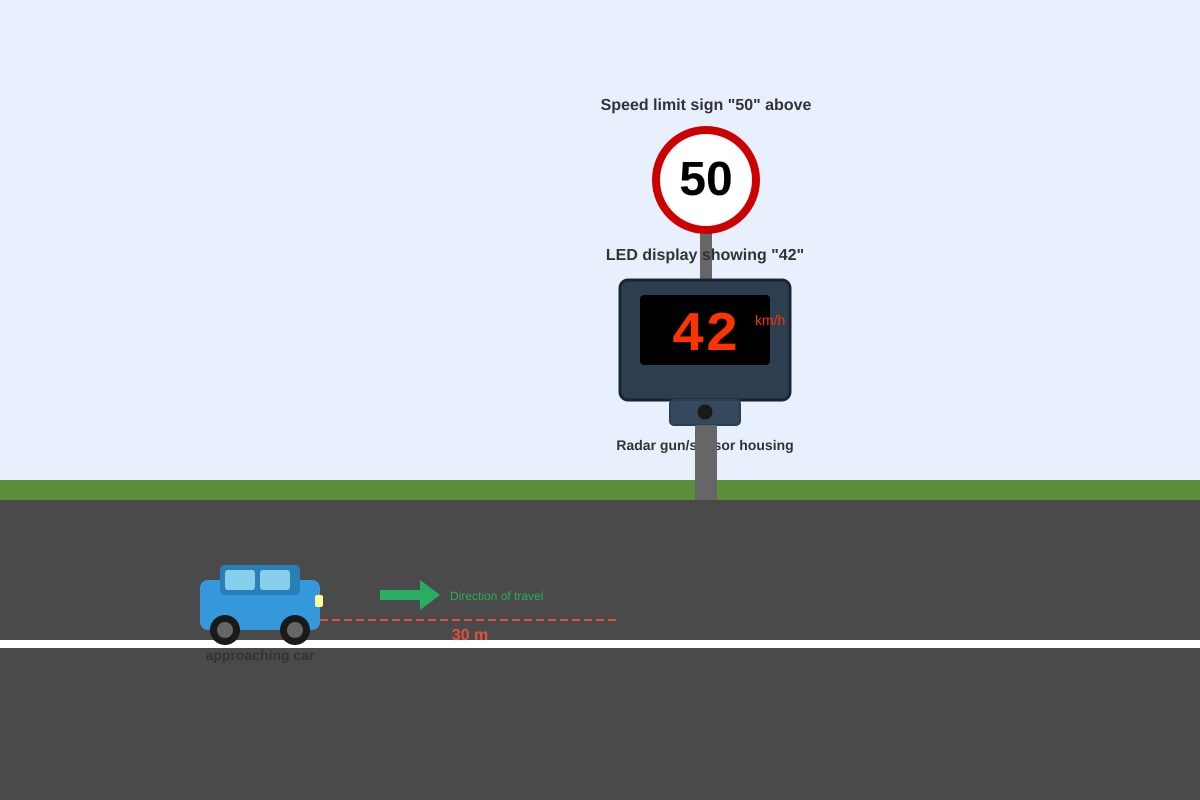
18 The photograph shows a traffic speed limit sign that uses radar to detect approaching vehicles.
<image_placeholder> id: Q18-fig1 type: source_image linked_question: Q18 description: Roadside electronic speed display sign showing current vehicle speed labels: Radar gun/sensor housing, LED display showing "42", Speed limit sign "50" above, approaching car values: Display shows 42 km/h; speed limit 50 km/h; car 30 m from sign approaching must_show: Electronic speed display with visible number, speed limit context, vehicle approaching, roadside mounting </image_placeholder>
(a) The radar emits microwaves with frequency 24 GHz. The reflected waves from an approaching car are detected with a slightly higher frequency. Name this wave phenomenon and explain why the detected frequency is higher.
[2]
(b) If a car travels at 42 km/h, calculate how far it will travel in 2.5 seconds. Give your answer in metres.
[2]
19 A student designs an experiment to compare the thermal insulating properties of different materials. She wraps identical hot water-filled beakers with equal thicknesses of different materials and records the temperature every 5 minutes.
(a) Identify the independent, dependent, and one controlled variable in this experiment.
Independent variable: ________________________________________________________
Dependent variable: ________________________________________________________
Controlled variable: ________________________________________________________
[3]
(b) Explain why recording temperature over time is more useful than measuring a single final temperature.
[2]
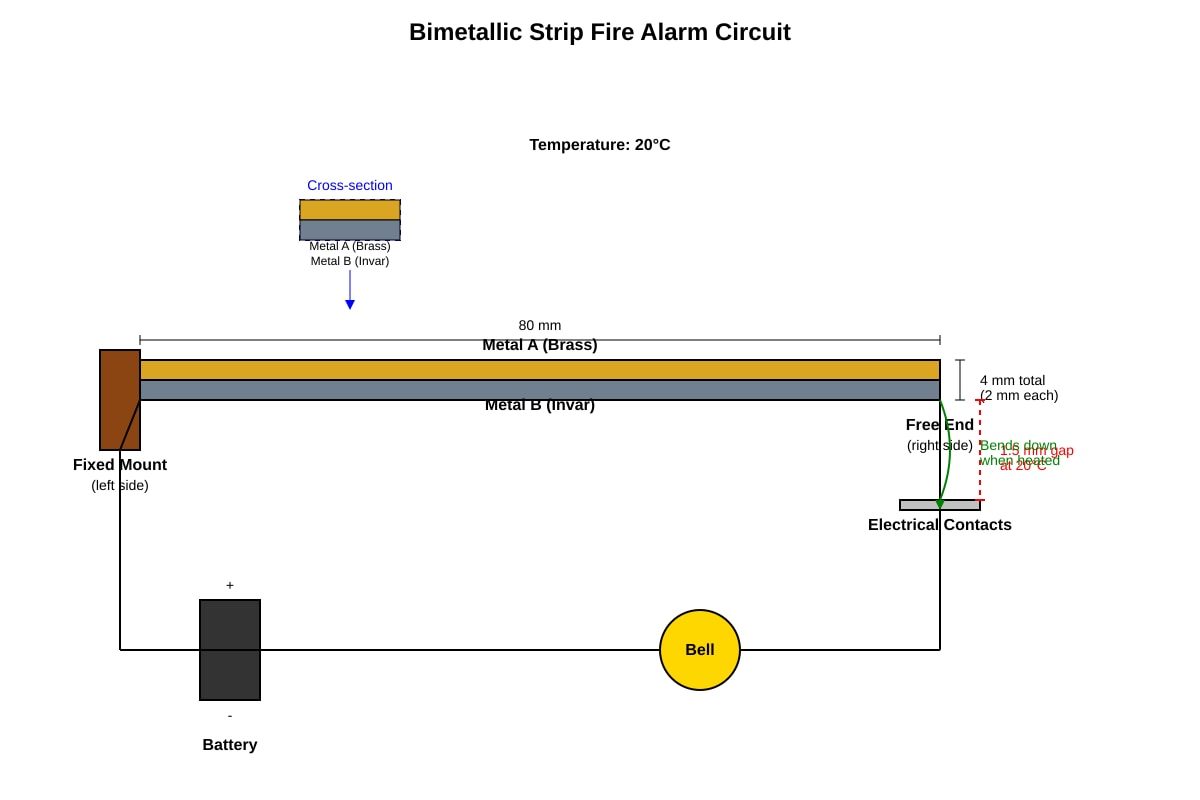
20 The diagram shows a bimetallic strip used as a fire alarm sensor.
<image_placeholder> id: Q20-fig1 type: diagram linked_question: Q20 description: Bimetallic strip with two metal layers, mounted at one end, free end near electrical contacts labels: Metal A (top layer, brass), Metal B (bottom layer, invar), Fixed mount left side, Free end right side, Electrical contacts below free end, Circuit with battery and bell values: Strip length 80 mm, thickness 2 mm each layer; gap to contacts 1.5 mm at 20°C must_show: Cross-section of strip showing two distinct metal layers, fixed support, curved or straight strip with gap to contacts labeled, complete alarm circuit with bell and battery </image_placeholder>
(a) Explain why the free end of the bimetallic strip bends downward when the temperature rises.
[2]
(b) Explain how this bimetallic strip can be used to complete an electrical circuit and sound an alarm when a fire occurs.
[2]
(c) Suggest one modification to this design that would make the alarm trigger at a lower temperature.
[1]
END OF PAPER
| Section | Marks |
|---|---|
| A (Questions 1–10) | 20 |
| B (Questions 11–15) | 25 |
| C (Questions 16–20) | 15 |
| TOTAL | 60 |
Answers
TuitionGoWhere Practice Paper - Science Secondary 1
SA2 Physical Sciences – Version 3: Answer Key and Marking Scheme
SECTION A: Multiple Choice and Short Response
1 Answer: C [1]
Explanation:
- Vertically: F1 (12 N up) = F2 (12 N down), so vertical forces balance → equilibrium.
- Horizontally: F3 (8 N right) ≠ F4 (5 N left), so net force = 3 N to the right → not in equilibrium horizontally.
- The block accelerates to the right, but C is the only statement about equilibrium conditions. D is incorrect because horizontal forces don't balance; A is wrong because acceleration is to the right; B describes the motion but the question asks about equilibrium statement.
2 Answer: [2]
Marking points:
- States Hooke's Law: extension is directly proportional to load/force (within elastic limit) [1]
- Identifies that data up to 300 g shows direct proportionality (constant ratio or straight line through origin) [0.5]
- Identifies that 400 g gives extension 8.5 cm, which does NOT fit pattern (would expect 8.0 cm) [0.5]
Full answer: Hooke's Law states that the extension of a spring is directly proportional to the applied force (or mass), provided the elastic limit is not exceeded. For the first four readings, the extension doubles as the mass doubles (constant ratio of 0.02 cm/g). However, at 400 g, the extension is 8.5 cm instead of the expected 8.0 cm, so the spring does not obey Hooke's Law over the entire range. The elastic limit was exceeded between 300 g and 400 g.
3 (a) Answer: Chemical energy → gravitational potential energy [1]
(b) Answer: [2]
Marking points:
- Work is done against gravity / force is applied upward through a distance [1]
- Energy is transferred/converted even though speed (and hence kinetic energy) stays constant [1]
Full answer: As the student climbs, she exerts an upward force through a vertical distance. Work done against gravity transfers chemical energy from her muscles into gravitational potential energy. Although her kinetic energy stays constant (constant speed), her height increases, so gravitational potential energy () increases.
4 Answer: [3]
Working:
- Clockwise moment = Anticlockwise moment for balance
- Mass A × distance A = Mass B × distance B
- 300 g × 20 cm = Mass B × 20 cm
- Mass B = 300 g × 20 / 20 = 300 g [2 for working, 1 for answer]
Explanation: The principle of moments states that for a balanced object, the sum of clockwise moments equals the sum of anticlockwise moments. Both masses are at equal perpendicular distances from the pivot (20 cm), so they must have equal masses for balance. Common mistake: Using weight in newtons is also valid (2.94 N each) and earns full credit if consistent.
5 (a) Answer: [2]
Working:
- Correct formula [1], correct substitution and answer with unit [1]
(b) Answer: [2]
Working:
- Correct formula [1], correct substitution and answer with unit [1]
6 Answer: [2]
Advantage (1 mark): Provides reliable/safe stopping; allows control of speed; essential for safety Disadvantage (1 mark): Causes wear of brake pads and rim; generates heat which can damage components; reduces efficiency
Example answers:
- Advantage: Friction between brake pads and rim allows the cyclist to slow down and stop safely when needed.
- Disadvantage: Friction causes wear on both the brake pads and the wheel rim, requiring regular maintenance and replacement.
7 (a) Answer: [2]
Working:
- Correct formula [1], correct substitution and answer with unit [1]
(b) Answer: The cyclist is stationary / at rest / not moving [1]
(c) Answer: [2]
Working:
- Correct total distance and total time identified [1]
- Correct calculation and unit [1]
8 (a) Answer: [2]
Working:
- Rearrangement of formula [1], correct substitution and answer with unit [1]
(b) Answer: [3]
Working:
- Convert time to seconds: 30 min = 1800 s [1]
- Correct substitution into [1]
- Correct answer in kilojoules with unit [1]
9 Answer: [3]
Working: Total resistance: [1]
Current: [2 for correct formula, substitution, answer]
Explanation: In a series circuit, total resistance equals the sum of individual resistances. With the switch closed, the complete circuit has 12 Ω resistance and 12 V EMF, giving 1.0 A current by Ohm's Law.
10 Answer: [2]
Marking points:
- Heating element heats water at the bottom [1]
- Hot water rises (by convection), cold water sinks, setting up convection current that heats all water efficiently [1]
Full answer: The heating element is placed at the bottom because when water is heated, it expands, becomes less dense, and rises. Cooler, denser water sinks to take its place and gets heated in turn. This creates a convection current that distributes heat throughout the kettle efficiently. If the element were at the top, only the top layer would be heated.
SECTION B: Structured Response
11 (a) Answer: [2]
Marking points:
- Trolley starts from rest (initial velocity ) [1]
- Constant acceleration assumed (or neglecting friction/air resistance) / equation of motion for uniform acceleration applies [1]
11 (b) Answer: [3]
Working:
- Correct rearrangement [1]
- Correct substitution [1]
- Correct answer with unit (2–4.1 m/s² acceptable) [1]
11 (c) Answer: [2]
Any two from:
- Repeat measurements and calculate mean/average time
- Use a narrower card on the trolley to more precisely define when it passes the gate
- Ensure the trolley starts from the exact same point each time (use a release mechanism)
- Use a more precise electronic timer
- Reduce friction in the wheel bearings / lubricate wheels
[1 mark each, max 2]
12 (a) Answer: 150 N [1]
12 (b) Answer: [2]
Marking points:
- Single fixed pulley only changes direction of force, does not multiply force (no mechanical advantage) [1]
- Useful because it allows the person to apply downward force (using body weight) rather than lifting upward; more convenient/comfortable/allows use of gravity [1]
12 (c) Answer: [3]
Working:
- Correct work calculation [1]
- Correct power formula and substitution [1]
- Correct answer with unit [1]
13 (a) Answer: 0°C [1]
13 (b) Answer: [2]
Marking points:
- The substance is melting / changing from solid to liquid [1]
- Heat energy is being used to break intermolecular bonds (increase potential energy) rather than raise kinetic energy / temperature [1]
13 (c) Answer: [3]
Working:
- Correct formula [1]
- Correct substitution [1]
- Correct answer with unit [1]
13 (d) Answer: [2]
Marking points:
- During boiling, energy supplied is used as latent heat of vaporization [1]
- Energy breaks intermolecular bonds / separates molecules rather than increasing kinetic energy, so temperature stays constant during phase change [1]
14 (a) Answer: [2]
Working:
- Correct formula for series resistors [1], correct answer with unit [1]
14 (b) Answer: [3]
Working: For two equal resistors in parallel: [1]
[2]
14 (c) Answer: [3]
Order: P (12 Ω) < R (6 Ω) < Q (3 Ω) [1 for correct order]
Reasoning:
- Power (same voltage across all circuits) [1]
- Power is inversely proportional to total resistance; lower resistance means higher current, therefore higher power [1]
- P has highest resistance → lowest power; Q has lowest resistance → highest power; R is intermediate
15 (a) Answer: [4]
Marking points (any three well-explained features):
| Design Feature | Explanation |
|---|---|
| Multiple thin plates / large surface area | Increases surface area exposed to air for more efficient heat transfer by convection and radiation [1] |
| Thin plates | Reduces thermal resistance / allows heat to conduct quickly from base through metal to surface [1] |
| Vertical orientation with gaps | Allows natural convection: hot air rises through gaps, drawing cooler air in from below, maintaining continuous airflow [1] |
| Metal material (typically aluminium) | Good thermal conductor, efficiently transfers heat from base to extended surfaces [1] |
| Close spacing near optimum | Balances surface area against air flow restriction to maximize convective cooling [1] |
[Max 4 marks]
15 (b) Answer: [3]
Working and explanation:
- Temperature difference = 85 − 25 = 60°C [1]
- If surrounding temperature rises to 35°C, new temperature difference = 85 − 35 = 50°C [1]
- Rate of thermal energy transfer decreases because the temperature gradient/difference driving heat transfer is smaller; less steep gradient means slower energy flow by conduction/convection [1]
SECTION C: Data Analysis and Extended Response
16 (a) Answer: [2]
| P × V (kPa·cm³) |
|---|
| 6000 |
| — |
| — |
| — |
| 6000 |
P × V for 100 kPa: 6000 [1] P × V for 300 kPa: 6000 [1]
(All values should be approximately 6000; slight rounding variations accepted)
16 (b) Answer: [2]
Marking points:
- As pressure increases, volume decreases / pressure and volume are inversely proportional [1]
- Product P × V is constant (within experimental error), which is Boyle's Law [1]
16 (c) Answer: [2]
Description of graph:
- Straight line passing through the origin [1]
- Positive gradient (upward to the right) [1]
Sketch notes: The graph of P against 1/V should show a straight line with positive slope starting from (0,0), demonstrating direct proportionality between pressure and reciprocal of volume.
17 (a) Answer: [1]
Water is replenished in the reservoir by rainfall/river flow naturally, so the energy source is continuously renewed / the water cycle is sustained by solar energy.
17 (b) Answer: [2]
Working:
Or: 750 000 W or 750 kW of gravitational power
- Correct formula [1], correct substitution and answer with unit [1]
17 (c) Answer: [3]
Working:
Or:
Or approximately 638 kW or 6.4 × 10⁵ W
- Correct efficiency application (output = 0.85 × input) [1]
- Correct substitution [1]
- Correct answer with unit, rounded appropriately [1]
18 (a) Answer: [2]
Phenomenon: Doppler effect [1]
Explanation: As the car approaches the radar source, the reflected waves are compressed, resulting in a higher detected frequency (blue shift). The relative motion between source and observer causes the frequency shift. [1]
18 (b) Answer: [2]
Working:
Or using km/h directly:
- Conversion to consistent units [1], correct calculation and answer [1]
19 (a) Answer: [3]
- Independent variable: Type of insulating material / wrapping material [1]
- Dependent variable: Temperature of water (at given times) / rate of cooling / temperature drop [1]
- Controlled variable: Any one from: initial water temperature; volume/mass of water; thickness of wrapping material; size/shape of beaker; environmental temperature; time intervals [1]
19 (b) Answer: [2]
Marking points:
- Single final temperature only tells you which beaker lost most heat overall [1]
- Time-based data reveals rate of cooling / allows comparison of cooling curves / shows if insulation affects initial rate differently from long-term performance / identifies when most heat is lost [1]
20 (a) Answer: [2]
Marking points:
- Metals expand when heated, but brass expands more than invar (different expansion coefficients) [1]
- Since brass is on top and expands more, the strip bends downward (toward the invar side) / unequal expansion causes bending [1]
20 (b) Answer: [2]
Marking points:
- When heated sufficiently, the free end bends down enough to touch the electrical contacts below [1]
- This completes the circuit containing the bell/alarm, allowing current to flow and sound the alarm [1]
20 (c) Answer: [1]
Any one from:
- Use a metal that expands more easily than brass (for top layer)
- Reduce the gap between free end and contacts
- Increase the length of the strip
- Use thinner metal layers
- Use a metal with higher expansion coefficient for the top layer
TOTAL MARKS: 60