From Real Exams Exam Paper
Secondary 1 Science Semestral Assessment 2 (End of Year) Paper 3
Free Sec 1 Science SA2 Paper 3, Exam version, with questions, answers, and syllabus-aligned practice for Singapore students.
These static practice materials are generated from the site's syllabus and paper-generation workflow, with source and model context shown so students and parents can evaluate the material before use.
Questions
Free quiz and exam paper access
Enter your details to view this paper
Your access is remembered on this device.
Answers
TuitionGoWhere Practice Paper - Science Secondary 1
Answer Key and Marking Scheme
Subject: Science
Level: Secondary 1
Paper: SA2 (Version 3)
Total Marks: 70 marks
Section A: Multiple Choice Questions [10 marks]
1 mark each
1. D) 0 J Work = Force × Displacement. Since the book is held stationary, displacement = 0, therefore work = 0 J
2. A) Kinetic energy → Gravitational potential energy As the ball rises, it slows down (loses KE) and gains height (gains GPE)
3. B) Increases because the area decreases Pressure = Force ÷ Area. Force (weight) remains constant, but smaller area increases pressure
4. C) Flammable Flame symbol indicates fire hazard/flammable material
5. C) Using a separating funnel Oil and water are immiscible liquids with different densities, so they can be separated using a separating funnel
Section B: Structured Questions [45 marks]
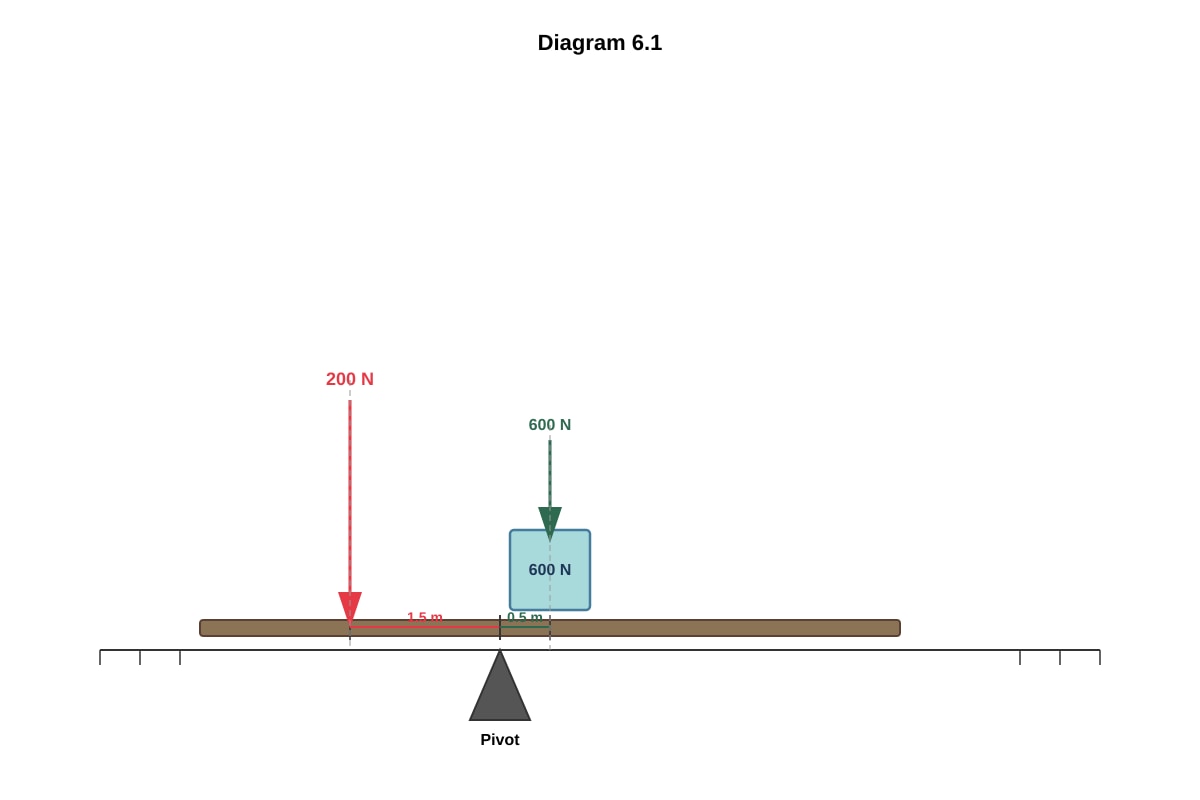
6. (a) Calculate the moment of the 200 N force about the pivot. [2] Answer: 300 N⋅m Working: Moment = Force × Perpendicular distance = 200 N × 1.5 m = 300 N⋅m [1 mark for correct formula, 1 mark for correct answer with units]
(b) State the energy conversion when the box is raised at constant velocity. [1] Answer: Chemical energy → Gravitational potential energy [1 mark for correct energy conversion]
(c) Calculate the work done in raising the box through 0.2 m. [2] Answer: 120 J Working: Work done = Force × Distance = 600 N × 0.2 m = 120 J [1 mark for correct formula, 1 mark for correct answer with units]
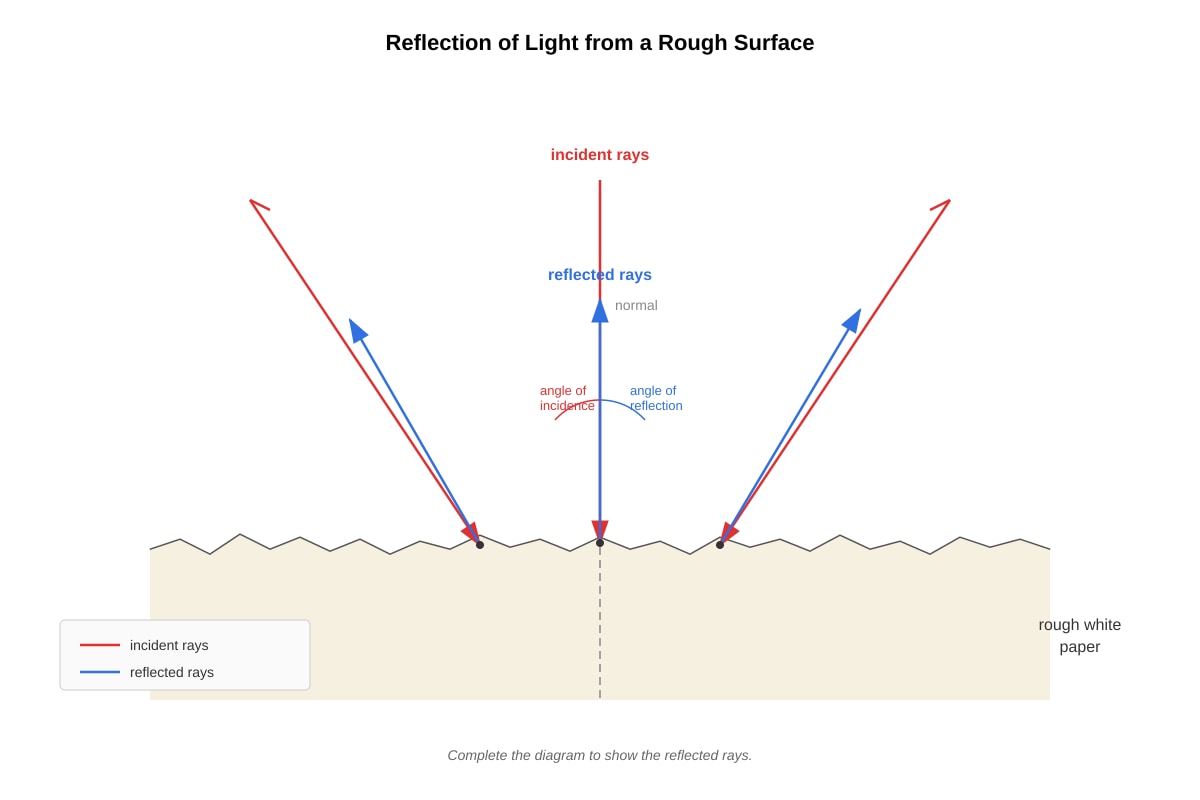
7. (a) Complete the diagram to show reflection from rough surface. [2] Answer: Reflected rays should be drawn in various random directions from the surface [1 mark for showing multiple rays, 1 mark for showing diffuse/scattered reflection]
(b) Explain why reflected rays travel in different directions. [2] Answer: The rough surface has many small surfaces at different angles. Each small surface reflects light according to the law of reflection, but since the surfaces face different directions, the reflected rays scatter in different directions. [1 mark for mentioning rough/uneven surface, 1 mark for explaining different angles cause scattering]
8. (a) State a hypothesis for this experiment. [1] Answer: If the temperature increases and/or stirring is applied, then the sugar will dissolve faster. [1 mark for testable hypothesis linking variables]
(b) Identify two factors affecting rate of dissolving. [2] Answer: Factor 1: Temperature Factor 2: Stirring [1 mark each for correct factors]
(c) Explain how stirring increases the rate of dissolving. [2] Answer: Stirring moves the dissolved sugar particles away from the surface of the undissolved sugar, allowing fresh water to come into contact with the sugar surface, increasing the rate of dissolving. [1 mark for mentioning movement of particles, 1 mark for explaining increased contact]
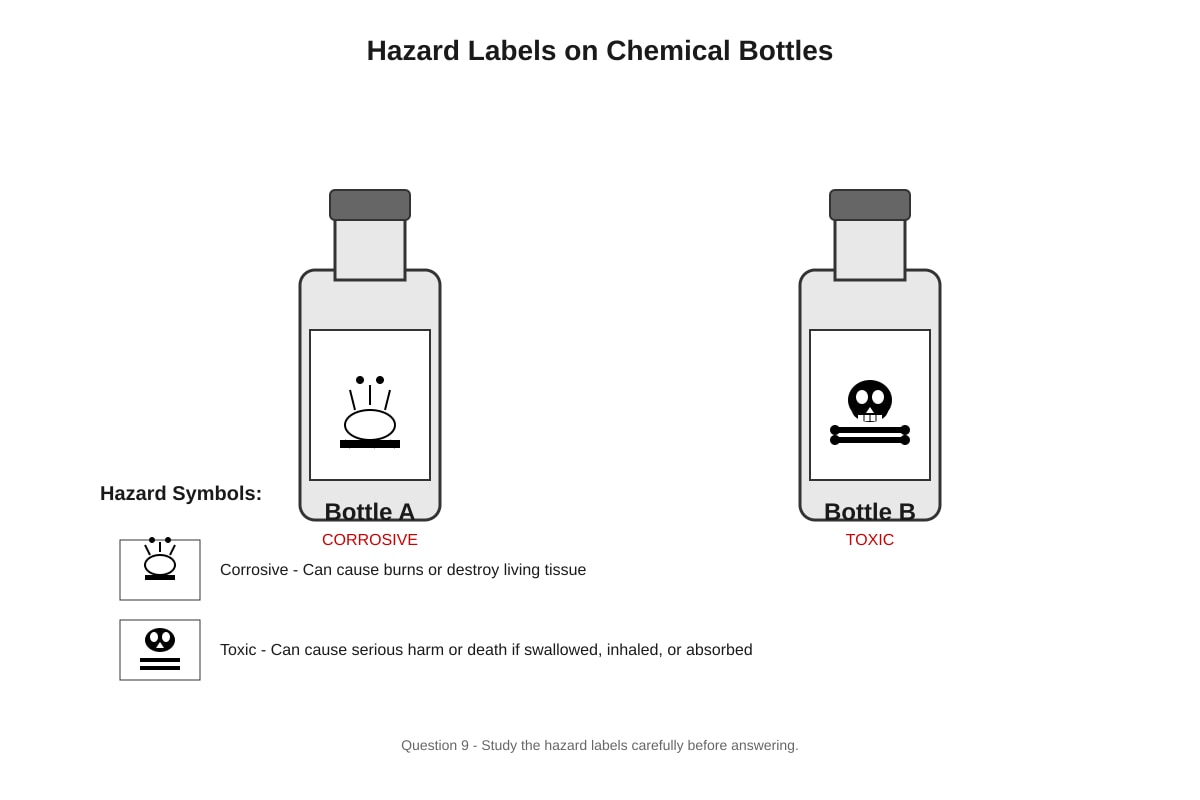
9. (a) State two precautions for corrosive chemical. [2] Answer: Precaution 1: Wear protective gloves Precaution 2: Wear eye protection/safety goggles [1 mark each for appropriate precautions for corrosive substances]
(b) What should student do if toxic chemical is spilled? [1] Answer: Inform the teacher immediately / Do not touch the spill / Evacuate the area [1 mark for appropriate immediate action]
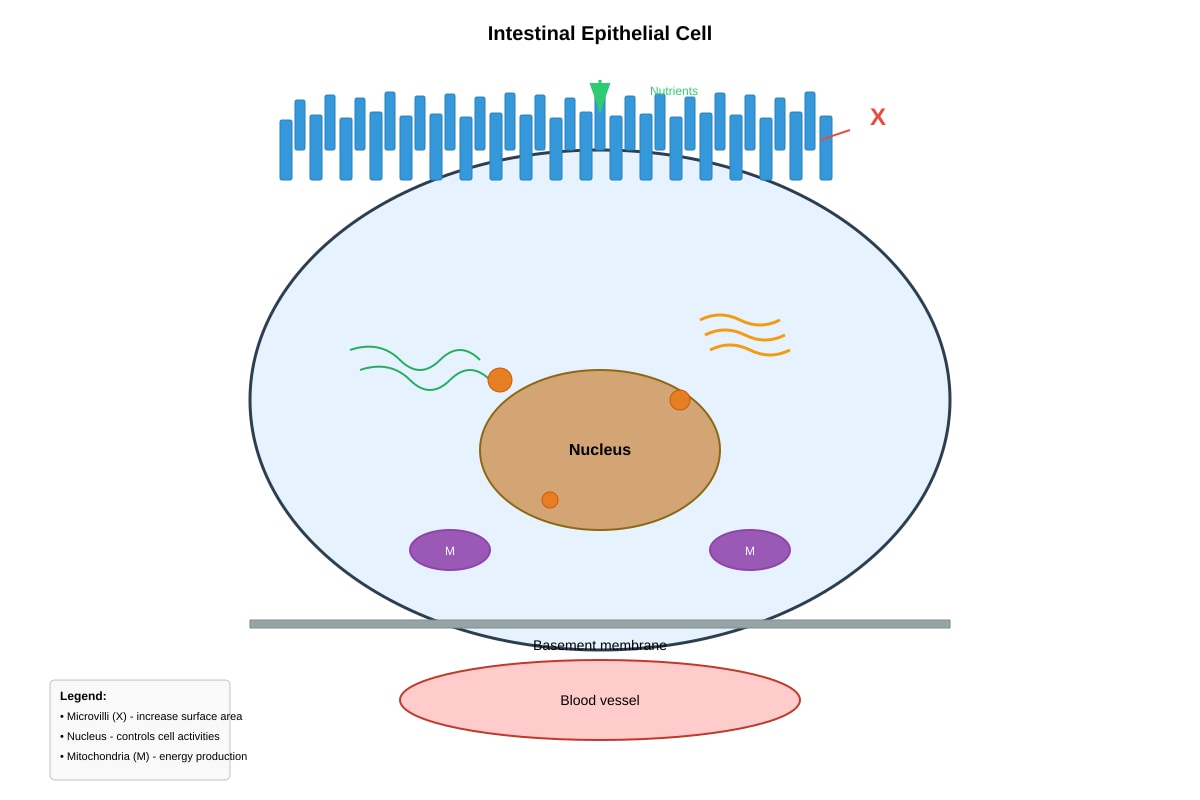
10. (a) Name structure X. [1] Answer: Microvilli [1 mark for correct identification]
(b) Explain how structure X helps the cell function. [2] Answer: Microvilli increase the surface area of the cell membrane, allowing more efficient absorption of nutrients from digested food. [1 mark for mentioning increased surface area, 1 mark for linking to absorption function]
(c) State the main function of this cell type. [1] Answer: Absorption of nutrients/digested food [1 mark for correct function]
11. (a) Calculate total magnification. [1] Answer: ×400 Working: Total magnification = Eyepiece × Objective = 10 × 40 = 400 [1 mark for correct calculation]
(b) Calculate actual length in micrometers. [2] Answer: 5.0 μm Working: Actual length = Image size ÷ Magnification = 2.0 mm ÷ 400 = 0.005 mm = 5.0 μm [1 mark for correct method, 1 mark for correct answer with units]
(c) Name one structure visible in plant cells only. [1] Answer: Cell wall / Chloroplast / Large permanent vacuole [1 mark for any correct plant-specific structure]
Section C: Data Analysis and Extended Response [15 marks]
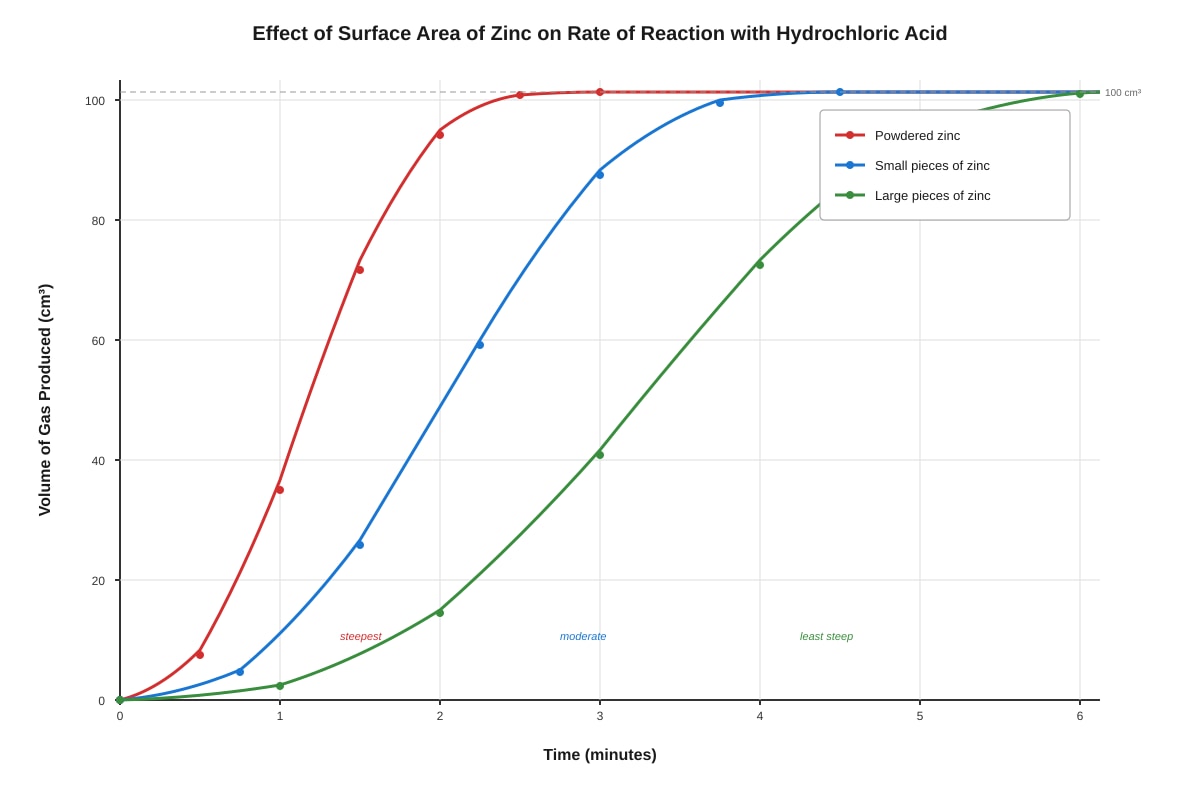
12. (a) State the independent variable. [1] Answer: Surface area of zinc pieces [1 mark for correct identification]
(b) Describe the relationship between surface area and reaction rate. [2] Answer: As the surface area increases, the rate of reaction increases. This is shown by the steeper curves for smaller zinc pieces (larger surface area). [1 mark for stating relationship, 1 mark for reference to graph evidence]
(c) Explain why increasing surface area increases reaction rate. [3] Answer: Increasing surface area exposes more zinc atoms to the hydrochloric acid. This provides more sites for collision between zinc atoms and acid molecules. More frequent collisions lead to a faster rate of reaction. [1 mark for more exposed atoms/particles, 1 mark for more collisions, 1 mark for linking to faster reaction]
(d) State what his hypothesis might have been. [1] Answer: If the surface area of zinc increases, then the rate of reaction with hydrochloric acid will increase. [1 mark for hypothesis linking surface area to reaction rate]
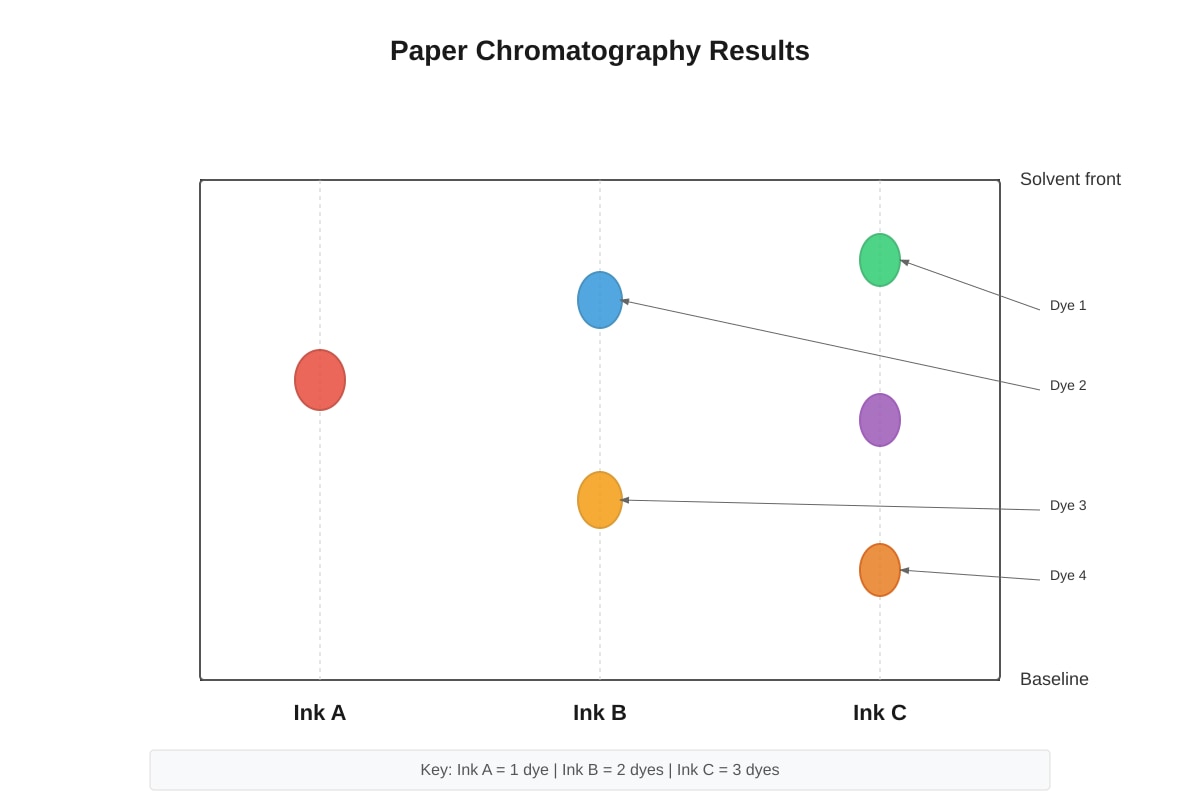
13. (a) Which ink contains only one dye? [2] Answer: Ink B Explanation: Ink B shows only one spot/band on the chromatography paper, indicating it contains only one dye component. [1 mark for correct ink, 1 mark for explanation]
(b) State one advantage of chromatography. [1] Answer: Can separate and identify multiple components in a mixture / Requires only a small sample / Quick and sensitive test [1 mark for any valid advantage]
(c) Explain how chromatography helps solve the forensic case. [3] Answer: The forensic scientist can compare the chromatography pattern of the ink from the document with the ink from the suspect's pen. If the patterns match (same number and position of dye spots), it suggests the same ink was used. If the patterns are different, it indicates different inks were used. [1 mark for comparing patterns, 1 mark for matching patterns = same ink, 1 mark for different patterns = different inks]
(d) Suggest why different dyes travel different distances. [2] Answer: Different dyes have different solubilities in the solvent. More soluble dyes dissolve better and travel further up the paper, while less soluble dyes travel shorter distances. [1 mark for mentioning different solubilities, 1 mark for linking solubility to distance traveled]
Total: 70 marks
Mark Distribution:
- Section A (Multiple Choice): 10 marks
- Section B (Structured Questions): 45 marks
- Section C (Data Analysis): 15 marks
Grade Boundaries (Suggested):
- A1: 63-70 marks (90-100%)
- A2: 56-62 marks (80-89%)
- B3: 49-55 marks (70-79%)
- B4: 42-48 marks (60-69%)
- C5: 35-41 marks (50-59%)
- C6: 28-34 marks (40-49%)