From Real Exams Exam Paper

Secondary 1 Science Semestral Assessment 2 (End of Year) Paper 2

Free Nemo AI-generated Sec 1 Science SA2 Paper 2 with questions, answers, and syllabus-aligned practice for Singapore students preparing for exams.

These static practice materials are generated from the site's syllabus and paper-generation workflow, with source and model context shown so students and parents can evaluate the material before use.

Secondary 1 Science From Real Exams Generated by NVIDIA Nemotron 3 Ultra 550B A55B Free Updated 2026-06-14

Questions

<!-- TuitionGoWhere generation metadata: stage=3-1; model=nvidia/nemotron-3-ultra-550b-a55b:free; model_label=NVIDIA Nemotron 3 Ultra 550B A55B Free; generated=2026-06-14; Sources: Stage 2-1 real exam-derived templates and Stage 2-2 exam-enriched syllabus. -->

TuitionGoWhere Practice Paper - Science Secondary 1

TuitionGoWhere Secondary School (AI)

Subject: Science
Level: Secondary 1 (G3)
Paper: SA2 Version 2
Duration: 1 hour 30 minutes
Total Marks: 60

Name: ________________________
Class: ________________________
Date: ________________________


Instructions to Candidates

  1. Write your name, class, and date in the spaces provided above.
  2. Answer all questions.
  3. Write your answers in the spaces provided on the question paper.
  4. The number of marks is given in brackets [ ] at the end of each question or part question.
  5. The total number of marks for this paper is 60.
  6. You may use a calculator.
  7. Where necessary, take the acceleration due to gravity, g=10 N/kgg = 10 \text{ N/kg}.

Section A: Multiple Choice Questions [10 marks]

Answer all questions. For each question, choose the correct option (A, B, C, or D) and write the letter in the box provided.

Question 1 [1]

A student lifts a 2 kg book from the floor to a shelf 1.5 m above the floor at constant velocity. What is the work done by the student against gravity?

A. 3 J
B. 15 J
C. 30 J
D. 45 J

Answer: \fbox{\phantom{A}}

Question 2 [1]

Which of the following energy conversions takes place when a battery-powered toy car moves across the floor?

A. Chemical energy \rightarrow Kinetic energy only
B. Chemical energy \rightarrow Electrical energy \rightarrow Kinetic energy
C. Electrical energy \rightarrow Chemical energy \rightarrow Kinetic energy
D. Kinetic energy \rightarrow Electrical energy \rightarrow Chemical energy

Answer: \fbox{\phantom{A}}

Question 3 [1]

A force of 20 N is applied to push a box 4 m across a horizontal floor. The frictional force acting on the box is 8 N. What is the net work done on the box?

A. 32 J
B. 48 J
C. 80 J
D. 112 J

Answer: \fbox{\phantom{A}}

Question 4 [1]

A pendulum bob is released from rest at position X and swings to position Y at the bottom of its swing. Which statement correctly describes the energy changes?

A. Gravitational potential energy at X is converted to kinetic energy at Y.
B. Kinetic energy at X is converted to gravitational potential energy at Y.
C. Total energy at X is greater than total energy at Y.
D. No energy conversion occurs during the swing.

Answer: \fbox{\phantom{A}}

Question 5 [1]

A 500 g ball is thrown vertically upwards with an initial speed of 10 m/s. What is its initial kinetic energy? (Take g=10 N/kgg = 10 \text{ N/kg})

A. 5 J
B. 25 J
C. 50 J
D. 500 J

Answer: \fbox{\phantom{A}}

Question 6 [1]

Which of the following is a renewable energy source?

A. Coal
B. Natural gas
C. Solar energy
D. Nuclear fission (uranium)

Answer: \fbox{\phantom{A}}

Question 7 [1]

A machine has an efficiency of 80%. If the useful work output is 400 J, what is the work input?

A. 320 J
B. 400 J
C. 500 J
D. 800 J

Answer: \fbox{\phantom{A}}

Question 8 [1]

A spring is compressed by a force of 10 N. The spring constant is 50 N/m. What is the extension of the spring?

A. 0.2 m
B. 0.5 m
C. 2 m
D. 5 m

Answer: \fbox{\phantom{A}}

Question 9 [1]

When a car brakes to a stop, its kinetic energy is mainly converted to:

A. Sound energy only
B. Heat energy only
C. Heat and sound energy
D. Chemical energy

Answer: \fbox{\phantom{A}}

Question 10 [1]

A student does 200 J of work in 10 seconds. What is the average power developed?

A. 2 W
B. 20 W
C. 200 W
D. 2000 W

Answer: \fbox{\phantom{A}}


Section B: Structured Questions [30 marks]

Answer all questions in the spaces provided.

Question 11 [4]

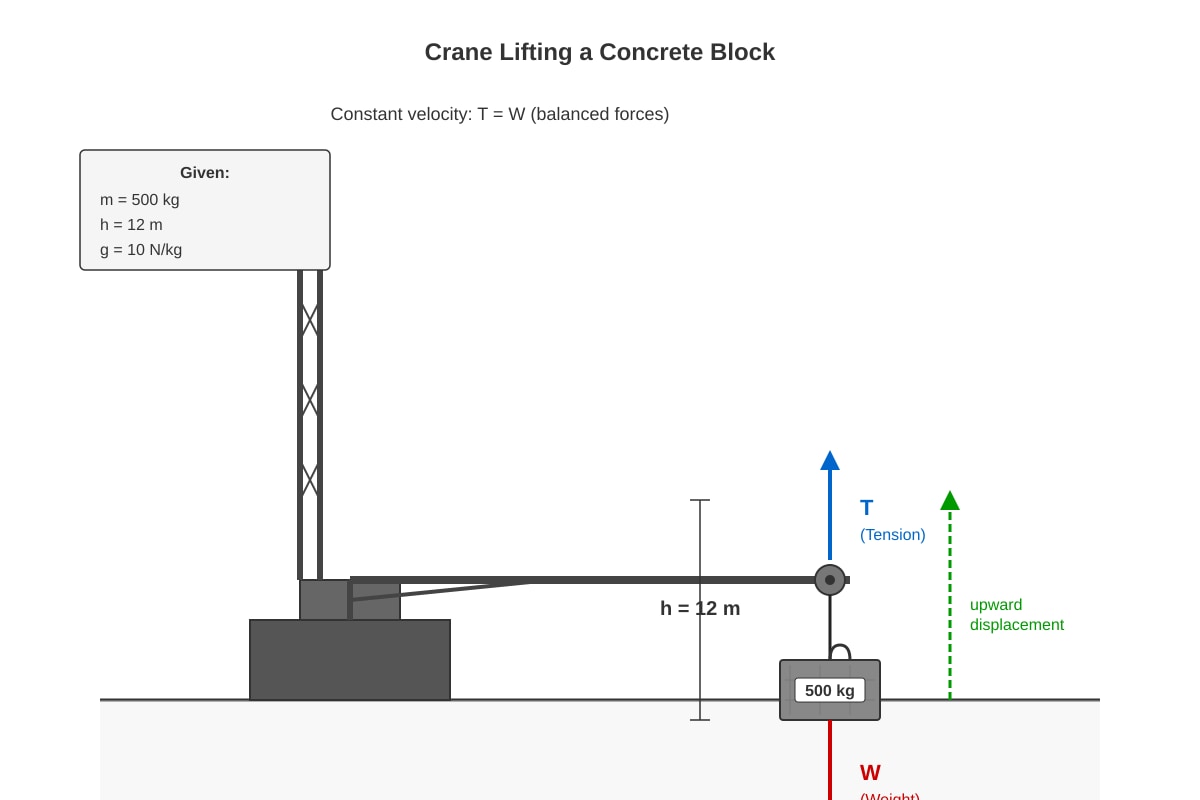
A crane lifts a concrete block of mass 500 kg vertically upwards through a height of 12 m at constant velocity.

<image_placeholder> id: Q11-fig1 type: diagram linked_question: Q11 description: A crane lifting a concrete block vertically. Show the crane arm, cable, and block. Label the mass (500 kg), height (12 m), and direction of motion (upward arrow). Include force arrows for weight (downward) and tension (upward) of equal length. labels: mass = 500 kg, height = 12 m, weight (W), tension (T), upward displacement values: m = 500 kg, h = 12 m, g = 10 N/kg must_show: Vertical lift, equal and opposite force arrows for constant velocity, clear labels </image_placeholder>

(a) Calculate the weight of the concrete block. [1]

(b) Calculate the work done by the crane in lifting the block. [2]

(c) State the energy conversion that takes place during the lift. [1]


Question 12 [5]

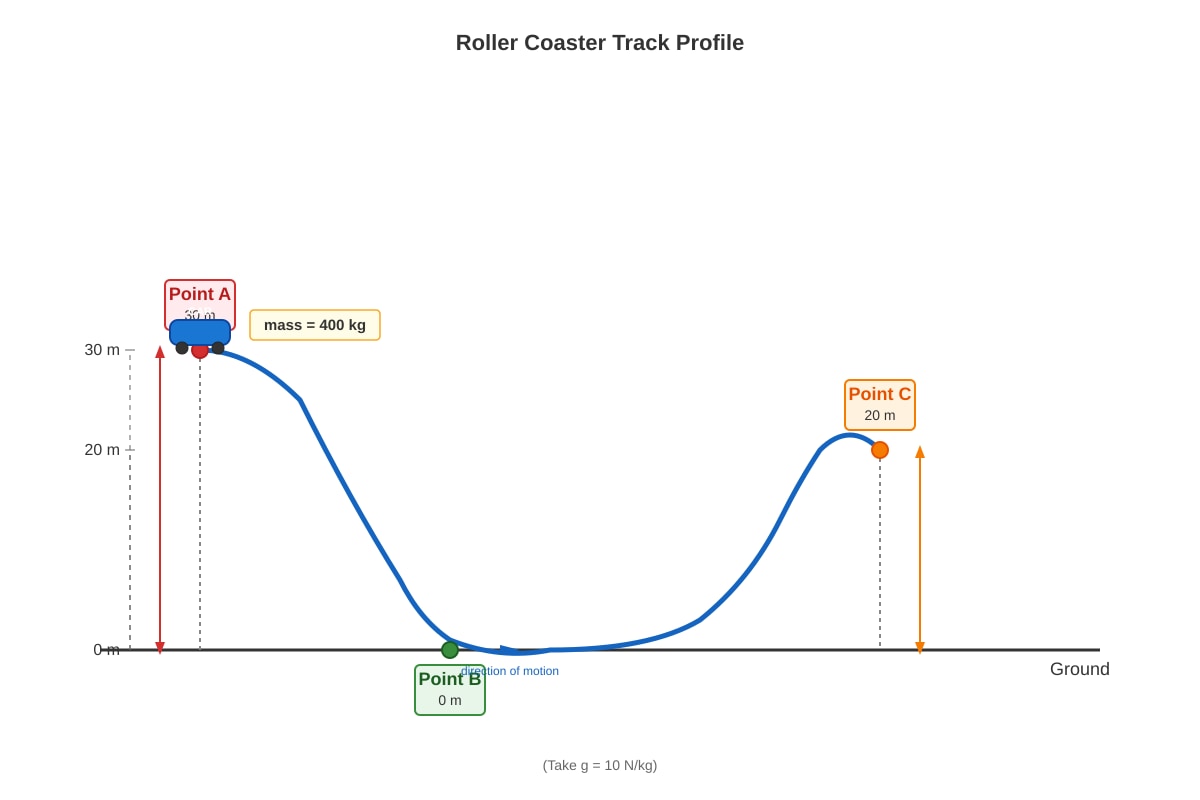
A roller coaster car of mass 400 kg starts from rest at point A, which is 30 m above the ground. It travels down a frictionless track to point B at ground level, then up to point C which is 20 m above the ground.

<image_placeholder> id: Q12-fig1 type: diagram linked_question: Q12 description: Roller coaster track profile showing points A (30 m high), B (ground level), and C (20 m high). Car at point A. Label heights and points. labels: Point A (30 m), Point B (0 m), Point C (20 m), mass = 400 kg values: m = 400 kg, h_A = 30 m, h_B = 0 m, h_C = 20 m, g = 10 N/kg must_show: Track profile with three labelled points, heights indicated, car at starting position </image_placeholder>

(a) Calculate the gravitational potential energy of the car at point A. [1]

(b) State the kinetic energy of the car at point B. Explain your answer. [2]

(c) Calculate the speed of the car at point C. [2]


Question 13 [4]

A student pulls a 5 kg box across a horizontal floor using a constant horizontal force of 30 N. The box moves 6 m in 4 seconds. The frictional force between the box and the floor is 10 N.

(a) Calculate the net force acting on the box. [1]

(b) Calculate the acceleration of the box. [1]

(c) Calculate the work done by the applied force. [1]

(d) Calculate the power developed by the student. [1]


Question 14 [5]

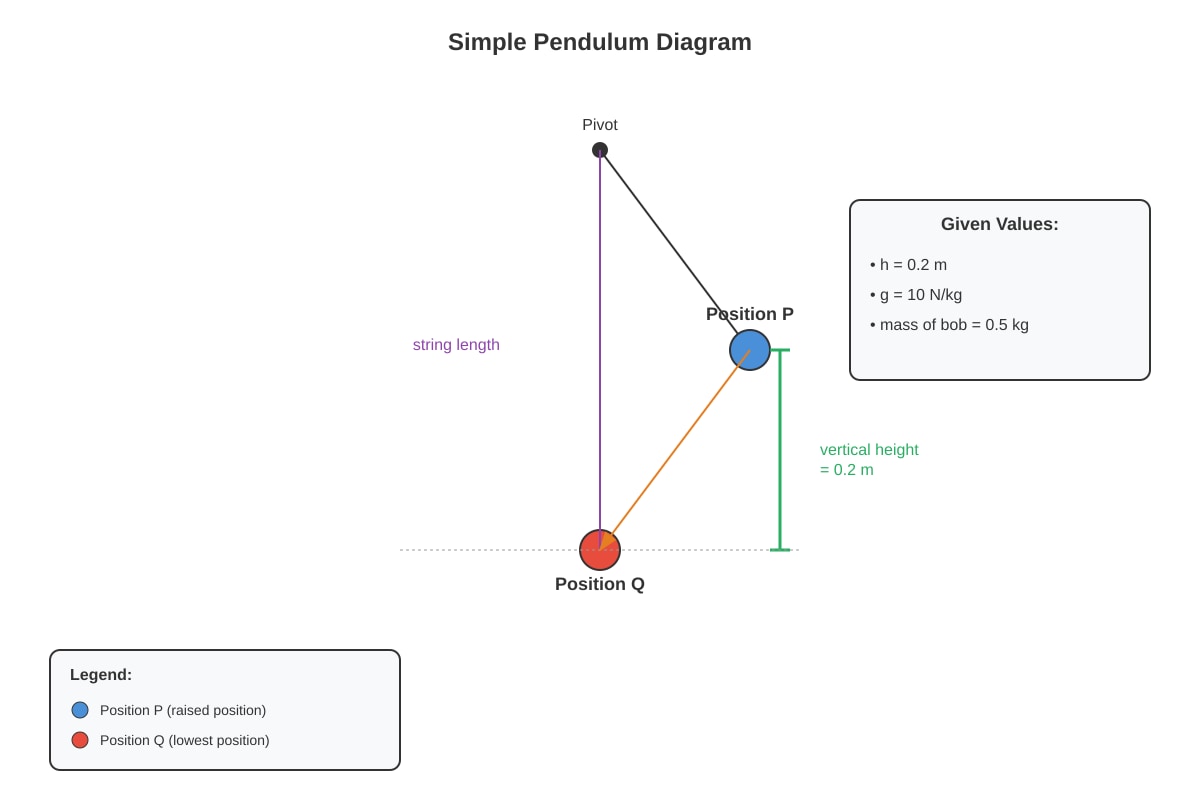
The diagram below shows a simple pendulum. The bob is pulled aside to position P, which is 0.2 m vertically above the lowest position Q, and released from rest.

<image_placeholder> id: Q14-fig1 type: diagram linked_question: Q14 description: Simple pendulum showing bob at position P (raised 0.2 m above Q) and at lowest position Q. Label the vertical height difference, string length, and positions P and Q. labels: Position P, Position Q, vertical height = 0.2 m, string length values: h = 0.2 m, g = 10 N/kg, mass of bob = 0.5 kg must_show: Pendulum at two positions, vertical height difference clearly shown, labels for P and Q </image_placeholder>

(a) Calculate the gravitational potential energy of the bob at position P relative to Q. [1]

(b) State the kinetic energy of the bob at position Q. Explain your answer. [1]

(c) Calculate the speed of the bob at position Q. [2]

(d) The bob eventually comes to rest at Q after several swings. Explain what happens to its initial gravitational potential energy. [1]


Question 15 [6]

A 1200 kg car accelerates uniformly from rest to a speed of 20 m/s in 10 seconds along a horizontal road.

(a) Calculate the acceleration of the car. [1]

(b) Calculate the resultant force acting on the car. [1]

(c) Calculate the kinetic energy of the car at 20 m/s. [1]

(d) Calculate the work done by the resultant force. [1]

(e) Calculate the average power developed by the car's engine during this acceleration, assuming no energy losses. [2]


Question 16 [6]

A hydroelectric power station uses falling water to generate electricity. Water falls through a vertical height of 50 m. The mass of water passing through the turbines per second is 2000 kg.

(a) Calculate the gravitational potential energy lost by the water each second. [2]

(b) If the power station has an efficiency of 85%, calculate the electrical power output. [2]

(c) State the main energy conversions that take place in a hydroelectric power station. [2]


Section C: Longer Structured and Data-Based Questions [20 marks]

Answer all questions in the spaces provided.

Question 17 [7]

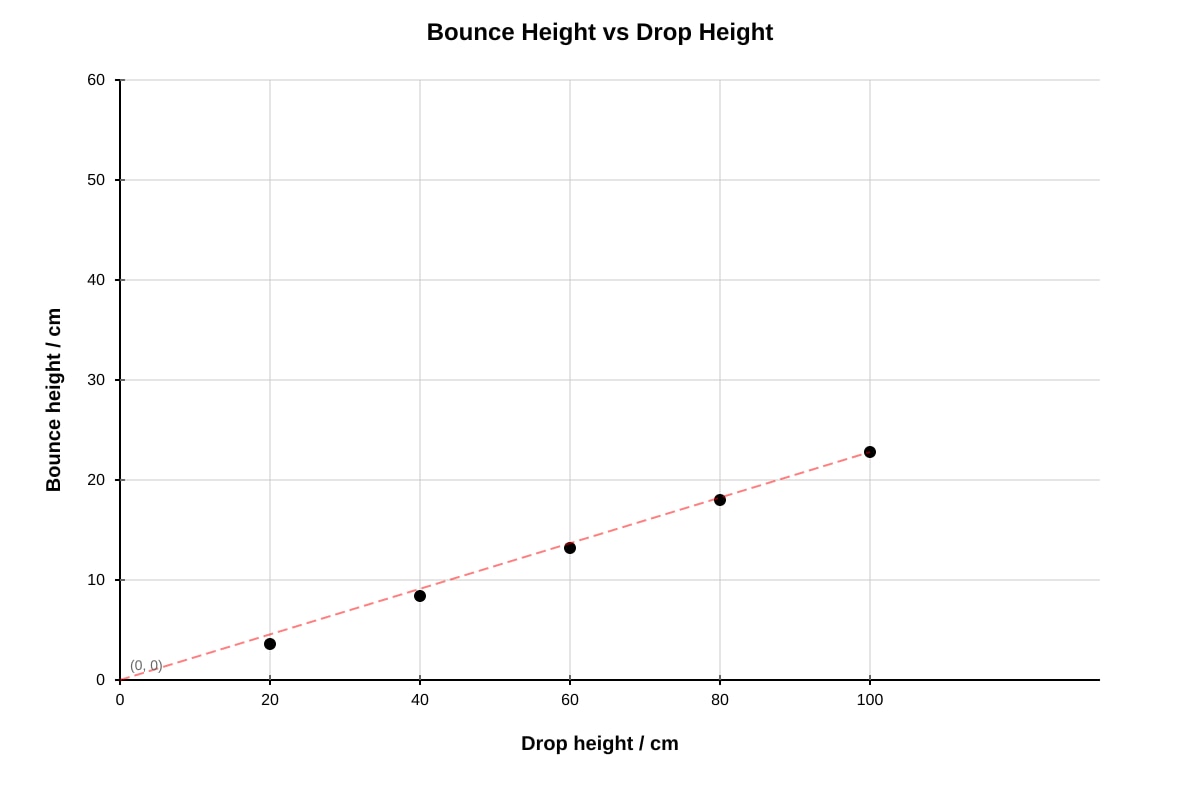
A student investigates the relationship between the height from which a ball is dropped and the height of its first bounce. The ball has a mass of 50 g. The results are shown in the table below.

Drop height / cmBounce height / cm
2012
4024
6036
8048
10060

<image_placeholder> id: Q17-fig1 type: graph linked_question: Q17 description: Grid for plotting bounce height vs drop height. Axes labelled with units. Drop height on x-axis (0-100 cm), bounce height on y-axis (0-60 cm). Data points from table should be plottable. labels: x-axis: Drop height / cm, y-axis: Bounce height / cm values: (20,12), (40,24), (60,36), (80,48), (100,60) must_show: Linear relationship through origin, clear axes with units, grid lines </image_placeholder>

(a) Plot the data on the grid above and draw the best-fit line. [2]

(b) Describe the relationship between drop height and bounce height. [1]

(c) Calculate the percentage of gravitational potential energy retained after the first bounce when the ball is dropped from 100 cm. [2]

(d) Explain why the bounce height is always less than the drop height. [1]

(e) The student suggests that if the ball is dropped from 200 cm, the bounce height will be 120 cm. Comment on this prediction. [1]


Question 18 [7]

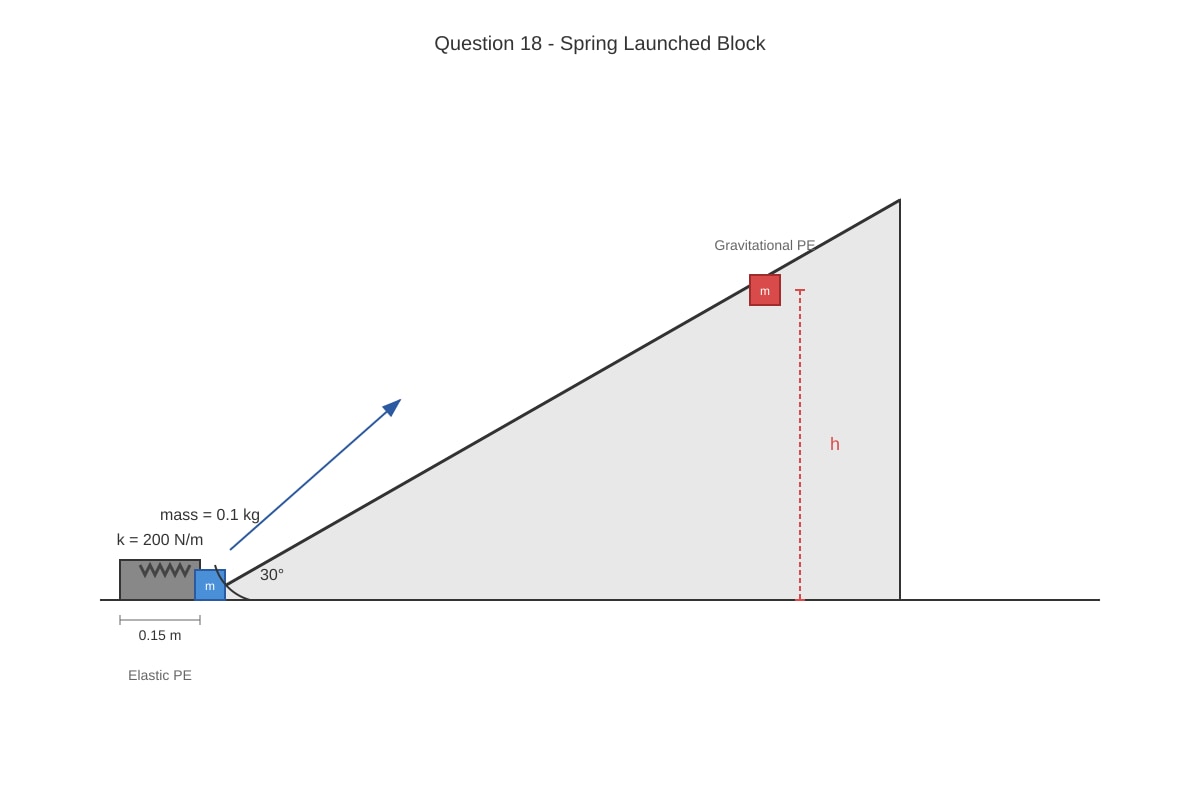
The diagram below shows a compressed spring launching a 0.1 kg block up a smooth ramp inclined at 30° to the horizontal. The spring constant is 200 N/m and the spring is compressed by 0.15 m. The block slides up the ramp and momentarily comes to rest at a vertical height hh above the starting point.

<image_placeholder> id: Q18-fig1 type: diagram linked_question: Q18 description: Compressed spring at bottom of ramp launching a block up a 30° incline. Show spring compressed, block at start, and block at maximum height h. Label spring constant, compression, mass, angle, and height h. labels: k = 200 N/m, compression = 0.15 m, mass = 0.1 kg, angle = 30°, height h values: k = 200 N/m, x = 0.15 m, m = 0.1 kg, θ = 30°, g = 10 N/kg must_show: Spring compressed at base of ramp, block on ramp, incline angle labelled, maximum height h shown </image_placeholder>

(a) Calculate the elastic potential energy stored in the compressed spring. [2]

(b) Assuming no energy losses, calculate the maximum vertical height hh reached by the block. [2]

(c) Calculate the distance along the ramp that the block travels before stopping. [2]

(d) In reality, the ramp is not perfectly smooth. Explain how friction would affect the maximum height reached. [1]


Question 19 [6]

A wind turbine generates electricity. The blades sweep out a circular area of radius 25 m. The density of air is 1.2 kg/m³. The wind speed is 12 m/s.

The kinetic energy of air passing through the swept area per second is given by: Pwind=12ρAv3P_{\text{wind}} = \frac{1}{2} \rho A v^3 where ρ\rho is the density of air, AA is the swept area, and vv is the wind speed.

(a) Calculate the swept area AA of the turbine blades. [1]

(b) Calculate the kinetic energy of air passing through the swept area per second (i.e., the wind power). [2]

(c) The turbine has an efficiency of 40%. Calculate the electrical power output. [1]

(d) State two factors that affect the amount of electrical power generated by a wind turbine. [2]


Question 20 [6]

A food label on a packet of biscuits states: "Energy: 2000 kJ per 100 g". A student of mass 50 kg eats 50 g of these biscuits.

(a) Calculate the energy intake from the biscuits in joules. [1]

(b) The student decides to climb stairs to use up this energy. If the efficiency of the human body in converting food energy to gravitational potential energy is 25%, calculate the maximum vertical height the student could climb using this energy. [3]

(c) In practice, the student would not be able to climb this height using only the energy from the biscuits. Suggest two reasons why. [2]


End of Paper

Answers

<!-- TuitionGoWhere generation metadata: stage=3-1; model=nvidia/nemotron-3-ultra-550b-a55b:free; model_label=NVIDIA Nemotron 3 Ultra 550B A55B Free; generated=2026-06-14; Sources: Stage 2-1 real exam-derived templates and Stage 2-2 exam-enriched syllabus. -->

TuitionGoWhere Practice Paper - Science Secondary 1

Answer Key and Marking Scheme (SA2 Version 2)

Total Marks: 60


Section A: Multiple Choice Questions [10 marks]

Question 1 [1]

Answer: C

Working:

  • Mass m=2 kgm = 2 \text{ kg}
  • Height h=1.5 mh = 1.5 \text{ m}
  • g=10 N/kgg = 10 \text{ N/kg}
  • Work done against gravity =mgh=2×10×1.5=30 J= mgh = 2 \times 10 \times 1.5 = 30 \text{ J}

Key concept: Work done against gravity = gain in gravitational potential energy = mghmgh.


Question 2 [1]

Answer: B

Explanation: In a battery-powered toy car:

  1. Chemical energy stored in the battery
  2. Converted to electrical energy in the circuit
  3. Electrical energy converted to kinetic energy (and some heat/sound) by the motor

Common mistake: Option A omits the electrical energy intermediate step.


Question 3 [1]

Answer: B

Working:

  • Applied force F=20 NF = 20 \text{ N}
  • Frictional force f=8 Nf = 8 \text{ N}
  • Net force Fnet=208=12 NF_{\text{net}} = 20 - 8 = 12 \text{ N}
  • Displacement s=4 ms = 4 \text{ m}
  • Net work done =Fnet×s=12×4=48 J= F_{\text{net}} \times s = 12 \times 4 = 48 \text{ J}

Alternative method: Work by applied force =20×4=80 J= 20 \times 4 = 80 \text{ J}; Work against friction =8×4=32 J= 8 \times 4 = 32 \text{ J}; Net work =8032=48 J= 80 - 32 = 48 \text{ J}.


Question 4 [1]

Answer: A

Explanation: At position X (highest point), the bob has maximum gravitational potential energy and zero kinetic energy (released from rest). At position Y (lowest point), gravitational potential energy is minimum and kinetic energy is maximum. By conservation of energy (ignoring air resistance), GPE at X \rightarrow KE at Y.


Question 5 [1]

Answer: B

Working:

  • Mass m=500 g=0.5 kgm = 500 \text{ g} = 0.5 \text{ kg}
  • Speed v=10 m/sv = 10 \text{ m/s}
  • Kinetic energy =12mv2=12×0.5×102=0.25×100=25 J= \frac{1}{2}mv^2 = \frac{1}{2} \times 0.5 \times 10^2 = 0.25 \times 100 = 25 \text{ J}

Common mistake: Forgetting to convert grams to kg (would give 25000 J) or forgetting the 12\frac{1}{2} factor (would give 50 J).


Question 6 [1]

Answer: C

Explanation: Solar energy is renewable (continuously replenished by the Sun). Coal, natural gas, and uranium for nuclear fission are finite fossil/nuclear fuels — non-renewable.


Question 7 [1]

Answer: C

Working:

  • Efficiency =Useful work outputWork input×100%= \frac{\text{Useful work output}}{\text{Work input}} \times 100\%
  • 80%=400Work input×100%80\% = \frac{400}{\text{Work input}} \times 100\%
  • Work input =4000.8=500 J= \frac{400}{0.8} = 500 \text{ J}

Question 8 [1]

Answer: A

Working:

  • Hooke's Law: F=kxF = kx
  • 10=50×x10 = 50 \times x
  • x=1050=0.2 mx = \frac{10}{50} = 0.2 \text{ m}

Question 9 [1]

Answer: C

Explanation: When a car brakes, friction between brake pads and discs/drums, and between tyres and road, converts kinetic energy primarily into heat energy. Some sound energy is also produced (squealing brakes, tyre noise).


Question 10 [1]

Answer: B

Working:

  • Power =Work doneTime taken=200 J10 s=20 W= \frac{\text{Work done}}{\text{Time taken}} = \frac{200 \text{ J}}{10 \text{ s}} = 20 \text{ W}

Section B: Structured Questions [30 marks]

Question 11 [4]

(a) [1] Weight W=mg=500×10=5000 NW = mg = 500 \times 10 = 5000 \text{ N} (or 5 kN5 \text{ kN})

(b) [2] Work done by crane =Force×distance=Tension×height= \text{Force} \times \text{distance} = \text{Tension} \times \text{height} Since constant velocity, Tension =Weight=5000 N= \text{Weight} = 5000 \text{ N} Work done =5000×12=60000 J= 5000 \times 12 = 60000 \text{ J} (or 60 kJ60 \text{ kJ})

Mark breakdown: 1 mark for correct tension/force, 1 mark for correct calculation with units.

(c) [1] Chemical energy (in fuel/electricity) \rightarrow Gravitational potential energy (of block) Accept: Electrical energy \rightarrow Gravitational potential energy (if electric crane)


Question 12 [5]

(a) [1] GPE at A =mghA=400×10×30=120000 J= mgh_A = 400 \times 10 \times 30 = 120000 \text{ J} (or 120 kJ120 \text{ kJ})

(b) [2] At point B (ground level), h=0h = 0, so GPE =0= 0. By conservation of energy (frictionless track), total energy at A = total energy at B. GPE at A == KE at B =120000 J= 120000 \text{ J}. Mark breakdown: 1 mark for correct value (120000 J), 1 mark for explanation referencing conservation of energy / frictionless track.

(c) [2] At point C: Total energy == GPE at C ++ KE at C 120000=mghC+KEC120000 = mgh_C + \text{KE}_C 120000=(400×10×20)+KEC120000 = (400 \times 10 \times 20) + \text{KE}_C 120000=80000+KEC120000 = 80000 + \text{KE}_C KEC=40000 J\text{KE}_C = 40000 \text{ J}

KEC=12mvC2\text{KE}_C = \frac{1}{2}mv_C^2 40000=12×400×vC240000 = \frac{1}{2} \times 400 \times v_C^2 40000=200×vC240000 = 200 \times v_C^2 vC2=200v_C^2 = 200 vC=200=10214.1 m/sv_C = \sqrt{200} = 10\sqrt{2} \approx 14.1 \text{ m/s}

Mark breakdown: 1 mark for correct KE at C (40000 J), 1 mark for correct speed calculation with units.


Question 13 [4]

(a) [1] Net force =Applied forceFriction=3010=20 N= \text{Applied force} - \text{Friction} = 30 - 10 = 20 \text{ N} (forward)

(b) [1] Fnet=maF_{\text{net}} = ma 20=5×a20 = 5 \times a a=4 m/s2a = 4 \text{ m/s}^2

(c) [1] Work done by applied force =F×s=30×6=180 J= F \times s = 30 \times 6 = 180 \text{ J}

(d) [1] Power =Work doneTime=1804=45 W= \frac{\text{Work done}}{\text{Time}} = \frac{180}{4} = 45 \text{ W}


Question 14 [5]

(a) [1] GPE at P relative to Q =mgh=0.5×10×0.2=1 J= mgh = 0.5 \times 10 \times 0.2 = 1 \text{ J}

(b) [1] At Q (lowest point), all GPE is converted to KE (assuming no air resistance). KE at Q =1 J= 1 \text{ J}. Explanation: By conservation of energy, loss in GPE = gain in KE.

(c) [2] KE=12mv2\text{KE} = \frac{1}{2}mv^2 1=12×0.5×v21 = \frac{1}{2} \times 0.5 \times v^2 1=0.25v21 = 0.25 v^2 v2=4v^2 = 4 v=2 m/sv = 2 \text{ m/s}

Mark breakdown: 1 mark for correct substitution/formula, 1 mark for correct answer with units.

(d) [1] The initial gravitational potential energy is converted to kinetic energy, then gradually dissipated as heat and sound energy due to air resistance and friction at the pivot, until the bob comes to rest at Q.


Question 15 [6]

(a) [1] a=vut=20010=2 m/s2a = \frac{v - u}{t} = \frac{20 - 0}{10} = 2 \text{ m/s}^2

(b) [1] F=ma=1200×2=2400 NF = ma = 1200 \times 2 = 2400 \text{ N}

(c) [1] KE=12mv2=12×1200×202=600×400=240000 J\text{KE} = \frac{1}{2}mv^2 = \frac{1}{2} \times 1200 \times 20^2 = 600 \times 400 = 240000 \text{ J} (or 240 kJ240 \text{ kJ})

(d) [1] Work done by resultant force == Gain in kinetic energy =240000 J= 240000 \text{ J} (Work-energy theorem: net work = change in KE)

(e) [2] Average power =Work doneTime=24000010=24000 W= \frac{\text{Work done}}{\text{Time}} = \frac{240000}{10} = 24000 \text{ W} (or 24 kW24 \text{ kW})

Mark breakdown: 1 mark for correct work done (or recognition that work done = KE gain), 1 mark for correct power calculation with units.


Question 16 [6]

(a) [2] Mass of water per second =2000 kg= 2000 \text{ kg} Height h=50 mh = 50 \text{ m} GPE lost per second =mgh=2000×10×50=1000000 J/s=1 MW= mgh = 2000 \times 10 \times 50 = 1000000 \text{ J/s} = 1 \text{ MW}

Mark breakdown: 1 mark for correct formula/substitution, 1 mark for correct answer with units (J/s or W).

(b) [2] Efficiency =85%=0.85= 85\% = 0.85 Electrical power output =0.85×1000000=850000 W=850 kW= 0.85 \times 1000000 = 850000 \text{ W} = 850 \text{ kW}

Mark breakdown: 1 mark for correct efficiency calculation, 1 mark for correct answer with units.

(c) [2] Gravitational potential energy of water \rightarrow Kinetic energy of falling water \rightarrow Kinetic energy of turbine rotation \rightarrow Electrical energy (via generator)

Mark breakdown: 1 mark for GPE \rightarrow KE of water, 1 mark for KE of turbine \rightarrow Electrical energy (or complete chain with all steps).


Section C: Longer Structured and Data-Based Questions [20 marks]

Question 17 [7]

(a) [2] Marking points for graph:

  • Axes correctly labelled with units (Drop height / cm on x-axis, Bounce height / cm on y-axis) [1]
  • All 5 points plotted correctly [1]
  • Best-fit straight line through origin [1] Total 2 marks (typically 1 for plotting, 1 for line; or 1 for axes+points, 1 for line)

(b) [1] Bounce height is directly proportional to drop height. (Or: Bounce height increases linearly with drop height; the ratio bounce height/drop height is constant at 0.6).

(c) [2] Drop height =100 cm=1 m= 100 \text{ cm} = 1 \text{ m} Bounce height =60 cm=0.6 m= 60 \text{ cm} = 0.6 \text{ m} Mass =50 g=0.05 kg= 50 \text{ g} = 0.05 \text{ kg}

Initial GPE =mghdrop=0.05×10×1=0.5 J= mgh_{\text{drop}} = 0.05 \times 10 \times 1 = 0.5 \text{ J} GPE after bounce =mghbounce=0.05×10×0.6=0.3 J= mgh_{\text{bounce}} = 0.05 \times 10 \times 0.6 = 0.3 \text{ J}

Percentage retained =0.30.5×100%=60%= \frac{0.3}{0.5} \times 100\% = 60\%

Alternative (simpler): Since GPE h\propto h, percentage retained =hbouncehdrop×100%=60100×100%=60%= \frac{h_{\text{bounce}}}{h_{\text{drop}}} \times 100\% = \frac{60}{100} \times 100\% = 60\%.

Mark breakdown: 1 mark for correct method (ratio of heights or GPE calculation), 1 mark for correct answer (60%).

(d) [1] During the bounce, some energy is converted to heat and sound energy due to deformation of the ball and floor, and air resistance. This energy is not recovered, so the ball has less kinetic energy after the bounce, resulting in a lower maximum height.

(e) [1] The prediction assumes the linear relationship (60% retention) holds at greater heights. However, at higher drop heights:

  • Air resistance becomes more significant (proportional to v2v^2)
  • The ball may deform more, increasing energy loss
  • The percentage retention may decrease So the actual bounce height would likely be less than 120 cm.

Question 18 [7]

(a) [2] Elastic potential energy =12kx2=12×200×(0.15)2=100×0.0225=2.25 J= \frac{1}{2}kx^2 = \frac{1}{2} \times 200 \times (0.15)^2 = 100 \times 0.0225 = 2.25 \text{ J}

Mark breakdown: 1 mark for correct formula/substitution, 1 mark for correct answer with units.

(b) [2] Assuming no energy losses: Elastic PE \rightarrow GPE 12kx2=mgh\frac{1}{2}kx^2 = mgh 2.25=0.1×10×h2.25 = 0.1 \times 10 \times h 2.25=h2.25 = h h=2.25 mh = 2.25 \text{ m}

Mark breakdown: 1 mark for energy conservation equation, 1 mark for correct answer with units.

(c) [2] Vertical height h=2.25 mh = 2.25 \text{ m} Incline angle θ=30\theta = 30^\circ Distance along ramp d=hsinθ=2.25sin30=2.250.5=4.5 md = \frac{h}{\sin\theta} = \frac{2.25}{\sin 30^\circ} = \frac{2.25}{0.5} = 4.5 \text{ m}

Mark breakdown: 1 mark for correct trigonometric relationship, 1 mark for correct answer with units.

(d) [1] Friction would do negative work on the block, converting some mechanical energy to heat. This reduces the kinetic energy available for conversion to GPE, so the maximum vertical height reached would be less than 2.25 m.


Question 19 [6]

(a) [1] Swept area A=πr2=π×252=625π1963.5 m2A = \pi r^2 = \pi \times 25^2 = 625\pi \approx 1963.5 \text{ m}^2 (accept 1960 m21960 \text{ m}^2 or 625π m2625\pi \text{ m}^2)

(b) [2] Pwind=12ρAv3P_{\text{wind}} = \frac{1}{2} \rho A v^3 =12×1.2×1963.5×123= \frac{1}{2} \times 1.2 \times 1963.5 \times 12^3 =0.6×1963.5×1728= 0.6 \times 1963.5 \times 1728 =0.6×3392928= 0.6 \times 3392928 =2035756.8 W2.04 MW= 2035756.8 \text{ W} \approx 2.04 \text{ MW}

Using A=625πA = 625\pi: Pwind=12×1.2×625π×1728=648000π2.036 MWP_{\text{wind}} = \frac{1}{2} \times 1.2 \times 625\pi \times 1728 = 648000\pi \approx 2.036 \text{ MW}

Mark breakdown: 1 mark for correct substitution, 1 mark for correct calculation with units (W or MW).

(c) [1] Efficiency =40%=0.4= 40\% = 0.4 Electrical power output =0.4×2.04 MW=0.816 MW=816 kW= 0.4 \times 2.04 \text{ MW} = 0.816 \text{ MW} = 816 \text{ kW}

(d) [2] Any two of:

  • Wind speed (power v3\propto v^3, so small changes in wind speed cause large changes in power)
  • Air density (varies with temperature, altitude, humidity)
  • Swept area / blade length (larger blades capture more air)
  • Turbine efficiency / design (aerodynamic efficiency, generator efficiency)
  • Wind direction relative to turbine orientation

Mark breakdown: 1 mark per valid factor (max 2).


Question 20 [6]

(a) [1] Energy per 100 g =2000 kJ=2000000 J= 2000 \text{ kJ} = 2000000 \text{ J} Energy per 50 g =50100×2000000=1000000 J= \frac{50}{100} \times 2000000 = 1000000 \text{ J} (or 1000 kJ1000 \text{ kJ})

(b) [3] Useful energy for climbing =25%×1000000=250000 J= 25\% \times 1000000 = 250000 \text{ J} This equals gain in GPE: mgh=250000mgh = 250000 50×10×h=25000050 \times 10 \times h = 250000 500h=250000500h = 250000 h=500 mh = 500 \text{ m}

Mark breakdown: 1 mark for calculating useful energy (250000 J), 1 mark for equating to mghmgh, 1 mark for correct height with units.

(c) [2] Any two of:

  • The human body also uses energy for basal metabolic processes (breathing, heartbeat, maintaining body temperature), not just climbing.
  • Muscles are not 100% efficient even within the 25% figure; the 25% is an average/maximum under ideal conditions.
  • Energy is lost as heat during muscle contraction.
  • The student would need energy to descend as well (controlled lowering requires muscle work).
  • Fatigue and physiological limits prevent sustained maximum efficiency.
  • Some energy from food is not fully digested/absorbed.

Mark breakdown: 1 mark per valid reason (max 2).


End of Answer Key