From Real Exams Exam Paper

Secondary 1 Science Semestral Assessment 2 (End of Year) Paper 2

Free Kimi AI-generated Sec 1 Science SA2 Paper 2 with questions, answers, and syllabus-aligned practice for Singapore students preparing for exams.

These static practice materials are generated from the site's syllabus and paper-generation workflow, with source and model context shown so students and parents can evaluate the material before use.

Secondary 1 Science From Real Exams Generated by Kimi K2.6 Free Updated 2026-06-09

Questions

<!-- TuitionGoWhere generation metadata: stage=3-1; model=moonshotai/kimi-k2.6:free; model_label=Kimi K2.6 Free; generated=2026-06-07; Sources: Stage 2-1 real exam-derived templates and Stage 2-2 exam-enriched syllabus. -->

TuitionGoWhere Practice Paper - Science Secondary 1

TuitionGoWhere Secondary School (AI)

Subject: Science
Level: Secondary 1 (G3)
Paper: SA2 Practice Paper Version 2 of 5
Duration: 1 hour 15 minutes
Total Marks: 60 marks


Name: _________________________ Class: _________ Date: ___________

Instructions to Candidates

  • Write your name, class, and date on this paper.
  • This paper consists of THREE sections: A, B, and C.
  • Answer ALL questions.
  • Write your answers in the spaces provided.
  • All essential working must be shown. Marks will not be awarded for final answers without supporting working.
  • Calculators may be used where appropriate.
  • All diagrams should be drawn in pencil.

SECTION A: Multiple Choice (Questions 1–8)

8 marks (1 mark each)

Choose the correct answer for each question. Write your answer [A, B, C, or D] in the box provided.

QuestionAnswer Box
1[ ]
2[ ]
3[ ]
4[ ]
5[ ]
6[ ]
7[ ]
8[ ]

1. A student lifts a 5 kg box vertically upwards through a height of 2 m at constant speed. Which energy conversion takes place?

A. Chemical energy → Kinetic energy
B. Chemical energy → Gravitational potential energy
C. Kinetic energy → Gravitational potential energy
D. Gravitational potential energy → Chemical energy

Answer: [ ]


2. A force of 10 N acts on an object, but the object does not move. What is the work done by the force?

A. 0 J
B. 5 J
C. 10 J
D. Cannot be determined

Answer: [ ]


3. Which of the following situations best demonstrates the principle of moments?

A. A ball rolling down a slope
B. A seesaw balanced on a pivot with two children of different weights sitting at different distances
C. A car accelerating on a straight road
D. A stone falling freely under gravity

Answer: [ ]


4. The efficiency of a machine is defined as:

A. (Useful energy output / Total energy input) × 100%
B. (Total energy input / Useful energy output) × 100%
C. (Work output / Force applied) × 100%
D. (Power output / Time taken) × 100%

Answer: [ ]


5. A simple machine raises a load of 200 N through a vertical height of 0.5 m. The effort applied is 50 N and moves through a distance of 4 m. What is the mechanical advantage of this machine?

A. 0.25
B. 4
C. 5
D. 8

Answer: [ ]


6. Two forces of 8 N and 6 N act on an object. Which of the following CANNOT be the magnitude of the resultant force?

A. 2 N
B. 8 N
C. 14 N
D. 15 N

Answer: [ ]


7. A pulley system has 4 supporting strands. If the load to be raised is 400 N, what is the theoretical effort required? (Ignore friction and weight of pulleys)

A. 25 N
B. 50 N
C. 100 N
D. 1600 N

Answer: [ ]


8. The main purpose of using a lubricant in a machine is to:

A. Increase the mechanical advantage
B. Reduce friction and hence increase efficiency
C. Increase the speed of the machine
D. Reduce the load that needs to be moved

Answer: [ ]


SECTION B: Structured Response (Questions 9–14)

22 marks


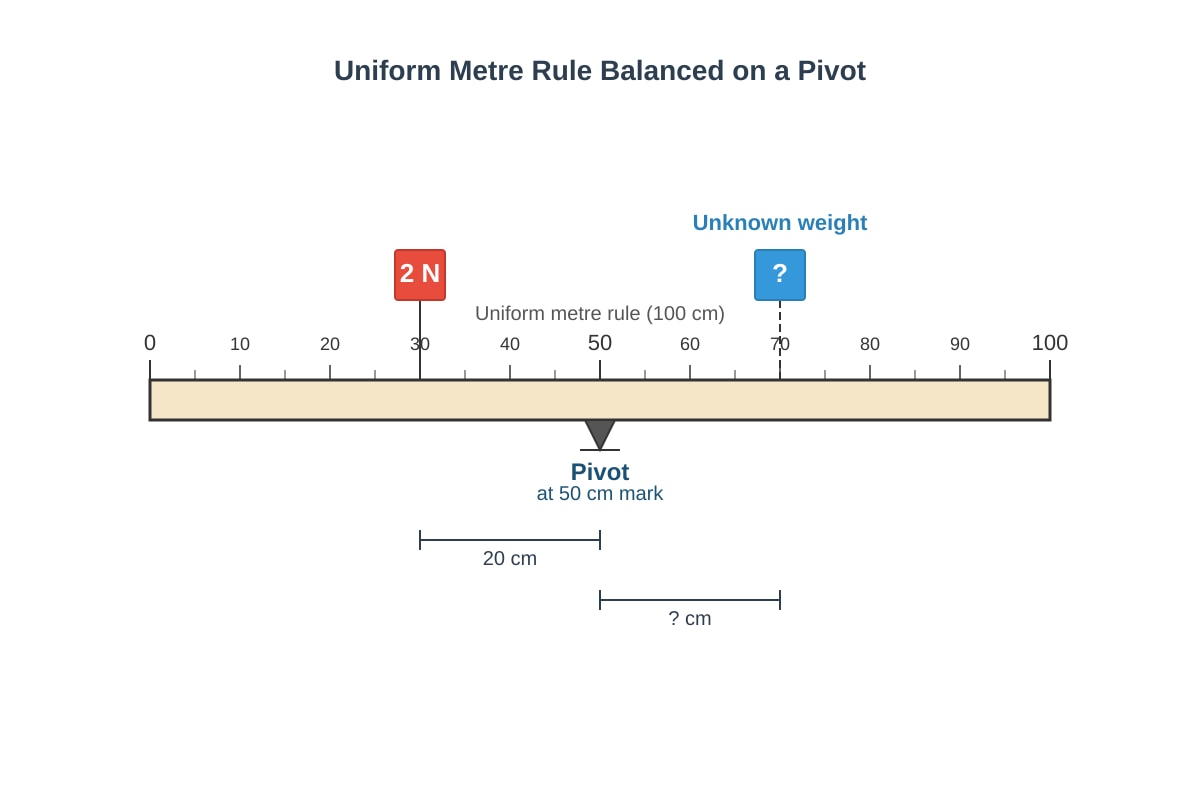
9. A student uses a uniform metre rule as a simple lever to investigate moments. The metre rule is balanced on a pivot at its 50 cm mark. A 2 N weight is placed at the 30 cm mark. [3 marks]

<image_placeholder> id: Q9-fig1 type: diagram linked_question: Q9 description: Uniform metre rule balanced on pivot at centre (50 cm mark). Weight of 2 N placed at 30 cm mark. Unlabelled position on right side for unknown weight to be determined. labels: Pivot at 50 cm mark; 2 N weight at 30 cm mark; metre rule with cm markings from 0 to 100 values: Rule length 100 cm, pivot at 50 cm, 2 N at 30 cm must_show: Equal scale markings, pivot symbol, weight hanging vertically, distance indications </image_placeholder>

(a) Calculate the perpendicular distance from the pivot to the line of action of the 2 N weight. [1]


(b) Another weight is placed on the right side of the pivot to balance the rule. State the principle that is applied when the rule is balanced. [1]


(c) If the weight on the right side is 4 N, determine the position where it should be placed to balance the rule. Show your working. [1]


10. A car of mass 1200 kg is travelling at a constant speed of 20 m/s on a level road. [4 marks]

(a) Calculate the kinetic energy of the car. [2]


(b) State the energy conversion that occurs when the driver applies the brakes and the car comes to rest. [1]


(c) Calculate the work done by the braking force to bring the car to rest. [1]


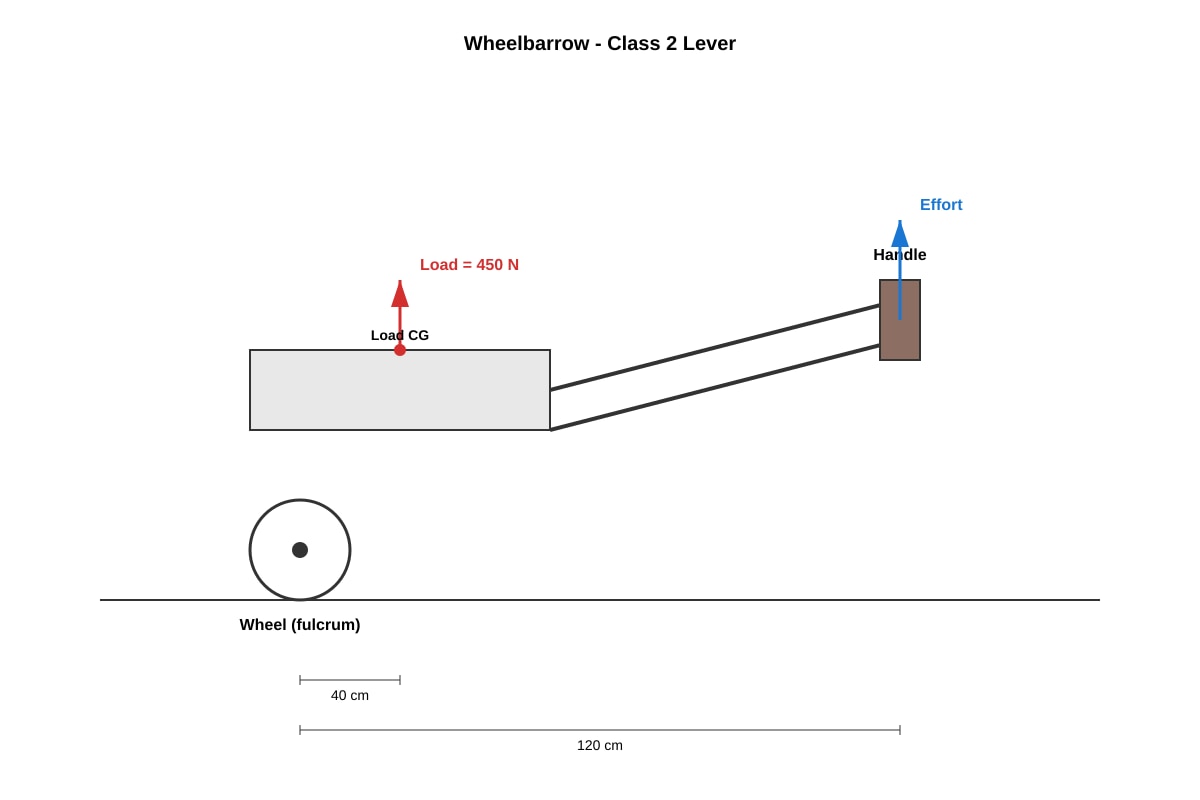
11. The diagram below shows a wheelbarrow with a load of 450 N. The centre of gravity of the load is 40 cm from the wheel (fulcrum). The handles are 120 cm from the wheel. A gardener lifts the handles to move the wheelbarrow. [4 marks]

<image_placeholder> id: Q11-fig1 type: diagram linked_question: Q11 description: Side view of wheelbarrow showing fulcrum at wheel, load between handles and wheel, effort applied at handles labels: Wheel (fulcrum) at left; Load CG marked; Handle at right; distances marked values: Load = 450 N, load distance from fulcrum = 40 cm, handle distance from fulcrum = 120 cm must_show: Triangle/wheel shape for wheel, rectangular tray, load arrow downward at CG, effort arrow upward at handle, dimension lines with values </image_placeholder>

(a) Calculate the effort force the gardener must apply at the handles to just lift the wheelbarrow. Assume the weight of the wheelbarrow itself is negligible. [2]


(b) The gardener moves the load so that its centre of gravity is now 25 cm from the wheel. Explain how this affects the effort needed to lift the wheelbarrow. [2]


12. An electric motor is used to lift a mass of 50 kg through a vertical height of 3 m. The motor operates with an efficiency of 80%. [4 marks]

(a) Calculate the useful work done in lifting the mass. (Take g = 10 N/kg) [2]


(b) Calculate the total energy input to the motor. [2]


13. A student designs an experiment to investigate how the surface area of a parachute affects the time it takes to fall a fixed distance. [4 marks]

(a) State the independent variable and the dependent variable in this investigation. [2]


(b) Suggest two controlled variables that must be kept constant for a fair test. [1]


(c) Explain how air resistance affects the motion of the parachute as it falls. [1]


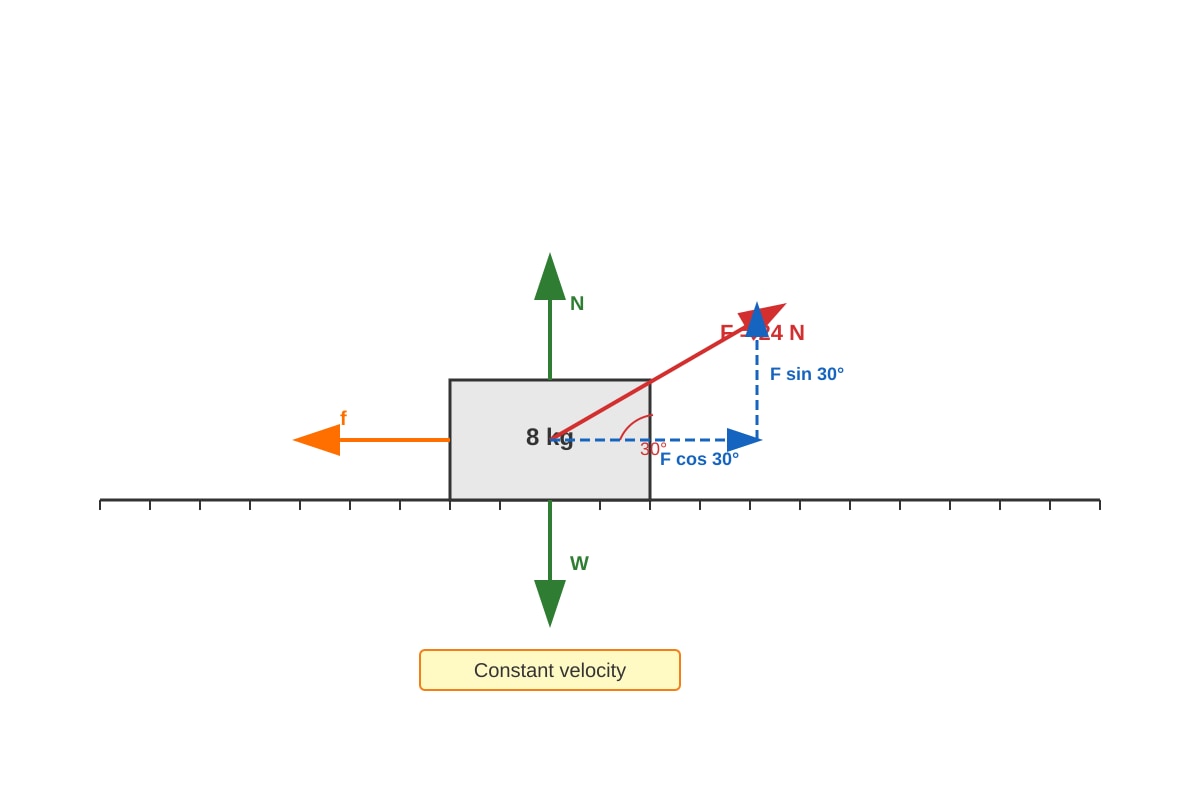
14. The diagram shows a block of mass 8 kg being pulled along a horizontal surface by a force of 24 N at an angle of 30° to the horizontal. The block moves at constant velocity. [3 marks]

<image_placeholder> id: Q14-fig1 type: diagram linked_question: Q14 description: Block on horizontal surface with angled pull, showing components of force labels: Block with mass labelled; Pulling force F = 24 N at 30° above horizontal; horizontal and vertical components indicated with dashed lines; friction arrow opposing motion values: Mass = 8 kg, F = 24 N, angle = 30°, constant velocity stated must_show: Rectangular block, horizontal surface, angled force arrow, component arrows (dashed), friction arrow opposite to motion direction, weight arrow downward </image_placeholder>

(a) Calculate the horizontal component of the pulling force. [1]


(b) Determine the magnitude of the frictional force acting on the block. Explain your answer. [2]


SECTION C: Extended Response (Questions 15–20)

30 marks


15. A hydroelectric power station uses falling water to generate electricity. Water is stored in a reservoir at a height of 150 m above the turbines. [5 marks]

(a) State the main energy conversions that take place from the water in the reservoir to the electrical energy output. [2]


(b) Explain why not all the gravitational potential energy of the water is converted into electrical energy. [2]


(c) Suggest one way to increase the power output of the hydroelectric station without changing the height of the reservoir. [1]


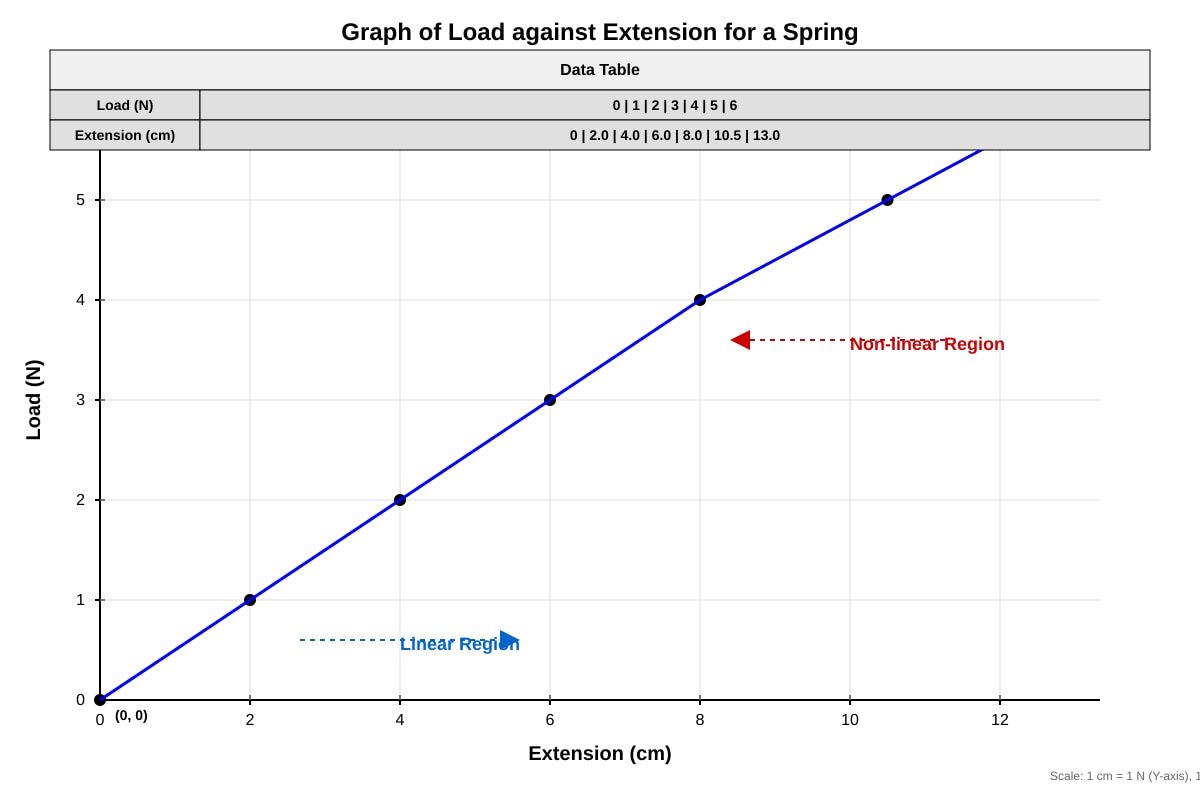
16. A student investigates the relationship between the load and extension of a spring. The results are recorded in the table below. [5 marks]

Load (N)0123456
Extension (cm)02.04.06.08.010.513.0

<image_placeholder> id: Q16-fig1 type: graph linked_question: Q16 description: Graph of load against extension for spring, showing linear then non-linear region labels: x-axis: Extension (cm); y-axis: Load (N); origin at (0,0); data points plotted and joined with straight lines values: Points at (0,0), (2,1), (4,2), (6,3), (8,4), (10.5,5), (13,6) must_show: Axes with correct labels and units, evenly spaced scales, all data points accurately placed, lines connecting points, linear region clearly distinguishable from non-linear region </image_placeholder>

(a) Plot a graph of load against extension using the data provided. [2]

(Use the grid below for your graph)

      Load (N)
      6  |                                        
      5  |                                        
      4  |                                        
      3  |                                        
      2  |                                        
      1  |                                        
      0  +--+--+--+--+--+--+--+--+--+--+--+--+--+
          0  2  4  6  8  10 12 14 16
                Extension (cm)

(b) Use your graph to determine the extension produced by a load of 3.5 N. [1]


(c) Explain why the student should not use this spring to measure loads greater than 4 N if the spring is to be used as a reliable measuring device. [2]


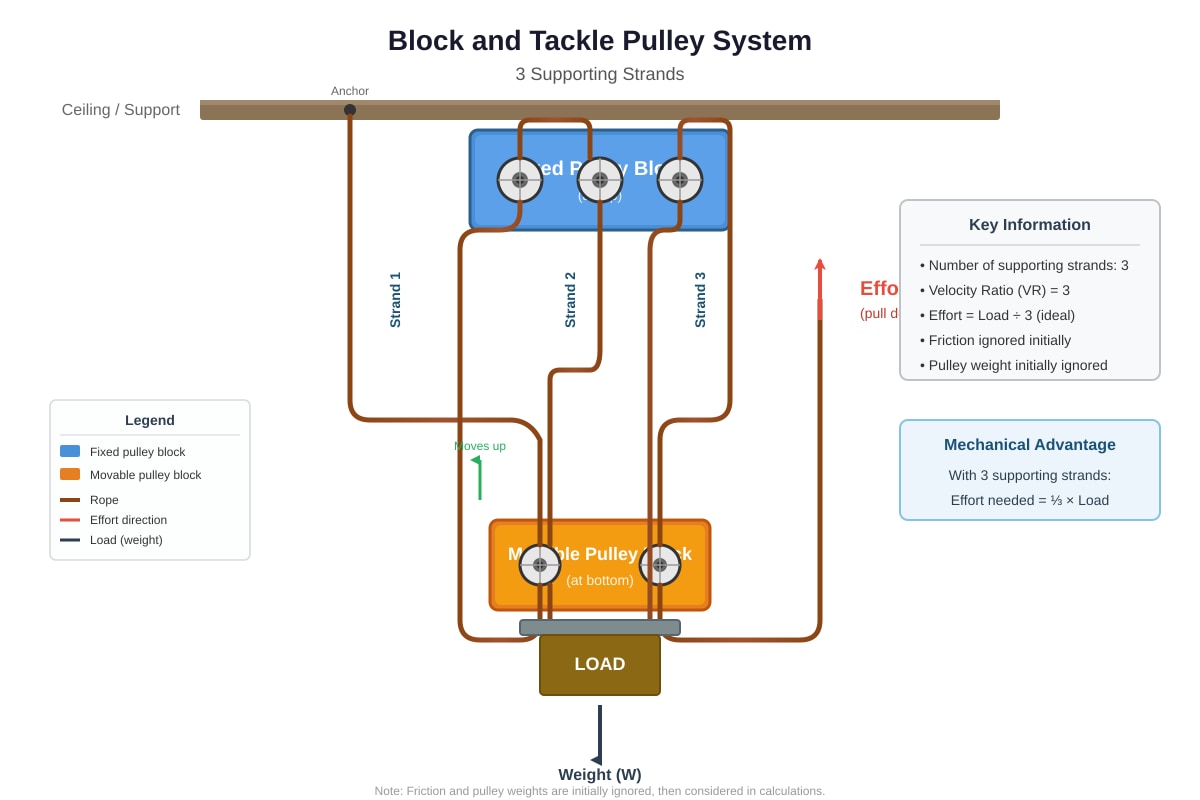
17. The diagram shows a block and tackle system with three supporting ropes used to raise a load. [5 marks]

<image_placeholder> id: Q17-fig1 type: diagram linked_question: Q17 description: Block and tackle pulley system with upper fixed block and lower movable block, three supporting strands labels: Fixed pulley block at top; Movable pulley block at bottom attached to load; Effort rope direction indicated; Load marked; three distinct supporting ropes between blocks values: System has 3 supporting strands; friction and pulley weights initially ignored then considered must_show: Two pulley blocks, rope threading clearly showing three supporting segments between blocks, load arrow downward, effort direction arrow, clear labelling of pulley types </image_placeholder>

(a) Explain why this system allows a smaller effort to lift a heavy load, using the concept of distance sacrificed. [2]


(b) A load of 600 N is to be raised using this system. Calculate: [2]

(i) The theoretical effort required if the system is 100% efficient. [1]


(ii) The actual effort required if the efficiency of the system is 75%. [1]


(c) Explain why the actual efficiency of any pulley system is always less than 100%. [2]


18. Two tugs pull a barge along a canal. Tug A exerts a force of 8000 N in a direction 40° east of north. Tug B exerts a force of 6000 N in a direction 30° west of north. [5 marks]

(a) Sketch a scale diagram or use calculation to determine the magnitude of the resultant force. [3]

(Show your construction lines or working clearly)


(b) Determine the direction of the resultant force relative to north. [1]


(c) State one assumption you have made in determining your answer to part (a). [1]


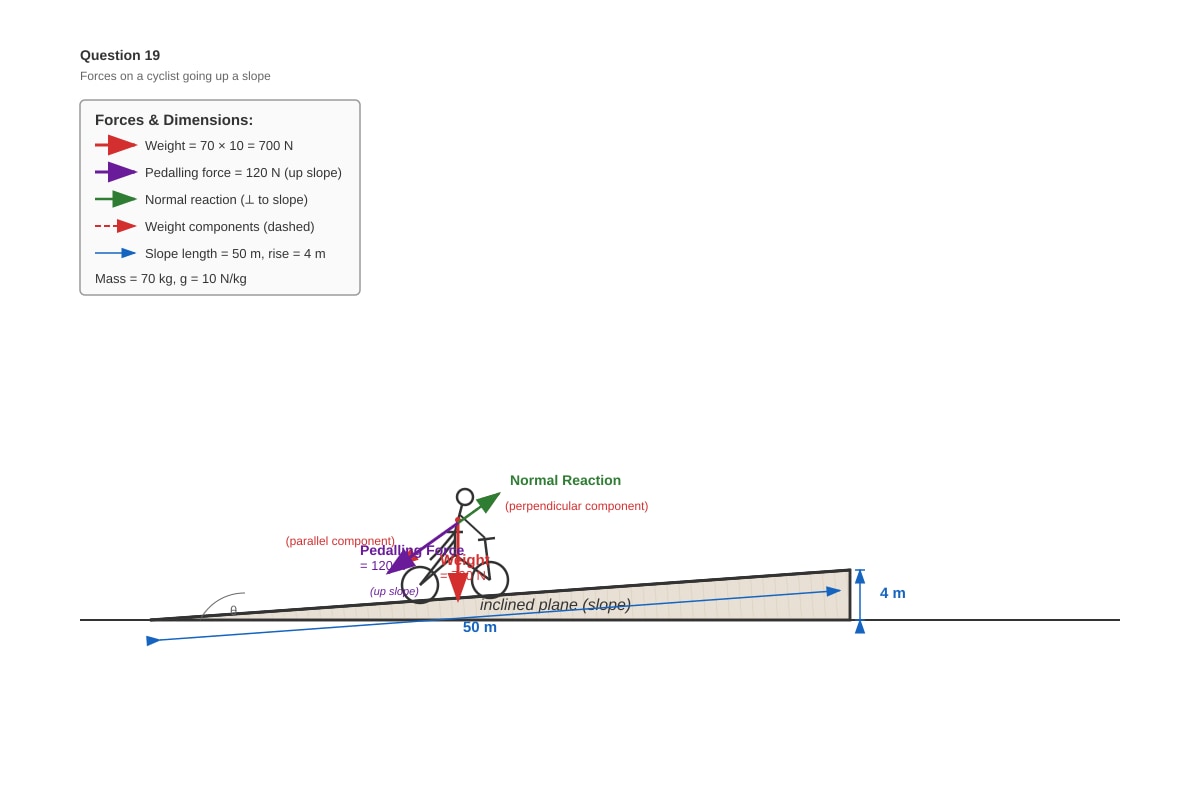
19. A cyclist and bicycle have a combined mass of 70 kg. The cyclist rides up a slope that is 50 m long and rises vertically through 4 m. The cyclist pedals with a constant force of 120 N to maintain a steady speed up the slope. [5 marks]

<image_placeholder> id: Q19-fig1 type: diagram linked_question: Q19 description: Cyclist on slope showing dimensions and forces labels: Slope as inclined plane; length along slope = 50 m; vertical rise = 4 m; weight arrow vertically downward; parallel component along slope shown; normal reaction perpendicular to slope; pedalling force up slope values: Mass = 70 kg, slope length = 50 m, vertical rise = 4 m, pedalling force = 120 N, g = 10 N/kg must_show: Inclined plane at shallow angle, dimension arrows for slope length and vertical rise, weight arrow from cyclist's CG vertically down, component arrows (dashed), pedalling force arrow parallel up slope </image_placeholder>

(a) Calculate the increase in gravitational potential energy of the cyclist and bicycle. [2]


(b) Calculate the work done by the cyclist against the component of weight down the slope. [2]


(c) Using your answer to part (b), explain why the total work done by the cyclist pedalling is greater than your answer in part (b). [1]


20. Read the following information about energy resources and answer the questions that follow. [5 marks]

Singapore has limited renewable energy options due to its small land area and lack of natural resources. However, solar panels are increasingly installed on rooftops. Some buildings use air-conditioning systems that are designed to be more energy efficient. The government also promotes the use of energy-efficient appliances through the Mandatory Energy Labelling Scheme.

(a) Explain why solar energy is considered a renewable energy source. [1]


(b) Describe two ways that air-conditioning systems can be designed to reduce energy consumption. [2]


(c) A household replaces an old refrigerator rated at 500 W with a new energy-efficient model rated at 300 W. Both refrigerators operate for 8 hours per day. Calculate the energy saved in one year (365 days) due to this replacement. Express your answer in kWh. [2]


END OF PAPER

Answers

<!-- TuitionGoWhere generation metadata: stage=3-1; model=moonshotai/kimi-k2.6:free; model_label=Kimi K2.6 Free; generated=2026-06-07; Sources: Stage 2-1 real exam-derived templates and Stage 2-2 exam-enriched syllabus. -->

TuitionGoWhere Practice Paper - Science Secondary 1

SA2 Practice Paper Version 2 of 5 — Answer Key

Subject: Science
Level: Secondary 1 (G3)
Total Marks: 60 marks


SECTION A: Multiple Choice

QuestionAnswerExplanation
1BWhen lifting at constant speed, kinetic energy does not change. The student's muscles convert chemical energy (from food) into gravitational potential energy of the box. Common trap: Option C ignores that the initial energy source is chemical, not kinetic.
2AWork done = force × distance moved in direction of force. Since distance moved = 0, work done = 0 J. Holding an object stationary requires force but does no work.
3BThe principle of moments involves a turning effect about a pivot. A balanced seesaw demonstrates clockwise moment = anticlockwise moment. Other options involve linear motion, not rotation.
4AEfficiency = (useful energy output / total energy input) × 100%. This measures how much input energy is successfully converted to useful form.
5BMechanical Advantage (MA) = Load / Effort = 200 N / 50 N = 4. Note: Velocity Ratio = distance effort moves / distance load moves = 4 m / 0.5 m = 8. Do not confuse MA with VR.
6DMaximum resultant = 8 + 6 = 14 N (same direction). Minimum resultant = 8 − 6 = 2 N (opposite directions). Any value between 2 N and 14 N is possible. 15 N exceeds the maximum possible resultant.
7CFor ideal pulley with n supporting strands: Effort = Load / n = 400 N / 4 = 100 N.
8BLubricants reduce friction between moving parts. Friction causes energy loss as heat; reducing friction increases efficiency but does not change the mechanical advantage, speed, or load.

Section A Total: 8 marks


SECTION B: Structured Response


9. [Total: 3 marks]

(a) Distance = 50 − 30 = 20 cm (or 0.20 m) [1]

The perpendicular distance is measured from the pivot (50 cm mark) to the line of action of the 2 N weight at the 30 cm mark.

(b) The principle of moments (or: the sum of clockwise moments equals the sum of anticlockwise moments when an object is in equilibrium) [1]

(c) By principle of moments: Clockwise moment = Anticlockwise moment [1]

2 N×20 cm=4 N×d2 \text{ N} \times 20 \text{ cm} = 4 \text{ N} \times d

d=2×204=10 cmd = \frac{2 \times 20}{4} = 10 \text{ cm} from the pivot

Position = 50 + 10 = 60 cm mark

Common error: Placing at 40 cm instead of 60 cm (forgetting which side of pivot).


10. [Total: 4 marks]

(a) Kinetic energy = 12mv2\frac{1}{2}mv^2 [1 for formula + substitution]

=12×1200 kg×(20 m/s)2= \frac{1}{2} \times 1200 \text{ kg} \times (20 \text{ m/s})^2

=12×1200×400= \frac{1}{2} \times 1200 \times 400

=240000 J= \mathbf{240\,000 \text{ J}} (or 240 kJ) [1]

(b) Kinetic energy → Thermal energy (heat) in the brakes and surroundings [1]

The friction in the brake pads converts the kinetic energy of the car into heat, dissipating it to the environment.

(c) By work-energy theorem, work done by braking force = change in kinetic energy = 240 000 J (or 240 kJ) [1]

The braking force does negative work, removing all the kinetic energy the car had.


11. [Total: 4 marks]

(a) By principle of moments: [1 for correct equation]

Clockwise moment = Anticlockwise moment

450 N×40 cm=E×120 cm450 \text{ N} \times 40 \text{ cm} = E \times 120 \text{ cm}

E=450×40120=18000120=150 NE = \frac{450 \times 40}{120} = \frac{18\,000}{120} = \mathbf{150 \text{ N}} [1]

(b) Moving load closer to fulcrum (25 cm instead of 40 cm): [1 for identifying change]

The clockwise moment decreases because the perpendicular distance from the pivot decreases (450×25=11250450 \times 25 = 11\,250 N cm, compared to 450×40=18000450 \times 40 = 18\,000 N cm). [1]

Since clockwise moment is smaller, a smaller anticlockwise moment (hence smaller effort) is needed to balance it. The effort needed decreases.


12. [Total: 4 marks]

(a) Useful work done = increase in gravitational potential energy = mghmgh [1]

=50 kg×10 N/kg×3 m= 50 \text{ kg} \times 10 \text{ N/kg} \times 3 \text{ m}

=1500 J= \mathbf{1500 \text{ J}} [1]

(b) Efficiency = useful work outputtotal energy input×100%\frac{\text{useful work output}}{\text{total energy input}} \times 100\% [1]

80%=1500Einput×100%80\% = \frac{1500}{E_{input}} \times 100\%

Einput=1500×10080=1875 JE_{input} = \frac{1500 \times 100}{80} = \mathbf{1875 \text{ J}} [1]

Teaching note: The extra 375 J is lost mainly as heat due to friction and motor heating.


13. [Total: 4 marks]

(a) Independent variable: The surface area of the parachute [1]

**Dependent variable:** The time taken to fall a fixed distance [1]

(b) Any two from: [1 for both correct]

  • Mass of the parachute/load
  • Height from which the parachute is dropped
  • Shape of the parachute (when open)
  • Material of the parachute

(c) Air resistance (drag) acts upwards, opposing the motion of the parachute. [1]

As the parachute falls, air resistance increases with speed until it balances the weight, causing the parachute to reach a constant (terminal) velocity. A larger surface area creates greater air resistance, leading to a slower descent.


14. [Total: 3 marks]

(a) Horizontal component = Fcosθ=24 N×cos30°=24×0.866=20.8 NF \cos \theta = 24 \text{ N} \times \cos 30° = 24 \times 0.866 = \mathbf{20.8 \text{ N}} (or ~20.8 N, accept 20.4–21.0 N depending on rounding) [1]

(b) Since the block moves at constant velocity, the net force is zero (Newton's first law / equilibrium). [1]

The horizontal component of the pulling force is balanced by friction.

Therefore, frictional force = 20.8 N (same value as part (a)), acting opposite to the direction of motion. [1]


Section B Total: 22 marks


SECTION C: Extended Response


15. [Total: 5 marks]

(a) Gravitational potential energy → Kinetic energy → Electrical energy [2]

The water at height possesses gravitational potential energy. As it falls, this converts to kinetic energy of moving water. The moving water turns turbines, which transfer kinetic energy to generators that produce electrical energy. Accept: including sound/thermal as intermediate losses if mentioned correctly.

(b) Energy is lost to: [2 marks for any two valid points with explanation]

  • Friction in the turbines and pipes (converted to thermal energy)
  • Sound energy produced by moving machinery
  • Heat generated in the generator due to electrical resistance
  • Some water may not fall through the optimal path (turbine design limitations)

Marking: 1 mark per distinct energy loss mechanism, 1 mark for explaining it reduces useful electrical output.

(c) Increase the mass/volume of water flowing through the turbines per second (or: increase the flow rate) [1]

Power = energy/time = (mgh)/t. Without changing h, increasing mass flow rate (m/t) increases power output.


16. [Total: 5 marks]

(a) Graph marking points: [2]

  • Correct axes with labels and units: Load (N) vs Extension (cm) [0.5]
  • Correct scale and origin starting at (0,0) [0.5]
  • All data points accurately plotted [0.5]
  • Best-fit straight lines showing two distinct regions [0.5]

Expected: straight line through origin to (8, 4), then distinctly different gradient from (8,4) to (13, 6).

(b) From graph: load of 3.5 N falls in linear region. Extension ≈ 7.0 cm [1]

(Accept 6.8–7.2 cm depending on graph reading; proportional: 3.5/1 × 2.0 = 7.0 cm)

(c) Beyond 4 N (extension 8.0 cm), the spring shows non-linear behaviour [1]

The load-extension graph is no longer a straight line through the origin, indicating the spring has exceeded its limit of proportionality / elastic limit. [1]

For a reliable measuring device, we need a linear (proportional) relationship so that scale markings are evenly spaced. Above 4 N, equal changes in load do not produce equal changes in extension.


17. [Total: 5 marks]

(a) With 3 supporting strands, the load is supported by 3 sections of rope sharing the tension. [1]

The effort only needs to pull with 1/3 of the load force, but in return, the effort must move through 3 times the distance the load rises (distance sacrificed). Work input = Work output for ideal case, so smaller force requires greater distance. [1]

(b)(i) Ideal effort = Loadn=6003=200 N\frac{\text{Load}}{n} = \frac{600}{3} = \mathbf{200 \text{ N}} [1]

(b)(ii) Efficiency = Mechanical AdvantageVelocity Ratio×100%\frac{\text{Mechanical Advantage}}{\text{Velocity Ratio}} \times 100\% or: useful worktotal work\frac{\text{useful work}}{\text{total work}}

Actual effort = Ideal effortefficiency=2000.75=266.7 N\frac{\text{Ideal effort}}{\text{efficiency}} = \frac{200}{0.75} = \mathbf{266.7 \text{ N}} (or 267 N) [1]

(c) Efficiency < 100% because: [2 marks for any two valid points]

  • Friction in the pulley bearings requires extra effort work
  • Weight of the moving pulley block must also be lifted
  • Rope stiffness/stretch absorbs some energy
  • Air resistance on moving parts (minor effect)

18. [Total: 5 marks]

(Scale diagram method or calculation method both acceptable)

(a) Scale diagram method: [3]

  • Choose scale (e.g., 1 cm = 1000 N or 1 cm = 500 N) [0.5]
  • Draw vectors to scale at correct angles: 40° east of north and 30° west of north [1]
  • Complete parallelogram and draw diagonal, OR use head-to-tail method [1]
  • Measure resultant: approximately 12,400 N (or 12 000–12 800 N acceptable due to measurement variation) [0.5]

Calculation method (resolving):

Component north from A: 8000cos40°=8000×0.766=61288000 \cos 40° = 8000 \times 0.766 = 6128 N Component east from A: 8000sin40°=8000×0.643=51428000 \sin 40° = 8000 \times 0.643 = 5142 N

Component north from B: 6000cos30°=6000×0.866=51966000 \cos 30° = 6000 \times 0.866 = 5196 N Component west from B: 6000sin30°=6000×0.5=30006000 \sin 30° = 6000 \times 0.5 = 3000 N

Total north: 6128+5196=11,3246128 + 5196 = 11,324 N Net east: 51423000=21425142 - 3000 = 2142 N (east)

Resultant = 11,3242+21422=1.283×10⁸+4.59×106=1.329×10811,530 N\sqrt{11,324^2 + 2142^2} = \sqrt{1.283 \times 10^8 + 4.59 \times 10^6} = \sqrt{1.329 \times 10^8} \approx \mathbf{11,530 \text{ N}}

Accept answers in range 11,000–13,000 N depending on method and rounding.

(b) Direction: tanθ=214211,324=0.189\tan \theta = \frac{2142}{11,324} = 0.189, so θ10.7°\theta \approx \mathbf{10.7°} east of north (accept 10°–12°) [1]

(c) Assumption: The two forces act in the same vertical plane / simultaneously / from the same point [1]

Alternative acceptable answers: No other forces act on the barge; water resistance is negligible; the barge moves slowly so acceleration effects are negligible.


19. [Total: 5 marks]

(a) GPE = mghmgh [1 for formula + substitution]

=70 kg×10 N/kg×4 m= 70 \text{ kg} \times 10 \text{ N/kg} \times 4 \text{ m}

=2800 J= \mathbf{2800 \text{ J}} [1]

(b) Work against component of weight = force × distance [1]

The component of weight parallel to slope = mgsinθ=70×10×450=70×10×0.08=56mg \sin \theta = 70 \times 10 \times \frac{4}{50} = 70 \times 10 \times 0.08 = 56 N

OR: Work = GPE gained = 2800 J (since no acceleration, and assuming no friction) — but careful: this equals total work against gravity, not just the pedalling against the component.

Actually: if friction exists, work done against weight component = 56×50=280056 \times 50 = 2800 J [1]

However, this equals the GPE gain. The cyclist does 2800 J of work just to overcome gravity.

(c) The total work done by the cyclist is greater because: [1]

The cyclist must also do work against frictional forces (air resistance, rolling resistance) in addition to overcoming the component of weight. The pedalling force (120 N over 50 m = 6000 J) exceeds the minimum needed for gravity alone, indicating significant resistance forces.


20. [Total: 5 marks]

(a) Solar energy is renewable because: [1]

The Sun's energy is continuously replenished and will last for billions of years. It is not depleted by human use, unlike fossil fuels which take millions of years to form.

(b) Two design features for efficiency: [2]

  • Variable speed compressors that adjust cooling output to match demand, rather than running at full power continuously [1]
  • Heat recovery systems that reuse waste heat for water heating [1]
  • Better insulation of cooled spaces to reduce heat gain from outside [1]
  • Smart thermostats that optimize cooling schedules [1]

(Any two valid, distinct points accepted)

(c) Energy saved per day: [2]

Old: E=Pt=500 W×8 h=4000 Wh=4 kWhE = Pt = 500 \text{ W} \times 8 \text{ h} = 4000 \text{ Wh} = 4 \text{ kWh}

New: E=300 W×8 h=2400 Wh=2.4 kWhE = 300 \text{ W} \times 8 \text{ h} = 2400 \text{ Wh} = 2.4 \text{ kWh}

Daily saving: 42.4=1.6 kWh4 - 2.4 = 1.6 \text{ kWh} [1]

Annual saving: 1.6×365=584 kWh1.6 \times 365 = \mathbf{584 \text{ kWh}} [1]

Alternative: Power difference = 200 W = 0.2 kW. Annual saving = 0.2 kW × 8 h × 365 = 584 kWh.


Section C Total: 30 marks


GRAND TOTAL: 60 MARKS

SectionMarks
A8
B22
C30
Total60