From Real Exams Exam Paper
Secondary 1 Science Semestral Assessment 2 (End of Year) Paper 2
Free Sec 1 Science SA2 Paper 2, HY3 Exam version, with questions, answers, and syllabus-aligned practice for Singapore students.
These static practice materials are generated from the site's syllabus and paper-generation workflow, with source and model context shown so students and parents can evaluate the material before use.
Questions
Free quiz and exam paper access
Enter your details to view this paper
Your access is remembered on this device.
Answers
TuitionGoWhere Exam Practice (AI) – SA2 Science Secondary 1 (Version 2) Answer Key
Total Marks: 60
Section A: Forces and Energy (24 marks)
1. [1 mark]
Chemical energy (in muscles) → Gravitational potential energy.
Teaching note: When raising, the boy’s muscles provide chemical energy which becomes stored as GPE of the book.
Common mistake: Stating only “potential energy” without conversion process.
2. [2 marks]
Work done = 0 J.
Working: Work = Force × displacement. Displacement = 0 (stationary), so Work = 20 N × 0 m = 0 J.
Marking: 1 mark for “0”, 1 mark for correct reason (no displacement).
Teaching note: Holding stationary means no movement, so no work is done on the bag.
3. [2 marks]
Work = Force × distance = 50 N × 4 m = 200 J.
Marking: 1 mark for formula/substitution, 1 mark for answer with unit.
Teaching note: Horizontal push uses same formula; force and motion same direction.
4. [2 marks]
Pressure increases. Weight (30 N) unchanged. Smallest face → smaller contact area. Pressure = Force ÷ Area, so smaller area gives larger pressure.
Marking: 1 mark for “pressure increases”, 1 mark for correct reasoning with formula link.
Common mistake: Saying force changes.
5. [2 marks]
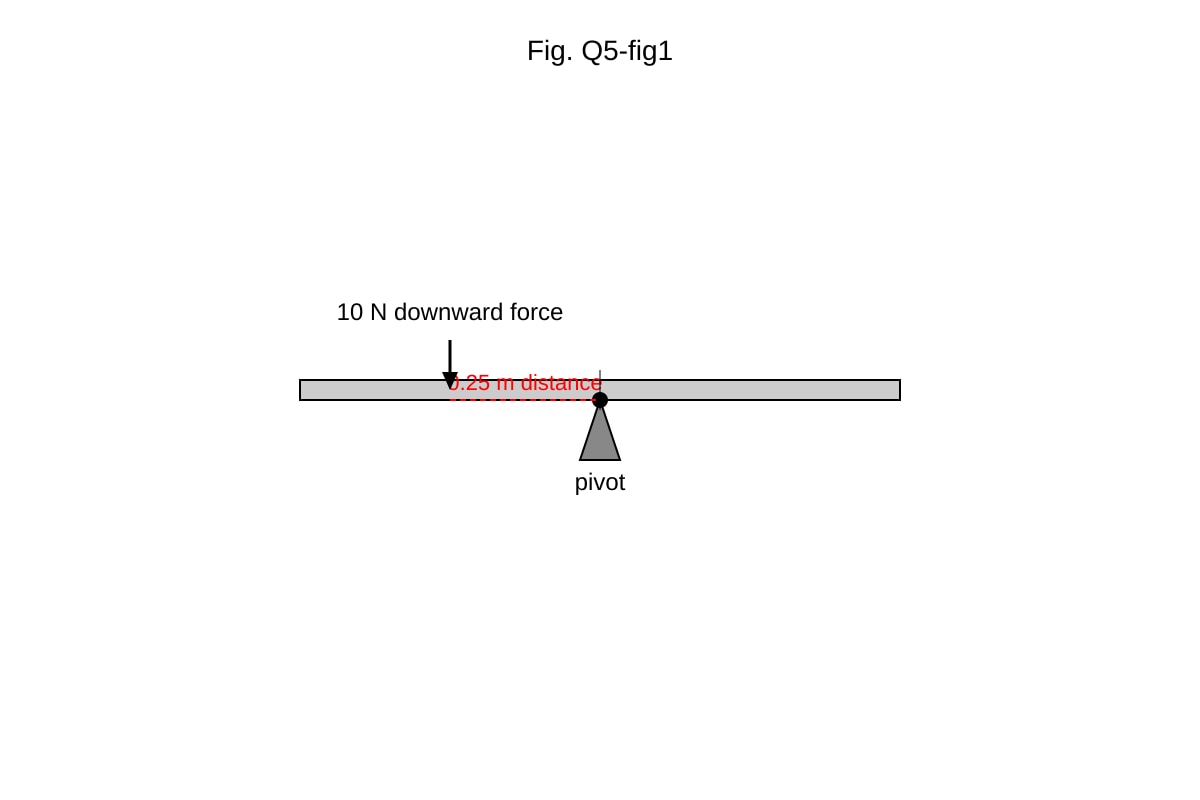
Moment = Force × perpendicular distance = 10 N × 0.25 m = 2.5 N·m.
Marking: 1 mark working, 1 mark answer with unit.
Teaching note: Use perpendicular distance from pivot.
6. [2 marks]
Example: crowbar / seesaw / scissors. It reduces effort needed by increasing distance from pivot (lever principle).
Marking: 1 mark example, 1 mark explanation.
7. [2 marks]
Work = Force × height = 500 N × 10 m = 5000 J (or 5 kJ).
Marking: 1 mark substitution, 1 mark answer.
8. [3 marks]
Renewable: biomass, hydropower, sun, wind (any two). Non-renewable: coal, crude oil, natural gas (one).
Marking: 2 marks for two renewable, 1 mark for one non-renewable.
Section B: Heat and Light (18 marks)
9. [2 marks]
Temperature measures degree of hotness; heat is energy that flows due to temperature difference.
Marking: 1 mark each.
10. [2 marks]
Metals expand when heated. Railway tracks lengthen and buckle if no gap.
Marking: 1 mark expansion, 1 mark buckling consequence.
11. [2 marks]
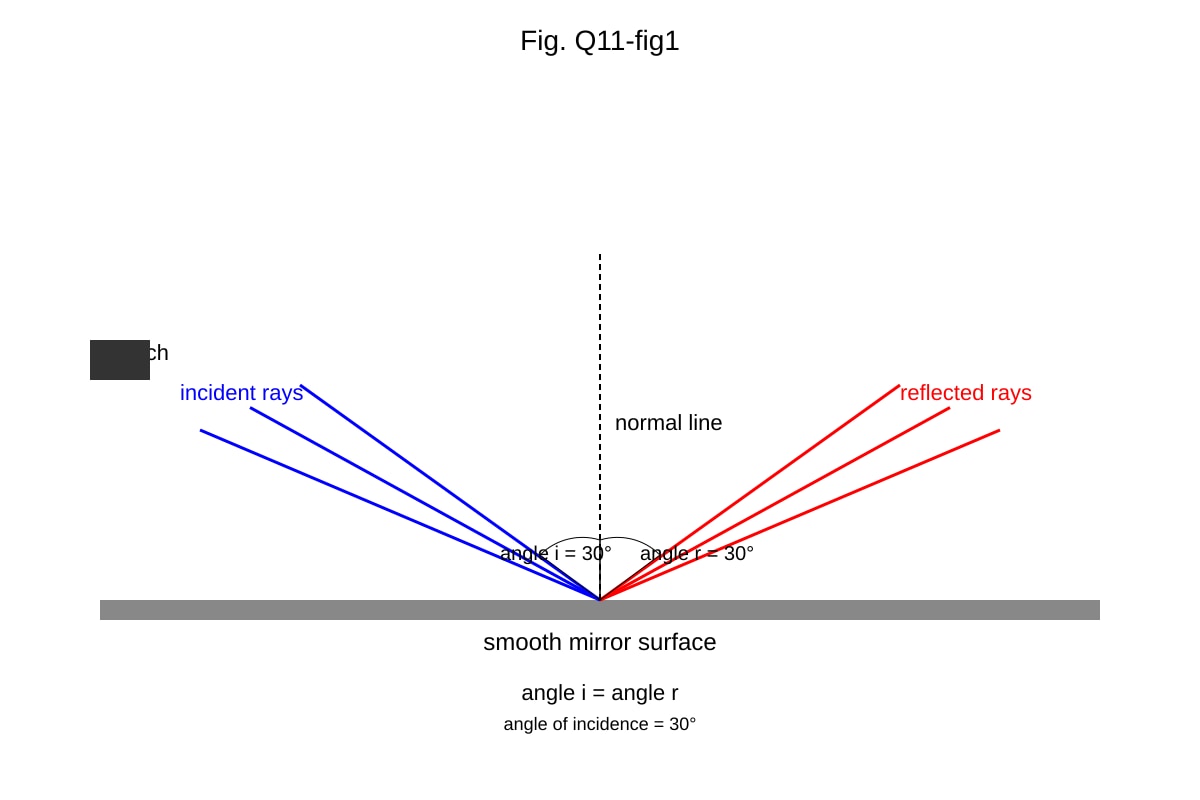
Reflected rays drawn with angle r = 30° (same as i). Law: angle of incidence = angle of reflection.
Marking: 1 mark ray drawn correctly, 1 mark law stated.
12. [1 mark]
Diffuse reflection – light scatters in many directions.
13. [1 mark]
Maintains temperature at a set value.
14. [2 marks]
Heat flows until both reach same temperature (thermal equilibrium).
Marking: 1 mark “same temperature”, 1 mark concept of equilibrium.
Section C: Electricity (18 marks)
15. [2 marks]
Current: ampere (A). Voltage: volt (V).
Marking: 1 mark each.
16. [2 marks]
Diagram: cell – switch – lamp – lamp – back to cell in one loop.
Marking: 1 mark symbols correct, 1 mark series arrangement.
17. [1 mark]
230 V.
18. [3 marks]
Features: fuse, circuit breaker, earth wire (any two). Function e.g. fuse melts to break circuit when current too high.
Marking: 2 marks names, 1 mark function.
19. [2 marks]
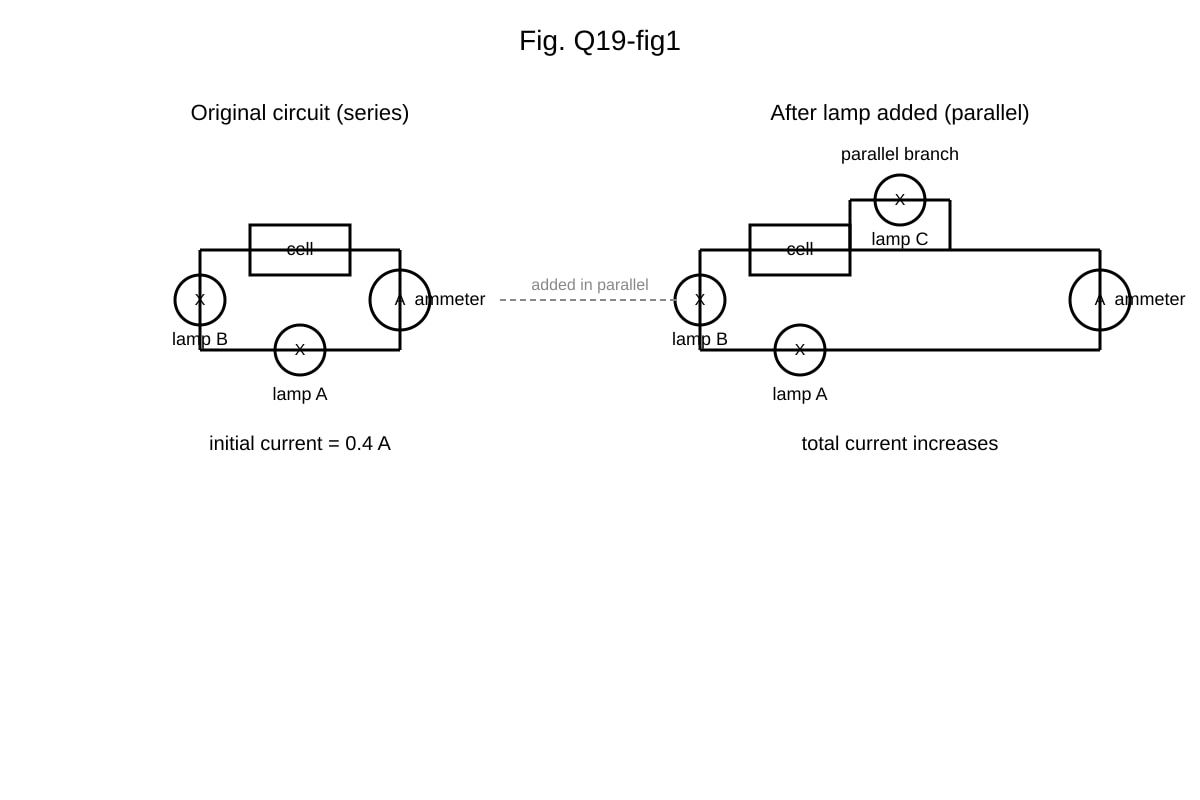
Total current increases because parallel branch provides extra path for current.
Marking: 1 mark increase, 1 mark reason.
20. [2 marks]
Fuse protects circuit by melting when current exceeds safe value, breaking circuit.
Marking: 1 mark purpose, 1 mark mechanism.