From Real Exams Exam Paper
Secondary 1 Science Semestral Assessment 2 (End of Year) Paper 2
Free Sec 1 Science SA2 Paper 2, Exam version, with questions, answers, and syllabus-aligned practice for Singapore students.
These static practice materials are generated from the site's syllabus and paper-generation workflow, with source and model context shown so students and parents can evaluate the material before use.
Questions
Free quiz and exam paper access
Enter your details to view this paper
Your access is remembered on this device.
Answers
TuitionGoWhere Practice Paper - Science Secondary 1 SA2 (Version 2)
Answer Key and Marking Scheme
Section A: Multiple Choice Questions [10 marks]
1 mark each
1. D) 0 J
- Work = Force × Displacement. Since the book is held stationary, displacement = 0, therefore work = 0 J
2. B) Chemical energy → Kinetic energy → Gravitational potential energy
- Chemical energy in muscles converts to kinetic energy of the moving ball, which converts to gravitational potential energy as it rises
3. B) Increases because the contact area decreases
- Pressure = Force ÷ Area. Force (weight) remains constant, but smaller contact area increases pressure
4. A) 6.0 N⋅m
- Moment = Force × Perpendicular distance = 20 N × 0.3 m = 6.0 N⋅m
5. B) Diffuse with rays scattered in different directions
- Rough surfaces cause diffuse reflection where light rays scatter in multiple directions
Section B: Structured Questions [45 marks]
6. Mixture Separation [8 marks]
(a) Immiscible [1 mark]
- Oil and water do not mix/dissolve in each other
(b) Separating funnel [1 mark]
- Accept: separatory funnel
(c) Oil has a lower density than water [1 mark], so it floats on top [1 mark]
- Accept: oil is less dense than water
(d) No [1 mark]. Ethanol and water are miscible/mix completely [1 mark], so they cannot be separated using a separating funnel. Fractional distillation would be needed instead.
- Accept: they have different boiling points so distillation is needed
(e) Any two from: [2 marks, 1 each]
- Keep away from flames/heat sources
- Use in well-ventilated area
- Wear safety goggles/eye protection
- Wear protective gloves
- Do not inhale vapors
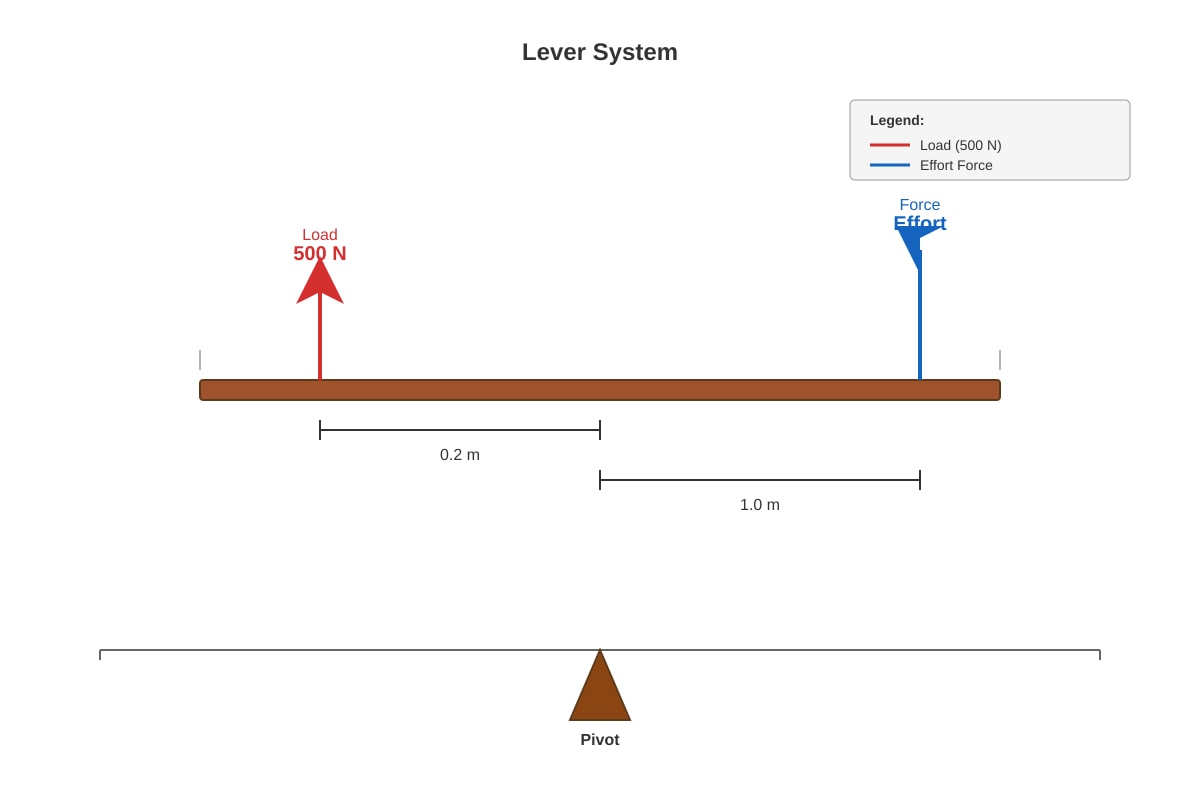
7. Lever System [10 marks]
(a) Moment = Force × Distance [1 mark] = 500 N × 0.2 m = 100 N⋅m [1 mark]
(b) For balance: Clockwise moment = Anticlockwise moment [1 mark] Effort × 1.0 m = 100 N⋅m Effort force = 100 N [1 mark]
(c) Chemical energy (in muscles) → Gravitational potential energy (of the load) [2 marks]
- Accept: Chemical energy → Kinetic energy → Gravitational potential energy
(d) Work done = Force × Distance [1 mark] = 500 N × 0.1 m = 50 J [1 mark]
(e) Energy is lost due to friction [1 mark] at the pivot/moving parts [1 mark]
- Accept: some energy is wasted as heat/sound
8. Chromatography [12 marks]
(a) Different substances have different solubilities [1 mark] in the solvent, so they travel different distances [1 mark]
- Accept: components move at different rates through the medium
(b) Drink A shows three separate spots/bands [1 mark] indicating three different dyes [1 mark]. Drink B shows only one spot/band indicating one dye [1 mark]
- Accept: number of spots equals number of components
(c) More polar solvent would dissolve polar dyes better [1 mark], causing them to travel further/change the separation pattern [1 mark]
- Accept: different solvent gives different Rf values
(d) Any two from: [2 marks, 1 each]
- Requires only small sample size
- Quick/rapid analysis
- Can identify multiple components simultaneously
- Sensitive technique
- Relatively inexpensive
(e) Banned colors may be harmful to health [1 mark]. Early detection prevents these substances from reaching consumers [1 mark]. Protects public from potential toxic effects [1 mark]
- Accept: ensures food safety standards are met
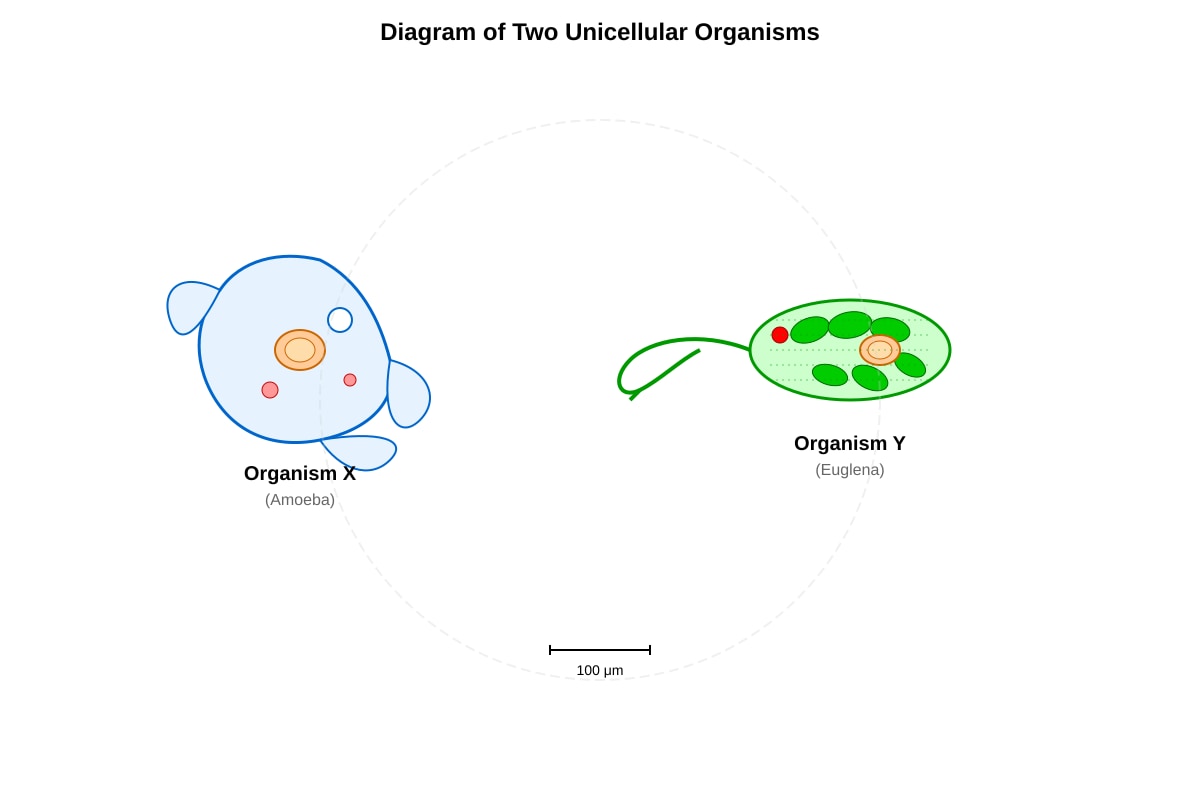
9. Unicellular Organisms [15 marks]
(a) Total magnification = 10 × 40 = 400× [1 mark]
(b) Actual length = Image size ÷ Magnification [1 mark] = 8 mm ÷ 400 = 0.02 mm = 20 μm [1 mark]
- Accept: 8000 μm ÷ 400 = 20 μm
(c) Any one from: [1 mark]
- Organism Y has flagellum, X does not
- Organism Y has chloroplasts, X does not
- Different shape/structure
(d) Flagellum: Allows rapid movement [1 mark] in a directed manner/towards stimuli [1 mark] Pseudopodia: Allows movement in any direction [1 mark], can engulf food particles during movement [1 mark]
- Accept: flagellum is more energy efficient; pseudopodia allows feeding while moving
(e) Organism Y can photosynthesize [1 mark] using chloroplasts to make its own food from light energy [1 mark]. Organism X must obtain food from the environment/by ingesting other organisms [1 mark]
- Accept: Y is autotrophic, X is heterotrophic
(f) Unicellular means: Made of only one cell [1 mark] Next level: Tissue [1 mark]
- Accept: multicellular organism for next level
(g) Any two from: [2 marks, 1 each]
- Cell membrane
- Cytoplasm
- Nucleus/genetic material
- Can reproduce
- Can respond to stimuli
- Carry out life processes
Section C: Data Analysis and Experimental Design [15 marks]
10. Dissolving Rate Investigation [15 marks]
(a) If temperature increases, then the time to dissolve will decrease [1 mark] because higher temperature increases particle movement/collision rate [1 mark]
- Accept: As temperature increases, sugar dissolves faster
(b) Independent variable: Temperature [1 mark] Dependent variable: Time to dissolve completely [1 mark]
(c) Any three from: [3 marks, 1 each]
- Amount/mass of sugar
- Volume of water
- Size of sugar crystals/particle size
- Method of stirring
- Type of container
- Pressure
(d) As temperature increases, dissolving time decreases [1 mark]. The relationship is inverse/negative [1 mark]
- Accept: higher temperature leads to faster dissolving
(e) The conclusion is supported [1 mark]. The data shows that as temperature increases from 20°C to 60°C, the dissolving time decreases from 180s to 45s [1 mark]. This shows that higher temperature increases the rate of dissolving (shorter time = faster rate) [1 mark]
(f) Any one from: [1 mark]
- Repeat the experiment multiple times and calculate average
- Use more temperature values
- Use a stopwatch for more accurate timing
- Ensure complete mixing
(g) Approximately 30-35 seconds [1 mark]
- Accept: any reasonable extrapolation from the pattern
(h) Higher temperature gives particles more kinetic energy [1 mark], so they move faster and collide more frequently, increasing the rate of dissolving
- Accept: particles vibrate more at higher temperature
Marking Guidelines
Total: 70 marks
Grade Boundaries (Suggested):
- A: 63-70 marks (90-100%)
- B: 56-62 marks (80-89%)
- C: 49-55 marks (70-79%)
- D: 42-48 marks (60-69%)
- E: 35-41 marks (50-59%)
- F: Below 35 marks (<50%)
Common Marking Notes:
- Award marks for correct method even if final answer is wrong
- Accept alternative correct answers not listed in mark scheme
- Deduct marks for missing units where specified
- Award partial marks for partially correct explanations
- Look for evidence of understanding rather than exact wording