From Real Exams Exam Paper
Secondary 1 Science Semestral Assessment 2 (End of Year) Paper 1
Free Nemo AI-generated Sec 1 Science SA2 Paper 1 with questions, answers, and syllabus-aligned practice for Singapore students preparing for exams.
These static practice materials are generated from the site's syllabus and paper-generation workflow, with source and model context shown so students and parents can evaluate the material before use.
Questions
TuitionGoWhere Practice Paper - Science Secondary 1
TuitionGoWhere Secondary School (AI)
Subject: Science
Level: Secondary 1 (G3)
Paper: SA2 Practice Paper Version 1
Duration: 1 hour 30 minutes
Total Marks: 60
Name: ________________________
Class: ________________________
Date: ________________________
Instructions to Candidates
- Write your name, class, and date in the spaces provided above.
- Answer all questions.
- Write your answers in the spaces provided on the question paper.
- The number of marks is given in brackets [ ] at the end of each question or part question.
- The total number of marks for this paper is 60.
- You may use a calculator.
- Where appropriate, show your working clearly.
Section A: Multiple Choice Questions [10 marks]
Answer all questions. For each question, choose the correct answer and write the letter (A, B, C, or D) in the box provided.
Question 1 [1]
A student lifts a 5 N book from the floor to a shelf 1.2 m above the floor at constant velocity. What is the work done by the student on the book?
A. 0 J
B. 4.2 J
C. 6.0 J
D. 7.2 J
Answer: \fbox{\phantom{A}}
Question 2 [1]
Which of the following energy conversions takes place when a compressed spring is released and pushes a toy car forward along a horizontal floor?
A. Elastic potential energy → Kinetic energy
B. Kinetic energy → Elastic potential energy
C. Gravitational potential energy → Kinetic energy
D. Chemical energy → Kinetic energy
Answer: \fbox{\phantom{A}}
Question 3 [1]
A force of 15 N is applied to push a box 4 m across a rough floor. The frictional force acting on the box is 5 N. What is the net work done on the box?
A. 20 J
B. 40 J
C. 60 J
D. 80 J
Answer: \fbox{\phantom{A}}
Question 4 [1]
A 2 kg object is dropped from a height of 10 m. Ignoring air resistance, what is its kinetic energy just before it hits the ground? (Take )
A. 20 J
B. 100 J
C. 200 J
D. 400 J
Answer: \fbox{\phantom{A}}
Question 5 [1]
A machine lifts a load of 500 N through a height of 2 m. The effort applied is 200 N and moves through a distance of 6 m. What is the efficiency of the machine?
A. 33.3%
B. 50.0%
C. 66.7%
D. 83.3%
Answer: \fbox{\phantom{A}}
Question 6 [1]
Which of the following statements about work is correct?
A. Work is done whenever a force acts on an object.
B. Work is done only when the object moves in the direction of the force.
C. Work is a vector quantity.
D. No work is done when a force acts at right angles to the direction of motion.
Answer: \fbox{\phantom{A}}
Question 7 [1]
A pendulum bob is released from rest at position X. It swings through the lowest point Y and rises to position Z. Ignoring air resistance, which statement is correct?
A. The kinetic energy at Y is greater than the gravitational potential energy at X.
B. The gravitational potential energy at Z is equal to the gravitational potential energy at X.
C. The total energy at Y is less than the total energy at X.
D. The kinetic energy at Z is maximum.
Answer: \fbox{\phantom{A}}
Question 8 [1]
A car of mass 1000 kg accelerates from rest to 20 m/s in 10 s. What is the average power developed by the engine? (Assume no energy losses)
A. 20 kW
B. 40 kW
C. 200 kW
D. 400 kW
Answer: \fbox{\phantom{A}}
Question 9 [1]
A block slides down a rough inclined plane. Which energy conversion takes place?
A. Gravitational potential energy → Kinetic energy only
B. Gravitational potential energy → Kinetic energy + Heat energy
C. Kinetic energy → Gravitational potential energy + Heat energy
D. Chemical energy → Kinetic energy + Heat energy
Answer: \fbox{\phantom{A}}
Question 10 [1]
A student does 50 J of work in pushing a trolley 5 m across a horizontal floor. What is the average pushing force exerted by the student?
A. 5 N
B. 10 N
C. 25 N
D. 250 N
Answer: \fbox{\phantom{A}}
Section B: Structured Questions [30 marks]
Answer all questions in the spaces provided.
Question 11 [4]
A crane lifts a concrete block of mass 800 kg vertically upwards at a constant speed through a height of 15 m. Take .
(a) Calculate the weight of the concrete block.
[1]
(b) State the magnitude and direction of the tension in the cable lifting the block. Explain your answer.
[2]
(c) Calculate the work done by the tension in the cable.
[1]
Question 12 [5]
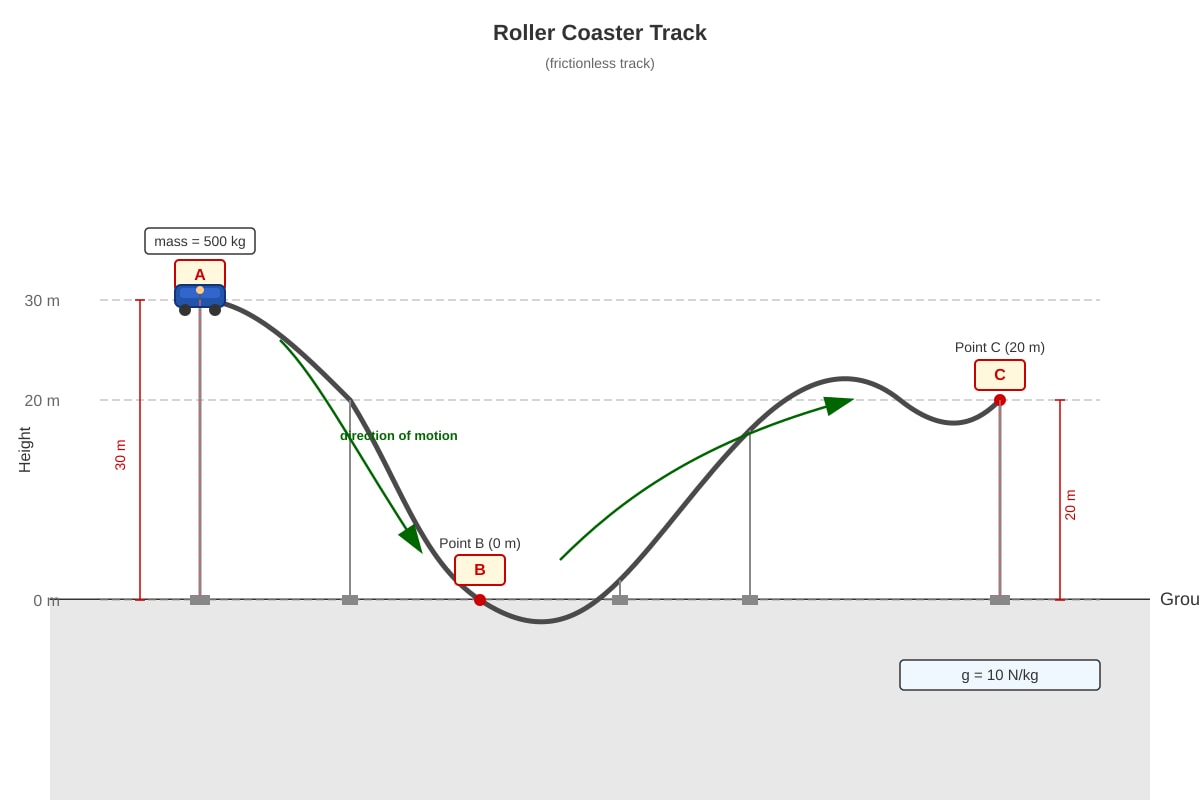
<image_placeholder> id: Q12-fig1 type: diagram linked_question: Q12 description: A roller coaster track with three labelled points: A (starting point, height 30 m), B (bottom of first dip, height 0 m), C (top of second hill, height 20 m). A car of mass 500 kg is shown at point A. Arrows indicate the direction of motion from A to B to C. labels: Point A (30 m), Point B (0 m), Point C (20 m), mass = 500 kg, direction arrows values: g = 10 N/kg, heights as labelled must_show: Three distinct heights, car at starting position, clear labels for A, B, C with heights </image_placeholder>
The diagram shows a roller coaster car of mass 500 kg at point A, 30 m above the ground. The car is released from rest and moves along the frictionless track to point B (ground level) and then up to point C, 20 m above the ground. Take .
(a) Calculate the gravitational potential energy of the car at point A.
[1]
(b) State the kinetic energy of the car at point B. Explain your answer.
[2]
(c) Calculate the speed of the car at point C.
[2]
Question 13 [4]
A student pulls a wooden block of mass 3 kg across a horizontal table using a spring balance. The block moves at a constant velocity of 0.5 m/s when the spring balance reads 8 N.
(a) What is the frictional force acting on the block? Explain your reasoning.
[2]
(b) Calculate the work done against friction when the block moves 2 m.
[1]
(c) The student now pulls the block with a force of 12 N. Describe the motion of the block.
[1]
Question 14 [5]
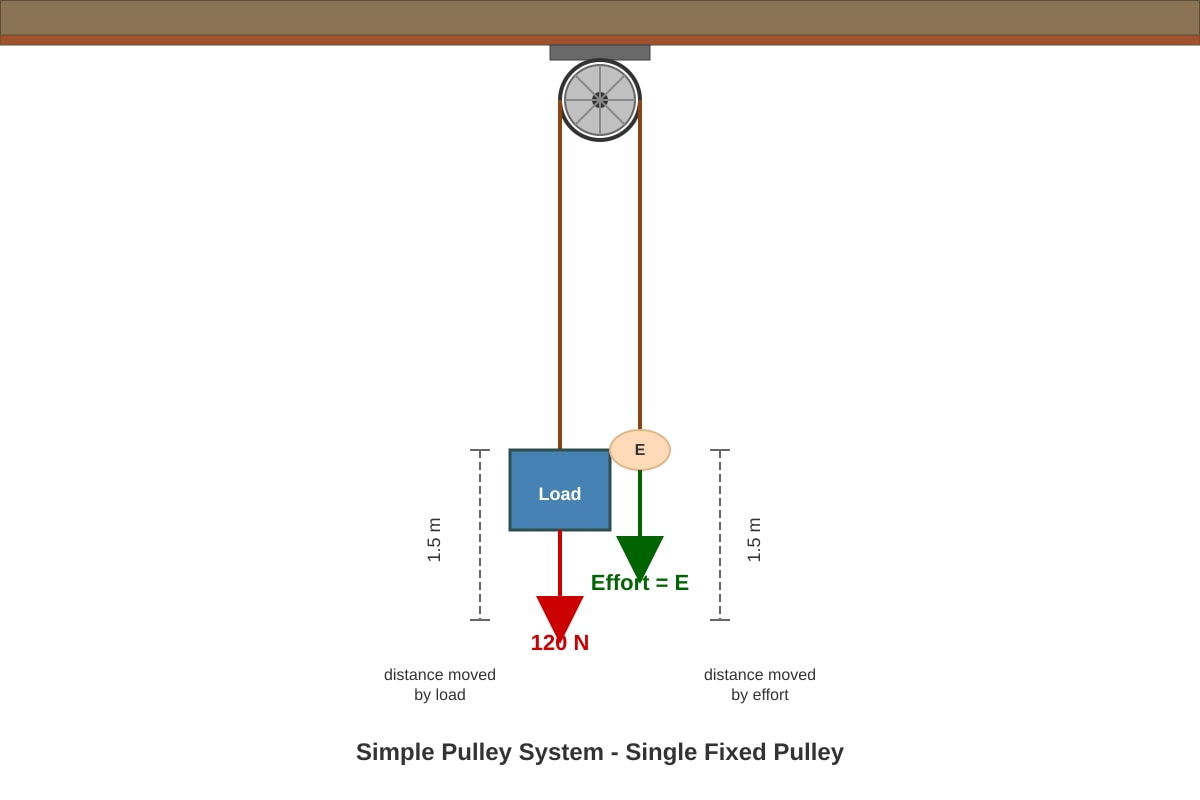
<image_placeholder> id: Q14-fig1 type: diagram linked_question: Q14 description: A simple pulley system with a single fixed pulley. A load of 120 N is attached to one end of the rope. An effort E is applied downwards on the other end. The load is lifted 1.5 m when the effort moves 1.5 m. labels: Load = 120 N, Effort = E, distance moved by load = 1.5 m, distance moved by effort = 1.5 m values: Load = 120 N, distances = 1.5 m must_show: Single fixed pulley, load and effort clearly labelled, equal distances moved indicated </image_placeholder>
The diagram shows a simple pulley system used to lift a load of 120 N. The effort E moves downwards by 1.5 m to lift the load by 1.5 m. The work done by the effort is 270 J.
(a) Calculate the effort E.
[1]
(b) Calculate the work done on the load.
[1]
(c) Calculate the efficiency of the pulley system.
[1]
(d) Suggest one reason why the efficiency is less than 100%.
[1]
(e) If the same load is lifted using a pulley system with a velocity ratio of 3, state how the effort required would change, assuming the same efficiency.
[1]
Question 15 [4]
A ball of mass 0.2 kg is thrown vertically upwards with an initial speed of 15 m/s. Take . Ignore air resistance.
(a) Calculate the initial kinetic energy of the ball.
[1]
(b) Calculate the maximum height reached by the ball.
[2]
(c) State the kinetic energy of the ball at its maximum height.
[1]
Question 16 [4]
A 60 W electric motor is used to lift a 2 kg mass through a height of 5 m. The motor runs for 4 seconds. Take .
(a) Calculate the electrical energy supplied to the motor in 4 seconds.
[1]
(b) Calculate the gravitational potential energy gained by the mass.
[1]
(c) Calculate the efficiency of the motor.
[1]
(d) State what happens to the remaining energy.
[1]
Question 17 [4]
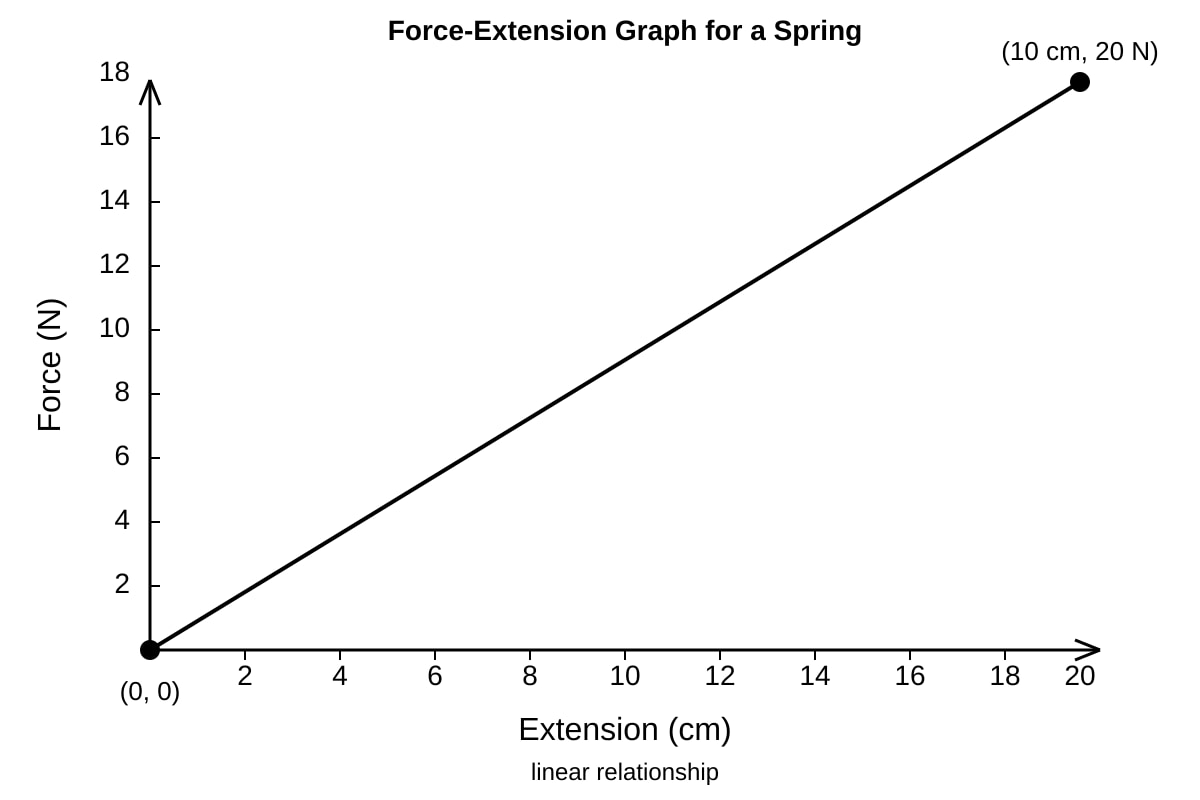
<image_placeholder> id: Q17-fig1 type: graph linked_question: Q17 description: Force-extension graph for a spring. X-axis: Extension (cm) from 0 to 10. Y-axis: Force (N) from 0 to 20. Straight line passing through origin and point (10, 20). labels: Extension (cm), Force (N), linear relationship values: Point at (10 cm, 20 N), origin (0,0) must_show: Linear graph through origin, axes labelled with units, clear scale </image_placeholder>
The graph shows how the force applied to a spring varies with its extension.
(a) State the relationship between force and extension for this spring.
[1]
(b) Calculate the spring constant of the spring in N/m.
[2]
(c) Calculate the elastic potential energy stored in the spring when it is extended by 6 cm.
[1]
Section C: Longer Structured Questions [20 marks]
Answer all questions in the spaces provided.
Question 18 [7]
A cyclist and bicycle have a combined mass of 80 kg. The cyclist starts from rest at the top of a hill 25 m high and freewheels down to the bottom. At the bottom of the hill, the speed of the cyclist is 18 m/s. Take .
(a) Calculate the gravitational potential energy lost by the cyclist and bicycle.
[1]
(b) Calculate the kinetic energy of the cyclist and bicycle at the bottom of the hill.
[1]
(c) Calculate the work done against friction and air resistance during the descent.
[1]
(d) Calculate the average resistive force if the length of the slope is 100 m.
[2]
(e) The cyclist now pedals up a second hill of height 15 m. At the top of the second hill, the speed is 5 m/s. Calculate the work done by the cyclist in pedalling up the second hill.
[2]
Question 19 [7]
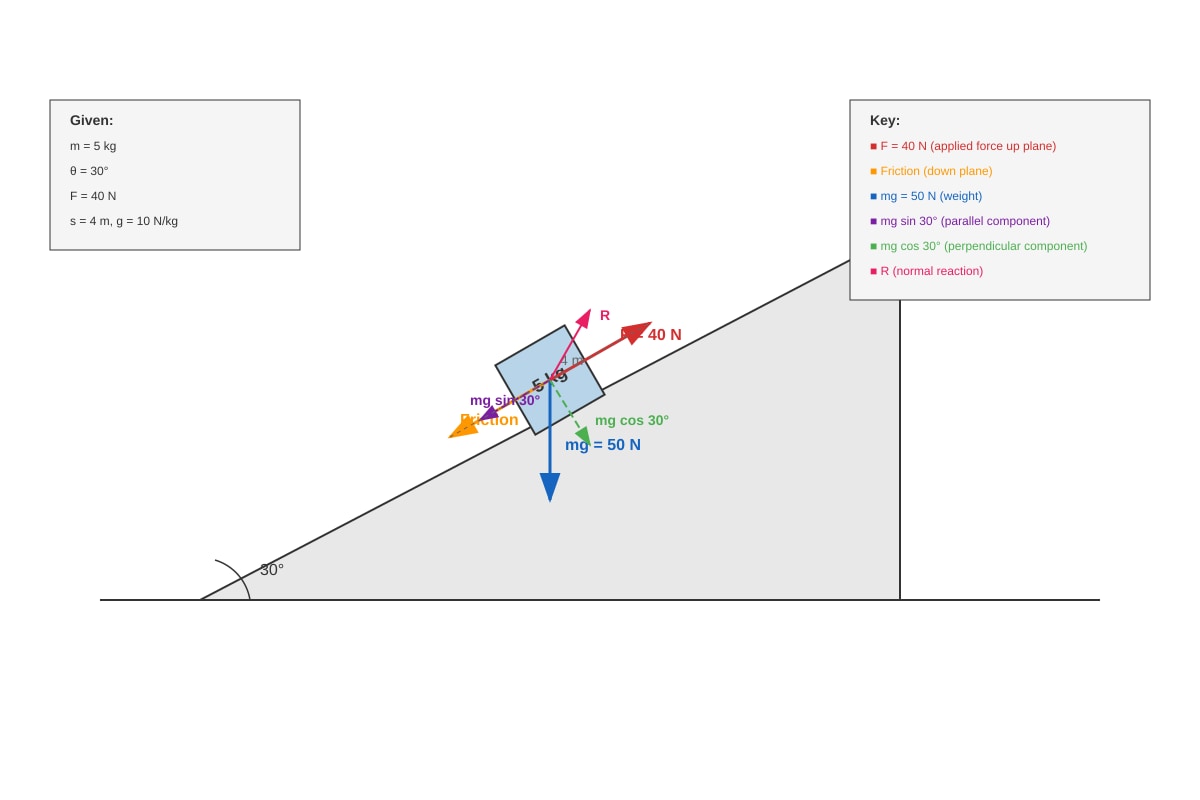
<image_placeholder> id: Q19-fig1 type: diagram linked_question: Q19 description: An inclined plane at 30 degrees to horizontal. A block of mass 5 kg is on the plane. A force F = 40 N is applied parallel to the plane, pulling the block up. The block moves 4 m up the plane. Friction acts down the plane. labels: Mass = 5 kg, angle = 30°, Force F = 40 N parallel up plane, distance = 4 m, friction direction down plane, weight components values: m = 5 kg, θ = 30°, F = 40 N, s = 4 m, g = 10 N/kg must_show: Inclined plane with angle, block, applied force parallel to plane, friction direction, weight mg and components labelled </image_placeholder>
A block of mass 5 kg is pulled up a rough inclined plane at 30° to the horizontal by a constant force of 40 N acting parallel to the plane. The block moves 4 m up the plane. The coefficient of friction between the block and the plane is 0.2. Take .
(a) Calculate the component of the weight acting down the plane.
[1]
(b) Calculate the frictional force acting on the block.
[2]
(c) Calculate the net force acting on the block parallel to the plane.
[1]
(d) Calculate the acceleration of the block.
[1]
(e) Calculate the work done by the applied force F.
[1]
(f) Calculate the gain in gravitational potential energy of the block.
[1]
Question 20 [6]
A hydroelectric power station uses falling water to generate electricity. Water falls through a vertical height of 50 m at a rate of 200 kg/s. The electrical power output of the generator is 80 kW. Take .
(a) Calculate the gravitational potential energy lost by the water each second.
[1]
(b) Calculate the power input to the system from the falling water.
[1]
(c) Calculate the efficiency of the power station.
[1]
(d) State two forms of energy that account for the energy losses in the system.
[2]
(e) Suggest one way to increase the electrical power output without changing the water flow rate or height.
[1]
End of Paper
Answers
TuitionGoWhere Practice Paper - Science Secondary 1
SA2 Practice Paper Version 1 - Answer Key
Total Marks: 60
Section A: Multiple Choice Questions [10 marks]
Question 1 [1]
Answer: C
Working:
Work done = Force × Distance moved in direction of force
= 5 N × 1.2 m = 6.0 J
Explanation: When lifting at constant velocity, the upward force equals the weight (5 N). Work done = force × displacement = 5 × 1.2 = 6.0 J.
Question 2 [1]
Answer: A
Explanation: A compressed spring stores elastic potential energy. When released, this converts to kinetic energy of the toy car. No change in height means no gravitational potential energy change.
Question 3 [1]
Answer: B
Working:
Net force = Applied force − Frictional force = 15 N − 5 N = 10 N
Net work done = Net force × Distance = 10 N × 4 m = 40 J
Alternative: Work by applied force = 15 × 4 = 60 J; Work against friction = 5 × 4 = 20 J; Net work = 60 − 20 = 40 J.
Question 4 [1]
Answer: C
Working:
GPE lost = mgh = 2 × 10 × 10 = 200 J
By conservation of energy (no air resistance), KE at bottom = GPE lost = 200 J
Explanation: All gravitational potential energy converts to kinetic energy.
Question 5 [1]
Answer: C
Working:
Work output (useful) = Load × Distance moved by load = 500 N × 2 m = 1000 J
Work input = Effort × Distance moved by effort = 200 N × 6 m = 1200 J
Efficiency = (Work output / Work input) × 100% = (1000 / 1200) × 100% = 83.3%
Wait - recalculating: 1000/1200 = 5/6 = 83.3%. But option C is 66.7%. Let me check: 1000/1200 = 0.833 = 83.3%. Option D is 83.3%.
Correct Answer: D
Correction: Efficiency = (500 × 2) / (200 × 6) × 100% = 1000/1200 × 100% = 83.3%
Question 6 [1]
Answer: D
Explanation: Work done = Force × Distance × cos(θ). When force is perpendicular to motion (θ = 90°), cos(90°) = 0, so no work is done.
- A is incorrect: force must cause displacement in its direction.
- B is incorrect: work can be done when force has a component in direction of motion.
- C is incorrect: work is a scalar quantity.
Question 7 [1]
Answer: B
Explanation: Ignoring air resistance, mechanical energy is conserved. At X and Z, the bob is momentarily at rest (KE = 0), so total energy = GPE. Since height at Z equals height at X, GPE at Z = GPE at X.
- A: KE at Y = GPE at X (not greater).
- C: Total energy is conserved.
- D: KE at Z is zero (momentarily at rest).
Question 8 [1]
Answer: A
Working:
KE gained = ½mv² = ½ × 1000 × 20² = 200,000 J
Average power = Work done / Time = 200,000 J / 10 s = 20,000 W = 20 kW
Question 9 [1]
Answer: B
Explanation: On a rough inclined plane, gravitational potential energy converts to kinetic energy AND heat energy (due to work done against friction). Some GPE → KE + Heat.
Question 10 [1]
Answer: B
Working:
Work done = Force × Distance
50 J = Force × 5 m
Force = 50 / 5 = 10 N
Section B: Structured Questions [30 marks]
Question 11 [4]
(a) [1]
Weight = mg = 800 kg × 10 N/kg = 8000 N
(b) [2]
Tension = 8000 N, upwards
Explanation: Since the block moves at constant velocity, net force = 0 (Newton's First Law). The upward tension balances the downward weight. Tension = Weight = 8000 N, directed upwards.
(c) [1]
Work done by tension = Tension × Distance = 8000 N × 15 m = 120,000 J (or 120 kJ)
Question 12 [5]
(a) [1]
GPE at A = mgh = 500 kg × 10 N/kg × 30 m = 150,000 J (or 150 kJ)
(b) [2]
KE at B = 150,000 J (or 150 kJ)
Explanation: Track is frictionless, so mechanical energy is conserved. At A: Total energy = GPE = 150,000 J, KE = 0. At B: Height = 0, so GPE = 0. By conservation of energy, KE at B = Total energy = 150,000 J.
(c) [2]
At C: GPE = mgh = 500 × 10 × 20 = 100,000 J
Total energy = 150,000 J (conserved)
KE at C = Total energy − GPE at C = 150,000 − 100,000 = 50,000 J
KE = ½mv² → 50,000 = ½ × 500 × v²
v² = 100,000 / 500 = 200
v = √200 = 14.1 m/s (or 10√2 m/s)
Question 13 [4]
(a) [2]
Frictional force = 8 N, opposite to direction of motion
Reasoning: Constant velocity means zero acceleration, so net force = 0 (Newton's First Law). The pulling force (8 N forward) is balanced by the frictional force (8 N backward).
(b) [1]
Work done against friction = Frictional force × Distance = 8 N × 2 m = 16 J
(c) [1]
The block will accelerate (speed up) in the direction of the pull.
Explanation: Net force = 12 N − 8 N = 4 N forward. By Newton's Second Law (F = ma), a = F/m = 4/3 = 1.33 m/s² forward.
Question 14 [5]
(a) [1]
Work done by effort = Effort × Distance moved by effort
270 J = E × 1.5 m
E = 270 / 1.5 = 180 N
(b) [1]
Work done on load = Load × Distance moved by load = 120 N × 1.5 m = 180 J
(c) [1]
Efficiency = (Work output / Work input) × 100% = (180 / 270) × 100% = 66.7%
(d) [1]
Work done against friction in the pulley bearings / Work done against the weight of the moving parts of the pulley / Energy lost as heat and sound.
(Any one valid reason)
(e) [1]
The effort required would decrease (become one-third of the original effort for an ideal system, or proportionally less for the same efficiency).
Explanation: Velocity ratio = 3 means effort moves 3 times the distance of the load. For the same work output and efficiency, Work input = Work output / efficiency. Since Work input = Effort × Distance_effort, and Distance_effort increases by factor of 3, Effort decreases by factor of 3.
Question 15 [4]
(a) [1]
Initial KE = ½mv² = ½ × 0.2 kg × (15 m/s)² = 0.1 × 225 = 22.5 J
(b) [2]
At max height, KE = 0, all initial KE → GPE
mgh = 22.5 J
0.2 × 10 × h = 22.5
2h = 22.5
h = 11.25 m
(c) [1]
Kinetic energy at maximum height = 0 J
Explanation: At maximum height, the ball is momentarily at rest before falling down, so velocity = 0, KE = 0.
Question 16 [4]
(a) [1]
Electrical energy = Power × Time = 60 W × 4 s = 240 J
(b) [1]
GPE gained = mgh = 2 kg × 10 N/kg × 5 m = 100 J
(c) [1]
Efficiency = (Useful energy output / Energy input) × 100% = (100 / 240) × 100% = 41.7%
(d) [1]
The remaining energy is converted to heat and sound (dissipated to the surroundings).
Explanation: Energy losses in the motor (resistance heating in coils, friction in bearings, sound) account for the difference.
Question 17 [4]
(a) [1]
Force is directly proportional to extension (Hooke's Law: F = kx). The graph is a straight line passing through the origin.
(b) [2]
From graph: At extension = 10 cm = 0.10 m, Force = 20 N
Spring constant k = F / x = 20 N / 0.10 m = 200 N/m
(c) [1]
Elastic potential energy = ½kx² = ½ × 200 N/m × (0.06 m)² = 100 × 0.0036 = 0.36 J
Alternative: Area under graph = ½ × base × height = ½ × 0.06 m × (200 × 0.06) = ½ × 0.06 × 12 = 0.36 J
Section C: Longer Structured Questions [20 marks]
Question 18 [7]
(a) [1]
GPE lost = mgh = 80 kg × 10 N/kg × 25 m = 20,000 J (or 20 kJ)
(b) [1]
KE at bottom = ½mv² = ½ × 80 × 18² = 40 × 324 = 12,960 J
(c) [1]
Work done against friction and air resistance = GPE lost − KE gained = 20,000 − 12,960 = 7,040 J
(d) [2]
Work done against resistive force = Resistive force × Distance
7,040 J = F_resistive × 100 m
F_resistive = 7,040 / 100 = 70.4 N
(e) [2]
Going up second hill:
GPE gained = mgh = 80 × 10 × 15 = 12,000 J
KE at top = ½ × 80 × 5² = 40 × 25 = 1,000 J
Total energy at top = 12,000 + 1,000 = 13,000 J
Energy at bottom of second hill = KE at bottom of first hill = 12,960 J (assuming no loss on flat)
Work done by cyclist = Energy at top − Energy at bottom = 13,000 − 12,960 = 40 J
Wait - this seems too small. Let me reconsider.
Actually, the cyclist starts at bottom of first hill with 12,960 J KE. To reach top of second hill (15 m high) with 5 m/s:
Energy needed at top = GPE + KE = 12,000 + 1,000 = 13,000 J
Energy available at bottom = 12,960 J
Work done by cyclist = 13,000 − 12,960 = 40 J
This is correct - the cyclist only needs to add a small amount because the KE at bottom is almost enough. The small difference is due to rounding (18² = 324, ½×80×324 = 12,960 exactly).
Question 19 [7]
(a) [1]
Component of weight down plane = mg sin θ = 5 × 10 × sin 30° = 50 × 0.5 = 25 N
(b) [2]
Normal reaction R = mg cos θ = 5 × 10 × cos 30° = 50 × 0.866 = 43.3 N
Frictional force = μR = 0.2 × 43.3 = 8.66 N (or 5√3 ≈ 8.66 N)
(c) [1]
Net force parallel to plane = Applied force − Weight component down − Friction
= 40 − 25 − 8.66 = 6.34 N (up the plane)
(d) [1]
Acceleration a = F_net / m = 6.34 / 5 = 1.27 m/s² (up the plane)
(e) [1]
Work done by applied force F = F × s = 40 N × 4 m = 160 J
(f) [1]
Vertical height gained = s sin θ = 4 × sin 30° = 4 × 0.5 = 2 m
GPE gained = mgh = 5 × 10 × 2 = 100 J
Question 20 [6]
(a) [1]
GPE lost per second = mass rate × g × h = 200 kg/s × 10 N/kg × 50 m = 100,000 J/s (or 100 kW)
(b) [1]
Power input = Rate of GPE loss = 100 kW (or 100,000 W)
(c) [1]
Efficiency = (Power output / Power input) × 100% = (80 kW / 100 kW) × 100% = 80%
(d) [2]
Any two of:
- Heat energy (due to friction in turbines, generators, and water turbulence)
- Sound energy (from moving water and machinery)
- Kinetic energy of water leaving the system (water still has kinetic energy after passing turbines)
- Electrical resistance losses in generator windings and transmission lines
(e) [1]
Increase the efficiency of the turbines/generators (e.g., better blade design, reduced friction, improved generator efficiency).
Alternative: Reduce energy losses in the system (any valid method that increases efficiency without changing flow rate or height).
End of Answer Key