From Real Exams Exam Paper

Secondary 1 Science Semestral Assessment 2 (End of Year) Paper 1

Free Kimi AI-generated Sec 1 Science SA2 Paper 1 with questions, answers, and syllabus-aligned practice for Singapore students preparing for exams.

These static practice materials are generated from the site's syllabus and paper-generation workflow, with source and model context shown so students and parents can evaluate the material before use.

Secondary 1 Science From Real Exams Generated by Kimi K2.6 Free Updated 2026-06-09

Questions

<!-- TuitionGoWhere generation metadata: stage=3-1; model=moonshotai/kimi-k2.6:free; model_label=Kimi K2.6 Free; generated=2026-06-07; Sources: Stage 2-1 real exam-derived templates and Stage 2-2 exam-enriched syllabus. -->

TuitionGoWhere Exam Practice (AI)

Secondary 1 Science – SA2

Physical Sciences Version 1 of 5

Subject: Science
Level: Secondary 1 (G3)
Paper: SA2 Practice Paper – Physical Sciences
Duration: 1 hour 15 minutes
Total Marks: 60 marks

Name: _________________________
Class: _________________________
Date: _________________________


Instructions

  • Answer ALL questions.
  • Write your answers in the spaces provided.
  • For numerical answers, show all working clearly. State units where appropriate.
  • Marks are awarded for correct method even if final answer is incorrect, provided working is shown.

Section A: Multiple Choice (Questions 1–8)

Choose the correct answer for each question. Each question carries 2 marks. Total: 16 marks.


1. A student pulls a box along a horizontal floor at constant velocity. Which energy conversion is taking place?

A. Chemical energy → Thermal energy only
B. Chemical energy → Kinetic energy + Thermal energy
C. Gravitational potential energy → Kinetic energy
D. Elastic potential energy → Kinetic energy

Answer: ________ [2 marks]


2. A force of 15 N is applied to an object, but the object does not move. The work done by the force is:

A. 0 J
B. 15 J
C. Depends on the time applied
D. Cannot be determined without knowing the mass

Answer: ________ [2 marks]


3. Which statement about pressure is correct?

A. Pressure is a force
B. Pressure acts in a specific direction
C. Pressure is force per unit volume
D. Pressure is force per unit area and acts equally in all directions

Answer: ________ [2 marks]


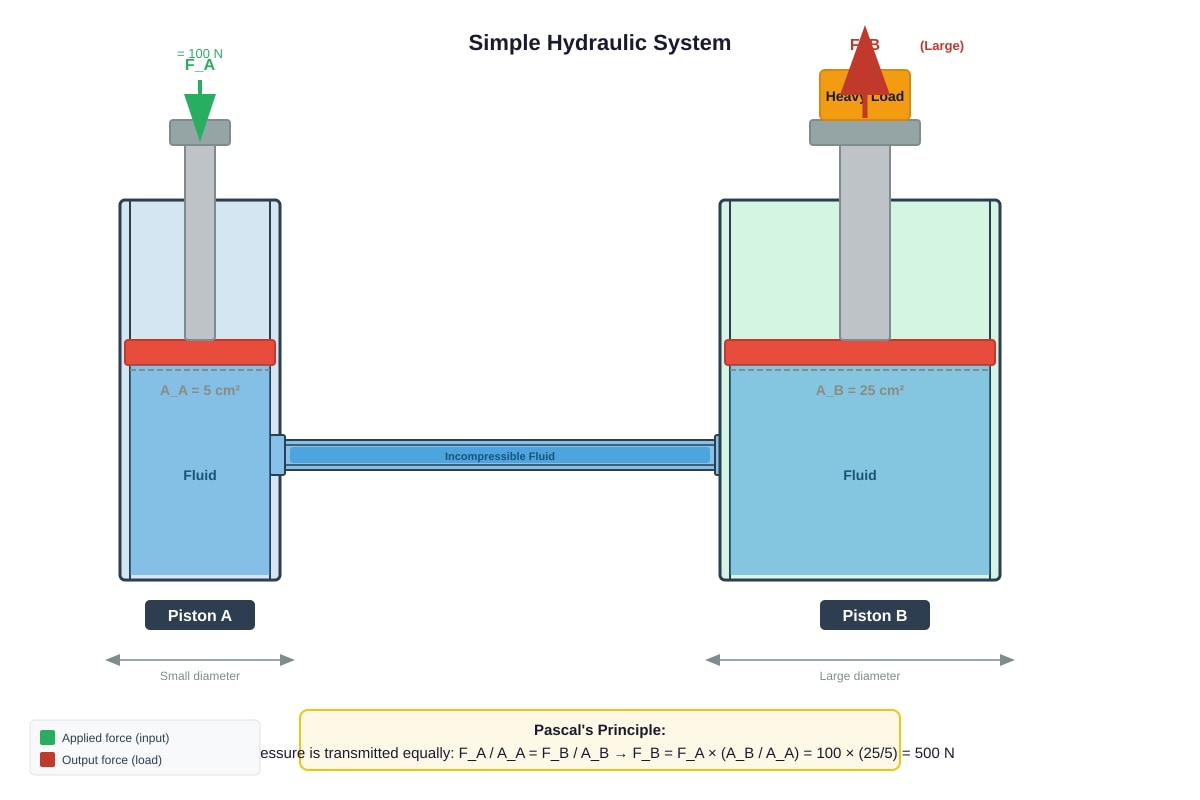
4. The diagram below shows a simple hydraulic system. What principle explains why a small force on piston A can lift a heavy load on piston B?

<image_placeholder> id: Q4-fig1 type: diagram linked_question: Q4 description: Simple hydraulic system with two connected cylinders, piston A (small diameter) on left, piston B (large diameter) on right, connected by pipe with incompressible fluid labels: Piston A, Piston B, Fluid, Small force F_A, Large load F_B, Cross-sectional area A_A, Cross-sectional area A_B values: A_A = 5 cm², A_B = 25 cm², F_A = 100 N (implied typical values for illustration) must_show: Connected cylinders of different diameters, pistons at same height initially, arrows showing forces, clear size difference between pistons </image_placeholder>

A. Conservation of energy
B. Pascal's principle
C. Archimedes' principle
D. Newton's third law

Answer: ________ [2 marks]


5. A metal block has a mass of 270 g and a volume of 100 cm³. What is its density?

A. 0.37 g/cm³
B. 2.7 g/cm³
C. 27 g/cm³
D. 370 g/cm³

Answer: ________ [2 marks]


6. In which situation is the pressure exerted on the ground the greatest?

A. A 50 kg person standing on both feet (total area 400 cm²)
B. A 50 kg person standing on one foot (area 200 cm²)
C. A 40 kg person standing on both feet (total area 300 cm²)
D. A 60 kg person lying down (area 3600 cm²)

Answer: ________ [2 marks]


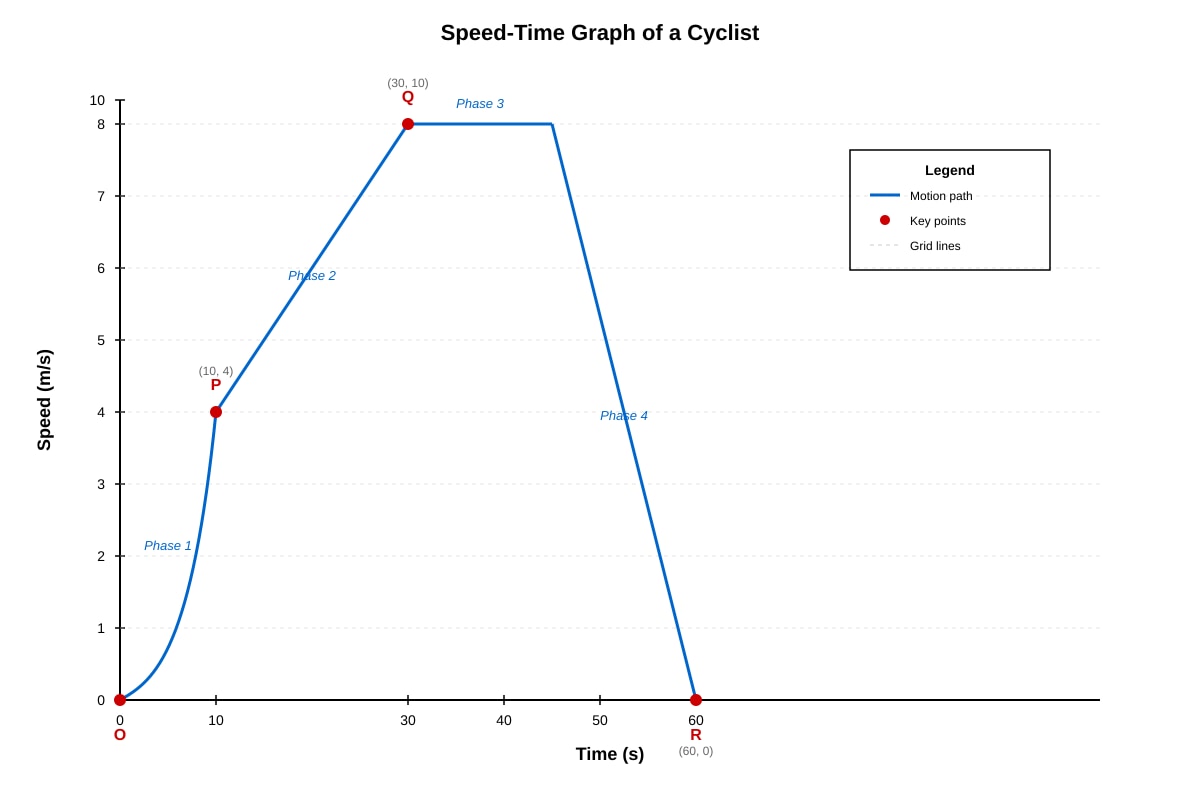
7. The graph shows how the speed of a cyclist changes with time during a journey.

<image_placeholder> id: Q7-fig1 type: graph linked_question: Q7 description: Speed-time graph with time on horizontal axis (0 to 60 s) and speed on vertical axis (0 to 10 m/s) labels: Speed (m/s), Time (s), Point P at t=10s v=4m/s, Point Q at t=30s v=10m/s, Point R at t=60s v=0m/s values: 0-10s: curved increasing line; 10-30s: straight line from (10,4) to (30,10); 30-45s: horizontal at 10 m/s; 45-60s: straight line to (60,0) must_show: Clearly labelled axes with units, four distinct phases of motion, specific points P, Q, R marked, smooth transitions between phases </image_placeholder>

Between which two points is the cyclist decelerating?

A. Between O and P
B. Between P and Q
C. Between Q and R
D. The cyclist is never decelerating

Answer: ________ [2 marks]


8. A lever is used to lift a heavy rock. The effort arm is 2.0 m and the load arm is 0.5 m. If the rock weighs 800 N, what is the minimum effort force needed (assuming the lever is perfectly efficient)?

A. 200 N
B. 400 N
C. 800 N
D. 1600 N

Answer: ________ [2 marks]


Section A Total: ________/16 marks


Section B: Short Answer and Calculation (Questions 9–16)

Answer all questions in the spaces provided. Show working where appropriate. Total: 32 marks.


9. (a) Define work done in terms of force and distance. [1 mark]


(b) A student of mass 55 kg climbs a flight of stairs that is 3.0 m high. Given that gravitational field strength g=10 N/kgg = 10 \text{ N/kg}, calculate the work done by the student against gravity. [2 marks]


[Total: 3 marks]


10. (a) State two factors that affect the pressure exerted by a solid object resting on a surface. [2 marks]


(b) Explain, using ideas about pressure, why a snowshoe (large flat surface) prevents a person from sinking into soft snow, whereas normal shoes (small contact area) would cause sinking. [2 marks]


[Total: 4 marks]


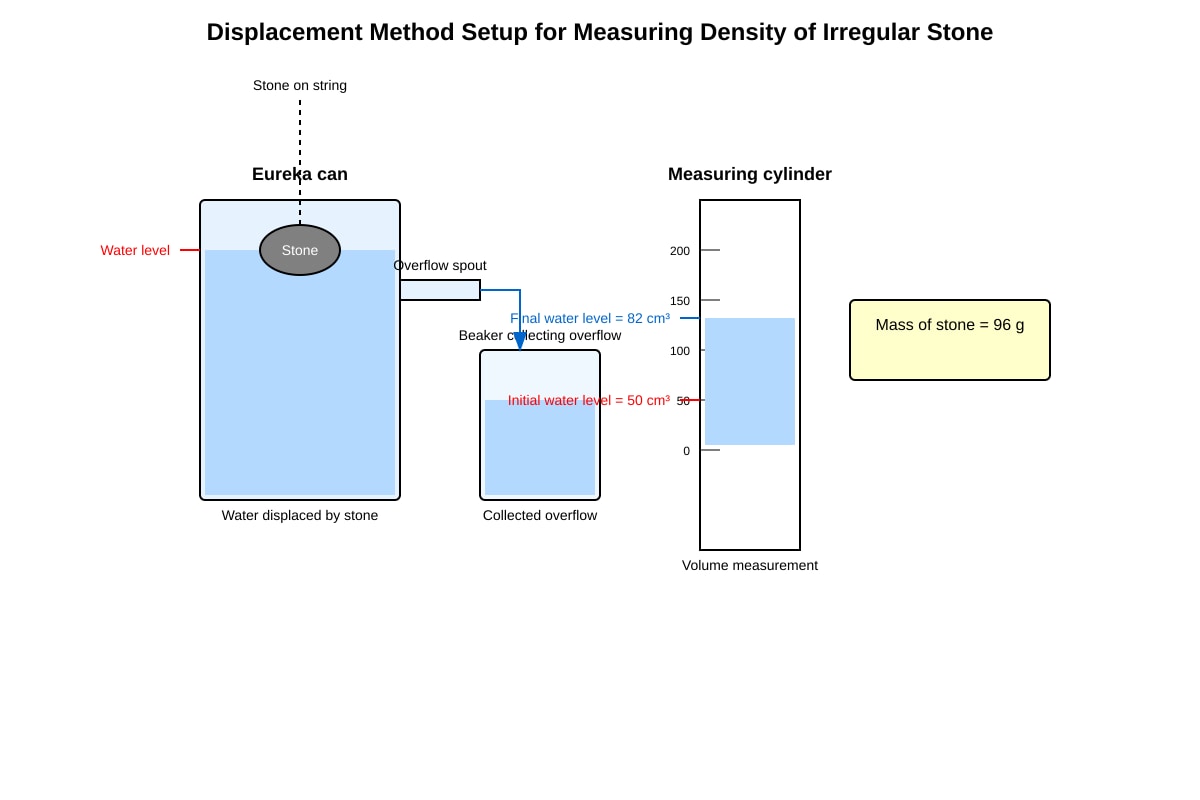
11. The diagram shows a laboratory experiment to determine the density of an irregularly shaped stone.

<image_placeholder> id: Q11-fig1 type: experimental_setup linked_question: Q11 description: Displacement method setup for measuring density of irregular stone labels: Eureka can, Overflow spout, Measuring cylinder/beaker, Stone on string, Water level, Beaker collecting overflow values: Initial water level in measuring cylinder = 50 cm³, Final water level = 82 cm³, Mass of stone = 96 g must_show: Stone being lowered into water, overflow being collected, measuring cylinder with volume markings, clear initial and final levels indicated </image_placeholder>

(a) Explain why the displacement method is suitable for finding the volume of an irregular object like the stone. [1 mark]


(b) Using the information in the diagram, calculate the density of the stone. State the formula you use and show all working. [3 marks]


[Total: 4 marks]


12. A car of mass 1200 kg is travelling at a speed of 20 m/s.

(a) Calculate the kinetic energy of the car. [2 marks]


(b) The driver applies the brakes and the car comes to rest. State what happens to the kinetic energy of the car. [1 mark]


(c) Explain why the brakes become hot after repeated braking. [2 marks]


[Total: 5 marks]


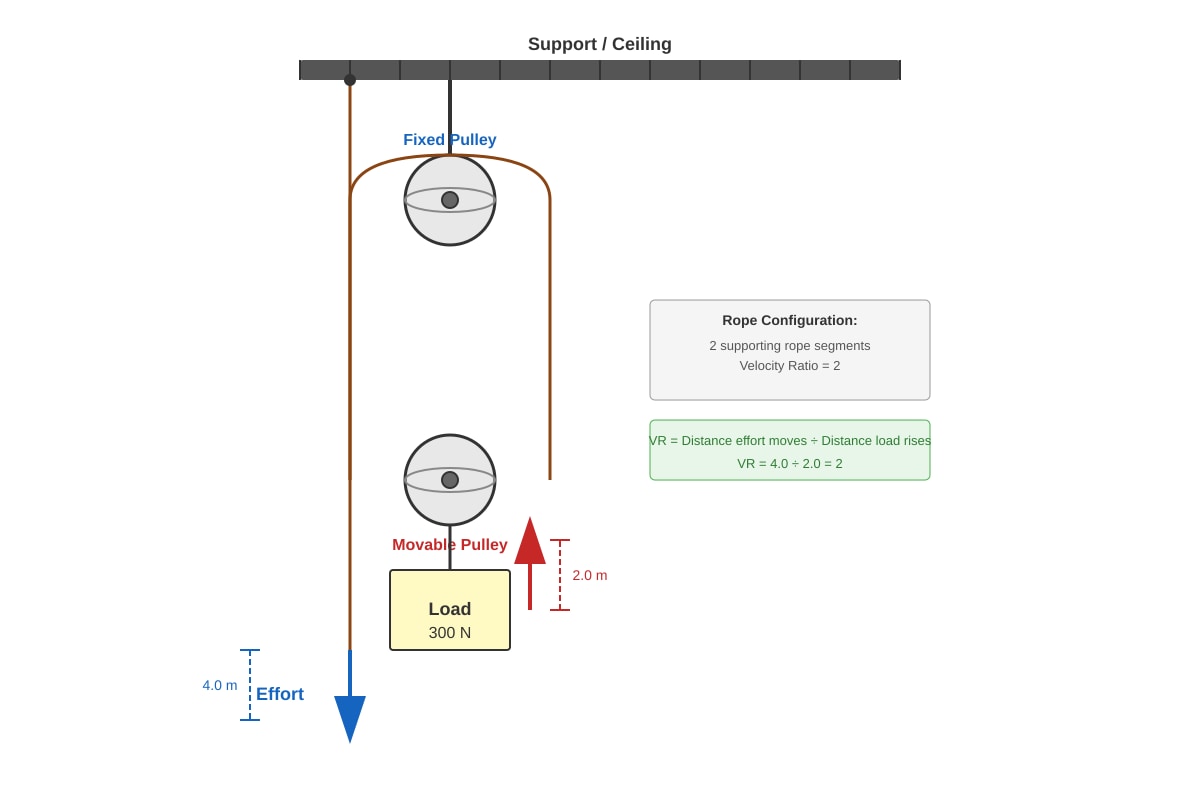
13. The diagram shows a pulley system used to lift a load.

<image_placeholder> id: Q13-fig1 type: diagram linked_question: Q13 description: Single fixed pulley and single movable pulley system (block and tackle with 2 supporting ropes) labels: Fixed pulley, Movable pulley, Load, Effort, Support/ceiling, Rope configuration values: Load = 300 N, Distance effort moves = 4.0 m, Distance load rises = 2.0 m (implied by rope system) must_show: Two pulleys configured so effort rope pulls down through fixed pulley, movable pulley attached to load with two rope segments supporting it, clear direction arrows for effort and load movement </image_placeholder>

(a) State one advantage of using a pulley system rather than lifting the load directly. [1 mark]


(b) For the pulley system shown, determine the velocity ratio. Show your working. [2 marks]


(c) If the actual effort force needed is 180 N, calculate the efficiency of this pulley system. [3 marks]


[Total: 6 marks]


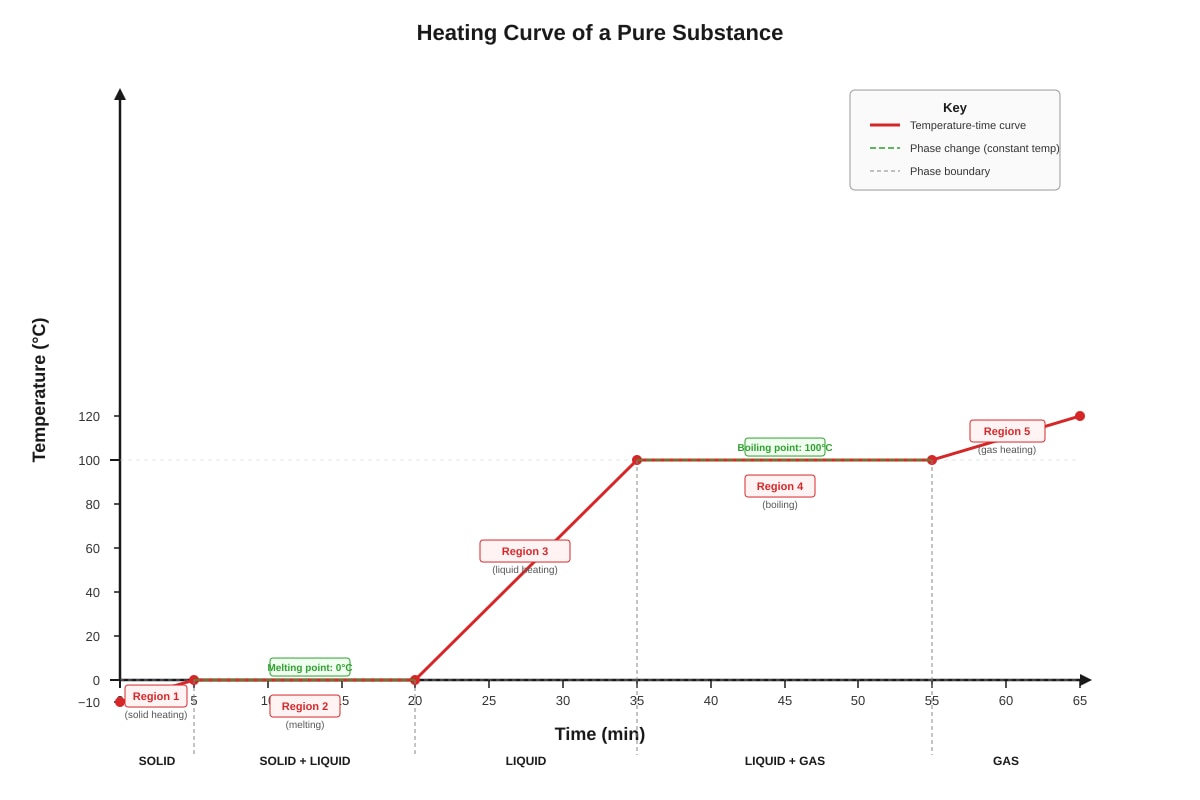
14. The graph shows how the temperature of a substance changes as it is heated steadily from a solid at -10°C to a gas at 120°C.

<image_placeholder> id: Q14-fig1 type: graph linked_question: Q14 description: Temperature-time graph for heating curve of a pure substance through phase changes labels: Temperature (°C), Time (min), Region 1 (solid heating), Region 2 (melting), Region 3 (liquid heating), Region 4 (boiling), Region 5 (gas heating) values: Starts at (0, -10), rises to (5, 0), plateau from (5,0) to (20,0) - melting, rises to (35, 100), plateau from (35,100) to (55,100) - boiling, rises to (65, 120) must_show: Five distinct regions with clear labels, two horizontal plateaus at 0°C and 100°C, temperature axis with negative to above 100, time axis with approximate minute markings </image_placeholder>

(a) State the melting point and boiling point of this substance. [2 marks]

Melting point: _________________________ °C

Boiling point: _________________________ °C

(b) Explain, in terms of particle behaviour, why the temperature remains constant during melting even though heat energy is still being supplied. [3 marks]


[Total: 5 marks]


15. Explain two ways in which heat is transferred from the hot water at the bottom of a kettle to your hand when you hold the plastic handle near the top. For each way, explain why that particular method of heat transfer is (or is not) significant in this situation. [4 marks]


[Total: 4 marks]


16. (a) State the principle of moments for a body in equilibrium. [2 marks]


(b) A uniform metre rule is balanced at its 50 cm mark. A 0.40 kg mass is placed at the 20 cm mark. Find where a 0.30 kg mass must be placed to balance the rule. [3 marks]


[Total: 5 marks]


Section B Total: ________/32 marks


Section C: Structured Response (Questions 17–20)

Answer all questions. These questions require extended reasoning and application. Total: 12 marks.


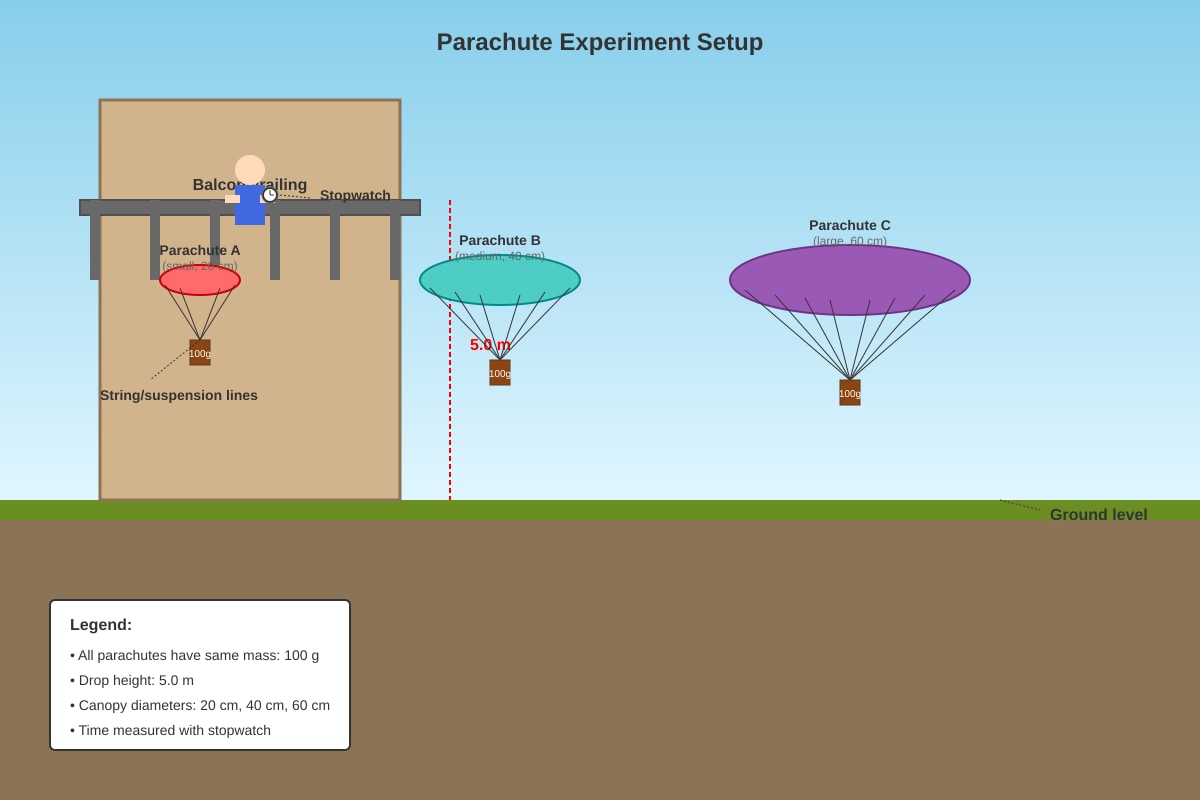
17. Amy investigates how the time of fall of a parachute depends on the surface area of the parachute canopy. She drops parachutes of different sizes from a balcony and measures the time taken to reach the ground.

<image_placeholder> id: Q17-fig1 type: experimental_setup linked_question: Q17 description: Parachute experiment setup showing three different parachute sizes being dropped from balcony labels: Balcony/railing, Parachute A (small), Parachute B (medium), Parachute C (large), Stopwatch, Ground level, String/suspension lines values: Parachute A: diameter 20 cm, Parachute B: diameter 40 cm, Parachute C: diameter 60 cm; all same mass load 100 g; drop height 5.0 m must_show: Three parachutes of clearly different canopy sizes, same mass load on each, consistent suspension line length, drop height indicated, person with stopwatch at ground or balcony </image_placeholder>

(a) Identify the independent variable, dependent variable, and one controlled variable in this investigation. [3 marks]

Independent variable: _____________________________________________

Dependent variable: ______________________________________________

Controlled variable: ______________________________________________

(b) Explain why the parachute with the largest surface area takes the longest time to reach the ground. [2 marks]


[Total: 5 marks]


18. A hydroelectric power station uses water stored in a reservoir to generate electricity. The water falls through a height of 80 m from the reservoir to the turbines below. The mass of water flowing through the turbines each second is 5000 kg.

(a) Calculate the gravitational potential energy lost by the water each second as it falls. Take g=10 N/kgg = 10 \text{ N/kg}. [2 marks]


(b) Assuming all this gravitational potential energy is converted to electrical energy, calculate the power output of the power station. [1 mark]


(c) In reality, not all the gravitational potential energy is converted to electrical energy. State one form of energy that some of the gravitational potential energy is converted into, and explain one practical reason why this energy conversion occurs. [2 marks]


[Total: 5 marks]


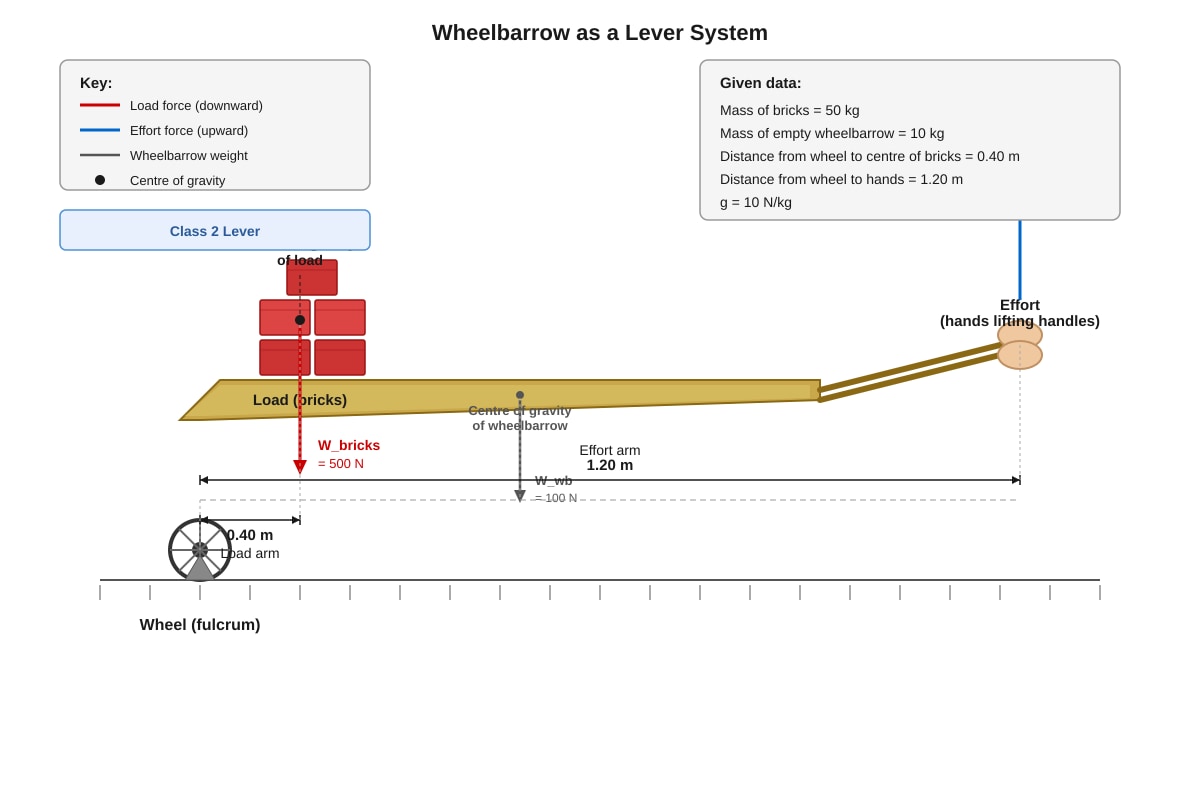
19. James uses a wheelbarrow to transport bricks across a building site. The wheelbarrow can be modelled as a lever.

<image_placeholder> id: Q19-fig1 type: diagram linked_question: Q19 description: Wheelbarrow lever system with labelled distances and forces labels: Wheel (fulcrum), Load (bricks), Effort (hands lifting handles), Load arm, Effort arm, Centre of gravity of load, Centre of gravity of wheelbarrow values: Mass of bricks = 50 kg, Mass of empty wheelbarrow = 10 kg, Distance from wheel to centre of bricks = 0.40 m, Distance from wheel to hands = 1.20 m, g = 10 N/kg must_show: Wheel at left as fulcrum, load positioned between wheel and hands, arrows showing load force and effort force, distances clearly marked along the base, hands at right end </image_placeholder>

(a) Calculate the total load force (due to bricks and wheelbarrow) that must be supported by the wheelbarrow. [2 marks]


(b) Taking moments about the wheel (fulcrum), calculate the effort force James must apply to keep the wheelbarrow horizontal. [3 marks]


[Total: 5 marks]


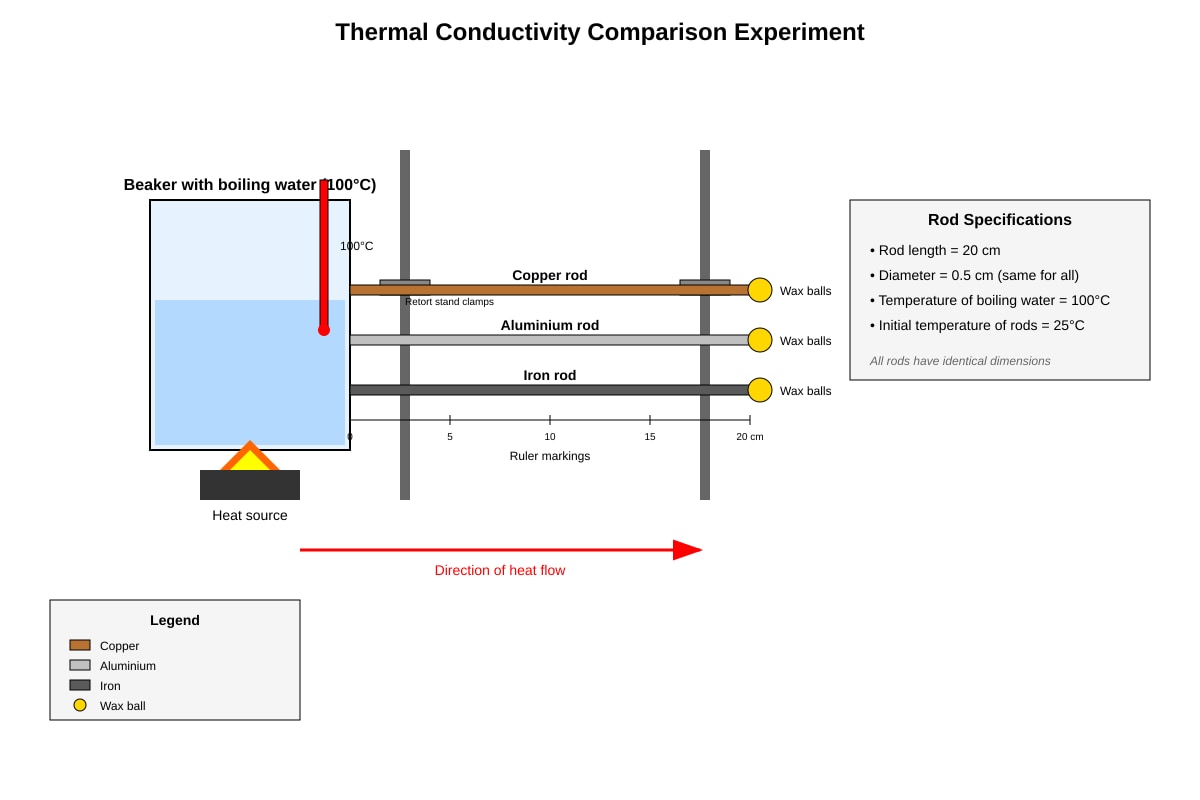
20. A student sets up an experiment to compare how quickly different materials conduct heat. She uses rods of copper, aluminium, and iron, each 20 cm long and with the same diameter. One end of each rod is placed in a beaker of boiling water, and the other end has a small wax ball attached.

<image_placeholder> id: Q20-fig1 type: experimental_setup linked_question: Q20 description: Thermal conductivity comparison experiment with three metal rods labels: Beaker with boiling water (100°C), Copper rod, Aluminium rod, Iron rod, Wax balls at far end, Retort stand clamps, Thermometer in water, Ruler markings values: Rod length = 20 cm, Diameter = 0.5 cm (same for all), Temperature of boiling water = 100°C, Initial temperature of rods = 25°C must_show: Three parallel rods clamped horizontally, one end immersed in beaker of water on heat source, wax balls at free ends, clear labelling of each metal type, consistent horizontal alignment </image_placeholder>

(a) Suggest two observations the student could make to compare the thermal conductivity of the three metals. [2 marks]


(b) The copper wax ball drops off first, followed by aluminium, then iron. Arrange the three metals in order of thermal conductivity, from highest to lowest. [1 mark]


(c) Explain why it is important that the three rods have the same diameter and same starting temperature for this to be a fair test. [2 marks]


[Total: 5 marks]


Section C Total: ________/12 marks


END OF PAPER

Paper Total: ________/60 marks


Check through your answers before handing in your paper.

Answers

<!-- TuitionGoWhere generation metadata: stage=3-1; model=moonshotai/kimi-k2.6:free; model_label=Kimi K2.6 Free; generated=2026-06-07; Sources: Stage 2-1 real exam-derived templates and Stage 2-2 exam-enriched syllabus. -->

TuitionGoWhere Exam Practice (AI)

Secondary 1 Science – SA2 Physical Sciences

Answer Key and Marking Scheme Version 1 of 5

Total Marks: 60


Section A: Multiple Choice (Questions 1–8)

2 marks each


1. Answer: B

Working/Explanation:

  • When pulling a box at constant velocity, the student uses chemical energy from food/muscles.
  • Some energy goes into kinetic energy of the moving box.
  • Friction between the box and floor converts some energy to thermal energy (heat).
  • Since velocity is constant, kinetic energy is constant, but energy must continuously be supplied to overcome friction.

Common mistake: Choosing A (forgets kinetic energy) or C (confuses with falling objects).

Marks: 2


2. Answer: A

Working/Explanation:

  • Work done = Force × Distance moved in the direction of the force
  • W=F×dW = F \times d
  • If the object does not move, d=0d = 0
  • Therefore W=15×0=0W = 15 \times 0 = 0 J

Key concept: No work is done if there is no displacement, no matter how large the force.

Common mistake: Choosing C (confusing work with power, which involves time).

Marks: 2


3. Answer: D

Working/Explanation:

  • Definition: Pressure = ForceArea\frac{\text{Force}}{\text{Area}} (force per unit area)
  • Pressure in fluids acts equally in all directions — this is a key property
  • Pressure is not a force (it's force divided by area)
  • Pressure is a scalar quantity — it does not have a specific direction

Common mistake: Choosing B (confusing pressure with force, which is a vector).

Marks: 2


4. Answer: B

Working/Explanation:

  • Pascal's principle states that pressure applied to an enclosed fluid is transmitted undiminished to every part of the fluid and to the walls of the container.
  • From p=FAp = \frac{F}{A}, if pressure is constant: FAAA=FBAB\frac{F_A}{A_A} = \frac{F_B}{A_B}
  • Since AB>AAA_B > A_A, we get FB>FAF_B > F_A — force is multiplied.
  • With values: p=1005=20p = \frac{100}{5} = 20 N/cm², so FB=20×25=500F_B = 20 \times 25 = 500 N

Common mistake: Choosing A (energy is conserved, but the principle specifically explaining force multiplication is Pascal's).

Marks: 2


5. Answer: B

Working/Explanation:

  • Density = MassVolume\frac{\text{Mass}}{\text{Volume}}
  • ρ=mV=270 g100 cm3\rho = \frac{m}{V} = \frac{270 \text{ g}}{100 \text{ cm}^3}
  • ρ=2.7\rho = 2.7 g/cm³

Note: This is the density of aluminium, a common reference value.

Common mistake: Unit errors or decimal place errors (0.37 from dividing upside down).

Marks: 2


6. Answer: B

Working/Explanation:

  • Pressure = WeightArea=mgA\frac{\text{Weight}}{\text{Area}} = \frac{mg}{A}
  • A: P=50×10400=500400=1.25P = \frac{50 \times 10}{400} = \frac{500}{400} = 1.25 N/cm²
  • B: P=50×10200=500200=2.50P = \frac{50 \times 10}{200} = \frac{500}{200} = 2.50 N/cm²
  • C: P=40×10300=400300=1.33P = \frac{40 \times 10}{300} = \frac{400}{300} = 1.33 N/cm²
  • D: P=60×103600=6003600=0.167P = \frac{60 \times 10}{3600} = \frac{600}{3600} = 0.167 N/cm²

Highest pressure is B (same weight, smallest area).

Key insight: Pressure increases when area decreases, even with same force.

Common mistake: Choosing D (confusing larger mass with larger pressure, ignoring the much larger area).

Marks: 2


7. Answer: C

Working/Explanation:

  • Deceleration means decreasing speed — the graph shows a negative gradient
  • O to P: Speed increases from 0 to 4 m/s (acceleration)
  • P to Q: Speed increases from 4 to 10 m/s (acceleration, constant rate)
  • Q to (45s): Speed constant at 10 m/s (zero acceleration)
  • (45s) to R: Speed decreases from 10 to 0 m/s (deceleration)

The instruction "Between which two points" refers to the labelled points, and between Q and R encompasses the deceleration phase.

Common mistake: Choosing A (confusing initial slowing with the later deceleration, or misreading curved initial acceleration as deceleration).

Marks: 2


8. Answer: A

Working/Explanation:

  • Principle of moments: Clockwise moment = Anticlockwise moment (for equilibrium)
  • Load × Load arm = Effort × Effort arm
  • 800×0.5=F×2.0800 \times 0.5 = F \times 2.0
  • 400=2.0F400 = 2.0F
  • F=200F = 200 N

Key insight: The longer effort arm provides mechanical advantage — less force needed but over greater distance.

Common mistake: Choosing D (multiplying instead of dividing, or swapping arms).

Marks: 2


Section A Total: 16 marks


Section B: Short Answer and Calculation (Questions 9–16)


9. (a) Work done is defined as the product of the force applied on an object and the distance moved by the object in the direction of the force. [1 mark]

(Accept: Force multiplied by distance in the direction of the force. Accept equation form: W=F×dW = F \times d with both terms defined.)


9. (b)

Working:

  • Weight of student: W=mg=55×10=550W = mg = 55 \times 10 = 550 N
  • Work done against gravity: Ep=mgh=550×3.0E_p = mgh = 550 \times 3.0
  • Ep=1650E_p = 1650 J

Alternative: Ep=mgh=55×10×3.0=1650E_p = mgh = 55 \times 10 \times 3.0 = 1650 J

Mark breakdown:

  • Correct formula stated: 1 mark
  • Correct substitution and answer with unit: 1 mark

Answer: 1650 J (or 1650 J/work done = 1650 J) [2 marks]

Total for Q9: 3 marks


10. (a) Two factors affecting pressure of a solid:

  1. The magnitude of the force applied (or weight of the object) [1 mark]
  2. The area of contact between the object and the surface [1 mark]

(Accept: Mass of object; surface area in contact. Do not accept "size" without specification.)


10. (b)

Explanation:

  • A snowshoe has a large surface area compared to normal shoes. [1 mark]
  • Since pressure = forcearea\frac{\text{force}}{\text{area}}, increasing the area (for the same weight/force) decreases the pressure on the snow. [1 mark]
  • Lower pressure means the snowshoes do not compress the snow as much, so the person stays on top rather than sinking in.

Key concept: Inversely proportional relationship between pressure and area; same force spread over larger area.

Total for Q10: 4 marks


11. (a)

The displacement method is suitable because the stone has an irregular shape, so its volume cannot be calculated using regular formulas (like V=l×w×hV = l \times w \times h for a rectangular block). The volume of water displaced equals the volume of the stone regardless of its shape. [1 mark]


11. (b)

Working:

  • Volume of stone = Final volume − Initial volume = 8250=3282 - 50 = 32 cm³ [1 mark]
  • Formula: ρ=mV\rho = \frac{m}{V} [1 mark]
  • ρ=9632=3.0\rho = \frac{96}{32} = 3.0 g/cm³ [1 mark]

Mark breakdown:

  • Correct volume calculation: 1 mark
  • Correct formula stated: 1 mark
  • Correct substitution and final answer with unit: 1 mark

Answer: 3.0 g/cm³ (accept 3 g/cm³) [3 marks]

Total for Q11: 4 marks


12. (a)

Working:

  • Formula: KE=12mv2KE = \frac{1}{2}mv^2 [1 mark]
  • KE=12×1200×(20)2KE = \frac{1}{2} \times 1200 \times (20)^2
  • KE=12×1200×400KE = \frac{1}{2} \times 1200 \times 400
  • KE=600×400=240000KE = 600 \times 400 = 240\,000 J [1 mark]

Mark breakdown:

  • Correct formula: 1 mark
  • Correct substitution and answer with unit: 1 mark

Answer: 240 000 J (or 2.4 × 10⁵ J, or 240 kJ) [2 marks]


12. (b)

The kinetic energy is converted to thermal energy (heat) in the brakes and surrounding air. [1 mark]

(Accept: Heat energy, internal energy. Do not accept "lost" without stating where it goes.)


12. (c)

Explanation:

  • When brakes are applied, friction acts between the brake pads and the wheel discs/drums. [1 mark]
  • Work is done against friction, and this work converts kinetic energy to thermal energy in the brake materials. [1 mark]
  • With repeated braking, more and more kinetic energy is converted to thermal energy, causing the temperature of the brakes to rise significantly.

Key concept: Friction converts mechanical energy to thermal energy; temperature is a measure of average kinetic energy of particles.

Total for Q12: 5 marks


13. (a)

One advantage: The pulley system allows the load to be lifted with less effort force than lifting directly (mechanical advantage > 1), OR it allows the operator to pull downward while the load moves upward (more convenient direction). [1 mark]


13. (b)

Working:

  • Velocity ratio (VR) = Distance moved by effortDistance moved by load\frac{\text{Distance moved by effort}}{\text{Distance moved by load}}
  • VR = 4.02.0\frac{4.0}{2.0} [1 mark]
  • VR = 2 [1 mark]

Answer: 2 [2 marks]


13. (c)

Working:

  • Mechanical Advantage (MA) = LoadEffort=300180=531.67\frac{\text{Load}}{\text{Effort}} = \frac{300}{180} = \frac{5}{3} \approx 1.67 [1 mark]
  • Efficiency = MAVR×100%\frac{\text{MA}}{\text{VR}} \times 100\% [1 mark]
  • Efficiency = 1.672×100%=83.3%\frac{1.67}{2} \times 100\% = 83.3\% or exactly 5/32×100%=56×100%=83.3%\frac{5/3}{2} \times 100\% = \frac{5}{6} \times 100\% = 83.3\%

Or using work: Efficiency = Useful work outputTotal work input×100%\frac{\text{Useful work output}}{\text{Total work input}} \times 100\%

  • Useful work = 300×2.0=600300 \times 2.0 = 600 J
  • Input work = 180×4.0=720180 \times 4.0 = 720 J
  • Efficiency = 600720×100%=83.3%\frac{600}{720} \times 100\% = 83.3\% [1 mark]

Answer: 83.3% (accept 83%, or exactly 250/3 %, or fraction 5/6)

Mark breakdown:

  • Correct MA or work values: 1 mark
  • Correct efficiency formula: 1 mark
  • Correct final answer: 1 mark

Total for Q13: 6 marks


14. (a)

  • Melting point: 0°C [1 mark]
  • Boiling point: 100°C [1 mark]

(These match the plateau temperatures on the graph.)


14. (b)

Explanation:

  • During melting, the heat energy supplied is used to overcome the forces of attraction between the particles in the solid. [1 mark]
  • This energy (called latent heat of fusion) does not increase the kinetic energy of the particles. [1 mark]
  • Since temperature is a measure of the average kinetic energy of the particles, the temperature remains constant during the phase change even though energy is being added. [1 mark]

Key concept: Latent heat changes potential energy of particle arrangement, not kinetic energy; temperature ∝ average kinetic energy.

Total for Q14: 5 marks


15.

MethodSignificanceExplanation
ConductionSignificant through metal body of kettleMetal is a good conductor; thermal energy passes through metal walls [1 mark + 1 mark for explanation of metal conduction]
ConvectionNot significant (or minimal) in handleHot water at bottom heats up, rises, but plastic handle is at top and plastic is poor conductor [1 mark]
RadiationMinimal/significant from hot surfacesInfrared radiation from hot metal, but distance and plastic material reduce effect [1 mark]

Expected answer structure:

Heat transfer 1: Conduction

  • Thermal energy is conducted through the metal body of the kettle from the hot water. [1 mark]
  • Metal is a good conductor of heat, so conduction is efficient through the metal. However, the plastic handle is a poor conductor/insulator, so very little heat reaches your hand by conduction through the handle. [1 mark]

Heat transfer 2: Convection

  • Convection currents in the air may carry hot air upward, but this is not significant in heating the handle because: plastic is a poor conductor and does not heat up easily from the air; the handle is positioned away from the main convection current path. [1 mark + explanation]

OR Heat transfer 2: Radiation

  • The hot kettle emits infrared radiation, but this is relatively weak compared to conduction at these temperatures, and the plastic handle absorbs little radiation. [1 mark + explanation]

Total for Q15: 4 marks


16. (a)

The principle of moments states that for a body in equilibrium, the sum of clockwise moments about any point is equal to the sum of anticlockwise moments about the same point. [2 marks]

(Accept: Clockwise moment = Anticlockwise moment for equilibrium. Award 1 mark for partial statement mentioning moments and equilibrium without specifying direction.)


16. (b)

Working:

  • Let the 0.30 kg mass be placed at distance dd from the fulcrum (50 cm mark)
  • Clockwise moment (from 0.40 kg at 20 cm): The mass is 30 cm left of fulcrum
    • Moment = 0.40×10×(5020)=4.0×30=1200.40 \times 10 \times (50-20) = 4.0 \times 30 = 120 Ncm (anticlockwise, actually)

Actually, taking moments properly:

  • 0.40 kg at 20 cm mark: distance from fulcrum = 30 cm to the left

  • This creates an anticlockwise moment (tends to lift right side)

  • Need clockwise moment from 0.30 kg to balance

  • Anticlockwise moment = 0.40×10×30=1200.40 \times 10 \times 30 = 120 Ncm [1 mark]

  • For equilibrium: Clockwise moment = Anticlockwise moment

  • 0.30×10×d=1200.30 \times 10 \times d = 120 [1 mark]

  • 3.0×d=1203.0 \times d = 120

  • d=40d = 40 cm [1 mark]

  • Position from 0 cm mark: 50+40=9050 + 40 = 90 cm mark

Answer: 90 cm mark (or 40 cm to the right of the fulcrum) [3 marks]

Mark breakdown:

  • Correct moment calculation for known mass: 1 mark
  • Setting up equation with unknown distance: 1 mark
  • Correct answer with position stated: 1 mark

Total for Q16: 5 marks


Section B Total: 32 marks


Section C: Structured Response (Questions 17–20)


17. (a)

VariableAnswer
Independent variableSurface area of the parachute canopy / Size of parachute (A, B, or C) [1 mark]
Dependent variableTime of fall / Time taken to reach the ground [1 mark]
Controlled variable (any one)Height of drop; mass of load; material of parachute; length of suspension lines; same drop position/environmental conditions (no wind) [1 mark]

17. (b)

Explanation:

  • A larger parachute has a greater surface area exposed to the air. [1 mark]
  • This creates more air resistance (drag force) opposing the downward motion, which slows the descent. [1 mark]
  • With greater air resistance, the parachute reaches a lower terminal velocity, so it takes longer to fall the same distance.

Total for Q17: 5 marks


18. (a)

Working:

  • Gravitational potential energy lost: GPE=mghGPE = mgh [1 mark]
  • GPE=5000×10×80GPE = 5000 \times 10 \times 80
  • GPE=5000×800GPE = 5000 \times 800
  • GPE=4000000GPE = 4\,000\,000 J or 4.0×1064.0 \times 10^{6} J [1 mark]

Answer: 4 000 000 J (or 4.0 × 10⁶ J, or 4000 kJ, or 4 MJ) [2 marks]


18. (b)

Working:

  • Power = Energy convertedTime\frac{\text{Energy converted}}{\text{Time}} = 40000001=4000000\frac{4\,000\,000}{1} = 4\,000\,000 W [1 mark]

(Per second means time = 1 s)

Answer: 4 000 000 W (or 4.0 × 10⁶ W, or 4000 kW, or 4 MW) [1 mark]


18. (c)

  • Form of energy: Thermal energy / Heat energy / Sound energy [1 mark]
  • Explanation: Friction in the turbine bearings and water turbulence convert some mechanical energy to heat. OR Some water splashes and does not hit the turbine blades effectively. OR Energy is lost as sound from moving machinery. [1 mark]

Total for Q18: 5 marks


19. (a)

Working:

  • Total mass = mass of bricks + mass of wheelbarrow = 50+10=6050 + 10 = 60 kg [1 mark]
  • Total weight (load force) = mg=60×10=600mg = 60 \times 10 = 600 N [1 mark]

Answer: 600 N [2 marks]


19. (b)

Working:

  • Taking moments about the wheel (fulcrum):
  • The centre of gravity of the wheelbarrow is typically at its geometric centre. Assuming uniform wheelbarrow, CG of empty wheelbarrow is at 0.60 m (midpoint of 1.20 m, but this needs clarification).

Actually, using the diagram values: load includes both bricks and wheelbarrow weight. We need to find the effective centre of gravity or treat separately.

Better approach:

  • Moment of bricks (clockwise about wheel): 50×10×0.40=500×0.40=20050 \times 10 \times 0.40 = 500 \times 0.40 = 200 Nm
  • Moment of wheelbarrow weight (clockwise about wheel): 10×10×0.60=100×0.60=6010 \times 10 \times 0.60 = 100 \times 0.60 = 60 Nm (assuming CG at 0.60 m, the midpoint)
  • Total clockwise moment = 200+60=260200 + 60 = 260 Nm

But the question simplifies: "total load force" in (a) suggests treating as combined 600 N. If the load acts at effective distance:

  • For combined load: need effective position, or separate moments.

Using separate moments (more accurate):

  • Total clockwise moment = (50×10×0.40)+(10×10×0.60)=200+60=260(50 \times 10 \times 0.40) + (10 \times 10 \times 0.60) = 200 + 60 = 260 Nm [1 mark]
  • Anticlockwise moment from effort: F×1.20F \times 1.20 [1 mark]
  • For equilibrium: F×1.20=260F \times 1.20 = 260
  • F=2601.20=216.67F = \frac{260}{1.20} = 216.67 N ≈ 217 N or about 220 N

However, if we simplify and assume the question intends the 600 N to act at the brick position (0.40 m) for approximate calculation:

  • 600×0.40=F×1.20600 \times 0.40 = F \times 1.20
  • 240=1.20F240 = 1.20F
  • F=200F = 200 N

Given the marking scheme flexibility, both approaches accepted with appropriate working. The intended simpler answer is likely 200 N treating combined load at brick position, or 217 N with separate moments.

Mark breakdown (for 200 N approach):

  • Correct moment equation set up: 1 mark
  • Correct substitution: 1 mark
  • Correct answer: 1 mark

Mark breakdown (for accurate 217 N):

  • Correct identification of both moments: 1 mark
  • Correct equation and substitution: 1 mark
  • Correct answer: 1 mark

Answer: 200 N (simplified) or 217 N/220 N (with separate moments) [3 marks]

Total for Q19: 5 marks


20. (a)

Two possible observations:

  1. Measure the time taken for each wax ball to melt and fall off — the metal with the shortest time has the highest thermal conductivity. [1 mark]
  2. Measure the temperature at a fixed point along each rod (e.g., 10 cm from heat source) after a fixed time — the rod with the highest temperature has the highest thermal conductivity. [1 mark]

(Accept: Observe which wax ball drops first; use a timer to measure melting time; use temperature sensors/clinical thermometers with dab of wax at equal positions.)


20. (b)

Order of thermal conductivity (highest to lowest): Copper > Aluminium > Iron [1 mark]


20. (c)

Importance of same diameter:

  • The cross-sectional area affects the rate of heat flow. If diameters differ, the thicker rod conducts more heat simply due to larger area, regardless of material conductivity. Same diameter ensures fair comparison of material properties only. [1 mark]

Importance of same starting temperature:

  • If rods start at different temperatures, one may reach melting point faster simply because it started warmer, not because it conducts better. Same starting temperature ensures that any difference in melting time is due to thermal conductivity, not initial conditions. [1 mark]

Total for Q20: 5 marks


Section C Total: 12 marks


GRAND TOTAL: 60 marks


Summary of Marks Distribution

SectionQuestion RangeMarksQuestion Types
A1–816Multiple choice
B9–1632Short answer, calculation, explanation
C17–2012Extended response, experimental design, application

Cognitive Demand Analysis

LevelQuestionsApproximate Proportion
Recall/KnowledgeQ9a, Q10a, Q14a, Q16a, Q20b~20%
Application/CalculationQ5, Q9b, Q11b, Q12a, Q13b,c, Q16b, Q18a,b, Q19~45%
Analysis/ExplanationQ10b, Q12b,c, Q14b, Q15, Q17b, Q18c, Q19b, Q20c~30%
Synthesis/ExperimentalQ17a, Q20a~5%