From Real Exams Exam Paper
Secondary 1 Science Semestral Assessment 2 (End of Year) Paper 1
Free Sec 1 Science SA2 Paper 1, HY3 Exam version, with questions, answers, and syllabus-aligned practice for Singapore students.
These static practice materials are generated from the site's syllabus and paper-generation workflow, with source and model context shown so students and parents can evaluate the material before use.
Questions
TuitionGoWhere Exam Practice (AI) – SA2 Practice Paper
Science Secondary 1 — Physical Sciences (Version 1 of 5)
School: TuitionGoWhere Secondary School (AI)
Subject: Science
Level: Secondary 1
Paper: SA2 Practice (Physical Sciences)
Duration: 60 minutes
Total Marks: 60
Name: ___________________________
Class: ____________
Date: ____________
Instructions:
- This paper contains 20 questions across Sections A, B, C, and D.
- Answer all questions in the spaces provided.
- Use appropriate units in your answers.
- Show your working clearly for calculation questions.
- Section marks and question marks add up to 60.
Section A: Forces and Energy (Questions 1–6) [12 marks]
1. [1 mark] A boy raises a book at constant speed from the floor to a table. State the energy conversion that takes place.
2. [2 marks] A girl holds a 20 N bag stationary at a height of 1.2 m above the ground for 10 seconds. Calculate the work done by the girl on the bag while she holds it stationary.
Work done = ____________________ J
3. [2 marks] A 30 N force is applied to push a box horizontally for 4 m. Calculate the work done by the force.
Work done = ____________________ J
4. [1 mark] Name the unit used to measure force.
5. [3 marks] A brick of weight 10 N rests on a table on its largest face (area 0.05 m²). It is then turned to rest on its smallest face (area 0.01 m²). Explain how the pressure exerted on the table changes.
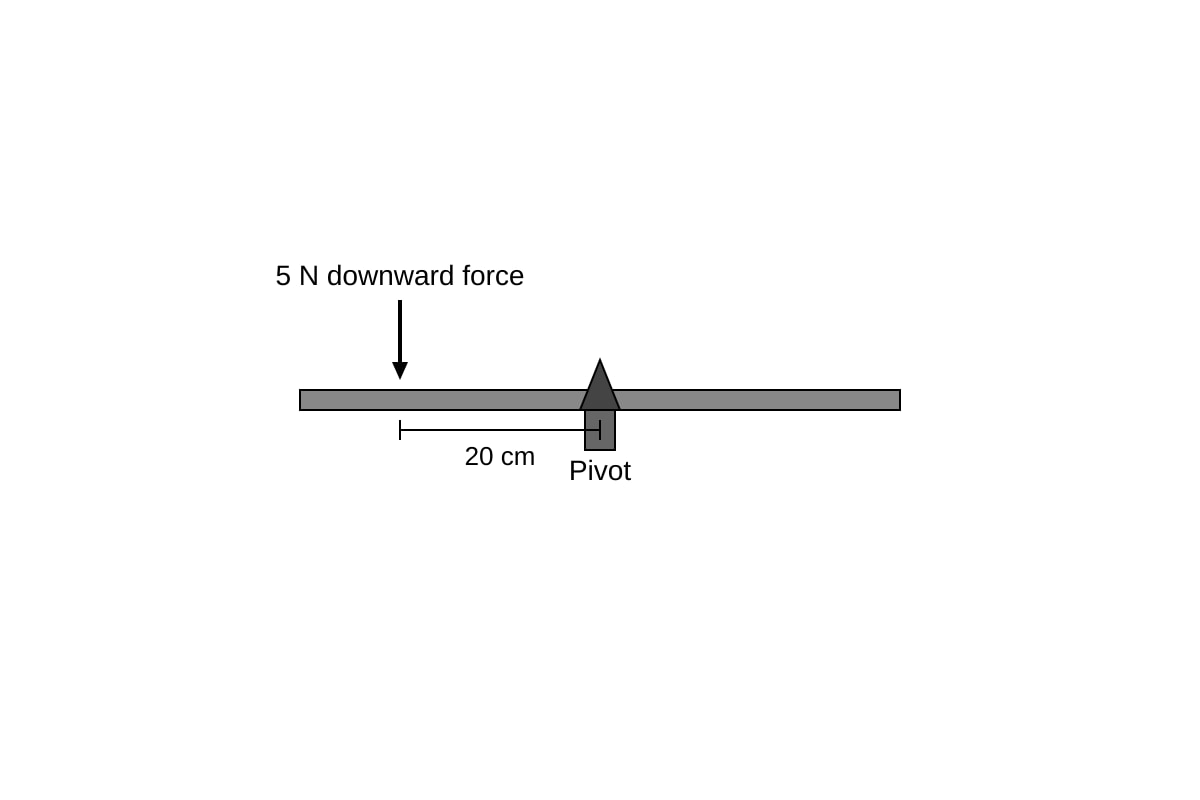
6. [3 marks] The diagram below shows a uniform rod pivoted at its centre. A 5 N weight hangs 20 cm from the pivot on the left. Calculate the moment of the weight about the pivot.
Image pending generation: diagram for Q6.
Moment = ____________________ N·m
Section B: Electricity and Heat (Questions 7–11) [15 marks]
7. [1 mark] State the voltage supplied to homes in Singapore.
8. [2 marks] Draw the circuit symbol for a cell and for an ammeter in the space below.
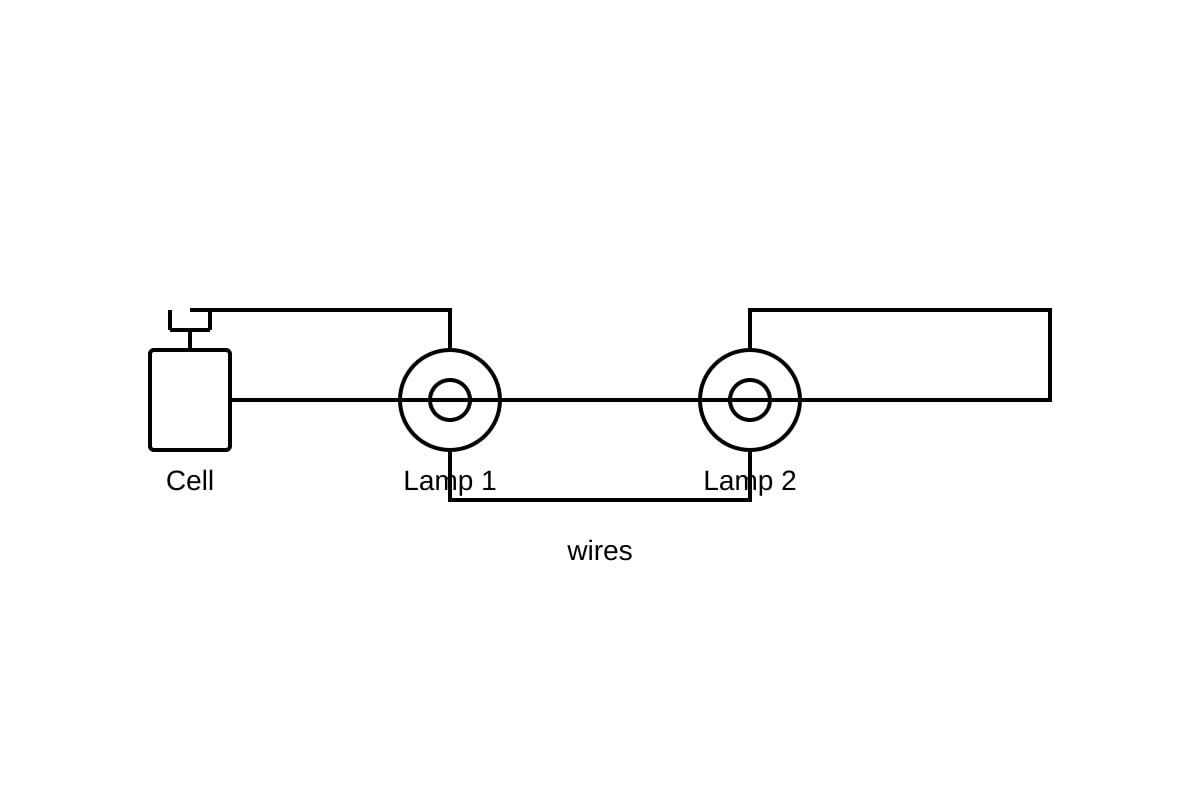
9. [3 marks] The figure shows a simple circuit with two lamps in series and one cell. Label the components and state what happens to the brightness of the other lamp if one lamp is removed.
Image pending generation: circuit for Q9.
10. [2 marks] Heat flows from a hot mug of tea to the surrounding air. State the direction of heat flow and the condition when heat flow stops.
11. [3 marks] A bimetallic strip is used in a thermostat. Explain how expansion and contraction help the thermostat maintain temperature.
12. [4 marks] A data logger records the temperature of water cooling from 80 °C to 30 °C. The temperature drop is 50 °C. If the heat lost is 2000 J, what is the average heat loss per degree Celsius? Show your working.
Average heat loss = ____________________ J/°C
Section C: Light and Pressure (Questions 13–16) [12 marks]
13. [1 mark] A ray of light hits a smooth mirror at 30° to the normal. State the angle of reflection.
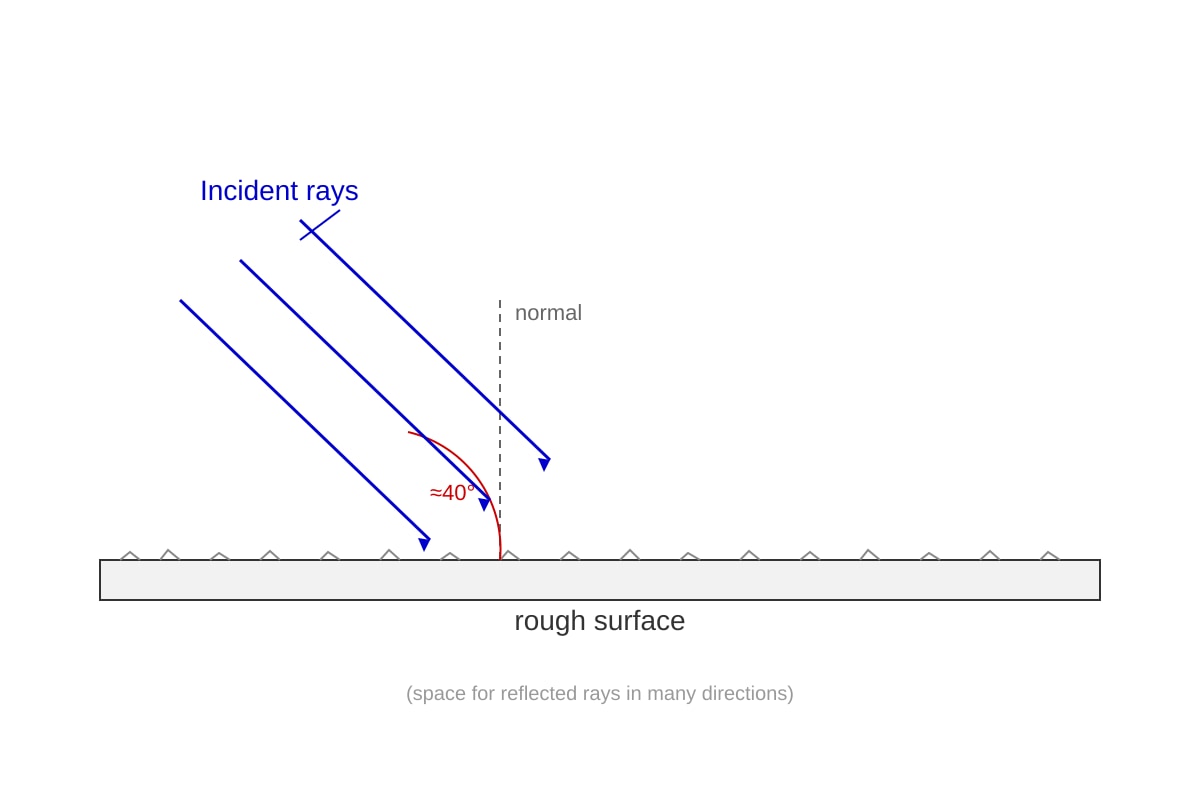
14. [2 marks] The diagram shows light rays falling on a sheet of white paper. Complete the reflected rays to show diffuse reflection.
Image pending generation: diagram for Q14.
15. [3 marks] A woman wears flat shoes (area 0.02 m² each) and then heeled shoes (area 0.002 m² each). Her weight is 500 N. Explain which shoe exerts greater pressure on the ground.
16. [2 marks] State one everyday example of a simple machine and how it makes work easier.
Section D: Integrated Physical Sciences (Questions 17–20) [21 marks]
17. [4 marks] A crane lifts a 200 N load through a height of 5 m in 10 s. (a) Calculate the work done by the crane. [2] (b) State the energy conversion. [1] (c) If the crane uses electrical energy, name the source of the electrical energy if it is from a non-renewable source. [1]
(a) Work done = ____________________ J (b) ___________________________________________________________ (c) ___________________________________________________________
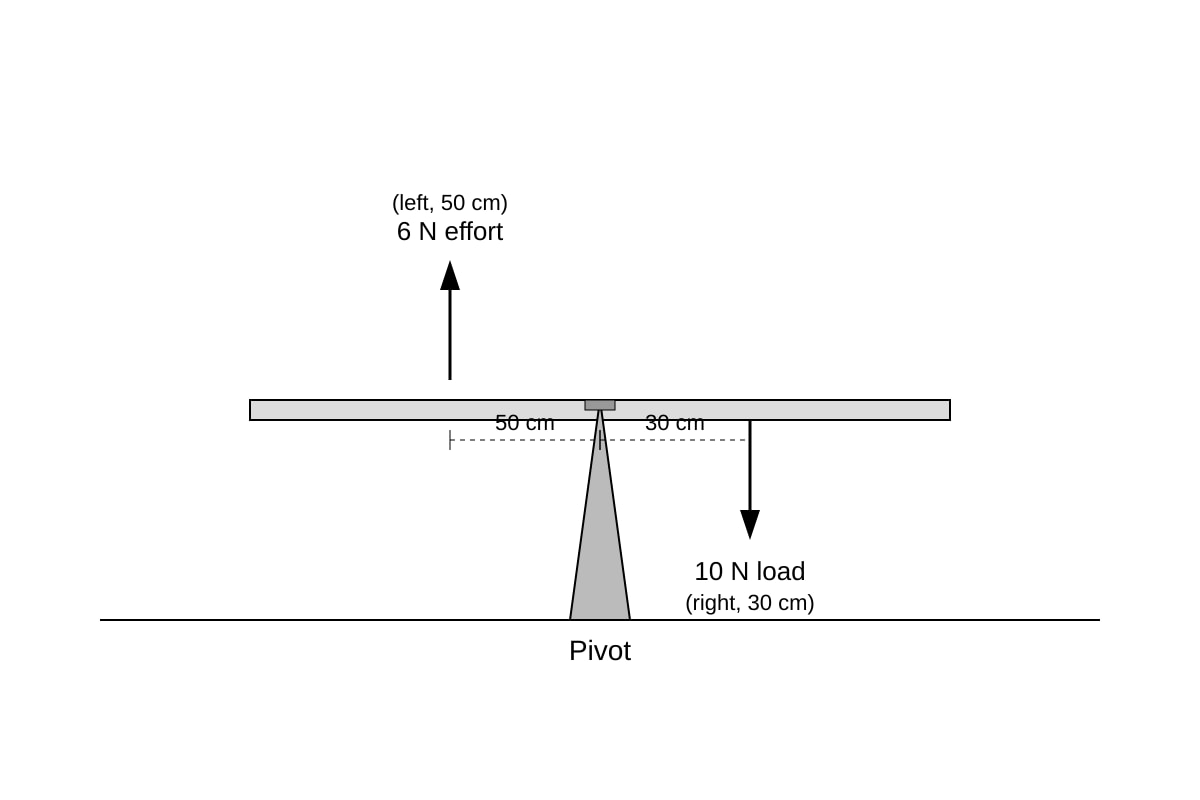
18. [5 marks] The diagram shows a lever with a pivot. A 10 N load is 30 cm from the pivot on the right. A 6 N effort is applied on the left. (a) Calculate the moment of the load. [2] (b) Calculate the moment of the effort if it is placed 50 cm from the pivot. [2] (c) State whether the lever is balanced. [1]
Image pending generation: diagram for Q18.
(a) Moment of load = ____________________ N·cm (b) Moment of effort = ____________________ N·cm (c) ___________________________________________________________
19. [6 marks] A student investigates how surface area affects pressure. He uses a 12 N block placed on three different faces: A (0.06 m²), B (0.03 m²), C (0.01 m²). (a) Calculate pressure on each face. [3] (b) State the trend. [1] (c) Explain why a sharp knife cuts better than a blunt knife using pressure ideas. [2]
(a) P_A = ______ Pa, P_B = ______ Pa, P_C = ______ Pa (b) ___________________________________________________________ (c) ___________________________________________________________
20. [6 marks] A 12 V battery connects to two resistors in series: R1 = 4 Ω, R2 = 2 Ω. (a) Calculate total resistance. [1] (b) Calculate current using V = IR. [2] (c) State one hazard of using electricity in damp conditions and one safety feature. [3]
(a) R_total = ______ Ω (b) I = ______ A (c) Hazard: ___________________________________________________________ Safety feature: ___________________________________________________________
Answers
TuitionGoWhere Exam Practice (AI) – SA2 Practice Paper
Science Secondary 1 — Physical Sciences (Version 1 of 5) Answer Key
Total Marks: 60
Section A: Forces and Energy (12 marks)
1. [1 mark]
Answer: Chemical energy → Gravitational potential energy.
Teaching note: The boy uses chemical energy from his muscles to raise the book, increasing its height and thus its gravitational potential energy (GPE). State both forms for the mark.
2. [2 marks]
Answer: 0 J
Working: Work = Force × displacement. Held stationary → displacement = 0 m. Work = 20 N × 0 m = 0 J.
Marking: 1 mark for correct reason (no displacement), 1 mark for answer 0 J.
Common mistake: Using height 1.2 m; height above ground is irrelevant if no movement occurs.
3. [2 marks]
Answer: 120 J
Working: Work = Force × distance = 30 N × 4 m = 120 J.
Marking: 1 mark working, 1 mark answer with unit.
4. [1 mark]
Answer: Newton (N).
Teaching note: Force is measured in newtons, named after Sir Isaac Newton.
5. [3 marks]
Answer: Pressure increases when on smallest face.
Reasoning: Weight (force) = 10 N constant. Pressure = Force ÷ Area. Largest area 0.05 m² → P = 10 ÷ 0.05 = 200 Pa. Smallest area 0.01 m² → P = 10 ÷ 0.01 = 1000 Pa. Smaller area gives higher pressure.
Marking: 1 mark force constant, 1 mark use P=F/A, 1 mark conclusion.
6. [3 marks]
Answer: 1.0 N·m
Working: Moment = Force × perpendicular distance = 5 N × 0.20 m = 1.0 N·m. (Or 5 N × 20 cm = 100 N·cm = 1.0 N·m)
Marking: 1 mark identify distance 20 cm perpendicular, 1 mark formula, 1 mark answer with unit.
Image note: Q6-fig1 must show pivot centre, 5 N down at 20 cm left.
Section B: Electricity and Heat (15 marks)
7. [1 mark]
Answer: 230 V.
8. [2 marks]
Answer: Cell = two lines (long thin, short thick) ; Ammeter = circle with A.
Marking: 1 mark each symbol.
9. [3 marks]
Answer: Labels: Cell, Lamp 1, Lamp 2. If one lamp removed, circuit open → other lamp goes off.
Marking: 1 mark labels, 2 marks for explanation (series = single path).
Image note: Q9-fig1 shows series loop; removing one breaks circuit.
10. [2 marks]
Answer: From higher temperature (tea) to lower temperature (air). Stops when both reach same temperature (thermal equilibrium).
Marking: 1 mark direction, 1 mark stop condition.
11. [3 marks]
Answer: Different metals expand at different rates; strip bends on heating/cooling, breaking/making contact to switch heater off/on, maintaining set temperature.
Marking: 1 mark expansion difference, 1 mark bending action, 1 mark control of temperature.
12. [4 marks]
Answer: 40 J/°C
Working: Heat loss per °C = Total heat lost ÷ Temperature drop = 2000 J ÷ 50 °C = 40 J/°C.
Marking: 1 mark identify drop 50 °C, 2 marks working, 1 mark answer with unit.
Section C: Light and Pressure (12 marks)
13. [1 mark]
Answer: 30° (law of reflection: angle of incidence = angle of reflection).
14. [2 marks]
Answer: Reflected rays drawn in many random directions (diffuse reflection).
Marking: 2 marks for correct diffuse pattern.
Image note: Q14-fig1 rough surface; reflected rays scatter.
15. [3 marks]
Answer: Heeled shoes exert greater pressure.
Reasoning: P = F ÷ A. Flat: 500 ÷ 0.02 = 25000 Pa per shoe. Heel: 500 ÷ 0.002 = 250000 Pa. Smaller area → larger pressure.
Marking: 1 mark formula, 1 mark comparison, 1 mark conclusion.
16. [2 marks]
Answer: Example: inclined plane; reduces effort force needed to lift load by increasing distance. (Lever, pulley also accepted.)
Marking: 1 mark example, 1 mark explanation.
Section D: Integrated Physical Sciences (21 marks)
17. [4 marks]
(a) [2] Work = 200 N × 5 m = 1000 J. (1 mark working, 1 answer)
(b) [1] Electrical → Gravitational potential (or Chemical→GPE if crane engine).
(c) [1] Coal / crude oil / natural gas.
18. [5 marks]
(a) [2] Moment load = 10 N × 30 cm = 300 N·cm.
(b) [2] Moment effort = 6 N × 50 cm = 300 N·cm.
(c) [1] Yes, balanced (moments equal).
Image note: Q18-fig1 shows distances and forces as labelled.
19. [6 marks]
(a) [3] P_A = 12 ÷ 0.06 = 200 Pa; P_B = 12 ÷ 0.03 = 400 Pa; P_C = 12 ÷ 0.01 = 1200 Pa. (1 each)
(b) [1] Pressure increases as area decreases.
(c) [2] Sharp knife has smaller contact area → higher pressure for same force → cuts better.
20. [6 marks]
(a) [1] R_total = 4 + 2 = 6 Ω.
(b) [2] I = V ÷ R = 12 ÷ 6 = 2 A. (1 working, 1 answer)
(c) [3] Hazard: electric shock / short circuit (1). Safety: circuit breaker / fuse / earth wire (2 for naming + brief use).
Free quiz and exam paper access
Enter your details to view this paper
Your access is remembered on this device.