From Real Exams Exam Paper
Secondary 1 Science Semestral Assessment 2 (End of Year) Paper 1
Free Exam-Derived Secondary 1 Science Semestral Assessment 2 (End of Year) Paper 1 practice paper with questions and answers for Singapore students. This page is rendered as a direct URL so the questions and answers can be discovered without pressing in-page buttons.
These static practice materials are generated from the site's syllabus and paper-generation workflow, with source and model context shown so students and parents can evaluate the material before use.
Questions
TuitionGoWhere Practice Paper - Science Secondary 1
TuitionGoWhere Secondary School (AI)
Subject: Science
Level: Secondary 1
Paper: SA2
Duration: 1 hour 30 minutes
Total Marks: 70
Name: _________________ Class: _______ Date: _____________
Instructions to Candidates
- This paper consists of Section A and Section B.
- Answer ALL questions in both sections.
- Write your answers in the spaces provided.
- Show all working clearly for calculations.
- Include appropriate units in your final answers.
Section A: Multiple Choice and Short Answer Questions [25 marks]
For questions 1-5, choose the best answer and write the letter in the box provided.
1. Which of the following is an example of chemical energy being converted to kinetic energy?
A. A battery powering a motor
B. A person lifting a weight
C. Water flowing down a waterfall
D. A stretched spring being released
Answer: [ ] [1]
2. The diagram shows light rays hitting a plane mirror. Which ray shows the correct reflection?
[DIAGRAM: Incident ray hitting mirror with 4 possible reflected rays labeled A, B, C, D]
Answer: [ ] [1]
3. Which separation technique would be most suitable for separating a mixture of iron filings and sulfur powder? A. Filtration B. Magnetic separation C. Distillation D. Chromatography
Answer: [ ] [1]
4. A microscope has an eyepiece magnification of ×15 and an objective magnification of ×20. What is the total magnification? A. ×35 B. ×300 C. ×150 D. ×5
Answer: [ ] [1]
5. Which of the following statements about elements is correct? A. Elements can be broken down into simpler substances B. All elements are metals C. Elements contain only one type of atom D. Elements always exist as single atoms
Answer: [ ] [1]
Answer the following questions in the spaces provided.
6. State the energy conversion that takes place when a ball is dropped from a height.
_________________________________________________ [1]
7. A chemical container has a "corrosive" hazard symbol. State two precautions that should be taken when handling this chemical.
-
-
_____________________________________________ [2]
8. Complete the following equation for calculating work done:
Work done = _________________ × _________________ [1]
9. Name the process by which particles of a substance spread out to fill the available space.
_________________________________________________ [1]
10. A student observes that sugar dissolves faster in hot water than in cold water. State a hypothesis for an experiment to investigate this observation.
_________________________________________________ [2]
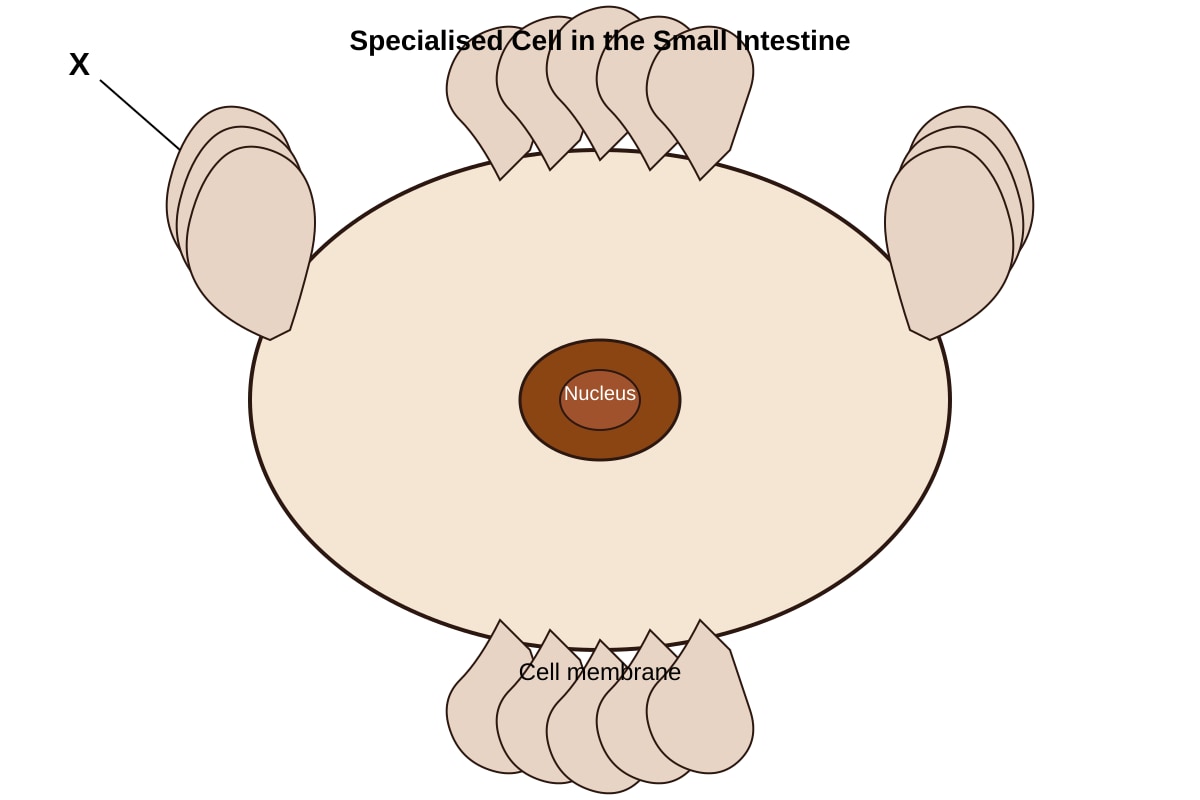
11. The diagram shows a specialised cell found in the small intestine.
[DIAGRAM: Intestinal cell with finger-like projections labeled X]
(a) Name structure X. _________________________ [1]
(b) Explain how structure X helps the cell carry out its function.
_________________________________________________ [2]
12. A mixture contains salt dissolved in water. After heating, all the water evaporates and white crystals remain. State, with a reason, whether the original mixture was an element, compound, or mixture.
Classification: _________________________________
Reason: ______________________________________
_____________________________________________ [2]
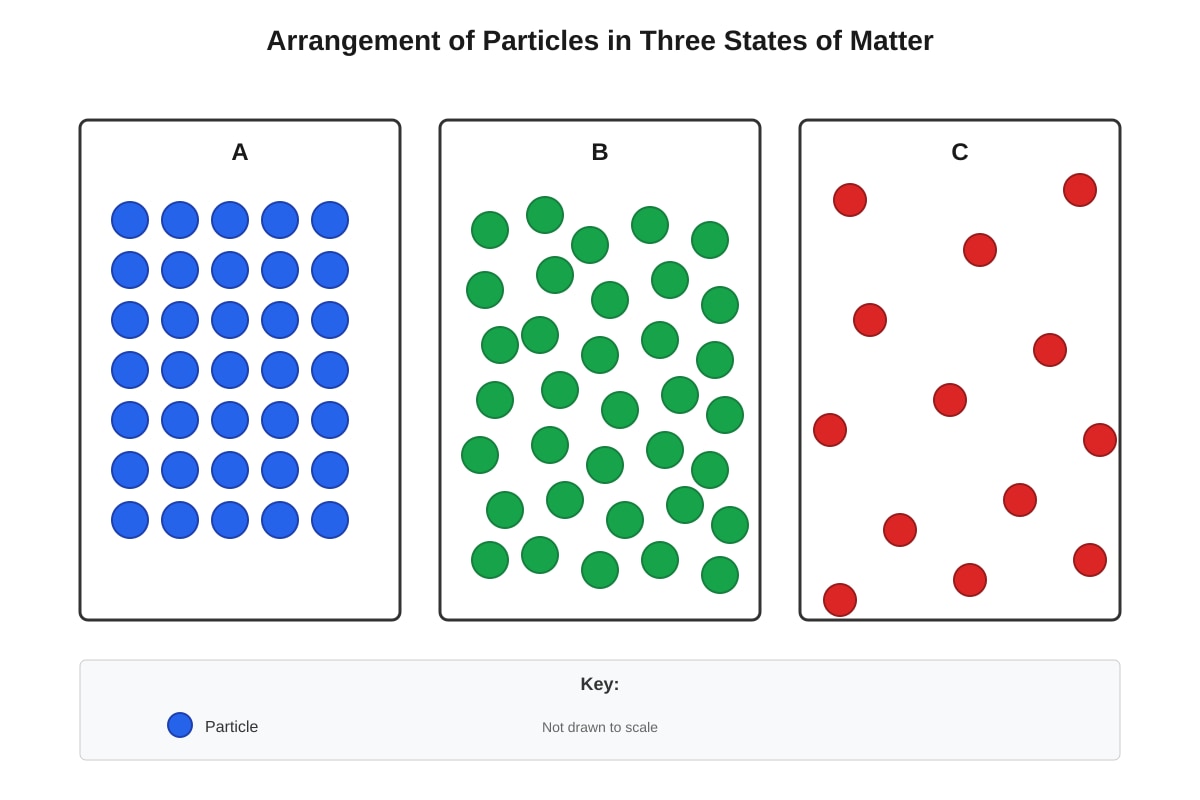
13. The diagram shows the arrangement of particles in three different states of matter.
[DIAGRAM: Three boxes showing particle arrangements - A: tightly packed regular, B: close but irregular, C: far apart and random]
(a) Identify the states of matter shown in A, B, and C.
A: _________________ B: _________________ C: _________________ [3]
(b) Explain what happens to the particles when substance A is heated and changes to substance B.
_________________________________________________ [2]
Section B: Structured Questions [45 marks]
14. A student investigates the factors affecting the rate of dissolving sugar cubes in water. The results are shown in the table below.
| Experiment | Temperature (°C) | Size of sugar pieces | Time to dissolve (s) |
|---|---|---|---|
| 1 | 20 | Cube (1 cm³) | 180 |
| 2 | 20 | Crushed | 95 |
| 3 | 40 | Cube (1 cm³) | 85 |
| 4 | 40 | Crushed | 45 |
(a) State the independent variables in this investigation.
_________________________________________________ [2]
(b) State the dependent variable.
_________________________________________________ [1]
(c) Compare experiments 1 and 2. State what can be concluded about the effect of surface area on dissolving rate.
_________________________________________________ [2]
(d) Explain why crushed sugar dissolves faster than sugar cubes.
_________________________________________________ [3]
(e) The student wants to investigate the effect of stirring on dissolving rate. Describe how the experimental setup should be modified.
_________________________________________________ [2]
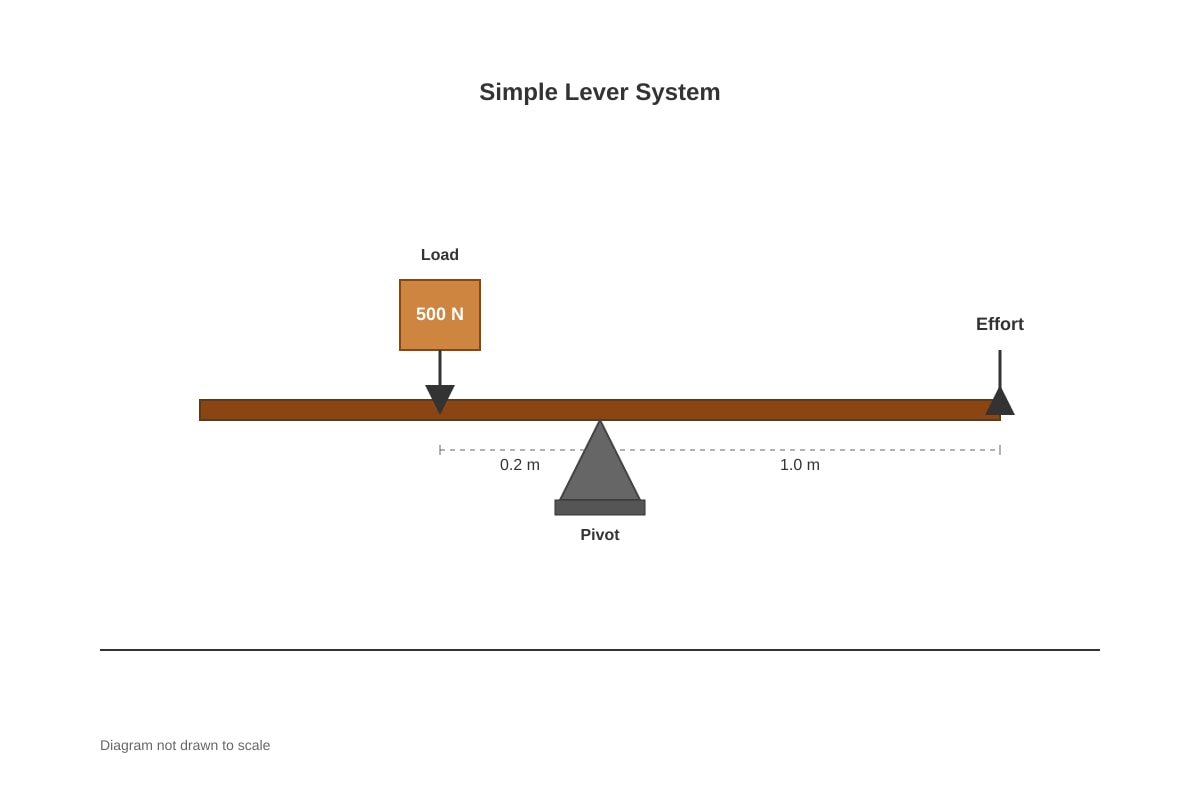
15. The diagram shows a simple lever being used to lift a heavy load.
[DIAGRAM: Lever with 500N load at 0.2m from pivot, effort force at 1.0m from pivot]
(a) Calculate the moment of the load about the pivot.
Moment = _________________ N⋅m [2]
(b) For the lever to be balanced, calculate the effort force required.
Effort force = _________________ N [3]
(c) State one advantage of using this lever system.
_________________________________________________ [1]
(d) The load is raised by 0.1 m. Calculate the work done against gravity.
Work done = _________________ J [2]
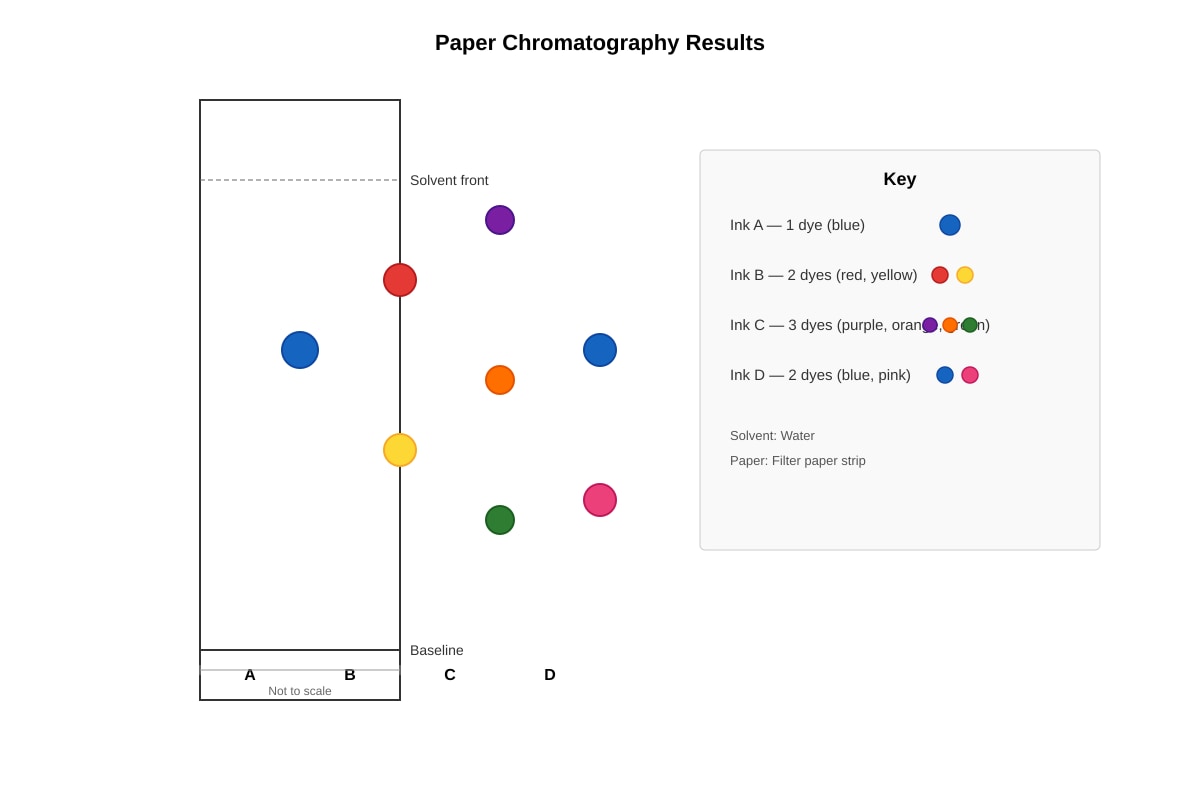
16. A student performs paper chromatography to identify the dyes in different colored inks. The results are shown below.
[DIAGRAM: Chromatography paper showing separated dye spots for inks A, B, C, and D with different colored spots at various heights]
(a) Which ink contains only one dye? Explain your answer.
Ink: _________
Explanation: __________________________________
_____________________________________________ [2]
(b) Which two inks contain the same blue dye? Give evidence from the chromatogram.
Inks: _________ and _________
Evidence: ____________________________________
_____________________________________________ [2]
(c) A student suggests using a different solvent for the chromatography. Explain how this might affect the separation of the dyes.
_________________________________________________ [3]
(d) State one advantage of using chromatography to analyze inks.
_________________________________________________ [1]
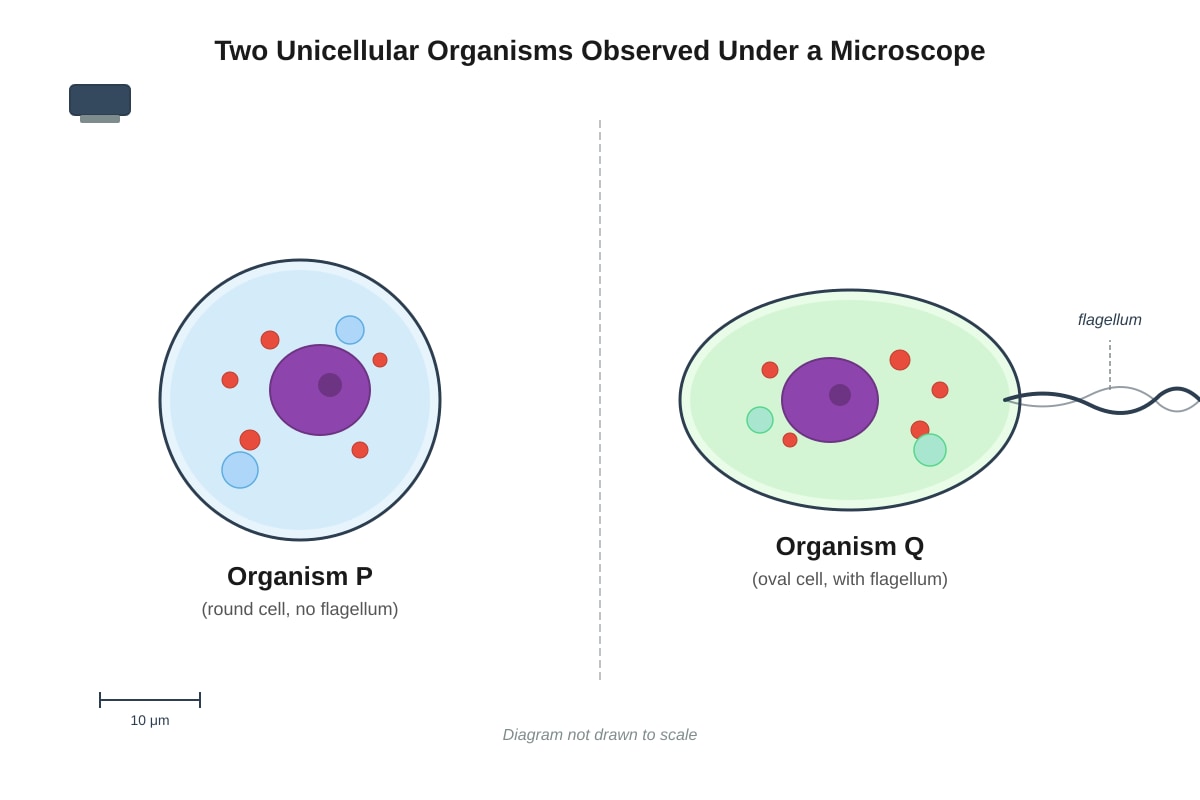
17. The diagram shows two different unicellular organisms observed under a microscope.
[DIAGRAM: Two cells - Organism P (round with nucleus, no flagellum) and Organism Q (oval with nucleus and flagellum)]
(a) Both organisms are eukaryotic cells. State one piece of evidence from the diagram that supports this.
_________________________________________________ [1]
(b) Organism Q can move but Organism P cannot. Explain this difference with reference to the diagram.
_________________________________________________ [2]
(c) The actual length of Organism P is 50 μm. The image length is 20 mm. Calculate the magnification used.
Magnification = _________________ × [3]
(d) Suggest why Organism Q needs to be able to move.
_________________________________________________ [1]
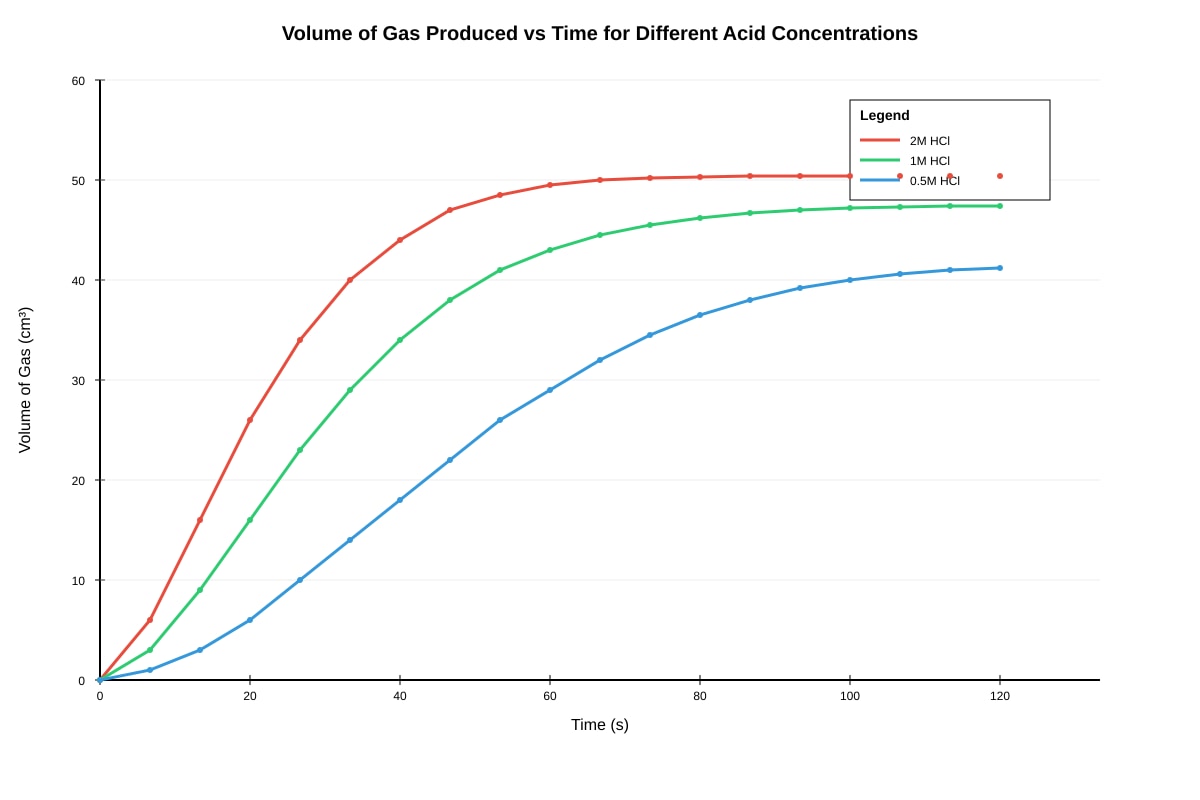
18. A student investigates how the concentration of acid affects the rate of reaction with magnesium ribbon. The graph shows the results.
[DIAGRAM: Graph showing volume of gas produced vs time for three different acid concentrations - 2M, 1M, and 0.5M HCl]
(a) State the relationship between acid concentration and reaction rate shown by the graph.
_________________________________________________ [2]
(b) Explain why increasing the concentration increases the reaction rate.
_________________________________________________ [3]
(c) All three reactions produce the same total volume of gas. Explain why this occurs.
_________________________________________________ [2]
(d) The student repeats the experiment at a higher temperature. Predict and explain how this would affect the reaction rate.
Prediction: ___________________________________
Explanation: __________________________________
_____________________________________________ [3]
Answers
TuitionGoWhere Practice Paper - Science Secondary 1 (Answer Key)
Section A: Multiple Choice and Short Answer Questions [25 marks]
1. A [1] Chemical energy in battery → electrical energy → kinetic energy in motor
2. [Depends on diagram - correct ray should show angle of incidence = angle of reflection] [1]
3. B [1] Iron is magnetic, sulfur is not - magnetic separation is most suitable
4. B [1] Total magnification = 15 × 20 = 300×
5. C [1] Elements contain only one type of atom
6. Gravitational potential energy → Kinetic energy [1] Accept: GPE → KE
7. 1. Wear protective gloves / Use eye protection [1] 2. Use in well-ventilated area / Avoid contact with skin [1] Accept any two reasonable precautions for corrosive chemicals
8. Work done = Force × Distance [1] Accept: Force × Displacement
9. Diffusion [1]
10. If the temperature increases, then the sugar will dissolve faster [2] 1 mark for if-then format, 1 mark for correct relationship Accept equivalent testable hypotheses
11.(a) Microvilli [1] Accept: Villi
11.(b) Microvilli increase the surface area [1] This allows more absorption of nutrients [1]
12. Classification: Mixture [1] Reason: The salt and water can be separated by physical means / The components retain their individual properties [1]
13.(a) A: Solid B: Liquid C: Gas [3] 1 mark each
13.(b) The particles gain kinetic energy and move faster [1] The particles move further apart and the regular arrangement breaks down [1]
Section B: Structured Questions [45 marks]
14.(a) Temperature and size of sugar pieces (surface area) [2] 1 mark each for identifying both independent variables
14.(b) Time to dissolve [1]
14.(c) Crushed sugar dissolves faster than sugar cubes [1] This shows that smaller pieces (larger surface area) dissolve faster [1]
14.(d) Crushed sugar has a larger surface area than sugar cubes [1] More sugar particles are exposed to the water [1] This increases the contact between sugar and water, making dissolving faster [1]
14.(e) Keep all other variables the same (temperature, size of sugar pieces) [1] Add stirring to one setup and no stirring to another, then compare dissolving times [1]
15.(a) Moment = Force × Distance = 500 × 0.2 = 100 N⋅m [2] 1 mark for method, 1 mark for correct answer
15.(b) For balance: Clockwise moment = Anticlockwise moment [1] 100 = Effort × 1.0 [1] Effort force = 100 N [1]
15.(c) Reduces the effort force needed / Makes lifting easier / Provides mechanical advantage [1]
15.(d) Work done = Force × Distance = 500 × 0.1 = 50 J [2] 1 mark for method, 1 mark for correct answer
16.(a) Ink: C [1] Explanation: It shows only one spot/color, indicating only one dye [1]
16.(b) Inks: A and D [1] Evidence: Both show a blue spot at the same height on the chromatogram [1]
16.(c) Different solvents have different polarities [1] This would cause the dyes to travel different distances [1] The separation pattern would change / Some dyes might separate better [1]
16.(d) Quick test / Requires small sample / Can identify multiple components / Sensitive [1]
17.(a) Both have a nucleus / Both have a nuclear membrane [1]
17.(b) Organism Q has a flagellum [1] The flagellum enables movement by beating/rotating to propel the organism [1]
17.(c) Convert units: 20 mm = 20,000 μm [1] Magnification = Image size ÷ Actual size = 20,000 ÷ 50 [1] Magnification = 400× [1]
17.(d) To find food / To escape from predators / To find suitable environment [1]
18.(a) As acid concentration increases, the reaction rate increases [1] Higher concentration produces gas faster / steeper initial slope [1]
18.(b) Higher concentration means more acid particles per unit volume [1] More frequent collisions between acid and magnesium [1] This increases the rate of reaction [1]
18.(c) The same amount of magnesium is used in all experiments [1] All the magnesium reacts completely, producing the same amount of gas [1]
18.(d) Prediction: The reaction rate would increase [1] Explanation: Higher temperature gives particles more kinetic energy [1] Particles move faster and collide more frequently [1] More collisions have enough energy to react [1]
Total: 70 marks
Marking Scheme Notes
Grade Boundaries (Suggested):
- A: 63-70 marks (90-100%)
- B: 56-62 marks (80-89%)
- C: 49-55 marks (70-79%)
- D: 42-48 marks (60-69%)
- E: 35-41 marks (50-59%)
- F: Below 35 marks (<50%)
General Marking Guidelines:
- Award marks for correct scientific terminology
- Accept equivalent expressions where meaning is clear
- For calculations, award method marks even if final answer is incorrect due to earlier error
- Spelling should be reasonably accurate for scientific terms
- Units are required for final answers in calculations
- Show working clearly for full marks in calculation questions