AI Generated Quiz
Secondary 1 Other General Other Quiz
Free Sec 1 Other General Other quiz, Nemo3 AI version, with questions, answers, and syllabus-aligned practice for Singapore students.
These static practice materials are generated from the site's syllabus and paper-generation workflow, with source and model context shown so students and parents can evaluate the material before use.
Questions
Free quiz and exam paper access
Enter your details to view this paper
Your access is remembered on this device.
Answers
Secondary 1 Other Quiz - General Other (Answer Key)
Total Marks: 40
Section A: Ratio and Proportion (10 marks)
1. Simplify the ratio to its simplest form.
[1]
Answer:
Working:
- Convert decimal to fraction:
- Write ratio:
- Multiply both sides by 5:
- Simplify by dividing by 3:
Marking Note: 1 mark for correct final answer. Accept or .
2. In a Secondary 1 class, the ratio of boys to girls is . If there are 18 boys, find the number of girls.
[2]
Answer: 30 girls
Working:
- Boys : Girls =
- 3 units = 18 boys
- 1 unit =
- Girls = 5 units =
Alternative Method:
- Girls =
Marking Note: 1 mark for finding 1 unit = 6, 1 mark for correct final answer.
3. A recipe requires flour and sugar in the ratio . If 250 g of sugar is used, how much flour is needed? Give your answer in kilograms.
[2]
Answer: 1 kg
Working:
- Flour : Sugar =
- 1 unit = 250 g (sugar)
- Flour = 4 units = g
- Convert to kg:
Marking Note: 1 mark for 1000 g or 4 × 250, 1 mark for correct conversion to 1 kg.
4. The ratio of the length to the breadth of a rectangle is . If the perimeter of the rectangle is 64 cm, find its area.
[3]
Answer: 240 cm²
Working:
- Let length = , breadth =
- Perimeter =
- Length = cm
- Breadth = cm
- Area = cm²
Marking Note: 1 mark for setting up and , 1 mark for finding , 1 mark for correct area.
5. A sum of money is divided among Ali, Bala, and Cindy in the ratio . If Cindy receives $120 more than Ali, find the total sum of money.
[2]
Answer: $600
Working:
- Ali : Bala : Cindy =
- Difference between Cindy and Ali = units
- 3 units = $120
- 1 unit = 40
- Total units = units
- Total sum = 400
Wait, let me recalculate: 10 × 40 = 400, not 600. Let me check again.
- Cindy gets 5 units, Ali gets 2 units, difference = 3 units = $120
- 1 unit = $40
- Total = 10 units = $400
Correct Answer: $400
Marking Note: 1 mark for finding 1 unit = $40, 1 mark for correct total.
Section B: Percentages and Discounts (10 marks)
6. Find 15% of 240.
[1]
Answer: 36
Working:
Marking Note: 1 mark for correct answer.
7. The price of a school bag was reduced from 64 during a sale. Calculate the percentage discount.
[2]
Answer: 20%
Working:
- Discount = Original Price - Sale Price = 64 = $16
- Percentage Discount =
Marking Note: 1 mark for finding discount = $16, 1 mark for correct percentage.
8. A bookshop sells a novel at a 20% discount. If the discounted price is $19.20, find the original price of the novel.
[2]
Answer: $24
Working:
- Discounted price = 80% of original price (since 100% - 20% = 80%)
- Original Price =
Alternative Method:
- Let original price =
Marking Note: 1 mark for recognising discounted price is 80% of original, 1 mark for correct calculation.
9. Mr Tan bought a television for $1,200 and sold it at a profit of 15%. He then bought a refrigerator with the proceeds and sold it at a loss of 10%. How much did he receive from selling the refrigerator?
[3]
Answer: $1,242
Working:
- Television:
- Cost Price = $1,200
- Profit = 15% of 180
- Selling Price = 180 = $1,380
- Refrigerator:
- Cost Price = $1,380 (proceeds from TV)
- Loss = 10% of 138
- Selling Price = 138 = $1,242
Marking Note: 1 mark for TV selling price (138) or 90% of 1,242).
10. The population of a town increased by 12% in the first year and then decreased by 8% in the second year. If the population at the start was 50,000, find the population at the end of the second year.
[2]
Answer: 51,520
Working:
- After Year 1: Population =
- After Year 2: Population =
Alternative (Single Calculation):
- Overall multiplier =
- Final Population =
Marking Note: 1 mark for correct Year 1 population (56,000), 1 mark for correct final answer. Common mistake: adding/subtracting percentages directly (12% - 8% = 4% increase → 52,000, which is wrong).
Section C: Unit Conversion and Rate (10 marks)
11. Convert 3.5 hours to minutes.
[1]
Answer: 210 minutes
Working:
Marking Note: 1 mark for correct answer.
12. A car travels at a constant speed of 72 km/h. How far does it travel in 20 minutes? Give your answer in kilometres.
[2]
Answer: 24 km
Working:
- Time = 20 minutes =
- Distance = Speed × Time =
Alternative:
- In 60 minutes → 72 km
- In 20 minutes →
Marking Note: 1 mark for converting 20 min to hour, 1 mark for correct distance.
13. Water flows from a tap at a rate of 8 litres per minute. How long, in hours and minutes, will it take to fill a tank with a capacity of 960 litres?
[2]
Answer: 2 hours 0 minutes
Working:
- Time =
Marking Note: 1 mark for 120 minutes, 1 mark for correct conversion to hours and minutes.
14. The fuel consumption of a car is 12 km per litre. If petrol costs $2.80 per litre, find the cost of petrol for a journey of 360 km.
[2]
Answer: $84
Working:
- Petrol needed =
- Cost = 84
Marking Note: 1 mark for finding 30 litres, 1 mark for correct cost.
15. A factory produces 480 toys in 6 hours. At the same rate, how many toys can it produce in 4 hours 30 minutes?
[3]
Answer: 360 toys
Working:
- Rate =
- Time = 4 hours 30 minutes =
- Toys produced =
Alternative (Proportion):
Marking Note: 1 mark for rate (80 toys/hour), 1 mark for converting 4h30min to 4.5 hours, 1 mark for final answer.
Section D: Data Interpretation and HDB Context (10 marks)
16. The table below shows the number of HDB flats of different room types in a neighbourhood.
| Room Type | Number of Flats |
|---|---|
| 2-room | 120 |
| 3-room | 280 |
| 4-room | 350 |
| 5-room | 150 |
(a) Find the total number of flats in the neighbourhood.
[1]
Answer: 900
Working:
- Total =
Marking Note: 1 mark for correct total.
(b) What percentage of the flats are 4-room flats? Give your answer correct to 1 decimal place.
[2]
Answer: 38.9%
Working:
- Number of 4-room flats = 350
- Total flats = 900
- Percentage = (1 d.p.)
Marking Note: 1 mark for correct fraction , 1 mark for correct percentage to 1 d.p.
17. A 4-room HDB flat has a floor area of 90 m². The living room occupies of the floor area, and the kitchen occupies 12 m². The remaining area is divided equally among 3 bedrooms. Find the area of each bedroom.
[3]
Answer: 18 m²
Working:
- Living room area =
- Kitchen area = 12 m²
- Total used =
- Remaining area =
- Area per bedroom =
Wait, let me recalculate: 90 - 48 = 42, 42 ÷ 3 = 14. So answer is 14 m², not 18 m².
Correct Answer: 14 m²
Marking Note: 1 mark for living room area (36 m²), 1 mark for remaining area (42 m²), 1 mark for area per bedroom (14 m²).
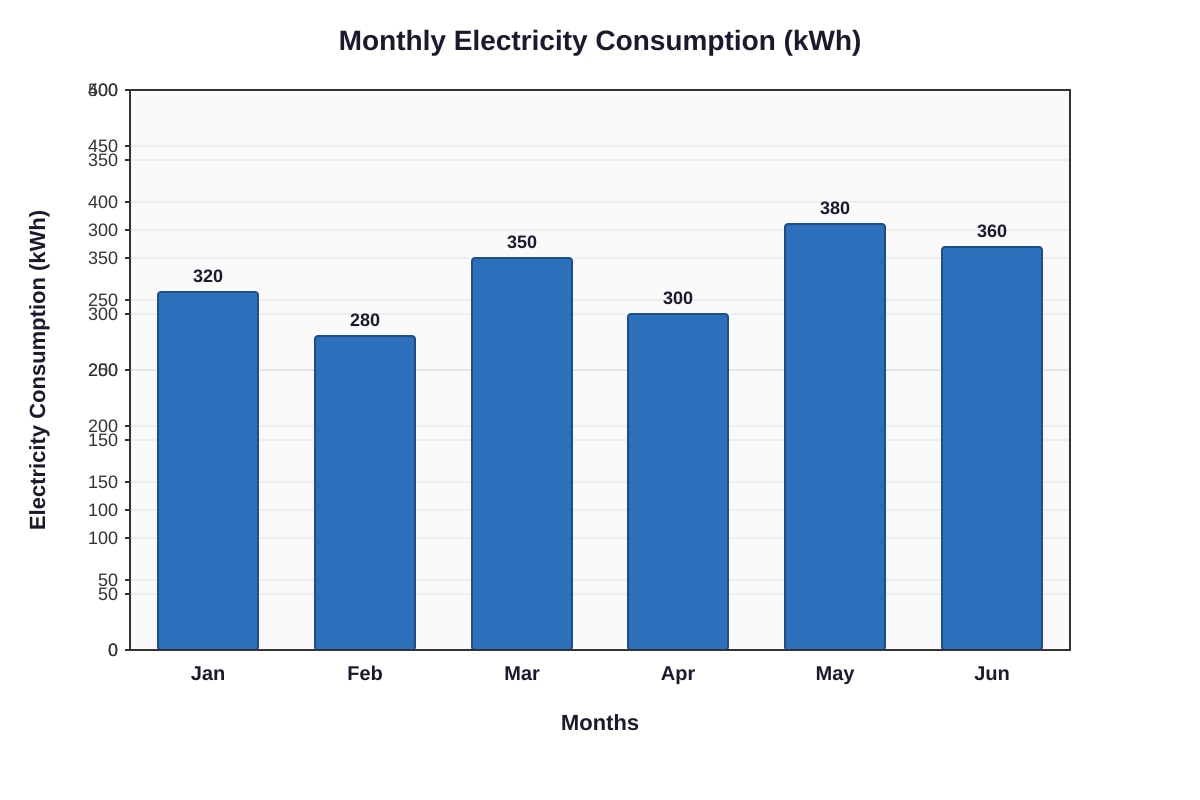
18. The bar chart below shows the monthly electricity consumption (in kWh) of a household for the first 6 months of a year.
Generated chart for Q18.
(a) In which month was the electricity consumption the highest?
[1]
Answer: May
Working:
- From the chart: May = 380 kWh (highest among all months)
Marking Note: 1 mark for correct month.
(b) Calculate the average monthly electricity consumption for these 6 months.
[2]
Answer: 331.7 kWh (or 331.67 kWh)
Working:
- Total =
- Average = (1 d.p.)
Marking Note: 1 mark for correct total (1990), 1 mark for correct average.
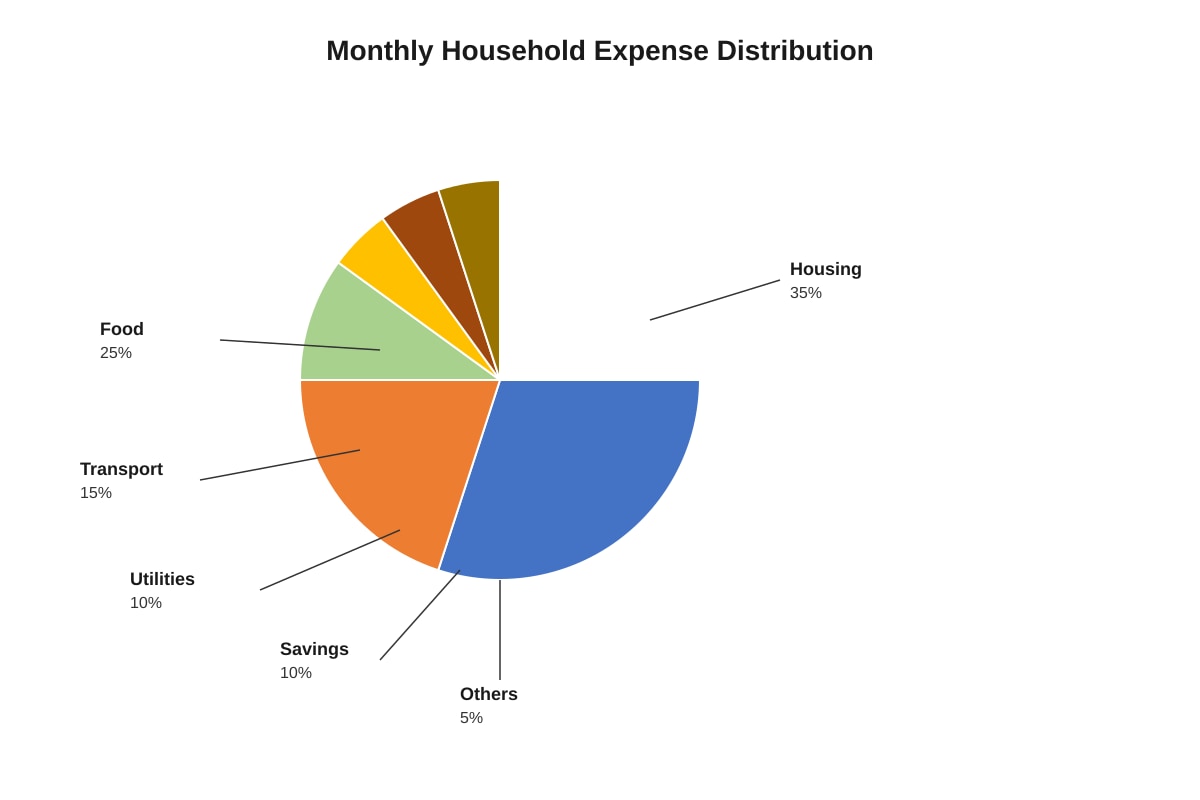
19. The pie chart below shows the distribution of household expenses for a family in a month.
Generated chart for Q19.
If the family's total monthly expenses are $4,000, how much do they spend on Food and Transport combined?
[2]
Answer: $1,600
Working:
- Food = 25%, Transport = 15%
- Combined = 25% + 15% = 40%
- Amount = 1,600
Alternative:
- Food = 1,000
- Transport = 600
- Total = 600 = $1,600
Marking Note: 1 mark for combined percentage (40%) or individual amounts, 1 mark for correct final answer.
20. A survey was conducted on the mode of transport used by 200 Secondary 1 students to go to school. The results are shown in the table below.
| Mode of Transport | Number of Students |
|---|---|
| Bus | 72 |
| MRT | 56 |
| Walk | 48 |
| Car | 24 |
(a) Draw a pie chart to represent this data.
[3]

Generated chart for Q20.
Answer: Pie chart with sectors:
- Bus:
- MRT:
- Walk:
- Car:
Working:
- Total students = 200
- Bus angle =
- MRT angle =
- Walk angle =
- Car angle =
- Check: ✓
Marking Note: 1 mark for correct angle calculations (or correct proportions), 1 mark for accurately drawn sectors, 1 mark for labelling all sectors with category names and values/percentages.
(b) What percentage of students walk to school?
[1]
Answer: 24%
Working:
- Students who walk = 48
- Total students = 200
- Percentage =
Marking Note: 1 mark for correct percentage.
End of Answer Key