AI Generated Exam Paper
Secondary 1 Other Practice Paper 5
Free Sec 1 Other Practice Paper 5, Nemo3 AI version, with questions, answers, and syllabus-aligned practice for Singapore students.
These static practice materials are generated from the site's syllabus and paper-generation workflow, with source and model context shown so students and parents can evaluate the material before use.
Questions
Free quiz and exam paper access
Enter your details to view this paper
Your access is remembered on this device.
Answers
TuitionGoWhere Practice Paper - Other Secondary 1 (Answer Key)
Subject: Other
Level: Secondary 1
Paper: Practice Paper Version 5
Total Marks: 60
Section A: Ratio and Proportion [15 marks]
Question 1 [2 marks]
Answer: or
Working:
- Convert decimal to fraction:
- Write ratio:
- Multiply both sides by 5 (LCM of denominators):
- Simplify by dividing by 2:
Alternative method: , so ratio is
Marking notes:
- 1 mark for correct conversion of decimal to fraction or correct method
- 1 mark for final simplified ratio
- Accept if student multiplies by 5 but forgets to simplify (1 mark only)
- Common error: Not simplifying fully (e.g., leaving as )
Question 2 [2 marks]
Answer: 200 students
Working:
- Ratio Bus : Walk =
- 3 units = 120 students
- 1 unit = students
- 5 units = students
Marking notes:
- 1 mark for finding value of 1 unit (40)
- 1 mark for correct final answer (200)
- Common error: Multiplying 120 by 5/3 directly without unit method
Question 3 [3 marks]
Answer:
Orange juice: 1000 mL
Apple juice: 1500 mL
Water: 2500 mL
Working:
- Total ratio parts = parts
- Total volume = 5 litres = 5000 mL
- 1 part = mL
- Orange juice = mL
- Apple juice = mL
- Water = mL
Check: mL ✓
Marking notes:
- 1 mark for correct total parts (10) and conversion to mL (5000)
- 1 mark for correct value of 1 part (500 mL)
- 1 mark for all three correct amounts
- Common error: Forgetting to convert litres to millilitres
Question 4 [3 marks]
Answer: 1008 cm²
Working:
- Let length = cm, breadth = cm
- Perimeter =
- Length = cm
- Breadth = cm
- Area = cm²
Marking notes:
- 1 mark for setting up or equivalent
- 1 mark for finding and correct dimensions
- 1 mark for correct area calculation
- Common error: Finding dimensions but forgetting to calculate area
Question 5 [3 marks]
Answer: $1350
Working:
- Ratio Ahmad : Bala : Cindy =
- Difference between Cindy and Ahmad = units
- 2 units = $180
- 1 unit = $90
- Total units = units
- Total sum = 1350
Check: Ahmad = 450, Cindy = 540 - 180 ✓
Marking notes:
- 1 mark for identifying 2 units = $180
- 1 mark for finding 1 unit = $90
- 1 mark for correct total sum
- Common error: Using wrong difference (e.g., 6 - 5 = 1 unit)
Question 6 [2 marks]
Answer: 2.1 km
Working:
- Scale means 1 cm on map = 25,000 cm in reality
- Map distance = 8.4 cm
- Actual distance = cm
- Convert to km: km
Marking notes:
- 1 mark for correct multiplication ()
- 1 mark for correct conversion to km (÷ 100,000)
- Common error: Wrong conversion factor (e.g., ÷ 1000 or ÷ 10,000)
Section B: Percentage and Discount [15 marks]
Question 7 [2 marks]
Answer: $23.80
Working:
- Discount = 4.20
- Sale price = 4.20 = $23.80
Alternative: Sale price = 23.80
Marking notes:
- 1 mark for correct discount calculation or correct method
- 1 mark for correct final answer
- Common error: Calculating 15% of 28 incorrectly
Question 8 [3 marks]
Answer: $61.20
Working:
- First discount (20%): Price = 68
- Second discount (10% for members): Price = 61.20
Alternative (single step): 61.20
Marking notes:
- 1 mark for correct first discounted price ($68)
- 1 mark for applying second discount correctly
- 1 mark for correct final answer
- Common error: Adding discounts (20% + 10% = 30%) and calculating 59.50 (incorrect)
Question 9 [2 marks]
Answer: $1600
Working:
- Let original price =
- After 25% discount:
Check: 25% of 1600 = 400, 1600 - 400 = 1200 ✓
Marking notes:
- 1 mark for correct equation ( or equivalent)
- 1 mark for correct answer
- Common error: Calculating (incorrect - this adds 25% of discounted price, not original)
Question 10 [2 marks]
Answer: 40%
Working:
- Cost price = $45
- Selling price = $63
- Profit = 45 = $18
- Profit % =
Marking notes:
- 1 mark for correct profit calculation ($18)
- 1 mark for correct percentage calculation
- Common error: Using selling price as denominator ()
Question 11 [2 marks]
Answer: 20%
Working:
- Increase =
- Percentage increase =
Marking notes:
- 1 mark for correct increase (9000)
- 1 mark for correct percentage calculation
- Common error: Using new population as denominator ()
Question 12 [4 marks]
Answer: $300
Working:
- Let cost price =
- Selling price after 15% discount = $306
- Marked price
- Marked price =
- Profit = 20% on cost price, so Selling price =
Wait, let me re-read: "sold for $306 after a discount of 15%. If the shopkeeper made a profit of 20% on the cost price"
So 306 = 1.2 \times \text{Cost price}306 \div 1.2 = 255$
Marking notes:
- 1 mark for recognising $306 is the selling price (after discount)
- 1 mark for setting up
- 1 mark for correct calculation of cost price
- 1 mark for correct final answer ($255)
- Common error: Finding marked price first ($360) then calculating 20% profit on that
Section C: Rate and Speed [15 marks]
Question 13 [2 marks]
Answer: 30 km
Working:
- Speed = 72 km/h
- Time = 25 minutes = hours = hours
- Distance = Speed Time = km
Marking notes:
- 1 mark for correct time conversion (25/60 hours)
- 1 mark for correct distance calculation
- Common error: Using 25 directly without converting to hours ()
Question 14 [2 marks]
Answer: 1350 pages
Working:
- Rate =
- Time = 1 hour 15 minutes = 75 minutes
- Pages = pages
Marking notes:
- 1 mark for correct rate (18 pages/min)
- 1 mark for correct time conversion (75 min) and final calculation
- Common error: Not converting 1 hour 15 min to minutes
Question 15 [2 marks]
Answer: 1 hour 0 minutes (or 1 hour)
Working:
- Rate = 4 L/min
- Capacity = 240 L
- Time = minutes = 1 hour
Marking notes:
- 1 mark for correct division (240 ÷ 4 = 60)
- 1 mark for correct conversion to hours and minutes
- Common error: Leaving answer as 60 minutes without converting
Question 16 [3 marks]
Answer: 18 km
Working:
- Let distance = km
- Time from A to B = hours
- Time from B to A = hours
- Total time = hours
- Multiply by 36:
- km
Check: Time A→B = 1 hour, Time B→A = 1.5 hours, Total = 2.5 hours ✓
Marking notes:
- 1 mark for correct equation setup
- 1 mark for solving equation correctly
- 1 mark for correct answer with units
- Common error: Using average of speeds km/h
Question 17 [3 marks]
Answer: 680 widgets
Working:
- Machine 1 rate = widgets/hour
- Machine 2 rate = widgets/hour
- Combined rate = widgets/hour
- In 2 hours: widgets
Marking notes:
- 1 mark for correct individual rates
- 1 mark for correct combined rate
- 1 mark for correct final answer
- Common error: Averaging the rates instead of adding
Question 18 [3 marks]
Answer: 3 hours 26 minutes (or 3 hours 25.7 minutes ≈ 3 h 26 min)
Working:
- Pump 1 rate = pool/hour
- Pump 2 rate = pool/hour
- Combined rate = pool/hour
- Time = hours = hours
- minutes ≈ 26 minutes
- Time = 3 hours 26 minutes
Marking notes:
- 1 mark for correct individual rates
- 1 mark for correct combined rate ()
- 1 mark for correct time calculation and conversion
- Accept 3 hours 25 minutes or 3 hours 26 minutes
- Common error: Adding times (6 + 8 = 14 hours) or averaging
Section D: Data Handling and Interpretation [15 marks]
Question 19 [6 marks]
(a) [1 mark]
Answer: 30 students
Working:
(b) [1 mark]
Answer: 2 books
Reasoning: The highest frequency is 10 students (for 2 books).
(c) [2 marks]
Answer: 1.8 books
Working:
- Total books =
- books
- Mean = books
(d) [2 marks]
Answer:
Working:
- Students with at least 2 books =
- Total students = 30
- Probability =
Marking notes for Q19:
- (a) 1 mark for correct total
- (b) 1 mark for correct mode
- (c) 1 mark for correct total books (54), 1 mark for correct mean (1.8)
- (d) 1 mark for correct numerator (19), 1 mark for correct fraction
- Common error in (c): Dividing by 5 (number of categories) instead of 30 (number of students)
Question 20 [8 marks]
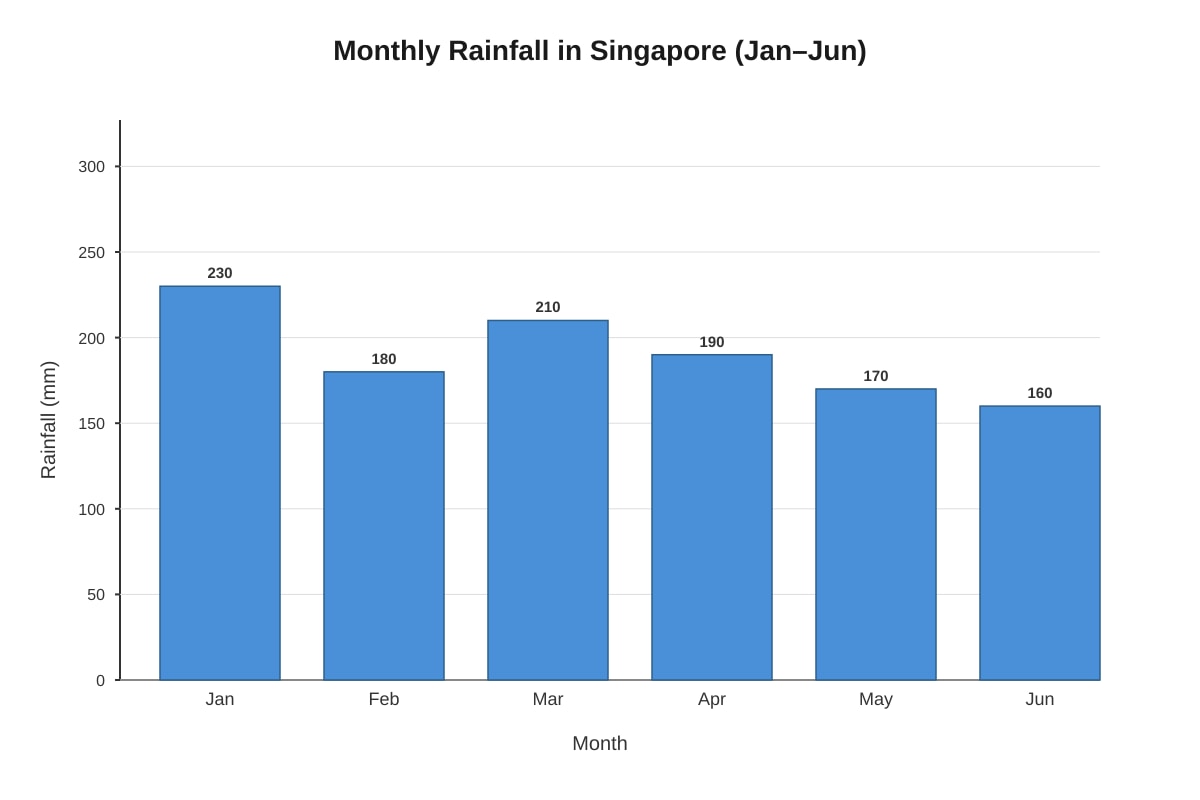
(a) [1 mark]
Answer: January
Reasoning: January has the highest bar at 230 mm.
(b) [1 mark]
Answer: 70 mm
Working: Highest = 230 mm (Jan), Lowest = 160 mm (Jun). Difference = mm.
(c) [2 marks]
Answer: 190 mm
Working:
- Total rainfall = mm
- Average = mm
(d) [2 marks]
Answer: 192 mm
Working:
- June rainfall = 160 mm
- July = mm
- Or: 20% of 160 = 32, so mm
(e) [2 marks]
Answer: No, the claim is incorrect. The rainfall increased from February (180 mm) to March (210 mm), so it did not decrease every month.
Required elements for full marks:
- State "No" or "Incorrect"
- Identify the specific increase (Feb to Mar: 180 → 210 mm)
- Use data from chart to support
Marking notes for Q20:
- (a) 1 mark for correct month
- (b) 1 mark for correct difference with units
- (c) 1 mark for correct total (1140), 1 mark for correct average (190)
- (d) 1 mark for correct method (×1.2 or +20%), 1 mark for correct answer (192)
- (e) 1 mark for "No/Incorrect", 1 mark for correct evidence (Feb→Mar increase)
- Common error in (e): Saying "Yes" or not providing specific counter-example
Total Marks: 60
General Marking Guidance
- Method marks (M): Awarded for correct method/approach even if arithmetic error occurs
- Accuracy marks (A): Awarded for correct final answer (dependent on correct method)
- Units: Deduct 1 mark per question for missing or incorrect units where applicable
- Fractions: Must be in simplest form unless otherwise stated
- Rounding: Follow standard conventions (3 significant figures unless exact)
- Alternative methods: Accept any mathematically valid method that leads to correct answer