AI Generated Exam Paper
Secondary 1 Other Practice Paper 3
Free Sec 1 Other Practice Paper 3, Nemo3 AI version, with questions, answers, and syllabus-aligned practice for Singapore students.
These static practice materials are generated from the site's syllabus and paper-generation workflow, with source and model context shown so students and parents can evaluate the material before use.
Questions
Free quiz and exam paper access
Enter your details to view this paper
Your access is remembered on this device.
Answers
TuitionGoWhere Practice Paper - Other Secondary 1 (Answer Key)
Subject: Other
Level: Secondary 1
Paper: Practice Paper 3 (General Other)
Total Marks: 60
Section A: Ratio, Proportion & Percentage [15 marks]
Question 1 [2 marks]
Simplify the ratio to its simplest form.
Working:
- Convert decimal to fraction:
- Write ratio:
- Multiply both sides by 5 (LCM of denominators):
- Simplify by dividing by 2:
Answer:
Marking notes:
- 1 mark for correct conversion of 2.8 to fraction ( or )
- 1 mark for correct simplification to
- Common error: Forgetting to simplify fully (e.g., leaving as )
Question 2 [2 marks]
In a Secondary 1 cohort, the ratio of students who take Art to those who take Music is . If there are 140 students who take Music, how many students take Art?
Working:
- Ratio Art : Music =
- Music = 7 units = 140 students
- 1 unit = students
- Art = 5 units = students
Answer: 100 students
Marking notes:
- 1 mark for finding value of 1 unit (20)
- 1 mark for correct final answer (100)
- Alternative method: (full marks if correct)
Question 3 [3 marks]
A recipe requires flour, sugar, and butter in the ratio by mass. If 300 g of butter is used, find the total mass of flour and sugar needed.
Working:
- Ratio Flour : Sugar : Butter =
- Butter = 2 units = 300 g
- 1 unit = g
- Flour = 4 units = g
- Sugar = 1 unit = g
- Total mass of flour and sugar = g
Answer: 750 g
Marking notes:
- 1 mark for finding 1 unit = 150 g
- 1 mark for finding flour (600 g) and sugar (150 g) individually or combined
- 1 mark for correct total (750 g)
- Common error: Finding only flour or only sugar
Question 4 [2 marks]
The price of a textbook was reduced from 36 during a sale. Calculate the percentage discount.
Working:
- Discount amount = 36 = $9
- Percentage discount =
Answer: 20%
Marking notes:
- 1 mark for correct discount amount ($9)
- 1 mark for correct percentage calculation (20%)
- Common error: Using new price as denominator ()
Question 5 [3 marks]
A shopkeeper buys a bag for $80 and sells it at a profit of 25%. During a clearance sale, he gives a further 10% discount on the selling price. Find the final selling price of the bag.
Working:
- Cost price = $80
- Selling price before discount = 80 \times 1.25 = $100
- Discount = 10% of 10
- Final selling price = 10 = $90
Answer: $90
Marking notes:
- 1 mark for correct marked price ($100)
- 1 mark for correct discount amount ($10) or method
- 1 mark for correct final answer ($90)
- Common error: Calculating 10% discount on cost price instead of selling price
Question 6 [3 marks]
The population of a town increased from 24,000 to 27,600 over a year. Calculate the percentage increase in the population.
Working:
- Increase =
- Percentage increase =
Answer: 15%
Marking notes:
- 1 mark for correct increase (3,600)
- 1 mark for correct fraction setup
- 1 mark for correct percentage (15%)
- Common error: Using new population as denominator
Section B: Rate, Speed & Unit Conversion [15 marks]
Question 7 [1 mark]
Convert 3 hours 45 minutes into hours, giving your answer as a decimal.
Working:
- 45 minutes = hours
- Total = hours
Answer: 3.75 hours
Marking notes:
- 1 mark for correct answer
- Accept 3.75 or (but question asks for decimal)
Question 8 [2 marks]
A car travels at a constant speed of 72 km/h. How far, in metres, does it travel in 15 seconds?
Working:
- Speed = 72 km/h = m/s = 20 m/s
- Distance = Speed Time = m
Answer: 300 m
Marking notes:
- 1 mark for correct speed conversion to m/s (20 m/s)
- 1 mark for correct distance (300 m)
- Alternative: Distance in km = km = 300 m
Question 9 [3 marks]
Water flows from a tap at a rate of 8 litres per minute. How long, in hours and minutes, will it take to fill a tank with a capacity of 1,200 litres?
Working:
- Time in minutes = minutes
- 150 minutes = 2 hours 30 minutes
Answer: 2 hours 30 minutes
Marking notes:
- 1 mark for correct time in minutes (150)
- 1 mark for correct conversion to hours and minutes
- 1 mark for correct format (2 hours 30 minutes)
Question 10 [2 marks]
A printer can print 24 pages per minute. At this rate, how many pages can it print in 2 hours 30 minutes?
Working:
- 2 hours 30 minutes = 150 minutes
- Pages = pages
Answer: 3,600 pages
Marking notes:
- 1 mark for correct time conversion (150 minutes)
- 1 mark for correct multiplication (3,600)
Question 11 [3 marks]
Mr Tan drove from Town A to Town B at an average speed of 60 km/h. The journey took 2 hours 40 minutes. He then drove from Town B to Town C at an average speed of 80 km/h for 1 hour 30 minutes. Find the total distance travelled.
Working:
- Time A to B = 2 hours 40 minutes = hours = hours
- Distance A to B = km
- Time B to C = 1 hour 30 minutes = 1.5 hours
- Distance B to C = km
- Total distance = km
Answer: 280 km
Marking notes:
- 1 mark for correct distance A to B (160 km)
- 1 mark for correct distance B to C (120 km)
- 1 mark for correct total (280 km)
- Common error: Incorrect time conversion (e.g., 2.4 hours instead of )
Question 12 [2 marks]
A machine produces 360 widgets in 4 hours 30 minutes. At the same rate, how many widgets can it produce in 7 hours?
Working:
- 4 hours 30 minutes = 4.5 hours
- Rate = widgets per hour
- In 7 hours: widgets
Answer: 560 widgets
Marking notes:
- 1 mark for correct rate (80 widgets/hour)
- 1 mark for correct final answer (560)
- Alternative: Proportion method
Question 13 [2 marks]
A cyclist completes a 45 km route in 2 hours 30 minutes. Calculate his average speed in km/h.
Working:
- Time = 2 hours 30 minutes = 2.5 hours
- Average speed = km/h
Answer: 18 km/h
Marking notes:
- 1 mark for correct time conversion (2.5 hours)
- 1 mark for correct speed (18 km/h)
Section C: Data Interpretation & Algebraic Reasoning [15 marks]
Question 14 [5 marks]
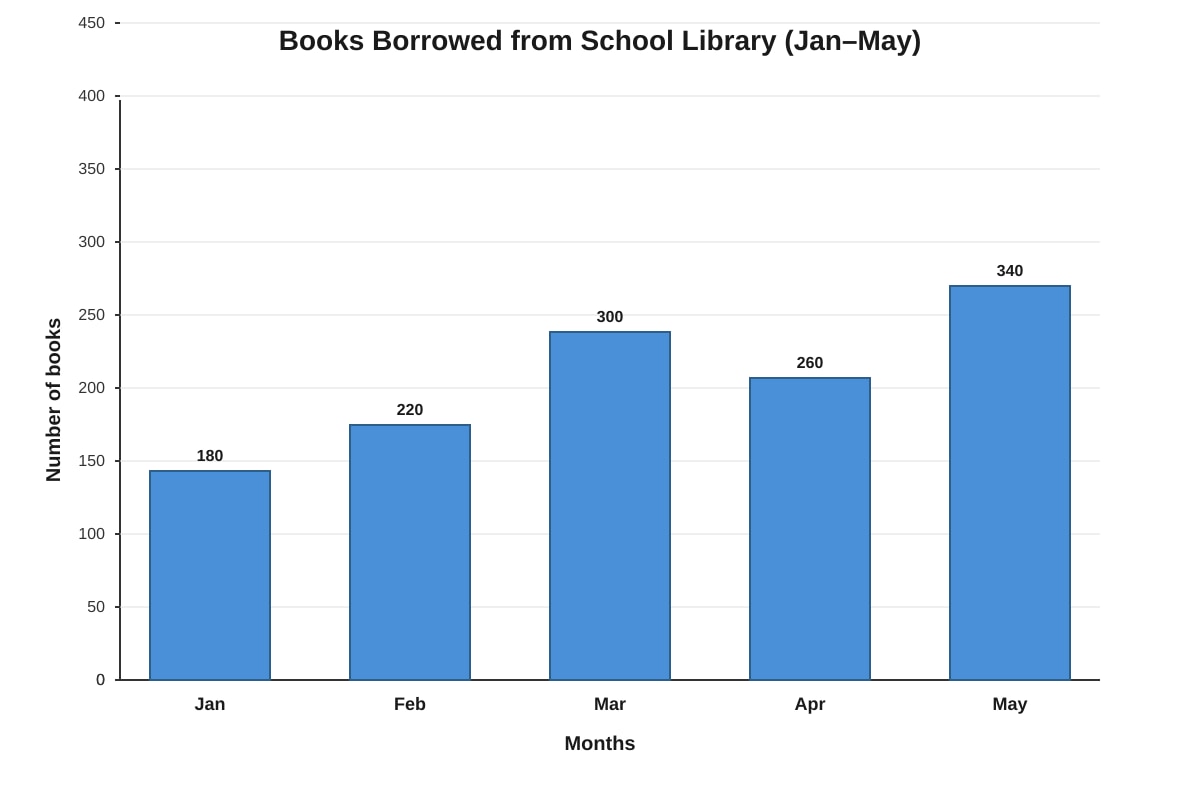
Refer to the bar chart showing books borrowed from a school library (Jan–May).
(a) In which month was the greatest number of books borrowed?
Answer: May
Mark: 1 mark for correct month (May)
(b) Calculate the percentage increase in books borrowed from February to March.
Working:
- February = 220, March = 300
- Increase =
- Percentage increase = (or )
Answer: 36.4% (or )
Marking notes:
- 1 mark for correct increase (80)
- 1 mark for correct percentage calculation
(c) Find the average number of books borrowed per month over the five months.
Working:
- Total =
- Average =
Answer: 260 books
Marking notes:
- 1 mark for correct total (1,300)
- 1 mark for correct average (260)
Question 15 [6 marks]
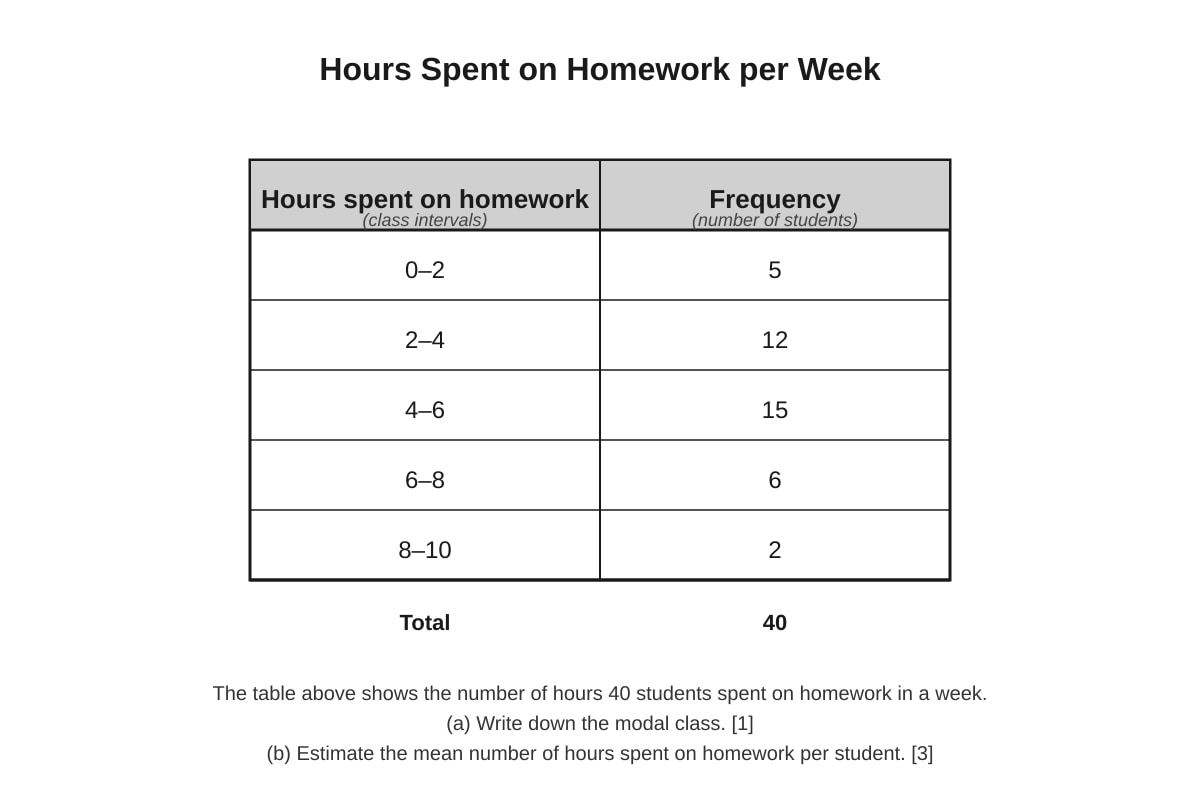
Refer to the frequency table showing hours spent on homework.
(a) Write down the modal class.
Answer: 4–6 hours
Mark: 1 mark (highest frequency = 15)
(b) Estimate the mean number of hours spent on homework per student.
Working:
| Hours | Midpoint () | Frequency () | |
|---|---|---|---|
| 0–2 | 1 | 5 | 5 |
| 2–4 | 3 | 12 | 36 |
| 4–6 | 5 | 15 | 75 |
| 6–8 | 7 | 6 | 42 |
| 8–10 | 9 | 2 | 18 |
| Total | 40 | 176 |
- Estimated mean = hours
Answer: 4.4 hours
Marking notes:
- 1 mark for correct midpoints
- 1 mark for correct column and total (176)
- 1 mark for correct mean (4.4)
(c) What fraction of the students spent 6 hours or more on homework? Give your answer in simplest form.
Working:
- Students with 6+ hours = (from 6–8 and 8–10 classes)
- Fraction =
Answer:
Marking notes:
- 1 mark for correct numerator (8)
- 1 mark for correct simplification to
Question 16 [3 marks]
The sum of three consecutive even numbers is 126. Find the largest of these three numbers.
Working:
- Let the three consecutive even numbers be , ,
- Numbers: 40, 42, 44
- Largest = 44
Answer: 44
Marking notes:
- 1 mark for correct algebraic setup
- 1 mark for solving
- 1 mark for correct largest number (44)
- Alternative: Let middle number be , then , largest = 44
Question 17 [4 marks]
A rectangle has a length that is 3 cm more than twice its width. The perimeter of the rectangle is 54 cm. Find the area of the rectangle.
Working:
- Let width = cm
- Length = cm
- Perimeter =
- cm
- Length = cm
- Area = cm²
Answer: 152 cm²
Marking notes:
- 1 mark for correct expressions for length and width
- 1 mark for correct perimeter equation
- 1 mark for solving width = 8 cm (and length = 19 cm)
- 1 mark for correct area (152 cm²)
Question 18 [7 marks]
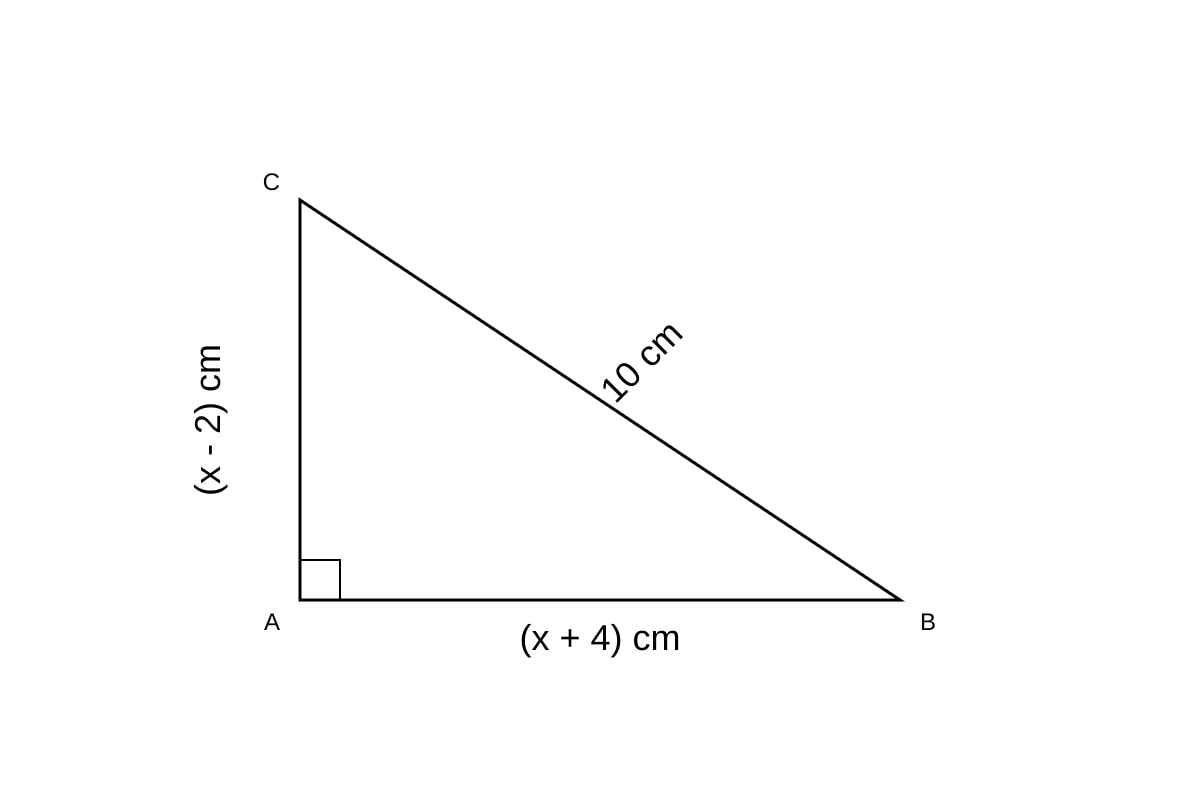
Refer to the right-angled triangle with base cm, height cm, hypotenuse 10 cm.
(a) Form an equation in and show that it simplifies to .
Working:
- By Pythagoras' theorem:
- Divide by 2: ✓
Marking notes:
- 1 mark for correct Pythagoras equation
- 1 mark for correct expansion of brackets
- 1 mark for correct simplification to
(b) Solve the equation , giving your answers correct to 2 decimal places.
Working:
- Using quadratic formula: with
- (positive root, since length > 0)
- (reject, negative length)
Answer: (reject )
Marking notes:
- 1 mark for correct quadratic formula substitution
- 1 mark for correct answers to 2 d.p. (both roots, with rejection of negative)
(c) Hence, find the area of the triangle.
Working:
- Base = cm
- Height = cm
- Area = cm²
Answer: 15.98 cm² (or 16.0 cm² to 3 s.f.)
Marking notes:
- 1 mark for correct base and height using
- 1 mark for correct area calculation
Section D: Geometry & Mensuration [15 marks]
Question 19 [6 marks]
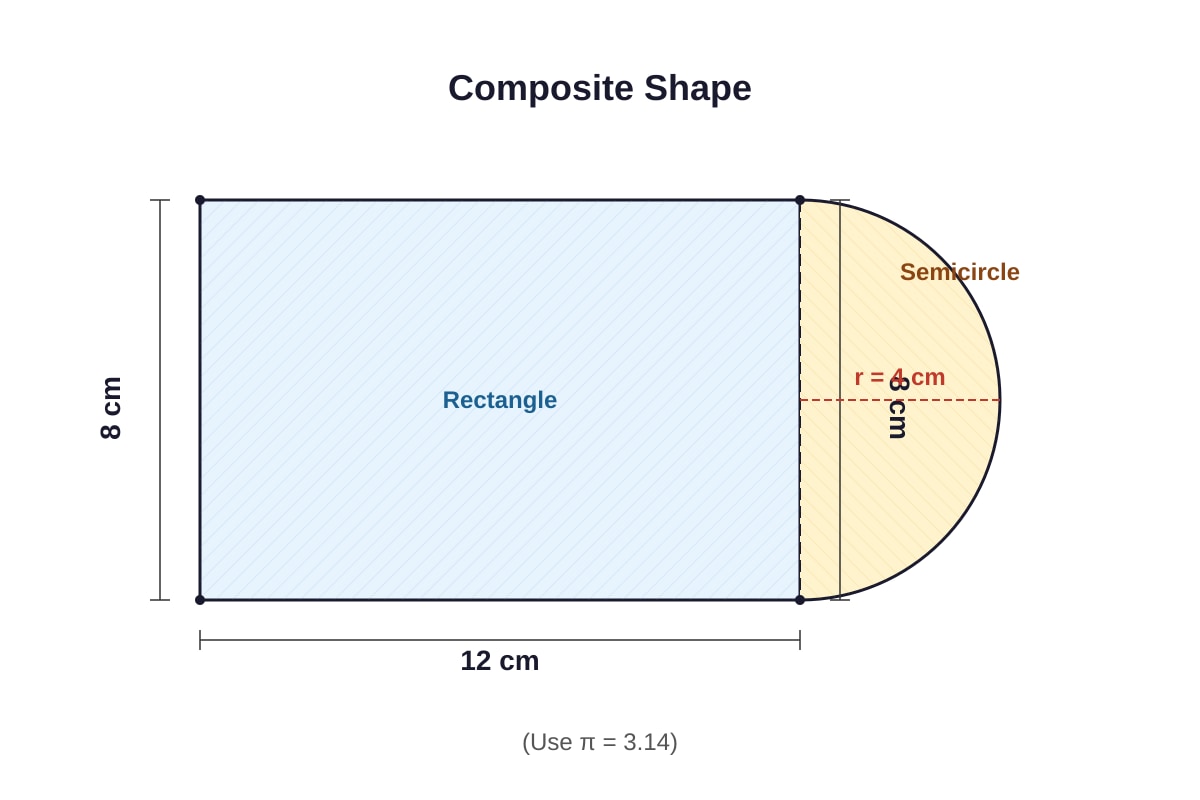
Refer to the composite shape (rectangle 12 cm × 8 cm with semicircle of diameter 8 cm attached). Use .
(a) Find the perimeter of the composite shape.
Working:
- Perimeter = 3 sides of rectangle + semicircular arc
- Rectangle sides: cm (excluding the side where semicircle attaches)
- Semicircle arc = cm
- Total perimeter = cm
Answer: 44.56 cm
Marking notes:
- 1 mark for correct rectangle sides included (32 cm)
- 1 mark for correct semicircle arc calculation (12.56 cm)
- 1 mark for correct total (44.56 cm)
- Common error: Including all 4 rectangle sides or using full circle circumference
(b) Find the area of the composite shape.
Working:
- Rectangle area = cm²
- Semicircle area = cm²
- Total area = cm²
Answer: 121.12 cm²
Marking notes:
- 1 mark for correct rectangle area (96 cm²)
- 1 mark for correct semicircle area (25.12 cm²)
- 1 mark for correct total (121.12 cm²)
Question 20 [6 marks]
Cylindrical water tank: radius 35 cm, height 1.2 m. Fill rate 5 litres/min. Use .
(a) Find the volume of the tank in litres. (1 litre = 1000 cm³)
Working:
- Height = 1.2 m = 120 cm
- Volume =
- (since )
- cm³
- Volume in litres = litres
Answer: 462 litres
Marking notes:
- 1 mark for correct height conversion (120 cm)
- 1 mark for correct volume formula and substitution
- 1 mark for correct final answer in litres (462)
(b) How long, in hours and minutes, will it take to fill the empty tank completely?
Working:
- Time in minutes = minutes
- 92.4 minutes = 1 hour 32.4 minutes = 1 hour 32 minutes 24 seconds
- In hours and minutes: 1 hour 32 minutes (or 1 hour 32 minutes 24 seconds)
Answer: 1 hour 32 minutes (or 1 hour 32 minutes 24 seconds)
Marking notes:
- 1 mark for correct time in minutes (92.4)
- 1 mark for correct conversion to hours and minutes
- 1 mark for correct format (1 hour 32 minutes)
- Accept 1 hour 32.4 minutes or 1 hour 32 minutes 24 seconds
Total Marks: 60
End of Answer Key