AI Generated Exam Paper

Secondary 1 Other Practice Paper 2

Free AI-Generated NVIDIA Nemotron 3 Ultra 550B A55B Free Secondary 1 Other Practice Paper 2 practice paper with questions and answers for Singapore students. This page is rendered as a direct URL so the questions and answers can be discovered without pressing in-page buttons.

These static practice materials are generated from the site's syllabus and paper-generation workflow, with source and model context shown so students and parents can evaluate the material before use.

Secondary 1 Other AI Generated Generated by NVIDIA Nemotron 3 Ultra 550B A55B Free Updated 2026-06-07

Questions

<!-- TuitionGoWhere generation metadata: stage=5-2; model=nvidia/nemotron-3-ultra-550b-a55b:free; model_label=NVIDIA Nemotron 3 Ultra 550B A55B Free; generated=2026-06-06; Sources: Stage 4-0 LLM templates, syllabus context, and Stage 2 evidence where available. -->

TuitionGoWhere Practice Paper - Other Secondary 1

TuitionGoWhere Practice Paper (AI) — Version 2

Subject: Other
Level: Secondary 1
Paper: Practice Paper 2 (General Other)
Duration: 1 hour 30 minutes
Total Marks: 60

Name: ________________________
Class: ________________________
Date: ________________________


Instructions to Candidates

  1. Write your name, class, and date in the spaces provided above.
  2. Answer all questions.
  3. Write your answers in the spaces provided on the question paper.
  4. Show all working clearly for calculation questions.
  5. The number of marks is given in brackets [ ] at the end of each question or part question.
  6. The total number of marks for this paper is 60.
  7. You may use a calculator unless otherwise stated.
  8. If the degree of accuracy is not specified, give answers to 3 significant figures or 1 decimal place for angles in degrees.

Section A: Ratio, Proportion & Percentage [18 marks]

Answer all questions in this section.

1

Simplify the ratio 2.8:452.8 : \frac{4}{5} to its simplest form.
[2]

Answer: ________________________

2

In a Secondary 1 cohort, the ratio of students who take Higher Chinese to those who take Chinese Language is 3:73 : 7. If 84 students take Chinese Language, how many students take Higher Chinese?
[2]

Answer: ________________________

3

A recipe for 12 cupcakes requires 180 g of flour. How much flour is needed to make 30 cupcakes?
[2]

Answer: ________________________ g

4

The price of a school bag was reduced from 65to65 to 52 during a sale. Calculate the percentage discount.
[2]

Answer: ________________________ %

5

A student scored 36 out of 45 marks for a Mathematics test. Express the score as a percentage.
[2]

Answer: ________________________ %

6

The population of a town increased from 24,000 to 27,600 over a year. Calculate the percentage increase.
[2]

Answer: ________________________ %

7

A rectangular tank measures 50 cm by 30 cm by 40 cm. It is filled with water to a height of 25 cm. Find the volume of water in the tank in litres.
[3]

Answer: ________________________ litres

8

Convert 3 hours 45 minutes into hours, giving your answer as a decimal.
[1]

Answer: ________________________ hours

9

The scale of a map is 1 : 25,000. The distance between two MRT stations on the map is 6.4 cm. Find the actual distance between the stations in kilometres.
[2]

Answer: ________________________ km


Section B: Data Handling & Interpretation [18 marks]

Answer all questions in this section.

10

The table below shows the number of books borrowed by students in a class during a reading week.

Number of books012345
Frequency358642

(a) Find the total number of students in the class.
[1]

(b) Calculate the mean number of books borrowed per student.
[2]

(c) State the mode.
[1]

Answers:
(a) ________________________
(b) ________________________
(c) ________________________

11

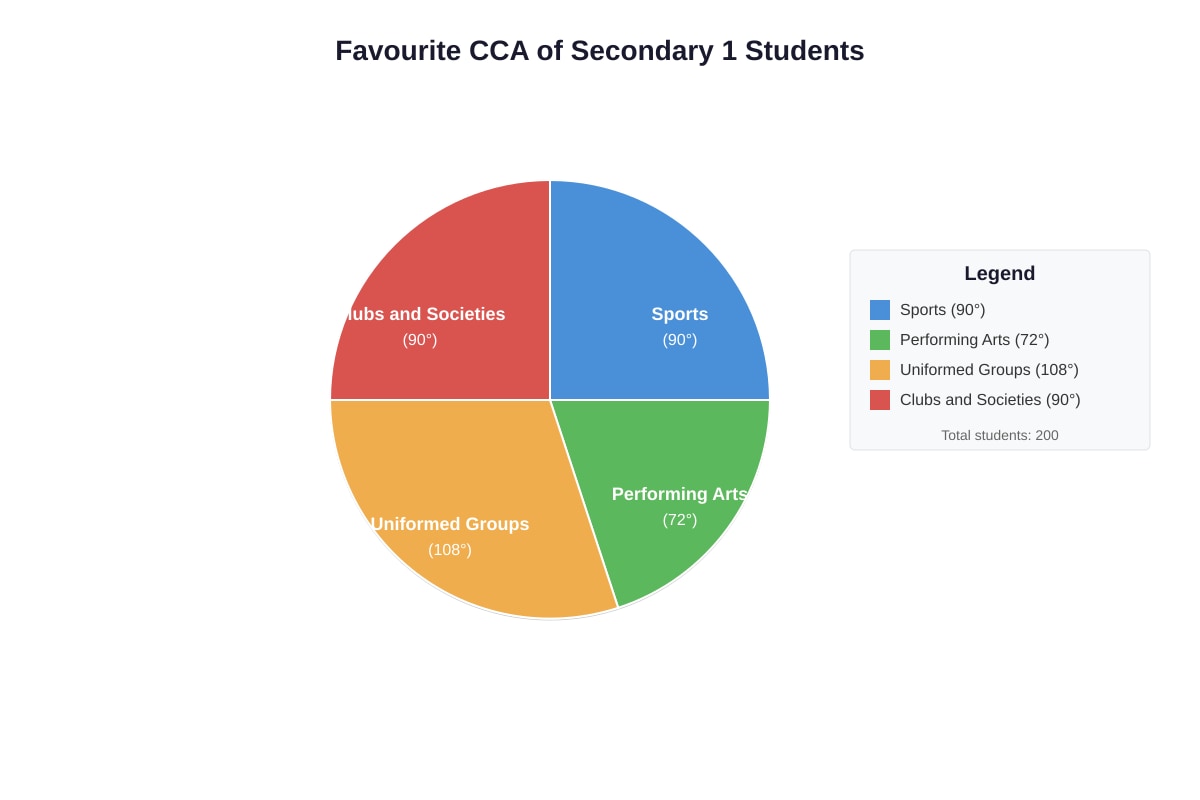
The pie chart below shows the favourite CCA categories of 200 Secondary 1 students.

<image_placeholder> id: Q11-fig1 type: chart linked_question: Q11 description: Pie chart showing favourite CCA categories of 200 Secondary 1 students. Four sectors: Sports (108°), Uniformed Groups (72°), Performing Arts (90°), Clubs & Societies (90°). Each sector labelled with category name and angle. labels: Sports (108°), Uniformed Groups (72°), Performing Arts (90°), Clubs & Societies (90°) values: Total students = 200; angles as shown must_show: Four clearly labelled sectors with angles marked; legend or direct labels; title "Favourite CCA Categories of 200 Secondary 1 Students" </image_placeholder>

(a) Which CCA category is the most popular?
[1]

(b) Calculate the number of students who chose Sports.
[2]

(c) What percentage of students chose Performing Arts?
[2]

Answers:
(a) ________________________
(b) ________________________
(c) ________________________ %

12

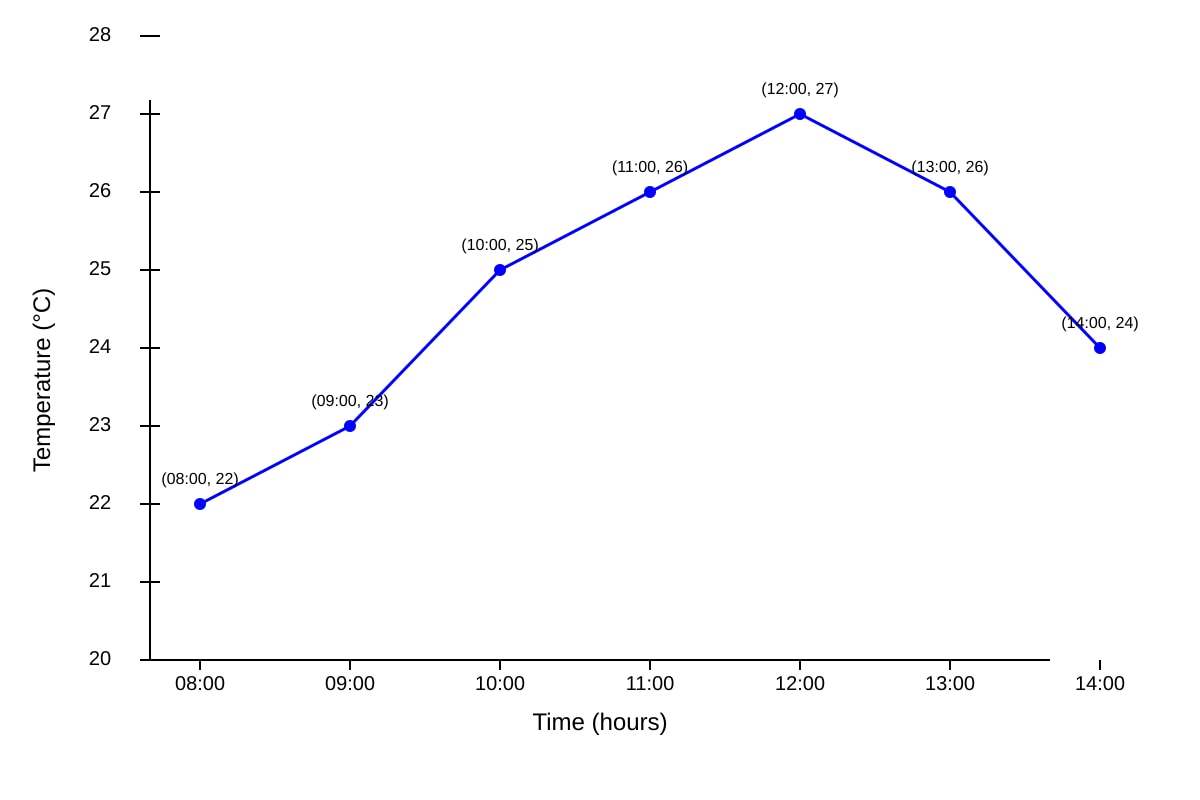
The line graph below shows the temperature (in °C) recorded at a school field over a 12-hour period from 6:00 to 18:00.

<image_placeholder> id: Q12-fig1 type: graph linked_question: Q12 description: Line graph with time on x-axis (6:00 to 18:00 at 2-hour intervals) and temperature on y-axis (24°C to 34°C). Points: (6:00, 26), (8:00, 28), (10:00, 31), (12:00, 33), (14:00, 34), (16:00, 32), (18:00, 29). Smooth curve connecting points. labels: x-axis: Time (hours), 6:00, 8:00, 10:00, 12:00, 14:00, 16:00, 18:00; y-axis: Temperature (°C), 24 to 34 in steps of 2 values: Data points as listed must_show: Axes labelled with units; points plotted and connected; gridlines; title "Temperature at School Field from 6:00 to 18:00" </image_placeholder>

(a) What was the highest temperature recorded and at what time?
[1]

(b) Find the increase in temperature from 8:00 to 12:00.
[1]

(c) Estimate the temperature at 11:00.
[1]

(d) During which 2-hour interval did the temperature drop the most?
[1]

Answers:
(a) ________________________ °C at ________________________
(b) ________________________ °C
(c) ________________________ °C
(d) ________________________ to ________________________

13

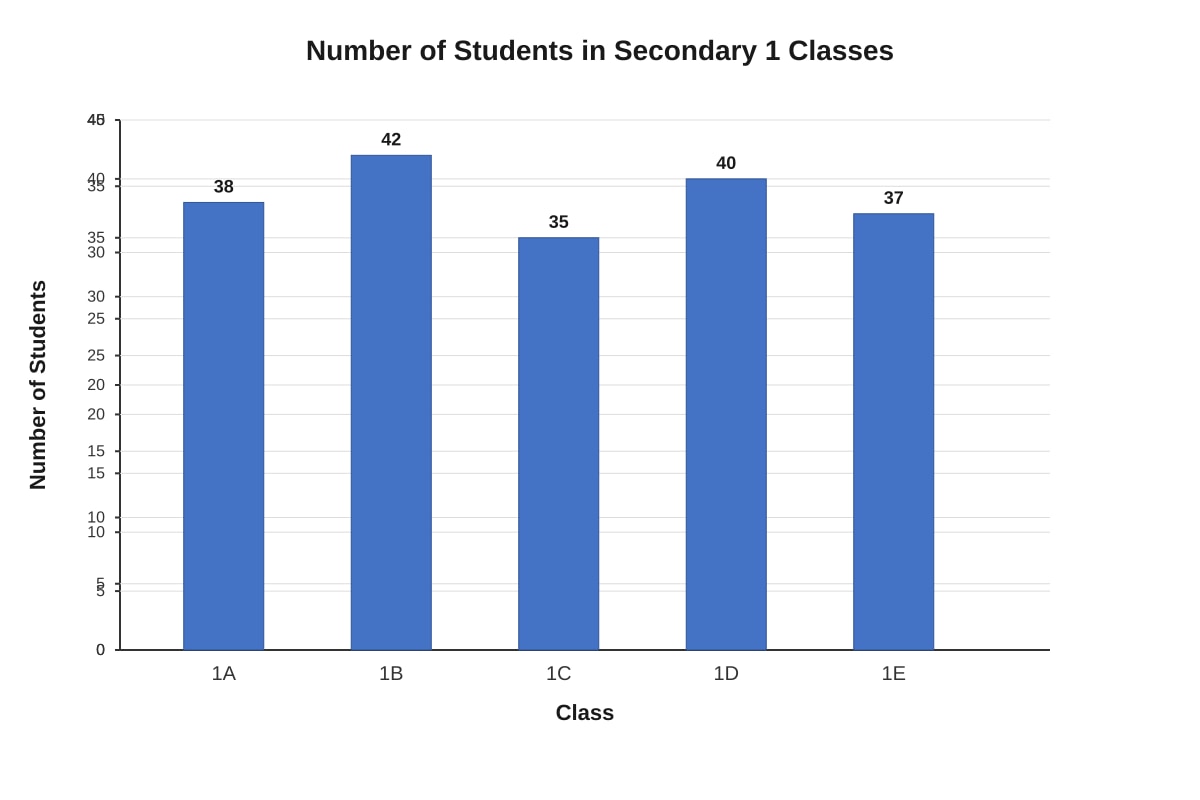
A survey was conducted on the mode of transport used by 150 students to go to school. The results are shown in the bar chart below.

<image_placeholder> id: Q13-fig1 type: chart linked_question: Q13 description: Bar chart showing mode of transport for 150 students. Categories: Walk (30), Bus (55), MRT (25), Car (20), Bicycle (20). Vertical axis: Number of students (0 to 60 in steps of 10). Horizontal axis: Mode of transport. labels: Walk, Bus, MRT, Car, Bicycle; vertical axis: Number of students values: Walk=30, Bus=55, MRT=25, Car=20, Bicycle=20; total=150 must_show: Five bars with heights proportional to values; axes labelled; title "Mode of Transport to School for 150 Students" </image_placeholder>

(a) How many students travel to school by MRT?
[1]

(b) What fraction of the students travel by bus? Give your answer in simplest form.
[2]

(c) The school wants to encourage more students to walk or cycle. What percentage of students currently walk or cycle to school?
[2]

Answers:
(a) ________________________
(b) ________________________
(c) ________________________ %


Section C: Geometry, Mensuration & Problem Solving [24 marks]

Answer all questions in this section.

14

The figure below shows a parallelogram ABCDABCD. AB=12AB = 12 cm, BC=8BC = 8 cm, and the perpendicular height from DD to ABAB is 6 cm.

<image_placeholder> id: Q14-fig1 type: diagram linked_question: Q14 description: Parallelogram ABCD with AB horizontal at top (12 cm), BC slanted down right (8 cm). Perpendicular from D to AB shown as dashed line, length 6 cm, meeting AB at point E. Angle DAB marked as acute. labels: A, B, C, D vertices; AB = 12 cm; BC = 8 cm; DE = 6 cm (height); E on AB values: AB=12 cm, BC=8 cm, height=6 cm must_show: Parallelogram with labelled vertices; base AB and height DE clearly marked with measurements; right angle symbol at E </image_placeholder>

(a) Calculate the area of parallelogram ABCDABCD.
[2]

(b) Find the perpendicular height from AA to BCBC.
[2]

Answers:
(a) ________________________ cm²
(b) ________________________ cm

15

A cylindrical water tank has a radius of 35 cm and a height of 120 cm.
(Take π=227\pi = \frac{22}{7})

(a) Calculate the volume of the tank in cm³.
[2]

(b) If the tank is filled with water at a rate of 5 litres per minute, how long will it take to fill the tank completely? Give your answer in hours and minutes.
[3]

Answers:
(a) ________________________ cm³
(b) ________________________ hours ________________________ minutes

16

The figure shows a composite solid made by joining a cube of side 10 cm to a square-based pyramid of height 6 cm. The base of the pyramid matches the top face of the cube exactly.

<image_placeholder> id: Q16-fig1 type: diagram linked_question: Q16 description: Composite solid: cube (side 10 cm) at bottom, square-based pyramid (height 6 cm) on top. Base of pyramid = top face of cube = 10 cm × 10 cm. Dashed lines show hidden edges. labels: Cube side = 10 cm; Pyramid height = 6 cm; Base side = 10 cm values: Cube side=10 cm, pyramid height=6 cm, base side=10 cm must_show: 3D composite solid with cube and pyramid; dimensions labelled; hidden edges dashed; right angle symbols where appropriate </image_placeholder>

(a) Calculate the volume of the cube.
[1]

(b) Calculate the volume of the pyramid.
[2]

(c) Find the total volume of the composite solid.
[1]

Answers:
(a) ________________________ cm³
(b) ________________________ cm³
(c) ________________________ cm³

17

In the diagram, PQRPQR is a straight line. PQ=QRPQ = QR. PQS=55\angle PQS = 55^\circ and SQR=65\angle SQR = 65^\circ.

<image_placeholder> id: Q17-fig1 type: diagram linked_question: Q17 description: Straight line PQR horizontal. Point S above the line. PQ = QR marked with equal ticks. Angle PQS = 55° (between QP and QS). Angle SQR = 65° (between QS and QR). Angle PQS and SQR are adjacent. labels: P, Q, R collinear; S above line; PQ = QR (ticks); ∠PQS = 55°; ∠SQR = 65° values: ∠PQS=55°, ∠SQR=65°, PQ=QR must_show: Straight line PQR; point S above; equal segment marks on PQ and QR; angle arcs with degree labels </image_placeholder>

(a) Find PQR\angle PQR.
[1]

(b) Determine whether triangle PQSPQS is isosceles. Explain your reasoning.
[2]

Answers:
(a) ________________________ °
(b) ________________________

18

A rectangular piece of paper measuring 28 cm by 20 cm has four identical squares of side xx cm cut from its corners. The remaining flap is folded to form an open-top box.

<image_placeholder> id: Q18-fig1 type: diagram linked_question: Q18 description: Net of open-top box: rectangle 28×20 with four corner squares (x×x) shaded/cut out. Central rectangle becomes base; four side flaps fold up. Dimensions labelled: 28 cm, 20 cm, x cm on cut squares. labels: Original rectangle 28 cm × 20 cm; cut squares side x cm; base dimensions (28-2x) × (20-2x); height = x values: Original: 28 cm × 20 cm; cut squares: x cm must_show: Net diagram with cut corners; dimensions labelled; fold lines dashed; x marked on cut squares </image_placeholder>

(a) Write down the length and width of the base of the box in terms of xx.
[1]

(b) Write down an expression for the volume VV of the box in terms of xx.
[2]

(c) If x=3x = 3, calculate the volume of the box.
[1]

Answers:
(a) Length = ________________________ cm, Width = ________________________ cm
(b) V=V = ________________________
(c) ________________________ cm³

19

Mr Tan wants to tile his rectangular kitchen floor measuring 4.5 m by 3.2 m using square tiles of side 40 cm.

(a) How many tiles are needed along the length of the floor?
[1]

(b) How many tiles are needed along the width of the floor?
[1]

(c) Calculate the total number of tiles needed.
[1]

(d) If each tile costs $3.50, find the total cost of tiling the floor.
[2]

Answers:
(a) ________________________
(b) ________________________
(c) ________________________
(d) $________________________

20

A school is planning a learning journey. The ratio of teachers to students must be 1 : 15. There are 12 teachers available.

(a) What is the maximum number of students that can go on the learning journey?
[2]

(b) If 165 students sign up, what is the minimum number of additional teachers needed?
[2]

(c) The cost per student is 28andthecostperteacheris28 and the cost per teacher is 45. Calculate the total cost for the maximum number of students with 12 teachers.
[2]

Answers:
(a) ________________________
(b) ________________________
(c) $________________________


End of Paper

Answers

<!-- TuitionGoWhere generation metadata: stage=5-2; model=nvidia/nemotron-3-ultra-550b-a55b:free; model_label=NVIDIA Nemotron 3 Ultra 550B A55B Free; generated=2026-06-06; Sources: Stage 4-0 LLM templates, syllabus context, and Stage 2 evidence where available. -->

TuitionGoWhere Practice Paper - Other Secondary 1 (Answer Key)

TuitionGoWhere Practice Paper (AI) — Version 2

Subject: Other
Level: Secondary 1
Paper: Practice Paper 2 (General Other)
Total Marks: 60


Section A: Ratio, Proportion & Percentage [18 marks]

1 [2 marks]

Answer: 7:17 : 1

Working:

  1. Convert decimal to fraction: 2.8=2810=1452.8 = \frac{28}{10} = \frac{14}{5}
  2. Write ratio: 145:45\frac{14}{5} : \frac{4}{5}
  3. Multiply both sides by 5 (denominator): 14:414 : 4
  4. Simplify by dividing by 2: 7:27 : 2

Wait, let me recheck:
2.8:45=145:45=14:4=7:22.8 : \frac{4}{5} = \frac{14}{5} : \frac{4}{5} = 14 : 4 = 7 : 2

Correct Answer: 7:27 : 2

Marking Notes:

  • 1 mark for converting 2.8 to fraction correctly (145\frac{14}{5} or 2810\frac{28}{10})
  • 1 mark for correct simplification to 7:27 : 2
  • Common error: Forgetting to convert decimal first, or simplifying incorrectly to 7:17 : 1

2 [2 marks]

Answer: 36 students

Working:

  • Ratio Higher Chinese : Chinese Language = 3:73 : 7
  • 7 parts = 84 students
  • 1 part = 84÷7=1284 \div 7 = 12 students
  • 3 parts = 3×12=363 \times 12 = 36 students

Alternative method:
37×84=36\frac{3}{7} \times 84 = 36

Marking Notes:

  • 1 mark for finding value of 1 part (12)
  • 1 mark for correct final answer (36)
  • Common error: Using ratio as 7:37 : 3 instead of 3:73 : 7

3 [2 marks]

Answer: 450 g

Working:

  • Flour for 12 cupcakes = 180 g
  • Flour per cupcake = 180÷12=15180 \div 12 = 15 g
  • Flour for 30 cupcakes = 15×30=45015 \times 30 = 450 g

Alternative method (proportion):
18012=x30x=180×3012=450\frac{180}{12} = \frac{x}{30} \Rightarrow x = \frac{180 \times 30}{12} = 450

Marking Notes:

  • 1 mark for correct unit rate or proportion setup
  • 1 mark for correct final answer with unit (g)
  • Common error: Inverting the proportion

4 [2 marks]

Answer: 20%

Working:

  • Discount = Original price − Sale price = 6552=65 - 52 = 13
  • Percentage discount = DiscountOriginal price×100%=1365×100%=20%\frac{\text{Discount}}{\text{Original price}} \times 100\% = \frac{13}{65} \times 100\% = 20\%

Marking Notes:

  • 1 mark for finding discount amount ($13)
  • 1 mark for correct percentage calculation
  • Common error: Using sale price as denominator (1352=25%\frac{13}{52} = 25\%)

5 [2 marks]

Answer: 80%

Working:

  • Percentage = 3645×100%=45×100%=80%\frac{36}{45} \times 100\% = \frac{4}{5} \times 100\% = 80\%

Marking Notes:

  • 1 mark for correct fraction (3645\frac{36}{45} or simplified 45\frac{4}{5})
  • 1 mark for correct percentage (80%)
  • Common error: Calculation error in division or multiplication

6 [2 marks]

Answer: 15%

Working:

  • Increase = 27,60024,000=3,60027,600 - 24,000 = 3,600
  • Percentage increase = 3,60024,000×100%=36240×100%=15%\frac{3,600}{24,000} \times 100\% = \frac{36}{240} \times 100\% = 15\%

Marking Notes:

  • 1 mark for finding increase (3,600)
  • 1 mark for correct percentage (15%)
  • Common error: Using new population as denominator

7 [3 marks]

Answer: 37.5 litres

Working:

  • Volume of water = length × width × height of water
  • =50×30×25=37,500= 50 \times 30 \times 25 = 37,500 cm³
  • 1 litre = 1000 cm³
  • Volume in litres = 37,500÷1000=37.537,500 \div 1000 = 37.5 litres

Marking Notes:

  • 1 mark for correct volume in cm³ (37,500)
  • 1 mark for correct conversion (÷ 1000)
  • 1 mark for correct final answer with unit (litres)
  • Common error: Using full height 40 cm instead of water height 25 cm

8 [1 mark]

Answer: 3.75 hours

Working:

  • 45 minutes = 4560=0.75\frac{45}{60} = 0.75 hours
  • Total = 3+0.75=3.753 + 0.75 = 3.75 hours

Marking Notes:

  • 1 mark for correct decimal conversion
  • Common error: Writing 3.45 (treating minutes as decimal directly)

9 [2 marks]

Answer: 1.6 km

Working:

  • Map distance = 6.4 cm
  • Scale 1 : 25,000 means 1 cm on map = 25,000 cm actual
  • Actual distance = 6.4×25,000=160,0006.4 \times 25,000 = 160,000 cm
  • Convert to km: 160,000÷100,000=1.6160,000 \div 100,000 = 1.6 km

Marking Notes:

  • 1 mark for correct multiplication (160,000 cm)
  • 1 mark for correct conversion to km (1.6 km)
  • Common error: Incorrect conversion (e.g., ÷ 1000 instead of ÷ 100,000)

Section B: Data Handling & Interpretation [18 marks]

10 [4 marks]

(a) [1 mark]
Answer: 28 students
Working: Total = 3+5+8+6+4+2=283 + 5 + 8 + 6 + 4 + 2 = 28

(b) [2 marks]
Answer: 2.21 books (or 2.21 to 3 s.f.)
Working:

  • Total books = (0×3)+(1×5)+(2×8)+(3×6)+(4×4)+(5×2)(0 \times 3) + (1 \times 5) + (2 \times 8) + (3 \times 6) + (4 \times 4) + (5 \times 2)
  • =0+5+16+18+16+10=62= 0 + 5 + 16 + 18 + 16 + 10 = 62
  • Mean = 6228=2.21428...2.21\frac{62}{28} = 2.21428... \approx 2.21

(c) [1 mark]
Answer: 2 books
Reason: Highest frequency is 8 (for 2 books)

Marking Notes:

  • (a) 1 mark for correct total
  • (b) 1 mark for correct total books (62), 1 mark for correct mean calculation
  • (c) 1 mark for correct mode
  • Common error in (b): Dividing by 6 (number of categories) instead of 28 (total frequency)

11 [5 marks]

(a) [1 mark]
Answer: Sports
Reason: Largest sector angle (108°)

(b) [2 marks]
Answer: 60 students
Working:

  • Fraction for Sports = 108°360°=310\frac{108°}{360°} = \frac{3}{10}
  • Number of students = 310×200=60\frac{3}{10} \times 200 = 60

(c) [2 marks]
Answer: 25%
Working:

  • Fraction for Performing Arts = 90°360°=14\frac{90°}{360°} = \frac{1}{4}
  • Percentage = 14×100%=25%\frac{1}{4} \times 100\% = 25\%

Marking Notes:

  • (a) 1 mark for correct category
  • (b) 1 mark for correct fraction/angle method, 1 mark for correct answer
  • (c) 1 mark for correct fraction, 1 mark for correct percentage
  • Common error: Using angle directly as percentage (e.g., 90%)

12 [4 marks]

(a) [1 mark]
Answer: 34°C at 14:00 (or 2:00 PM)
Reading from graph: Highest point is at 14:00 with temperature 34°C

(b) [1 mark]
Answer: 5°C
Working: Temperature at 12:00 = 33°C, at 8:00 = 28°C; Increase = 3328=5°C33 - 28 = 5°C

(c) [1 mark]
Answer: 32°C (accept 31–33°C)
Estimation: At 11:00 (midway between 10:00 and 12:00), temperature ≈ halfway between 31°C and 33°C = 32°C

(d) [1 mark]
Answer: 16:00 to 18:00
Working: Drops: 14:00–16:00: 3432=2°C34-32=2°C; 16:00–18:00: 3229=3°C32-29=3°C. Largest drop is 3°C from 16:00 to 18:00.

Marking Notes:

  • Each part 1 mark
  • (c) Accept reasonable estimate from graph interpolation
  • Common error in (d): Choosing 14:00–16:00 without calculating both drops

13 [5 marks]

(a) [1 mark]
Answer: 25 students
Reading from bar chart: MRT bar height = 25

(b) [2 marks]
Answer: 1130\frac{11}{30}
Working:

  • Bus = 55 students, Total = 150
  • Fraction = 55150=1130\frac{55}{150} = \frac{11}{30}

(c) [2 marks]
Answer: 33.3% (or 3313%33\frac{1}{3}\%)
Working:

  • Walk + Bicycle = 30+20=5030 + 20 = 50 students
  • Percentage = 50150×100%=13×100%=3313%33.3%\frac{50}{150} \times 100\% = \frac{1}{3} \times 100\% = 33\frac{1}{3}\% \approx 33.3\%

Marking Notes:

  • (a) 1 mark for correct reading
  • (b) 1 mark for correct fraction (55/150), 1 mark for simplification to 11/30
  • (c) 1 mark for correct sum (50), 1 mark for correct percentage
  • Common error: Not simplifying fraction in (b)

Section C: Geometry, Mensuration & Problem Solving [24 marks]

14 [4 marks]

(a) [2 marks]
Answer: 72 cm²
Working:

  • Area of parallelogram = base × perpendicular height
  • =12×6=72= 12 \times 6 = 72 cm²

(b) [2 marks]
Answer: 9 cm
Working:

  • Area = base × height (using BC as base)
  • 72=8×h72 = 8 \times h
  • h=72÷8=9h = 72 \div 8 = 9 cm

Marking Notes:

  • (a) 1 mark for correct formula, 1 mark for correct answer with unit
  • (b) 1 mark for using area from (a), 1 mark for correct calculation
  • Common error: Using slanted side (8 cm) as height in (a)

15 [5 marks]

(a) [2 marks]
Answer: 462,000 cm³
Working:

  • Volume of cylinder = πr2h\pi r^2 h
  • =227×352×120= \frac{22}{7} \times 35^2 \times 120
  • =227×1225×120= \frac{22}{7} \times 1225 \times 120
  • =22×175×120= 22 \times 175 \times 120
  • =462,000= 462,000 cm³

(b) [3 marks]
Answer: 1 hour 32 minutes
Working:

  • Volume in litres = 462,000÷1000=462462,000 \div 1000 = 462 litres
  • Time = 462÷5=92.4462 \div 5 = 92.4 minutes
  • 92.492.4 minutes = 1 hour 32.4 minutes ≈ 1 hour 32 minutes

Marking Notes:

  • (a) 1 mark for correct formula/substitution, 1 mark for correct calculation
  • (b) 1 mark for cm³ to litres conversion, 1 mark for time in minutes, 1 mark for conversion to hours and minutes
  • Common error: Forgetting to convert cm³ to litres, or incorrect time conversion

16 [4 marks]

(a) [1 mark]
Answer: 1000 cm³
Working: Volume of cube = 103=100010^3 = 1000 cm³

(b) [2 marks]
Answer: 200 cm³
Working:

  • Volume of pyramid = 13×base area×height\frac{1}{3} \times \text{base area} \times \text{height}
  • Base area = 10×10=10010 \times 10 = 100 cm²
  • Volume = 13×100×6=200\frac{1}{3} \times 100 \times 6 = 200 cm³

(c) [1 mark]
Answer: 1200 cm³
Working: Total = 1000+200=12001000 + 200 = 1200 cm³

Marking Notes:

  • (a) 1 mark for correct answer
  • (b) 1 mark for correct formula/substitution, 1 mark for correct answer
  • (c) 1 mark for correct sum
  • Common error: Using 12\frac{1}{2} instead of 13\frac{1}{3} for pyramid volume

17 [3 marks]

(a) [1 mark]
Answer: 120°
Working: PQR=PQS+SQR=55°+65°=120°\angle PQR = \angle PQS + \angle SQR = 55° + 65° = 120°

(b) [2 marks]
Answer: No, triangle PQS is not isosceles.
Reasoning:

  • In PQS\triangle PQS, PQS=55°\angle PQS = 55°
  • QPS=180°PQR=180°120°=60°\angle QPS = 180° - \angle PQR = 180° - 120° = 60° (angles on straight line)
  • PSQ=180°55°60°=65°\angle PSQ = 180° - 55° - 60° = 65° (angle sum of triangle)
  • Angles are 55°, 60°, 65° — no two angles are equal, so no two sides are equal.
  • Therefore, PQS\triangle PQS is not isosceles.

Alternative reasoning: Since PQ = QR (given) but QR is not a side of PQS\triangle PQS, the given equality does not make PQS\triangle PQS isosceles.

Marking Notes:

  • (a) 1 mark for correct angle
  • (b) 1 mark for correct angle calculation (finding all three angles), 1 mark for correct conclusion with reasoning
  • Common error: Assuming PQ = QS because PQ = QR, or stating "yes" without proof

18 [4 marks]

(a) [1 mark]
Answer: Length = (282x)(28 - 2x) cm, Width = (202x)(20 - 2x) cm

(b) [2 marks]
Answer: V=x(282x)(202x)V = x(28 - 2x)(20 - 2x) cm³
Working:

  • Height of box = xx cm (side of cut square)
  • Length of base = 282x28 - 2x cm
  • Width of base = 202x20 - 2x cm
  • Volume = length × width × height = x(282x)(202x)x(28 - 2x)(20 - 2x)

(c) [1 mark]
Answer: 2646 cm³
Working:

  • Substitute x=3x = 3:
  • V=3×(286)×(206)=3×22×14=924V = 3 \times (28 - 6) \times (20 - 6) = 3 \times 22 \times 14 = 924 cm³

Wait, let me recalculate:
282(3)=286=2228 - 2(3) = 28 - 6 = 22
202(3)=206=1420 - 2(3) = 20 - 6 = 14
V=3×22×14=924V = 3 \times 22 \times 14 = 924 cm³

Correct Answer: 924 cm³

Marking Notes:

  • (a) 1 mark for both expressions correct
  • (b) 1 mark for correct height identification, 1 mark for correct volume expression
  • (c) 1 mark for correct substitution and calculation
  • Common error: Forgetting to subtract 2x from both dimensions, or using x=3 incorrectly

19 [5 marks]

(a) [1 mark]
Answer: 12 tiles
Working: Length = 4.5 m = 450 cm; 450÷40=11.25450 \div 40 = 11.25 → need 12 tiles (round up)

(b) [1 mark]
Answer: 8 tiles
Working: Width = 3.2 m = 320 cm; 320÷40=8320 \div 40 = 8 tiles exactly

(c) [1 mark]
Answer: 96 tiles
Working: Total = 12×8=9612 \times 8 = 96 tiles

(d) [2 marks]
Answer: 336Working:Cost=336 **Working:** Cost = 96 \times 3.50 = $336

Marking Notes:

  • (a) 1 mark for correct rounding up (11.25 → 12)
  • (b) 1 mark for correct division
  • (c) 1 mark for correct multiplication
  • (d) 1 mark for correct multiplication, 1 mark for correct dollar answer
  • Common error: Rounding down in (a) to 11 tiles

20 [6 marks]

(a) [2 marks]
Answer: 180 students
Working: Ratio teachers : students = 1 : 15
12 teachers → 12×15=18012 \times 15 = 180 students

(b) [2 marks]
Answer: 1 teacher
Working:

  • Required teachers for 165 students = 165÷15=11165 \div 15 = 11 teachers
  • Available = 12 teachers
  • Since 12 > 11, no additional teachers needed. Minimum additional = 0.

Wait, re-reading: "minimum number of additional teachers needed"
If 165 students sign up, required teachers = 11. We have 12. So 0 additional needed.

But wait — the question says "12 teachers available" in the stem, then asks for additional teachers needed for 165 students.
Required = 11, have 12 → 0 additional.

However, sometimes these questions imply the 12 teachers are for the maximum in (a). Let me check:
For 180 students (max with 12 teachers), ratio is exactly 1:15.
For 165 students, need 11 teachers. Have 12. So 0 additional.

Answer: 0 teachers

(c) [2 marks]
Answer: $540
Working:

  • Maximum students = 180 (from part a)
  • Cost for students = 180×28=180 \times 28 = 5,040
  • Cost for teachers = 12×45=12 \times 45 = 540
  • Total cost = 5,040+5,040 + 540 = $5,580

Wait, the question asks: "Calculate the total cost for the maximum number of students with 12 teachers."
This means: 180 students + 12 teachers.

Student cost: 180×28=180 \times 28 = 5,040
Teacher cost: 12×45=12 \times 45 = 540
Total: $5,580

Marking Notes:

  • (a) 1 mark for correct ratio application, 1 mark for answer
  • (b) 1 mark for finding required teachers (11), 1 mark for correct comparison (0 additional)
  • (c) 1 mark for student cost, 1 mark for teacher cost and total
  • Common error in (b): Saying 1 additional teacher needed (misreading "additional")
  • Common error in (c): Calculating only student cost or only teacher cost

End of Answer Key

Total Marks Check:
Section A: 2+2+2+2+2+2+3+1+2 = 18 ✓
Section B: 4+5+4+5 = 18 ✓
Section C: 4+5+4+3+4+5+6 = 24 ✓
Grand Total: 60 ✓