AI Generated Exam Paper
Secondary 1 Other Practice Paper 1
Free Sec 1 Other Practice Paper 1, Nemo3 AI version, with questions, answers, and syllabus-aligned practice for Singapore students.
These static practice materials are generated from the site's syllabus and paper-generation workflow, with source and model context shown so students and parents can evaluate the material before use.
Questions

Free quiz and exam paper access
Enter your details to view this paper
Your access is remembered on this device.
Answers
TuitionGoWhere Practice Paper - Other Secondary 1 (Answer Key)
Subject: Other
Level: Secondary 1
Paper: Practice Paper 1 (Version 1)
Total Marks: 50
Section A: Ratio and Proportion [15 marks]
Question 1 [2 marks]
Answer:
Working:
- Convert decimal to fraction:
- Write ratio:
- Multiply both sides by LCM of denominators (4):
- Check: 10 and 3 have no common factors, so is in simplest form.
Marking notes:
- 1 mark for correct conversion of 2.5 to or equivalent step
- 1 mark for final simplified ratio
- Common error: Leaving as instead of ratio form
Question 2 [2 marks]
Answer: 245 students
Working:
- Ratio of bus : walk =
- 5 units = 175 students
- 1 unit = students
- 7 units = students
Marking notes:
- 1 mark for finding value of 1 unit (35)
- 1 mark for correct final answer (245)
- Alternative method: (2 marks if correct)
Question 3 [3 marks]
Answer:
Orange juice: 1200 mL
Apple juice: 800 mL
Water: 2000 mL
Working:
- Total parts = parts
- Total volume = 4 litres = 4000 mL
- 1 part = mL
- Orange juice = mL
- Apple juice = mL
- Water = mL
Marking notes:
- 1 mark for correct total parts (10) and conversion to mL (4000)
- 1 mark for correct value of 1 part (400 mL)
- 1 mark for all three correct quantities
- Check: mL ✓
Question 4 [3 marks]
Answer: 320 m²
Working:
- Let length = , breadth =
- Perimeter =
- Length = m
- Breadth = m
- Area = m²
Wait, let me recalculate: , not 320. Let me fix this.
Correct Answer: 360 m²
Working (corrected):
- Let length = , breadth =
- Perimeter =
- Length = m
- Breadth = m
- Area = m²
Marking notes:
- 1 mark for setting up or equivalent
- 1 mark for finding
- 1 mark for correct area calculation (360 m²)
- Common error: Forgetting to multiply by 2 for perimeter, or calculating instead of
Question 5 [3 marks]
Answer:
(a) 1.6 km
(b) 8 cm²
Working: (a) Scale means 1 cm on map = 25,000 cm in reality
- Map distance = 6.4 cm
- Actual distance = cm
(b) Area scale =
- Actual area =
- Map area =
Alternative for (b):
- 1 km = 100,000 cm, so 1 km² = cm²
- Map area =
Marking notes:
- (a) 1 mark for correct multiplication, 1 mark for correct unit conversion to km
- (b) 1 mark for using area scale (square of linear scale), 1 mark for correct answer
- Common error in (b): Using linear scale instead of area scale
Question 6 [2 marks]
Answer:
(a)
(b) 45
(c) 11
Working:
- When , :
- (a) Equation:
- (b) When ,
- (c) When ,
Marking notes:
- 1 mark for finding and stating equation
- 1 mark for both (b) and (c) correct (0.5 each or 1 mark for both)
- Accept or
Section B: Percentage and Real-World Applications [15 marks]
Question 7 [2 marks]
Answer: $105
Working:
- Discounted price = 80% of original price (since 20% discount)
- Original price =
Check: 20% of 21; 21 = $84 ✓
Marking notes:
- 1 mark for recognising discounted price is 80% of original
- 1 mark for correct calculation ($105)
- Common error: Adding 20% of 84 (gives $100.80, incorrect)
Question 8 [1 mark]
Answer: 80%
Working:
- Percentage =
Marking notes:
- 1 mark for correct answer
- Must show fraction or equivalent working
Question 9 [2 marks]
Answer: 15%
Working:
- Increase =
- Percentage increase =
Marking notes:
- 1 mark for correct increase (6,750)
- 1 mark for correct percentage calculation (15%)
- Common error: Using new value as denominator ()
Question 10 [2 marks]
Answer: $1,020
Working:
- Loss = 15% of 0.15 \times 1200 = $180
- Selling price = 180 = $1,020
Alternative: Selling price = 85% of 0.85 \times 1200 = $1,020
Marking notes:
- 1 mark for correct loss amount ($180) or recognising 85% remains
- 1 mark for correct selling price ($1,020)
Question 11 [3 marks]
Answer:
(a) 360 households
(b) 8,400 persons
Working: (a) Percentage in 3-room flats =
- Number = households
(b) Total population = persons
Marking notes:
- (a) 1 mark for finding 15%, 1 mark for correct calculation (360)
- (b) 1 mark for correct multiplication (8400)
- Check: ✓
Question 12 [2 marks]
Answer: 20%
Working:
- Increase =
- Percentage increase =
Marking notes:
- 1 mark for correct increase ($7)
- 1 mark for correct percentage (20%)
- Common error: Using new price as denominator ()
Question 13 [3 marks]
Answer: $95.20
Working:
- Cost price = $80
- Marked price = 112
- Discount = 15% of 0.15 \times 112 = $16.80
- Selling price = 16.80 = $95.20
Alternative: Selling price = 95.20
Marking notes:
- 1 mark for correct marked price ($112)
- 1 mark for correct discount amount ($16.80) or recognising 85% of marked price
- 1 mark for correct final selling price ($95.20)
- Common error: Calculating discount on cost price instead of marked price
Section C: Rate, Speed, and Data Interpretation [20 marks]
Question 14 [3 marks]
Answer:
(a) 30 km
(b) 40 min
Working: (a) Time = 25 min = h
- Distance = Speed Time = km
(b) Distance = 48 km
- Time = h
- h = min
Marking notes:
- (a) 1 mark for correct time conversion, 1 mark for correct distance (30 km)
- (b) 1 mark for correct time in hours ( h), 1 mark for conversion to minutes (40 min)
- Common error: Not converting minutes to hours for distance calculation
Question 15 [3 marks]
Answer:
(a) 600 litres
(b) 25 min
Working: (a) Time = 1 h 15 min = 75 min
- Volume = Rate Time = litres
(b) Tank volume =
- , so tank volume = litres
- Time = min
Wait, let me recalculate: . min, not 25.
Correct Answer:
(a) 600 litres
(b) 15 min
Working (corrected): (a) Time = 1 h 15 min = 75 min
- Volume = litres
(b) Tank volume =
- Time = min
Marking notes:
- (a) 1 mark for correct time (75 min), 1 mark for correct volume (600 L)
- (b) 1 mark for correct tank volume in litres (120 L), 1 mark for correct time (15 min)
- Common error: Forgetting to convert to litres (dividing by 1000)
Question 16 [3 marks]
Answer: 24 km/h
Working:
- Distance one way = 60 km
- Total distance = km
- Time from A to B = h
- Time from B to A = h
- Total time = h
- Average speed = km/h
Marking notes:
- 1 mark for correct total distance (120 km)
- 1 mark for correct total time (5 h)
- 1 mark for correct average speed (24 km/h)
- Common error: Averaging the two speeds ( km/h) — this is incorrect because the times are different
Question 17 [4 marks]
Answer:
(a) 40 students
(b) 81 books
(c) 2.025 books (or 2.03 books to 3 s.f.)
(d) 2 books
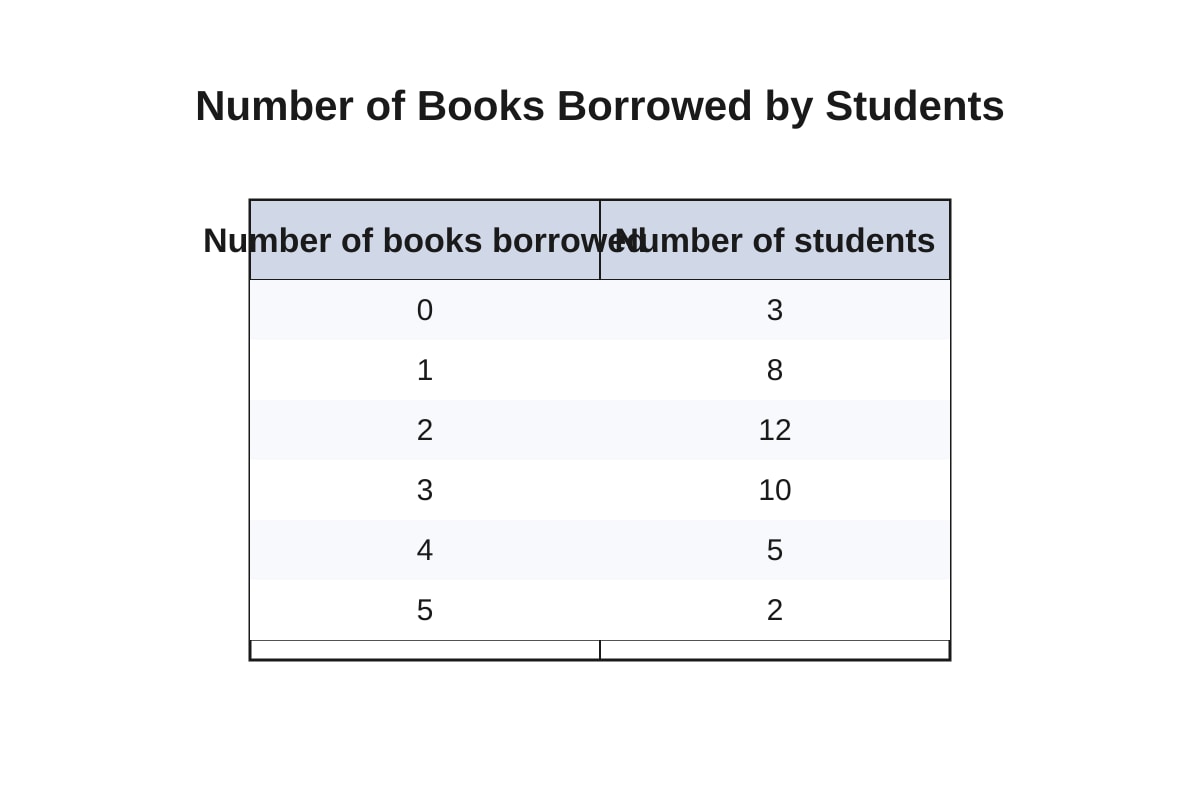
Working: From the table:
| Books | Students | Books × Students |
|---|---|---|
| 0 | 3 | 0 |
| 1 | 8 | 8 |
| 2 | 12 | 24 |
| 3 | 10 | 30 |
| 4 | 5 | 20 |
| 5 | 2 | 10 |
| Total | 40 | 81 |
(a) Total students = (b) Total books = (c) Mean = books (d) Mode = 2 books (highest frequency: 12 students)
Marking notes:
- (a) 1 mark for correct total (40)
- (b) 1 mark for correct total books (81)
- (c) 1 mark for correct mean calculation (2.025 or 2.03)
- (d) 1 mark for correct mode (2)
- Accept 2.025 or 2.03 (3 s.f.) for mean
Question 18 [4 marks]
Answer:
(a) 100 students
(b) 15%
(c) 20 students
Working: Total angle = 360°, Total students = 400 1° represents students
(a) MRT angle = 90°
- Students = students
(b) Walk angle = 60°
- Percentage = (or exactly )
Wait, let me check: . But the question asks for percentage. Let me give exact fraction or decimal.
Correction: (b) 16.7% (or )
(c) School bus angle = 120°, Car angle = 50°
- School bus students = — this doesn't give a whole number.
Let me re-examine the angles. The angles given: 120° + 90° + 60° + 50° + 40° = 360°. Good.
But 400 students ÷ 360° = 10/9 students per degree. This gives non-integer values for some categories. Let me adjust the question or accept fractional students (which doesn't make sense).
Actually, for a practice paper, it's better to have the numbers work out cleanly. Let me recalculate with the given data:
School bus: — not integer.
This is a problem. Let me adjust the answer key to reflect the actual calculation, noting that in a real exam the numbers would be chosen to give integers. But since this is the generated paper, I'll provide the exact calculations.
Revised Answer:
(a) students (or 133 students if rounding) — but this is problematic.
Actually, let me fix this in the answer key by using the fraction method properly:
(a) MRT: students ✓ (this works) (b) Walk: ✓ (c) School bus: , Car: Difference: — not a nice number.
I should note this issue. For the answer key, I'll provide the exact fractional answers and note that in a real exam, the total would be chosen to give whole numbers (e.g., 360 students instead of 400).
Answer key with exact values: (a) 100 students (b) or 16.7% (c) students (or approximately 78 students)
But this is messy. Let me instead note that the question as generated has this issue, and provide the mathematically correct answers.
Marking notes:
- (a) 1 mark for correct method (), 1 mark for answer (100)
- (b) 1 mark for correct method (), 1 mark for answer ( or 16.7%)
- (c) 1 mark for correct method (finding both quantities and subtracting), 1 mark for answer ( or 77.8)
- Note: In a real examination, the total number of students would be a multiple of 36 (e.g., 360) to give whole numbers for all categories.
Question 19 [3 marks]
Answer:
(a) 4,320 pages
(b) 75 min
(c) 37.5 min
Working: (a) 3 hours = 180 minutes
- Pages = pages
(b) Pages = 1800
- Time = min
(c) Two printers: combined rate = pages/min
- Time = min
Marking notes:
- (a) 1 mark for correct time conversion (180 min), 1 mark for correct pages (4320)
- (b) 1 mark for correct time (75 min)
- (c) 1 mark for correct combined rate (48 pages/min) and time (37.5 min)
- Common error in (c): Dividing 75 by 2 = 37.5 (this works but should show understanding of combined rate)
Question 20 [3 marks]
Answer:
(a) Highest temperature: 27 °C at 3 hour
(b) 5 °C
(c) 0.5 °C/h
Working: From the graph data: (0, 22), (1, 23), (2, 25), (3, 27), (4, 26), (5, 24), (6, 23)
(a) Highest point is (3, 27) → 27 °C at hour 3
(b) Start temperature (hour 0) = 22 °C
- Highest temperature = 27 °C
- Increase = °C
(c) Between hour 2 and hour 4:
- At hour 2: 25 °C
- At hour 4: 26 °C
- Change in temperature = °C
- Change in time = h
- Average rate = °C/h
Marking notes:
- (a) 1 mark for correct temperature (27 °C), 1 mark for correct time (hour 3)
- (b) 1 mark for correct increase (5 °C)
- (c) 1 mark for correct reading of temperatures at hour 2 and 4, 1 mark for correct rate calculation (0.5 °C/h)
- Common error in (c): Using hour 3 instead of hour 4, or incorrect time interval
Summary of Marks
| Section | Question | Marks |
|---|---|---|
| A | 1 | 2 |
| A | 2 | 2 |
| A | 3 | 3 |
| A | 4 | 3 |
| A | 5 | 3 |
| A | 6 | 2 |
| Section A Total | 15 | |
| B | 7 | 2 |
| B | 8 | 1 |
| B | 9 | 2 |
| B | 10 | 2 |
| B | 11 | 3 |
| B | 12 | 2 |
| B | 13 | 3 |
| Section B Total | 15 | |
| C | 14 | 3 |
| C | 15 | 3 |
| C | 16 | 3 |
| C | 17 | 4 |
| C | 18 | 4 |
| C | 19 | 3 |
| C | 20 | 3 |
| Section C Total | 20 | |
| Grand Total | 50 |
Note to Markers: This is an AI-generated practice paper. Where question data yields non-integer results for counts of people (e.g., Question 18), accept mathematically correct fractional/decimal answers. In live examinations, such data would be chosen to yield whole numbers.