AI Generated Quiz
Secondary 1 Mathematics Graphs Coordinate Geometry Quiz
Free Sec 1 Maths Graphs Geometry quiz, Nemo3 AI version, with questions, answers, and syllabus-aligned practice for Singapore students.
These static practice materials are generated from the site's syllabus and paper-generation workflow, with source and model context shown so students and parents can evaluate the material before use.
Questions
Free quiz and exam paper access
Enter your details to view this paper
Your access is remembered on this device.
Answers
Secondary 1 Mathematics Quiz - Graphs Coordinate Geometry (Answer Key)
Total Marks: 40
Section A: Cartesian Coordinates and Plotting (Questions 1–5, 10 marks)
1. Write down the coordinates of the point that is 3 units to the left of the origin and 4 units above the x-axis.
Answer: (–3, 4)
[1]
Explanation: Left of origin means negative x-direction. Above x-axis means positive y-direction. Coordinates are (x, y) = (–3, 4).
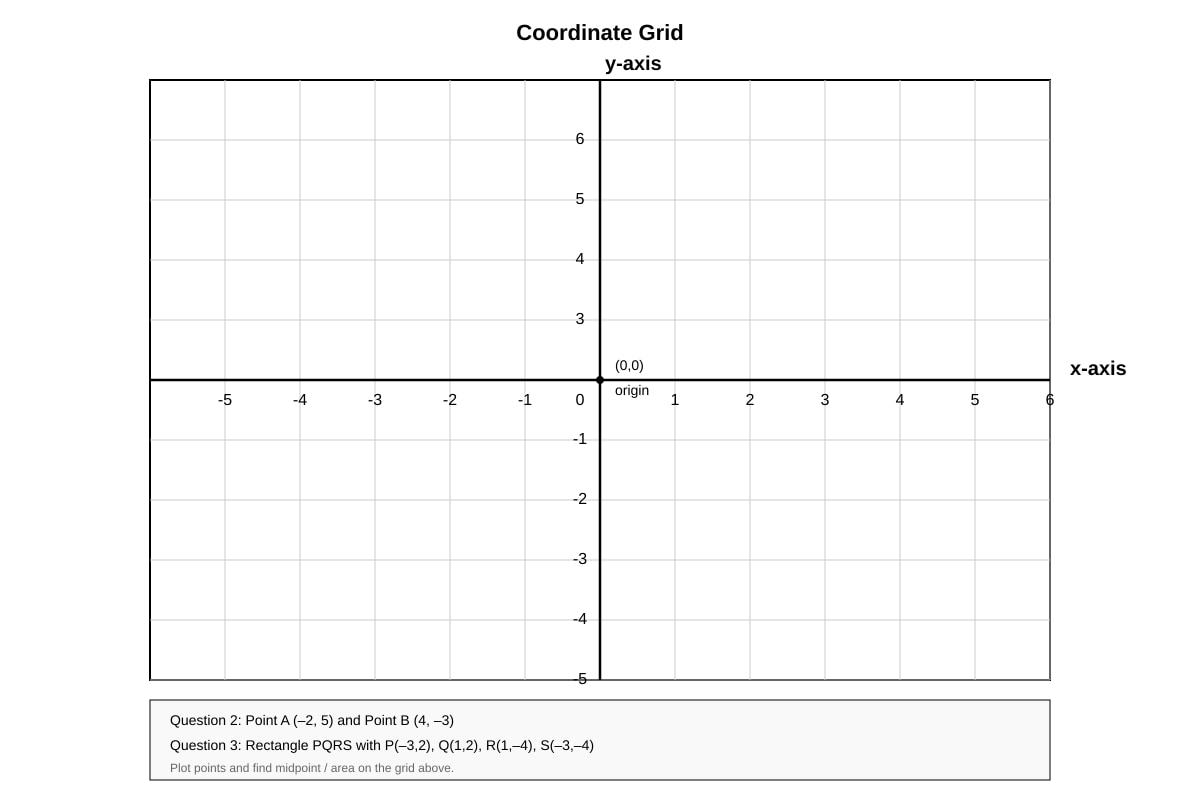
2. Point A has coordinates (–2, 5). Point B has coordinates (4, –3).
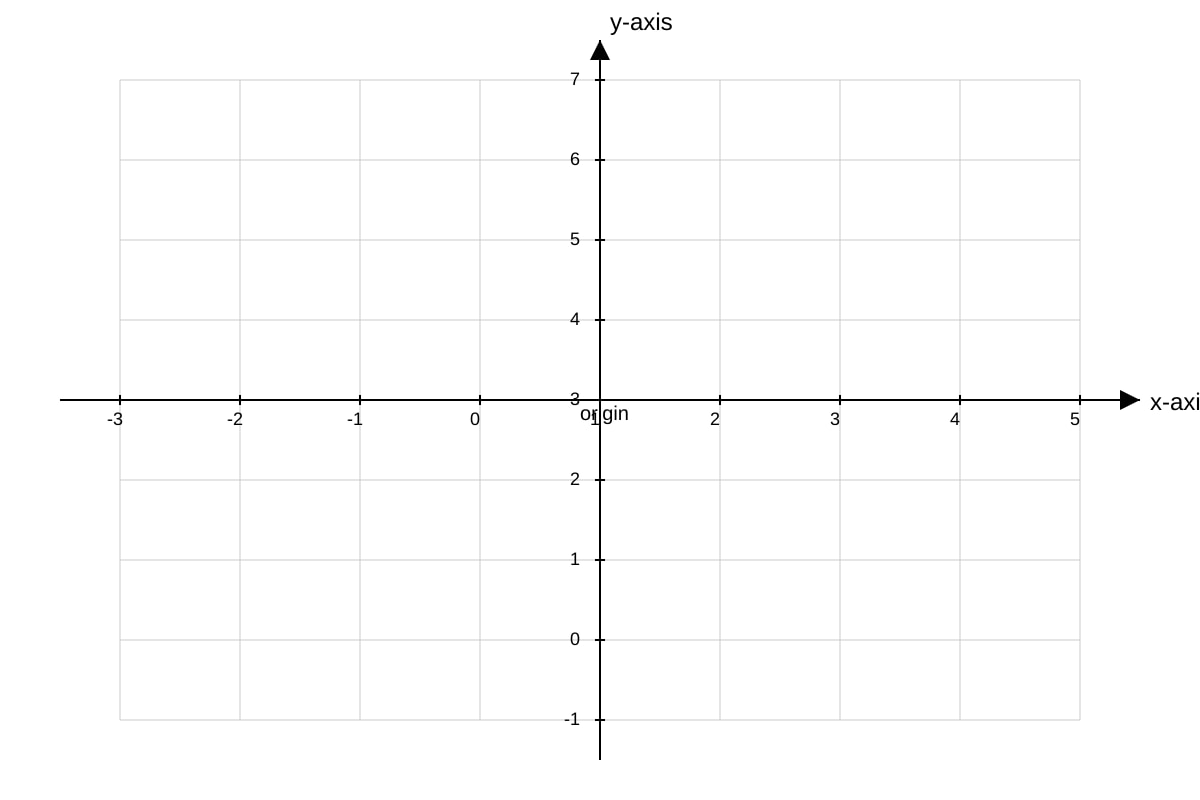
(a) Plot and label points A and B on the grid.
(b) Write down the coordinates of the midpoint of AB.
Answer (b): (1, 1)
[2]
Working:
Midpoint formula:
Marking: 1 mark for correct plotting of both points; 1 mark for correct midpoint coordinates.
3. The points P(–3, 2), Q(1, 2), R(1, –4), and S(–3, –4) are the vertices of a rectangle.
(a) Plot the points and draw the rectangle PQRS on the grid.
(b) Find the area of rectangle PQRS.
Answer (b): 24 square units
[2]
Working:
Length PQ = units (horizontal distance)
Length QR = units (vertical distance)
Area = length × breadth = square units
Marking: 1 mark for correct plotting/drawing; 1 mark for correct area with units.
4. A point lies on the y-axis and is 7 units below the origin. Write down its coordinates.
Answer: (0, –7)
[1]
Explanation: On y-axis means x-coordinate is 0. Below origin means negative y-direction.
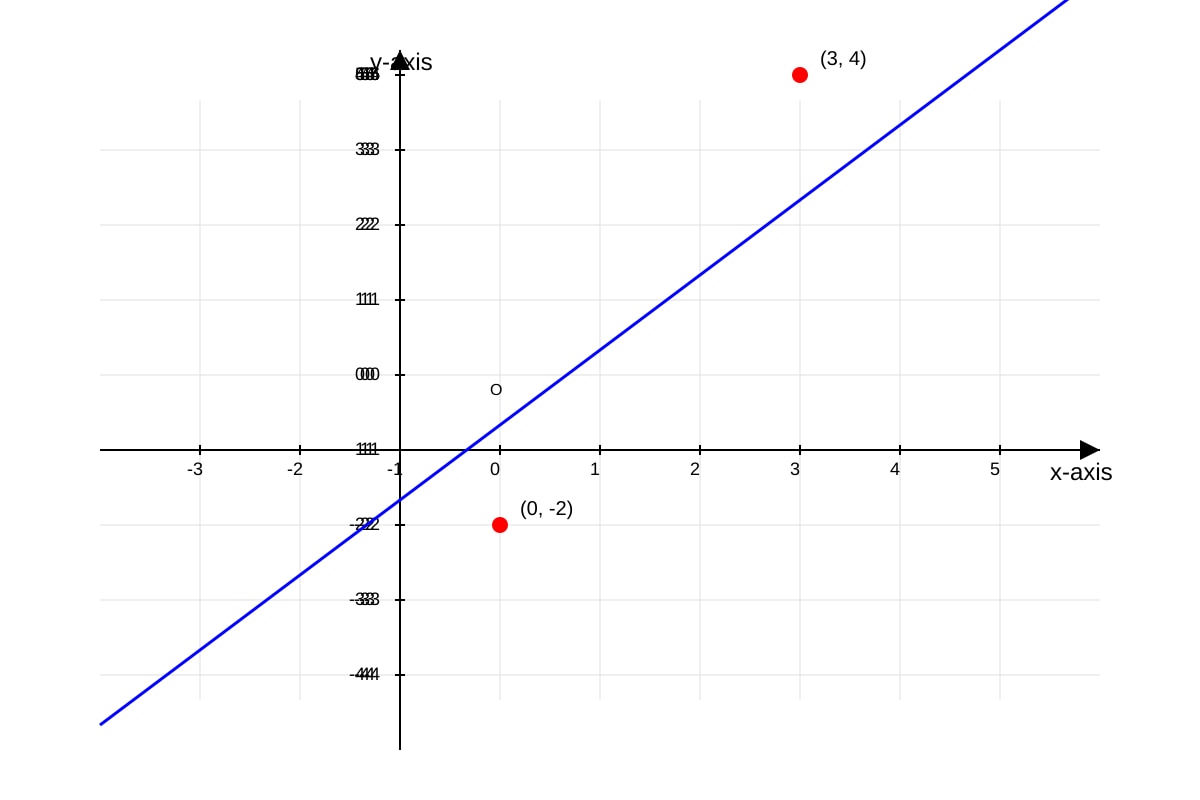
5. The diagram shows a straight line passing through the points (0, –2) and (3, 4).
(a) Find the gradient of the line.
(b) Write down the y-intercept of the line.
Answer (a): 2
Answer (b): –2
[2]
Working (a): Gradient
Working (b): The line passes through (0, –2), so the y-intercept is –2.
Common mistake: Using (reciprocal) or subtracting in wrong order.
Section B: Linear Graphs and Equations (Questions 6–14, 20 marks)
6. The equation of a straight line is .
(a) Complete the table of values for .
| -1 | 0 | 1 | 2 | 3 | |
|---|---|---|---|---|---|
| -7 | -5 | -3 | -1 | 1 |
(b) Draw the graph of for .
[3]
Marking: 1 mark for correct table (all 5 values correct); 2 marks for accurate plotting of all 5 points and drawing a straight line through them with a ruler. Deduct 1 mark if line not straight or not through all points.
7. A straight line has gradient and passes through the point (0, –2).
(a) Write down the equation of the line in the form .
(b) Find the x-coordinate of the point where this line crosses the x-axis.
Answer (a):
Answer (b): or
[2]
Working (a): , (since point is (0, –2), this is the y-intercept).
Working (b): At x-axis, .
Marking: 1 mark each part.
8. The diagram shows the graph of .
(a) Write down the gradient of the line.
(b) Write down the equation of the line.
(c) Find the value of when .
Answer (a):
Answer (b):
Answer (c): 5
[3]
Working (c): Substitute :
Marking: 1 mark each part.
9. The line has equation . The line has equation .
(a) Write down the gradient of .
(b) Write down the gradient of .
(c) Are and perpendicular? Explain your answer.
Answer (a): 4
Answer (b):
Answer (c): Yes, because the product of their gradients is .
[3]
Explanation: Two lines are perpendicular if and only if the product of their gradients is –1 (provided neither is vertical/horizontal). Here , so they are perpendicular.
Marking: 1 mark each for (a) and (b); 1 mark for correct conclusion with correct reasoning in (c).
10. A straight line passes through the points (2, 5) and (6, 13).
(a) Calculate the gradient of the line.
(b) Find the equation of the line in the form .
Answer (a): 2
Answer (b):
[3]
Working (a):
Working (b): Using and point (2, 5):
Equation:
(Check with (6, 13): ✓)
Marking: 1 mark for gradient; 2 marks for equation (1 mark for method/substitution, 1 mark for correct final equation).
11. The equation of a line is .
(a) Rearrange the equation to the form .
(b) Write down the gradient and the y-intercept of the line.
Answer (a):
Answer (b): Gradient = , y-intercept = 4
[2]
Working (a):
Marking: 1 mark for correct rearrangement; 1 mark for correct gradient and intercept.
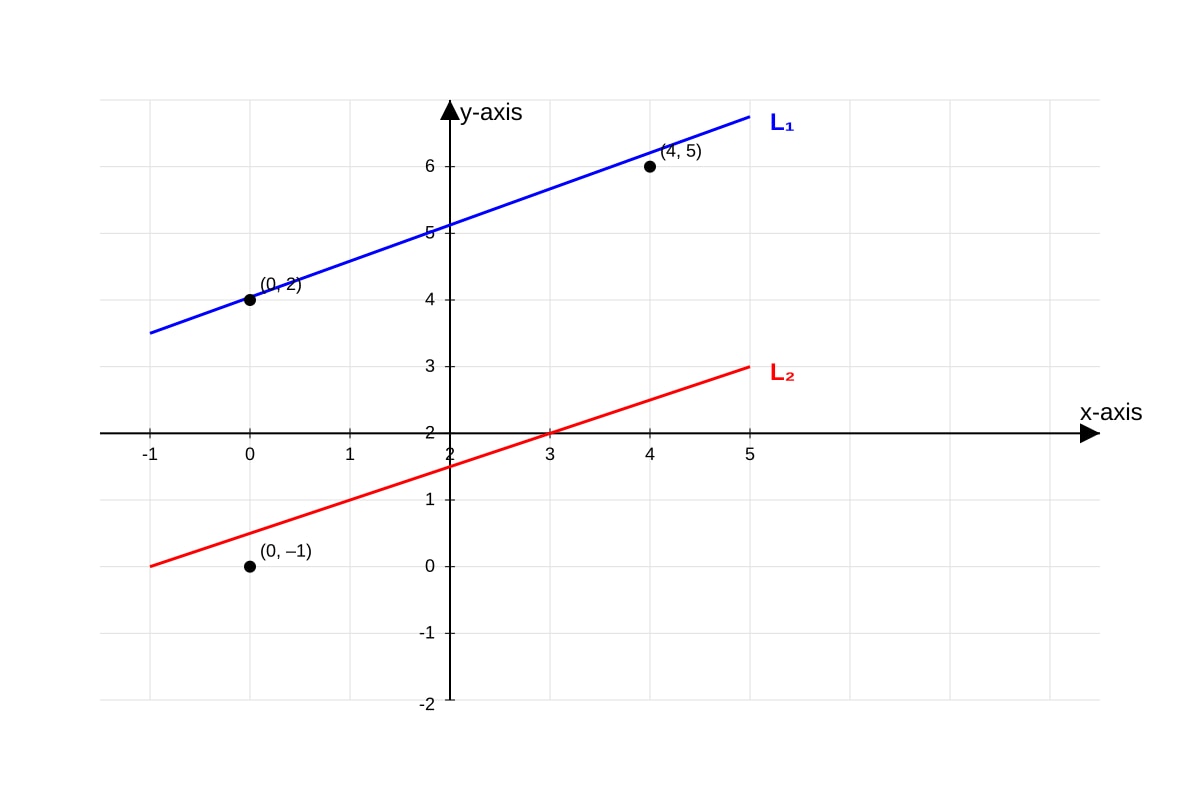
12. The diagram shows two parallel lines, and . Line passes through (0, 2) and (4, 5). Line passes through (0, –1).
(a) Find the gradient of .
(b) Write down the equation of .
Answer (a):
Answer (b):
[3]
Working (a):
Working (b): Parallel lines have the same gradient, so .
passes through (0, –1), so .
Equation:
Marking: 1 mark for gradient; 2 marks for equation (1 mark for using same gradient, 1 mark for correct intercept/equation).
13. The cost (in dollars) of hiring a bicycle for hours is given by the formula .
(a) Write down the cost of hiring the bicycle for 3 hours.
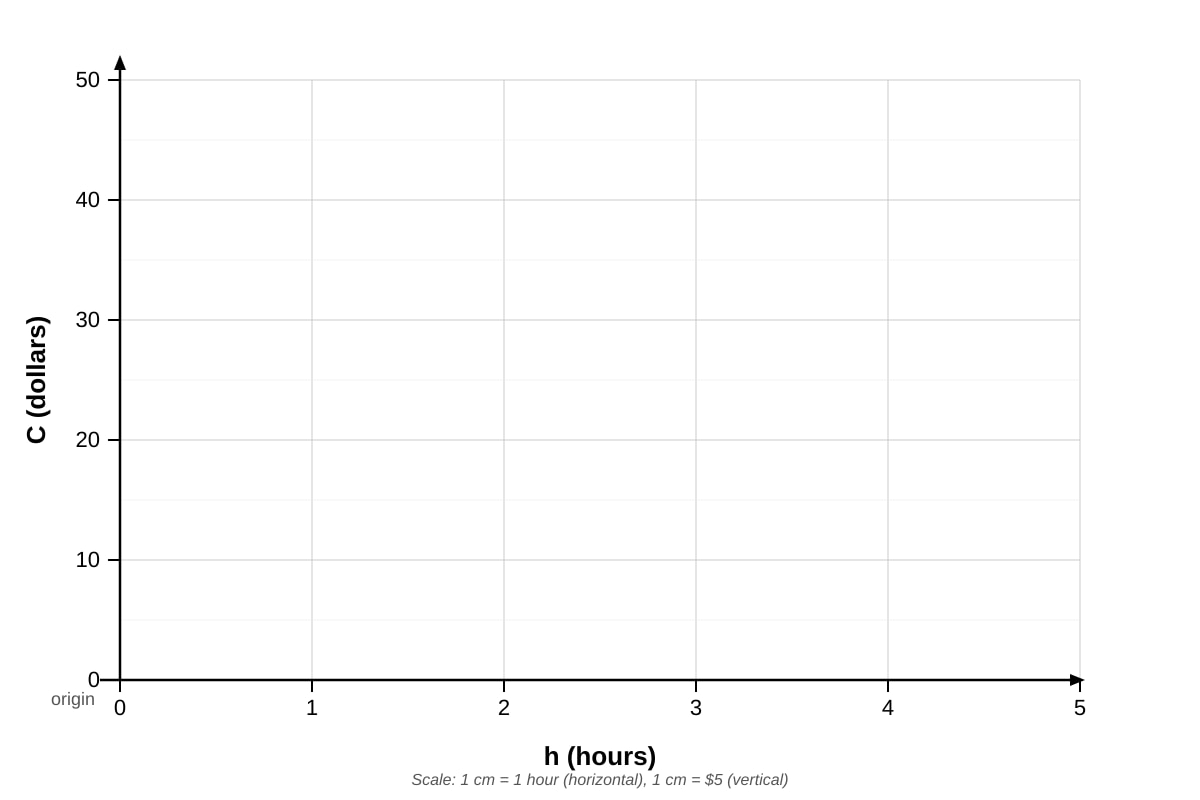
(b) Sketch the graph of against for . Label the axes and indicate the scale.
(c) Interpret the meaning of the number 5 in the formula.
Answer (a): h = 0C = 8(3) + 5 = 24 + 5 = 29hC). Scale indicated (e.g., 1 cm = 1 hour, 1 cm = 10).
Marking: 1 mark for (a); 1 mark for correct straight line graph with labelled axes and scale; 1 mark for correct interpretation in (c).
14. A line passes through the point (–2, 7) and has gradient –3.
(a) Find the equation of the line in the form .
(b) Determine whether the point (1, –2) lies on this line. Show your working.
Answer (a):
Answer (b): Yes, the point (1, –2) lies on the line.
[3]
Working (a): . Substitute (–2, 7):
Equation:
Working (b): Substitute into equation:
This matches the y-coordinate of the point (1, –2), so the point lies on the line.
Marking: 2 marks for (a) (1 mark for , 1 mark for finding ); 1 mark for (b) with correct substitution and conclusion.
Section C: Problem Solving and Applications (Questions 15–20, 10 marks)
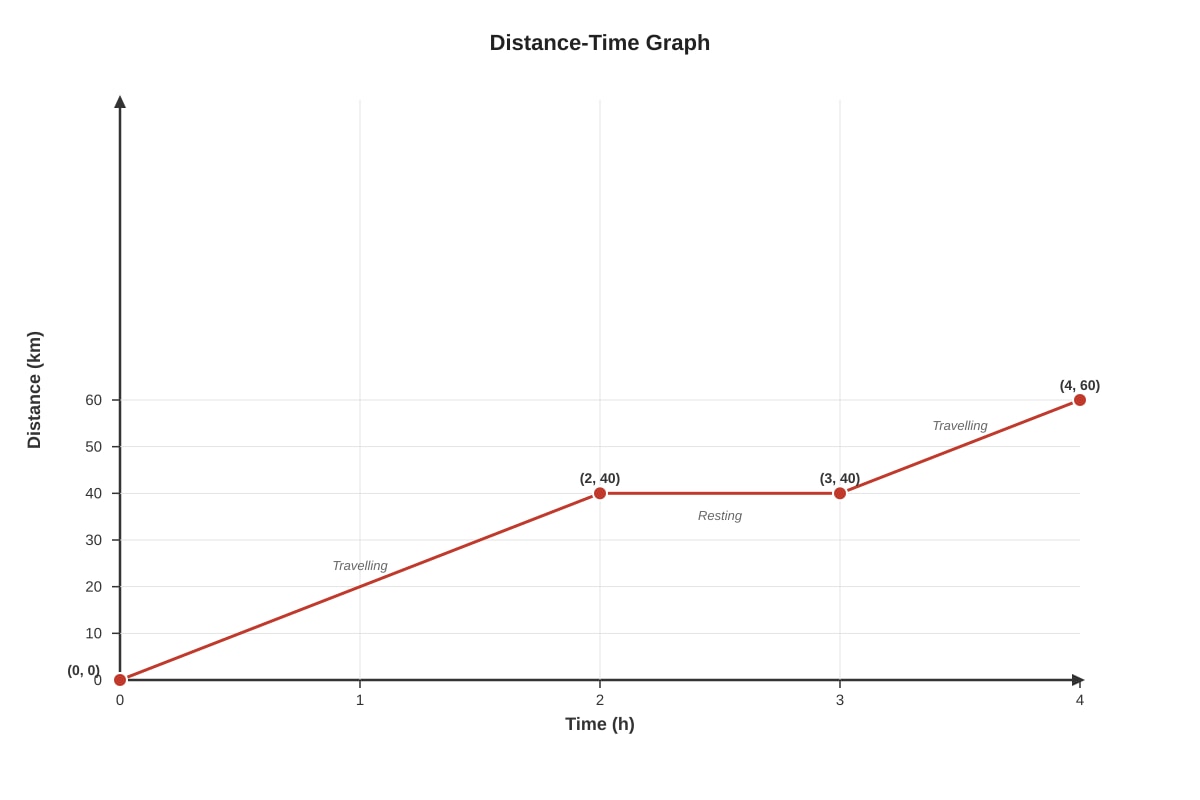
15. The graph shows the distance travelled by a cyclist over time.
(a) What is the speed of the cyclist during the first 2 hours?
(b) What happened between the 2nd and 3rd hour?
(c) Calculate the average speed for the whole journey.
Answer (a): 20 km/h
Answer (b): The cyclist stopped / rested / was stationary (distance did not change).
Answer (c): 15 km/h
[3]
Working (a): Speed = gradient = km/h
Working (c): Total distance = 60 km. Total time = 4 hours.
Average speed = km/h
Marking: 1 mark each part.
16. The vertices of a triangle are A(–2, 1), B(4, 1), and C(4, 5).
(a) Plot the triangle on the grid.
(b) Find the area of triangle ABC.
(c) Write down the coordinates of the midpoint of AC.
Answer (b): 12 square units
Answer (c): (1, 3)
[3]
Working (b): Triangle is right-angled at B.
Base AB = units.
Height BC = units.
Area = square units.
Working (c): Midpoint of AC =
Marking: 1 mark for plotting; 1 mark for area with units; 1 mark for midpoint.
17. Two lines have equations and .
(a) What is the relationship between these two lines?
(b) Find the vertical distance between the two lines.
(c) Write down the equation of a line that is perpendicular to both lines and passes through the origin.
Answer (a): The lines are parallel (they have the same gradient, 2).
Answer (b): 7 units
Answer (c):
[3]
Working (b): Vertical distance = difference in y-intercepts = units.
(Since gradients are equal, vertical distance is constant.)
Working (c): Perpendicular gradient = (negative reciprocal of 2).
Passes through origin ⇒ .
Equation:
Marking: 1 mark each part.
18. A straight line passes through the points (–1, 4) and (3, –4).
(a) Find the equation of the line.
(b) The line crosses the y-axis at point P and the x-axis at point Q. Find the coordinates of P and Q.
(c) Find the area of triangle OPQ, where O is the origin.
Answer (a):
Answer (b): P(0, 2), Q(1, 0)
Answer (c): 1 square unit
[4]
Working (a):
Using point (–1, 4):
Equation:
Working (b): P is y-intercept: ⇒ P(0, 2)
Q is x-intercept: ⇒ Q(1, 0)
Working (c): Triangle OPQ is right-angled at O.
Base = 1, Height = 2.
Area = square unit.
Marking: 1 mark for gradient, 1 mark for equation in (a); 1 mark for both intercepts in (b); 1 mark for area in (c).
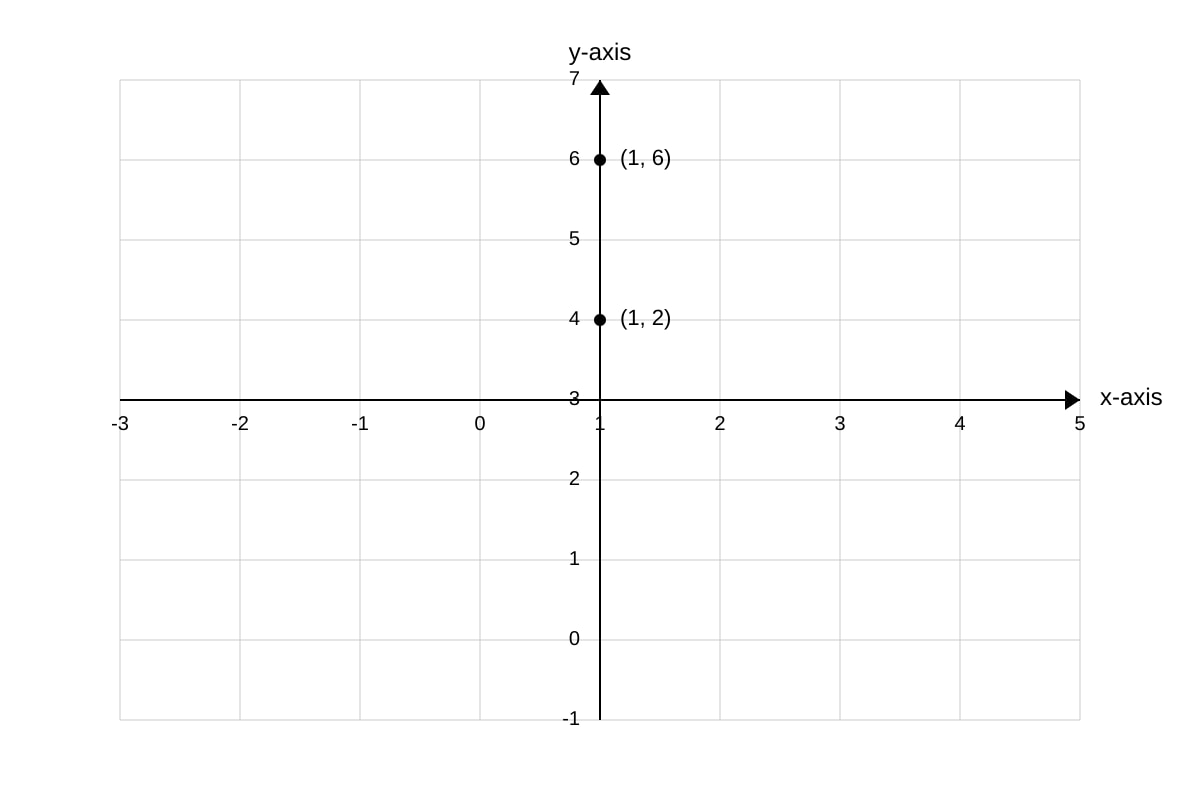
19. The diagram shows a square with two vertices at (1, 2) and (1, 6).
(a) Find the side length of the square.
(b) Write down the coordinates of the other two vertices. (There are two possible answers; give one.)
Answer (a): 4 units
Answer (b): (5, 2) and (5, 6) OR (–3, 2) and (–3, 6)
[3]
Working (a): The two given points have the same x-coordinate, so they form a vertical side.
Length = units.
Working (b): The square can be to the right or left of this vertical side.
To the right: add 4 to x-coordinates → (5, 2) and (5, 6).
To the left: subtract 4 from x-coordinates → (–3, 2) and (–3, 6).
Marking: 1 mark for side length; 2 marks for correct pair of vertices (either set accepted).
20. A line has equation . It passes through the points (2, 5) and (5, 11).
(a) Find the values of and .
(b) A second line is perpendicular to and passes through the point (0, 3). Find the equation of .
(c) Find the coordinates of the point of intersection of and .
Answer (a): ,
Answer (b):
Answer (c): or (0.8, 2.6)
[4]
Working (a):
Using (2, 5):
Equation of :
Working (b): Gradient of = (negative reciprocal of 2).
Passes through (0, 3) ⇒ .
Equation of :
Working (c): Solve simultaneously:
Intersection:
Marking: 2 marks for (a) (1 mark each for and ); 1 mark for (b); 1 mark for (c) with correct working.
End of Answer Key