AI Generated Quiz
Secondary 1 Mathematics Graphs Coordinate Geometry Quiz
Free Sec 1 Maths Graphs Geometry quiz, Claude AI version, with questions, answers, and syllabus-aligned practice for Singapore students.
These static practice materials are generated from the site's syllabus and paper-generation workflow, with source and model context shown so students and parents can evaluate the material before use.
Questions
Free quiz and exam paper access
Enter your details to view this paper
Your access is remembered on this device.
Answers
Secondary 1 Mathematics Quiz - Graphs Coordinate Geometry
Answer Key and Marking Scheme
Total Marks: 60
Section A: Basic Coordinate Concepts [20 marks]
1. Plot the following points: A(3, 2), B(-2, 4), C(-1, -3), D(4, -2) [4 marks] Answer: Correct plotting of all four points Marking: 1 mark per correctly plotted point Common errors: Confusing x and y coordinates, incorrect scale reading
2. Midpoint of P(5, 7) and Q(-3, 1) [2 marks] Answer: Midpoint = (1, 4) Working: Midpoint = ((5 + (-3))/2, (7 + 1)/2) = (2/2, 8/2) = (1, 4) Marking: 1 mark for correct method, 1 mark for correct answer
3. Distance between R(2, 6) and S(8, -2) [3 marks] Answer: Distance RS = 10 units Working: Distance = √[(8-2)² + (-2-6)²] = √[36 + 64] = √100 = 10 Marking: 1 mark for distance formula, 1 mark for substitution, 1 mark for correct answer
4. Point T on x-axis equidistant from A(4, 3) and B(2, 7) [3 marks] Answer: T = (0, 0) Working: Let T = (t, 0). Distance TA = Distance TB √[(t-4)² + 9] = √[(t-2)² + 49] (t-4)² + 9 = (t-2)² + 49 t² - 8t + 16 + 9 = t² - 4t + 4 + 49 -8t + 25 = -4t + 53 -4t = 28, t = -7 Correction: T = (-7, 0) Marking: 1 mark for setting up equal distances, 1 mark for correct algebra, 1 mark for answer
5. M(a, b) reflected in y-axis gives M'(-5, 3) [2 marks] Answer: a = 5, b = 3 Working: Reflection in y-axis changes sign of x-coordinate only Marking: 1 mark for each correct value
Section B: Linear Graphs and Gradients [20 marks]
6. Gradient through C(1, 4) and D(7, 16) [2 marks] Answer: Gradient = 2 Working: Gradient = (16-4)/(7-1) = 12/6 = 2 Marking: 1 mark for formula, 1 mark for correct answer
7. Line with gradient -3 through (2, 5) [3 marks] Answer: y = -3x + 11 Working: y - 5 = -3(x - 2), y - 5 = -3x + 6, y = -3x + 11 Marking: 1 mark for point-slope form, 1 mark for expansion, 1 mark for final form
8. Intercepts of 2x + 3y = 12 [4 marks] Answer: (a) x-intercept = 6, (b) y-intercept = 4 Working: (a) When y = 0: 2x = 12, x = 6 (b) When x = 0: 3y = 12, y = 4 Marking: 2 marks per intercept (1 for method, 1 for answer)
9. Gradient of 4x - 2y + 8 = 0 [3 marks] Answer: Gradient = 2 Working: 4x - 2y + 8 = 0 → -2y = -4x - 8 → y = 2x + 4 Marking: 1 mark for rearranging, 1 mark for y = mx + c form, 1 mark for gradient
10. Perpendicular gradient to 2/3 [2 marks] Answer: Gradient = -3/2 Working: Perpendicular gradients multiply to give -1 Marking: 1 mark for concept, 1 mark for correct answer
Section C: Graph Interpretation and Applications [20 marks]
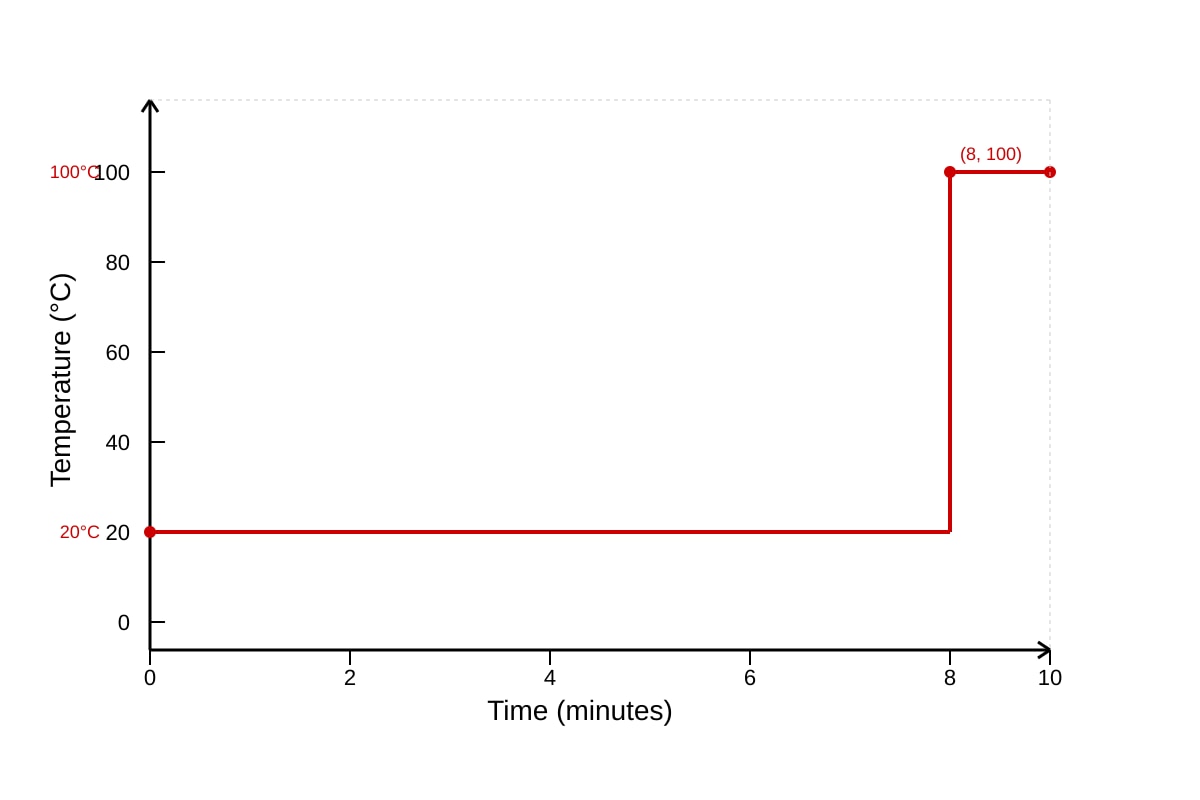
11. Temperature graph interpretation [4 marks] Answer: (a) 20°C (b) 10°C per minute (c) Temperature remains constant at 100°C (water boiling) Working: (b) Rate = (100-20)/(8-0) = 80/8 = 10°C per minute Marking: 1 mark each for (a) and (c), 2 marks for (b)
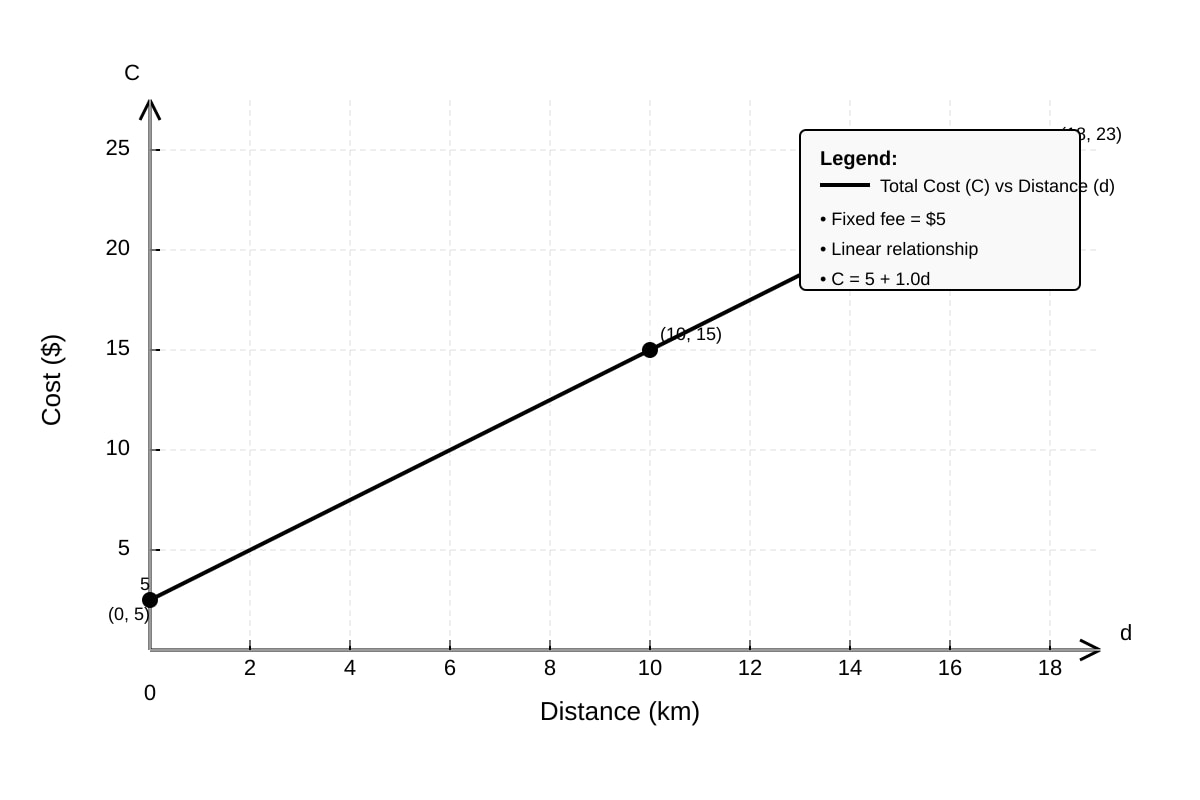
12. Taxi cost graph [5 marks] Answer: (a) 2 per km (c) C = 2d + 5 Working: (b) Rate = (25-5)/10 = 20/10 = $2 per km Marking: 1 mark for (a), 2 marks for (b), 2 marks for (c)
13. Rectangle vertices [4 marks] Answer: (a) D = (1, 6) (b) Area = 16 square units Working: (b) Length = 4, Width = 4, Area = 4 × 4 = 16 Marking: 2 marks each part
14. Line through P(-2, 1) and Q(4, 7) [4 marks] Answer: (a) y = x + 3 (b) y-intercept = 3 Working: Gradient = (7-1)/(4-(-2)) = 6/6 = 1 y - 1 = 1(x - (-2)), y = x + 3 Marking: 2 marks for gradient and equation, 2 marks for method, 1 mark for y-intercept
15. Point R(3, k) on y = 2x - 1 [2 marks] Answer: k = 5 Working: k = 2(3) - 1 = 6 - 1 = 5 Marking: 1 mark for substitution, 1 mark for answer
16. Line parallel to y = 4x + 3 through (1, -2) [3 marks] Answer: y = 4x - 6 Working: Parallel lines have same gradient: m = 4 y - (-2) = 4(x - 1), y + 2 = 4x - 4, y = 4x - 6 Marking: 1 mark for parallel gradient, 1 mark for point-slope, 1 mark for final form
17. Intersection of y = 2x + 1 and y = -x + 7 [3 marks] Answer: Intersection point = (2, 5) Working: 2x + 1 = -x + 7, 3x = 6, x = 2 y = 2(2) + 1 = 5 Marking: 1 mark for setting equal, 1 mark for solving x, 1 mark for finding y
18. Triangle ABC with A(0, 0), B(6, 0), C(3, 4) [4 marks] Answer: (a) Correct plotting and triangle drawing (b) Area = 12 square units Working: Base = 6, Height = 4, Area = ½ × 6 × 4 = 12 Marking: 2 marks for plotting, 2 marks for area calculation
19. Line with x-intercept 4, y-intercept -3 [3 marks] Answer: 3x - 4y - 12 = 0 Working: Points (4, 0) and (0, -3) Gradient = (-3-0)/(0-4) = 3/4 y = (3/4)x - 3, multiply by 4: 4y = 3x - 12, rearrange: 3x - 4y - 12 = 0 Marking: 1 mark for finding gradient, 1 mark for equation, 1 mark for standard form
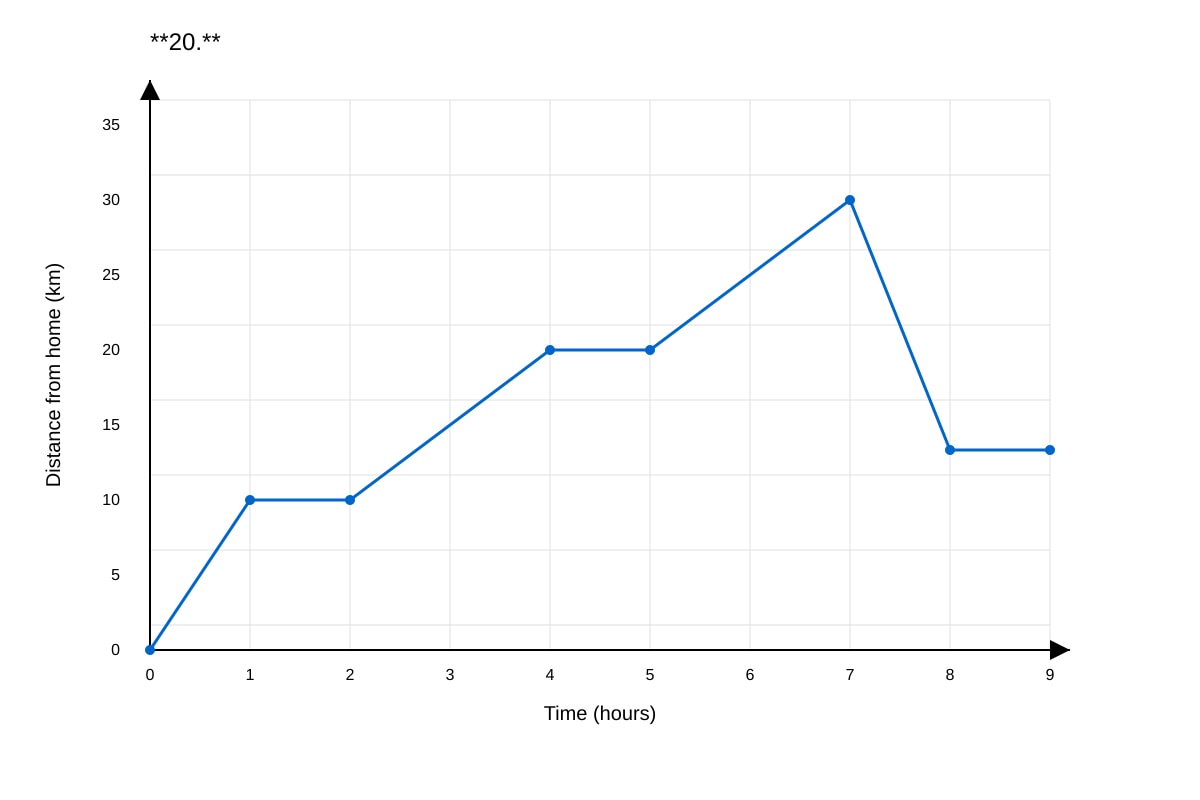
20. Cyclist journey graph [4 marks] Answer: (a) 8 km (b) 3 to 4 hours (c) 8 km/h Working: (c) Speed = distance/time = 8/1 = 8 km/h Marking: 1 mark each for (a) and (b), 2 marks for (c)
Common Student Errors:
- Confusing x and y coordinates when plotting
- Incorrect application of distance formula
- Sign errors when finding gradients
- Forgetting to multiply by -1 for perpendicular gradients
- Misreading graph scales and intercepts
- Arithmetic errors in fraction calculations
Teaching Notes:
- Emphasize careful plotting and labeling of points
- Practice gradient calculations with positive and negative values
- Reinforce the relationship between parallel and perpendicular lines
- Use real-world contexts to make graph interpretation meaningful
- Encourage students to check answers by substitution