AI Generated Quiz

Secondary 1 Mathematics Calculus Quiz

Free AI-Generated Kimi K2 6 Free Secondary 1 Mathematics Calculus quiz with questions and answers for Singapore students. This page is rendered as a direct URL so the questions and answers can be discovered without pressing in-page buttons.

These static practice materials are generated from the site's syllabus and paper-generation workflow, with source and model context shown so students and parents can evaluate the material before use.

Secondary 1 Mathematics AI Generated Generated by Kimi K2 6 Free Updated 2026-06-07

Questions

<!-- TuitionGoWhere generation metadata: stage=5-1; model=moonshotai/kimi-k2.6:free; model_label=Kimi K2.6 Free; generated=2026-06-07; Sources: Stage 4-0 LLM templates, syllabus context, and Stage 2 evidence where available. -->

Secondary 1 Mathematics Quiz - Calculus

Name: _________________________________ Class: _______________ Date: _______________

Duration: 35 minutes

Total Marks: 40

Instructions:

  • Answer all questions.
  • Show your working clearly. Marks will be awarded for correct method even if the final answer is wrong.
  • Write your answers in the spaces provided.
  • Use of calculator is allowed unless otherwise stated.

Section A: Conceptual Understanding (Questions 1–8, 1 mark each, total 8 marks)

1. What is the gradient of a horizontal line?

____________________________________________________________________ [1]


2. If the gradient of a line is negative, what does this tell you about the slope of the line?

____________________________________________________________________ [1]


3. In the context of motion along a straight line, what does the gradient of a distance-time graph represent?

____________________________________________________________________ [1]


4. State whether the gradient of the curve y=x2y = x^2 is positive, negative, or zero at the point where x=0x = 0.

____________________________________________________________________ [1]


5. A curve has a maximum point at x=3x = 3. What is the value of the gradient at this maximum point?

____________________________________________________________________ [1]


6. If the gradient function of a curve is 6x+26x + 2, what was the original function yy?

____________________________________________________________________ [1]


7. What is the gradient of the line y=5x3y = 5x - 3?

____________________________________________________________________ [1]


8. For the curve y=x3y = x^3, is the gradient increasing or decreasing as xx increases from 2-2 to 00?

____________________________________________________________________ [1]


Section B: Gradient and Rate of Change (Questions 9–14, 3 marks each, total 18 marks)

9. Find the gradient of the straight line passing through the points A(2,5)A(2, 5) and B(6,13)B(6, 13).

<image_placeholder> id: Q9-fig1 type: graph linked_question: Q9 description: Coordinate plane showing points A(2,5) and B(6,13) with a straight line through them labels: Points A and B with coordinates, x-axis, y-axis, origin O values: A(2,5), B(6,13), x-axis from 0 to 8, y-axis from 0 to 15 must_show: Clear coordinate grid, labeled points, straight line connecting A and B </image_placeholder>

Working: ____________________________________________________________


Answer: ____________________________________________________________ [3]


10. A ball is thrown upwards. Its height above ground after tt seconds is given by h=20t5t2h = 20t - 5t^2 metres.

(a) Find the gradient of the height-time graph at t=1t = 1.

Working: ____________________________________________________________


Answer: ____________________________________________________________ [2]

(b) Explain what this gradient represents in the context of this problem.


____________________________________________________________________ [1]


11. The table below shows the distance ss metres travelled by a cyclist after tt seconds.

tt (s)012345
ss (m)038152435

(a) Find the average speed of the cyclist between t=2t = 2 and t=5t = 5.

Working: ____________________________________________________________


Answer: ____________________________________________________________ [2]

(b) Explain why the instantaneous speed at t=3t = 3 is different from your answer in part (a).


____________________________________________________________________ [1]


12. For the curve y=x2+3x4y = x^2 + 3x - 4:

(a) Find the gradient at the point where x=2x = 2 by considering the gradient of a small interval.

Working: ____________________________________________________________


Answer: ____________________________________________________________ [2]

(b) Use your answer to write the equation of the tangent to the curve at x=2x = 2.

Working: ____________________________________________________________


Answer: ____________________________________________________________ [1]


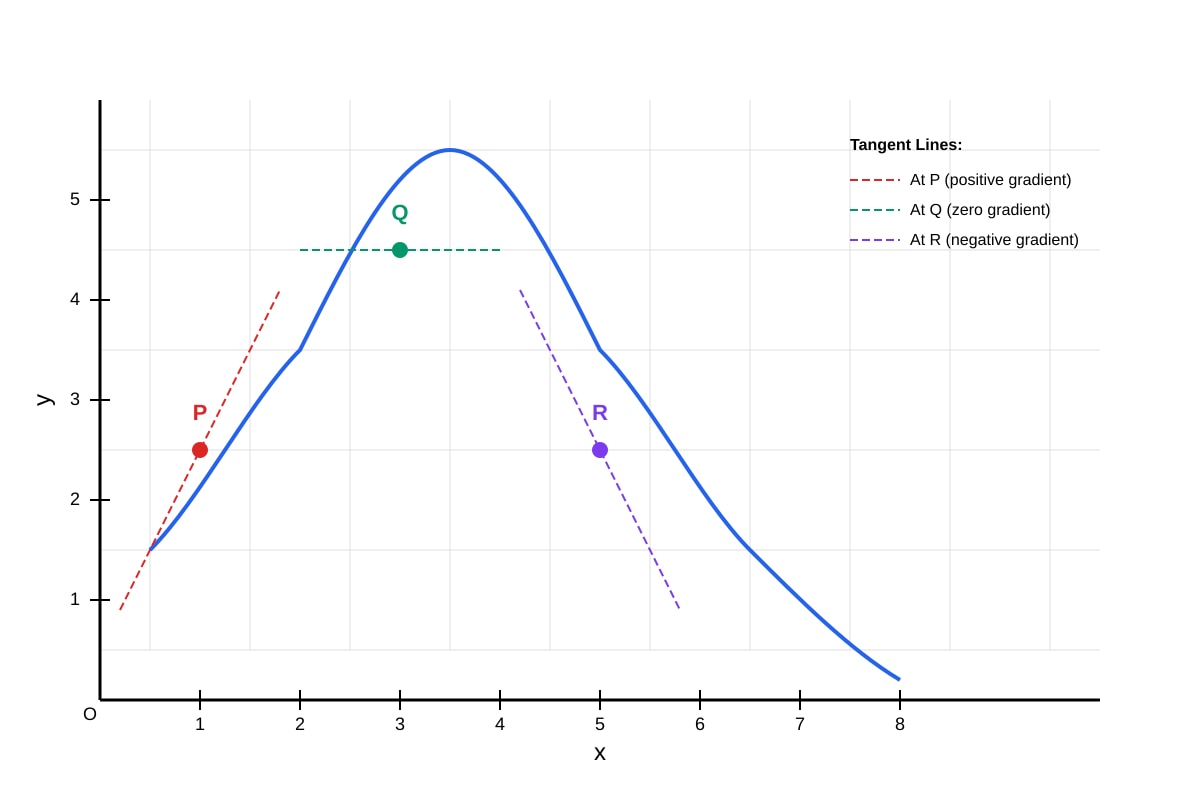
13. <image_placeholder> id: Q13-fig1 type: graph linked_question: Q13 description: A curve on a coordinate plane with points P, Q, and R marked, with tangent lines drawn at each point labels: Points P (where curve is rising steeply), Q (maximum point), R (where curve is falling), tangent lines at each point values: P at approximately x=1, Q at approximately x=3, R at approximately x=5 must_show: Curve peaking at Q, tangent at P sloping upward, tangent at Q horizontal, tangent at R sloping downward </image_placeholder>

The diagram shows a curve with points PP, QQ, and RR.

(a) State which point has a positive gradient.

____________________________________________________________________ [1]

(b) State which point has zero gradient.

____________________________________________________________________ [1]

(c) Arrange the points in order of gradient, from largest to smallest.

____________________________________________________________________ [1]


14. The cost CC dollars of producing xx items is given by C=0.1x2+50x+2000C = 0.1x^2 + 50x + 2000.

(a) Find the rate of change of cost with respect to the number of items produced when x=100x = 100.

Working: ____________________________________________________________


Answer: ____________________________________________________________ [2]

(b) The selling price of each item is \80.Therevenue. The revenue Rfromsellingfrom sellingxitemsisitems isR = 80x.Findtherateofchangeofprofitwithrespectto. Find the rate of change of profit with respect to xwhenwhenx = 100$.

(Profit = Revenue - Cost)

Working: ____________________________________________________________


Answer: ____________________________________________________________ [1]


Section C: Problem Solving (Questions 15–20, 3 or 4 marks each, total 14 marks)

15. A particle moves along a straight line so that its displacement ss metres from a fixed point OO after tt seconds is given by s=t36t2+9ts = t^3 - 6t^2 + 9t.

(a) Find the velocity of the particle when t=4t = 4.

Working: ____________________________________________________________


Answer: ____________________________________________________________ [2]

(b) Find the value of tt when the particle is momentarily at rest.

Working: ____________________________________________________________


Answer: ____________________________________________________________ [2]


16. The area AA of a square is increasing at a constant rate of 8 cm2/s8 \text{ cm}^2/\text{s}. Find the rate of increase of the side length when the area is 64 cm264 \text{ cm}^2.

Working: ____________________________________________________________


Answer: ____________________________________________________________ [4]


17. For the curve y=2x28x+5y = 2x^2 - 8x + 5:

(a) Find the coordinates of the turning point.

Working: ____________________________________________________________


Answer: ____________________________________________________________ [3]

(b) Determine whether this turning point is a maximum or a minimum.

Working: ____________________________________________________________

____________________________________________________________________ [1]


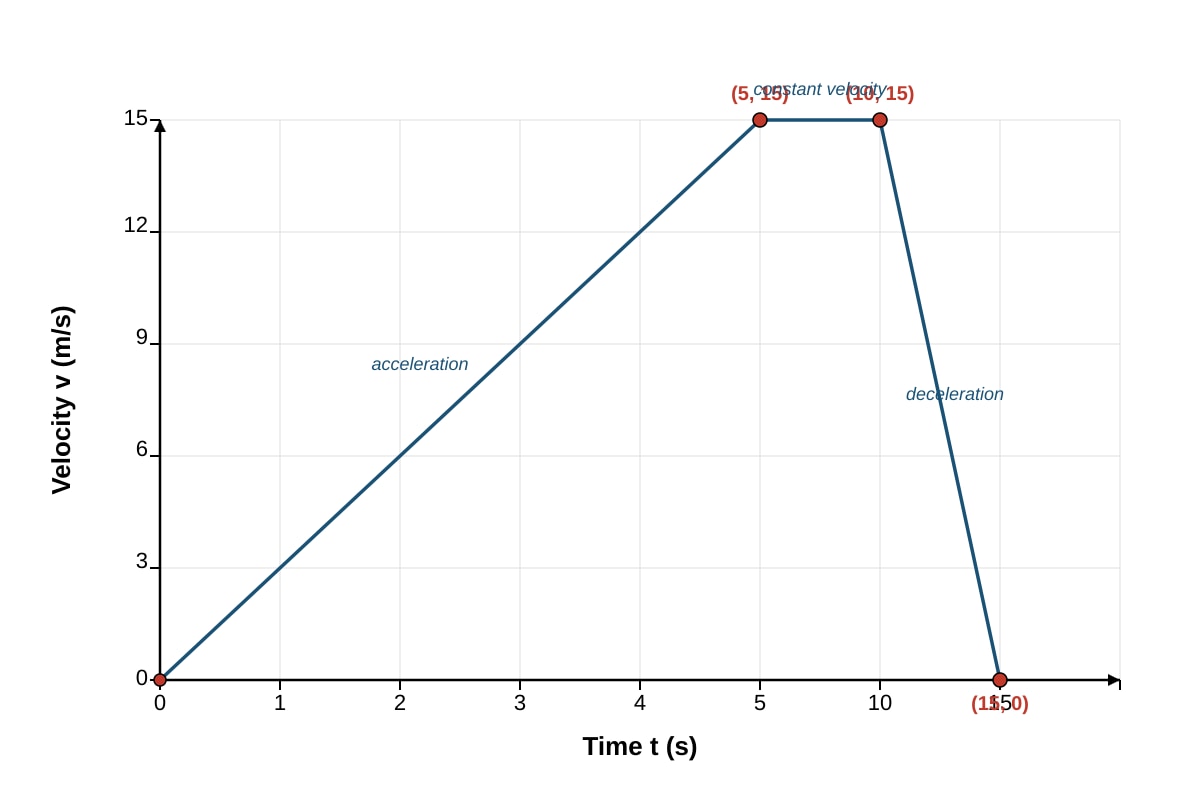
18. <image_placeholder> id: Q18-fig1 type: graph linked_question: Q18 description: A velocity-time graph showing a straight line from origin, sloping upward to point (5, 15), then horizontal to point (10, 15), then sloping downward to point (15, 0) labels: Velocity v (m/s) on y-axis, time t (s) on x-axis, points at t=5, t=10, t=15 values: Line segments: (0,0) to (5,15), (5,15) to (10,15), (10,15) to (15,0) must_show: Three distinct segments clearly labeled, axes with units, numerical values at key points </image_placeholder>

The graph shows the velocity vv m/s of an object at time tt seconds.

(a) Find the acceleration during the first 5 seconds.

Working: ____________________________________________________________


Answer: ____________________________________________________________ [1]

(b) Find the total distance travelled in the 15 seconds.

Working: ____________________________________________________________


Answer: ____________________________________________________________ [3]


19. A rectangular box has a square base of side xx cm and height hh cm. The volume of the box is 1000 cm31000 \text{ cm}^3.

(a) Show that the surface area AA of the box is given by A=2x2+4000xA = 2x^2 + \frac{4000}{x}.

Working: ____________________________________________________________


____________________________________________________________________ [2]

(b) Find the value of xx that makes the surface area a minimum.

Working: ____________________________________________________________


Answer: ____________________________________________________________ [3]


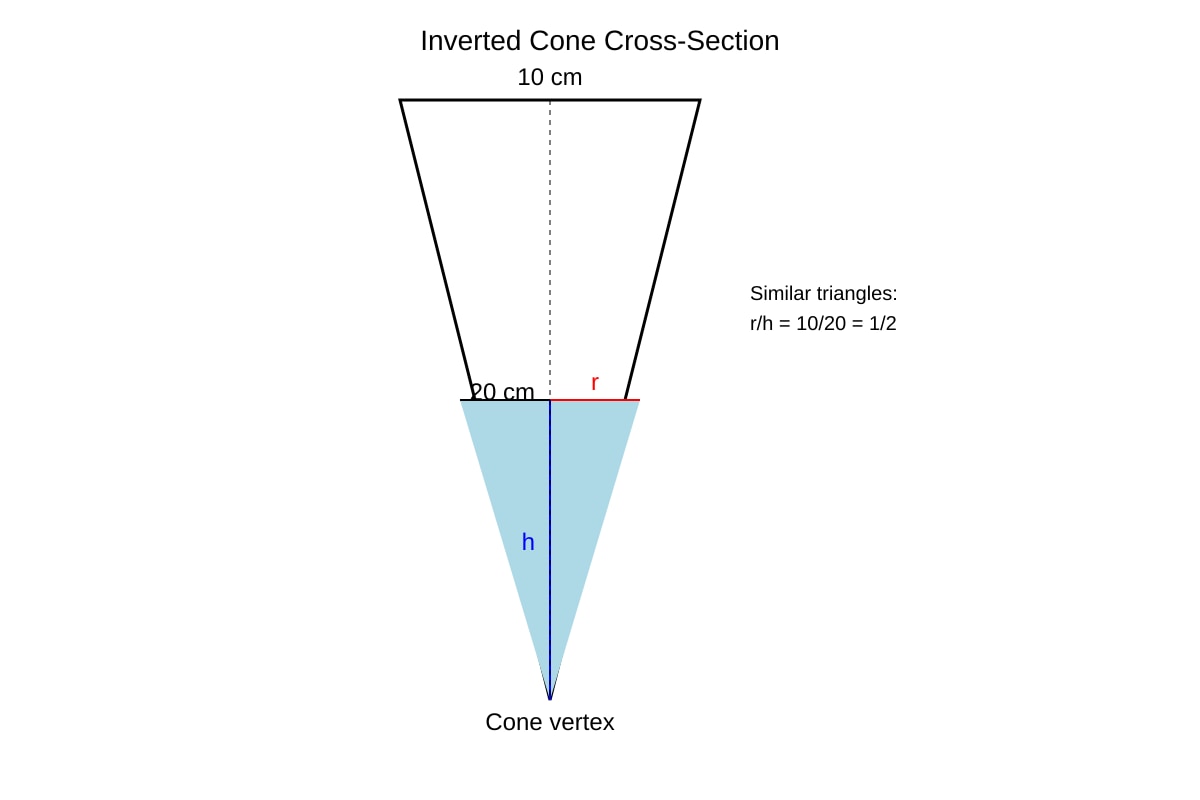
20. Water is poured into a conical container at a constant rate of 10 cm3/s10 \text{ cm}^3/\text{s}. The height of the cone is 20 cm and the radius of the base is 10 cm. When the water level is at height hh cm, the radius of the water surface is rr cm.

<image_placeholder> id: Q20-fig1 type: diagram linked_question: Q20 description: A vertical cross-section of an inverted cone showing water filling to height h with surface radius r labels: Cone height 20 cm, base radius 10 cm, water height h, water surface radius r, cone vertex at bottom values: Total height 20 cm, base radius 10 cm, water height h, water radius r must_show: Similar triangles relationship, labeled dimensions, water level clearly marked, inverted cone orientation </image_placeholder>

(a) Explain why rh=12\frac{r}{h} = \frac{1}{2}.

Working: ____________________________________________________________

____________________________________________________________________ [1]

(b) Show that the volume of water V=112πh3V = \frac{1}{12}\pi h^3.

Working: ____________________________________________________________


____________________________________________________________________ [2]

(c) Find the rate at which the water level is rising when h=5h = 5 cm.

Working: ____________________________________________________________


Answer: ____________________________________________________________ [3]


END OF QUIZ

Answers

<!-- TuitionGoWhere generation metadata: stage=5-1; model=moonshotai/kimi-k2.6:free; model_label=Kimi K2.6 Free; generated=2026-06-07; Sources: Stage 4-0 LLM templates, syllabus context, and Stage 2 evidence where available. -->

Secondary 1 Mathematics Quiz - Calculus (Answer Key)

Section A: Conceptual Understanding (8 marks)

1. What is the gradient of a horizontal line?

Answer: 0 (zero)

Explanation: The gradient measures steepness. A horizontal line has no "rise" for any "run", so riserun=0run=0\frac{\text{rise}}{\text{run}} = \frac{0}{\text{run}} = 0. Visualise: as you move right, yy doesn't change.

Marking: [1] for "0" or "zero"


2. If the gradient of a line is negative, what does this tell you about the slope of the line?

Answer: The line slopes downward from left to right (as xx increases, yy decreases).

Explanation: Gradient = change in ychange in x\frac{\text{change in } y}{\text{change in } x}. A negative gradient means as we move right (positive xx direction), the yy-value goes down. The line "falls" as we read left to right.

Marking: [1] for any equivalent description of downward slope


3. In the context of motion along a straight line, what does the gradient of a distance-time graph represent?

Answer: Speed (or velocity, if direction is considered)

Explanation: Gradient = ΔsΔt=change in distancechange in time\frac{\Delta s}{\Delta t} = \frac{\text{change in distance}}{\text{change in time}} = speed. This is the fundamental meaning of rate of change in this context.

Marking: [1] for "speed" or "velocity"


4. State whether the gradient of the curve y=x2y = x^2 is positive, negative, or zero at the point where x=0x = 0.

Answer: Zero

Explanation: The curve y=x2y = x^2 is a parabola opening upward with its minimum at (0,0)(0, 0). At this turning point, the tangent is horizontal, so gradient = 0. To the left of 0, gradient is negative; to the right, positive. At exactly 0, it's zero.

Marking: [1] for "zero"


5. A curve has a maximum point at x=3x = 3. What is the value of the gradient at this maximum point?

Answer: 0 (zero)

Explanation: At any maximum or minimum (turning point), the tangent to the curve is horizontal. A horizontal tangent has gradient zero. This is a key principle: turning points occur where dydx=0\frac{dy}{dx} = 0.

Marking: [1] for "0" or "zero"


6. If the gradient function of a curve is 6x+26x + 2, what was the original function yy?

Answer: y=3x2+2x+cy = 3x^2 + 2x + c (where cc is an arbitrary constant)

Explanation: This is reverse differentiation (anti-differentiation or integration). The gradient function is dydx=6x+2\frac{dy}{dx} = 6x + 2, so we find yy by reversing the power rule: 6xdx=6x22=3x2\int 6x \, dx = \frac{6x^2}{2} = 3x^2 and 2dx=2x\int 2 \, dx = 2x. The constant cc appears because any constant disappears when differentiated.

Marking: [1] for 3x2+2x+c3x^2 + 2x + c (must include +c+c)


7. What is the gradient of the line y=5x3y = 5x - 3?

Answer: 5

Explanation: For y=mx+cy = mx + c form, mm is the gradient. Here m=5m = 5. This means for every 1 unit increase in xx, yy increases by 5 units.

Marking: [1] for "5"


8. For the curve y=x3y = x^3, is the gradient increasing or decreasing as xx increases from 2-2 to 00?

Answer: Decreasing

Explanation: For y=x3y = x^3, the gradient function is 3x23x^2. As xx goes from 2-2 to 00: at x=2x = -2, gradient = 3×4=123 \times 4 = 12; at x=1x = -1, gradient = 3×1=33 \times 1 = 3; at x=0x = 0, gradient = 0. The gradient values decrease: 12 → 3 → 0.

Common mistake: Students might think "as xx increases, everything increases." Not so—gradient is 3x23x^2, which decreases toward zero as xx approaches 0 from either side.

Marking: [1] for "decreasing"


Section B: Gradient and Rate of Change (18 marks)

9. Find the gradient of the straight line passing through the points A(2,5)A(2, 5) and B(6,13)B(6, 13).

Answer: 2

Working: Gradient=y2y1x2x1=13562=84=2\text{Gradient} = \frac{y_2 - y_1}{x_2 - x_1} = \frac{13 - 5}{6 - 2} = \frac{8}{4} = 2

Explanation: The gradient formula measures "rise over run". From AA to BB: we go up 8 units (rise) and right 4 units (run). The ratio is 2, meaning the line is quite steep—every 1 unit right, we go 2 units up.

Marking: [1] for correct formula or method; [1] for correct substitution; [1] for final answer 2


10. A ball is thrown upwards. Its height above ground after tt seconds is given by h=20t5t2h = 20t - 5t^2 metres.

(a) Find the gradient of the height-time graph at t=1t = 1.

Answer: 10

Working: Gradient function: dhdt=2010t\frac{dh}{dt} = 20 - 10t

At t=1t = 1: dhdt=2010(1)=10\frac{dh}{dt} = 20 - 10(1) = 10

Explanation: The gradient of h=20t5t2h = 20t - 5t^2 is found by: the term 20t20t has gradient 20 (constant), and 5t2-5t^2 has gradient 10t-10t (using the rule: for xnx^n, gradient is nxn1nx^{n-1}; so 5×2×t1=10t-5 \times 2 \times t^1 = -10t).

Marking: [1] for gradient function; [1] for answer 10

(b) Explain what this gradient represents in the context of this problem.

Answer: The velocity of the ball at t=1t = 1 second, which is 1010 m/s upward.

Explanation: Since hh is height (distance) and tt is time, dhdt\frac{dh}{dt} = rate of change of height with time = velocity. Positive means the ball is still going up at this moment.

Marking: [1] for identifying as velocity/speed with units and direction


11. The table shows the distance ss metres travelled by a cyclist after tt seconds.

(a) Find the average speed of the cyclist between t=2t = 2 and t=5t = 5.

Answer: 9 m/s

Working: Average speed=change in distancechange in time=35852=273=9 m/s\text{Average speed} = \frac{\text{change in distance}}{\text{change in time}} = \frac{35 - 8}{5 - 2} = \frac{27}{3} = 9 \text{ m/s}

Explanation: Average speed over an interval = gradient of chord joining the two points on the distance-time graph.

Marking: [1] for method; [1] for answer 9 m/s

(b) Explain why the instantaneous speed at t=3t = 3 is different from your answer in part (a).

Answer: The cyclist is accelerating (speeding up), so the speed at any instant differs from the average. The table shows non-constant increases: from t=2t=2 to t=3t=3, distance increases by 7m; from t=3t=3 to t=4t=4, by 9m. The cyclist is going faster at later times, so the average over t=2t=2 to 5 doesn't equal the instant at t=3t=3.

Explanation: Average speed is a "smoothed out" value over an interval. Instantaneous speed is the gradient of the tangent at one point. For changing speed, these differ.

Marking: [1] for correct explanation mentioning acceleration/changing speed/non-constant rate


12. For the curve y=x2+3x4y = x^2 + 3x - 4:

(a) Find the gradient at the point where x=2x = 2 by considering the gradient of a small interval.

Answer: 7

Working: Gradient function: dydx=2x+3\frac{dy}{dx} = 2x + 3

At x=2x = 2: dydx=2(2)+3=7\frac{dy}{dx} = 2(2) + 3 = 7

Or by small interval: gradient of chord from x=2x=2 to x=2+hx=2+h: (2+h)2+3(2+h)4(4+64)h=4+4h+h2+6+3h46h=7h+h2h=7+h7 as h0\frac{(2+h)^2 + 3(2+h) - 4 - (4+6-4)}{h} = \frac{4+4h+h^2+6+3h-4-6}{h} = \frac{7h+h^2}{h} = 7 + h \to 7 \text{ as } h \to 0

Explanation: The "small interval" method leads us to the derivative. The power rule gives 2x2x from x2x^2 and 33 from 3x3x. The constant 4-4 contributes nothing to gradient.

Marking: [1] for gradient function; [1] for answer 7

(b) Use your answer to write the equation of the tangent to the curve at x=2x = 2.

Answer: y=7x10y = 7x - 10 (or equivalent)

Working: When x=2x = 2: y=4+64=6y = 4 + 6 - 4 = 6, so point is (2,6)(2, 6)

Tangent: y6=7(x2)y - 6 = 7(x - 2)

y=7x14+6=7x10y = 7x - 14 + 6 = 7x - 10

Explanation: The tangent has the same gradient as the curve at that point (7). We use point-slope form: yy1=m(xx1)y - y_1 = m(x - x_1).

Marking: [1] for correct equation


13. The diagram shows a curve with points PP, QQ, and RR.

(a) State which point has a positive gradient.

Answer: Point PP

Explanation: At PP, the curve is rising as we move left to right, so tangent slopes upward → positive gradient.

(b) State which point has zero gradient.

Answer: Point QQ

Explanation: At QQ (the maximum), the tangent is horizontal, gradient = 0.

(c) Arrange the points in order of gradient, from largest to smallest.

Answer: P>Q>RP > Q > R (or equivalent: P,Q,RP, Q, R)

Explanation: PP: positive gradient (steepest upward); QQ: zero gradient (flat); RR: negative gradient (sloping downward). So P>Q>RP > Q > R.

Marking: (a) [1], (b) [1], (c) [1]


14. The cost CC dollars of producing xx items is given by C=0.1x2+50x+2000C = 0.1x^2 + 50x + 2000.

(a) Find the rate of change of cost with respect to the number of items produced when x=100x = 100.

Answer: 70 dollars/item

Working: dCdx=0.2x+50\frac{dC}{dx} = 0.2x + 50

At x=100x = 100: 0.2(100)+50=20+50=700.2(100) + 50 = 20 + 50 = 70

Explanation: "Rate of change of cost with respect to number of items" = marginal cost = dCdx\frac{dC}{dx}. The term 0.1x20.1x^2 gives 0.2x0.2x, the 50x50x gives 5050, and the constant 20002000 gives 0.

Marking: [1] for derivative; [1] for answer 70 (accept "$70 per item")

(b) Find the rate of change of profit with respect to xx when x=100x = 100.

Answer: 10 dollars/item

Working: Profit P=RC=80x(0.1x2+50x+2000)=0.1x2+30x2000P = R - C = 80x - (0.1x^2 + 50x + 2000) = -0.1x^2 + 30x - 2000

dPdx=0.2x+30\frac{dP}{dx} = -0.2x + 30

At x=100x = 100: 0.2(100)+30=20+30=10-0.2(100) + 30 = -20 + 30 = 10

Or: dPdx=dRdxdCdx=8070=10\frac{dP}{dx} = \frac{dR}{dx} - \frac{dC}{dx} = 80 - 70 = 10

Explanation: Rate of change of profit = marginal revenue − marginal cost. Since each item sells for 80andmarginalcostis80 and marginal cost is 70, each additional item adds $10 to profit at this production level.

Marking: [1] for answer 10 with correct working


Section C: Problem Solving (14 marks)

15. A particle moves along a straight line so that its displacement ss metres from a fixed point OO after tt seconds is given by s=t36t2+9ts = t^3 - 6t^2 + 9t.

(a) Find the velocity of the particle when t=4t = 4.

Answer: 9 m/s

Working: v=dsdt=3t212t+9v = \frac{ds}{dt} = 3t^2 - 12t + 9

At t=4t = 4: v=3(16)12(4)+9=4848+9=9v = 3(16) - 12(4) + 9 = 48 - 48 + 9 = 9

Explanation: Velocity is rate of change of displacement. Differentiate: t33t2t^3 \to 3t^2, 6t212t-6t^2 \to -12t, 9t99t \to 9.

Marking: [1] for velocity expression; [1] for answer 9 m/s

(b) Find the value of tt when the particle is momentarily at rest.

Answer: t=1t = 1 or t=3t = 3

Working: Momentarily at rest: v=0v = 0

3t212t+9=03t^2 - 12t + 9 = 0

t24t+3=0t^2 - 4t + 3 = 0

(t1)(t3)=0(t - 1)(t - 3) = 0

t=1 or t=3t = 1 \text{ or } t = 3

Explanation: "Momentarily at rest" means velocity is zero (particle changes direction). Solve the quadratic. The particle stops at t=1t=1 and t=3t=3 seconds.

Marking: [1] for setting v=0v=0; [1] for both values correct


16. The area AA of a square is increasing at a constant rate of 8 cm2/s8 \text{ cm}^2/\text{s}. Find the rate of increase of the side length when the area is 64 cm264 \text{ cm}^2.

Answer: 0.5 cm/s

Working: Given: dAdt=8\frac{dA}{dt} = 8

For a square: A=x2A = x^2, so x=Ax = \sqrt{A}

When A=64A = 64: x=8x = 8

dAdx=2x=16 when x=8\frac{dA}{dx} = 2x = 16 \text{ when } x = 8

Using chain rule: dxdt=dxdA×dAdt=1dAdx×dAdt=12x×8=4x\frac{dx}{dt} = \frac{dx}{dA} \times \frac{dA}{dt} = \frac{1}{\frac{dA}{dx}} \times \frac{dA}{dt} = \frac{1}{2x} \times 8 = \frac{4}{x}

At x=8x = 8: dxdt=48=0.5\frac{dx}{dt} = \frac{4}{8} = 0.5 cm/s

Alternative method: A=x2A = x^2, so dAdt=2xdxdt\frac{dA}{dt} = 2x\frac{dx}{dt}

8=2(8)dxdt8 = 2(8)\frac{dx}{dt}

dxdt=816=0.5\frac{dx}{dt} = \frac{8}{16} = 0.5 cm/s

Explanation: This is a "related rates" problem. We connect dAdt\frac{dA}{dt} to dxdt\frac{dx}{dt} using the chain rule. The key insight: we can differentiate A=x2A = x^2 with respect to time (treating xx as a function of tt) to get dAdt=2xdxdt\frac{dA}{dt} = 2x\frac{dx}{dt}.

Marking: [1] for x=8x = 8 when A=64A = 64; [1] for differentiation method; [1] for chain rule setup; [1] for final answer 0.5 cm/s


17. For the curve y=2x28x+5y = 2x^2 - 8x + 5:

(a) Find the coordinates of the turning point.

Answer: (2,3)(2, -3)

Working: dydx=4x8=0\frac{dy}{dx} = 4x - 8 = 0

x=2x = 2

When x=2x = 2: y=2(4)8(2)+5=816+5=3y = 2(4) - 8(2) + 5 = 8 - 16 + 5 = -3

Turning point: (2,3)(2, -3)

Explanation: At turning points, gradient = 0. Solve 4x8=04x - 8 = 0 to get x=2x = 2, then substitute back to find yy. The parabola y=2x28x+5y = 2x^2 - 8x + 5 opens upward (positive x2x^2), so this is a minimum.

Marking: [1] for dydx=0\frac{dy}{dx} = 0; [1] for x=2x = 2; [1] for y=3y = -3 and coordinates

(b) Determine whether this turning point is a maximum or a minimum.

Answer: Minimum

Working: d2ydx2=4>0\frac{d^2y}{dx^2} = 4 > 0

Since second derivative is positive, the curve is concave up, so the turning point is a minimum.

Or: The coefficient of x2x^2 is positive (2>02 > 0), so parabola opens upward → minimum.

Explanation: Second derivative test: if d2ydx2>0\frac{d^2y}{dx^2} > 0, it's a minimum (curve shaped like a cup ∪); if <0< 0, maximum (curve shaped like a cap ∩). Here d2ydx2=4>0\frac{d^2y}{dx^2} = 4 > 0, so minimum.

Marking: [1] for "minimum" with valid reason


18. The graph shows the velocity vv m/s of an object at time tt seconds.

(a) Find the acceleration during the first 5 seconds.

Answer: 3 m/s²

Working: Acceleration = gradient of velocity-time graph = 15050=155=3\frac{15 - 0}{5 - 0} = \frac{15}{5} = 3 m/s²

Explanation: Acceleration is rate of change of velocity, which is the gradient of the vtv-t graph. The first segment goes from (0,0)(0,0) to (5,15)(5,15).

Marking: [1] for answer 3 m/s²

(b) Find the total distance travelled in the 15 seconds.

Answer: 150 m

Working: Distance = area under velocity-time graph

Segment 1 (t=0t = 0 to 55): Triangle = 12×5×15=37.5\frac{1}{2} \times 5 \times 15 = 37.5 m

Segment 2 (t=5t = 5 to 1010): Rectangle = 5×15=755 \times 15 = 75 m

Segment 3 (t=10t = 10 to 1515): Triangle = 12×5×15=37.5\frac{1}{2} \times 5 \times 15 = 37.5 m

Total distance = 37.5+75+37.5=15037.5 + 75 + 37.5 = 150 m

Explanation: For velocity-time graphs, area = distance. We break the area into simple shapes. The velocity is always positive, so the object never reverses direction—all area contributes to total distance.

Marking: [1] for any correct area segment; [1] for all three areas; [1] for summing to 150 m


19. A rectangular box has a square base of side xx cm and height hh cm. The volume of the box is 1000 cm31000 \text{ cm}^3.

(a) Show that the surface area AA of the box is given by A=2x2+4000xA = 2x^2 + \frac{4000}{x}.

Working: Volume: V=x2h=1000V = x^2 h = 1000, so h=1000x2h = \frac{1000}{x^2}

Surface area: A=2(base)+4(side faces)=2x2+4(x×h)=2x2+4x×1000x2A = 2(\text{base}) + 4(\text{side faces}) = 2x^2 + 4(x \times h) = 2x^2 + 4x \times \frac{1000}{x^2}

=2x2+4000x= 2x^2 + \frac{4000}{x}

Shown.

Explanation: A box with square base has: base + top = 2×x2=2x22 \times x^2 = 2x^2. Four sides, each with area x×h=xhx \times h = xh, so 4xh=4x×1000x2=4000x4xh = 4x \times \frac{1000}{x^2} = \frac{4000}{x}.

Marking: [1] for h=1000x2h = \frac{1000}{x^2}; [1] for correct substitution and simplification

(b) Find the value of xx that makes the surface area a minimum.

Answer: x=10x = 10 cm (or 10003=10\sqrt[3]{1000} = 10)

Working: A=2x2+4000x=2x2+4000x1A = 2x^2 + \frac{4000}{x} = 2x^2 + 4000x^{-1}

dAdx=4x4000x2=0\frac{dA}{dx} = 4x - \frac{4000}{x^2} = 0

4x=4000x24x = \frac{4000}{x^2}

4x3=40004x^3 = 4000

x3=1000x^3 = 1000

x=10x = 10

Verify minimum: d2Adx2=4+8000x3>0\frac{d^2A}{dx^2} = 4 + \frac{8000}{x^3} > 0 for x>0x > 0, so minimum.

Explanation: We need the turning point of A(x)A(x). Differentiate, set equal to zero. The negative power x1x^{-1} becomes x2-x^{-2}. Solve to find where surface area is minimized—this gives the most efficient box shape.

Marking: [1] for differentiation; [1] for setting dAdx=0\frac{dA}{dx} = 0; [1] for solving to x=10x = 10


20. Water is poured into a conical container at a constant rate of 10 cm3/s10 \text{ cm}^3/\text{s}.

(a) Explain why rh=12\frac{r}{h} = \frac{1}{2}.

Answer: By similar triangles: the full cone has radius 10 cm and height 20 cm, so rh=1020=12\frac{r}{h} = \frac{10}{20} = \frac{1}{2}.

Explanation: The water surface forms a smaller cone similar to the container. The ratio of corresponding sides in similar figures is constant. radiusheight=1020=12\frac{\text{radius}}{\text{height}} = \frac{10}{20} = \frac{1}{2} for any water level.

Marking: [1] for correct explanation using similar triangles or proportion

(b) Show that the volume of water V=112πh3V = \frac{1}{12}\pi h^3.

Working: From (a): r=h2r = \frac{h}{2}

Volume of cone: V=13πr2h=13π(h2)2h=13π×h24×h=13π×h34=112πh3V = \frac{1}{3}\pi r^2 h = \frac{1}{3}\pi \left(\frac{h}{2}\right)^2 h = \frac{1}{3}\pi \times \frac{h^2}{4} \times h = \frac{1}{3}\pi \times \frac{h^3}{4} = \frac{1}{12}\pi h^3

Shown.

Explanation: Substitute r=h2r = \frac{h}{2} into the cone volume formula. Key algebra: (h2)2=h24\left(\frac{h}{2}\right)^2 = \frac{h^2}{4}, then 13×14=112\frac{1}{3} \times \frac{1}{4} = \frac{1}{12}.

Marking: [1] for r=h2r = \frac{h}{2}; [1] for correct substitution and simplification

(c) Find the rate at which the water level is rising when h=5h = 5 cm.

Answer: 25π\frac{2}{5\pi} cm/s (or approximately 0.127 cm/s)

Working: V=112πh3V = \frac{1}{12}\pi h^3

dVdh=112π×3h2=14πh2\frac{dV}{dh} = \frac{1}{12}\pi \times 3h^2 = \frac{1}{4}\pi h^2

Given: dVdt=10\frac{dV}{dt} = 10

Chain rule: dVdt=dVdh×dhdt\frac{dV}{dt} = \frac{dV}{dh} \times \frac{dh}{dt}

10=14πh2×dhdt10 = \frac{1}{4}\pi h^2 \times \frac{dh}{dt}

dhdt=40πh2\frac{dh}{dt} = \frac{40}{\pi h^2}

At h=5h = 5: dhdt=40π×25=4025π=85π=25π\frac{dh}{dt} = \frac{40}{\pi \times 25} = \frac{40}{25\pi} = \frac{8}{5\pi} = \frac{2}{5\pi} cm/s

Or decimal: 0.127\approx 0.127 cm/s

Explanation: We know how volume changes (dVdt=10\frac{dV}{dt} = 10) and want how height changes (dhdt\frac{dh}{dt}). The chain rule links these through dVdh\frac{dV}{dh}. Notice: as hh increases, the same volume fills a wider cross-section, so dhdt\frac{dh}{dt} slows down—water level rises more slowly as the cone fills.

Marking: [1] for dVdh\frac{dV}{dh}; [1] for chain rule setup; [1] for final answer


Total Marks: 40