AI Generated Quiz

Secondary 1 Mathematics Algebra Functions Quiz

Free Sec 1 Maths Algebra Functions quiz with questions, answers, and syllabus-aligned practice for Singapore students preparing for school assessments.

These static practice materials are generated from the site's syllabus and paper-generation workflow, with source and model context shown so students and parents can evaluate the material before use.

Secondary 1 Mathematics AI Generated Generated by NVIDIA Nemotron 3 Ultra 550B A55B Free Updated 2026-06-14

Questions

<!-- TuitionGoWhere generation metadata: stage=5-1; model=nvidia/nemotron-3-ultra-550b-a55b:free; model_label=NVIDIA Nemotron 3 Ultra 550B A55B Free; generated=2026-06-14; Sources: Stage 4-0 LLM templates, syllabus context, and Stage 2 evidence where available. -->

Secondary 1 Mathematics Quiz - Algebra Functions

Name: ___________________________
Class: ___________________________
Date: ___________________________
Score: _____ / 50

Duration: 60 minutes
Total Marks: 50

Instructions:

  • Answer all questions.
  • Write your answers in the spaces provided.
  • Show all working clearly for questions in Section B and Section C.
  • Omission of essential working will result in loss of marks.
  • The number of marks is given in brackets [ ] at the end of each question or part question.

Section A: Multiple Choice and Short Answer (Questions 1–10, 20 marks)

1. Given the function f(x)=3x5f(x) = 3x - 5, find f(4)f(4).
[1]

Answer: ___________________________

2. If g(x)=x2+2xg(x) = x^2 + 2x, evaluate g(3)g(-3).
[1]

Answer: ___________________________

3. The function hh is defined as h(x)=12xh(x) = \frac{12}{x} for x0x \neq 0. Find the value of h(4)h(4).
[1]

Answer: ___________________________

4. A function pp is defined by p(x)=2x+7p(x) = 2x + 7. If p(k)=19p(k) = 19, find the value of kk.
[2]

Answer: ___________________________

5. The function q(x)=ax+bq(x) = ax + b passes through the points (1,5)(1, 5) and (3,11)(3, 11). Find the values of aa and bb.
[2]

Answer: a=a = __________, b=b = __________

6. Given f(x)=42xf(x) = 4 - 2x, solve f(x)=10f(x) = 10.
[2]

Answer: ___________________________

7. The function C(d)=50+15dC(d) = 50 + 15d represents the cost CC (in dollars) of hiring a bicycle for dd days. Find the cost of hiring the bicycle for 7 days.
[2]

Answer: ___________________________

8. A function T(n)=3n+2T(n) = 3n + 2 gives the number of matchsticks needed to form a pattern with nn triangles. How many matchsticks are needed for 15 triangles?
[2]

Answer: ___________________________

9. The function V(r)=43πr3V(r) = \frac{4}{3}\pi r^3 gives the volume of a sphere of radius rr. If the radius is 3 cm, find the volume in terms of π\pi.
[2]

Answer: ___________________________

10. The table below shows some values of a linear function y=mx+cy = mx + c.

xx0246
yy371115

Find the values of mm and cc.
[2]

Answer: m=m = __________, c=c = __________


Section B: Structured Questions (Questions 11–16, 18 marks)

11. A function ff is defined by f(x)=2x23x+1f(x) = 2x^2 - 3x + 1.

(a) Find f(2)f(2).
[1]

(b) Find f(1)f(-1).
[1]

(c) Solve f(x)=3f(x) = 3.
[3]

Answers:
(a) ___________________________
(b) ___________________________
(c) ___________________________

12. The cost CC (in dollars) of printing nn T-shirts is given by the function C(n)=20+8nC(n) = 20 + 8n.

(a) State the fixed cost and the variable cost per T-shirt.
[2]

(b) Find the cost of printing 50 T-shirts.
[1]

(c) If the total cost is $180, how many T-shirts were printed?
[2]

Answers:
(a) Fixed cost = __________, Variable cost = __________
(b) ___________________________
(c) ___________________________

13. A car rental company charges a flat fee of 30plus30 plus 0.50 per kilometre driven.

(a) Write a function C(k)C(k) for the total cost CC (in dollars) in terms of the distance kk (in km).
[1]

(b) Find the cost of driving 120 km.
[1]

(c) If a customer paid $85, how many kilometres did they drive?
[2]

Answers:
(a) C(k)=C(k) = ___________________________
(b) ___________________________
(c) ___________________________

14. The function A(s)=s2A(s) = s^2 gives the area of a square of side length ss cm.

(a) Find A(5)A(5).
[1]

(b) If the area is 64 cm², find the side length.
[1]

(c) The side length of a square increases from 4 cm to 7 cm. Find the increase in area.
[2]

Answers:
(a) ___________________________
(b) ___________________________
(c) ___________________________

15. A function P(t)=500(1.05)tP(t) = 500(1.05)^t models the population of a town tt years after 2020.

(a) What was the population in 2020?
[1]

(b) Find the population in 2023 (correct to the nearest whole number).
[2]

(c) Explain what the number 1.05 represents in this context.
[1]

Answers:
(a) ___________________________
(b) ___________________________
(c) ___________________________

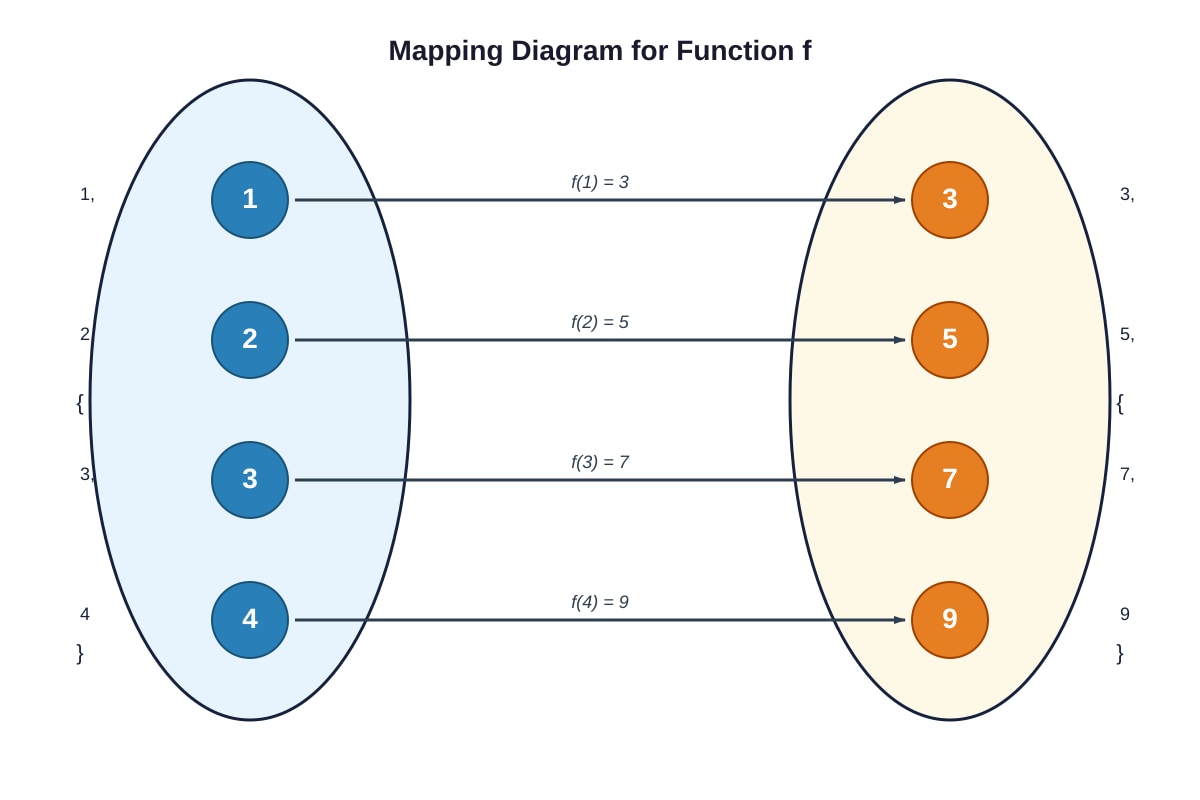
16. The diagram below shows a mapping diagram for a function ff.

<image_placeholder> id: Q16-fig1 type: diagram linked_question: Q16 description: Mapping diagram showing domain {1, 2, 3, 4} mapping to co-domain {3, 5, 7, 9} with arrows: 1→3, 2→5, 3→7, 4→9 labels: Domain: 1, 2, 3, 4; Co-domain: 3, 5, 7, 9; Arrows showing mapping values: f(1)=3, f(2)=5, f(3)=7, f(4)=9 must_show: Clear arrows from each domain element to its image; domain and co-domain sets labelled </image_placeholder>

(a) Write down the set of ordered pairs for this function.
[1]

(b) Express the function in the form f(x)=ax+bf(x) = ax + b.
[2]

(c) Find f(10)f(10).
[1]

Answers:
(a) ___________________________
(b) ___________________________
(c) ___________________________


Section C: Application and Problem Solving (Questions 17–20, 12 marks)

17. A rectangular garden has a length that is 3 m more than its width ww metres.

(a) Write a function A(w)A(w) for the area of the garden in terms of ww.
[1]

(b) If the area of the garden is 70 m², form an equation in ww and solve it to find the dimensions of the garden.
[3]

(c) Find the perimeter of the garden.
[1]

Answers:
(a) A(w)=A(w) = ___________________________
(b) ___________________________
(c) ___________________________

18. A taxi company charges a flag-down fare of 3.50forthefirstkilometreand3.50 for the first kilometre and 0.60 for each additional kilometre or part thereof.

(a) Write a function F(d)F(d) for the fare FF (in dollars) for a journey of dd kilometres, where d1d \geq 1 and dd is an integer.
[2]

(b) Calculate the fare for a journey of 8 km.
[1]

(c) A passenger pays $10.10. Find the distance travelled.
[2]

Answers:
(a) F(d)=F(d) = ___________________________
(b) ___________________________
(c) ___________________________

19. The function h(t)=5t2+20t+2h(t) = -5t^2 + 20t + 2 gives the height hh (in metres) of a ball thrown upwards tt seconds after release.

(a) Find the height of the ball at t=0t = 0. What does this represent?
[2]

(b) Find the height of the ball at t=2t = 2.
[1]

(c) Solve h(t)=22h(t) = 22 and interpret your answer.
[3]

Answers:
(a) ___________________________
(b) ___________________________
(c) ___________________________

20. A company's profit PP (in thousands of dollars) from selling xx hundred units of a product is given by P(x)=2x2+24x40P(x) = -2x^2 + 24x - 40.

(a) Find the profit when 500 units are sold.
[1]

(b) Find the number of units that must be sold to break even (profit = 0).
[3]

(c) What is the maximum profit, and how many units must be sold to achieve it?
[2]

Answers:
(a) ___________________________
(b) ___________________________
(c) ___________________________


End of Quiz

Answers

<!-- TuitionGoWhere generation metadata: stage=5-1; model=nvidia/nemotron-3-ultra-550b-a55b:free; model_label=NVIDIA Nemotron 3 Ultra 550B A55B Free; generated=2026-06-14; Sources: Stage 4-0 LLM templates, syllabus context, and Stage 2 evidence where available. -->

Secondary 1 Mathematics Quiz - Algebra Functions (Answer Key)

Total Marks: 50


Section A: Multiple Choice and Short Answer (Questions 1–10, 20 marks)

1. Given the function f(x)=3x5f(x) = 3x - 5, find f(4)f(4).
[1]

Answer: 77
Working: f(4)=3(4)5=125=7f(4) = 3(4) - 5 = 12 - 5 = 7
Marking Note: 1 mark for correct answer. Substitution must be shown or implied.

2. If g(x)=x2+2xg(x) = x^2 + 2x, evaluate g(3)g(-3).
[1]

Answer: 33
Working: g(3)=(3)2+2(3)=96=3g(-3) = (-3)^2 + 2(-3) = 9 - 6 = 3
Marking Note: 1 mark for correct answer. Common error: (3)2=9(-3)^2 = -9 (incorrect). Remind students that squaring a negative gives a positive.

3. The function hh is defined as h(x)=12xh(x) = \frac{12}{x} for x0x \neq 0. Find the value of h(4)h(4).
[1]

Answer: 33
Working: h(4)=124=3h(4) = \frac{12}{4} = 3
Marking Note: 1 mark for correct answer. Note the domain restriction x0x \neq 0.

4. A function pp is defined by p(x)=2x+7p(x) = 2x + 7. If p(k)=19p(k) = 19, find the value of kk.
[2]

Answer: k=6k = 6
Working:
2k+7=192k + 7 = 19
2k=122k = 12
k=6k = 6
Marking Note: 1 mark for setting up equation 2k+7=192k + 7 = 19, 1 mark for correct solution k=6k = 6.

5. The function q(x)=ax+bq(x) = ax + b passes through the points (1,5)(1, 5) and (3,11)(3, 11). Find the values of aa and bb.
[2]

Answer: a=3a = 3, b=2b = 2
Working:
Substitute (1,5)(1, 5): a(1)+b=5a+b=5a(1) + b = 5 \Rightarrow a + b = 5
Substitute (3,11)(3, 11): a(3)+b=113a+b=11a(3) + b = 11 \Rightarrow 3a + b = 11
Subtract: (3a+b)(a+b)=1152a=6a=3(3a + b) - (a + b) = 11 - 5 \Rightarrow 2a = 6 \Rightarrow a = 3
Substitute a=3a = 3 into a+b=5a + b = 5: 3+b=5b=23 + b = 5 \Rightarrow b = 2
Marking Note: 1 mark for correct aa, 1 mark for correct bb. Alternative: gradient m=11531=3m = \frac{11-5}{3-1} = 3, then y=3x+cy = 3x + c, substitute (1,5)(1,5) gives c=2c=2.

6. Given f(x)=42xf(x) = 4 - 2x, solve f(x)=10f(x) = 10.
[2]

Answer: x=3x = -3
Working:
42x=104 - 2x = 10
2x=6-2x = 6
x=3x = -3
Marking Note: 1 mark for setting up equation, 1 mark for correct solution. Common error: forgetting to reverse inequality sign (not applicable here, but watch for sign errors when dividing by negative).

7. The function C(d)=50+15dC(d) = 50 + 15d represents the cost CC (in dollars) of hiring a bicycle for dd days. Find the cost of hiring the bicycle for 7 days.
[2]

Answer: 155155
Working: C(7)=50+15(7)=50+105=155C(7) = 50 + 15(7) = 50 + 105 = 155
Marking Note: 1 mark for correct substitution, 1 mark for correct answer with units (dollars). The 50isafixedcost(deposit/basefee),50 is a fixed cost (deposit/base fee), 15 is the daily rate.

8. A function T(n)=3n+2T(n) = 3n + 2 gives the number of matchsticks needed to form a pattern with nn triangles. How many matchsticks are needed for 15 triangles?
[2]

Answer: 4747
Working: T(15)=3(15)+2=45+2=47T(15) = 3(15) + 2 = 45 + 2 = 47
Marking Note: 1 mark for substitution, 1 mark for answer. The +2+2 represents the starting matchsticks (e.g., 2 matchsticks for the first triangle's base), and each additional triangle adds 3 matchsticks.

9. The function V(r)=43πr3V(r) = \frac{4}{3}\pi r^3 gives the volume of a sphere of radius rr. If the radius is 3 cm, find the volume in terms of π\pi.
[2]

Answer: 36π cm336\pi \text{ cm}^3
Working: V(3)=43π(3)3=43π(27)=36πV(3) = \frac{4}{3}\pi (3)^3 = \frac{4}{3}\pi (27) = 36\pi
Marking Note: 1 mark for correct substitution and 33=273^3 = 27, 1 mark for simplification to 36π36\pi. Units cm3\text{cm}^3 required.

10. The table below shows some values of a linear function y=mx+cy = mx + c.

xx0246
yy371115

Find the values of mm and cc.
[2]

Answer: m=2m = 2, c=3c = 3
Working:
When x=0x = 0, y=3c=3y = 3 \Rightarrow c = 3 (y-intercept)
Gradient m=7320=42=2m = \frac{7 - 3}{2 - 0} = \frac{4}{2} = 2
Check: y=2x+3y = 2x + 3 gives x=4y=11x=4 \Rightarrow y=11, x=6y=15x=6 \Rightarrow y=15
Marking Note: 1 mark for c=3c = 3 (reading intercept from table), 1 mark for m=2m = 2 (calculating gradient). Common error: using wrong pair of points for gradient.


Section B: Structured Questions (Questions 11–16, 18 marks)

11. A function ff is defined by f(x)=2x23x+1f(x) = 2x^2 - 3x + 1.

(a) Find f(2)f(2).
[1]

Answer: 33
Working: f(2)=2(2)23(2)+1=2(4)6+1=86+1=3f(2) = 2(2)^2 - 3(2) + 1 = 2(4) - 6 + 1 = 8 - 6 + 1 = 3

(b) Find f(1)f(-1).
[1]

Answer: 66
Working: f(1)=2(1)23(1)+1=2(1)+3+1=2+3+1=6f(-1) = 2(-1)^2 - 3(-1) + 1 = 2(1) + 3 + 1 = 2 + 3 + 1 = 6
Marking Note: Common error: 2(1)2=22(-1)^2 = -2 (incorrect). Remind: (1)2=1(-1)^2 = 1, then 2×1=22 \times 1 = 2.

(c) Solve f(x)=3f(x) = 3.
[3]

Answer: x=1x = -1 or x=2.5x = 2.5
Working:
2x23x+1=32x^2 - 3x + 1 = 3
2x23x2=02x^2 - 3x - 2 = 0
(2x+1)(x2)=0(2x + 1)(x - 2) = 0
2x+1=0x=0.52x + 1 = 0 \Rightarrow x = -0.5
x2=0x=2x - 2 = 0 \Rightarrow x = 2
Wait, let me recheck:
2x23x+1=32x23x2=02x^2 - 3x + 1 = 3 \Rightarrow 2x^2 - 3x - 2 = 0
Using quadratic formula: x=3±94(2)(2)4=3±254=3±54x = \frac{3 \pm \sqrt{9 - 4(2)(-2)}}{4} = \frac{3 \pm \sqrt{25}}{4} = \frac{3 \pm 5}{4}
x=84=2x = \frac{8}{4} = 2 or x=24=0.5x = \frac{-2}{4} = -0.5
Correct Answer: x=2x = 2 or x=0.5x = -0.5
Marking Note: 1 mark for setting up quadratic equation 2x23x2=02x^2 - 3x - 2 = 0, 1 mark for correct factorisation/formula, 1 mark for both solutions. Accept x=2,12x = 2, -\frac{1}{2}.

12. The cost CC (in dollars) of printing nn T-shirts is given by the function C(n)=20+8nC(n) = 20 + 8n.

(a) State the fixed cost and the variable cost per T-shirt.
[2]

Answer: Fixed cost = 20,Variablecost=20, Variable cost = 8 per T-shirt
Marking Note: 1 mark each. Fixed cost is the constant term (cost when n=0n=0). Variable cost is the coefficient of nn.

(b) Find the cost of printing 50 T-shirts.
[1]

Answer: 420420
Working: C(50)=20+8(50)=20+400=420C(50) = 20 + 8(50) = 20 + 400 = 420

(c) If the total cost is $180, how many T-shirts were printed?
[2]

Answer: 2020
Working:
20+8n=18020 + 8n = 180
8n=1608n = 160
n=20n = 20
Marking Note: 1 mark for equation, 1 mark for solution. Check: nn must be integer (number of T-shirts).

13. A car rental company charges a flat fee of 30plus30 plus 0.50 per kilometre driven.

(a) Write a function C(k)C(k) for the total cost CC (in dollars) in terms of the distance kk (in km).
[1]

Answer: C(k)=30+0.5kC(k) = 30 + 0.5k or C(k)=30+12kC(k) = 30 + \frac{1}{2}k
Marking Note: 1 mark for correct function. 3030 is fixed, 0.5k0.5k is variable.

(b) Find the cost of driving 120 km.
[1]

Answer: 9090
Working: C(120)=30+0.5(120)=30+60=90C(120) = 30 + 0.5(120) = 30 + 60 = 90

(c) If a customer paid $85, how many kilometres did they drive?
[2]

Answer: 110 km110 \text{ km}
Working:
30+0.5k=8530 + 0.5k = 85
0.5k=550.5k = 55
k=110k = 110
Marking Note: 1 mark for equation, 1 mark for solution.

14. The function A(s)=s2A(s) = s^2 gives the area of a square of side length ss cm.

(a) Find A(5)A(5).
[1]

Answer: 25 cm225 \text{ cm}^2
Working: A(5)=52=25A(5) = 5^2 = 25

(b) If the area is 64 cm², find the side length.
[1]

Answer: 8 cm8 \text{ cm}
Working: s2=64s=64=8s^2 = 64 \Rightarrow s = \sqrt{64} = 8 (reject negative root as length > 0)
Marking Note: Must reject s=8s = -8 since side length cannot be negative.

(c) The side length of a square increases from 4 cm to 7 cm. Find the increase in area.
[2]

Answer: 33 cm233 \text{ cm}^2
Working:
Original area: A(4)=42=16 cm2A(4) = 4^2 = 16 \text{ cm}^2
New area: A(7)=72=49 cm2A(7) = 7^2 = 49 \text{ cm}^2
Increase: 4916=33 cm249 - 16 = 33 \text{ cm}^2
Marking Note: 1 mark for both areas, 1 mark for difference. Alternative: A(7)A(4)=4916=33A(7) - A(4) = 49 - 16 = 33.

15. A function P(t)=500(1.05)tP(t) = 500(1.05)^t models the population of a town tt years after 2020.

(a) What was the population in 2020?
[1]

Answer: 500500
Working: In 2020, t=0t = 0. P(0)=500(1.05)0=500(1)=500P(0) = 500(1.05)^0 = 500(1) = 500
Marking Note: 1 mark. Any number to the power 0 is 1.

(b) Find the population in 2023 (correct to the nearest whole number).
[2]

Answer: 579579
Working: 2023 is 3 years after 2020, so t=3t = 3.
P(3)=500(1.05)3=500(1.157625)=578.8125579P(3) = 500(1.05)^3 = 500(1.157625) = 578.8125 \approx 579
Marking Note: 1 mark for correct substitution t=3t=3, 1 mark for correct evaluation and rounding.

(c) Explain what the number 1.05 represents in this context.
[1]

Answer: The population grows by 5% each year (or the annual growth factor is 1.05, meaning a 5% increase per year).
Marking Note: 1 mark for correct interpretation. Must mention "5% increase" or "growth factor" and "per year".

16. The diagram below shows a mapping diagram for a function ff.

<image_placeholder> id: Q16-fig1 type: diagram linked_question: Q16 description: Mapping diagram showing domain {1, 2, 3, 4} mapping to co-domain {3, 5, 7, 9} with arrows: 1→3, 2→5, 3→7, 4→9 labels: Domain: 1, 2, 3, 4; Co-domain: 3, 5, 7, 9; Arrows showing mapping values: f(1)=3, f(2)=5, f(3)=7, f(4)=9 must_show: Clear arrows from each domain element to its image; domain and co-domain sets labelled </image_placeholder>

(a) Write down the set of ordered pairs for this function.
[1]

Answer: {(1,3),(2,5),(3,7),(4,9)}\{(1, 3), (2, 5), (3, 7), (4, 9)\}
Marking Note: 1 mark for correct set notation with all 4 pairs.

(b) Express the function in the form f(x)=ax+bf(x) = ax + b.
[2]

Answer: f(x)=2x+1f(x) = 2x + 1
Working:
The outputs increase by 2 each time (3, 5, 7, 9), so gradient a=2a = 2.
When x=1x = 1, f(1)=32(1)+b=3b=1f(1) = 3 \Rightarrow 2(1) + b = 3 \Rightarrow b = 1.
Check: f(2)=2(2)+1=5f(2) = 2(2) + 1 = 5 ✓, f(3)=7f(3) = 7 ✓, f(4)=9f(4) = 9
Marking Note: 1 mark for a=2a = 2, 1 mark for b=1b = 1. Can also use two points to find aa and bb.

(c) Find f(10)f(10).
[1]

Answer: 2121
Working: f(10)=2(10)+1=21f(10) = 2(10) + 1 = 21
Marking Note: 1 mark. Follow-through from (b) if their function is linear.


Section C: Application and Problem Solving (Questions 17–20, 12 marks)

17. A rectangular garden has a length that is 3 m more than its width ww metres.

(a) Write a function A(w)A(w) for the area of the garden in terms of ww.
[1]

Answer: A(w)=w(w+3)=w2+3wA(w) = w(w + 3) = w^2 + 3w
Marking Note: 1 mark. Length = w+3w + 3, Area = length × width = w(w+3)w(w+3).

(b) If the area of the garden is 70 m², form an equation in ww and solve it to find the dimensions of the garden.
[3]

Answer: Width = 7 m, Length = 10 m
Working:
w2+3w=70w^2 + 3w = 70
w2+3w70=0w^2 + 3w - 70 = 0
(w+10)(w7)=0(w + 10)(w - 7) = 0
w=10w = -10 (reject, width > 0) or w=7w = 7
Width = 7 m, Length = 7 + 3 = 10 m
Marking Note: 1 mark for quadratic equation, 1 mark for solving (factorisation or formula), 1 mark for correct dimensions with rejection of negative root and units.

(c) Find the perimeter of the garden.
[1]

Answer: 34 m34 \text{ m}
Working: Perimeter = 2(length+width)=2(10+7)=34 m2(\text{length} + \text{width}) = 2(10 + 7) = 34 \text{ m}
Marking Note: 1 mark. Follow-through from (b).

18. A taxi company charges a flag-down fare of 3.50forthefirstkilometreand3.50 for the first kilometre and 0.60 for each additional kilometre or part thereof.

(a) Write a function F(d)F(d) for the fare FF (in dollars) for a journey of dd kilometres, where d1d \geq 1 and dd is an integer.
[2]

Answer: F(d)=3.50+0.60(d1)F(d) = 3.50 + 0.60(d - 1) or F(d)=2.90+0.60dF(d) = 2.90 + 0.60d
Working: First km costs 3.50.Remaining3.50. Remaining (d-1)kmcostkm cost0.60 each.
F(d)=3.50+0.60(d1)=3.50+0.60d0.60=2.90+0.60dF(d) = 3.50 + 0.60(d - 1) = 3.50 + 0.60d - 0.60 = 2.90 + 0.60d
Marking Note: 1 mark for correct structure (flag-down + additional), 1 mark for simplified form. Must handle "first km" correctly.

(b) Calculate the fare for a journey of 8 km.
[1]

Answer: 7.707.70
Working: F(8)=3.50+0.60(7)=3.50+4.20=7.70F(8) = 3.50 + 0.60(7) = 3.50 + 4.20 = 7.70
Marking Note: 1 mark. 7 additional km after the first.

(c) A passenger pays $10.10. Find the distance travelled.
[2]

Answer: 13 km13 \text{ km}
Working:
3.50+0.60(d1)=10.103.50 + 0.60(d - 1) = 10.10
0.60(d1)=6.600.60(d - 1) = 6.60
d1=11d - 1 = 11
d=12d = 12
Wait, let me recalculate:
3.50+0.60(d1)=10.103.50 + 0.60(d-1) = 10.10
0.60(d1)=6.600.60(d-1) = 6.60
d1=11d-1 = 11
d=12d = 12
Correct Answer: 12 km12 \text{ km}
Marking Note: 1 mark for equation, 1 mark for solution. Check: 3.50+0.60(11)=3.50+6.60=10.103.50 + 0.60(11) = 3.50 + 6.60 = 10.10 ✓.

19. The function h(t)=5t2+20t+2h(t) = -5t^2 + 20t + 2 gives the height hh (in metres) of a ball thrown upwards tt seconds after release.

(a) Find the height of the ball at t=0t = 0. What does this represent?
[2]

Answer: Height = 2 m. This represents the initial height from which the ball is thrown (the height of the thrower's hand above ground).
Working: h(0)=5(0)2+20(0)+2=2h(0) = -5(0)^2 + 20(0) + 2 = 2
Marking Note: 1 mark for height, 1 mark for interpretation.

(b) Find the height of the ball at t=2t = 2.
[1]

Answer: 22 m22 \text{ m}
Working: h(2)=5(2)2+20(2)+2=5(4)+40+2=20+40+2=22h(2) = -5(2)^2 + 20(2) + 2 = -5(4) + 40 + 2 = -20 + 40 + 2 = 22
Marking Note: 1 mark.

(c) Solve h(t)=22h(t) = 22 and interpret your answer.
[3]

Answer: t=2t = 2 or t=2t = 2 (repeated root). The ball reaches 22 m at t=2t = 2 seconds (at its maximum height).
Working:
5t2+20t+2=22-5t^2 + 20t + 2 = 22
5t2+20t20=0-5t^2 + 20t - 20 = 0
Divide by -5: t24t+4=0t^2 - 4t + 4 = 0
(t2)2=0(t - 2)^2 = 0
t=2t = 2 (repeated root)
Interpretation: The ball reaches a height of 22 m only once, at t=2t = 2 seconds, which is its maximum height (vertex of the parabola).
Marking Note: 1 mark for equation, 1 mark for solving (showing repeated root), 1 mark for interpretation (maximum height / vertex). The discriminant is zero, indicating the line h=22h=22 is tangent to the parabola at its vertex.

20. A company's profit PP (in thousands of dollars) from selling xx hundred units of a product is given by P(x)=2x2+24x40P(x) = -2x^2 + 24x - 40.

(a) Find the profit when 500 units are sold.
[1]

Answer: 10 \text{ thousand dollars} = \10,000Working:500units=5hundredunits,so **Working:** 500 units = 5 hundred units, sox = 5.. P(5) = -2(5)^2 + 24(5) - 40 = -2(25) + 120 - 40 = -50 + 120 - 40 = 30Wait,recalculate: **Wait, recalculate:**-50 + 120 = 70,, 70 - 40 = 30.CorrectAnswer:. **Correct Answer:** 30 \text{ thousand dollars} = $30,000MarkingNote:1mark.Mustconvert500unitsto **Marking Note:** 1 mark. Must convert 500 units tox = 5$ (hundred units).

(b) Find the number of units that must be sold to break even (profit = 0).
[3]

Answer: 200 units or 1000 units
Working:
2x2+24x40=0-2x^2 + 24x - 40 = 0
Divide by -2: x212x+20=0x^2 - 12x + 20 = 0
(x2)(x10)=0(x - 2)(x - 10) = 0
x=2x = 2 or x=10x = 10
Since xx is in hundreds of units: 200 units or 1000 units.
Marking Note: 1 mark for equation, 1 mark for solving, 1 mark for correct units conversion (hundreds to units). Both break-even points required.

(c) What is the maximum profit, and how many units must be sold to achieve it?
[2]

Answer: Maximum profit = 32 \text{ thousand dollars} = \32,000at600units.Working:Thequadraticat 600 units. **Working:** The quadraticP(x) = -2x^2 + 24x - 40hasamaximumatitsvertex.has a maximum at its vertex. xcoordinateofvertex:-coordinate of vertex: x = -\frac{b}{2a} = -\frac{24}{2(-2)} = \frac{24}{4} = 6Maximumprofit: Maximum profit:P(6) = -2(6)^2 + 24(6) - 40 = -2(36) + 144 - 40 = -72 + 144 - 40 = 32 x = 6hundredunits=600units.MarkingNote:1markforfindinghundred units = 600 units. **Marking Note:** 1 mark for findingx = 6(vertex),1markformaximumprofitvalueandunitsconversion.Alternative:completethesquare(vertex), 1 mark for maximum profit value and units conversion. Alternative: complete the squareP(x) = -2(x-6)^2 + 32$.


End of Answer Key