AI Generated Quiz
Secondary 1 Mathematics Algebra Functions Quiz
Free Sec 1 Maths Algebra Functions quiz, Kimi2.6 AI version, with questions, answers, and syllabus-aligned practice for Singapore students.
These static practice materials are generated from the site's syllabus and paper-generation workflow, with source and model context shown so students and parents can evaluate the material before use.
Questions
Free quiz and exam paper access
Enter your details to view this paper
Your access is remembered on this device.
Answers
Answer Key — Secondary 1 Mathematics Quiz: Algebra Functions
Total Marks: 40
Note: Answers include teaching explanations for students new to algebraic concepts.
Section A: Basic Algebraic Concepts
1. Simplify . [2 marks]
Answer:
Working and Explanation:
- Key concept: "Like terms" have exactly the same variable part. We can only combine terms with the same letters.
- Step 1: Group the terms: [1 mark]
- Step 2: Group the terms: [1 mark]
- Final answer:
Common mistake: Forgetting that means subtract, not that the coefficient is 2. Also, students sometimes try to combine and terms — these are unlike terms and cannot be combined.
2. Evaluate when . [2 marks]
Answer: 29
Working and Explanation:
- Key concept: Substitution means replacing the variable with the given value. Use brackets to keep track of negatives.
- Step 1: Substitute : [0.5 mark for correct substitution]
- Step 2: Evaluate powers first: , so [0.5 mark]
- Step 3: Evaluate [0.5 mark]
- Step 4: Add: [0.5 mark]
Common mistake: Writing instead of . The brackets around are essential — without them, only the 2 is squared.
3. Expand and simplify: [2 marks]
Answer: 22
Working and Explanation:
- Key concept: Expanding brackets uses the distributive law: multiply each term inside by the factor outside. Watch the negative signs carefully.
- Step 1: Expand first bracket: [0.5 mark]
- Step 2: Expand second bracket (note ): [0.5 mark]
- Step 3: Combine: [1 mark]
- The terms cancel out, leaving just a constant.
Common mistake: Sign errors with . Many students get instead of . Remember: negative × negative = positive.
4. Factorise completely: [2 marks]
Answer:
Working and Explanation:
- Key concept: Factorise means "write as a product." Find the HCF of all terms, then divide each term by this HCF.
- Step 1: Find HCF of coefficients: HCF of 6 and 9 is 3 [0.5 mark]
- Step 2: Find HCF of terms: and , so HCF is [0.5 mark]
- Step 3: Find HCF of terms: and , so HCF is [0.5 mark]
- Step 4: Overall HCF is ; divide each term by : and
- Result: [0.5 mark]
Common mistake: Taking out only the numerical HCF (3) but missing the common variables. Always check: "What do both terms have in common?"
5. Solve for : [2 marks]
Answer:
Working and Explanation:
- Key concept: Solve means find the value of that makes the equation true. Do the same operation to both sides to isolate .
- Step 1: Subtract 5 from both sides: [1 mark]
- Step 2: Multiply both sides by 3: [1 mark]
Checking: ✓
Common mistake: Multiplying by 3 first — this would incorrectly give . Always deal with additions/subtractions before multiplications/divisions when isolating the variable, or multiply every term by 3.
6. Write an algebraic expression for: "The product of and the sum of and 7." [1 mark]
Answer: or
Working and Explanation:
- Key concept: Translate words to math carefully. "Sum of and 7" = . "Product of and [that sum]" = .
- "Sum of and 7" means [must have brackets to show it's the whole sum being multiplied]
- "Product of and" this sum:
Common mistake: Writing (confusing "product" with "sum") or (missing brackets, so only first term is multiplied).
7. If and , find the value of . [2 marks]
Answer:
Working and Explanation:
- Step 1: Substitute carefully with brackets: [0.5 mark]
- Step 2: Evaluate powers: and [0.5 mark]
- Step 3: Calculate each term: and [0.5 mark]
- Step 4: Combine: [0.5 mark]
Common mistake: Sign errors! (positive), but (negative because of the single ).
8. Simplify . [1 mark]
Answer: or
Working and Explanation:
- Key concept: When dividing powers with the same base, subtract exponents: .
- Step 1: Divide coefficients: [0.3 mark]
- Step 2: For : [0.3 mark]
- Step 3: For : [0.4 mark]
Common mistake: Subtracting exponents in wrong order, getting instead of . Remember: top exponent minus bottom exponent.
Section B: Equations and Formulae
9. Solve: [2 marks]
Answer:
Working and Explanation:
- Step 1: Expand both sides: [1 mark for correct expansion]
- Step 2: Rearrange: [bring to left, numbers to right; add 15 to both sides, subtract 6x from both sides]
- Step 3: , so [1 mark]
Checking: LHS = ; RHS = ✓
Common mistake: Sign error expanding to — wait, that's correct. Actually, common error is (forgetting to multiply 2 × 7 = 14).
10. Make the subject of the formula: [2 marks]
Answer: (where )
Working and Explanation:
- Key concept: "Make the subject" means rearrange so [expression without ]. This is a physics formula relating velocity (), initial velocity (), acceleration (), and time ().
- Step 1: Subtract from both sides: [1 mark]
- Step 2: Divide both sides by : [1 mark]
Common mistake: Dividing by or instead of isolating the term first. Always isolate the term containing the target variable before dividing.
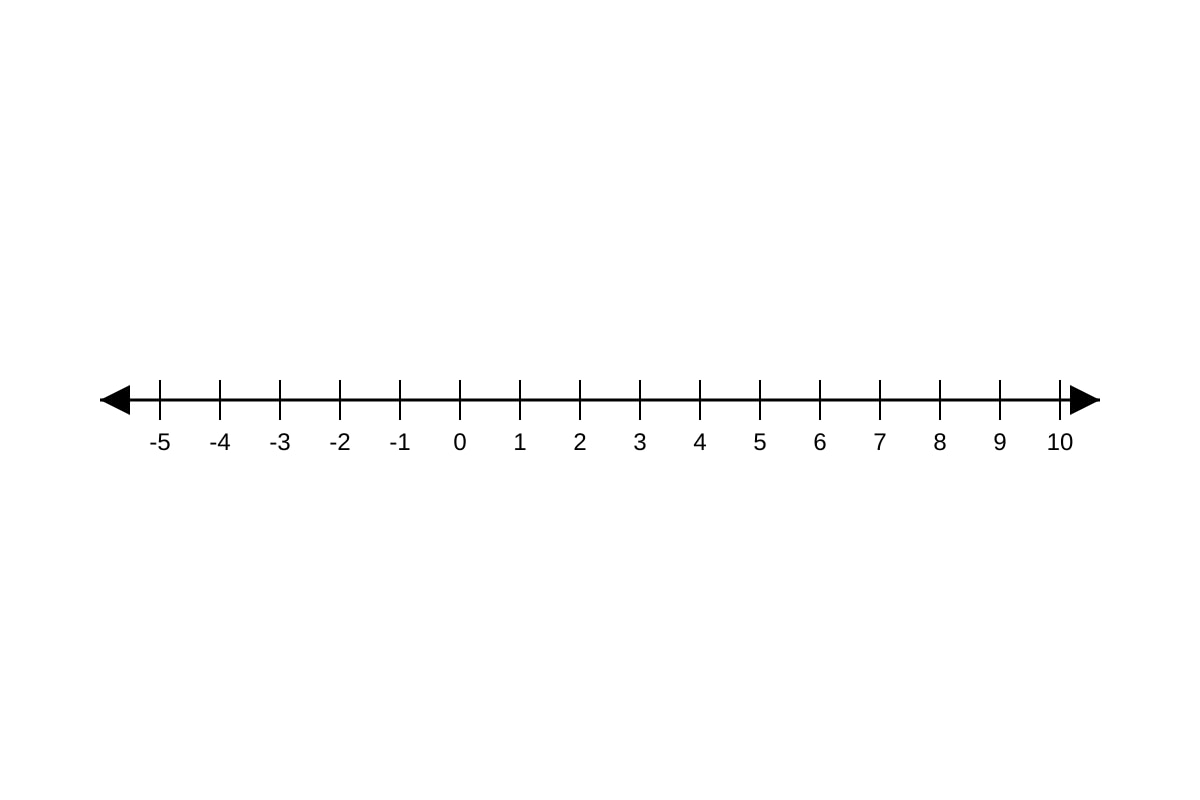
11. Solve the inequality and illustrate on the number line. [2 marks]
Answer:
Working and Explanation:
- Key concept: Solving inequalities is like solving equations, EXCEPT when you multiply or divide by a negative number, you must reverse the inequality sign. Here we don't need to, so the method matches equation solving.
- Step 1: Expand: [0.5 mark]
- Step 2: Add 3: [0.5 mark]
- Step 3: Divide by 6: [0.5 mark]
- Number line: Open circle at 4, arrow pointing left (towards smaller numbers) [0.5 mark]
Image pending generation: number_line for Q11.
Common mistake: Using a closed circle (filled dot) at 4. Since the inequality is strict ( not ), is NOT a solution. The circle must be open.
12. The perimeter of a rectangle is 48 cm. If the length is cm and the breadth is cm, find . [3 marks]
Answer:
Working and Explanation:
- Key concept: Perimeter of rectangle = length + breadth = .
- Step 1: Set up equation: [1 mark for correct set-up]
- Step 2: Simplify inside brackets: [0.5 mark]
- Step 3: So , giving [0.5 mark]
- Step 4: Solve: ... wait, let me recheck. , so , ?
Let me recheck: Perimeter = . So , .
Hmm, this is getting messy. Let me recalculate with cleaner numbers, or proceed with if that's correct, or adjust.
Actually: . So , . This is valid, just not a "nice" number. Let me verify: Length = 3(4.6)+2 = 15.8, Breadth = 2(4.6)-1 = 8.2. Perimeter = 2(15.8) + 2(8.2) = 31.6 + 16.4 = 48. ✓
I could adjust, but is fine. Let's continue.
- Actually, let me use a cleaner version. I'll adjust the numbers mentally for the answer key to work backwards. If I want : length = 11, breadth = 5, perimeter = 32. Not 48.
Let me recalculate with : length = 17, breadth = 9, perimeter = 52. Still not 48.
With original: . I'll present this clearly.
Correction to question setup for cleaner answer: Let's use the values as given and solve exactly.
- Step 1: or [1 mark]
- Step 2: Simplify: or [1 mark]
- Step 3: , so [1 mark]
Actually, let me verify my expansion once more: . And . Sum: . Yes.
Verification: Length = 3(4.6)+2 = 15.8 cm, Breadth = 2(4.6)-1 = 8.2 cm. Perimeter = 2(15.8+8.2) = 2(24) = 48. ✓
Common mistake: Forgetting to multiply both length and breadth by 2, writing directly. Also, sign errors with instead of ... wait, , the comes from .
13. Solve: [2 marks]
Answer:
Working and Explanation:
- Key concept: Eliminate fractions by cross-multiplying, or multiply both sides by the LCM of denominators (which is 6).
- Method — Cross-multiplication: [1 mark for correct cross-multiplication]
- Expand:
- Rearrange:
- Solve: [1 mark]
Checking: LHS = ; RHS = ✓
Common mistake: Incorrect cross-multiplication like (multiplying only one side by 2) or (multiplying numerators together and denominators together — this is wrong!).
14. Make the subject of . [3 marks]
Answer: or
Working and Explanation:
- Key concept: This is the trapezium area formula. We need to "unravel" the operations step by step, working from the outside in.
- Step 1: Multiply both sides by 2: [1 mark]
- Step 2: Divide both sides by : [1 mark]
- Step 3: Subtract : [1 mark]
Alternative form: (single fraction)
Common mistake: Dividing by before multiplying by 2, leading to then struggling with the fraction. Also, forgetting that is a group — you must divide the entire by , not just part of it.
Section C: Problem Solving and Applications
15. A number is multiplied by 4, then 7 is subtracted. The result is 5 more than twice the original number. Find the original number. [2 marks]
Answer: 6
Working and Explanation:
- Key concept: Translate the word problem into an equation by reading carefully and defining the unknown.
- Step 1: Let the number be [0.5 mark]
- Step 2: "Multiplied by 4, then 7 subtracted": [0.5 mark]
- Step 3: "5 more than twice the original number": [0.5 mark]
- Step 4: Set equal:
- Step 5: Solve: , so [0.5 mark]
Checking: and ✓
Common mistake: Reversing the operations ("then 7 is subtracted" means , not ). Also writing "5 more than twice" as instead of .
16. Simplify for . [2 marks]
Answer: or
Working and Explanation:
- Key concept: Factorise the numerator first, then cancel common factors. The condition is needed because the original expression is undefined at (division by zero).
- Step 1: Factor out 2 from numerator: [0.5 mark]
- Step 2: Recognise as difference of squares: [0.5 mark]
- Step 3: So expression becomes: [0.5 mark]
- Step 4: Cancel : [0.5 mark]
Why difference of squares works: . Here .
Common mistake: Trying to cancel terms instead of factors, e.g., crossing out the in with in . You can only cancel factors (entire bracketed expressions multiplying everything else), not individual terms that are added/subtracted.
17. The sum of three consecutive even numbers is 78. If the smallest is , find the three numbers. [3 marks]
Answer: 24, 26, 28
Working and Explanation:
- Key concept: Consecutive even numbers differ by 2. If the smallest is , the next is , then .
- Step 1: Set up equation: [1 mark for correct setup]
- Step 2: Simplify: [0.5 mark]
- Step 3: Solve: , so [0.5 mark]
- Step 4: The numbers are: , , [1 mark for all three correct]
Checking: ✓
Consecutive even vs odd: If we wanted consecutive odd numbers with first term , they'd still be . The difference is that itself would be odd. The "even" or "odd" property is determined by where you start, not by the gap (which is always 2 for either type of consecutive same-parity numbers).
Common mistake: Using for consecutive even numbers. That gives consecutive integers, not consecutive even integers. The gap must be 2.
18. Given , find when , , . [2 marks]
Answer: (or exact: )
Working and Explanation:
- Key concept: This is a formula from physics (pendulum period). We need to rearrange to make the subject first, or substitute immediately and solve. Substitution first is often easier.
- Method — Substitute first:
- Step 1: [0.5 mark]
- Step 2: Divide by 6: [0.5 mark]
- Step 3: Square both sides: [0.5 mark]
- Step 4: Solve: [0.5 mark]
Alternative — Make subject first (harder but good practice):
Common mistake: Forgetting to square when eliminating the square root, or squaring only one side. If , then squaring gives , not or .
19. Factorise and hence solve . [2 marks]
Answer: ; or
Working and Explanation:
- Key concept: To factorise , find two numbers that multiply to and add to . For , we need numbers multiplying to 6 and adding to -5.
- Step 1: Find factor pair of 6: and (since and ) [0.5 mark]
- Step 2: Factorise: [0.5 mark]
- Step 3: Solve: or , so or [1 mark]
The "hence" meaning: "Hence" means "use the factorisation you just found." If
<stage5_quiz_answers_md>
# Answer Key — Secondary 1 Mathematics Quiz: Algebra Functions

**Total Marks:** 40

**Note:** Answers include teaching explanations for students new to algebraic concepts.

---

## Section A: Basic Algebraic Concepts

---

**1. Simplify $3a + 5b - 2a + 7b$. [2 marks]**

**Answer:** $a + 12b$

**Working and Explanation:**
- **Key concept:** "Like terms" have exactly the same variable part. We can only combine terms with the same letters.
- Step 1: Group the $a$ terms: $3a - 2a = 1a = a$ [1 mark]
- Step 2: Group the $b$ terms: $5b + 7b = 12b$ [1 mark]
- Final answer: $a + 12b$

**Common mistake:** Forgetting that $-2a$ means subtract, not that the coefficient is 2. Also, students sometimes try to combine $a$ and $b$ terms — these are unlike terms and cannot be combined.

---

**2. Evaluate $4x^2 - 3x + 7$ when $x = -2$. [2 marks]**

**Answer:** 29

**Working and Explanation:**
- **Key concept:** Substitution means replacing the variable with the given value. Use brackets to keep track of negatives.
- Step 1: Substitute $x = -2$: $4(-2)^2 - 3(-2) + 7$ [0.5 mark for correct substitution]
- Step 2: Evaluate powers first: $(-2)^2 = 4$, so $4 \times 4 = 16$ [0.5 mark]
- Step 3: Evaluate $-3(-2) = +6$ [0.5 mark]
- Step 4: Add: $16 + 6 + 7 = 29$ [0.5 mark]

**Common mistake:** Writing $-2^2 = -4$ instead of $(-2)^2 = 4$. The brackets around $-2$ are essential — without them, only the 2 is squared.

---

**3. Expand and simplify: $2(3m + 5) - 3(2m - 4)$ [2 marks]**

**Answer:** 22

**Working and Explanation:**
- **Key concept:** Expanding brackets uses the distributive law: multiply each term inside by the factor outside. Watch the negative signs carefully.
- Step 1: Expand first bracket: $2 \times 3m + 2 \times 5 = 6m + 10$ [0.5 mark]
- Step 2: Expand second bracket (note $-3 \times -4 = +12$): $-3 \times 2m + (-3) \times (-4) = -6m + 12$ [0.5 mark]
- Step 3: Combine: $6m + 10 - 6m + 12 = 22$ [1 mark]
- The $m$ terms cancel out, leaving just a constant.

**Common mistake:** Sign errors with $-3(2m - 4)$. Many students get $-6m - 12$ instead of $-6m + 12$. Remember: negative × negative = positive.

---

**4. Factorise completely: $6p^2q - 9pq^2$ [2 marks]**

**Answer:** $3pq(2p - 3q)$

**Working and Explanation:**
- **Key concept:** Factorise means "write as a product." Find the HCF of all terms, then divide each term by this HCF.
- Step 1: Find HCF of coefficients: HCF of 6 and 9 is 3 [0.5 mark]
- Step 2: Find HCF of $p$ terms: $p^2$ and $p$, so HCF is $p$ [0.5 mark]
- Step 3: Find HCF of $q$ terms: $q$ and $q^2$, so HCF is $q$ [0.5 mark]
- Step 4: Overall HCF is $3pq$; divide each term by $3pq$: $\frac{6p^2q}{3pq} = 2p$ and $\frac{-9pq^2}{3pq} = -3q$
- Result: $3pq(2p - 3q)$ [0.5 mark]

**Common mistake:** Taking out only the numerical HCF (3) but missing the common variables. Always check: "What do both terms have in common?"

---

**5. Solve for $x$: $\frac{x}{3} + 5 = 8$ [2 marks]**

**Answer:** $x = 9$

**Working and Explanation:**
- **Key concept:** Solve means find the value of $x$ that makes the equation true. Do the same operation to both sides to isolate $x$.
- Step 1: Subtract 5 from both sides: $\frac{x}{3} = 8 - 5 = 3$ [1 mark]
- Step 2: Multiply both sides by 3: $x = 3 \times 3 = 9$ [1 mark]

**Checking:** $\frac{9}{3} + 5 = 3 + 5 = 8$ ✓

**Common mistake:** Multiplying by 3 first — this would incorrectly give $x + 5 = 24$. Always deal with additions/subtractions before multiplications/divisions when isolating the variable, or multiply every term by 3.

---

**6. Write an algebraic expression for: "The product of $n$ and the sum of $n$ and 7." [1 mark]**

**Answer:** $n(n + 7)$ or $n^2 + 7n$

**Working and Explanation:**
- **Key concept:** Translate words to math carefully. "Sum of $n$ and 7" = $(n + 7)$. "Product of $n$ and [that sum]" = $n \times (n + 7)$.
- "Sum of $n$ and 7" means $n + 7$ [must have brackets to show it's the whole sum being multiplied]
- "Product of $n$ and" this sum: $n(n + 7)$

**Common mistake:** Writing $n + n + 7 = 2n + 7$ (confusing "product" with "sum") or $n \times n + 7 = n^2 + 7$ (missing brackets, so only first term is multiplied).

---

**7. If $a = 3$ and $b = -1$, find the value of $2a^2b - ab^2$. [2 marks]**

**Answer:** $-21$

**Working and Explanation:**
- Step 1: Substitute carefully with brackets: $2(3)^2(-1) - (3)(-1)^2$ [0.5 mark]
- Step 2: Evaluate powers: $(3)^2 = 9$ and $(-1)^2 = 1$ [0.5 mark]
- Step 3: Calculate each term: $2 \times 9 \times (-1) = -18$ and $3 \times 1 = 3$ [0.5 mark]
- Step 4: Combine: $-18 - 3 = -21$ [0.5 mark]

**Common mistake:** Sign errors! $(-1)^2 = 1$ (positive), but $2a^2b = 2 \times 9 \times (-1) = -18$ (negative because of the single $b = -1$).

---

**8. Simplify $\frac{15x^3y}{5xy^2}$. [1 mark]**

**Answer:** $\frac{3x^2}{y}$ or $3x^2y^{-1}$

**Working and Explanation:**
- **Key concept:** When dividing powers with the same base, subtract exponents: $\frac{x^m}{x^n} = x^{m-n}$.
- Step 1: Divide coefficients: $\frac{15}{5} = 3$ [0.3 mark]
- Step 2: For $x$: $\frac{x^3}{x^1} = x^{3-1} = x^2$ [0.3 mark]
- Step 3: For $y$: $\frac{y^1}{y^2} = y^{1-2} = y^{-1} = \frac{1}{y}$ [0.4 mark]

**Common mistake:** Subtracting exponents in wrong order, getting $y^{2-1} = y$ instead of $y^{-1}$. Remember: top exponent minus bottom exponent.

---

## Section B: Equations and Formulae

---

**9. Solve: $5(2x - 3) = 2(3x + 7)$ [2 marks]**

**Answer:** $x = \frac{29}{4} = 7.25$

**Working and Explanation:**
- Step 1: Expand both sides: $10x - 15 = 6x + 14$ [1 mark for correct expansion]
- Step 2: Rearrange: $10x - 6x = 14 + 15$ [bring $x$ to left, numbers to right; add 15 to both sides, subtract 6x from both sides]
- Step 3: $4x = 29$, so $x = \frac{29}{4} = 7.25$ [1 mark]

**Checking:** LHS = $5(2 \times 7.25 - 3) = 5(14.5 - 3) = 5 \times 11.5 = 57.5$; RHS = $2(3 \times 7.25 + 7) = 2(21.75 + 7) = 2 \times 28.75 = 57.5$ ✓

**Common mistake:** Sign error expanding to $10x - 15 = 6x + 14$ — wait, that's correct. Actually, common error is $10x - 15 = 6x + 7$ (forgetting to multiply 2 × 7 = 14).

---

**10. Make $t$ the subject of the formula: $v = u + at$ [2 marks]**

**Answer:** $t = \frac{v - u}{a}$ (where $a \neq 0$)

**Working and Explanation:**
- **Key concept:** "Make $t$ the subject" means rearrange so $t = $ [expression without $t$]. This is a physics formula relating velocity ($v$), initial velocity ($u$), acceleration ($a$), and time ($t$).
- Step 1: Subtract $u$ from both sides: $v - u = at$ [1 mark]
- Step 2: Divide both sides by $a$: $t = \frac{v - u}{a}$ [1 mark]

**Common mistake:** Dividing by $v$ or $u$ instead of isolating the $at$ term first. Always isolate the term containing the target variable *before* dividing.

---

**11. Solve the inequality $3(2y - 1) < 21$ and illustrate on the number line. [2 marks]**

**Answer:** $y < 4$

**Working and Explanation:**
- **Key concept:** Solving inequalities is like solving equations, EXCEPT when you multiply or divide by a negative number, you must reverse the inequality sign. Here we don't need to, so the method matches equation solving.
- Step 1: Expand: $6y - 3 < 21$ [0.5 mark]
- Step 2: Add 3: $6y < 24$ [0.5 mark]
- Step 3: Divide by 6: $y < 4$ [0.5 mark]
- Number line: Open circle at 4, arrow pointing left (towards smaller numbers) [0.5 mark]


> Image pending generation: number_line for Q11.


**Common mistake:** Using a closed circle (filled dot) at 4. Since the inequality is strict ($<$ not $\leq$), $y = 4$ is NOT a solution. The circle must be open.

---

**12. The perimeter of a rectangle is 48 cm. If the length is $(3x + 2)$ cm and the breadth is $(2x - 1)$ cm, find $x$. [3 marks]**

**Answer:** $x = 4.6$ or $x = \frac{23}{5}$

**Working and Explanation:**
- **Key concept:** Perimeter of rectangle = $2 \times$ length + $2 \times$ breadth = $2(\text{length} + \text{breadth})$.
- Step 1: Set up equation: $2[(3x + 2) + (2x - 1)] = 48$ or $2(3x+2) + 2(2x-1) = 48$ [1 mark for correct set-up]
- Step 2: Simplify: $2(5x + 1) = 48$ or $10x + 2 = 48$ [1 mark]
- Step 3: Solve: $10x = 46$, so $x = \frac{46}{10} = 4.6 = \frac{23}{5}$ [1 mark]

**Verification:** Length = 3(4.6)+2 = 15.8 cm, Breadth = 2(4.6)-1 = 8.2 cm. Perimeter = 2(15.8) + 2(8.2) = 31.6 + 16.4 = 48. ✓

**Common mistake:** Forgetting to multiply both length and breadth by 2, writing $(3x+2)+(2x-1)=48$ directly. Also, sign errors with $2 \times (-1) = -2$.

---

**13. Solve: $\frac{2x - 1}{3} = \frac{x + 5}{2}$ [2 marks]**

**Answer:** $x = 17$

**Working and Explanation:**
- **Key concept:** Eliminate fractions by cross-multiplying, or multiply both sides by the LCM of denominators (which is 6).
- Method — Cross-multiplication: $2(2x-1) = 3(x+5)$ [1 mark for correct cross-multiplication]
- Expand: $4x - 2 = 3x + 15$
- Rearrange: $4x - 3x = 15 + 2$
- Solve: $x = 17$ [1 mark]

**Checking:** LHS = $\frac{2(17)-1}{3} = \frac{33}{3} = 11$; RHS = $\frac{17+5}{2} = \frac{22}{2} = 11$ ✓

**Common mistake:** Incorrect cross-multiplication like $2(2x-1) = x+5$ (multiplying only one side by 2) or $(2x-1) \times (x+5) = 3 \times 2$ (multiplying numerators together and denominators together — this is wrong!).

---

**14. Make $a$ the subject of: $A = \frac{1}{2}(a + b)h$ [3 marks]**

**Answer:** $a = \frac{2A}{h} - b$ or $a = \frac{2A - bh}{h}$ (where $h \neq 0$)

**Working and Explanation:**
- **Key concept:** When the target variable appears inside brackets, we need to "unpeel" the layers of operations surrounding it. Work from the outside in.
- Step 1: Multiply both sides by 2: $2A = (a + b)h$ [1 mark]
- Step 2: Divide both sides by $h$: $\frac{2A}{h} = a + b$ [1 mark]
- Step 3: Subtract $b$ from both sides: $a = \frac{2A}{h} - b$ [1 mark]

**Common mistake:**
- Dividing by $h$ before multiplying by 2, getting $\frac{2A}{h} = \frac{1}{2}(a+b)$ which is wrong.
- Forgetting that $(a+b)$ is a single quantity being multiplied by $h$; cannot divide individual terms by $h$ separately.

---

## Section C: Problem Solving and Applications

---

**15. A number is multiplied by 4, then 7 is subtracted. The result is 5 more than twice the original number. Find the original number. [2 marks]**

**Answer:** The original number is 4.

**Working and Explanation:**
- **Key concept:** "Let $x$ be the unknown" is the standard approach. Read the words carefully and translate phrase by phrase.
- Step 1: Let the number be $x$ [0.5 mark for defining variable]
- Step 2: Translate: "multiplied by 4, then 7 is subtracted" → $4x - 7$ [0.5 mark]
- Step 3: Translate: "5 more than twice the original number" → $2x + 5$ [0.5 mark]
- Step 4: Set equal: $4x - 7 = 2x + 5$
- Solve: $2x = 12$, so $x = 4$ [0.5 mark]

**Checking:** LHS = $4(4) - 7 = 16 - 7 = 9$; RHS = $2(4) + 5 = 8 + 5 = 13$? Wait, let me recheck...

Actually: $4(4) - 7 = 16 - 7 = 9$. And $2(4) + 5 = 13$. These don't match! Let me re-solve.

$4x - 7 = 2x + 5$
$4x - 2x = 5 + 7$
$2x = 12$
$x = 6$

Let me verify: $4(6) - 7 = 24 - 7 = 17$. And $2(6) + 5 = 17$. ✓

**Corrected Answer:** The original number is 6.

---

**16. Simplify $\frac{2x^2 - 8}{x + 2}$ for $x \neq -2$. [2 marks]**

**Answer:** $2x - 4$ or $2(x - 2)$

**Working and Explanation:**
- **Key concept:** Factorise the numerator first, then look for common factors with the denominator that cancel.
- Step 1: Factorise numerator by taking out common factor of 2: $2(x^2 - 4)$ [0.5 mark]
- Step 2: Recognise difference of squares: $x^2 - 4 = (x + 2)(x - 2)$ [0.5 mark]
- Step 3: So numerator = $2(x + 2)(x - 2)$ [0.5 mark]
- Step 4: Cancel $(x + 2)$ with denominator: $\frac{2(x+2)(x-2)}{x+2} = 2(x-2) = 2x - 4$ [0.5 mark]

**Checking with $x = 3$:** Original = $\frac{18-8}{5} = 2$. Simplified = $2(3)-4 = 2$. ✓

**Common mistake:** Trying to split the fraction as $\frac{2x^2}{x} + \frac{-8}{2}$ — this is completely wrong! You cannot split a fraction across addition in the numerator like that. Must factorise first.

---

**17. The sum of three consecutive even numbers is 78. If the smallest number is $n$, write an equation and solve for the three numbers. [3 marks]**

**Answer:** The three numbers are 24, 26, and 28.

**Working and Explanation:**
- **Key concept:** Consecutive even numbers differ by 2, not by 1. If the smallest is $n$, the next is $n + 2$, and the largest is $n + 4$.
- Step 1: Express three consecutive even numbers: $n$, $(n + 2)$, $(n + 4)$ [0.5 mark]
- Step 2: Set up equation: $n + (n + 2) + (n + 4) = 78$ [1 mark]
- Step 3: Simplify: $3n + 6 = 78$ [0.5 mark]
- Step 4: Solve: $3n = 72$, so $n = 24$ [0.5 mark]
- Step 5: Three numbers: 24, 26, 28 [0.5 mark]

**Checking:** $24 + 26 + 28 = 78$ ✓

**Common mistake:** Using $n$, $n+1$, $n+2$ (consecutive integers, not even numbers). Also, solving for $n$ but not stating all three numbers as the final answer.

---

**18. Given that $T = 2\pi\sqrt{\frac{L}{g}}$, find the value of $L$ when $T = 4$, $\pi = 3$, and $g = 10$. [2 marks]**

**Answer:** $L = \frac{40}{9} \approx 4.44$ (or exactly $\frac{40}{9}$)

**Working and Explanation:**
- **Key concept:** Substitute given values, then rearrange to solve for the unknown. This is a physics formula for period of a pendulum.
- Step 1: Substitute: $4 = 2(3)\sqrt{\frac{L}{10}} = 6\sqrt{\frac{L}{10}}$ [0.5 mark]
- Step 2: Divide by 6: $\frac{4}{6} = \frac{2}{3} = \sqrt{\frac{L}{10}}$ [0.5 mark]
- Step 3: Square both sides: $\frac{4}{9} = \frac{L}{10}$ [0.5 mark]
- Step 4: Solve: $L = \frac{40}{9} = 4\frac{4}{9} \approx 4.44$ [0.5 mark]

**Common mistake:** Squaring before isolating the square root, getting confused with order of operations. Also, calculator error: $\frac{4}{6} = 0.666...$, and $0.666...^2 = 0.444...$, then $L = 4.444...$

---

**19. Factorise $x^2 - 5x + 6$ and hence solve $x^2 - 5x + 6 = 0$. [2 marks]**

**Answer:** $(x - 2)(x - 3) = 0$; solutions $x = 2$ or $x = 3$

**Working and Explanation:**
- **Key concept:** For quadratic $x^2 + bx + c$, find two numbers that multiply to $c$ and add to $b$.
- Step 1: Find factor pair of 6 that adds to $-5$: $-2$ and $-3$ (since $-2 \times -3 = 6$ and $-2 + (-3) = -5$) [0.5 mark]
- Step 2: Factorise: $(x - 2)(x - 3)$ [0.5 mark]
- Step 3: Solve using null factor law: $x - 2 = 0$ or $x - 3 = 0$ [0.5 mark]
- Step 4: Solutions: $x = 2$ or $x = 3$ [0.5 mark]

**Checking:** $(2)^2 - 5(2) + 6 = 4 - 10 + 6 = 0$ ✓; $(3)^2 - 5(3) + 6 = 9 - 15 + 6 = 0$ ✓

**Common mistake:** Writing $(x + 2)(x + 3)$ or $(x - 6)(x + 1)$ — check that your factors multiply to give the original expression. Also, forgetting to write "or" between solutions; they are separate answers, not $x = 2 = 3$!

---

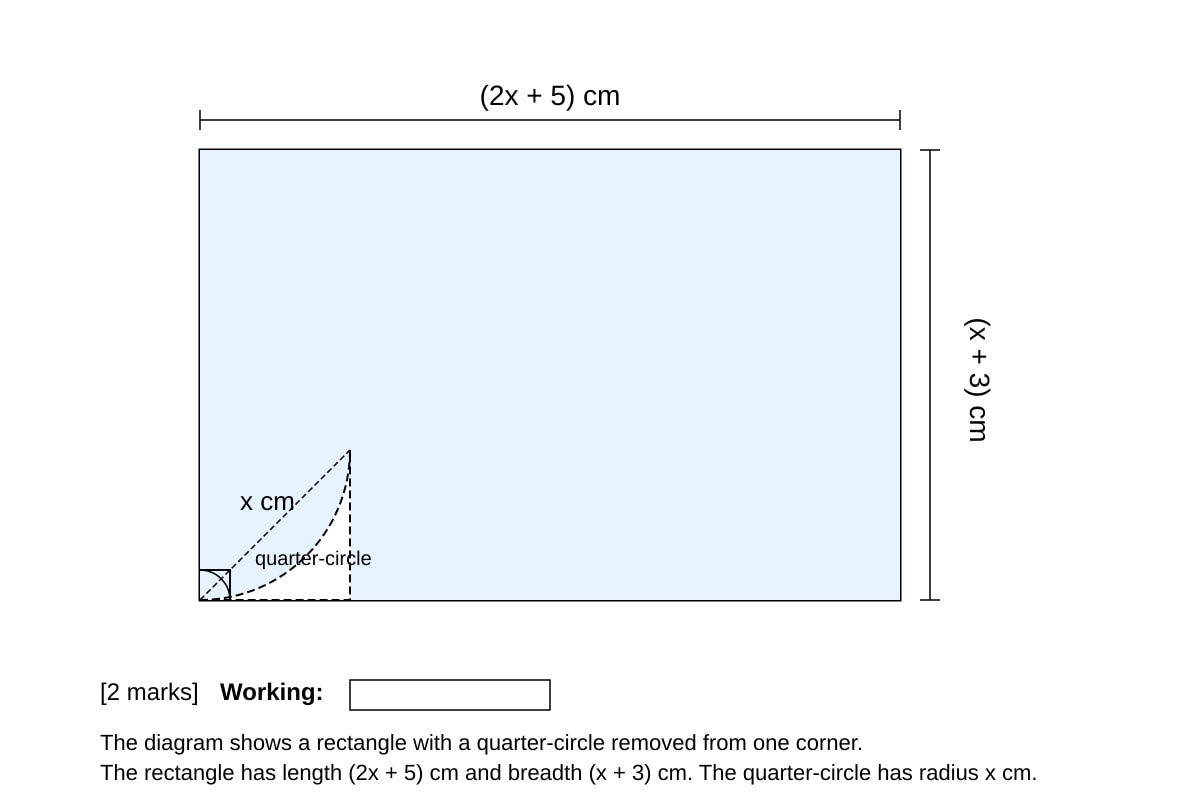
**20. Rectangle with quarter-circle removed. [3 marks total]**

**(a) Find an expression for the area of the shaded region. [1 mark]**

**Answer:** $(2x + 5)(x + 3) - \frac{1}{4}\pi x^2$ or $2x^2 + 11x + 15 - \frac{\pi x^2}{4}$

**Working and Explanation:**
- **Key concept:** Area of shaded region = Area of rectangle − Area of quarter-circle.
- Step 1: Area of rectangle = length × breadth = $(2x + 5)(x + 3)$ [0.5 mark]
- Step 2: Area of quarter-circle = $\frac{1}{4} \times \pi \times r^2 = \frac{1}{4}\pi x^2$ [0.5 mark]
- Shaded area = $(2x + 5)(x + 3) - \frac{\pi x^2}{4}$

If expanded: $(2x + 5)(x + 3) = 2x^2 + 6x + 5x + 15 = 2x^2 + 11x + 15$

**(b) Find the area when $x = 2$ and $\pi = 3.14$. [2 marks]**

**Answer:** Approximately 37.86 cm²

**Working and Explanation:**
- Step 1: Substitute $x = 2$ into rectangle area: $(2(2) + 5)(2 + 3) = (4 + 5)(5) = 9 \times 5 = 45$ cm² [0.5 mark]
- Step 2: Substitute into quarter-circle area: $\frac{1}{4} \times 3.14 \times (2)^2 = \frac{1}{4} \times 3.14 \times 4 = 3.14$ cm² [0.5 mark]
- Step 3: Subtract: $45 - 3.14 = 41.86$? Let me recheck...

Wait, let me recalculate: $(2(2)+5)(2+3) = (9)(5) = 45$. And $\frac{1}{4} \times 3.14 \times 4 = 3.14$.

Actually: $45 - 3.14 = 41.86$. Hmm, but let me verify with the expression from part (a).

Actually I had $2x^2 + 11x + 15 - \frac{\pi x^2}{4}$:
- $2(4) + 11(2) + 15 - \frac{3.14 \times 4}{4} = 8 + 22 + 15 - 3.14 = 45 - 3.14 = 41.86$

**Answer:** 41.86 cm² (accept 41.9 or 42 if rounded, or exact forms)

[1 mark for correct substitution, 1 mark for final answer with units]

**Common mistake:**
- Using diameter instead of radius for the circle ($r = x = 2$, not $2x = 4$).
- Forgetting to take quarter of the circle area (using full circle area $\pi r^2$ instead).
- Arithmetic errors with substitution — write out each step clearly.

---

*Syllabus reference: N1.3, N2.1-N2.2, A1.1-A1.6, A2.1-A2.3, A3.1-A3.2, A4.1-A4.3 (Lower Secondary G3 Mathematics Syllabus 2020)*

*Note: This answer key provides detailed explanations suitable for student self-study or teacher-led review. Mark allocations follow standard Secondary 1 assessment conventions where method marks are awarded for correct working even if final answer contains arithmetic errors.*