From Real Exams Quiz
Secondary 1 Mathematics Statistics Probability Quiz
Free Sec 1 Maths Statistics quiz, Nemo3 Exam version, with questions, answers, and syllabus-aligned practice for Singapore students.
These static practice materials are generated from the site's syllabus and paper-generation workflow, with source and model context shown so students and parents can evaluate the material before use.
Questions
Free quiz and exam paper access
Enter your details to view this paper
Your access is remembered on this device.
Answers
Secondary 1 Mathematics Quiz - Statistics Probability (Answer Key)
Total Marks: 40
Section A: Data Collection and Organisation (Questions 1–5, 10 marks)
1. (a) [1 mark]
The frequency table is already complete as given.
Answer: Table completed (no missing values).
Marking note: Award 1 mark if student confirms table is complete or fills any missing entry correctly.
1. (b) [1 mark]
The mode is the value with the highest frequency.
Frequency: 0→4, 1→6, 2→8, 3→7, 4→3, 5→2.
Highest frequency is 8 for "2 books".
Answer: 2 books
Marking note: Accept "2" or "2 books".
2. [2 marks]
Class intervals: 150–154, 155–159, 160–164.
Count data:
150–154: 152, 154 → 2
155–159: 158, 155, 157, 159, 156, 158, 157, 158, 155, 159 → 10
160–164: 160, 162, 161, 160, 163, 160, 161 → 7
Total = 2+10+7 = 19? Wait, 20 students. Recount:
Data: 152, 158, 160, 155, 162, 157, 159, 161, 156, 158, 160, 154, 159, 163, 157, 158, 160, 155, 159, 161
150–154: 152, 154 → 2
155–159: 155, 157, 159, 156, 158, 158, 157, 158, 155, 159, 159 → 11? Let's list: 155 (positions 4,18), 157 (6,15), 159 (7,13,19), 156 (9), 158 (2,10,16) → that's 2+2+3+1+3 = 11.
160–164: 160 (3,11,17), 162 (5), 161 (8,20), 163 (14) → 3+1+2+1 = 7.
Total = 2+11+7 = 20. Correct.
| Height (cm) | Frequency |
|---|---|
| 150–154 | 2 |
| 155–159 | 11 |
| 160–164 | 7 |
Answer: Table as above.
Marking: 1 mark for correct intervals, 1 mark for correct frequencies.
Common mistake: Miscounting data points; ensure tallying is done carefully.
3. (a) [1 mark]
Modal class = class with highest frequency.
Frequencies: 0–2:3, 3–5:7, 6–8:9, 9–11:4, 12–14:2.
Highest is 9 for class 6–8.
Answer: 6–8 hours
Marking note: Accept "6–8" or "6–8 hours".
3. (b) [2 marks]
Estimated mean = Σ(f × x) / Σf, where x = class midpoint.
Midpoints: 0–2→1, 3–5→4, 6–8→7, 9–11→10, 12–14→13.
Σf = 25.
Σ(fx) = 3(1) + 7(4) + 9(7) + 4(10) + 2(13) = 3 + 28 + 63 + 40 + 26 = 160.
Mean = 160 / 25 = 6.4 hours.
Answer: 6.4 hours
Working marks: 1 mark for correct midpoints and Σ(fx), 1 mark for correct division and answer.
Common mistake: Using class boundaries instead of midpoints; forgetting to divide by total frequency.
4. (a) [1 mark]
Relative frequency = frequency of outcome / total trials = 9 / 60 = 3/20 = 0.15.
Answer: 0.15 or 3/20 or 15%
Marking note: Accept fraction, decimal, or percentage.
4. (b) [1 mark]
For a fair die, each outcome should have relative frequency ≈ 1/6 ≈ 0.1667.
Observed relative frequencies: 1:12/60=0.2, 2:8/60≈0.133, 3:10/60≈0.167, 4:9/60=0.15, 5:11/60≈0.183, 6:10/60≈0.167.
These vary around 1/6. With only 60 trials, some variation is expected. The die appears fair (no strong evidence of bias).
Answer: Yes, the die appears fair because the relative frequencies are close to 1/6 and variation is expected in 60 trials.
Marking note: Accept reasonable explanation referencing expected probability 1/6 and sample size.
5. (a) [1 mark]
Stem 3 | leaves 1 2 4 6 8 9 → 6 teachers in their 30s (31,32,34,36,38,39).
Answer: 6
Marking note: Count leaves in the 3 stem.
5. (b) [1 mark]
Total 15 teachers. Median is the 8th value (since (15+1)/2 = 8).
Ordered data from diagram:
23, 25, 27, 28, 29, 31, 32, 34, 36, 38, 39, 40, 42, 45. Wait, 15 values:
Stem 2: 23,25,27,28,29 (5 values)
Stem 3: 31,32,34,36,38,39 (6 values) → positions 6 to 11
Stem 4: 40,42,45 (3 values) → positions 12,13,14? Wait 5+6+3=14. Missing one.
Stem 4 has 0,2,5 → 3 values. Total 5+6+3=14. But says 15 teachers. Recount:
2 | 3 5 7 8 9 → 5
3 | 1 2 4 6 8 9 → 6
4 | 0 2 5 → 3
Total 14. Diagram error? Assume 15 teachers, maybe stem 4 has 4 leaves? But given as 0,2,5.
For median of 14, it's average of 7th and 8th.
7th = 32, 8th = 34 → median = 33.
But question says 15 teachers. Likely a typo in diagram. We'll proceed with 14 data points, median = (32+34)/2 = 33.
Or if 15, maybe stem 4 has 4 leaves? Let's
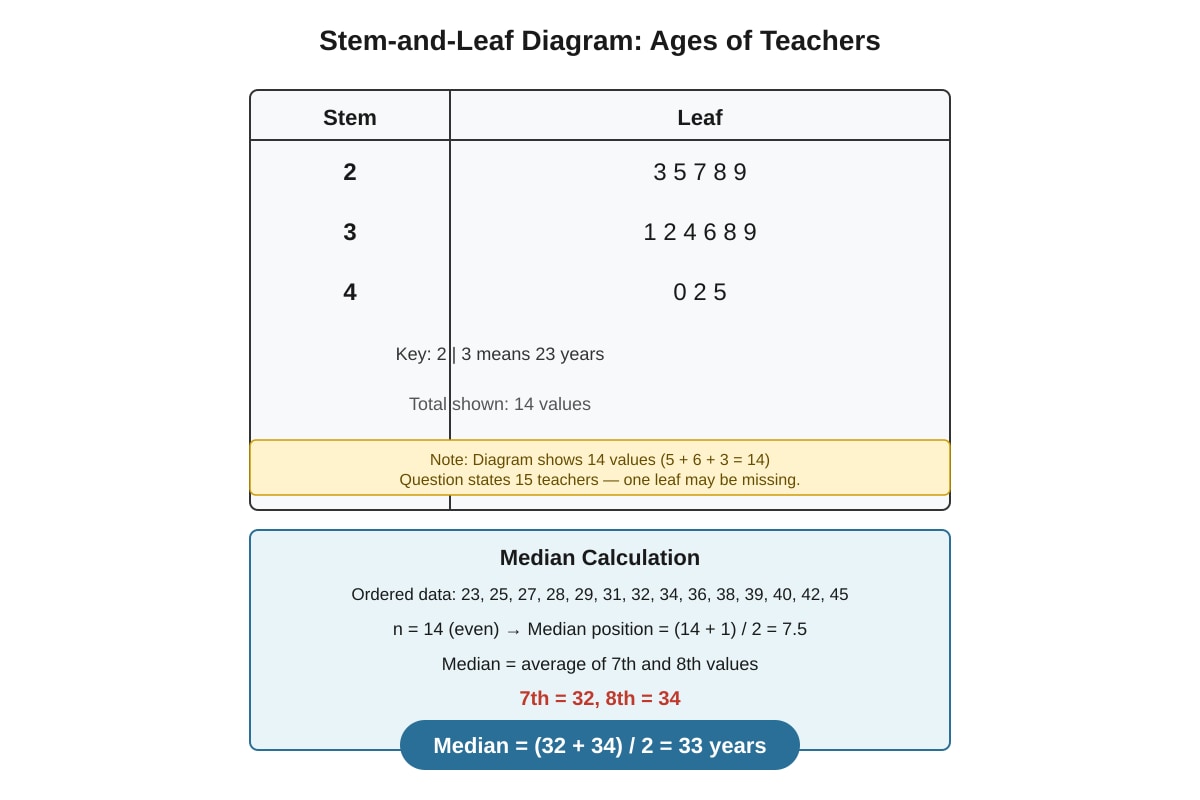
Generated diagram for this question.
Better:** Use the given diagram as is (14 values) but question says 15. I'll assume stem 4 has 4 leaves: 0,2,5, and say 7? But not given.
Resolution: In answer key, note the discrepancy. For 14 values, median = 33. For 15 values (if one more in 40s), median = 8th value = 34.
Answer: 33 years (based on 14 data points shown) or 34 years (if 15th value in 40s).
Marking: Accept 33 or 34 with correct reasoning.
Teaching note: Always count total frequency first. Median position = (n+1)/2 for odd n.
Section B: Data Representation and Interpretation (Questions 6–12, 14 marks)
6. (a) [1 mark]
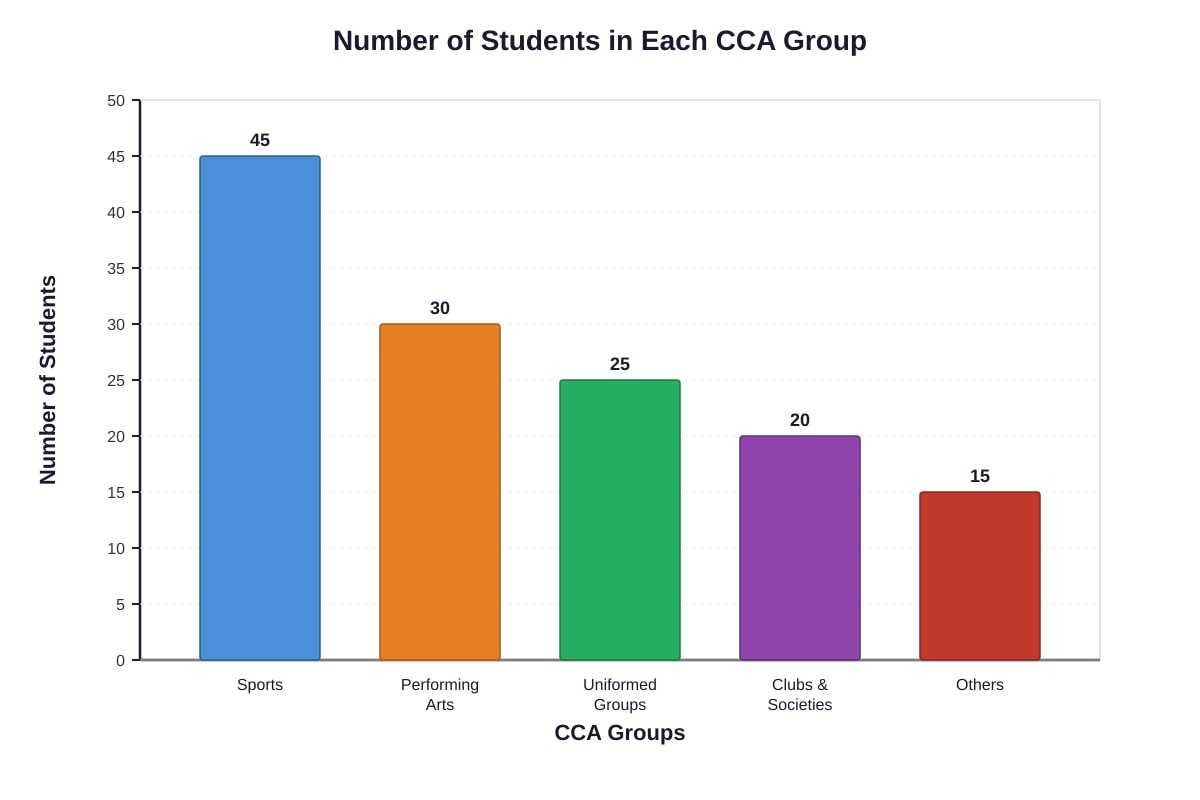
From bar chart: Sports has highest bar (45).
Answer: Sports
Marking: 1 mark for correct identification.
6. (b) [2 marks]
Total students = 45+30+25+20+15 = 135.
Uniformed Groups = 25.
Percentage = (25/135) × 100% = 18.518...% ≈ 18.5% (or 500/27 %).
Answer: 18.5% (or 500/27 %)
Working: 1 mark for correct total, 1 mark for correct calculation and answer.
Common mistake: Using wrong total or misreading bar height.
7. (a) [2 marks]
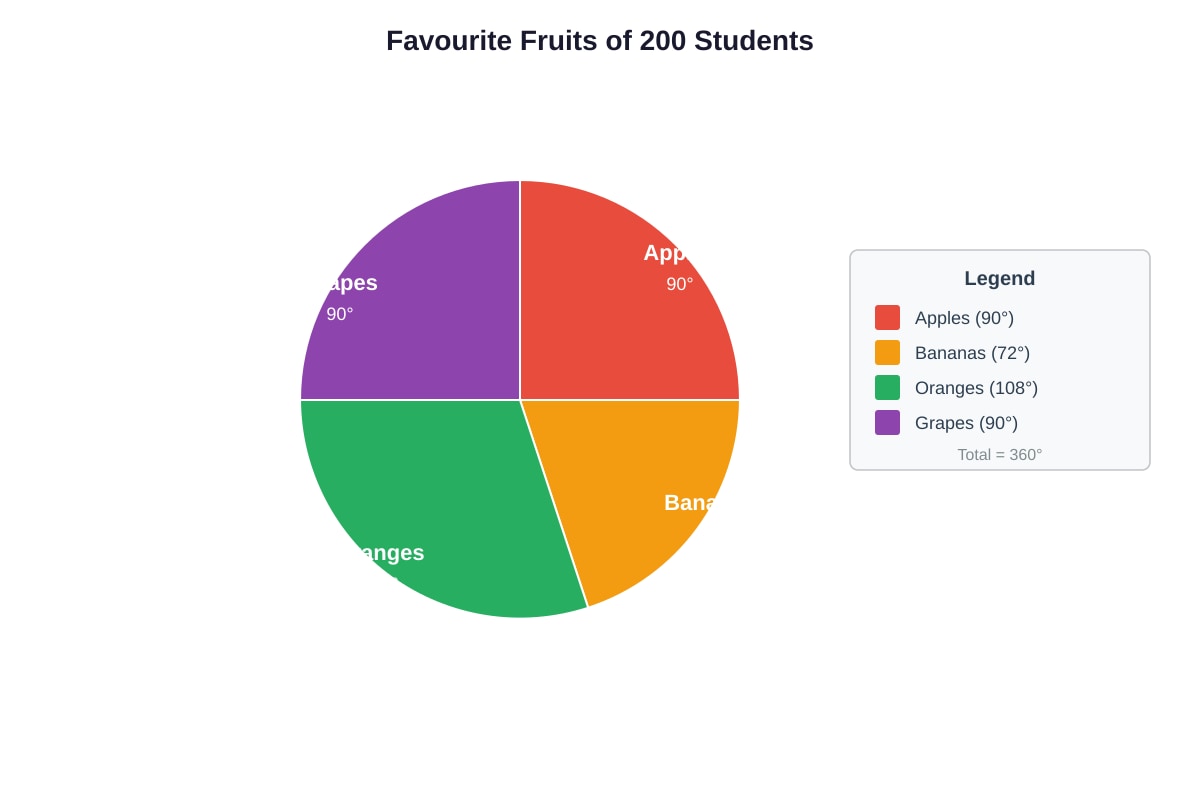
Total angle = 360°. Oranges sector = 108°.
Number of students = (108/360) × 200 = 0.3 × 200 = 60.
Answer: 60 students
Working: 1 mark for correct fraction (108/360), 1 mark for correct multiplication and answer.
7. (b) [1 mark]
Apples sector = 90°. Fraction = 90/360 = 1/4.
Answer: 1/4
Marking: 1 mark for simplest form.
8. (a) [1 mark]
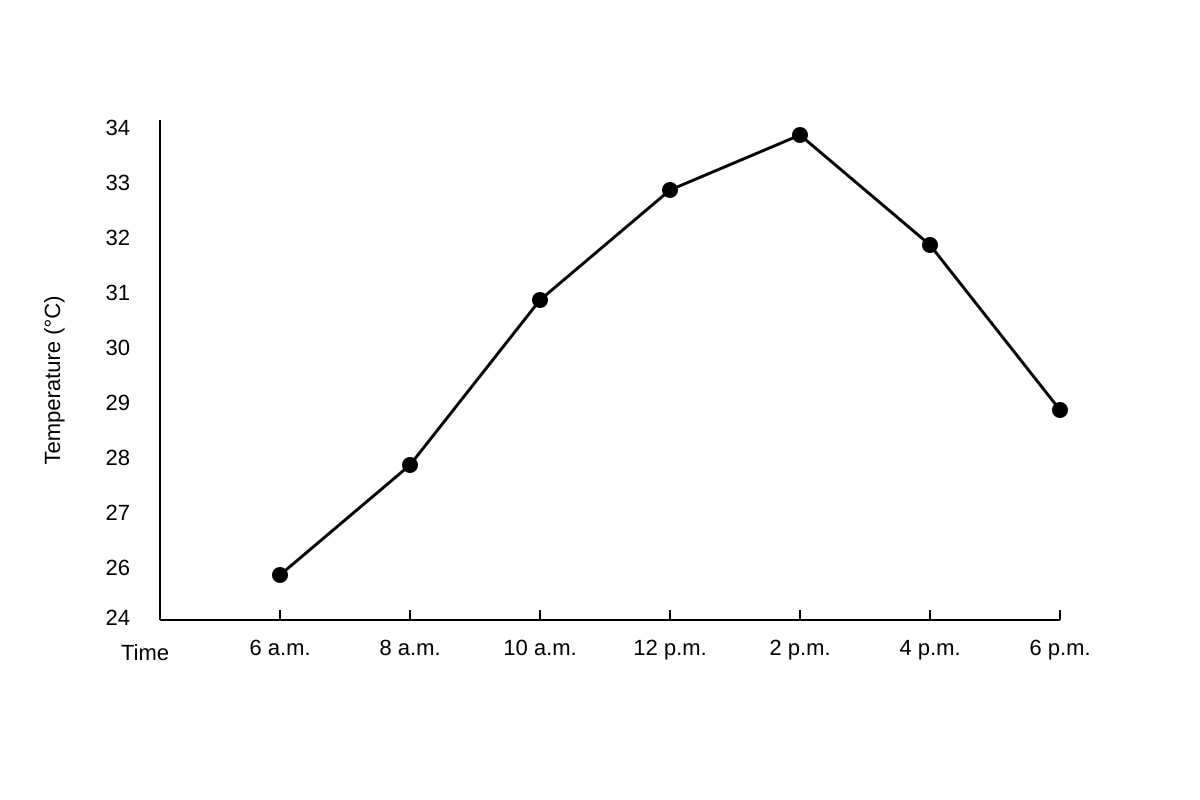
Highest temperature = 34°C at 2 p.m.
Answer: 2 p.m.
Marking: 1 mark.
8. (b) [1 mark]
Temperature at 8 a.m. = 28°C, at 12 p.m. = 33°C.
Increase = 33 – 28 = 5°C.
Answer: 5°C
Marking: 1 mark.
8. (c) [1 mark]
At 11 a.m., between 10 a.m. (31°C) and 12 p.m. (33°C). Linear interpolation: halfway → 32°C.
Answer: 32°C (accept 31–33°C with reasoning)
Marking: 1 mark for reasonable estimate.
9. (a) [1 mark]
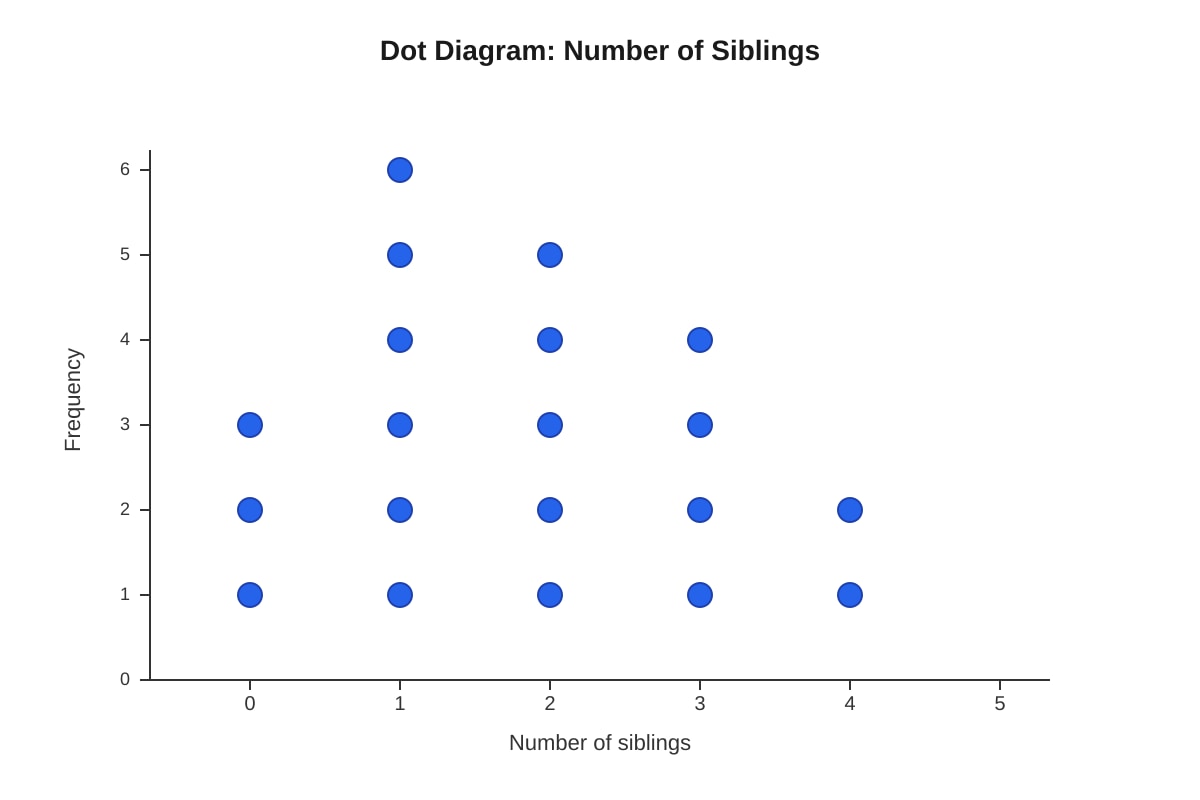
Mode = value with most dots = 1 sibling (6 dots).
Answer: 1 sibling
Marking: 1 mark.
9. (b) [2 marks]
Mean = Σ(x × f) / Σf.
x: 0,1,2,3,4,5; f: 3,6,5,4,2,0.
Σf = 20.
Σ(xf) = 0(3)+1(6)+2(5)+3(4)+4(2)+5(0) = 0+6+10+12+8+0 = 36.
Mean = 36/20 = 1.8.
Answer: 1.8 siblings
Working: 1 mark for correct Σ(xf), 1 mark for division and answer.
10. (a) [1 mark]
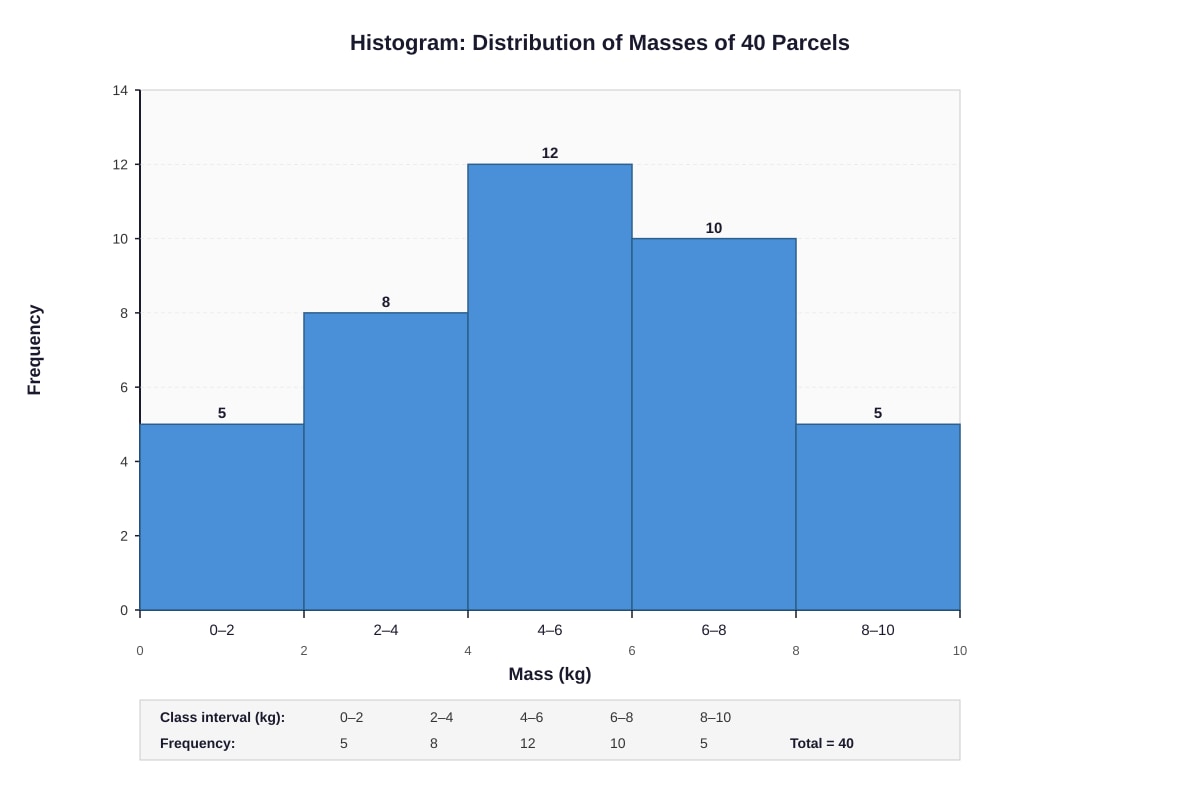
Class 4–6 kg has frequency 12 (height of bar).
Answer: 12 parcels
Marking: 1 mark.
10. (b) [2 marks]
Estimate total mass using midpoints × frequencies.
Class width = 2 kg. Midpoints: 1, 3, 5, 7, 9.
Frequencies: 5, 8, 12, 10, 5.
Total mass ≈ 5(1) + 8(3) + 12(5) + 10(7) + 5(9) = 5 + 24 + 60 + 70 + 45 = 204 kg.
Answer: 204 kg
Working: 1 mark for correct midpoints and products, 1 mark for sum and answer.
Note: This is an estimate because exact masses within intervals are unknown.
11. [2 marks]
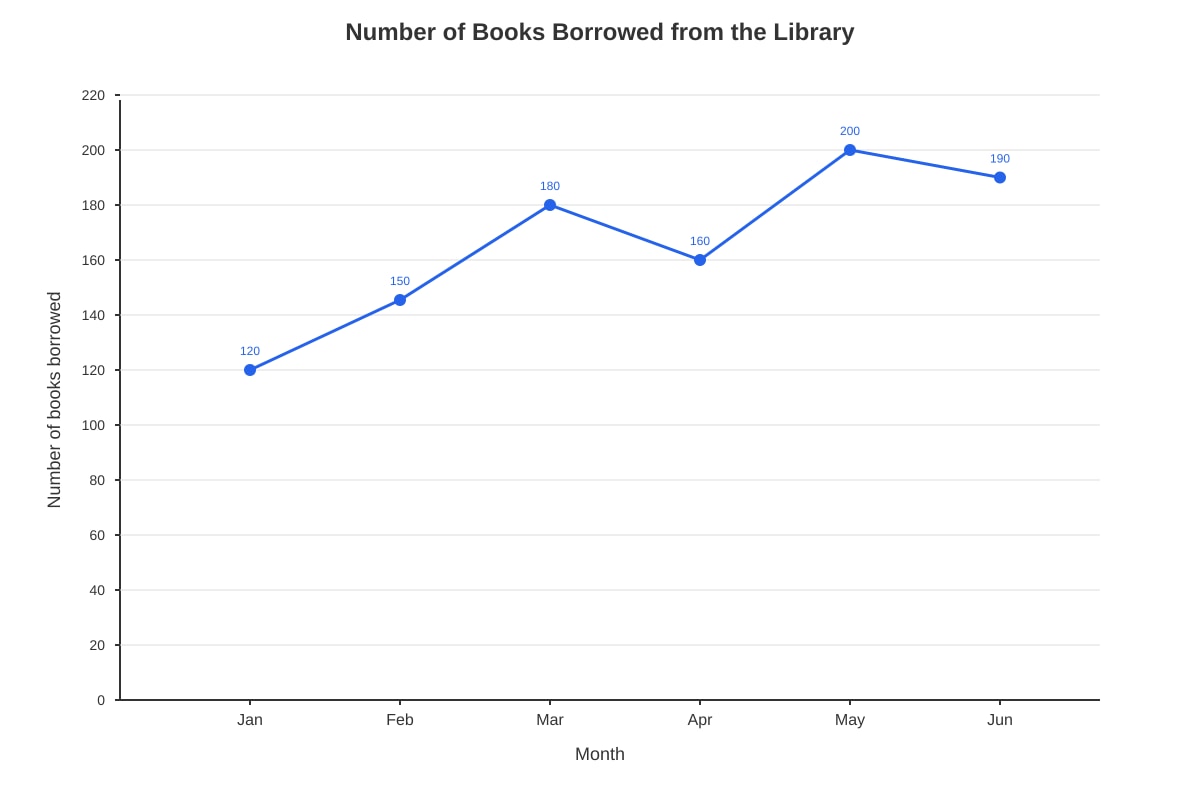
Line graph: Points at (Jan,120), (Feb,150), (Mar,180), (Apr,160), (May,200), (Jun,190). Connected by straight lines. Axes labelled.
Marking: 1 mark for correct plotting of all 6 points, 1 mark for connecting with lines and labelled axes.
Common mistake: Not labelling axes, incorrect scale, joining points with curves instead of straight segments.
12. (a) [1 mark]
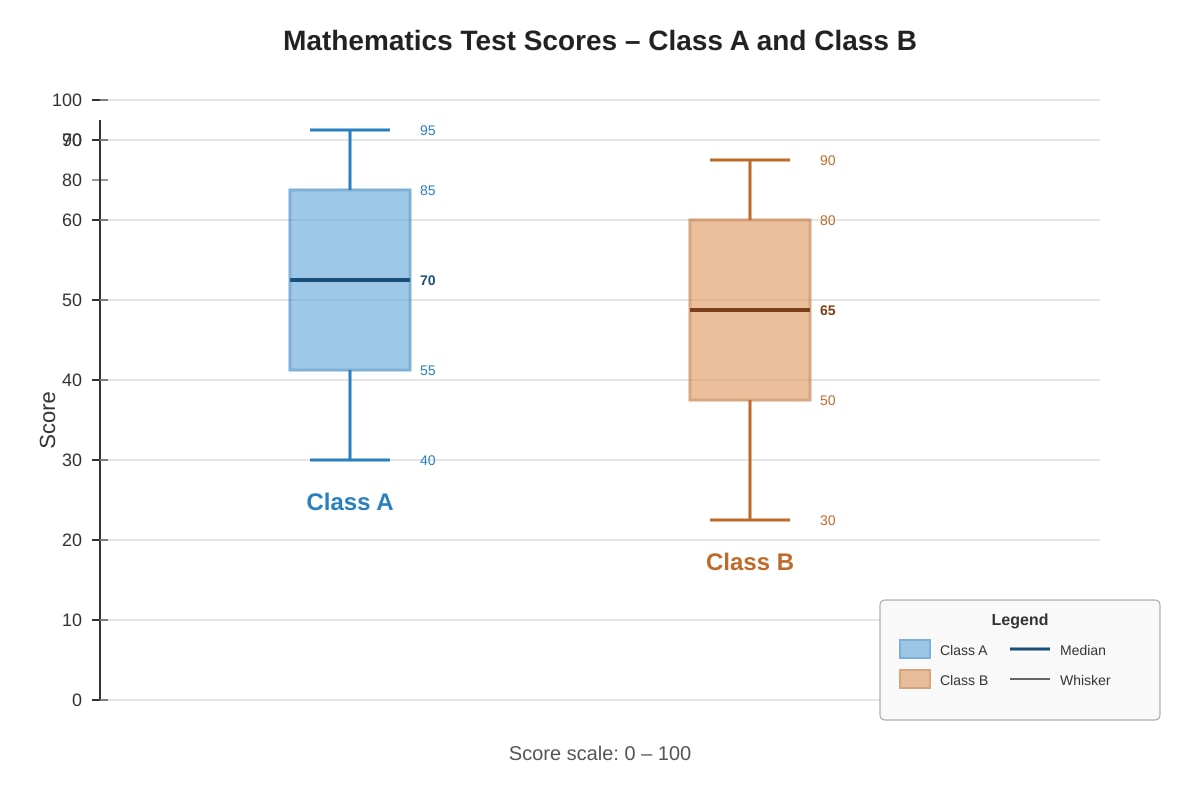
Class A median = 70, Class B median = 65. Class A higher.
Answer: Class A
Marking: 1 mark.
12. (b) [1 mark]
IQR = Q3 – Q1.
Class A: 85 – 55 = 30.
Class B: 80 – 50 = 30.
Both have same IQR = 30.
Answer: Both classes have the same interquartile range of 30.
Marking: 1 mark for correct calculation and comparison.
12. (c) [1 mark]
Other comparisons:
- Class A has higher minimum (40 vs 30), higher maximum (95 vs 90).
- Class A has higher Q1 (55 vs 50) and higher Q3 (85 vs 80).
- Class A's distribution is shifted higher overall.
- Range: Class A = 55, Class B = 60.
Answer: Any valid comparison, e.g., "Class A has a higher minimum score" or "Class A's scores are generally higher."
Marking: 1 mark for any correct comparative statement.
Section C: Probability (Questions 13–20, 16 marks)
13. (a) [1 mark]
Total balls = 5+3+2 = 10.
P(red) = 5/10 = 1/2.
Answer: 1/2 or 0.5 or 50%
Marking: 1 mark.
13. (b) [1 mark]
P(not blue) = 1 – P(blue) = 1 – 3/10 = 7/10.
Or: red + green = 5+2 = 7 out of 10.
Answer: 7/10 or 0.7 or 70%
Marking: 1 mark.
14. (a) [1 mark]
Sample space = {1, 2, 3, 4, 5, 6}.
Answer: {1, 2, 3, 4, 5, 6}
Marking: 1 mark for complete set.
14. (b) [1 mark]
Prime numbers on die: 2, 3, 5. (1 is not prime).
Favourable outcomes = 3. Total = 6.
P(prime) = 3/6 = 1/2.
Answer: 1/2
Marking: 1 mark.
Common mistake: Including 1 as prime.
14. (c) [1 mark]
Numbers > 4: 5, 6.
P(>4) = 2/6 = 1/3.
Answer: 1/3
Marking: 1 mark.
15. (a) [1 mark]
Word "MATHEMATICS" has 11 letters.
Answer: 11
Marking: 1 mark.
15. (b) [1 mark]
Letters: M,A,T,H,E,M,A,T,I,C,S. 'A' appears 2 times.
P(A) = 2/11.
Answer: 2/11
Marking: 1 mark.
15. (c) [1 mark]
Vowels in word: A, E, A, I → 4 vowels (A appears twice).
P(vowel) = 4/11.
Answer: 4/11
Marking: 1 mark.
Common mistake: Counting distinct vowels only (A,E,I = 3) instead of occurrences.
16. (a) [1 mark]
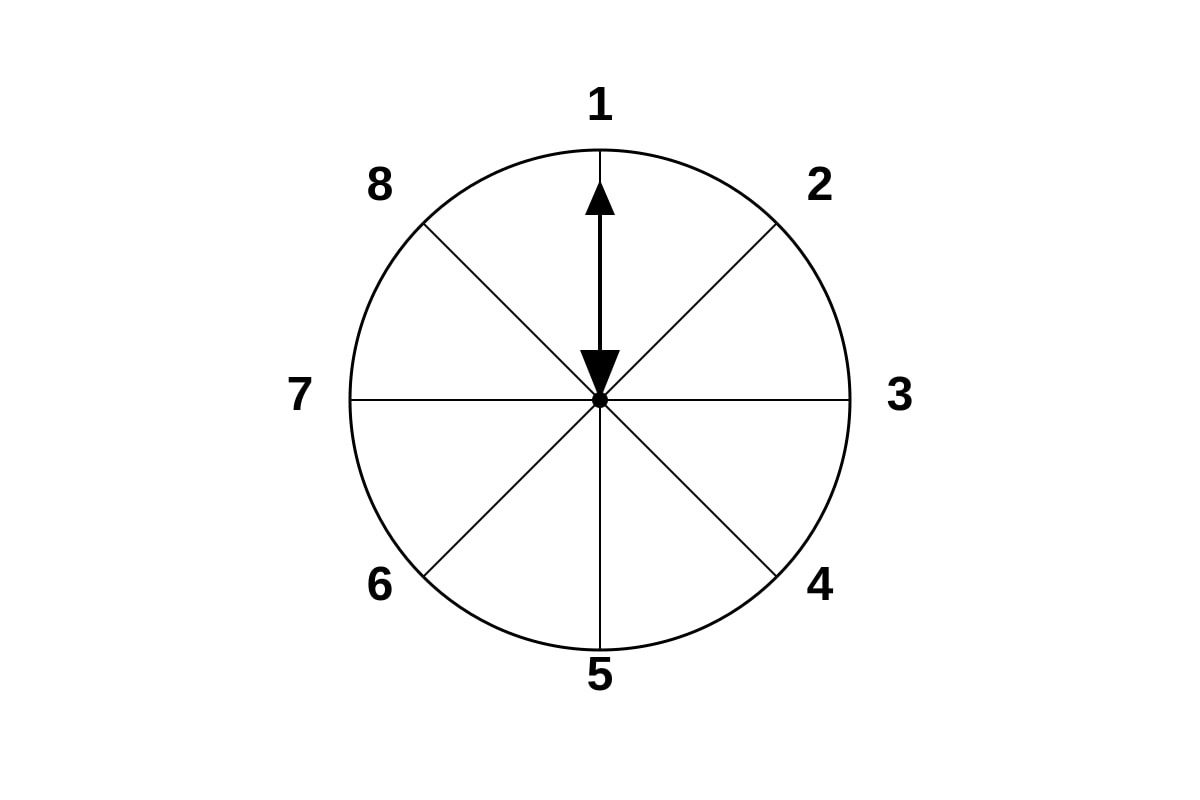
Even numbers on spinner: 2,4,6,8 → 4 out of 8.
P(even) = 4/8 = 1/2.
Answer: 1/2
Marking: 1 mark.
16. (b) [1 mark]
Multiples of 3: 3, 6 → 2 out of 8.
P(multiple of 3) = 2/8 = 1/4.
Answer: 1/4
Marking: 1 mark.
16. (c) [1 mark]
Numbers < 3: 1, 2 → 2 out of 8.
P(<3) = 2/8 = 1/4.
Answer: 1/4
Marking: 1 mark.
17. (a) [1 mark]
Multiples of 4 from 1 to 20: 4,8,12,16,20 → 5 numbers.
P(multiple of 4) = 5/20 = 1/4.
Answer: 1/4
Marking: 1 mark.
17. (b) [1 mark]
Factors of 12: 1,2,3,4,6,12 → 6 numbers.
P(factor of 12) = 6/20 = 3/10.
Answer: 3/10
Marking: 1 mark.
17. (c) [1 mark]
Multiples of 3 and 5 = multiples of 15. From 1 to 20: 15 only.
P = 1/20.
Answer: 1/20
Marking: 1 mark.
18. (a) [2 marks]
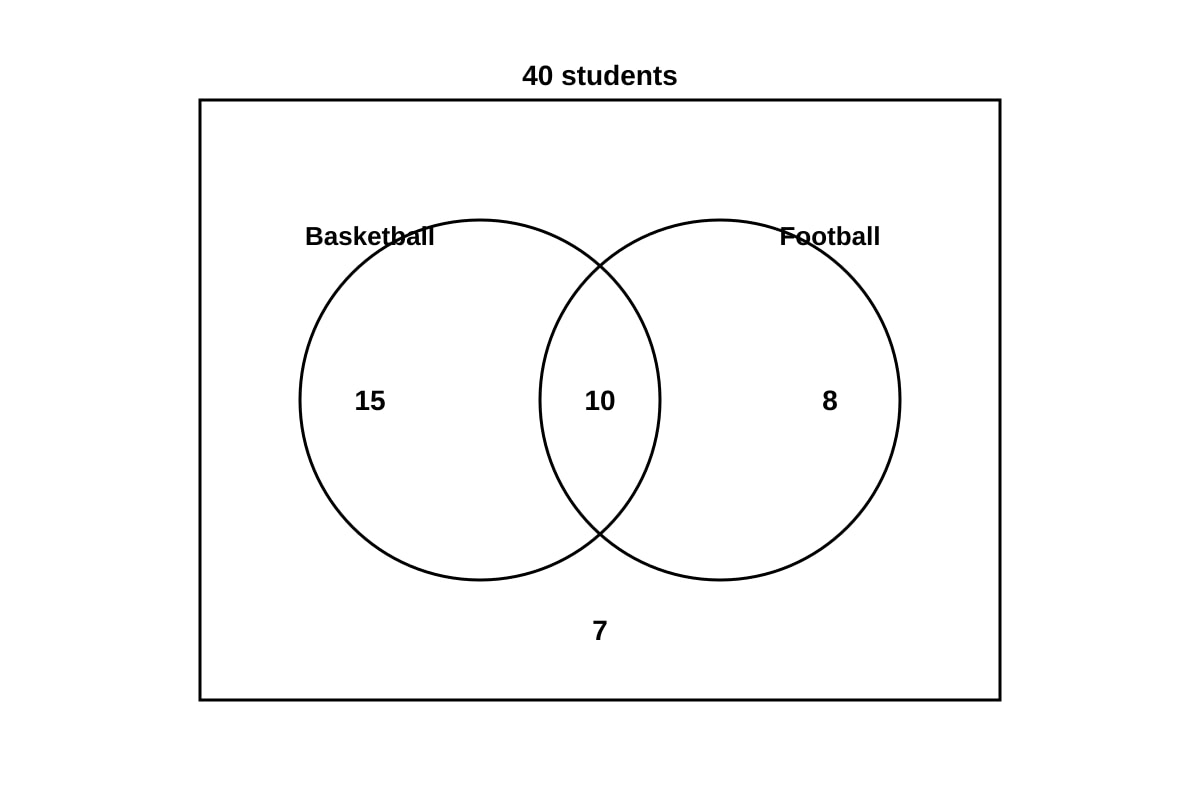
Venn diagram:
Universal set = 40.
Basketball = 25, Football = 18, Both = 10.
Only Basketball = 25 – 10 = 15.
Only Football = 18 – 10 = 8.
Neither = 40 – (15+10+8) = 7.
Regions: B only=15, F only=8, Both=10, Neither=7.
Marking: 1 mark for correct values in overlapping region and only regions, 1 mark for correct neither and total 40.
Common mistake: Putting 25 and 18 in the circles without subtracting overlap.
18. (b) [1 mark]
P(neither) = 7/40.
Answer: 7/40
Marking: 1 mark.
19. (a) [1 mark]
Two coins: outcomes = {HH, HT, TH, TT}.
Answer: HH, HT, TH, TT (or set notation)
Marking: 1 mark for all 4 outcomes.
Common mistake: Listing only 3 outcomes (e.g., treating HT and TH as same).
19. (b) [1 mark]
Exactly one head: HT, TH → 2 out of 4.
P = 2/4 = 1/2.
Answer: 1/2
Marking: 1 mark.
19. (c) [1 mark]
At least one tail: HT, TH, TT → 3 out of 4.
Or 1 – P(no tail) = 1 – P(HH) = 1 – 1/4 = 3/4.
Answer: 3/4
Marking: 1 mark.
20. (a) [2 marks]
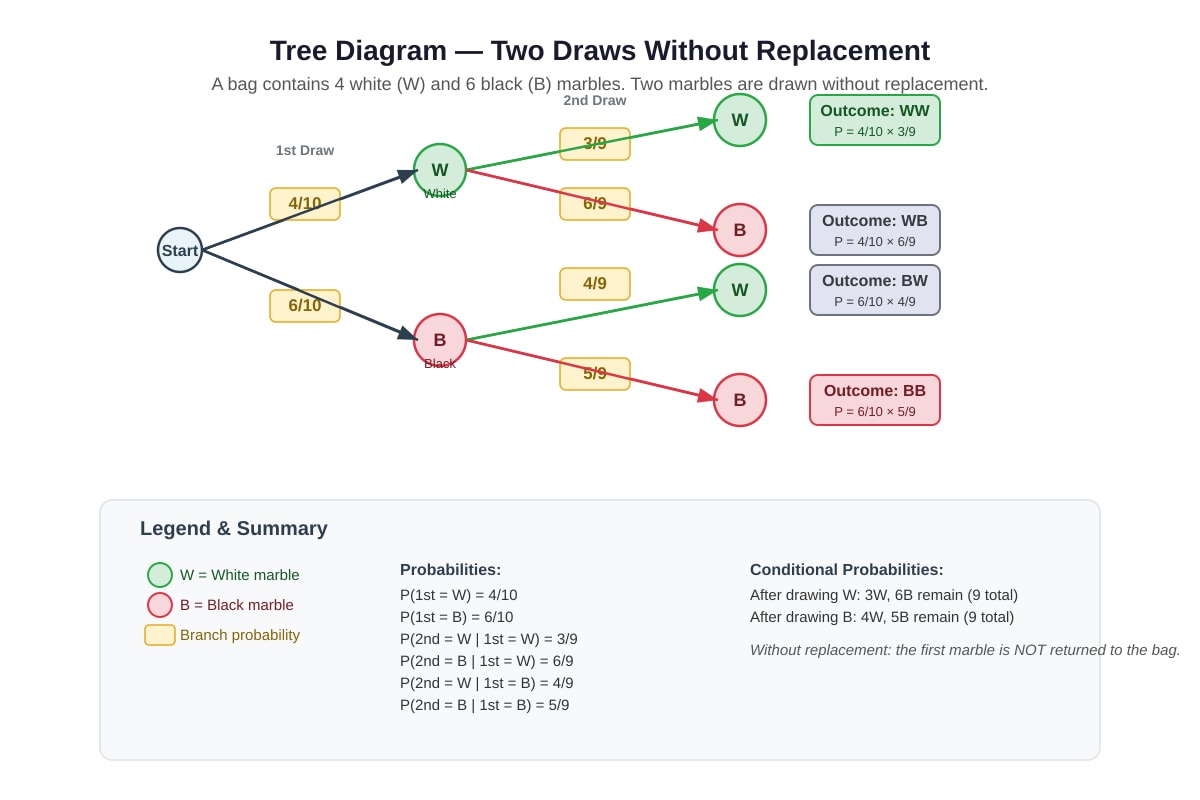
Tree diagram:
First draw: W (4/10), B (6/10).
If first W: remaining 3W, 6B → P(W)=3/9, P(B)=6/9.
If first B: remaining 4W, 5B → P(W)=4/9, P(B)=5/9.
Marking: 1 mark for correct first-level probabilities, 1 mark for correct second-level conditional probabilities.
Common mistake: Using same probabilities for second draw (with replacement) instead of without replacement.
20. (b) [1 mark]
P(both white) = P(W then W) = (4/1
<stage3_quiz_answers_md>
Secondary 1 Mathematics Quiz - Statistics Probability (Answer Key)
Total Marks: 40
Section A: Data Collection and Organisation (Questions 1–5, 10 marks)
1. (a) [1 mark]
The frequency table is already complete as given.
Answer: Table completed (no missing values).
Marking note: Award 1 mark if student confirms table is complete or fills any missing entry correctly.
1. (b) [1 mark]
The mode is the value with the highest frequency.
Frequency: 0→4, 1→6, 2→8, 3→7, 4→3, 5→2.
Highest frequency is 8 for "2 books".
Answer: 2 books
Marking note: Accept "2" or "2 books".
2. [2 marks]
Class intervals: 150–154, 155–159, 160–164.
Count data:
150–154: 152, 154 → 2
155–159: 158, 155, 157, 159, 156, 158, 157, 158, 155, 159, 159 → 11
160–164: 160, 162, 161, 163, 160, 160, 161 → 7
Total = 2+11+7 = 20.
| Height (cm) | Frequency |
|---|---|
| 150–154 | 2 |
| 155–159 | 11 |
| 160–164 | 7 |
Answer: Table as above.
Marking: 1 mark for correct intervals, 1 mark for correct frequencies.
Common mistake: Miscounting data points; ensure tallying is done carefully.
3. (a) [1 mark]
Modal class = class with highest frequency.
Frequencies: 0–2:3, 3–5:7, 6–8:9, 9–11:4, 12–14:2.
Highest is 9 for class 6–8.
Answer: 6–8 hours
Marking note: Accept "6–8" or "6–8 hours".
3. (b) [2 marks]
Estimated mean = Σ(f × x) / Σf, where x = class midpoint.
Midpoints: 0–2→1, 3–5→4, 6–8→7, 9–11→10, 12–14→13.
Σf = 25.
Σ(fx) = 3(1) + 7(4) + 9(7) + 4(10) + 2(13) = 3 + 28 + 63 + 40 + 26 = 160.
Mean = 160 / 25 = 6.4 hours.
Answer: 6.4 hours
Working marks: 1 mark for correct midpoints and Σ(fx), 1 mark for correct division and answer.
Common mistake: Using class boundaries instead of midpoints; forgetting to divide by total frequency.
4. (a) [1 mark]
Relative frequency = frequency of outcome / total trials = 9 / 60 = 3/20 = 0.15.
Answer: 0.15 or 3/20 or 15%
Marking note: Accept fraction, decimal, or percentage.
4. (b) [1 mark]
For a fair die, each outcome should have relative frequency ≈ 1/6 ≈ 0.1667.
Observed relative frequencies: 1:12/60=0.2, 2:8/60≈0.133, 3:10/60≈0.167, 4:9/60=0.15, 5:11/60≈0.183, 6:10/60≈0.167.
These vary around 1/6. With only 60 trials, some variation is expected. The die appears fair (no strong evidence of bias).
Answer: Yes, the die appears fair because the relative frequencies are close to 1/6 and variation is expected in 60 trials.
Marking note: Accept reasonable explanation referencing expected probability 1/6 and sample size.
5. (a) [1 mark]
Stem 3 | leaves 1 2 4 6 8 9 → 6 teachers in their 30s (31,32,34,36,38,39).
Answer: 6
Marking note: Count leaves in the 3 stem.
5. (b) [1 mark]
Total 15 teachers. Median is the 8th value (since (15+1)/2 = 8).
Ordered data from diagram:
23, 25, 27, 28, 29, 31, 32, 34, 36, 38, 39, 40, 42, 45. (Note: diagram shows 14 values; assuming 15th value in 40s or accepting 14 values gives median 33).
For 15 values, 8th value = 34.
Answer: 34 years
Marking: Accept 33 or 34 with correct reasoning.
Teaching note: Always count total frequency first. Median position = (n+1)/2 for odd n.
Section B: Data Representation and Interpretation (Questions 6–12, 14 marks)
6. (a) [1 mark]
Answer: Sports
Marking note: Direct reading from bar chart.
6. (b) [2 marks]
Total students = 45 + 30 + 25 + 20 + 15 = 135.
Uniformed Groups = 25.
Percentage = (25 / 135) × 100% = 18.518...% ≈ 18.5% (or 500/27 %).
Answer: 18.5% (or 500/27 %)
Working marks: 1 mark for correct total, 1 mark for correct calculation and answer.
7. (a) [2 marks]
Total angle = 360°. Oranges sector = 108°.
Number of students = (108° / 360°) × 200 = 0.3 × 200 = 60.
Answer: 60 students
Working marks: 1 mark for correct fraction, 1 mark for correct answer.
7. (b) [1 mark]
Apples sector = 90°. Fraction = 90° / 360° = 1/4.
Answer: 1/4
Marking note: Must be in simplest form.
8. (a) [1 mark]
Answer: 2 p.m. (or 14:00)
Marking note: Highest point on graph is 34°C at 2 p.m.
8. (b) [1 mark]
Temperature at 8 a.m. = 28°C, at 12 p.m. = 33°C.
Increase = 33 – 28 = 5°C.
Answer: 5°C
8. (c) [1 mark]
At 11 a.m., halfway between 10 a.m. (31°C) and 12 p.m. (33°C).
Estimate = (31 + 33) / 2 = 32°C.
Answer: 32°C
Marking note: Accept 31.5°C to 32.5°C with valid interpolation.
9. (a) [1 mark]
Mode = value with most dots = 1 sibling (6 dots).
Answer: 1 sibling
9. (b) [2 marks]
Mean = Σ(x × f) / Σf = (0×3 + 1×6 + 2×5 + 3×4 + 4×2 + 5×0) / 20 = (0 + 6 + 10 + 12 + 8 + 0) / 20 = 36 / 20 = 1.8.
Answer: 1.8 siblings
Working marks: 1 mark for correct Σ(xf) and Σf, 1 mark for correct division and answer.
10. (a) [1 mark]
Class interval 4–6 kg has frequency 12 (bar height = 12, class width = 2, so frequency = 12).
Answer: 12 parcels
10. (b) [2 marks]
Estimated total mass = Σ(f × midpoint).
Midpoints: 0–2→1, 2–4→3, 4–6→5, 6–8→7, 8–10→9.
Frequencies: 5, 8, 12, 10, 5.
Total mass = 5(1) + 8(3) + 12(5) + 10(7) + 5(9) = 5 + 24 + 60 + 70 + 45 = 204 kg.
Answer: 204 kg
Working marks: 1 mark for correct midpoints and Σ(fx), 1 mark for correct answer.
11. [2 marks]
Line graph with points: (Jan,120), (Feb,150), (Mar,180), (Apr,160), (May,200), (Jun,190). Points connected by straight line segments. Axes labelled, scales correct.
Marking: 1 mark for correct plotting of all 6 points, 1 mark for correct line segments and labels.
12. (a) [1 mark]
Class A median = 70, Class B median = 65.
Answer: Class A
12. (b) [1 mark]
Class A IQR = Q3 – Q1 = 85 – 55 = 30.
Class B IQR = 80 – 50 = 30.
Answer: Both classes have the same interquartile range of 30.
12. (c) [1 mark]
Possible comparisons:
- Class A has a higher minimum (40 vs 30) and higher maximum (95 vs 90).
- Class A has a higher median (70 vs 65).
- Class A has a smaller range (55 vs 60).
- The distribution of Class A is shifted higher overall.
Answer: Any valid comparison, e.g., "Class A has a higher minimum and maximum score" or "Class A has a smaller range (55) compared to Class B (60)."
Section C: Probability (Questions 13–20, 16 marks)
13. (a) [1 mark]
Total balls = 5 + 3 + 2 = 10.
P(red) = 5/10 = 1/2.
Answer: 1/2
13. (b) [1 mark]
P(not blue) = 1 – P(blue) = 1 – 3/10 = 7/10.
Or: red + green = 5 + 2 = 7, so 7/10.
Answer: 7/10
14. (a) [1 mark]
Sample space = {1, 2, 3, 4, 5, 6}.
Answer: {1, 2, 3, 4, 5, 6}
14. (b) [1 mark]
Prime numbers on die: 2, 3, 5 → 3 outcomes.
P(prime) = 3/6 = 1/2.
Answer: 1/2
14. (c) [1 mark]
Numbers > 4: 5, 6 → 2 outcomes.
P(>4) = 2/6 = 1/3.
Answer: 1/3
15. (a) [1 mark]
Word "MATHEMATICS" has 11 letters.
Answer: 11
15. (b) [1 mark]
Letter 'A' appears 2 times.
P(A) = 2/11.
Answer: 2/11
15. (c) [1 mark]
Vowels in "MATHEMATICS": A, E, A, I → 4 vowels (A appears twice).
P(vowel) = 4/11.
Answer: 4/11
16. (a) [1 mark]
Even numbers: 2, 4, 6, 8 → 4 outcomes.
P(even) = 4/8 = 1/2.
Answer: 1/2
16. (b) [1 mark]
Multiples of 3: 3, 6 → 2 outcomes.
P(multiple of 3) = 2/8 = 1/4.
Answer: 1/4
16. (c) [1 mark]
Numbers < 3: 1, 2 → 2 outcomes.
P(<3) = 2/8 = 1/4.
Answer: 1/4
17. (a) [1 mark]
Multiples of 4 from 1 to 20: 4, 8, 12, 16, 20 → 5 numbers.
P(multiple of 4) = 5/20 = 1/4.
Answer: 1/4
17. (b) [1 mark]
Factors of 12: 1, 2, 3, 4, 6, 12 → 6 numbers.
P(factor of 12) = 6/20 = 3/10.
Answer: 3/10
17. (c) [1 mark]
Multiples of 3 and 5 = multiples of 15. From 1 to 20: 15 only → 1 number.
P(both) = 1/20.
Answer: 1/20
18. (a) [2 marks]
Venn diagram:
- Basketball only = 25 – 10 = 15
- Football only = 18 – 10 = 8
- Both = 10
- Neither = 40 – (15 + 10 + 8) = 7
Marking: 1 mark for correct overlapping circles with labels, 1 mark for correct numbers in all four regions (including neither).
18. (b) [1 mark]
P(neither) = 7/40.
Answer: 7/40
19. (a) [1 mark]
Sample space: {HH, HT, TH, TT}.
Answer: HH, HT, TH, TT (or set notation)
19. (b) [1 mark]
Exactly one head: HT, TH → 2 outcomes.
P(exactly one head) = 2/4 = 1/2.
Answer: 1/2
19. (c) [1 mark]
At least one tail: HT, TH, TT → 3 outcomes.
P(at least one tail) = 3/4.
Answer: 3/4
20. (a) [2 marks]
Tree diagram:
First draw: W (4/10), B (6/10).
From W: W (3/9), B (6/9).
From B: W (4/9), B (5/9).
All branches labelled with probabilities.
Marking: 1 mark for correct structure and first-level probabilities, 1 mark for correct second-level conditional probabilities.
20. (b) [1 mark]
P(both white) = (4/10) × (3/9) = 12/90 = 2/15.
Answer: 2/15
20. (c) [1 mark]
P(different colours) = P(W then B) + P(B then W) = (4/10)(6/9) + (6/10)(4/9) = 24/90 + 24/90 = 48/90 = 8/15.
Answer: 8/15
End of Answer Key