From Real Exams Quiz
Secondary 1 Mathematics Numbers Ratio Proportion Quiz
Free Sec 1 Maths Numbers Ratio quiz, Kimi2.6 Exam version, with questions, answers, and syllabus-aligned practice for Singapore students.
These static practice materials are generated from the site's syllabus and paper-generation workflow, with source and model context shown so students and parents can evaluate the material before use.
Questions
Free quiz and exam paper access
Enter your details to view this paper
Your access is remembered on this device.
Answers
Answer Key - Secondary 1 Mathematics Quiz - Numbers Ratio Proportion
Total Marks: 50
Question 1 [2 marks]
Find the HCF of 126 and 180 using prime factorisation.
Working:
For HCF, take lowest power of each common prime factor:
- Common primes: 2 and 3
- HCF
Answer: HCF = 18 [2]
Teaching note: HCF uses the lowest power of each common prime. A common error is to include 7 or 5, which appear in only one number.
Question 2 [2 marks]
Find the LCM of 56 and 84 using prime factorisation.
Working:
For LCM, take highest power of all primes present:
- LCM
Answer: LCM = 168 [2]
Teaching note: LCM uses the highest power of all primes that appear in either number. Students often confuse this with HCF.
Question 3 [2 marks]
Evaluate without a calculator.
Working:
Note: means the base is , so the negative is part of what gets cubed. This differs from .
- (since )
Note: The cube root of a negative number is negative, unlike square roots.
- Total:
Answer: -129 [2]
Common trap: Students may write or confuse with . Cube roots preserve the sign.
Question 4 [2 marks]
Express 0.0375 as a fraction in simplest form.
Working:
Find HCF of 375 and 10000:
HCF
Answer: [2]
Question 5 [2 marks]
Arrange in ascending order: , , , ,
Working: Convert all to decimals:
- (since , )
Ordering: , then , then , then , then
Wait — let me recheck: , so these are equal.
Correct ascending order: (or ), (same value), , ,
Since exactly, we can write: , , ,
But for strict ascending with distinct positions: , then , then , then ?
Recheck: ? No, is correct.
Actually: , and , so .
Final order: (or ), , ,
Answer: (or ), , , [2]
Note: Accept either or first since equal.
Question 6 [2 marks]
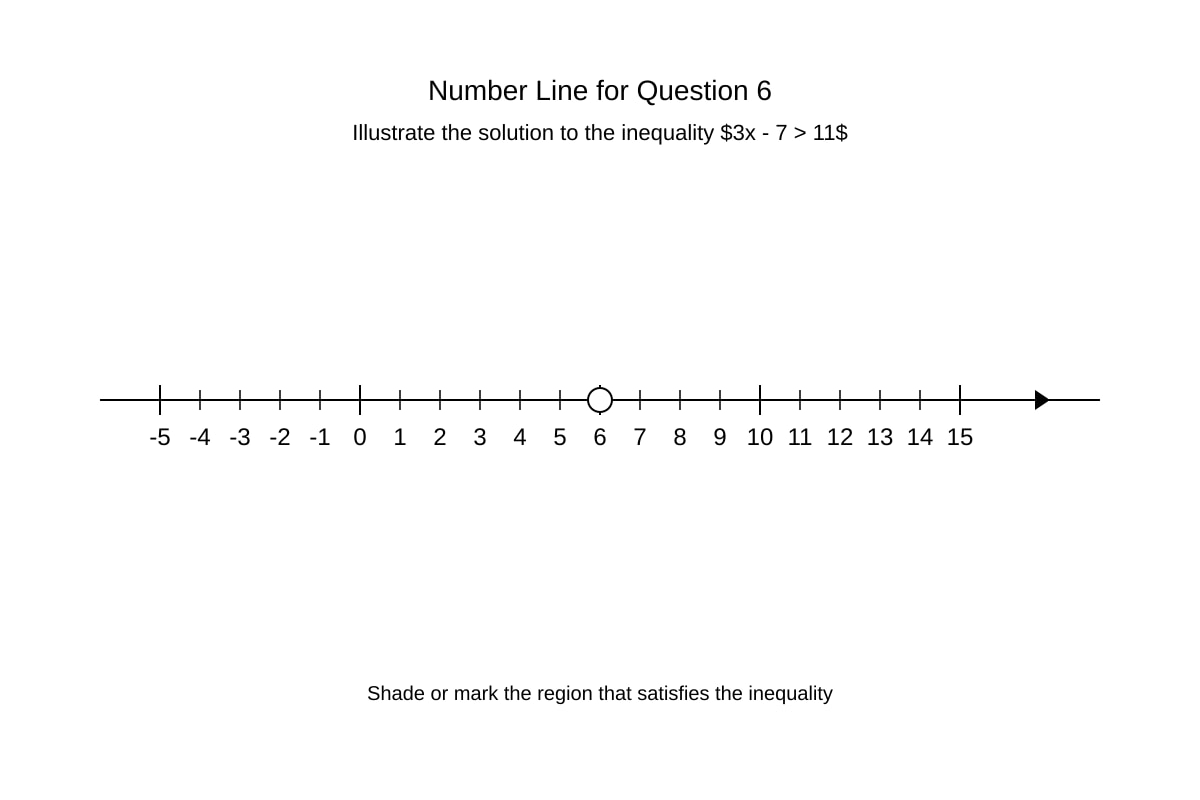
Solve and illustrate on number line.
Working:
- (add 7 to both sides)
- (divide by 3; positive so inequality unchanged)
Number line: open circle at 6, arrow pointing right.
Answer: with open circle at 6, arrow to the right [2]
Common trap: Forgetting the inequality stays the same when dividing by positive 3. (Reverse only for negative divisors.)
Question 7 [2 marks]
Simplify to simplest integer ratio.
Working: Convert to improper fractions:
Ratio:
Find LCM of denominators 4, 3, 6 = 12. Multiply each term by 12:
Ratio:
Check HCF of 27, 20, 10 = 1. Already simplest form.
Answer: [2]
Question 8 [2 marks]
Scale 1 : 50 000, actual distance 12.5 km. Find map distance in cm.
Working:
- Scale means 1 cm on map = 50 000 cm in reality
Or: convert actual distance to cm first:
Map distance: cm
Answer: 25 cm [2]
Common trap: Forgetting to convert km to cm, or confusing which side is map vs actual.
Question 9 [2 marks]
Calculate monthly savings: earnings $4,200, spends 35% rent, 25% food/transport.
Working: Total spent:
Saved:
Amount saved:
Or:
- Rent:
- Food/transport:
- Total spent:
- Saved:
Answer: $1 680 [2]
Question 10 [2 marks]
Ratio 3 : 5 : 7, total $45 000. Find smallest investment.
Working: Total parts: parts
Value of one part:
Smallest investment (3 parts):
Answer: $9 000 [2]
Question 11 [4 marks]
(a) Express 504 as product of prime factors in index notation.
Working:
So or
Answer (a): [2]
(b) Find smallest such that is a perfect square.
Working: For a perfect square, all prime powers must be even.
Current:
- Power of 2: 3 (odd, need 4) → need one more 2
- Power of 3: 2 (even, OK)
- Power of 7: 1 (odd, need 2) → need one more 7
So
Check: ✓
Answer (b): [2]
Question 12 [4 marks]
(a) Evaluate
Working:
- (negative squared is positive)
- (negative cubed is negative)
Numerator:
Fraction: (negative divided by negative is positive)
Answer (a): 12 [2]
(b) List all integer values of where
Working: means (includes ) means (does not include 3)
Values:
Answer (b): [2]
Question 13 [4 marks]
(a) Lower bound of mass (2.5 kg to nearest 100g)
Working: Nearest 100 g means rounding to 0.1 kg. Lower bound: kg = 2450 g
Or: 2.5 kg = 2500 g to nearest 100 g. Lower bound: g.
Answer (a): 2450 g [1]
(b) Maximum number of complete 150g bars (to nearest 10g)
Working: Maximum mass of gold bar: g (using original 2500 g ± 50 g)
Each small bar minimum mass: g (to make most bars, use minimum mass per bar)
Wait — to get maximum number of complete bars from maximum gold: use minimum mass per bar.
Maximum number:
Check: ✓ ✗
Or using upper bound approach:
- Upper bound of gold: 2550 g
- Lower bound of small bar: 145 g
- Maximum bars: , so 17 complete bars
Answer (b): 17 [3]
Marking: Bounds identification [1], correct calculation [1], final answer with reasoning [1]
Question 14 [4 marks]
(a) Ratio flour : sugar : butter
Working:
Divide by 50:
Check HCF of 9, 6, 4 = 1. Simplest form is ?
Wait: HCF of 450, 300, 200 = 50. , , .
HCF of 9, 6, 4 is 1. So is correct.
Actually check: can we divide further? 9=3², 6=2×3, 4=2². No common factor >1.
Answer (a): [1]
(b) Ingredients for 15 people
Working: Scale factor:
- Flour: g
- Sugar: g
- Butter: g
Answer (b): Flour: 1125 g, Sugar: 750 g, Butter: 500 g [2]
(c) Maximum people with 250 g butter
Working: Butter needed per person: g
With 250 g: number of people =
Maximum whole people: 7 people
Or using ratio: , so , maximum 7.
Answer (c): 7 people [1]
Question 15 [4 marks]
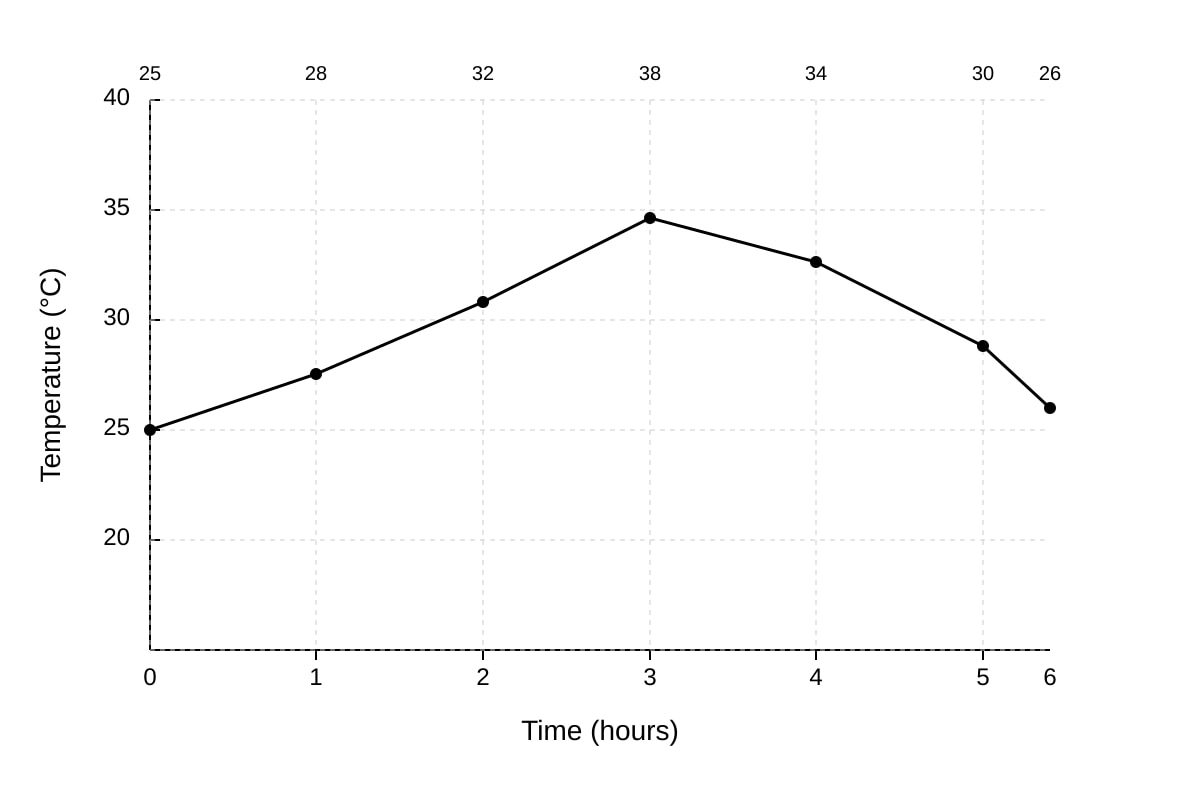
Expected visual: Line graph with points (0,25), (1,28), (2,32), (3,38), (4,34), (5,30), (6,26)
(a) Temperature at 2.5 hours by linear interpolation
Working: At 2 hours: 32°C, at 3 hours: 38°C
Linear interpolation: temperature increases from 32 to 38 over 1 hour. At 2.5 hours (midway): °C
Or: average of 32 and 38 =
Answer (a): 35°C [2]
(b) Largest temperature decrease between consecutive hours
Working: Changes:
- 0→1: +3
- 1→2: +4
- 2→3: +6
- 3→4: -4
- 4→5: -4
- 5→6: -4
Decreases: 4°C (3→4), 4°C (4→5), 4°C (5→6)
Largest decrease: 4°C between 3 and 4 hours (or any of the decreasing periods; 3→4 is first and largest equal)
Actually all decreases are equal at 4°C. Accept any of: 3 and 4, 4 and 5, or 5 and 6 hours.
Answer (b): Between 3 and 4 hours (or 4 and 5, or 5 and 6) [1]
(c) Overall change from start to end
Working: Start (0 hours): 25°C, End (6 hours): 26°C
Change: °C
Answer (c): Increase of 1°C (or +1°C) [1]
Question 16 [4 marks]
(a) Number of boys and girls (ratio 5:7, total 840)
Working: Total parts:
Each part:
- Boys:
- Girls:
Answer (a): Boys: 350, Girls: 490 [2]
(b) New girls joining, new ratio 2:3 with boys unchanged
Working: Boys remain 350. New ratio boys:girls = 2:3.
If 2 parts = 350, then 1 part = 175
New number of girls:
New girls joined:
Answer (b): 35 new girls [2]
Question 17 [5 marks]
(a) Solve
Working: LCM of 3 and 2 is 6. Multiply all terms by 6:
Answer (a): [3]
Marking: Common denominator [1], expansion [1], final inequality [1]
(b) Smallest integer value
Answer (b): 14 [1]
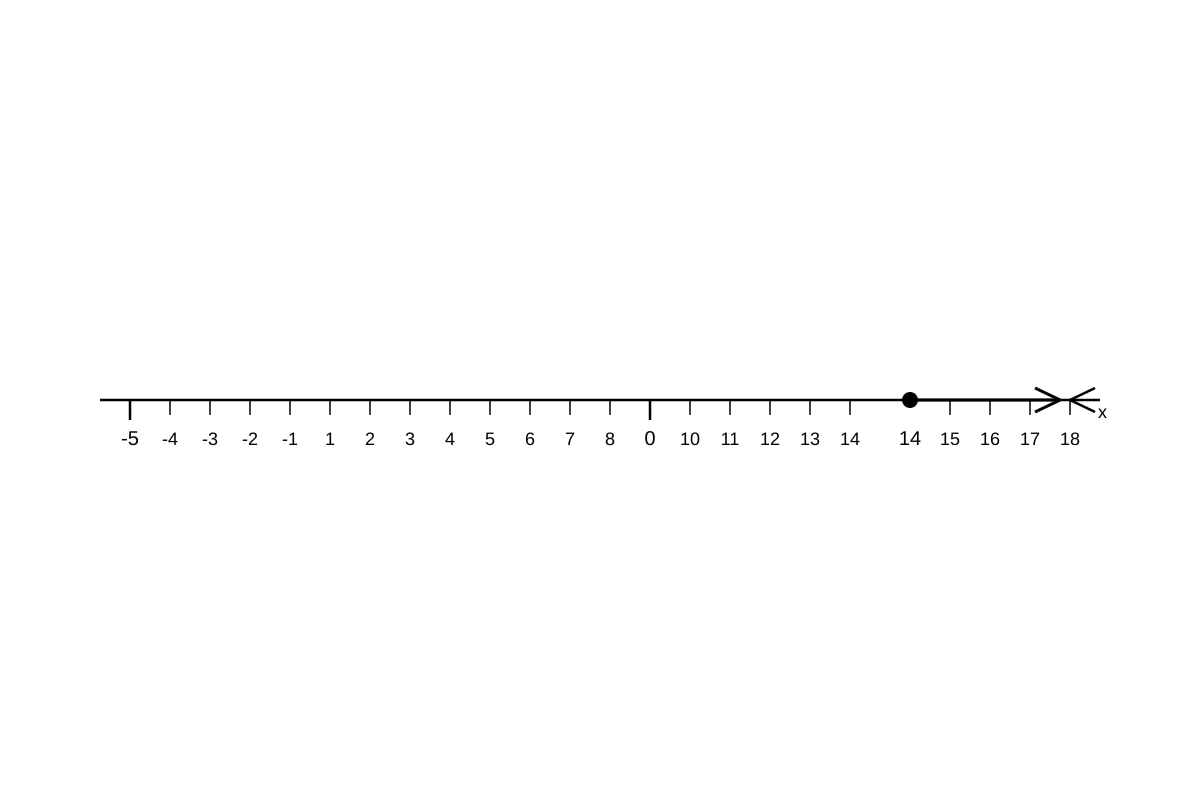
(c) Number line illustration
Closed circle at 14, arrow pointing to the right.
Answer (c): Closed circle at 14, arrow right [1]
Question 18 [5 marks]
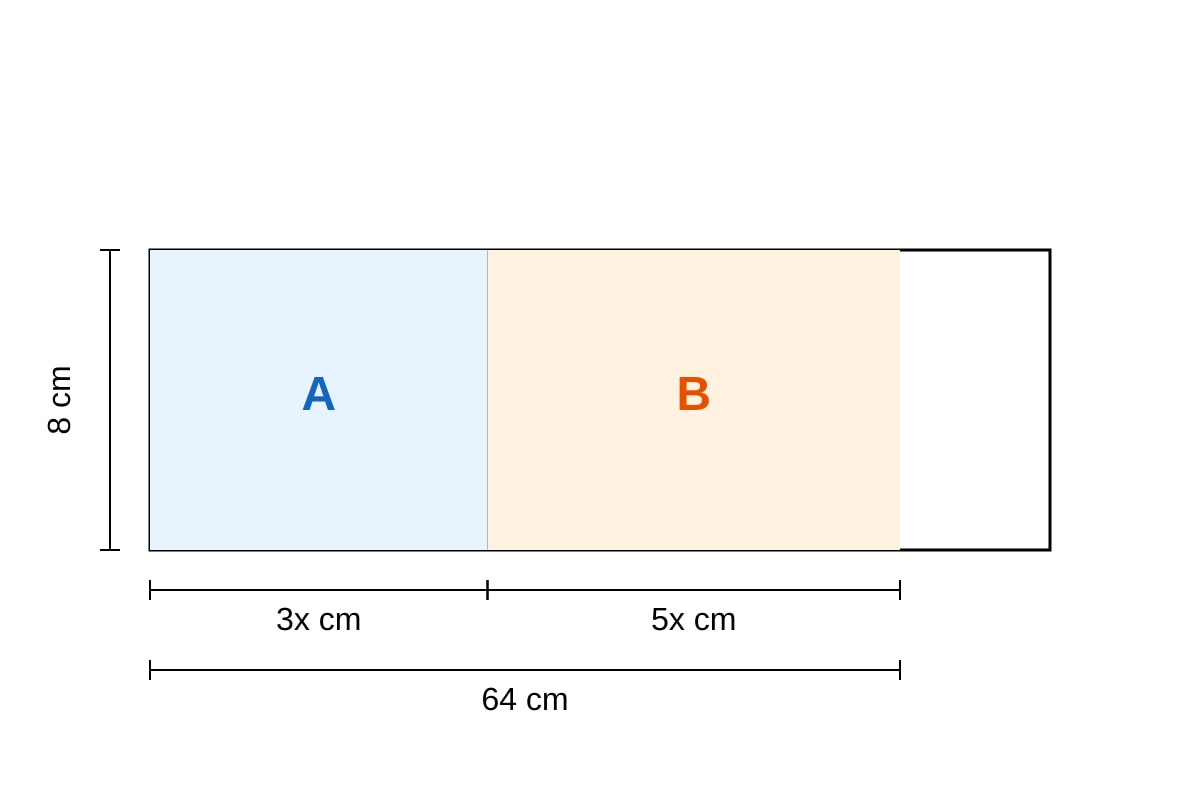
Expected visual: Rectangle A (width 3x, height 8) and Rectangle B (width 5x, height 8) side by side, total length 64 cm
(a) Form equation and solve for x
Working: Total width = width of A + width of B
Answer (a): [2]
(b) Ratio of area A : area B
Working:
- Area A: cm²
- Area B: cm²
Ratio:
Simplify: divide by 64 →
Or note: heights equal, so area ratio = width ratio =
Answer (b): [2]
(c) New total area with 25% height increase
Working: New height: cm
New total area: cm²
Or: original total area = cm² New area = cm²
Answer (c): 640 cm² [1]
Question 19 [5 marks]
(a) Best value for money
Working: Calculate price per litre (or ml per dollar) for each:
Price per litre:
- Small: \frac{1.20}{0.5} = \2.40$ per litre
- Medium: \frac{2.50}{1.25} = \2.00$ per litre
- Large: \frac{3.60}{2} = \1.80$ per litre
Or ml per dollar:
- Small: ml/$
- Medium: ml/$
- Large: ml/$
Lowest price per litre (or highest ml per dollar) is best value.
Answer (a): Large (2 litre) at $1.80 per litre (or equivalent comparison) [3]
Marking: Calculation for each size [1], comparison statement [1], conclusion [1]
(b) Cheapest combination for exactly 30 litres
Working: Need exactly 30 litres = 30 000 ml
To minimize cost, use as many Large bottles as possible:
- Large bottles exactly? No, 15 × 2 = 30 litres. Yes!
Cost: 15 \times 3.60 = \54.00$
Check alternatives:
- 14 Large (28L) + 1 Medium (1.25L) = 29.25L, need 0.75L more — not exact with given sizes
- 14 Large + 2 Medium = 28 + 2.5 = 30.5L (too much)
Actually: 15 × 2L = 30L exactly.
Or: 12 × 2L + 4 × 1.25L + 2 × 0.5L = 24 + 5 + 1 = 30. Cost = 12(3.60) + 4(2.50) + 2(1.20) = 43.20 + 10 + 2.40 = $55.60
15 Large is cheapest at $54.00.
Answer (b): 15 Large bottles; $54.00 [2]
Question 20 [5 marks]
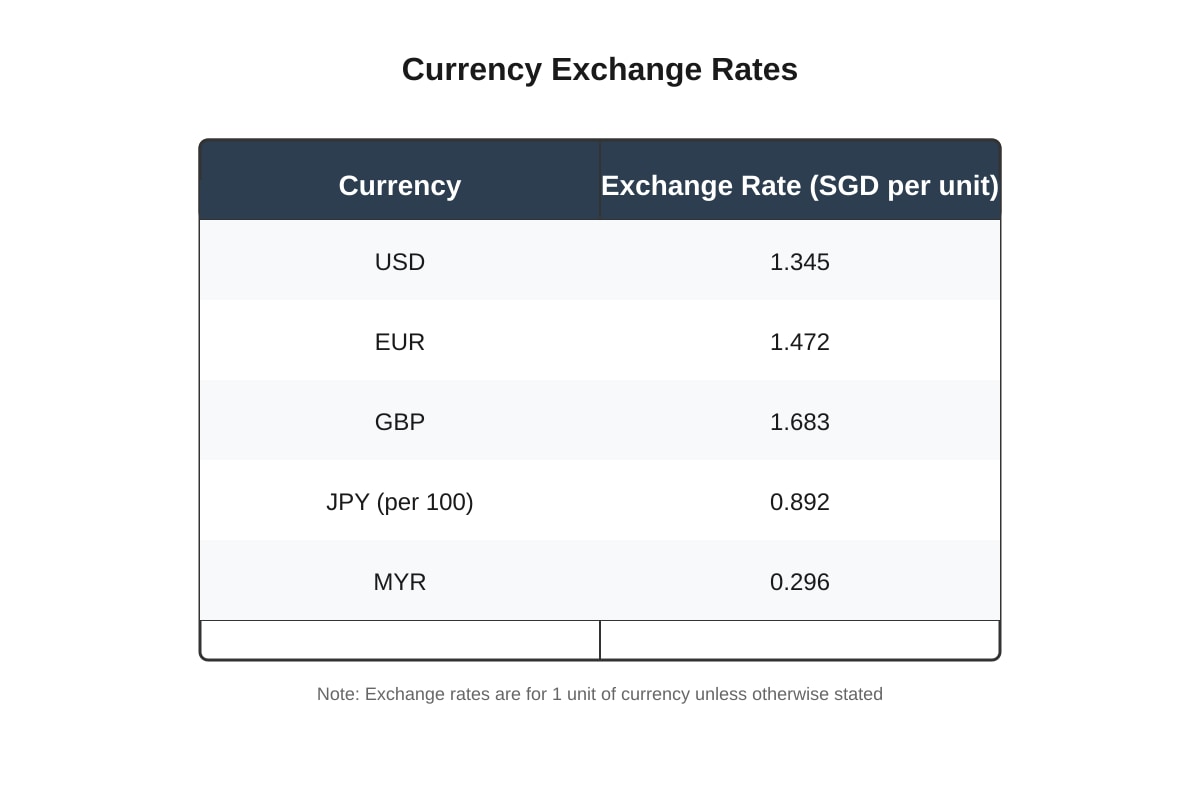
Expected visual: Exchange rate table: USD 1 = SGD 1.345, EUR 1 = SGD 1.472, GBP 1 = SGD 1.683, JPY 100 = SGD 0.892, MYR 1 = SGD 0.296
(a) SGD 2 000 to Euros
Working: EUR 1 = SGD 1.472, so SGD 1 = EUR
SGD 2000 =
To nearest cent: EUR 1358.70
Or: 2000 ÷ 1.472 = 1358.6956...
Answer (a): EUR 1 358.70 (or €1358.70) [2]
(b) Save by buying at cheaper location
Working: Watch in London: GBP 185 Convert to SGD: SGD
In Singapore: SGD 320
Cheaper in London. Savings: 320 - 311.355 = 8.645 \approx \8.65$
Or keep exact:
Answer (b): $8.65 (or $8.64 if rounding differently; accept $8.645) [2]
(c) JPY 50 000 → SGD → MYR
Working: JPY 50 000 to SGD:
- Rate is JPY 100 = SGD 0.892
- JPY 50 000 = JPY 100, so SGD SGD
SGD to MYR:
- MYR 1 = SGD 0.296, so SGD 1 = MYR
MYR =
Or: MYR
Answer (c): MYR 1 506.76 (or ≈ 1506.76, or 1507 rounded) [1]
Accept calculation showing
END OF ANSWER KEY