From Real Exams Quiz
Secondary 1 Mathematics Graphs Coordinate Geometry Quiz
Free Sec 1 Maths Graphs Geometry quiz, Kimi2.6 Exam version, with questions, answers, and syllabus-aligned practice for Singapore students.
These static practice materials are generated from the site's syllabus and paper-generation workflow, with source and model context shown so students and parents can evaluate the material before use.
Questions
Free quiz and exam paper access
Enter your details to view this paper
Your access is remembered on this device.
Answers
Secondary 1 Mathematics Quiz - Graphs Coordinate Geometry: Answer Key
Section A: Plotting and Reading Coordinates
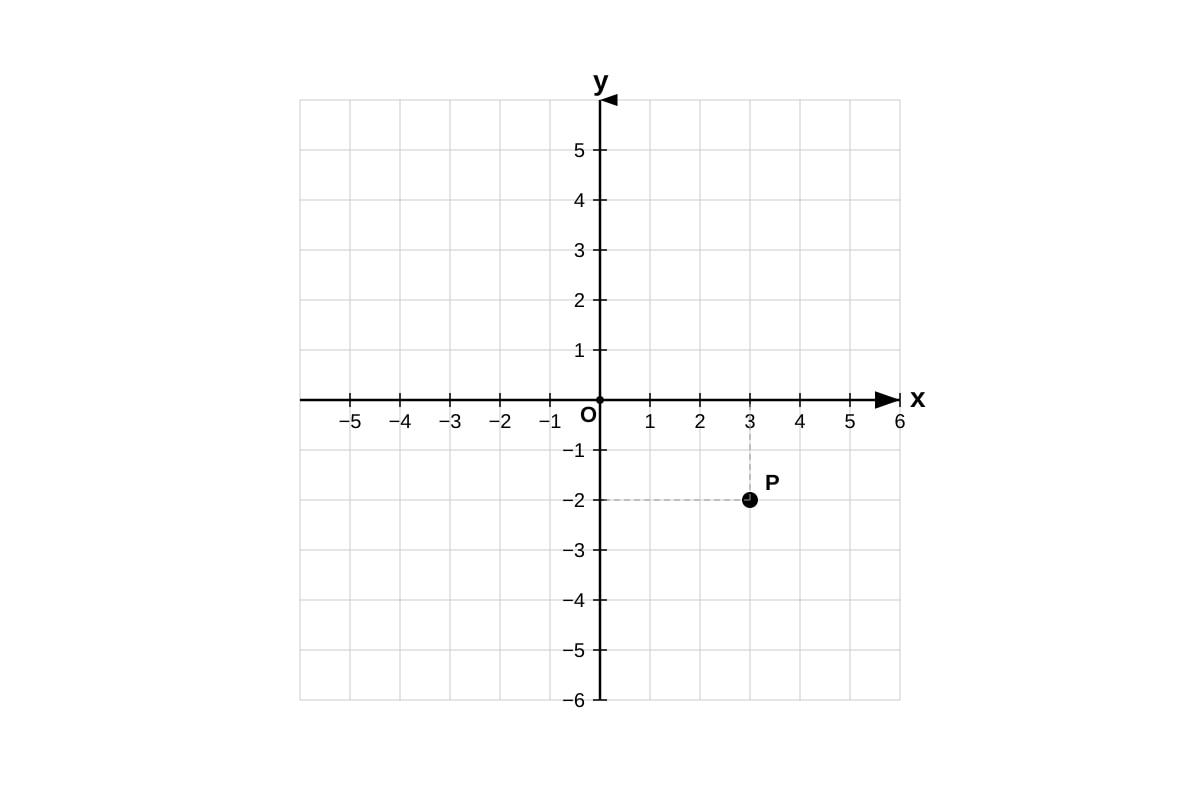
1. [2 marks]
Answer: P(3, -2)
Working and Teaching Notes:
- Coordinates are written as (x, y), where x is the horizontal distance from the origin and y is the vertical distance.
- From the diagram, move 3 units right along the x-axis (positive x), then 2 units down (negative y).
- Marking: 1 mark for x-coordinate 3; 1 mark for y-coordinate -2.
- Common mistake: Writing (-2, 3) or (3, 2) — always remember "x before y" and check the sign of each value.
2. [3 marks]
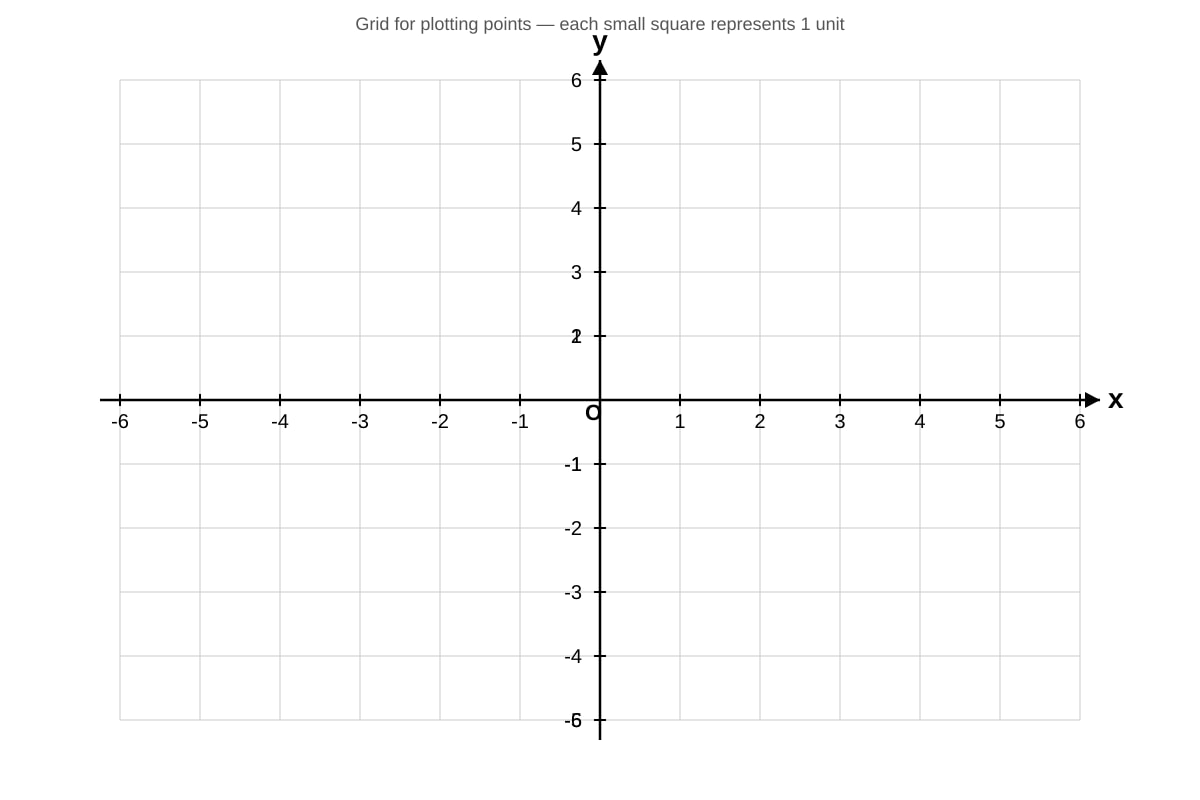
Expected answer: Three points correctly plotted and labeled.
Working and Teaching Notes:
- Point A(-4, 1): From origin, move 4 units left (negative x), 1 unit up (positive y).
- Point B(2, 5): From origin, move 2 units right, 5 units up.
- Point C(0, -3): On the y-axis, 3 units down — this lies on the y-axis since x = 0.
- Marking: 1 mark for each correctly plotted and labeled point.
- Common mistake: Swapping x and y coordinates; plotting C on the x-axis instead of the y-axis.
3. [2 marks] — 1 mark each part
(a) Answer: E(-5, -2)
(b) Answer: F(5, 2)
Working and Teaching Notes:
- Reflection in the y-axis: The y-coordinate stays the same; the x-coordinate changes sign.
- D(5, -2) → E(-5, -2)
- Rule: (x, y) → (-x, y)
- Reflection in the x-axis: The x-coordinate stays the same; the y-coordinate changes sign.
- D(5, -2) → F(5, 2)
- Rule: (x, y) → (x, -y)
- Common mistake: Confusing which coordinate changes — remember "y-axis reflection changes x, x-axis reflection changes y."
4. [1 mark]
Answer: Second quadrant
Teaching Notes:
- Quadrants are numbered counter-clockwise from the positive x-axis:
- First quadrant: x > 0, y > 0
- Second quadrant: x < 0, y > 0 ← (-7, 4) fits here
- Third quadrant: x < 0, y < 0
- Fourth quadrant: x > 0, y < 0
- For (-7, 4): x is negative, y is positive → second quadrant.
5. [3 marks]
Answer: k = 0
Working and Teaching Notes:
- A point on the line y = x must have its x-coordinate equal to its y-coordinate.
- For G(k, 2k): the x-coordinate is k and the y-coordinate is 2k.
- Since y = x: 2k = k
- Subtract k from both sides: 2k - k = 0, so k = 0.
- Check: G(0, 0), which is the origin, and the origin lies on y = x. ✓
- Marking: 1 mark for setting up equation 2k = k; 1 mark for solving; 1 mark for verifying or stating the point.
Alternative method: Substitute into y = x: 2k = k.
Section B: Distance and Length
6. [2 marks]
Answer: 5 units
Working and Teaching Notes:
- Use the distance formula:
- Substitute A(1, 2) and B(4, 6):
- Marking: 1 mark for correct substitution; 1 mark for final answer.
- This is a classic 3-4-5 Pythagorean triple — recognizing this pattern saves time.
7. [3 marks]
Answer: units (or )
Working and Teaching Notes:
- Using the distance formula with C(-3, 5) and D(1, -1):
- Marking: 1 mark for correct substitution; 1 mark for ; 1 mark for simplifying to .
- Common mistake: Forgetting to square negative values properly — , not -36.
8. [3 marks]
Answer: p = 5 or p = 13
Working and Teaching Notes:
- Using distance formula:
- Square both sides:
- So or
- If : p = 5
- If : p = 13
- Check:
- For p = 5: E(2, 5), distance = ✓
- For p = 13: E(2, 13), distance = ✓
- Marking: 1 mark for setting up equation; 1 mark for solving quadratic; 1 mark for both values.
- Common mistake: Forgetting the negative square root, giving only p = 5.
9. [2 marks]
Answer: 10 units
Working and Teaching Notes:
- O is (0, 0), so this is distance from origin.
- This is another Pythagorean triple: 6-8-10 (scaled 3-4-5).
- Marking: 1 mark for method; 1 mark for answer.
- Alternatively, recognize 6-8-10 pattern directly for full credit with stated reasoning.
10. [2 marks]
Answer: J(-4, 5) — both are at distance , so they are equidistant (same distance)
Working and Teaching Notes:
- Distance OJ =
- Distance OK =
Wait — let me recalculate:
- OJ =
- OK =
Corrected Answer: K(3, 6) is further from the origin.
- Marking: 1 mark for both distances calculated; 1 mark for correct comparison and conclusion.
- Common mistake: Not showing working, or only calculating one distance.
Section C: Gradient and Equation of Straight Line
11. [2 marks]
Answer: 2
Working and Teaching Notes:
- Gradient formula:
- Marking: 1 mark for substitution; 1 mark for simplification.
- Common mistake: Reversing the formula as — remember "rise over run" (y-change over x-change).
12. [3 marks]
Answer: or equivalent
Working and Teaching Notes:
- Start with y = mx + c with m = :
- Substitute point (8, 1):
- Final equation:
- Marking: 1 mark for using correct gradient; 1 mark for substituting point; 1 mark for finding c and stating equation.
- Common mistake: Arithmetic error with , or forgetting to write "y = " in final answer.
13. [3 marks] — 2 marks (a), 1 mark (b)
(a) Answer: A(5, 0)
(b) Answer: B(0, 2)
Working and Teaching Notes:
- x-intercept (point A): Set y = 0, solve for x:
- So A(5, 0)
- y-intercept (point B): Set x = 0, solve for y:
- So B(0, 2)
- Marking (a): 1 mark for setting y = 0; 1 mark for correct coordinates.
- Marking (b): 1 mark for correct coordinates (or follow-through from method).
14. [2 marks]
Answer:
Working and Teaching Notes:
- Rearrange to y = mx + c form:
- Gradient is the coefficient of x:
- Marking: 1 mark for rearranging; 1 mark for identifying gradient.
- Common mistake: Stopping at and thinking gradient is 4 or 3; sign errors when dividing by -4.
15. [2 marks]
Answer: (or -2.5)
Working and Teaching Notes:
- For perpendicular lines: , so
- Given :
- Marking: 1 mark for correct formula or method; 1 mark for answer.
- Common mistake: Giving (missing negative sign) or (reciprocal without flip).
Section D: Interpretation and Application
16. [5 marks] — 2 marks (a), 1 mark (b), 2 marks (c)
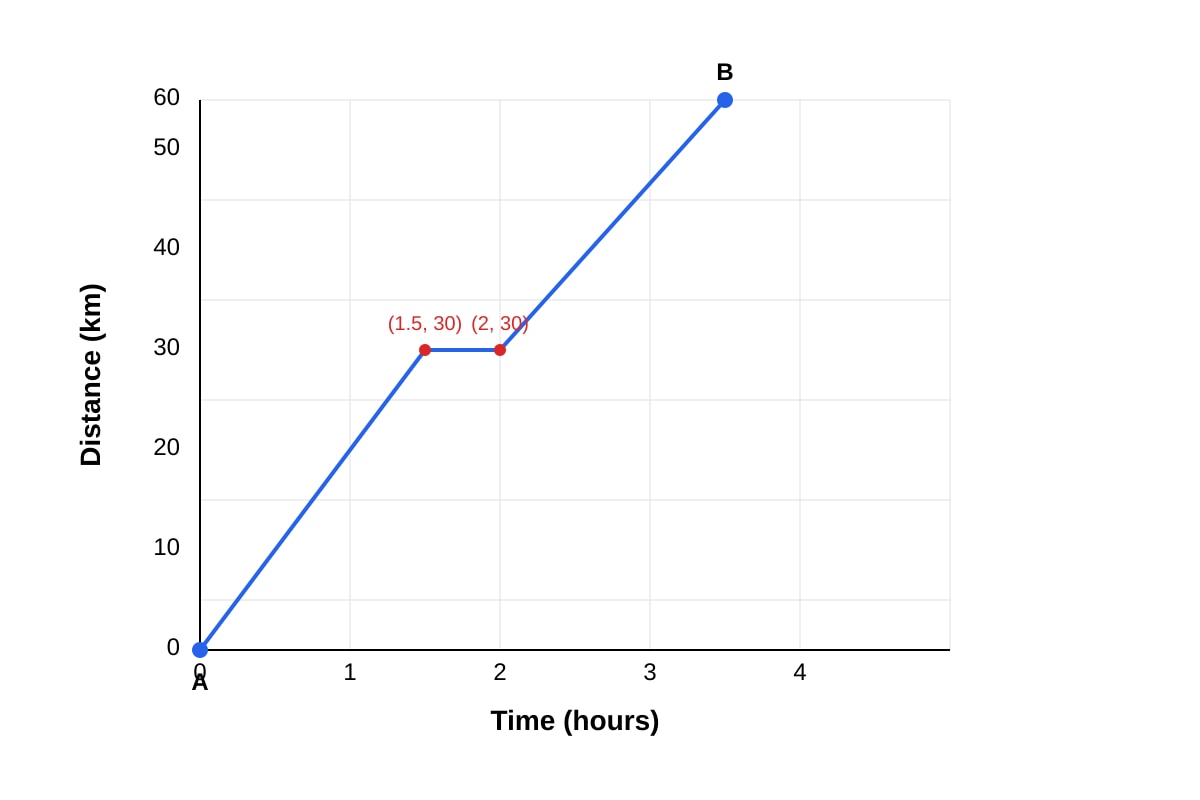
(a) Answer: 20 km/h
Working:
- Speed = gradient of distance-time graph =
- Speed = km/h
(b) Answer: 30 minutes
Working:
- Rest period is shown by horizontal line: from t = 1.5 to t = 2 hours
- Time = 2 - 1.5 = 0.5 hours = 30 minutes
(c) Answer: km/h (or exact: km/h)
Working:
- Total distance = 60 km
- Total time = 3.5 hours
- Average speed = km/h
Marking: (a) 1 mark for gradient interpretation, 1 mark for answer; (b) 1 mark; (c) 1 mark for total distance/time, 1 mark for correct calculation. Common mistake: For (c), using only moving time instead of total time.
17. [4 marks] — 2 marks (a), 2 marks (b)
(a) Answer:
| x | -2 | -1 | 0 | 1 | 2 |
|---|---|---|---|---|---|
| y | -7 | -5 | -3 | -1 | 1 |
Working: Substitute each x into y = 2x - 3:
- x = -2: y = -4 - 3 = -7
- x = -1: y = -2 - 3 = -5
- x = 0: y = 0 - 3 = -3
- x = 1: y = 2 - 3 = -1
- x = 2: y = 4 - 3 = 1
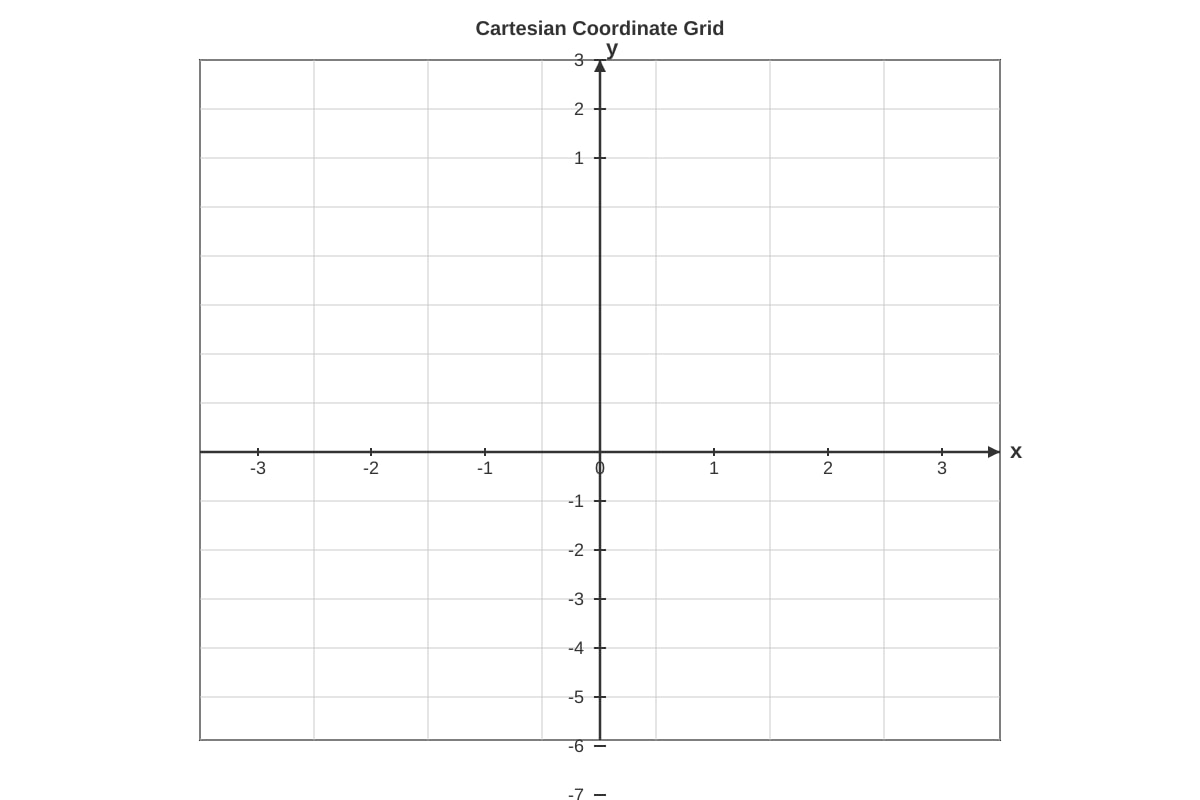
(b) Plot all five points and join with a straight line.
Marking (a): 2 marks for all correct (deduct 1 mark for 1-2 errors). Marking (b): 1 mark for correct points plotted; 1 mark for straight line through all points. Common mistake: Sign errors with negative x values, especially x = -2: 2(-2) = -4, not 4.
18. [4 marks] — 3 marks (a), 1 mark (b)
(a) Answer: P(1, 3)
Working:
- Set equations equal: x + 2 = 4 - x
- 2x = 2, so x = 1
- Substitute: y = 1 + 2 = 3
- Check in second equation: y = 4 - 1 = 3 ✓
- So P(1, 3)
(b) Answer: x = 1, y = 3
Teaching Notes:
- The simultaneous equations are rearrangements of the same lines:
- y = x + 2 → x - y = -2
- y = 4 - x → x + y = 4
- The intersection point is the solution to both equations.
Marking (a): 1 mark for eliminating one variable; 1 mark for finding x; 1 mark for finding y. Marking (b): 1 mark for stating both values (follow through from errors in part a).
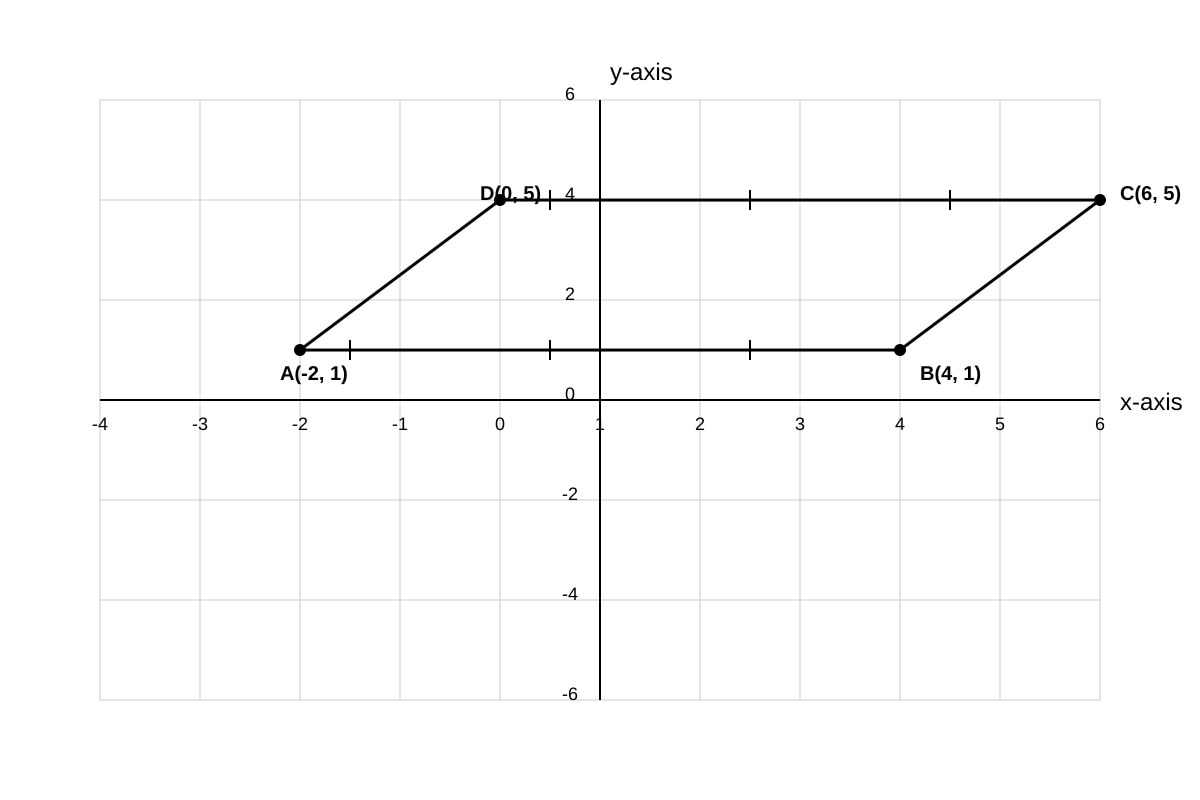
19. [3 marks]
Answer:
- Gradient of AB =
- Gradient of DC =
- Both gradients equal 0, so AB // DC (parallel)
Alternatively: Both are horizontal lines (constant y-value), so both have gradient 0.
Marking: 1 mark for each gradient calculated; 1 mark for conclusion with reason. Teaching Notes: Parallel lines have equal gradients. Horizontal lines have gradient 0. Common mistake: Calculating distance instead of gradient; not stating the conclusion explicitly.
20. [4 marks] — 2 marks each part
(a) Answer:
Working:
- Parallel lines have equal gradient, so m =
- Substitute (2, -3):
- c = -4
- Equation:
(b) Answer: No, the line does NOT pass through (6, 1)
Working:
- Check: when x = 6, y =
- But the point has y = 1, not -1.
- Alternatively: , and 1 ≠ -1.
- Or substitute into original: → 1 = 3 - 4 → 1 = -1, which is false.
Marking (a): 1 mark for gradient; 1 mark for finding c and equation. Marking (b): 1 mark for substitution; 1 mark for correct conclusion with evidence. Common mistake: In (b), saying "no" without showing the check — full marks require justification.
TOTAL MARKS: 40
Section totals: A = 10, B = 10, C = 10, D = 10