From Real Exams Quiz

Secondary 1 Mathematics Geometry Trigonometry Quiz

Free Exam-Derived Owl Alpha Secondary 1 Mathematics Geometry Trigonometry quiz with questions and answers for Singapore students. This page is rendered as a direct URL so the questions and answers can be discovered without pressing in-page buttons.

These static practice materials are generated from the site's syllabus and paper-generation workflow, with source and model context shown so students and parents can evaluate the material before use.

Secondary 1 Mathematics From Real Exams Generated by Owl Alpha Updated 2026-06-04

Questions

<!-- TuitionGoWhere generation metadata: stage=3-0; model=openrouter/owl-alpha; model_label=Owl Alpha; generated=2026-06-03; Sources: Stage 2-1 real exam-derived templates and Stage 2-2 exam-enriched syllabus. -->

Secondary 1 Mathematics Quiz - Geometry Trigonometry

Name: ________________________________ Class: ________________________________ Date: ________________________________ Score: ____ / 40

Duration: 50 minutes Total Marks: 40


Instructions

  • Answer all questions in the spaces provided.
  • Show all working clearly. Marks will be awarded for correct working even if the final answer is wrong.
  • Do not use a calculator unless stated otherwise.
  • Write your answers in the spaces provided.
  • The number of marks for each question is shown in brackets [ ].

Section A: Angle Properties and Parallel Lines (Questions 1–5)

Questions 1–5 test your understanding of angles formed by parallel lines and transversals, and basic angle properties.


1. In the diagram below, lines ABAB and CDCD are parallel, and line EFEF is a transversal. EGB=68°\angle EGB = 68°.

        A ________________________ B
                    /
                   / 68°
          E -----/----------------- F
                  \
                   \
        C ________________________ D

Find the value of GHD\angle GHD. Give a reason for your answer.

GHD=________°\angle GHD = \_\_\_\_\_\_\_\_° \hspace{2cm} Reason: ____________________________________________

[2]


2. In the diagram, PQRSPQ \parallel RS and TUTU is a transversal. QUT=115°\angle QUT = 115°.

Find the values of:

(a) RUV=________°\angle RUV = \_\_\_\_\_\_\_\_°

(b) PUV=________°\angle PUV = \_\_\_\_\_\_\_\_°

[3]


3. Two parallel lines are cut by a transversal. One of the co-interior angles is (3x+15)°(3x + 15)° and the other is (2x+45)°(2x + 45)°.

(a) Form an equation in xx.

Equation: ____________________________________________

(b) Solve for xx.

x=________x = \_\_\_\_\_\_\_\_

(c) Find the size of each co-interior angle.

Angle 1 = ________° \hspace{2cm} Angle 2 = ________°

[4]


4. In the diagram, ABCDAB \parallel CD. BAC=42°\angle BAC = 42° and ACD=73°\angle ACD = 73°.

Calculate ABC\angle ABC. Show all your working clearly.

ABC=________°\angle ABC = \_\_\_\_\_\_\_\_°

[3]


5. The diagram shows two parallel lines cut by a transversal. Find the value of xx.

        _______________
               / (5x - 10)°
              /
    _________/__________
            /
           / (3x + 20)°
    _________/__________

x=________x = \_\_\_\_\_\_\_\_

[2]


Section B: Angle Properties of Triangles and Polygons (Questions 6–10)

Questions 6–10 test your understanding of angle sum properties of triangles and polygons.


6. In triangle ABCABC, A=55°\angle A = 55° and B=72°\angle B = 72°.

(a) Calculate C\angle C.

C=________°\angle C = \_\_\_\_\_\_\_\_°

(b) State the type of triangle ABCABC based on its angles (acute, right, or obtuse).

Type: ____________________________________________

[3]


7. In an isosceles triangle PQRPQR, PQ=PRPQ = PR. Q=(4x+8)°\angle Q = (4x + 8)° and R=(6x12)°\angle R = (6x - 12)°.

(a) Explain why Q=R\angle Q = \angle R.

__________________________________________________________________________________________

(b) Find the value of xx.

x=________x = \_\_\_\_\_\_\_\_

(c) Calculate P\angle P.

P=________°\angle P = \_\_\_\_\_\_\_\_°

[4]


8. The diagram shows a regular hexagon.

(a) Calculate the sum of the interior angles of a hexagon.

Sum = ________°

(b) Calculate the size of each interior angle of a regular hexagon.

Each interior angle = ________°

[3]


9. A polygon has an interior angle sum of 1440°1440°.

(a) Show that the polygon has 10 sides.

Working: ___________________________________________________________________________________________

(b) What is the name of this polygon?

Name: ____________________________________________

[3]


10. In triangle XYZXYZ, X=38°\angle X = 38° and the exterior angle at vertex YY is 127°127°.

(a) Calculate XYZ\angle XYZ.

XYZ=________°\angle XYZ = \_\_\_\_\_\_\_\_°

(b) Calculate XZY\angle XZY.

XZY=________°\angle XZY = \_\_\_\_\_\_\_\_°

[3]


Section C: Bearings, Scale Drawing, and Geometric Construction (Questions 11–15)

Questions 11–15 test your understanding of bearings, scale drawing, and geometric constructions.


11. A ship sails from Port AA to Port BB on a bearing of 065°065°.

(a) On the diagram below, draw and label the bearing of Port BB from Port AA.

         N
         |
         |
    A ───┼──────
         |
         |

(b) What is the bearing of Port AA from Port BB?

Bearing of AA from BB = ________°

[3]


12. The scale of a map is 1:250001 : 25\,000.

(a) On the map, the distance between two towns is 6.86.8 cm. Calculate the actual distance in kilometres.

Actual distance = ________ km

(b) The actual distance between two landmarks is 3.53.5 km. Calculate the distance on the map in centimetres.

Map distance = ________ cm

[3]


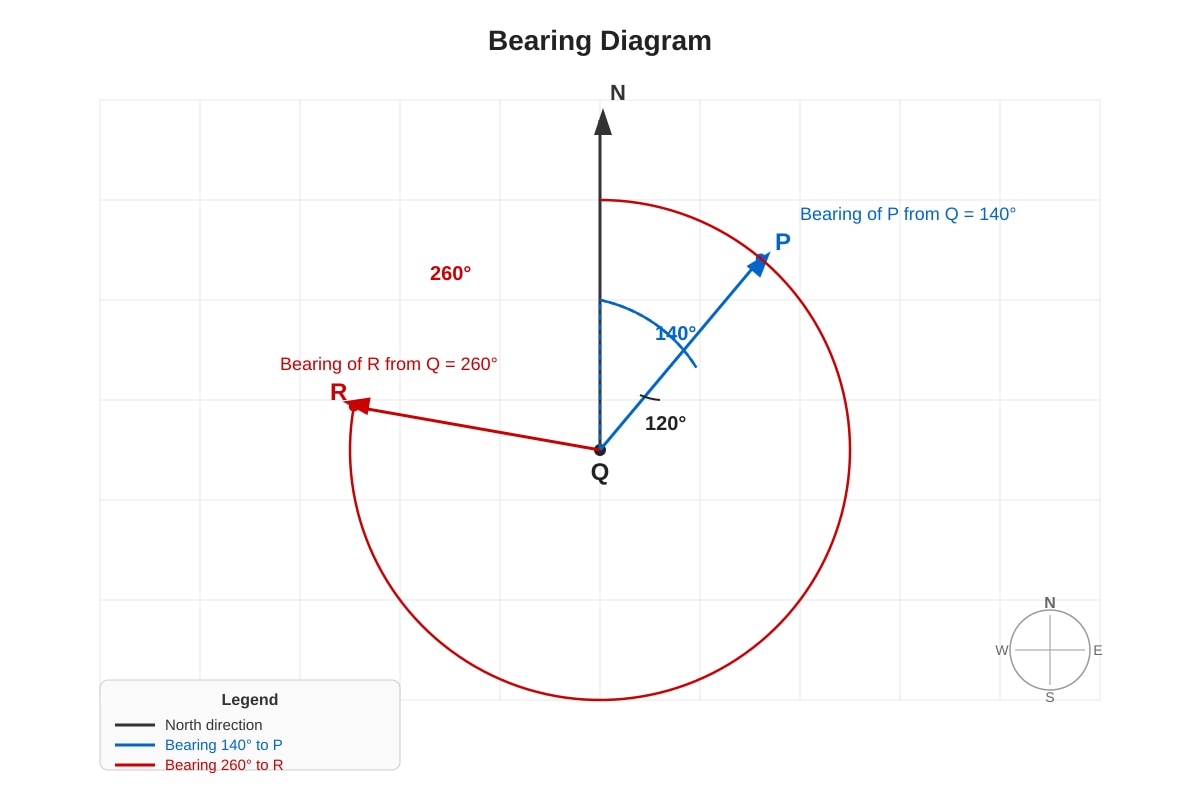
13. Town PP is on a bearing of 140°140° from Town QQ. Town RR is on a bearing of 260°260° from Town QQ.

(a) Draw a diagram showing the positions of PP, QQ, and RR. Mark North at QQ.

(b) Calculate PQR\angle PQR.

PQR=________°\angle PQR = \_\_\_\_\_\_\_\_°

[3]


14. A rectangular field has a length of 120120 m and a width of 8080 m. The field is drawn to a scale of 1:40001 : 4000.

(a) Calculate the length of the field on the drawing.

Length on drawing = ________ cm

(b) Calculate the width of the field on the drawing.

Width on drawing = ________ cm

[2]


15. The bearing of Town XX from Town YY is 215°215°.

(a) What is the bearing of Town YY from Town XX?

Bearing = ________°

(b) Explain how you found your answer.

__________________________________________________________________________________________

[2]


Section D: Pythagoras' Theorem and Trigonometry (Questions 16–20)

Questions 16–20 test your understanding of Pythagoras' Theorem and basic trigonometric ratios.


16. In triangle ABCABC, B=90°\angle B = 90°, AB=8AB = 8 cm and BC=6BC = 6 cm.

(a) Calculate the length of ACAC.

AC=________AC = \_\_\_\_\_\_\_\_ cm

(b) State whether triangle ABCABC is scalene, isosceles, or equilateral.

Type: ____________________________________________

[3]


17. A ladder 1010 m long leans against a wall. The foot of the ladder is 66 m from the base of the wall.

(a) Using Pythagoras' Theorem, calculate how far up the wall the ladder reaches.

Height = ________ m

(b) Give your answer correct to 11 decimal place.

Height = ________ m (1 d.p.)

[3]


18. In triangle PQRPQR, Q=90°\angle Q = 90°, PQ=5PQ = 5 cm and QR=12QR = 12 cm.

(a) Calculate tan(QPR)\tan(\angle QPR).

tan(QPR)=________\tan(\angle QPR) = \_\_\_\_\_\_\_\_

(b) Calculate sin(QRP)\sin(\angle QRP).

sin(QRP)=________\sin(\angle QRP) = \_\_\_\_\_\_\_\_

[3]


19. A vertical pole ABAB stands on horizontal ground. From point CC on the ground, 1515 m from the base of the pole, the angle of elevation of the top of the pole BB is 35°35°.

        B
        |\
        | \
        |  \
        |   \
        | 35°\
        A─────C
           15 m

Using tan35°=0.7002\tan 35° = 0.7002, calculate the height of the pole ABAB.

AB=________AB = \_\_\_\_\_\_\_\_ m

[3]


20. In triangle XYZXYZ, Y=90°\angle Y = 90°, XY=7XY = 7 cm and YZ=24YZ = 24 cm.

(a) Calculate the length of XZXZ.

XZ=________XZ = \_\_\_\_\_\_\_\_ cm

(b) Calculate cos(ZXY)\cos(\angle ZXY).

cos(ZXY)=________\cos(\angle ZXY) = \_\_\_\_\_\_\_\_

(c) Calculate ZXY\angle ZXY correct to the nearest degree.

ZXY=________°\angle ZXY = \_\_\_\_\_\_\_\_°

[4]


End of Quiz

Total: 40 marks

Answers

<!-- TuitionGoWhere generation metadata: stage=3-0; model=openrouter/owl-alpha; model_label=Owl Alpha; generated=2026-06-03; Sources: Stage 2-1 real exam-derived templates and Stage 2-2 exam-enriched syllabus. -->

Secondary 1 Mathematics Quiz - Geometry Trigonometry

Answer Key


Section A: Angle Properties and Parallel Lines

1. GHD=68°\angle GHD = 68° \hspace{1cm} Reason: Corresponding angles are equal (since ABCDAB \parallel CD).

[2 marks]

  • 1 mark for correct angle value.
  • 1 mark for correct reason (corresponding angles / alternate angles accepted if correctly identified).

Common mistake: Students may confuse corresponding angles with co-interior angles and give 116°116°.


2. (a) RUV=65°\angle RUV = 65° (co-interior / supplementary angles: 180°115°=65°180° - 115° = 65°)

(b) PUV=115°\angle PUV = 115° (corresponding angles are equal, or vertically opposite to QUT\angle QUT)

[3 marks]

  • 2 marks for part (a): 1 for method, 1 for correct answer.
  • 1 mark for part (b).

3. (a) Equation: (3x+15)+(2x+45)=180(3x + 15) + (2x + 45) = 180

(b) 5x+60=1805x + 60 = 180 5x=1205x = 120 x=24x = 24

(c) Angle 1 = 3(24)+15=87°3(24) + 15 = 87° Angle 2 = 2(24)+45=93°2(24) + 45 = 93°

[4 marks]

  • 1 mark for correct equation.
  • 1 mark for correct value of xx.
  • 1 mark for each correct angle.

Common mistake: Students may set the two angles equal instead of supplementary.


4. Draw line through CC parallel to ABAB (or use alternate angles): ABC=180°42°73°=65°\angle ABC = 180° - 42° - 73° = 65°

Alternatively: BCD=180°73°=107°\angle BCD = 180° - 73° = 107° (co-interior), then ABC=180°107°42°\angle ABC = 180° - 107° - 42°...

Using the standard method: Since ABCDAB \parallel CD, BAC+ACD+ABC\angle BAC + \angle ACD + \angle ABC is not directly applicable. Instead, construct or use: ABC=180°BACBCA\angle ABC = 180° - \angle BAC - \angle BCA where BCA=180°73°ACB\angle BCA = 180° - 73° - \angle ACB...

Correct method: Extend BCBC or use the fact that the sum of angles in triangle ABCABC is 180°180°. Since ABCDAB \parallel CD, ABC=180°42°73°=65°\angle ABC = 180° - 42° - 73° = 65° (using alternate interior angles: BCD=180°73°=107°\angle BCD = 180° - 73° = 107° is the exterior angle at CC, so ACB=73°42°\angle ACB = 73° - 42°... )

Simplest correct working: Since ABCDAB \parallel CD, ABC=180°42°73°=65°\angle ABC = 180° - 42° - 73° = 65° (angles on a straight line / alternate angles).

ABC=65°\angle ABC = 65°

[3 marks]

  • 1 mark for identifying the correct angle relationship.
  • 1 mark for correct working.
  • 1 mark for correct answer.

5. (5x10)+(3x+20)=180(5x - 10) + (3x + 20) = 180 (co-interior angles are supplementary) 8x+10=1808x + 10 = 180 8x=1708x = 170 x=21.25x = 21.25

x=21.25x = 21.25 (or x=854x = \frac{85}{4})

[2 marks]

  • 1 mark for correct equation.
  • 1 mark for correct answer.

Section B: Angle Properties of Triangles and Polygons

6. (a) C=180°55°72°=53°\angle C = 180° - 55° - 72° = 53°

(b) Type: Acute-angled triangle (all angles are less than 90°90°)

[3 marks]

  • 2 marks for part (a): 1 for method, 1 for correct answer.
  • 1 mark for part (b).

7. (a) Since PQ=PRPQ = PR, triangle PQRPQR is isosceles, so the base angles Q\angle Q and R\angle R are equal.

(b) 4x+8=6x124x + 8 = 6x - 12 8+12=6x4x8 + 12 = 6x - 4x 20=2x20 = 2x x=10x = 10

(c) Q=R=4(10)+8=48°\angle Q = \angle R = 4(10) + 8 = 48° P=180°48°48°=84°\angle P = 180° - 48° - 48° = 84°

[4 marks]

  • 1 mark for correct explanation in (a).
  • 1 mark for correct value of xx in (b).
  • 2 marks for part (c): 1 for each angle or 1 for method and 1 for answer.

8. (a) Sum of interior angles =(n2)×180°=(62)×180°=4×180°=720°= (n - 2) \times 180° = (6 - 2) \times 180° = 4 \times 180° = 720°

(b) Each interior angle =720°6=120°= \frac{720°}{6} = 120°

[3 marks]

  • 2 marks for part (a): 1 for formula, 1 for correct answer.
  • 1 mark for part (b).

9. (a) (n2)×180°=1440°(n - 2) \times 180° = 1440° n2=1440180=8n - 2 = \frac{1440}{180} = 8 n=10n = 10

The polygon has 10 sides.

(b) Name: Decagon

[3 marks]

  • 2 marks for part (a): 1 for correct equation, 1 for correct solution.
  • 1 mark for part (b).

10. (a) Exterior angle at Y=127°Y = 127° XYZ=180°127°=53°\angle XYZ = 180° - 127° = 53° (angles on a straight line)

(b) XZY=180°38°53°=89°\angle XZY = 180° - 38° - 53° = 89°

[3 marks]

  • 2 marks for part (a): 1 for method, 1 for correct answer.
  • 1 mark for part (b).

Section C: Bearings, Scale Drawing, and Geometric Construction

11. (a) [Diagram: From point AA, draw a line at 065°065° measured clockwise from North.]
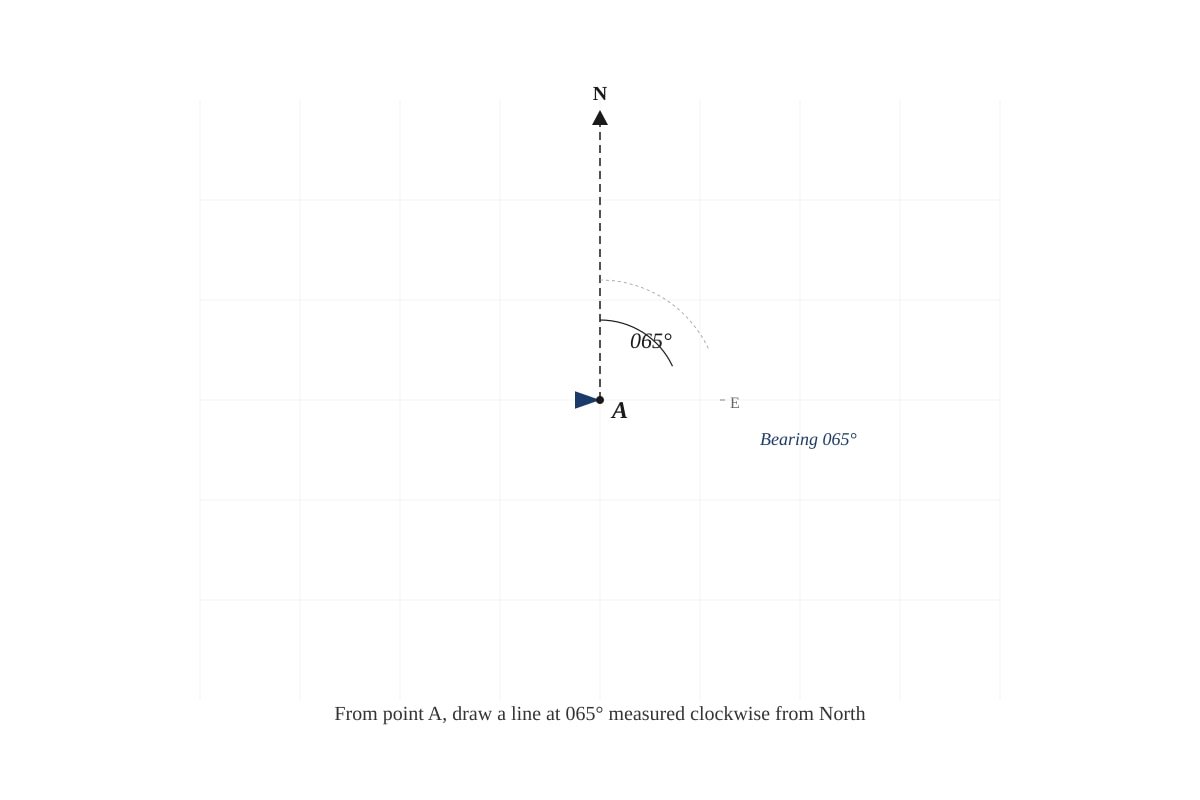
(b) Bearing of AA from B=065°+180°=245°B = 065° + 180° = 245°

[3 marks]

  • 2 marks for part (a): 1 for correct direction, 1 for correct angle.
  • 1 mark for part (b).

Common mistake: Students may subtract 180°180° incorrectly or give 065°065° without adding 180°180°.


12. (a) Map distance =6.8= 6.8 cm Scale 1:250001 : 25\,000 Actual distance =6.8×25000=170000= 6.8 \times 25\,000 = 170\,000 cm =1.7= 1.7 km

(b) Actual distance =3.5= 3.5 km =350000= 350\,000 cm Map distance =35000025000=14= \frac{350\,000}{25\,000} = 14 cm

[3 marks]

  • 2 marks for part (a): 1 for correct multiplication, 1 for correct unit conversion.
  • 1 mark for part (b).

13. (a) [Diagram: At point QQ, draw North. Measure 140°140° clockwise from North to locate PP. Measure 260°260° clockwise from North to locate RR.]

(b) PQR=260°140°=120°\angle PQR = 260° - 140° = 120°

[3 marks]

  • 2 marks for part (a): 1 for correct bearing of PP, 1 for correct bearing of RR.
  • 1 mark for part (b).

14. (a) Actual length =120= 120 m =12000= 12\,000 cm Length on drawing =120004000=3= \frac{12\,000}{4000} = 3 cm

(b) Actual width =80= 80 m =8000= 8\,000 cm Width on drawing =80004000=2= \frac{8\,000}{4000} = 2 cm

[2 marks]

  • 1 mark for each correct answer.

15. (a) Bearing of YY from X=215°180°=035°X = 215° - 180° = 035°

(b) To find the reverse bearing, subtract 180°180° from the original bearing (since the total of a bearing and its reverse is 360°360°, or equivalently, the reverse bearing is 180°180° different from the original).

[2 marks]

  • 1 mark for correct answer.
  • 1 mark for correct explanation.

Section D: Pythagoras' Theorem and Trigonometry

16. (a) AC2=AB2+BC2=82+62=64+36=100AC^2 = AB^2 + BC^2 = 8^2 + 6^2 = 64 + 36 = 100 AC=100=10AC = \sqrt{100} = 10 cm

(b) Type: Scalene (all three sides have different lengths: 6 cm, 8 cm, 10 cm)

[3 marks]

  • 2 marks for part (a): 1 for correct substitution into Pythagoras' formula, 1 for correct answer.
  • 1 mark for part (b).

17. (a) Let the height be hh m. h2+62=102h^2 + 6^2 = 10^2 h2+36=100h^2 + 36 = 100 h2=64h^2 = 64 h=64=8h = \sqrt{64} = 8 m

(b) Height =8.0= 8.0 m (1 d.p.)

[3 marks]

  • 2 marks for part (a): 1 for correct equation, 1 for correct answer.
  • 1 mark for part (b).

18. (a) First, find PRPR: PR2=PQ2+QR2=52+122=25+144=169PR^2 = PQ^2 + QR^2 = 5^2 + 12^2 = 25 + 144 = 169 PR=169=13PR = \sqrt{169} = 13 cm

tan(QPR)=oppositeadjacent=QRPQ=125=2.4\tan(\angle QPR) = \frac{\text{opposite}}{\text{adjacent}} = \frac{QR}{PQ} = \frac{12}{5} = 2.4

(b) sin(QRP)=oppositehypotenuse=PQPR=513\sin(\angle QRP) = \frac{\text{opposite}}{\text{hypotenuse}} = \frac{PQ}{PR} = \frac{5}{13}

[3 marks]

  • 2 marks for part (a): 1 for finding PRPR, 1 for correct ratio.
  • 1 mark for part (b).

19. tan35°=ABAC=AB15\tan 35° = \frac{AB}{AC} = \frac{AB}{15} AB=15×tan35°=15×0.7002=10.503AB = 15 \times \tan 35° = 15 \times 0.7002 = 10.503

AB=10.5AB = 10.5 m (or 10.5010.50 m)

[3 marks]

  • 1 mark for correct trigonometric ratio.
  • 1 mark for correct substitution.
  • 1 mark for correct answer.

20. (a) XZ2=XY2+YZ2=72+242=49+576=625XZ^2 = XY^2 + YZ^2 = 7^2 + 24^2 = 49 + 576 = 625 XZ=625=25XZ = \sqrt{625} = 25 cm

(b) cos(ZXY)=adjacenthypotenuse=XYXZ=725=0.28\cos(\angle ZXY) = \frac{\text{adjacent}}{\text{hypotenuse}} = \frac{XY}{XZ} = \frac{7}{25} = 0.28

(c) ZXY=cos1(725)=cos1(0.28)=73.74°74°\angle ZXY = \cos^{-1}\left(\frac{7}{25}\right) = \cos^{-1}(0.28) = 73.74° \approx 74° (nearest degree)

[4 marks]

  • 1 mark for part (a).
  • 1 mark for part (b).
  • 2 marks for part (c): 1 for correct inverse cosine, 1 for correct rounding.

End of Answer Key

Total: 40 marks