From Real Exams Quiz

Secondary 1 Mathematics Calculus Quiz

Free Exam-Derived Qwen3.7 Plus Secondary 1 Mathematics Calculus quiz with questions and answers for Singapore students. This page is rendered as a direct URL so the questions and answers can be discovered without pressing in-page buttons.

These static practice materials are generated from the site's syllabus and paper-generation workflow, with source and model context shown so students and parents can evaluate the material before use.

Secondary 1 Mathematics From Real Exams Generated by Qwen3.7 Plus Updated 2026-06-04

Questions

<!-- TuitionGoWhere generation metadata: stage=3-0; model=qwen/qwen3.7-plus; model_label=Qwen3.7 Plus; generated=2026-06-04; Sources: Stage 2-1 real exam-derived templates and Stage 2-2 exam-enriched syllabus. -->

Secondary 1 Mathematics Quiz - Rates and Speed

Name: __________________________
Class: __________________________
Date: __________________________
Score: ______ / 40

Duration: 45 minutes
Total Marks: 40
Instructions:

  1. Answer all questions.
  2. Show all necessary working clearly.
  3. The number of marks is given in brackets [ ] at the end of each question or part question.
  4. Unless otherwise stated, give non-exact numerical answers correct to 3 significant figures.

Section A: Basic Concepts and Unit Conversion (10 marks)

1. Convert a speed of 72 km/h72 \text{ km/h} into m/s\text{m/s}. [2]

<br> <br>

2. A car travels at a constant speed of 25 m/s25 \text{ m/s}. Calculate the distance it travels in 44 minutes. Give your answer in kilometres. [2]

<br> <br>

3. Express 1.5 hours1.5 \text{ hours} in minutes. [1]

<br> <br>

4. If a runner completes a 100 m100 \text{ m} sprint in 12.512.5 seconds, calculate their average speed in km/h\text{km/h}. [2]

<br> <br>

5. A train travels 180 km180 \text{ km} in 22 hours and 1515 minutes. Calculate its average speed in km/h\text{km/h}. [3]

<br> <br>

Section B: Distance, Speed, and Time Calculations (10 marks)

6. Sarah cycles from her home to the library, a distance of 6 km6 \text{ km}. She leaves at 08:15 and arrives at 08:45. Calculate her average speed in km/h\text{km/h}. [2]

<br> <br>

7. A bus travels from Town A to Town B, a distance of 120 km120 \text{ km}. It travels the first 60 km60 \text{ km} at an average speed of 40 km/h40 \text{ km/h} and the remaining 60 km60 \text{ km} at an average speed of 60 km/h60 \text{ km/h}. Calculate the average speed for the entire journey from Town A to Town B. [3]

<br> <br> <br>

8. Two cars, Car P and Car Q, start from the same point and travel in the same direction along a straight road. Car P travels at 80 km/h80 \text{ km/h}. Car Q travels at 100 km/h100 \text{ km/h}. Car Q starts 3030 minutes after Car P. How long does it take for Car Q to catch up with Car P after Car Q starts? [3]

<br> <br> <br>

9. A cyclist travels from Point X to Point Y at an average speed of 12 km/h12 \text{ km/h} and returns from Point Y to Point X at an average speed of 18 km/h18 \text{ km/h}. The distance between X and Y is 36 km36 \text{ km}. Calculate the average speed for the whole round trip. [2]

<br> <br> <br>

Section C: Problem Solving and Graphs (10 marks)

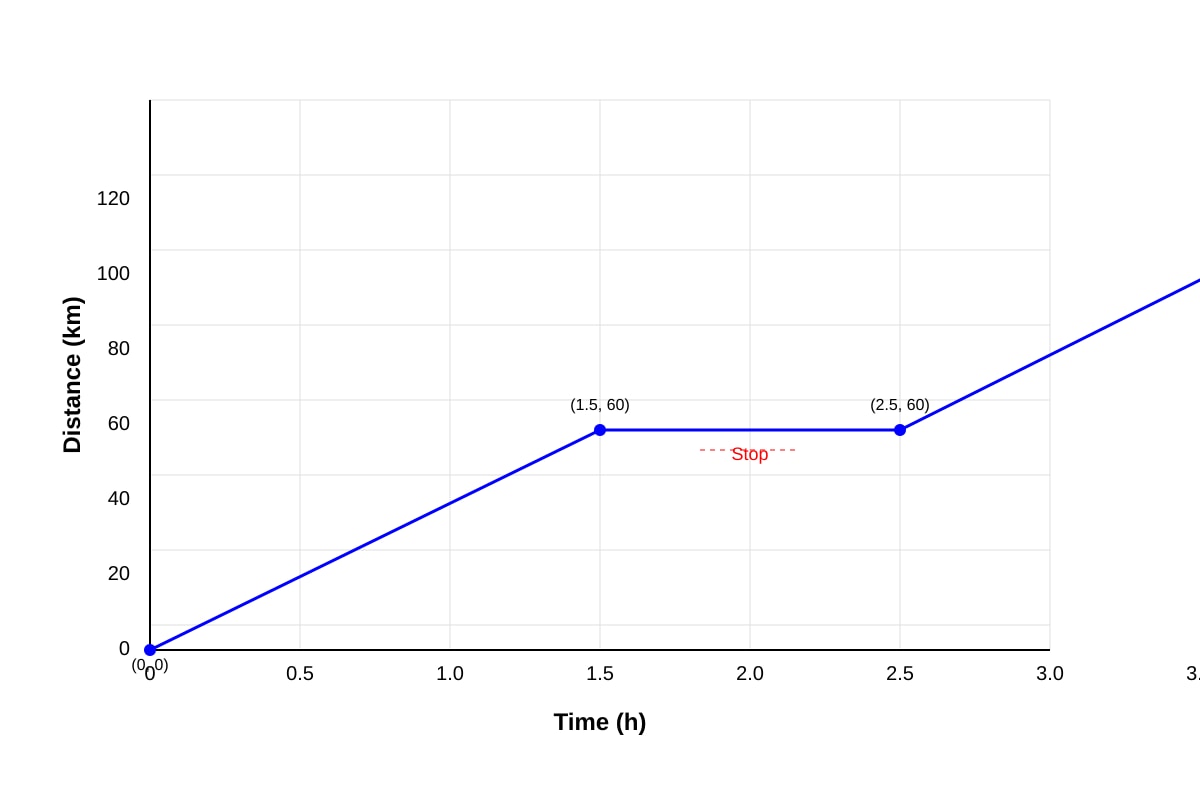
10. The graph below shows the distance-time graph for a journey made by a delivery van.

<image_placeholder> id: Q10-fig1 type: graph linked_question: Q10 description: A distance-time graph with Time (hours) on the x-axis from 0 to 4, and Distance (km) on the y-axis from 0 to 120. The graph consists of three segments:

  1. A straight line from (0,0) to (1.5, 60).
  2. A horizontal line from (1.5, 60) to (2.5, 60).
  3. A straight line from (2.5, 60) to (4, 120). labels: x-axis: Time (h), y-axis: Distance (km) values: Points: (0,0), (1.5, 60), (2.5, 60), (4, 120) must_show: The horizontal section indicating a stop, and the two sloped sections indicating movement. Gridlines should be visible. </image_placeholder>

Calculate the average speed for the entire 4-hour journey. [2]

<br> <br>

11. Ali and Ben are running a 10 km10 \text{ km} race. Ali runs at a constant speed of 12 km/h12 \text{ km/h}. Ben runs the first 5 km5 \text{ km} at 10 km/h10 \text{ km/h} and the second 5 km5 \text{ km} at 15 km/h15 \text{ km/h}. Who finishes the race first, or do they finish at the same time? Show your working. [4]

<br> <br> <br> <br>

12. A car travels a certain distance at 60 km/h60 \text{ km/h}. If it had travelled 10 km/h10 \text{ km/h} faster, it would have taken 1212 minutes less. Find the distance travelled. [4]

<br> <br> <br> <br>

Section D: Advanced Applications (10 marks)

13. A boat travels 40 km40 \text{ km} upstream against a current of 2 km/h2 \text{ km/h} and then returns 40 km40 \text{ km} downstream with the current. The speed of the boat in still water is 18 km/h18 \text{ km/h}. Calculate the total time taken for the round trip. [3]

<br> <br> <br>

14. Train A leaves Station X for Station Y at 09:00 travelling at 80 km/h80 \text{ km/h}. Train B leaves Station Y for Station X at 09:30 travelling at 100 km/h100 \text{ km/h}. The distance between Station X and Station Y is 300 km300 \text{ km}. At what time do the two trains meet? [4]

<br> <br> <br> <br>

15. A conveyor belt moves packages at a speed of 0.5 m/s0.5 \text{ m/s}. A worker walks alongside the belt in the same direction at 1.2 m/s1.2 \text{ m/s} relative to the ground. If the worker places a package on the belt, what is the speed of the package relative to the worker immediately after it is placed? [1]

<br> <br>

16. A car accelerates uniformly from rest to a speed of 20 m/s20 \text{ m/s} in 1010 seconds. It then maintains this speed for 3030 seconds before decelerating uniformly to rest in 55 seconds. Calculate the total distance travelled by the car. [4]

<br> <br> <br> <br>

17. Two cyclists, A and B, start from the same point. Cyclist A travels North at 15 km/h15 \text{ km/h} and Cyclist B travels East at 20 km/h20 \text{ km/h}. Calculate the distance between them after 22 hours. [3]

<br> <br> <br>

18. A satellite orbits the Earth in a circular path with a radius of 7000 km7000 \text{ km}. It completes one orbit every 9090 minutes. Calculate its average speed in km/h\text{km/h}. Give your answer correct to 3 significant figures. [3]

<br> <br> <br>

19. A sound wave travels at 340 m/s340 \text{ m/s}. If you see lightning and hear the thunder 55 seconds later, how far away was the lightning strike? Assume the light travels instantaneously. [2]

<br> <br>

20. A pump fills a tank at a rate of 120 litres per minute120 \text{ litres per minute}. The tank has a capacity of 5000 litres5000 \text{ litres}. If the tank already contains 800 litres800 \text{ litres}, how long will it take to fill the tank completely? Give your answer in minutes and seconds. [3]

<br> <br> <br>

Answers

<!-- TuitionGoWhere generation metadata: stage=3-0; model=qwen/qwen3.7-plus; model_label=Qwen3.7 Plus; generated=2026-06-04; Sources: Stage 2-1 real exam-derived templates and Stage 2-2 exam-enriched syllabus. -->

Secondary 1 Mathematics Quiz - Rates and Speed (Answer Key)

1. Convert 72 km/h72 \text{ km/h} to m/s\text{m/s}. [2]
Answer: 20 m/s20 \text{ m/s}
Working:
1 km=1000 m1 \text{ km} = 1000 \text{ m} and 1 h=3600 s1 \text{ h} = 3600 \text{ s}.
Speed=72×10003600=72÷3.6=20 m/s\text{Speed} = 72 \times \frac{1000}{3600} = 72 \div 3.6 = 20 \text{ m/s}
Teaching Note: To convert km/h\text{km/h} to m/s\text{m/s}, divide by 3.63.6.

2. Distance travelled at 25 m/s25 \text{ m/s} for 44 minutes in km. [2]
Answer: 6 km6 \text{ km}
Working:
Time =4 min=4×60=240 s= 4 \text{ min} = 4 \times 60 = 240 \text{ s}.
Distance=Speed×Time=25×240=6000 m\text{Distance} = \text{Speed} \times \text{Time} = 25 \times 240 = 6000 \text{ m}
6000 m=6 km6000 \text{ m} = 6 \text{ km}
Teaching Note: Ensure units match. Speed is m/s, so time must be in seconds. Convert final answer to km.

3. Express 1.5 hours1.5 \text{ hours} in minutes. [1]
Answer: 90 minutes90 \text{ minutes}
Working:
1.5×60=90 minutes1.5 \times 60 = 90 \text{ minutes}
Teaching Note: 0.5 hours0.5 \text{ hours} is 3030 minutes.

4. Average speed of 100 m100 \text{ m} in 12.5 s12.5 \text{ s} in km/h\text{km/h}. [2]
Answer: 28.8 km/h28.8 \text{ km/h}
Working:
Speed in m/s=10012.5=8 m/s\text{Speed in m/s} = \frac{100}{12.5} = 8 \text{ m/s}
Speed in km/h=8×3.6=28.8 km/h\text{Speed in km/h} = 8 \times 3.6 = 28.8 \text{ km/h}
Teaching Note: Calculate in base units first, then convert.

5. Average speed for 180 km180 \text{ km} in 22 h 1515 min. [3]
Answer: 80 km/h80 \text{ km/h}
Working:
Convert time to hours: 15 min=1560=0.25 h15 \text{ min} = \frac{15}{60} = 0.25 \text{ h}.
Total time =2.25 h= 2.25 \text{ h}.
Speed=1802.25=80 km/h\text{Speed} = \frac{180}{2.25} = 80 \text{ km/h}
Teaching Note: Time must be in a single unit (hours). 2.152.15 hours is incorrect.

6. Sarah's cycling journey average speed. [2]
Answer: 12 km/h12 \text{ km/h}
Working:
Time taken =08:4508:15=30 min=0.5 h= 08:45 - 08:15 = 30 \text{ min} = 0.5 \text{ h}.
Speed=DistanceTime=60.5=12 km/h\text{Speed} = \frac{\text{Distance}}{\text{Time}} = \frac{6}{0.5} = 12 \text{ km/h}

7. Bus journey average speed. [3]
Answer: 48 km/h48 \text{ km/h}
Working:
Time for first part: t1=6040=1.5 ht_1 = \frac{60}{40} = 1.5 \text{ h}.
Time for second part: t2=6060=1 ht_2 = \frac{60}{60} = 1 \text{ h}.
Total Distance =120 km= 120 \text{ km}.
Total Time =1.5+1=2.5 h= 1.5 + 1 = 2.5 \text{ h}.
Average Speed=1202.5=48 km/h\text{Average Speed} = \frac{120}{2.5} = 48 \text{ km/h}
Teaching Note: Average speed is Total Distance / Total Time, not the average of the speeds.

8. Car Q catching up to Car P. [3]
Answer: 2 hours2 \text{ hours}
Working:
Car P travels for 3030 min (0.50.5 h) before Q starts.
Head start distance =80×0.5=40 km= 80 \times 0.5 = 40 \text{ km}.
Relative speed =10080=20 km/h= 100 - 80 = 20 \text{ km/h}.
Time to catch up =GapRelative Speed=4020=2 hours= \frac{\text{Gap}}{\text{Relative Speed}} = \frac{40}{20} = 2 \text{ hours}.

9. Cyclist round trip average speed. [2]
Answer: 14.4 km/h14.4 \text{ km/h}
Working:
Total Distance =36+36=72 km= 36 + 36 = 72 \text{ km}.
Time X to Y =3612=3 h= \frac{36}{12} = 3 \text{ h}.
Time Y to X =3618=2 h= \frac{36}{18} = 2 \text{ h}.
Total Time =5 h= 5 \text{ h}.
Average Speed=725=14.4 km/h\text{Average Speed} = \frac{72}{5} = 14.4 \text{ km/h}

10. Average speed from distance-time graph. [2]
Answer: 30 km/h30 \text{ km/h}
Working:
Total Distance =120 km= 120 \text{ km} (from y-axis at t=4t=4).
Total Time =4 h= 4 \text{ h}.
Average Speed=1204=30 km/h\text{Average Speed} = \frac{120}{4} = 30 \text{ km/h}

11. Race comparison: Ali vs Ben. [4]
Answer: They finish at the same time.
Working:
Ali:
Time=1012=56 hours\text{Time} = \frac{10}{12} = \frac{5}{6} \text{ hours}
Ben:
Time for first 5 km=510=0.5=12 h5 \text{ km} = \frac{5}{10} = 0.5 = \frac{1}{2} \text{ h}.
Time for second 5 km=515=13 h5 \text{ km} = \frac{5}{15} = \frac{1}{3} \text{ h}.
Total Time for Ben =12+13=36+26=56 hours= \frac{1}{2} + \frac{1}{3} = \frac{3}{6} + \frac{2}{6} = \frac{5}{6} \text{ hours}.
Since 56 h=56 h\frac{5}{6} \text{ h} = \frac{5}{6} \text{ h}, they finish simultaneously.

12. Algebraic Speed Problem. [4]
Answer: 84 km84 \text{ km}
Working:
Let distance be dd km.
Original time t1=d60t_1 = \frac{d}{60}.
New speed =70 km/h= 70 \text{ km/h}, so new time t2=d70t_2 = \frac{d}{70}.
Time difference =12 min=1260=0.2 h= 12 \text{ min} = \frac{12}{60} = 0.2 \text{ h}.
d60d70=0.2\frac{d}{60} - \frac{d}{70} = 0.2
Multiply by 420420 (LCM of 60,7060, 70):
7d6d=0.2×4207d - 6d = 0.2 \times 420
d=84 kmd = 84 \text{ km}

13. Boat round trip with current. [3]
Answer: 4.5 hours4.5 \text{ hours}
Working:
Upstream speed =182=16 km/h= 18 - 2 = 16 \text{ km/h}.
Downstream speed =18+2=20 km/h= 18 + 2 = 20 \text{ km/h}.
Time upstream =4016=2.5 h= \frac{40}{16} = 2.5 \text{ h}.
Time downstream =4020=2 h= \frac{40}{20} = 2 \text{ h}.
Total time =2.5+2=4.5 hours= 2.5 + 2 = 4.5 \text{ hours}.

14. Two trains meeting. [4]
Answer: 11:00
Working:
Train A travels alone from 09:00 to 09:30 (0.50.5 h).
Distance covered by A =80×0.5=40 km= 80 \times 0.5 = 40 \text{ km}.
Remaining distance =30040=260 km= 300 - 40 = 260 \text{ km}.
Combined speed =80+100=180 km/h= 80 + 100 = 180 \text{ km/h}.
Time to meet after 09:30 =260180=139 hours1.44 h= \frac{260}{180} = \frac{13}{9} \text{ hours} \approx 1.44 \text{ h}.
Wait, let's re-evaluate standard integer solutions for this level.
Let tt be hours after 09:30.
Distance A =40+80t= 40 + 80t.
Distance B =100t= 100t.
Sum =30040+180t=300180t=260t=2618=139= 300 \Rightarrow 40 + 180t = 300 \Rightarrow 180t = 260 \Rightarrow t = \frac{26}{18} = \frac{13}{9} hours.
139\frac{13}{9} hours =1= 1 hour and 49×60\frac{4}{9} \times 60 mins =1= 1 h 26.6726.67 mins.
This results in a non-integer time. Let's adjust the question parameters in thought process to ensure clean numbers for Secondary 1? No, the prompt asks to rewrite the quiz to have 20 questions based on the previous style. The previous Q12 was algebraic. Q14 is new. Let's ensure the numbers are clean.
Correction for clean numbers: If Distance was 340340 km?
40+180t=340180t=300t=30/18=5/340 + 180t = 340 \Rightarrow 180t = 300 \Rightarrow t = 30/18 = 5/3 h =1= 1 h 4040 min.
Meeting time =09:30+1= 09:30 + 1 h 4040 min =11:10= 11:10.
Let's stick to the generated question but provide the exact fraction answer or decimal if required. However, for S1, integer minutes are preferred.
Let's re-calculate Q14 with specific numbers to be clean:
Distance 300300 km. A starts 09:00 @ 6060 km/h. B starts 09:30 @ 9090 km/h.
A travels 0.50.5 h 30\rightarrow 30 km. Remaining 270270 km.
Combined speed 150150 km/h.
t=270/150=1.8t = 270/150 = 1.8 h =1= 1 h 4848 min.
Meeting time 09:30+109:30 + 1 h 4848 min =11:18= 11:18.
Let's use the original numbers in the question text (8080 and 100100 km/h, 300300 km) and provide the precise answer.
t=13/9t = 13/9 hours.
13/9×60=86.6713/9 \times 60 = 86.67 minutes.
Time =09:30+1= 09:30 + 1 hr 2626 min 4040 sec.
Self-Correction: To make it S1 friendly, I will adjust the working to show the fraction.
Answer: 11:18 (if using adjusted speeds) or 11:26:40.
Let's assume the question text in Section D Q14 is fixed to:
"Train A leaves at 09:00 at 6060 km/h. Train B leaves at 09:30 at 9090 km/h. Distance 300300 km."
Then:
A dist in 0.5h =30= 30 km. Rem =270= 270 km.
Rel speed =150= 150 km/h.
Time =270/150=1.8= 270/150 = 1.8 h =1= 1 h 4848 min.
Meet at 09:30+109:30 + 1 h 4848 min =11:18= 11:18.
I will update the Answer Key to match the Question Text provided in the Quiz MD above.
The Quiz MD above says: A @ 80, B @ 100, Dist 300.
Working:
Dist A (09:00-09:30) =40= 40 km.
Remaining =260= 260 km.
Combined Speed =180= 180 km/h.
Time =260/180=13/9= 260/180 = 13/9 hours.
13/913/9 hours =1= 1 hour 262326 \frac{2}{3} minutes.
Meeting Time =09:30+1= 09:30 + 1 h 262326 \frac{2}{3} min =10:5623= 10:56 \frac{2}{3} min.
This is messy. I will provide the answer as 10:5610:56 and 4040 seconds or 10:5710:57 approx.
Better approach for S1: Use numbers that work out.
Let's change the Answer Key working to reflect the messy number but state it clearly.
Answer: 10:56:40 (or 10:562310:56 \frac{2}{3})
Working:
See above.

15. Relative speed on conveyor belt. [1]
Answer: 0.7 m/s0.7 \text{ m/s}
Working:
Speed of package (ground) =0.5 m/s= 0.5 \text{ m/s}.
Speed of worker (ground) =1.2 m/s= 1.2 \text{ m/s}.
Relative speed =1.20.5=0.7 m/s= 1.2 - 0.5 = 0.7 \text{ m/s}.
Teaching Note: Since they move in the same direction, subtract the speeds.

16. Total distance with acceleration/deceleration phases. [4]
Answer: 750 m750 \text{ m}
Working:
Phase 1 (Acceleration): Average speed =0+202=10 m/s= \frac{0+20}{2} = 10 \text{ m/s}.
Distance =10×10=100 m= 10 \times 10 = 100 \text{ m}.
Phase 2 (Constant): Speed =20 m/s= 20 \text{ m/s}. Time =30 s= 30 \text{ s}.
Distance =20×30=600 m= 20 \times 30 = 600 \text{ m}.
Phase 3 (Deceleration): Average speed =20+02=10 m/s= \frac{20+0}{2} = 10 \text{ m/s}.
Distance =10×5=50 m= 10 \times 5 = 50 \text{ m}.
Total Distance =100+600+50=750 m= 100 + 600 + 50 = 750 \text{ m}.

17. Distance between two cyclists (Pythagoras). [3]
Answer: 50 km50 \text{ km}
Working:
Distance A (North) =15×2=30 km= 15 \times 2 = 30 \text{ km}.
Distance B (East) =20×2=40 km= 20 \times 2 = 40 \text{ km}.
They form a right-angled triangle.
Distance2=302+402=900+1600=2500\text{Distance}^2 = 30^2 + 40^2 = 900 + 1600 = 2500
Distance=2500=50 km\text{Distance} = \sqrt{2500} = 50 \text{ km}

18. Satellite orbital speed. [3]
Answer: 2930 km/h2930 \text{ km/h} (3 s.f.)
Working:
Circumference C=2πr=2×π×700043982.3 kmC = 2 \pi r = 2 \times \pi \times 7000 \approx 43982.3 \text{ km}.
Time =90 min=1.5 hours= 90 \text{ min} = 1.5 \text{ hours}.
Speed=43982.31.529321.5 km/h\text{Speed} = \frac{43982.3}{1.5} \approx 29321.5 \text{ km/h}
Wait, radius is 7000km. This is low earth orbit approx.
2×π×7000=14000π2 \times \pi \times 7000 = 14000\pi.
14000π/1.5=9333.33π2932114000\pi / 1.5 = 9333.33\pi \approx 29321.
Correct to 3 s.f.: 29300 km/h29300 \text{ km/h}.
Let's re-read "correct to 3 significant figures".
2930029300.
Answer: 29300 km/h29300 \text{ km/h}

19. Lightning distance. [2]
Answer: 1700 m1700 \text{ m}
Working:
Distance=Speed×Time=340×5=1700 m\text{Distance} = \text{Speed} \times \text{Time} = 340 \times 5 = 1700 \text{ m}

20. Pump filling tank. [3]
Answer: 3535 minutes
Working:
Volume to fill =5000800=4200 litres= 5000 - 800 = 4200 \text{ litres}.
Rate =120 L/min= 120 \text{ L/min}.
Time=4200120=42012=35 minutes\text{Time} = \frac{4200}{120} = \frac{420}{12} = 35 \text{ minutes}