From Real Exams Quiz

Secondary 1 Mathematics Calculus Quiz

Free Nemo AI-generated Sec 1 Maths Calculus quiz with questions, answers, and syllabus-aligned practice for Singapore students preparing for school assessments.

These static practice materials are generated from the site's syllabus and paper-generation workflow, with source and model context shown so students and parents can evaluate the material before use.

Secondary 1 Mathematics From Real Exams Generated by NVIDIA Nemotron 3 Ultra 550B A55B Free Updated 2026-06-14

Questions

<!-- TuitionGoWhere generation metadata: stage=3-0; model=nvidia/nemotron-3-ultra-550b-a55b:free; model_label=NVIDIA Nemotron 3 Ultra 550B A55B Free; generated=2026-06-14; Sources: Stage 2-1 real exam-derived templates and Stage 2-2 exam-enriched syllabus. -->

Secondary 1 Mathematics Quiz - Calculus

Name: ___________________________
Class: ___________________________
Date: ___________________________
Score: _____ / 40

Duration: 45 minutes
Total Marks: 40

Instructions:

  • Answer all questions.
  • Write your answers in the spaces provided.
  • Show all working clearly.
  • Omission of essential working will result in loss of marks.
  • Calculators may be used unless otherwise stated.

Section A: Gradient and Rate of Change (Questions 1–5) [10 marks]

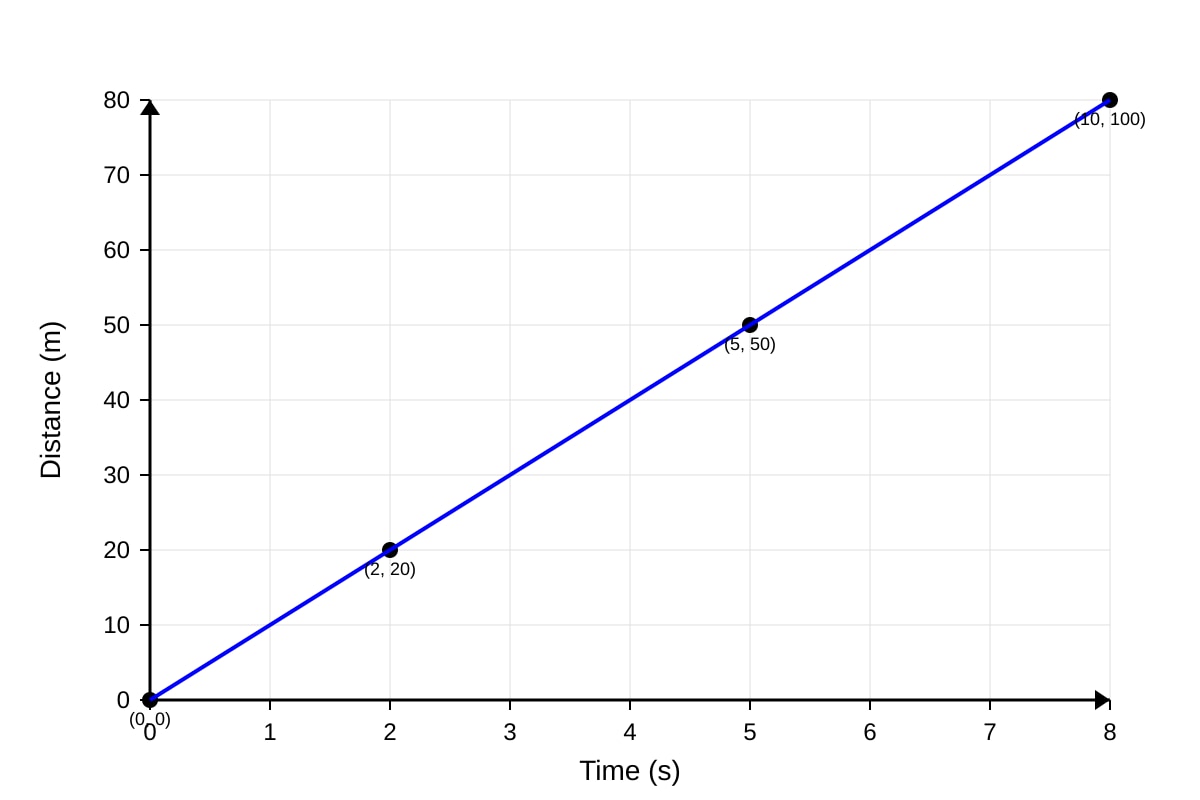
1. The graph shows the distance-time graph of a car travelling along a straight road.

<image_placeholder> id: Q1-fig1 type: graph linked_question: Q1 description: Distance-time graph with time (s) on horizontal axis from 0 to 10, distance (m) on vertical axis from 0 to 100. Straight line from (0,0) to (10,100). labels: Time (s), Distance (m) values: Points (0,0), (2,20), (5,50), (10,100) must_show: Straight line passing through origin with constant gradient </image_placeholder>

(a) Find the speed of the car.
Answer: ______________________ m/s [1]

(b) State what the gradient of the graph represents.
Answer: _________________________________________________________________________ [1]

2. A tank is being filled with water at a constant rate. The volume of water VV litres in the tank after tt minutes is given by V=5t+10V = 5t + 10.

(a) Find the rate at which water is flowing into the tank.
Answer: ______________________ litres/min [1]

(b) Explain what the value 10 represents in this context.
Answer: _________________________________________________________________________ [1]

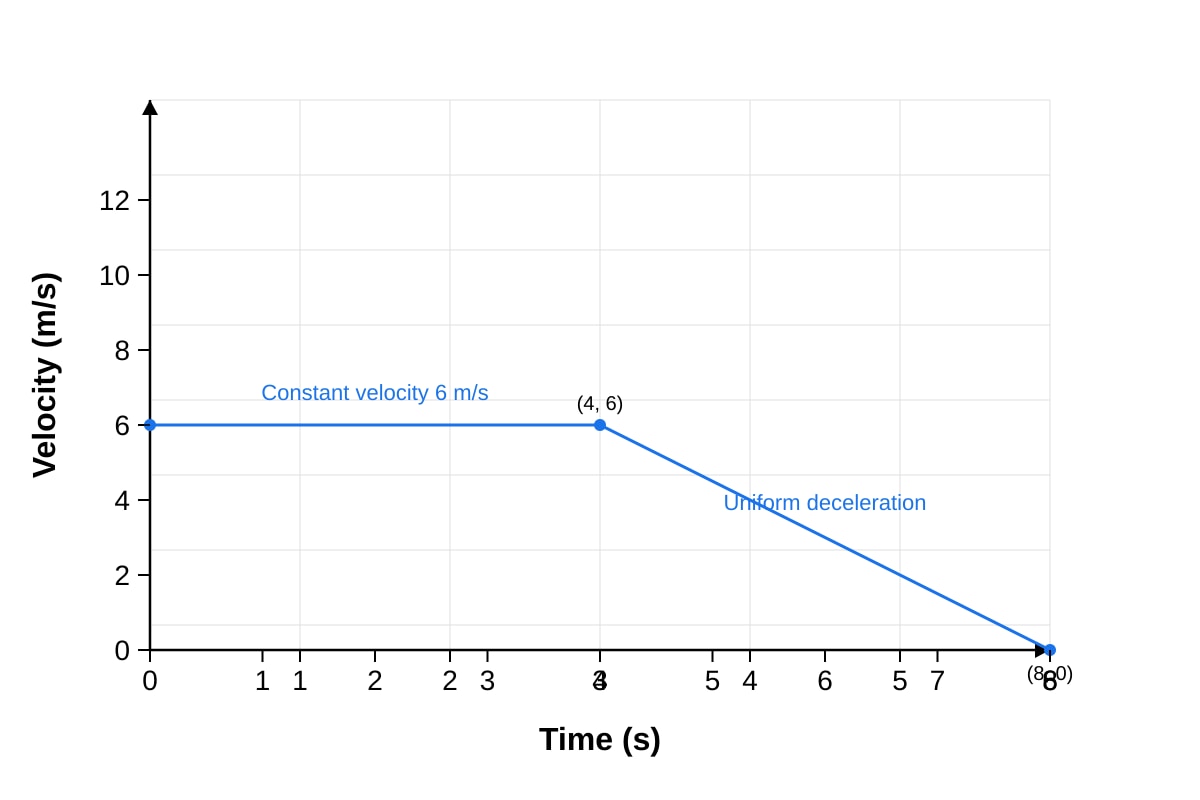
3. The graph below shows the velocity-time graph of a particle moving in a straight line.

<image_placeholder> id: Q3-fig1 type: graph linked_question: Q3 description: Velocity-time graph with time (s) on horizontal axis from 0 to 8, velocity (m/s) on vertical axis from 0 to 12. Horizontal line from (0,6) to (4,6), then straight line down to (8,0). labels: Time (s), Velocity (m/s) values: Constant velocity 6 m/s from t=0 to t=4; linear decrease from 6 m/s to 0 m/s between t=4 and t=8 must_show: Two distinct sections - constant velocity then uniform deceleration </image_placeholder>

(a) Find the acceleration of the particle during the first 4 seconds.
Answer: ______________________ m/s² [1]

(b) Find the acceleration of the particle between t=4t = 4 and t=8t = 8 seconds.
Answer: ______________________ m/s² [1]

(c) Calculate the total distance travelled by the particle in 8 seconds.
Answer: ______________________ m [2]

4. The cost CC dollars of producing xx items is given by C=2x+50C = 2x + 50.

(a) State the fixed cost.
Answer: $ ______________________ [1]

(b) State the variable cost per item.
Answer: $ ______________________ per item [1]

(c) If the selling price per item is $5, find the minimum number of items that must be sold to make a profit.
Answer: ______________________ items [2]

5. A car accelerates uniformly from rest. After 5 seconds, its velocity is 20 m/s.

(a) Find the acceleration of the car.
Answer: ______________________ m/s² [1]

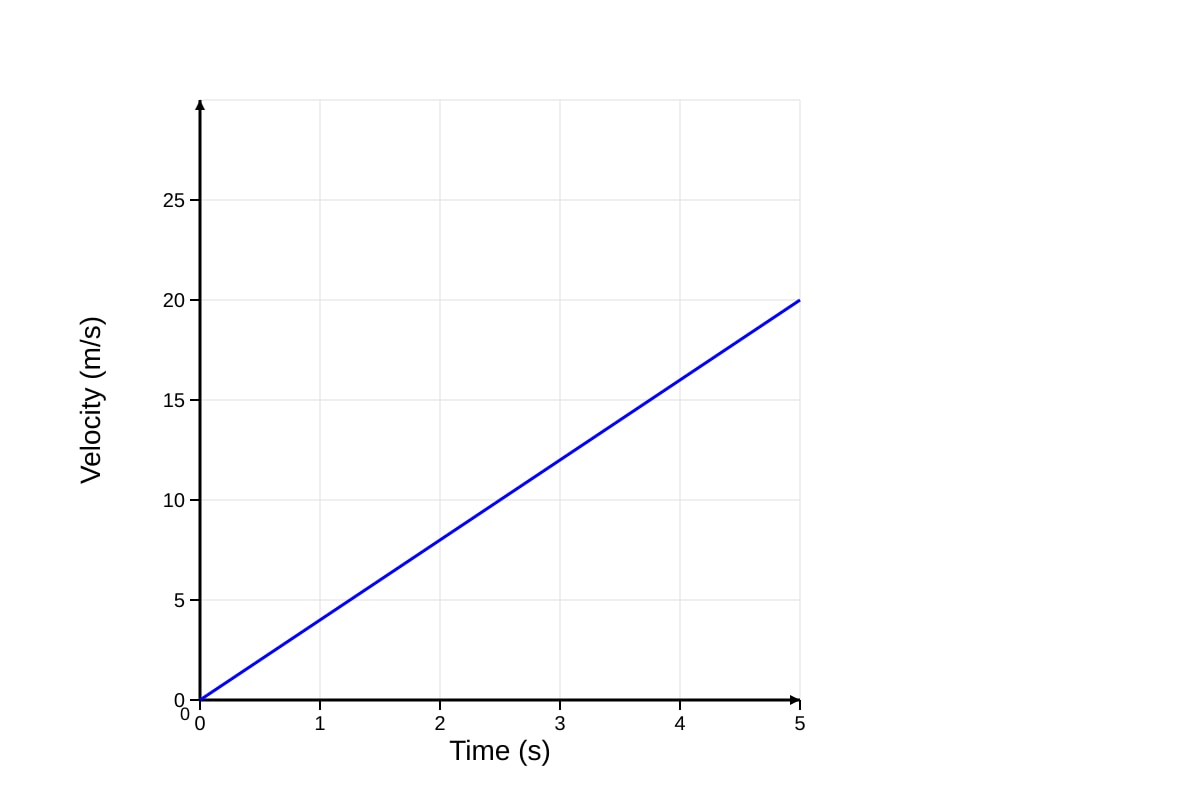
(b) Sketch the velocity-time graph for the first 5 seconds on the axes below.

<image_placeholder> id: Q5-fig1 type: graph linked_question: Q5 description: Blank axes for velocity-time graph. Horizontal axis: Time (s) from 0 to 5. Vertical axis: Velocity (m/s) from 0 to 25. labels: Time (s), Velocity (m/s) values: Line from (0,0) to (5,20) must_show: Straight line through origin with positive gradient, labelled axes </image_placeholder>


Section B: Area Under Graphs and Accumulation (Questions 6–12) [15 marks]

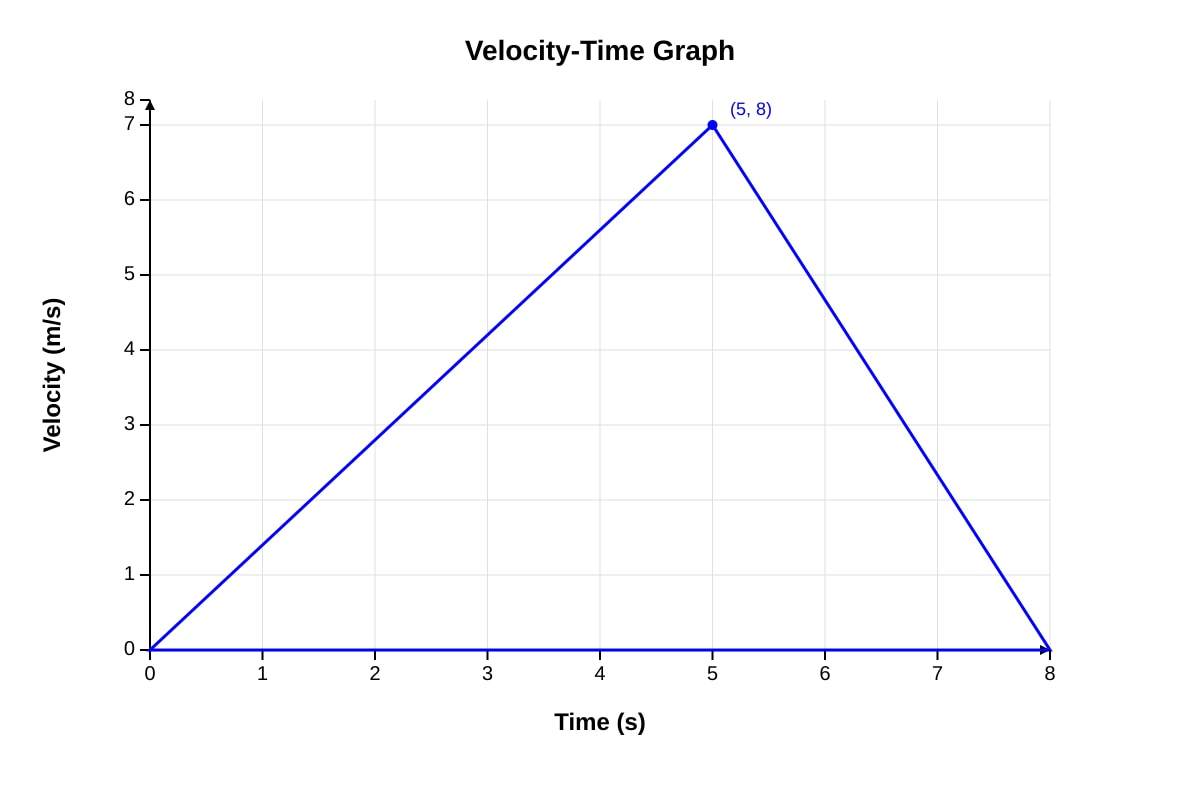
6. The graph shows the velocity-time graph of a cyclist for the first 10 seconds of motion.

<image_placeholder> id: Q6-fig1 type: graph linked_question: Q6 description: Velocity-time graph. Horizontal axis: Time (s) 0 to 10. Vertical axis: Velocity (m/s) 0 to 8. Shape: Triangle from (0,0) to (5,8) to (10,0). labels: Time (s), Velocity (m/s) values: Peak velocity 8 m/s at t=5 s; returns to 0 at t=10 s must_show: Symmetric triangle with peak at (5,8) </image_placeholder>

(a) Find the maximum velocity of the cyclist.
Answer: ______________________ m/s [1]

(b) Calculate the total distance travelled by the cyclist in 10 seconds.
Answer: ______________________ m [2]

7. Water flows into a container at a rate of rr litres per minute, where r=2t+3r = 2t + 3 and tt is the time in minutes.

(a) Find the rate of flow when t=4t = 4 minutes.
Answer: ______________________ litres/min [1]

(b) Calculate the total volume of water that flows into the container from t=0t = 0 to t=4t = 4 minutes.
Answer: ______________________ litres [3]

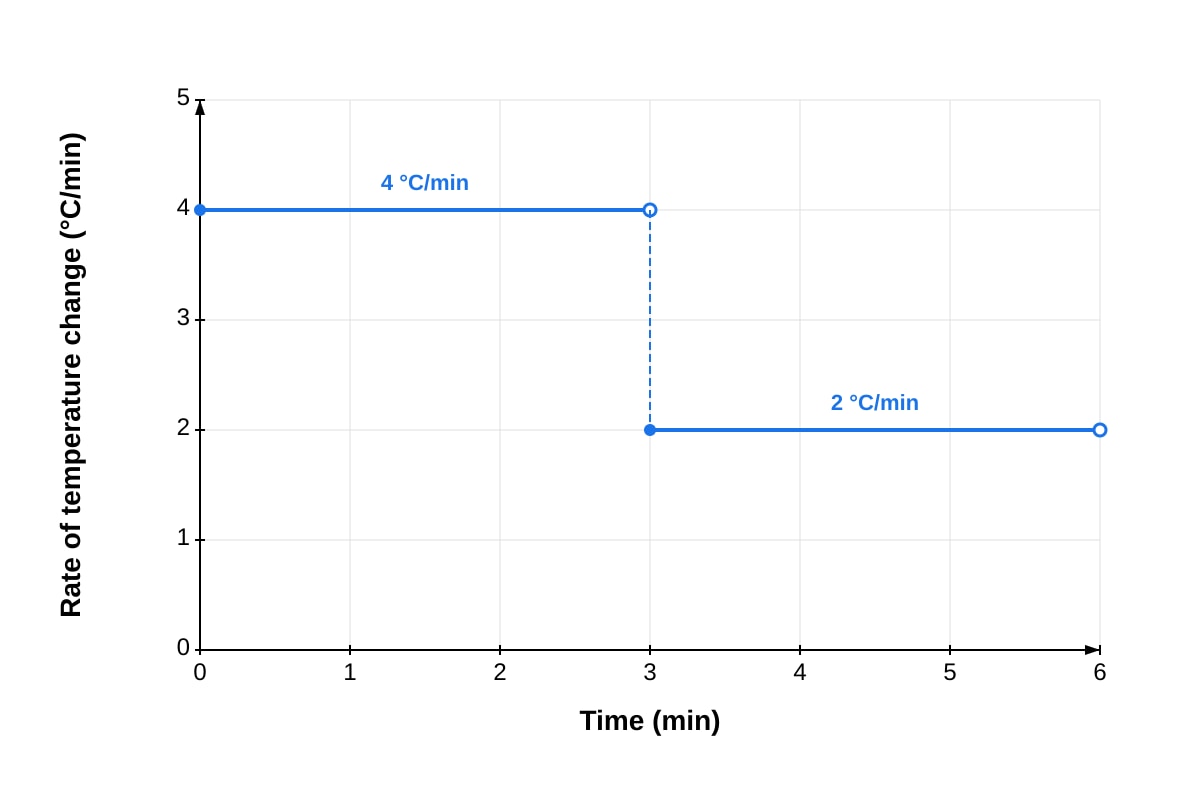
8. The graph below shows the rate of change of temperature (^\circC/min) of a substance being heated over 6 minutes.

<image_placeholder> id: Q8-fig1 type: graph linked_question: Q8 description: Rate of temperature change vs time graph. Horizontal axis: Time (min) 0 to 6. Vertical axis: Rate (°C/min) 0 to 5. Horizontal line at rate = 4 from t=0 to t=3, then horizontal line at rate = 2 from t=3 to t=6. labels: Time (min), Rate of temperature change (°C/min) values: Constant rate 4°C/min for first 3 min, then 2°C/min for next 3 min must_show: Two horizontal segments at different heights </image_placeholder>

(a) During which time interval is the temperature increasing at the fastest rate?
Answer: ______________________ [1]

(b) If the initial temperature is 20°C, find the temperature after 6 minutes.
Answer: ______________________ °C [3]

9. A particle moves in a straight line with velocity v=3t212t+9v = 3t^2 - 12t + 9 m/s, where tt is time in seconds.

(a) Find the velocity when t=0t = 0.
Answer: ______________________ m/s [1]

(b) Find the times when the particle is momentarily at rest.
Answer: ______________________ s [2]

(c) Find the acceleration when t=2t = 2 s.
Answer: ______________________ m/s² [2]

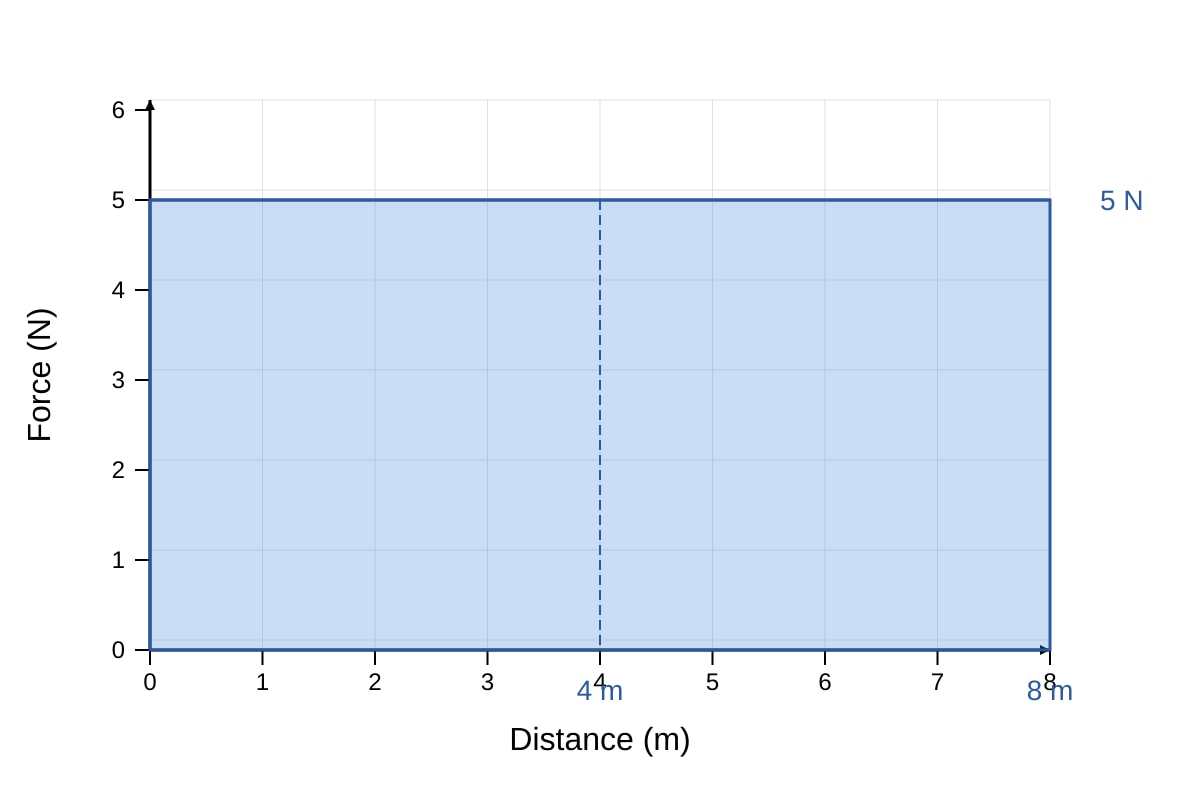
10. The graph shows the force (in newtons) applied to an object against the distance (in metres) moved.

<image_placeholder> id: Q10-fig1 type: graph linked_question: Q10 description: Force-distance graph. Horizontal axis: Distance (m) 0 to 8. Vertical axis: Force (N) 0 to 10. Shape: Rectangle from (0,0) to (4,5) to (8,5) to (8,0). labels: Distance (m), Force (N) values: Constant force 5 N from d=0 to d=4; constant force 5 N from d=4 to d=8 must_show: Rectangle of height 5 N and width 8 m </image_placeholder>

Calculate the work done in moving the object 8 metres.
Answer: ______________________ J [2]

11. A car travels with velocity v=102tv = 10 - 2t m/s for 0t50 \leq t \leq 5 seconds.

(a) Find the initial velocity of the car.
Answer: ______________________ m/s [1]

(b) Find the time when the car comes to rest.
Answer: ______________________ s [1]

(c) Calculate the total distance travelled before the car stops.
Answer: ______________________ m [2]

12. The rate of growth of a bacteria population is given by dPdt=50\frac{dP}{dt} = 50 bacteria per hour, where PP is the population and tt is time in hours.

(a) If the initial population is 200, find the population after 6 hours.
Answer: ______________________ bacteria [2]

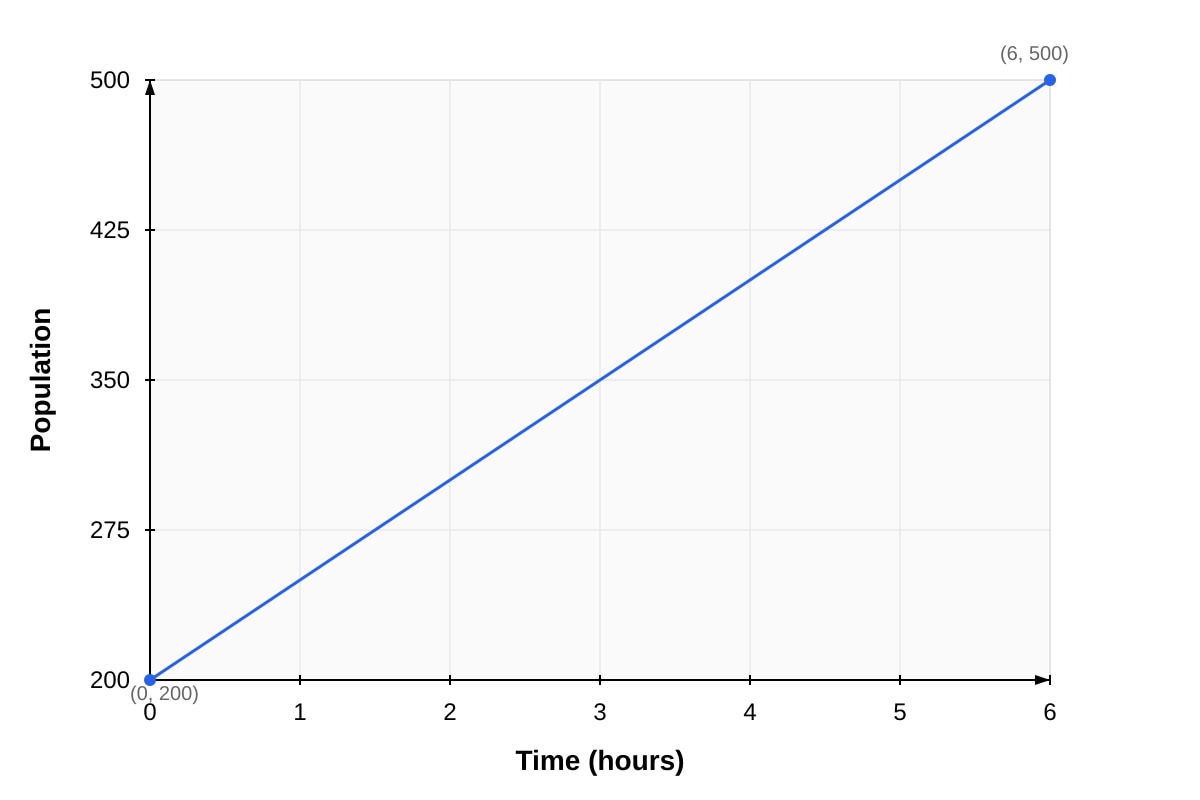
(b) Sketch the graph of population PP against time tt for the first 6 hours on the axes below.

<image_placeholder> id: Q12-fig1 type: graph linked_question: Q12 description: Blank axes for population-time graph. Horizontal axis: Time (hours) 0 to 6. Vertical axis: Population from 200 to 500. labels: Time (hours), Population values: Line from (0,200) to (6,500) must_show: Straight line with positive gradient starting at (0,200) </image_placeholder>


Section C: Applications and Problem Solving (Questions 13–20) [15 marks]

13. A stone is thrown vertically upwards. Its height hh metres above the ground after tt seconds is given by h=20t5t2h = 20t - 5t^2.

(a) Find the initial velocity of the stone.
Answer: ______________________ m/s [1]

(b) Find the maximum height reached by the stone.
Answer: ______________________ m [2]

(c) Find the time when the stone hits the ground.
Answer: ______________________ s [1]

14. The graph shows the velocity-time graph of a train journey between two stations.

<image_placeholder> id: Q14-fig1 type: graph linked_question: Q14 description: Velocity-time graph. Horizontal axis: Time (s) 0 to 100. Vertical axis: Velocity (m/s) 0 to 30. Shape: Trapezoid - accelerates uniformly from 0 to 30 m/s in 20 s, constant 30 m/s for 60 s, decelerates uniformly to 0 in 20 s. labels: Time (s), Velocity (m/s) values: (0,0), (20,30), (80,30), (100,0) must_show: Three distinct phases - acceleration, constant velocity, deceleration </image_placeholder>

(a) Find the acceleration during the first 20 seconds.
Answer: ______________________ m/s² [1]

(b) Find the deceleration during the last 20 seconds.
Answer: ______________________ m/s² [1]

(c) Calculate the distance between the two stations.
Answer: ______________________ m [3]

15. Oil leaks from a tank at a rate of R=1005tR = 100 - 5t litres per hour, where tt is the time in hours after the leak starts.

(a) Find the rate of leakage after 4 hours.
Answer: ______________________ litres/hour [1]

(b) Find the time when the leak stops.
Answer: ______________________ hours [1]

(c) Calculate the total amount of oil leaked.
Answer: ______________________ litres [3]

16. A rocket is launched vertically. Its velocity vv m/s after tt seconds is given by v=50t5t2v = 50t - 5t^2 for 0t100 \leq t \leq 10.

(a) Find the maximum velocity of the rocket.
Answer: ______________________ m/s [2]

(b) Find the acceleration when t=3t = 3 s.
Answer: ______________________ m/s² [1]

(c) Calculate the height of the rocket at t=10t = 10 s.
Answer: ______________________ m [2]

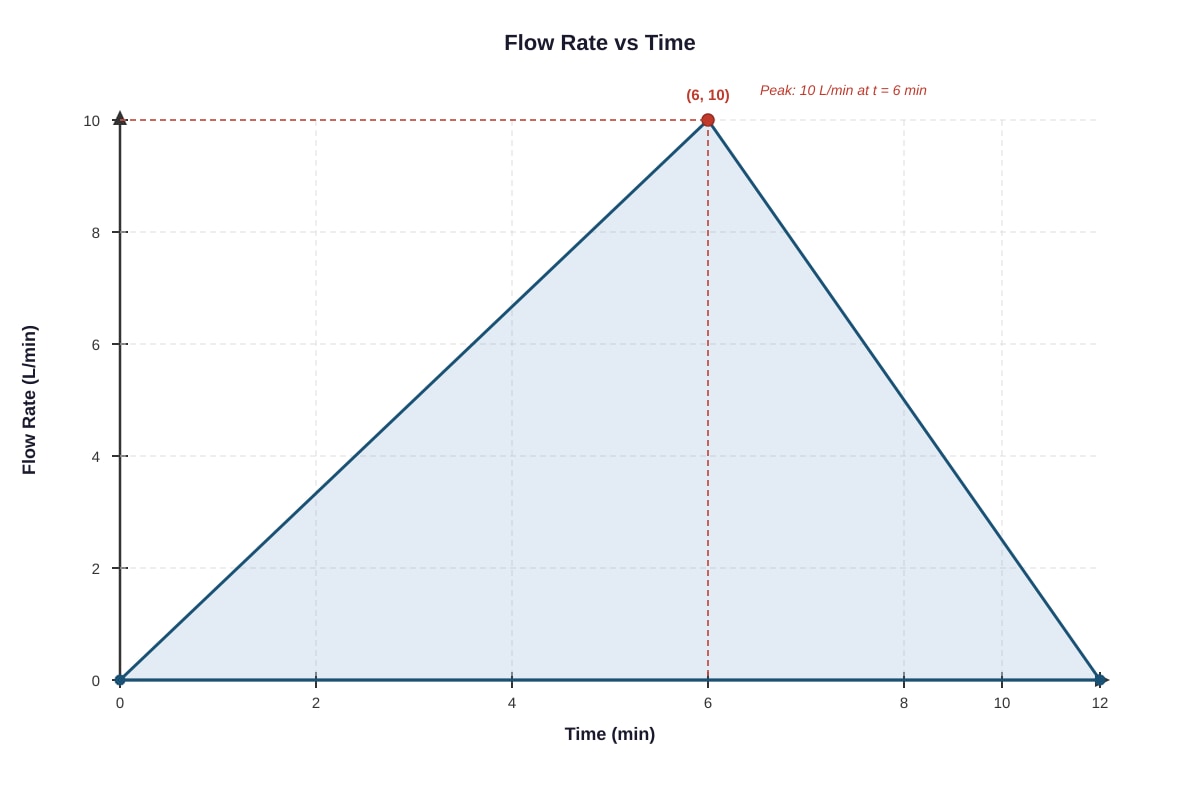
17. The graph below shows the rate of water flow (in litres/min) into a tank over 12 minutes.

<image_placeholder> id: Q17-fig1 type: graph linked_question: Q17 description: Flow rate vs time graph. Horizontal axis: Time (min) 0 to 12. Vertical axis: Flow rate (L/min) 0 to 10. Shape: Triangle from (0,0) to (6,10) to (12,0). labels: Time (min), Flow rate (L/min) values: Peak flow 10 L/min at t=6 min; zero at t=0 and t=12 must_show: Symmetric triangle with peak at (6,10) </image_placeholder>

(a) Find the maximum flow rate.
Answer: ______________________ L/min [1]

(b) Calculate the total volume of water in the tank after 12 minutes.
Answer: ______________________ litres [2]

(c) At what time is the flow rate exactly 5 L/min?
Answer: ______________________ min [1]

18. A particle moves along a straight line. Its displacement ss metres from a fixed point O after tt seconds is given by s=t36t2+9ts = t^3 - 6t^2 + 9t.

(a) Find the velocity when t=2t = 2 s.
Answer: ______________________ m/s [2]

(b) Find the acceleration when t=2t = 2 s.
Answer: ______________________ m/s² [1]

(c) Find the times when the particle changes direction.
Answer: ______________________ s [2]

19. The cost CC of producing xx units of a product is given by C=0.5x2+20x+500C = 0.5x^2 + 20x + 500.

(a) Find the marginal cost when x=10x = 10.
Answer: $ ______________________ [2]

(b) Explain the meaning of marginal cost in this context.
Answer: _________________________________________________________________________ [1]

(c) Find the average cost per unit when x=10x = 10.
Answer: $ ______________________ [1]

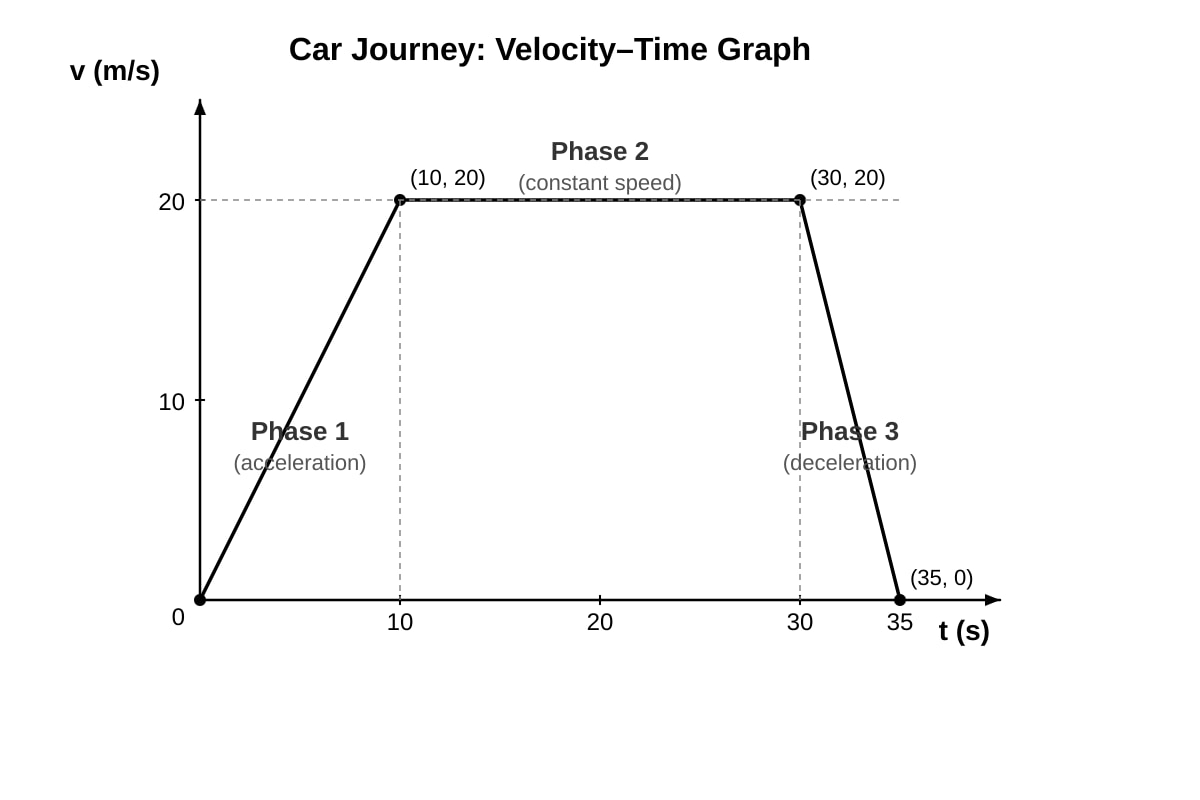
20. A car starts from rest and accelerates uniformly at 22 m/s² for 10 seconds. It then travels at constant velocity for 20 seconds before decelerating uniformly to rest in 5 seconds.

(a) Sketch the velocity-time graph for the whole journey on the axes below.

<image_placeholder> id: Q20-fig1 type: graph linked_question: Q20 description: Blank axes for velocity-time graph. Horizontal axis: Time (s) 0 to 35. Vertical axis: Velocity (m/s) 0 to 25. labels: Time (s), Velocity (m/s) values: (0,0) to (10,20) straight line; (10,20) to (30,20) horizontal; (30,20) to (35,0) straight line must_show: Three phases - acceleration, constant velocity, deceleration; labelled axes and key points </image_placeholder>

(b) Find the maximum velocity reached.
Answer: ______________________ m/s [1]

(c) Calculate the total distance travelled.
Answer: ______________________ m [2]


End of Quiz

Answers

<!-- TuitionGoWhere generation metadata: stage=3-0; model=nvidia/nemotron-3-ultra-550b-a55b:free; model_label=NVIDIA Nemotron 3 Ultra 550B A55B Free; generated=2026-06-14; Sources: Stage 2-1 real exam-derived templates and Stage 2-2 exam-enriched syllabus. -->

Secondary 1 Mathematics Quiz - Calculus (Answer Key)

Total Marks: 40


Section A: Gradient and Rate of Change (Questions 1–5) [10 marks]

1. Distance-time graph of a car

(a) Speed = gradient of distance-time graph
Gradient = change in distancechange in time=1000100=10010=10\frac{\text{change in distance}}{\text{change in time}} = \frac{100 - 0}{10 - 0} = \frac{100}{10} = 10 m/s
Answer: 10 m/s [1]

(b) The gradient of a distance-time graph represents the speed (or velocity) of the object.
Answer: The gradient represents the speed of the car. [1]

Teaching note: In a distance-time graph, gradient = speed. A straight line means constant speed. The steeper the line, the greater the speed.


2. Water tank filling: V=5t+10V = 5t + 10

(a) Rate of flow = coefficient of tt = 5 litres/min
Answer: 5 litres/min [1]

(b) The value 10 is the constant term. When t=0t = 0, V=10V = 10. This is the initial volume of water in the tank before filling starts.
Answer: The initial volume of water in the tank (at t=0t = 0) is 10 litres. [1]

Teaching note: In a linear model y=mx+cy = mx + c, mm is the rate of change and cc is the initial value (when x=0x = 0).


3. Velocity-time graph of a particle

(a) First 4 seconds: horizontal line at v=6v = 6 m/s. Gradient = 0.
Acceleration = 0 m/s²
Answer: 0 m/s² [1]

(b) Between t=4t = 4 and t=8t = 8: velocity decreases from 6 to 0 m/s uniformly.
Acceleration = gradient = 0684=64=1.5\frac{0 - 6}{8 - 4} = \frac{-6}{4} = -1.5 m/s²
Answer: -1.5 m/s² [1]

(c) Distance = area under velocity-time graph
Area = area of rectangle (0 to 4 s) + area of triangle (4 to 8 s)
= (4×6)+12×4×6(4 \times 6) + \frac{1}{2} \times 4 \times 6
= 24+12=3624 + 12 = 36 m
Answer: 36 m [2]

Marking: 1 mark for correct method (area under graph), 1 mark for correct answer.
Teaching note: Area under velocity-time graph = displacement (distance if velocity doesn't change sign).


4. Cost function: C=2x+50C = 2x + 50

(a) Fixed cost = constant term = 50Answer:50 **Answer:** 50 [1]

(b) Variable cost per item = coefficient of xx = 2peritemAnswer:2 per item **Answer:** 2 per item [1]

(c) Revenue R=5xR = 5x. Profit when R>CR > C:
5x>2x+505x > 2x + 50
3x>503x > 50
x>50316.67x > \frac{50}{3} \approx 16.67
Minimum integer x=17x = 17 items
Answer: 17 items [2]

Marking: 1 mark for setting up inequality 5x>2x+505x > 2x + 50, 1 mark for correct answer 17.
Teaching note: Break-even occurs when revenue = cost. Profit requires revenue > cost.


5. Car accelerating uniformly from rest

(a) Acceleration = change in velocitytime=2005=4\frac{\text{change in velocity}}{\text{time}} = \frac{20 - 0}{5} = 4 m/s²
Answer: 4 m/s² [1]

(b) Sketch: Straight line from (0,0) to (5,20) on velocity-time axes.
Answer: [Graph: straight line through origin with positive gradient, labelled axes] [1]
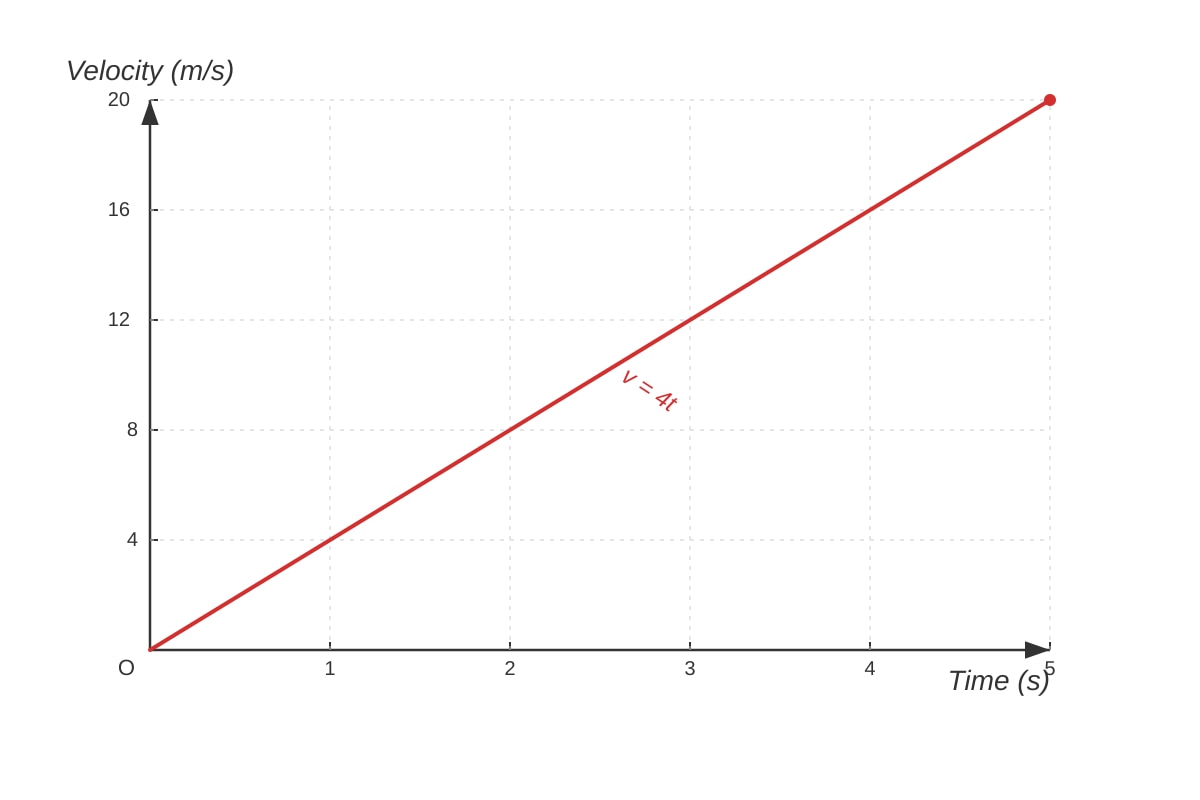
Teaching note: Uniform acceleration from rest gives a straight line through origin on a vv-tt graph. Gradient = acceleration.


Section B: Area Under Graphs and Accumulation (Questions 6–12) [15 marks]

6. Cyclist velocity-time graph (triangle)

(a) Maximum velocity = peak of triangle = 8 m/s
Answer: 8 m/s [1]

(b) Distance = area of triangle = 12×base×height=12×10×8=40\frac{1}{2} \times \text{base} \times \text{height} = \frac{1}{2} \times 10 \times 8 = 40 m
Answer: 40 m [2]

Marking: 1 mark for area formula, 1 mark for correct answer.


7. Water flow rate: r=2t+3r = 2t + 3

(a) At t=4t = 4: r=2(4)+3=8+3=11r = 2(4) + 3 = 8 + 3 = 11 litres/min
Answer: 11 litres/min [1]

(b) Total volume = area under rate-time graph from t=0t=0 to t=4t=4
= 04(2t+3)dt\int_0^4 (2t + 3) \, dt
= [t2+3t]04\left[ t^2 + 3t \right]_0^4
= (16+12)0=28(16 + 12) - 0 = 28 litres

Alternative (trapezium area): At t=0t=0, r=3r=3; at t=4t=4, r=11r=11. Area = 12(3+11)×4=28\frac{1}{2}(3+11) \times 4 = 28 litres
Answer: 28 litres [3]

Marking: 1 mark for correct method (integration or trapezium area), 1 mark for correct substitution/limits, 1 mark for correct answer.
Teaching note: Total quantity = area under rate-time graph. For linear rate, area is a trapezium.


8. Rate of temperature change graph

(a) Fastest rate = highest value on graph = 4°C/min (first 3 minutes)
Answer: 0 to 3 minutes [1]

(b) Temperature increase = area under rate-time graph
= Area of rectangle 1 + Area of rectangle 2
= (3×4)+(3×2)=12+6=18(3 \times 4) + (3 \times 2) = 12 + 6 = 18°C
Final temperature = 20+18=3820 + 18 = 38°C
Answer: 38°C [3]

Marking: 1 mark for area calculation, 1 mark for adding initial temperature, 1 mark for correct answer.


9. Particle velocity: v=3t212t+9v = 3t^2 - 12t + 9

(a) At t=0t = 0: v=3(0)212(0)+9=9v = 3(0)^2 - 12(0) + 9 = 9 m/s
Answer: 9 m/s [1]

(b) At rest when v=0v = 0:
3t212t+9=03t^2 - 12t + 9 = 0
t24t+3=0t^2 - 4t + 3 = 0
(t1)(t3)=0(t - 1)(t - 3) = 0
t=1t = 1 or t=3t = 3 seconds
Answer: 1 s and 3 s [2]

Marking: 1 mark for setting v=0v=0 and simplifying, 1 mark for correct solutions.

(c) Acceleration a=dvdt=6t12a = \frac{dv}{dt} = 6t - 12
At t=2t = 2: a=6(2)12=0a = 6(2) - 12 = 0 m/s²
Answer: 0 m/s² [2]

Marking: 1 mark for differentiating to get a=6t12a = 6t - 12, 1 mark for correct substitution and answer.
Teaching note: Acceleration is the derivative of velocity (gradient of vv-tt graph).


10. Force-distance graph (rectangle)

Work done = area under force-distance graph
= Force ×\times distance = 5×8=405 \times 8 = 40 J
Answer: 40 J [2]

Marking: 1 mark for identifying area = work done, 1 mark for correct calculation.


11. Car velocity: v=102tv = 10 - 2t

(a) Initial velocity at t=0t = 0: v=100=10v = 10 - 0 = 10 m/s
Answer: 10 m/s [1]

(b) At rest when v=0v = 0: 102t=0t=510 - 2t = 0 \Rightarrow t = 5 s
Answer: 5 s [1]

(c) Distance = area under vv-tt graph from t=0t=0 to t=5t=5
Graph is a triangle: base = 5, height = 10
Area = 12×5×10=25\frac{1}{2} \times 5 \times 10 = 25 m
Answer: 25 m [2]

Marking: 1 mark for correct area method, 1 mark for correct answer.


12. Bacteria growth: dPdt=50\frac{dP}{dt} = 50

(a) Constant rate of change \Rightarrow linear growth.
P=50t+cP = 50t + c. At t=0t=0, P=200c=200P=200 \Rightarrow c = 200.
P=50t+200P = 50t + 200
At t=6t = 6: P=50(6)+200=300+200=500P = 50(6) + 200 = 300 + 200 = 500 bacteria
Answer: 500 bacteria [2]

Marking: 1 mark for finding P=50t+200P = 50t + 200, 1 mark for correct answer.

(b) Sketch: Straight line from (0,200) to (6,500) on population-time axes.
Answer: [Graph: straight line with positive gradient starting at (0,200)] [1]
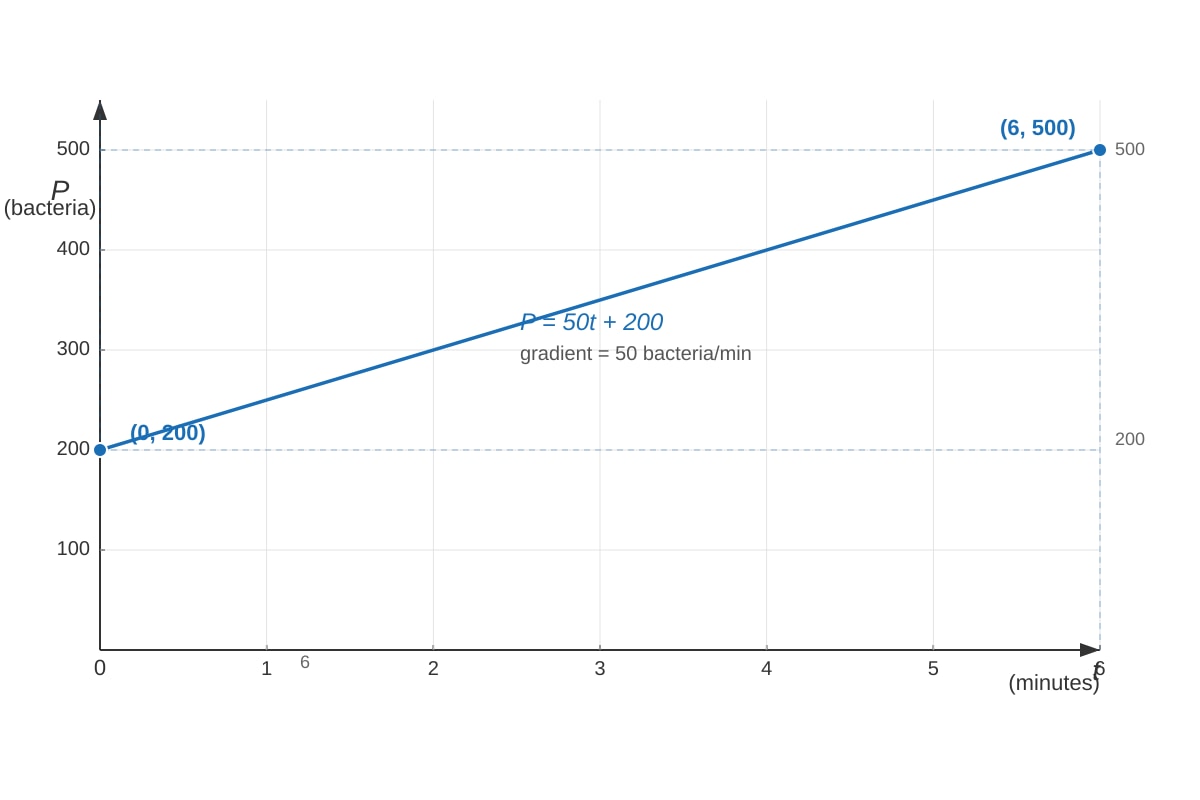
Teaching note: Constant rate of change \Rightarrow linear graph. Gradient = rate of change.


Section C: Applications and Problem Solving (Questions 13–20) [15 marks]

13. Stone thrown upwards: h=20t5t2h = 20t - 5t^2

(a) Velocity v=dhdt=2010tv = \frac{dh}{dt} = 20 - 10t
Initial velocity at t=0t = 0: v=20v = 20 m/s
Answer: 20 m/s [1]

Teaching note: Velocity is the derivative of displacement (gradient of hh-tt graph).

(b) Maximum height when v=0v = 0: 2010t=0t=220 - 10t = 0 \Rightarrow t = 2 s
hmax=20(2)5(2)2=4020=20h_{\text{max}} = 20(2) - 5(2)^2 = 40 - 20 = 20 m
Answer: 20 m [2]

Marking: 1 mark for finding t=2t=2, 1 mark for correct height.

(c) Hits ground when h=0h = 0: 20t5t2=05t(4t)=020t - 5t^2 = 0 \Rightarrow 5t(4 - t) = 0
t=0t = 0 (start) or t=4t = 4 s
Answer: 4 s [1]


14. Train velocity-time graph (trapezoid)

(a) Acceleration = gradient of first section = 300200=1.5\frac{30 - 0}{20 - 0} = 1.5 m/s²
Answer: 1.5 m/s² [1]

(b) Deceleration = gradient of last section = 03010080=3020=1.5\frac{0 - 30}{100 - 80} = \frac{-30}{20} = -1.5 m/s²
Magnitude of deceleration = 1.5 m/s²
Answer: 1.5 m/s² [1]

(c) Distance = area under graph = area of trapezoid
= 12×(sum of parallel sides)×height\frac{1}{2} \times (\text{sum of parallel sides}) \times \text{height}
= 12×(100+60)×30\frac{1}{2} \times (100 + 60) \times 30
Wait: parallel sides are the velocities at start and end of constant velocity phase?
Better: Area = rectangle + two triangles
= (60×30)+12(20×30)+12(20×30)(60 \times 30) + \frac{1}{2}(20 \times 30) + \frac{1}{2}(20 \times 30)
= 1800+300+300=24001800 + 300 + 300 = 2400 m

Or trapezium formula: Average velocity ×\times time = 0+302×20+30×60+30+02×20=300+1800+300=2400\frac{0+30}{2} \times 20 + 30 \times 60 + \frac{30+0}{2} \times 20 = 300 + 1800 + 300 = 2400 m
Answer: 2400 m [3]

Marking: 1 mark for correct area method, 1 mark for correct calculation of areas, 1 mark for correct answer.


15. Oil leak: R=1005tR = 100 - 5t

(a) At t=4t = 4: R=1005(4)=10020=80R = 100 - 5(4) = 100 - 20 = 80 litres/hour
Answer: 80 litres/hour [1]

(b) Leak stops when R=0R = 0: 1005t=0t=20100 - 5t = 0 \Rightarrow t = 20 hours
Answer: 20 hours [1]

(c) Total oil leaked = area under RR-tt graph from t=0t=0 to t=20t=20
Triangle: base = 20, height = 100
Area = 12×20×100=1000\frac{1}{2} \times 20 \times 100 = 1000 litres
Answer: 1000 litres [3]

Marking: 1 mark for identifying triangle area, 1 mark for correct base and height, 1 mark for correct answer.


16. Rocket: v=50t5t2v = 50t - 5t^2

(a) Maximum velocity when acceleration a=0a = 0:
a=dvdt=5010t=0t=5a = \frac{dv}{dt} = 50 - 10t = 0 \Rightarrow t = 5 s
vmax=50(5)5(5)2=250125=125v_{\text{max}} = 50(5) - 5(5)^2 = 250 - 125 = 125 m/s
Answer: 125 m/s [2]

Marking: 1 mark for setting a=0a=0 and finding t=5t=5, 1 mark for correct vmaxv_{\text{max}}.

(b) Acceleration a=5010ta = 50 - 10t
At t=3t = 3: a=5030=20a = 50 - 30 = 20 m/s²
Answer: 20 m/s² [1]

(c) Height = displacement = area under vv-tt graph from 0 to 10
h=010(50t5t2)dt=[25t253t3]010h = \int_0^{10} (50t - 5t^2) \, dt = \left[ 25t^2 - \frac{5}{3}t^3 \right]_0^{10}
= 25(100)53(1000)=250050003=750050003=25003833.3325(100) - \frac{5}{3}(1000) = 2500 - \frac{5000}{3} = \frac{7500 - 5000}{3} = \frac{2500}{3} \approx 833.33 m
Answer: 25003\frac{2500}{3} m or 833.33 m [2]

Marking: 1 mark for correct integration, 1 mark for correct evaluation and answer.


17. Water flow rate graph (triangle)

(a) Maximum flow rate = peak = 10 L/min
Answer: 10 L/min [1]

(b) Total volume = area of triangle = 12×12×10=60\frac{1}{2} \times 12 \times 10 = 60 litres
Answer: 60 litres [2]

Marking: 1 mark for area formula, 1 mark for correct answer.

(c) Flow rate = 5 L/min occurs at two times (rising and falling).
By symmetry, at t=3t = 3 min and t=9t = 9 min.
Or calculation: Rising: gradient = 106=53\frac{10}{6} = \frac{5}{3} L/min². 5=53tt=35 = \frac{5}{3}t \Rightarrow t = 3.
Falling: 5=1053(t6)t=95 = 10 - \frac{5}{3}(t-6) \Rightarrow t = 9.
Answer: 3 min and 9 min [1]


18. Particle displacement: s=t36t2+9ts = t^3 - 6t^2 + 9t

(a) Velocity v=dsdt=3t212t+9v = \frac{ds}{dt} = 3t^2 - 12t + 9
At t=2t = 2: v=3(4)12(2)+9=1224+9=3v = 3(4) - 12(2) + 9 = 12 - 24 + 9 = -3 m/s
Answer: -3 m/s [2]

Marking: 1 mark for correct differentiation, 1 mark for correct substitution and answer.

(b) Acceleration a=dvdt=6t12a = \frac{dv}{dt} = 6t - 12
At t=2t = 2: a=6(2)12=0a = 6(2) - 12 = 0 m/s²
Answer: 0 m/s² [1]

(c) Changes direction when v=0v = 0:
3t212t+9=0t24t+3=0(t1)(t3)=03t^2 - 12t + 9 = 0 \Rightarrow t^2 - 4t + 3 = 0 \Rightarrow (t-1)(t-3) = 0
t=1t = 1 s and t=3t = 3 s
Answer: 1 s and 3 s [2]

Marking: 1 mark for setting v=0v=0 and solving, 1 mark for both correct times.


19. Cost function: C=0.5x2+20x+500C = 0.5x^2 + 20x + 500

(a) Marginal cost = dCdx=x+20\frac{dC}{dx} = x + 20
At x=10x = 10: Marginal cost = 10+20=3010 + 20 = 30
Answer: $30 [2]

Marking: 1 mark for correct differentiation, 1 mark for correct substitution and answer.
Teaching note: Marginal cost is the derivative of total cost — the cost of producing one additional unit.

(b) Marginal cost represents the instantaneous rate of change of total cost with respect to quantity — the approximate cost of producing the next (11th) unit when 10 units have already been produced.
Answer: The cost of producing one additional unit (the 11th unit) when 10 units have been produced. [1]

(c) Average cost = Cx=0.5x2+20x+500x=0.5x+20+500x\frac{C}{x} = \frac{0.5x^2 + 20x + 500}{x} = 0.5x + 20 + \frac{500}{x}
At x=10x = 10: Average cost = 0.5(10)+20+50010=5+20+50=750.5(10) + 20 + \frac{500}{10} = 5 + 20 + 50 = 75
Answer: $75 [1]


20. Car journey: three phases

(a) Sketch:

  • 0 to 10 s: straight line from (0,0) to (10,20)
  • 10 to 30 s: horizontal line at v=20v = 20
  • 30 to 35 s: straight line from (30,20) to (35,0)
    Answer: [Graph with three phases, labelled axes and key points] [1]
(b) Maximum velocity = velocity after acceleration phase = a×t=2×10=20a \times t = 2 \times 10 = 20 m/s
Answer: 20 m/s [1]

(c) Total distance = area under vv-tt graph
= Area of triangle (0-10) + rectangle (10-30) + triangle (30-35)
= 12×10×20+20×20+12×5×20\frac{1}{2} \times 10 \times 20 + 20 \times 20 + \frac{1}{2} \times 5 \times 20
= 100+400+50=550100 + 400 + 50 = 550 m
Answer: 550 m [2]

Marking: 1 mark for correct area breakdown, 1 mark for correct answer.


End of Answer Key