From Real Exams Quiz
Secondary 1 Mathematics Calculus Quiz
Free Sec 1 Maths Calculus quiz, Kimi2.6 Exam version, with questions, answers, and syllabus-aligned practice for Singapore students.
These static practice materials are generated from the site's syllabus and paper-generation workflow, with source and model context shown so students and parents can evaluate the material before use.
Questions
Free quiz and exam paper access
Enter your details to view this paper
Your access is remembered on this device.
Answers
Secondary 1 Mathematics Quiz - Calculus: Answer Key
Total Marks: 40
Section A: Direct Calculation and Concept Recall
1. Find the value of .
Answer:
Working:
Teaching note: This tests basic index evaluation. means 3 multiplied by itself 4 times. Common error: thinking .
Marks: [2]
2. Given , find .
Answer:
Working: Using the power rule:
Here , so
Teaching note: The power rule is fundamental: bring the power down as a coefficient, then subtract 1 from the power. The gradient function tells us the slope at any point on .
Marks: [2]
3. Evaluate .
Answer:
Working:
Teaching note: A linear term has constant gradient 7. Using the power rule formally: , so the derivative is . This makes sense as is a straight line with slope 7.
Marks: [2]
4. Differentiate with respect to .
Answer:
Working:
Teaching note: A constant has zero gradient — its graph is a horizontal line. The power rule gives 0 when applied to any constant (since the "power" is effectively 0, and ). Common error: thinking the answer is 12.
Marks: [2]
5. Find the gradient function of .
Answer:
Working:
Teaching note: The coefficient 2 multiplies the result of differentiating . "Gradient function" is another name for the derivative — it gives the slope at any value of .
Marks: [2]
6. Given , find .
Answer:
Working: Differentiate term by term:
So
Teaching note: The prime notation means the same as . Differentiate each term separately (sum rule). Common error: combining terms before differentiating, e.g., writing then differentiating.
Marks: [2]
7. Find .
Answer:
Working:
Teaching note: Straightforward power rule application. The pattern: the new power is always one less than the original power.
Marks: [2]
8. Differentiate with respect to .
Answer:
Working:
Teaching note: The fraction coefficient stays as a multiplier. Multiply it by the power 4 to get . Watch for arithmetic errors in multiplying fractions by integers.
Marks: [2]
Section B: Application and Problem Solving
9. Given , find .
Answer:
Working: Differentiate term by term:
So
Teaching note: Apply the power rule to each term separately. The constant term 7 disappears (derivative of constant is 0). Be careful with negative coefficients: differentiates to , not or left unsimplified.
Marks: [2]
10. Differentiate with respect to .
Answer:
Working: Differentiate term by term:
So
Teaching note: Note that , so its derivative is . The vanishes. Watch signs: the gives , not .
Marks: [2]
11. Find the gradient of the curve at the point where .
Answer:
Working:
Step 1: Find the gradient function.
Step 2: Substitute .
Teaching note: "Gradient of the curve at a point" means evaluate the derivative at that specific -value. First differentiate, then substitute — never substitute before differentiating. Common error: finding when (which gives 4) instead of finding the gradient.
Marks: [2]
12. Given , find . (Express your answer using positive index notation.)
Answer:
Working:
Step 1: Rewrite using negative index:
Step 2: Differentiate term by term.
Step 3: Convert back to positive index:
Teaching note: Terms like must be rewritten as before differentiating. The power rule applies to : bring down , then subtract 1 to get . Remember to convert back to the requested positive index form. Common error: thinking (forgetting the coefficient ).
Marks: [2]
13. A curve has equation .
(a) Find .
Answer:
Working:
Teaching note: Straightforward differentiation. The disappears.
Marks: [1]
(b) Find the -coordinate of the stationary point on the curve.
Answer:
Working:
Step 1: At a stationary point, .
Step 2: Set gradient equal to zero.
Step 3: Solve.
Teaching note: A stationary point is where the curve temporarily stops rising or falling — the gradient is zero. Set the derivative equal to 0 and solve. The corresponding -coordinate would be , so the stationary point is , but the question only asks for .
Marks: [2]
14. Differentiate with respect to . (Express your answer using negative index notation.)
Answer: or
Working:
Step 1: Rewrite:
Step 2: Differentiate.
Teaching note: The term becomes . Applying the power rule: multiply by , subtract 1 from power. The question asks for negative index notation, so is acceptable; is also correct. Common error: getting the sign wrong ( instead of ) or adding 1 to the power instead of subtracting.
Marks: [2]
15. Given , find .
Answer:
Working:
Step 1: Expand the brackets first.
Step 2: Differentiate term by term.
Teaching note: At Secondary 1 level, we do not yet have the product rule, so we must expand brackets first, then differentiate. This is a key exam technique: when you see a product of linear factors, expand before differentiating. Common error: trying to "differentiate each bracket separately" — this is not valid at this level.
Marks: [2]
16. Find the value of for which the gradient of the curve is equal to 6.
Answer:
Working:
Step 1: Find the gradient function.
Step 2: Set gradient equal to 6.
Step 3: Solve.
Teaching note: This combines differentiation with solving equations. The "gradient" is , so we set our derivative equal to the given value 6. Check: when , gradient ✓
Marks: [3]
Section C: Reasoning and Extension
17. The curve passes through the point .
(a) Find the value of .
Answer:
Working:
Step 1: Substitute and into the equation.
Step 2: Simplify.
Step 3: Solve.
Teaching note: "Passes through" means the coordinates satisfy the equation. This is a substitution problem before calculus is applied — a common exam structure where part (a) sets up part (b).
Marks: [2]
(b) Find the gradient of the curve at the point where .
Answer:
Working:
Step 1: With , the equation is .
Step 2: Find .
Step 3: Substitute .
Teaching note: Part (b) depends on part (a). Must substitute before differentiating. The gradient at is 14. Notice we didn't need to verify again — the point was given to find .
Marks: [2]
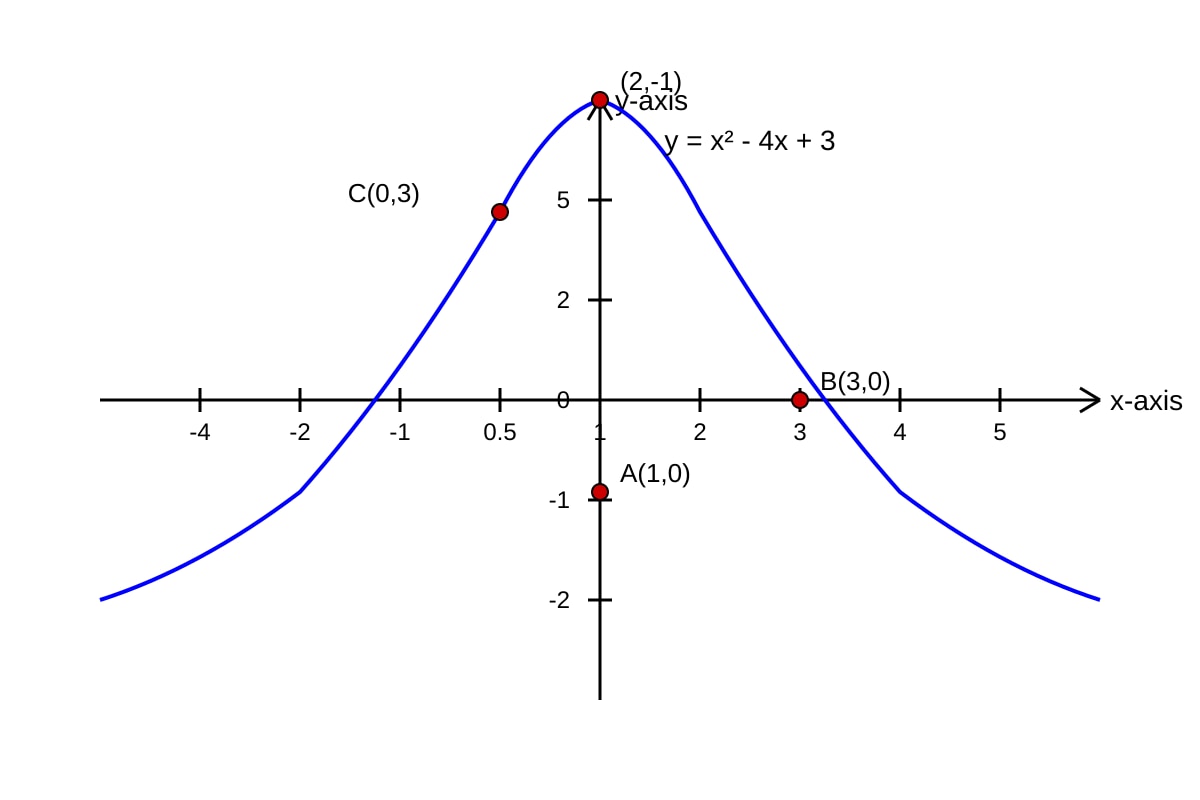
18. The diagram shows the curve .
Expected visual from Q18-fig1: Parabola opening upwards with x-intercepts at (1,0), (3,0), y-intercept at (0,3), minimum point at (2,-1).
(a) Find .
Answer:
Working:
Teaching note: Straightforward differentiation of a quadratic.
Marks: [1]
(b) Find the coordinates of the minimum point of the curve.
Answer:
Working:
Step 1: At minimum point, .
Step 2: Find -coordinate by substituting into original equation.
Minimum point is .
Teaching note: The minimum point is a stationary point where the curve changes from decreasing to increasing. For a parabola with , the single stationary point is the minimum. The expected diagram shows this visually: the lowest point is at , confirming our calculation.
Marks: [2]
19. Given that for , find in its simplest form.
Answer:
Working:
Step 1: Simplify by dividing each term by (valid since ).
Step 2: Differentiate.
Teaching note: Always simplify algebraic fractions before differentiating — it makes the differentiation much easier. Dividing by subtracts 1 from each power. Common error: trying to use quotient rule (not taught at this level) or incorrectly dividing only the first term.
Marks: [2]
20. A particle moves in a straight line so that its displacement metres from a fixed point after seconds is given by .
(a) Find an expression for the velocity, , of the particle in terms of .
Answer:
Working: Velocity is rate of change of displacement with respect to time.
Teaching note: In kinematics, velocity . This is an important application of differentiation — the derivative of displacement gives velocity. The coefficients 3, -12, 9 are typical of exam questions that factorise nicely in part (c).
Marks: [1]
(b) Find the velocity of the particle when .
Answer: m/s
Working:
Teaching note: Substitute into the velocity expression from part (a). Units are m/s (metres per second) since is in metres and in seconds.
Marks: [1]
(c) Find the value(s) of when the particle is instantaneously at rest.
Answer: and
Working:
Step 1: Instantaneously at rest means .
Step 2: Divide by 3 to simplify.
Step 3: Factorise.
Step 4: Solve.
Teaching note: "Instantaneously at rest" means velocity is zero at that instant — the particle stops momentarily before changing direction. The quadratic factorises neatly because the coefficients were chosen to work well. Common error: setting instead of (this finds when the particle is at , not when it is at rest).
Marks: [2]
END OF ANSWER KEY