From Real Exams Quiz
Secondary 1 Mathematics Calculus Quiz
Free Sec 1 Maths Calculus quiz, Exam version, with questions, answers, and syllabus-aligned practice for Singapore students.
These static practice materials are generated from the site's syllabus and paper-generation workflow, with source and model context shown so students and parents can evaluate the material before use.
Questions
Free quiz and exam paper access
Enter your details to view this paper
Your access is remembered on this device.
Answers
Answer Key: Secondary 1 Mathematics Quiz - Calculus
Total Marks: 40
Section A: Short Answer Questions (Questions 1 to 10)
Each question carries 2 marks.
1. Answer: 180 km
- Working: Distance = Speed × Time = 60 km/h × 3 h = 180 km
- Marking: 1 mark for correct formula, 1 mark for correct answer.
- Teaching Note: The fundamental relationship is distance = speed × time. Make sure units are consistent (km/h with hours gives km).
2. Answer: 60 litres
- Working: Volume = Rate × Time = 5 L/min × 12 min = 60 L
- Marking: 1 mark for correct method, 1 mark for correct answer.
- Teaching Note: Rate problems use the same structure: total = rate × time.
3. Answer: 15 km/h
- Working: Average speed = Total distance ÷ Total time = 30 km ÷ 2 h = 15 km/h
- Marking: 1 mark for correct formula, 1 mark for correct answer.
- Teaching Note: Average speed is not the average of speeds; it is total distance divided by total time.
4. Answer: 60 pages
- Working: Pages = Rate × Time = 12 pages/min × 5 min = 60 pages
- Marking: 1 mark for correct method, 1 mark for correct answer.
5. Answer: 3 hours
- Working: Time = Distance ÷ Speed = 240 km ÷ 80 km/h = 3 h
- Marking: 1 mark for correct formula, 1 mark for correct answer.
- Teaching Note: Rearranging the formula: time = distance / speed.
6. Answer: $120
- Working: Earnings = Rate × Time = 120
- Marking: 1 mark for correct method, 1 mark for correct answer.
7. Answer: 600 bottles
- Working: Bottles = Rate × Time = 40 bottles/min × 15 min = 600 bottles
- Marking: 1 mark for correct method, 1 mark for correct answer.
8. Answer: 2250 km
- Working: Distance = Speed × Time = 900 km/h × 2.5 h = 2250 km
- Marking: 1 mark for correct method, 1 mark for correct answer.
9. Answer: 25 minutes
- Working: Time = Volume ÷ Rate = 200 L ÷ 8 L/min = 25 min
- Marking: 1 mark for correct formula, 1 mark for correct answer.
10. Answer: 60 m
- Working: Distance = Speed × Time = 6 m/s × 10 s = 60 m
- Marking: 1 mark for correct method, 1 mark for correct answer.
Section B: Short-Answer Questions (Questions 11 to 15)
Each question carries 3 marks.
11. Answer: (a) 20 m/s (b) 100 m
- Working: (a) 72 km/h = 72 × (1000 m / 3600 s) = 72 × (5/18) = 20 m/s (b) Distance = Speed × Time = 20 m/s × 5 s = 100 m
- Marking: 1 mark for (a), 2 marks for (b) (1 for method, 1 for answer).
- Teaching Note: To convert km/h to m/s, multiply by 1000/3600 = 5/18. To convert m/s to km/h, multiply by 18/5.
- Common Mistake: Using 72 km/h directly in part (b) without converting to m/s.
12. Answer: (a) 300 toys per hour (b) 3600 toys
- Working: (a) Rate = 2400 toys ÷ 8 h = 300 toys/h (b) Toys = 300 toys/h × 12 h = 3600 toys
- Marking: 1 mark for (a), 2 marks for (b) (1 for method, 1 for answer).
- Teaching Note: Rate is constant, so we can scale up linearly.
13. Answer: (a) 10 litres per minute (b) 200 litres
- Working: (a) Net rate = Fill rate - Drain rate = 15 L/min - 5 L/min = 10 L/min (b) Volume after 10 min = Initial volume + (Net rate × Time) = 100 L + (10 L/min × 10 min) = 100 L + 100 L = 200 L
- Marking: 1 mark for (a), 2 marks for (b) (1 for method, 1 for answer).
- Teaching Note: When there are multiple rates, find the net rate by adding rates that increase the quantity and subtracting rates that decrease it.
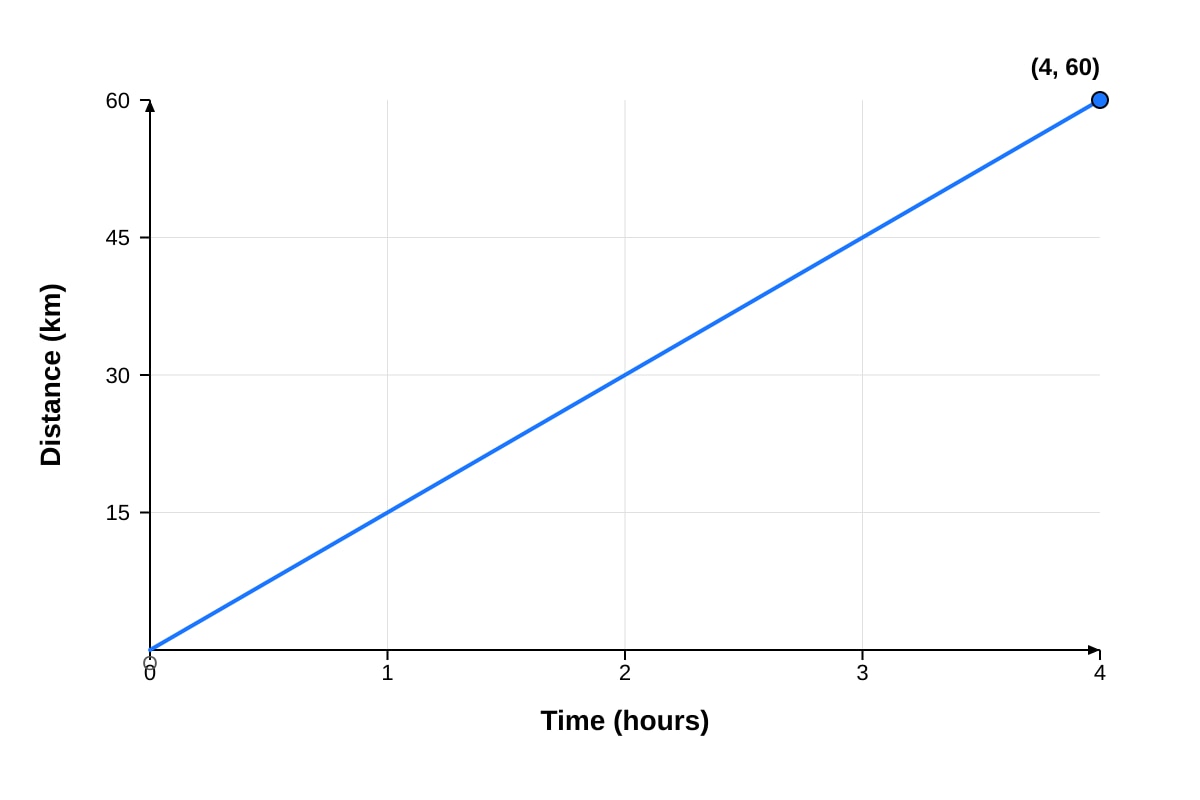
14. Answer: (a) 15 km/h (b) 45 km
- Working: (a) Speed = Gradient of line = (60 km - 0 km) / (4 h - 0 h) = 60/4 = 15 km/h (b) Distance in 3 hours = Speed × Time = 15 km/h × 3 h = 45 km
- Marking: 1 mark for (a), 2 marks for (b) (1 for method, 1 for answer).
- Teaching Note: On a distance-time graph, the gradient (slope) represents speed. A steeper line means a higher speed. A horizontal line means the object is stationary.
15. Answer: (a) 80 km/h (b) 2.5 hours
- Working: (a) Speed = Distance ÷ Time = 120 km ÷ 1.5 h = 80 km/h (b) Time = Distance ÷ Speed = 200 km ÷ 80 km/h = 2.5 h
- Marking: 1 mark for (a), 2 marks for (b) (1 for method, 1 for answer).
- Teaching Note: Since the speed is constant, we can use the same speed for any distance.
Section C: Structured-Answer Questions (Questions 16 to 20)
Each question carries 4 marks.
16. Answer: (a) 3 hours (b) 2 hours (c) 72 km/h
- Working: (a) Time (A to B) = 180 km ÷ 60 km/h = 3 h (b) Time (B to A) = 180 km ÷ 90 km/h = 2 h (c) Total distance = 180 km + 180 km = 360 km Total time = 3 h + 2 h = 5 h Average speed = 360 km ÷ 5 h = 72 km/h
- Marking: 1 mark each for (a) and (b), 2 marks for (c) (1 for total distance and time, 1 for final answer).
- Teaching Note: Average speed for a round trip is NOT the average of the two speeds. It is total distance divided by total time. The average of 60 and 90 is 75, but the correct average speed is 72 km/h. This is because the train spends more time travelling at the slower speed.
- Common Mistake: Students often calculate (60 + 90) ÷ 2 = 75 km/h, which is incorrect.
17. Answer: (a) 300 minutes (b) 50 litres per minute (c) 120 minutes
- Working: (a) Time (Pipe A only) = 6000 L ÷ 20 L/min = 300 min (b) Combined rate = 20 L/min + 30 L/min = 50 L/min (c) Time (both pipes) = 6000 L ÷ 50 L/min = 120 min
- Marking: 1 mark for (a), 1 mark for (b), 2 marks for (c) (1 for method, 1 for answer).
- Teaching Note: When two or more pipes fill a tank, their rates add up. The combined rate is the sum of individual rates.
18. Answer: (a) 2 m/s² (b) 30 m/s (c) 100 m
- Working: (a) Acceleration = Change in speed ÷ Time = (20 m/s - 0 m/s) ÷ 10 s = 2 m/s² (b) Speed after 15 s = Initial speed + (Acceleration × Time) = 0 + (2 m/s² × 15 s) = 30 m/s (c) Average speed in first 10 s = (0 + 20) ÷ 2 = 10 m/s Distance = Average speed × Time = 10 m/s × 10 s = 100 m
- Marking: 1 mark for (a), 1 mark for (b), 2 marks for (c) (1 for average speed, 1 for distance).
- Teaching Note: Acceleration is the rate of change of speed. For constant acceleration from rest, the average speed is half the final speed. The formula distance = ut + ½at² will be learned later, but the average speed method works here.
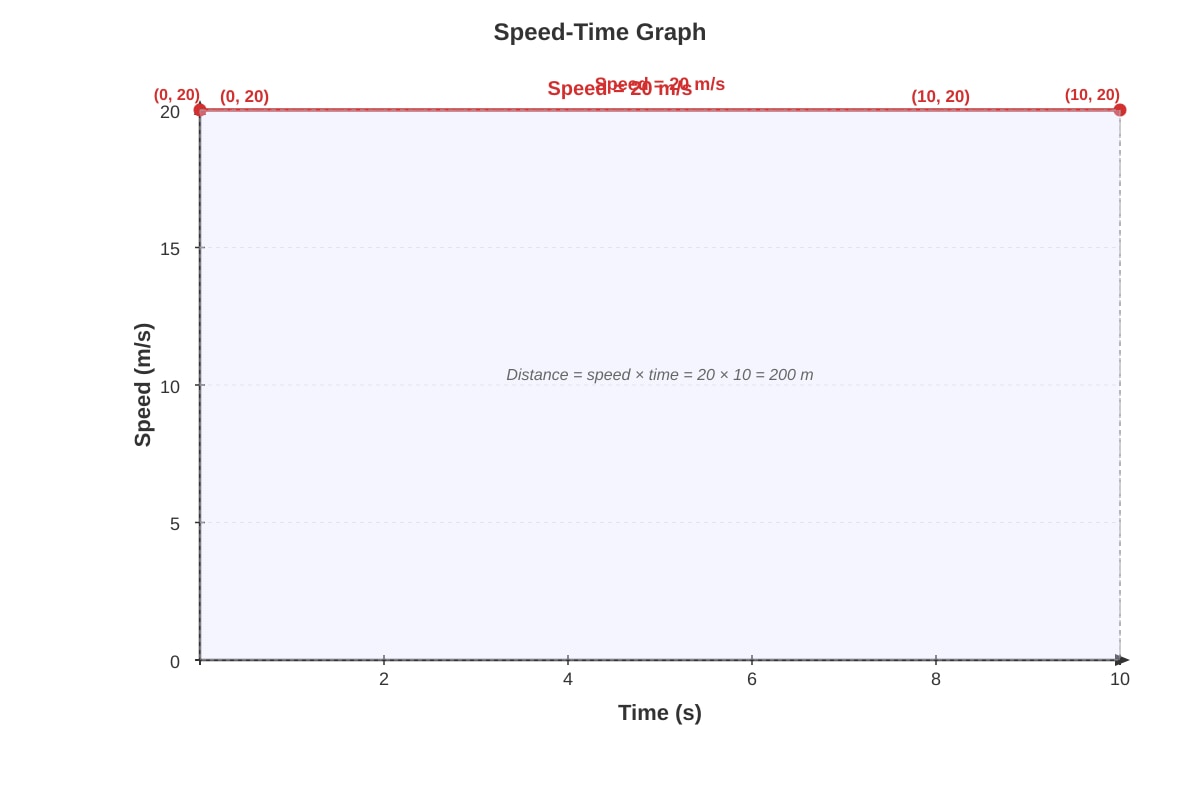
19. Answer: (a) The car is moving at a constant speed of 20 m/s. (b) 200 m (c) A straight line from (10, 20) to (15, 0) should be drawn.
- Working: (a) The horizontal line indicates constant speed (zero acceleration). (b) Distance = Speed × Time = 20 m/s × 10 s = 200 m (Alternatively, distance = area under graph = 20 × 10 = 200 m) (c) The deceleration is uniform, so the graph is a straight line from (10, 20) to (15, 0).
- Marking: 1 mark for (a), 1 mark for (b), 2 marks for (c) (1 for correct shape, 1 for correct endpoints).
- Teaching Note: On a speed-time graph:
- A horizontal line means constant speed.
- A sloping line means acceleration (upward) or deceleration (downward).
- The area under the graph represents distance travelled.
- Common Mistake: Students may draw a curved line for deceleration instead of a straight line.
20. Answer: (a) 6 litres per minute (b) V = 50 + 6t (c) 25 minutes
- Working: (a) Net rate = 10 L/min - 4 L/min = 6 L/min (b) V = Initial volume + (Net rate × Time) = 50 + 6t (c) Set V = 200: 200 = 50 + 6t 150 = 6t t = 25 minutes
- Marking: 1 mark for (a), 1 mark for (b), 2 marks for (c) (1 for forming equation, 1 for solving).
- Teaching Note: This is a linear relationship. The volume increases at a constant rate, so the graph of V against t is a straight line with gradient 6 and y-intercept 50. The equation V = 50 + 6t is a linear function where 6 is the rate of change (gradient) and 50 is the initial value (y-intercept).
End of Answer Key