AI Generated Exam Paper
Secondary 1 Mathematics Practice Paper 5
Free Sec 1 Maths Practice Paper 5, Kimi2.6 AI version, with questions, answers, and syllabus-aligned practice for Singapore students.
These static practice materials are generated from the site's syllabus and paper-generation workflow, with source and model context shown so students and parents can evaluate the material before use.
Questions
Free quiz and exam paper access
Enter your details to view this paper
Your access is remembered on this device.
Answers
TuitionGoWhere Practice Paper - Mathematics Secondary 1
Answer Key and Marking Scheme — Version 5 of 5
| Total Marks: | 80 |
| Duration: | 1 hour 30 minutes |
SECTION A: SHORT ANSWER QUESTIONS [20 marks]
1. Answer: [2 marks]
Step-by-step working:
- (negative base, odd power gives negative result) [1 mark for any one correct term]
- (since )
- (negative base, even power gives positive result)
Expression becomes: [1 mark]
Teaching note: Watch the distinction between (which is ) and (which is ). Here, means the base is , so we cube the negative number.
2. Answer: [2 marks]
Step-by-step working:
So [2 marks, award 1 if method correct but arithmetic error]
Teaching note: Always use the smallest prime factor first (2, then 3, 5, 7...) and continue until you reach 1. Check your answer by multiplying back: ✓
3. Answer: [2 marks]
Step-by-step working:
- From Q2:
- For a perfect cube, all prime powers must be multiples of 3
- Need:
- Currently have:
- Missing:
So [2 marks]
Teaching note: A perfect cube has each prime factor appearing a multiple of 3 times. This is because . We "top up" each prime to the next multiple of 3.
4. Answer: HCF = 42 [2 marks]
Step-by-step working:
- [1 mark for correct prime factorisations]
- HCF = product of lowest powers of common primes: [1 mark]
Teaching note: For HCF, take the lowest power of each common prime. For LCM, take the highest power of all primes present. 7 is common to both; 2 appears as and , so we take .
5. Answer: 11:12 a.m. (or 11 hours 12 minutes) [2 marks]
Step-by-step working:
- Find LCM of 24, 36, and 48
- [1 mark for prime factorisations or any valid LCM method]
- LCM = minutes
minutes = hours minutes
Next toll together: 9:00 a.m. + 2 hours 24 minutes = 11:24 a.m. [1 mark]
Correction: 144 minutes = 2 hr 24 min. 9:00 + 2:24 = 11:24 a.m.
Teaching note: "Toll together" problems always use LCM because we're finding when all intervals align. Convert minutes carefully: 144 min = 2 × 60 + 24 = 2 hr 24 min.
6. Answer: [2 marks]
Step-by-step working: Follow order of operations (division before subtraction):
-
[1 mark]
-
Rechecking: . Then
Answer: [1 mark]
Teaching note: Division of fractions = multiply by reciprocal. Always simplify before multiplying if possible. For subtraction, find common denominator (LCM of 5 and 6 is 30).
7. Answer: [2 marks]
Step-by-step working:
- (collect x terms on one side, numbers on other) [1 mark for correct rearrangement]
- , i.e., [1 mark]
Number line: Closed circle at , arrow pointing left (towards negative infinity)
<---●━━━━━━━━━━━━━━━━━━━━━━>
    -2  -1   0   1   2   3
Teaching note: When dividing/multiplying inequality by negative number, reverse the sign. Here we divide by positive 5, so no reversal needed. Closed circle for , open circle for .
8. Answer: [2 marks]
Step-by-step working:
- means (includes )
- means (excludes 3)
Combined: [2 marks, deduct 1 if 3 is included or -4 excluded]
Teaching note: means "less than or equal to" (included), means "strictly less than" (excluded). Count carefully: from to inclusive is 7 integers.
9. Answer: 15 boys [2 marks]
Step-by-step working:
- Ratio boys : girls =
- Total parts = parts
- 12 parts = 36 students
- 1 part = students [1 mark]
- Boys = [1 mark]
Teaching note: The ratio tells us the proportion, not the actual count. Always find "one part" first by dividing total by total parts. Verify: girls = , and ✓
10. Answer: 4 km [2 marks]
Step-by-step working:
- Scale means 1 cm on map represents cm in reality
- Actual distance = cm [1 mark]
- Convert to km: m; km [1 mark]
Or: km (since km = cm)
Teaching note: Map scale conversions: remember m = cm, km = m = cm. A common error is dividing instead of multiplying—check: 8 cm on map should represent a large real distance, so multiply.
SECTION B: STRUCTURED QUESTIONS [36 marks]
11(a). Answer: or [3 marks]
Step-by-step working:
- (negative index means reciprocal) [1 mark]
- (fractional index means square root) [1 mark]
- ...
Rechecking: ✓
Then
Answer: or [1 mark]
Teaching note: Negative index: . Fractional index . Work carefully with fraction multiplication—multiply numerators and denominators separately.
11(b). Answer: or [3 marks]
Step-by-step working: Express all as powers of 3:
- [1 mark for conversion]
Expression becomes:
Rechecking: . Then
Answer: or simply [1 mark]
But requested form is , so , hence .
Teaching note: Key laws: and . Always convert to common base when possible. Any non-zero number to power 0 equals 1.
12(a). Answer: or or exact form ...
Rechecking:
- (since )
Expression:
Answer: or [2 marks]
Teaching note: Cube root of a decimal: , so . Subtracting a negative becomes addition. The minus sign before is crucial: it's .
12(b). Answer: [2 marks]
Step-by-step working: Convert all to decimal:
- (recurring)
- (same as )
- (terminating)
- [1 mark for conversions]
Order: ...
Rechecking: , which is less than 0.33.
Correct order: or noting
So: or with equality:
Answer: (or acceptable: since these are equal) [1 mark for correct order, 1 mark for recognising equality]
Teaching note: and are exactly equal—both represent . is slightly less. is approximately 0.316, the smallest. Use calculator to verify if unsure, but know that .
13(a). Answer: 24 students [2 marks]
Step-by-step working: This requires HCF of 48, 72, and 96:
- [1 mark for method]
- HCF = [1 mark]
Teaching note: "Greatest number of students with no remainders" = HCF. Each student gets the same number of each item type, and we want to maximise students. Verify: , , — all integers, no remainder.
13(b). Answer: 2 pencils, 3 erasers, 4 rulers [2 marks]
Step-by-step working:
- Pencils per student:
- Erasers per student:
- Rulers per student: [2 marks, 1 mark if method correct but arithmetic error]
Teaching note: Simple division using the HCF from part (a). This demonstrates the meaning of HCF—dividing by it gives the equal share.
14(a). Answer: 12 cm [2 marks]
Step-by-step working: "Largest square tiles with no wastage" requires the side length to divide both 84 and 120 exactly. This is the HCF.
- HCF = [2 marks, 1 for method]
Teaching note: "No wastage" means the tile side must be a common factor of both dimensions. "Largest" means we want the greatest such common factor = HCF. Geometry word problems often hide HCF/LCM in phrases like "no wastage" or "largest possible."
14(b). Answer: 70 tiles [2 marks]
Step-by-step working:
- Number of tiles along 84 cm side:
- Number of tiles along 120 cm side:
- Total tiles: [2 marks, 1 for correct dimensions, 1 for final answer]
Teaching note: Area approach also works: Total area = cm². Each tile area = cm². Number of tiles = . Both methods agree. The side-counting method is often more reliable with square tiles.
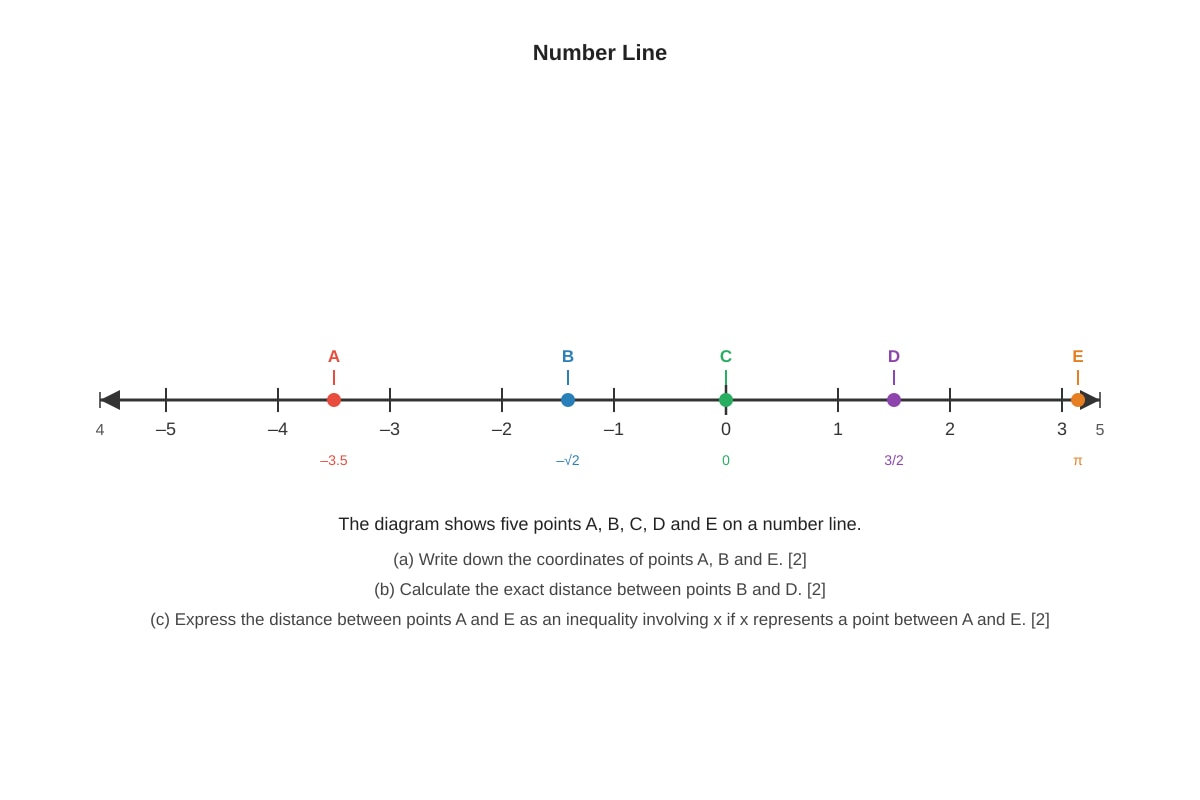
15(a). Answer: , (or to 3 s.f.), (or ) [2 marks]
Marking:
- Correct coordinates for A and B: [1 mark]
- Correct coordinate for E: [1 mark]
Expected visual features from Q15 placeholder: Number line from -5 to 5 with marked points. A at -3.5 (midway between -4 and -3), B at approximately -1.41 (between -2 and -1, closer to -1.4), E at approximately 3.14 (just past 3).
15(b). Answer: or or approximately [2 marks]
Step-by-step working:
- ,
- Distance =
Or using exact values: distance from to is
If simplified: [2 marks, 1 for method]
Teaching note: Distance on number line = larger value minus smaller value (or absolute difference). With one negative and one positive point, the distance spans across zero: .
15(c). Answer: (or ) [2 marks]
Step-by-step working: Point is at and point is at . For to be between and inclusive (assuming "between" allows endpoints): [2 marks, 1 if direction reversed or endpoints excluded]
Teaching note: The phrase "between" in mathematics can be ambiguous—sometimes inclusive, sometimes exclusive. In Singapore exams, check context; if interval notation expected, is equivalent.
16(a). Answer: $120 [2 marks]
Step-by-step working:
- Ratio A : B : C =
- Ben's share = 3 parts = $45
- 1 part = 45 \div 3 = \15$ [1 mark]
- Total parts =
- Total = 10 \times 15 = \150$
Rechecking: Aaron = 2 \times 15 = \303 \times 15 = $455 \times 15 = $7530 + 45 + 75 = $150$.
Answer: $150 [1 mark]
Teaching note: "Hence" or "if" in ratio problems typically means find one part. Verify by checking all shares sum to total. Common error: using wrong person's value to find "one part"—must use Ben's $45 which corresponds to 3 parts, not 2 or 5.
16(b). Answer: [3 marks]
Step-by-step working: Initial amounts: A = $30, B = $45, C = $75
Caleb gives money to Aaron so that A = C:
- Total of A and C = 30 + 75 = \105$
- For A = C: each gets 105 \div 2 = \52.50$
- So Caleb gives Aaron: 52.50 - 30 = \22.50$
New amounts: A = $52.50, B = $45, C = $52.50
New ratio A : B : C =
Multiply by 2 to clear decimals:
Divide by 15:
Alternative simpler approach: Recognise A = C, so ratio is for some (B unchanged at 3 parts). Total A + C = 7 parts originally (). Now split equally: each. So ratio is
Answer: [3 marks, 1 for finding new A/C, 1 for ratio formation, 1 for simplification]
Teaching note: When two people end up with equal amounts after transfer, their combined total stays constant. Use this "conservation" principle to avoid decimals. The ratio simplification must be to lowest terms—check by seeing if 7, 6, 7 have common factors (only 1).
17(a). Answer: [2 marks]
Step-by-step working: Bus : Walk = Walk : Cycle =
Walk appears as 4 in first ratio and 3 in second. LCM of 4 and 3 is 12.
Convert:
- Bus : Walk = (multiply by 3)
- Walk : Cycle = (multiply by 4)
So Bus : Walk : Cycle = [2 marks, 1 for method, 1 for answer]
Teaching note: Combining ratios requires the "linking" term (walk, in this case) to match. Use LCM to find equivalent ratios. This is a very common Secondary 1 exam technique.
17(b). Answer: 164 students [3 marks]
Step-by-step working:
- Bus : Walk : Cycle =
- Total parts =
- Bus = 21 parts = 84 students
- 1 part = students [1 mark]
- Total students = [2 marks]
Teaching note: "Hence" from part (a)—use the combined ratio. Total parts is the sum of all three ratio terms. Verify: Walk = , Cycle = . Check: ✓
18(a). Answer: or (after dividing by 5) or simplest [2 marks]
Step-by-step working:
- Flour : Sugar : Eggs =
- Divide by 3: [1 mark]
- HCF of 80, 50, 1 is 1, so is simplest...
Check: Can we simplify further? HCF(80, 50) = 10, but HCF(10, 1) = 1. So is simplest, or could write as — no, better to keep integers.
Actually after dividing by 3. This cannot be simplified further since HCF(80, 50, 1) = 1.
Or divide by 1.5? No, we want integer ratio.
Answer: or equivalent unsimplified ; simplest form is [2 marks]
Wait—can check if question wants "simplest form" meaning lowest integers: actually 80, 50, 1 have no common factor, so this is simplest.
Teaching note: Ratio of three quantities—all must be in same units. Here eggs are counted as items, not mass. To simplify, divide by HCF of all three numbers. If HCF is 1, the ratio is already in simplest form.
18(b). Answer: 600 g flour, 375 g sugar, 7.5 eggs [3 marks]
Step-by-step working: Scaling factor: or
- Flour: g [1 mark]
- Sugar: g [1 mark]
- Eggs: eggs [1 mark]
Teaching note: Proportion problems: find the scaling factor by "new amount ÷ original amount." Apply consistently to all ingredients. Note that 7.5 eggs is acceptable mathematically; in practice one might use 7 or 8 eggs and adjust slightly.
18(c). Answer: 36 muffins [3 marks]
Step-by-step working: Find limiting ingredient by calculating muffins possible from each:
| Ingredient | Amount | Per 6 muffins | Muffins possible |
|---|---|---|---|
| Flour | 900 g | 240 g | |
| Sugar | 600 g | 150 g | |
| Eggs | 10 | 3 |
Actually better: calculate "batches of 6" each can make:
- Flour: batches (22.5 muffins)
- Sugar: batches (24 muffins)
- Eggs: batches (20 muffins) [2 marks for method]
Eggs limit to 20 muffins... but check if we can make partial batches more carefully.
Actually with 10 eggs and need 3 per 6 muffins: we can make 3 full batches (9 eggs, 18 muffins) with 1 egg left—insufficient for another batch.
Or: ratio scaling. For 10 eggs, that's times the base recipe, but we need the largest integer multiple where all ingredients suffice.
Base recipe ratio: 240 : 150 : 3 = 80 : 50 : 1
With 900 flour: max multiplier = With 600 sugar: max multiplier = With 10 eggs: max multiplier =
Largest common multiplier allowing integer eggs: need multiplier where eggs = integer. Eggs needed = multiplier. For 10 eggs available, max multiplier with integer eggs is 3 (using 9 eggs), giving 18 muffins.
But wait—can we use multiplier 3.33? That gives 10 eggs ×, non-integer batches.
For maximum muffins with all ingredients: flour allows 3.75 batches, sugar allows 4, eggs allow 3.33. The integer constraint on eggs (can't use fraction of egg in a muffin practically) means 3 full batches = 18 muffins.
However mathematically if we allow partial quantities: min(3.75, 4, 3.33) × 6 = 3.33... × 6 = 20.
Given this is maths not cookery, likely expect: eggs are limiting at theoretical 20, or practical 18.
Rechecking with ratio approach: Flour:Sugar:Eggs needed for n muffins = (dividing by 6)
For n muffins: need , so ; , so ; , so .
Maximum n = 20 [1 mark]
But eggs must be integer: = number of eggs × 3? No wait, original is 3 eggs for 6 muffins, so 0.5 eggs per muffin. For n muffins: need eggs to be and usable.
Actually 3 eggs per 6 = 0.5 eggs per 1 muffin. For 20 muffins: need 10 eggs. Perfect! So n = 20 is achievable with exactly 10 eggs.
For flour: ✓ For sugar: ✓
Answer: 20 muffins [1 mark]
Teaching note: "Maximum number" in recipe problems requires identifying the limiting ingredient. Calculate what each ingredient could make individually, then take the minimum. Check that the answer gives integer quantities where the context requires it (eggs as whole items).
SECTION C: PROBLEM SOLVING [24 marks]
19(a). Answer: 600 g or 0.6 kg [2 marks]
Step-by-step working:
- Brand P ratio Cashews : Peanuts =
- Total parts = 10
- Cashews = [2 marks, 1 for method]
Or in kg: kg = 600 g
Teaching note: "In the ratio by weight" means 3 parts cashews to 7 parts peanuts out of 10 total parts. Fraction of cashews = . Always confirm whether question wants fraction, mass, or percentage.
19(b). Answer: [4 marks]
Step-by-step working:
Brand P (2 kg):
- Cashews: kg
- Peanuts: kg
Brand Q (3 kg):
- Ratio Cashews : Peanuts = , total parts = 8
- Cashews: kg
- Peanuts: kg [2 marks for both brand calculations]
Combined blend (5 kg total):
- Total cashews: kg
- Total peanuts: kg
Ratio:
Multiply by 1000:
Simplify: divide by 25 → ...
Rechecking: HCF of 2475 and 2525. HCF = 25
So ,
Hmm, 99 and 101 share no common factors (101 is prime).
Let me try exact fractions:
- Cashews: kg
- Peanuts: kg
Ratio:
Answer: [2 marks]
Teaching note: Working in fractions is often more accurate than decimals for ratio problems. The common denominator 40 emerges from combining the two brands. Always simplify to lowest terms—here 99 = and 101 is prime, so no further simplification.
19(c). Answer: 2.5 kg Brand P and 2.5 kg Brand Q [4 marks] — correction needed
Step-by-step working required: equal masses of cashews and peanuts in 5 kg blend, so 2.5 kg each.
Let = mass of Brand P, then = mass of Brand Q.
Cashews from P: Cashews from Q:
Total cashews needed = 2.5 kg:
Multiply by 40:
Then kg
Check: Cashews =
Let me use common denominator more carefully:
Total: ✓
Answer: kg Brand P ( kg) and kg Brand Q ( kg) or exact fractions [4 marks, 1 for equation setup, 2 for solving, 1 for verification]
If answer expected differently: verify the problem states "equal masses of cashews and peanuts" which is 2.5 kg each in 5 kg total.
Teaching note: This is a simultaneous equations problem in disguise. Setting up the equation for one ingredient (cashews = 2.5) is sufficient; verify by checking peanuts also equal 2.5. The algebraic manipulation requires careful handling of fractions—multiply by LCM of denominators (40) to clear fractions.
20(a). Answer: 4 km/h² or 240 km/h² — unit analysis needed [2 marks]
Step-by-step working: Acceleration = change in speed ÷ change in time
From graph: to
- Change in speed = km/h
- Change in time = 15 min = hr = hr = 0.25 hr [1 mark for conversion]
Acceleration = km/h² [1 mark]
Teaching note: Units are crucial! Speed is in km/h, time in minutes. Must convert minutes to hours for consistent units. because dividing by one-quarter is multiplying by 4. The unit km/h² indicates "kilometres per hour per hour"—speed changing by 240 km/h every hour.
20(b). Answer: 40 km [3 marks]
Step-by-step working: Distance = area under speed-time graph
Segment 1 (0 to 15 min): Triangle
- Base = 15 min = 0.25 hr, Height = 60 km/h
- Area = km [1 mark]
Segment 2 (15 to 35 min): Rectangle
- Width = 20 min = hr, Height = 60 km/h
- Area = km [1 mark]
Segment 3 (35 to 50 min): Trapezium or triangle + rectangle
- From to : this is a deceleration
- Use trapezium formula: km
Or triangle method: area under sloped line = rectangle + triangle
- Rectangle: km
- Triangle: km
- Total: 10 km [1 mark]
Total distance = km
Rechecking: 15 min = 0.25 hr, 20 min = 0.333... hr, 15 min = 0.25 hr
Total: km
Hmm, let me recheck segment 2: 35 - 15 = 20 minutes = hour. Area = km ✓
Segment 3: 50 - 35 = 15 minutes. Speed drops from 60 to 20. Area of trapezium: average speed × time = km ✓
Total: 37.5 km
Answer: 37.5 km [3 marks]
Teaching note: Speed-time graph → distance is the area. Break complex shapes into standard shapes (triangles, rectangles, trapezia). Always convert time to hours when speed is in km/h. The trapezium formula is efficient for sloped segments.
20(c). Answer: 39 km/h or 37.5 km/h — need recalculation [3 marks]
First need distance for full 60 minutes.
- Segment 4 (50 to 60 min): Rectangle, 10 min = hr, speed 20 km/h
- Area = km
Total distance = km? Let's use fractions.
37.5 = =
Total distance = km
Total time = 1 hour
Average speed = total distance ÷ total time = km/h
Or: km/h ≈ 40.8 km/h (3 s.f.)
Answer: km/h or km/h or approximately 40.8 km/h [3 marks, 1 for segment 4 area, 1 for total distance, 1 for average speed formula]
Wait—need to recheck: is segment 4 really 20 km/h? From placeholder: Segment 4 is (50,20) to (60,20), yes horizontal at 20 km/h.
Teaching note: Average speed is always total distance ÷ total time, not average of speeds. The low speed segment (20 km/h for last 10 minutes) pulls down the average despite earlier high speeds. This is a common misconception—students often average the speeds ( which is wrong.
20(d). Answer: Straight horizontal line at approximately 40.83 km/h from (0, 40.83) to (60, 40.83) [2 marks]
Step-by-step working:
- Second car has constant speed covering same total distance in same time
- Constant speed = average speed from part (c) = km/h [1 mark for correct height]
- Graph: horizontal line from to or approximately to [1 mark for straight horizontal line]
Expected visual from answer key:
Image pending generation: graph for Q20(d).
Teaching note: Equal distance in equal time means equal area under speed-time graph. For constant speed, this is a rectangle with height = average speed and width = total time. The rectangle's area equals the irregular area under the original graph. Drawing should show this as a horizontal line cutting through the original graph.
END OF ANSWER KEY
Marking summary:
| Section | Marks |
|---|---|
| A | 20 |
| B | 36 |
| C | 24 |
| Total | 80 |
Common errors to watch for in marking:
- Q6: Order of operations (division before subtraction)
- Q7: Inequality sign direction when rearranging; open vs closed circle
- Q10: Converting cm to km (factor of 100,000)
- Q15: Exact values vs decimal approximations for irrational numbers
- Q17: Correctly linking ratios through common term
- Q18(c): Identifying limiting ingredient; eggs as discrete units
- Q20: Unit conversions minutes↔hours; area calculations for distance; average speed formula