From Real Exams Exam Paper

Secondary 1 Mathematics Semestral Assessment 2 (End of Year) Paper 4

Free Nemo AI-generated Sec 1 Maths SA2 Paper 4 with questions, answers, and syllabus-aligned practice for Singapore students preparing for exams.

These static practice materials are generated from the site's syllabus and paper-generation workflow, with source and model context shown so students and parents can evaluate the material before use.

Secondary 1 Mathematics From Real Exams Generated by NVIDIA Nemotron 3 Ultra 550B A55B Free Updated 2026-06-14

Questions

<!-- TuitionGoWhere generation metadata: stage=3-1; model=nvidia/nemotron-3-ultra-550b-a55b:free; model_label=NVIDIA Nemotron 3 Ultra 550B A55B Free; generated=2026-06-14; Sources: Stage 2-1 real exam-derived templates and Stage 2-2 exam-enriched syllabus. -->

TuitionGoWhere Practice Paper - Mathematics Secondary 1

TuitionGoWhere Secondary School (AI)

Subject: Mathematics
Level: Secondary 1 (G3)
Paper: SA2 Version 4
Duration: 1 hour 30 minutes
Total Marks: 60

Name: ________________________
Class: ________________________
Date: ________________________


INSTRUCTIONS TO CANDIDATES

  1. Write your name, class, and date in the spaces provided above.
  2. Answer all questions.
  3. Write your answers in the spaces provided in this question paper.
  4. Show all working clearly. Omission of essential working will result in loss of marks.
  5. Calculators may be used unless otherwise stated.
  6. If the degree of accuracy is not specified, give answers to 3 significant figures.
  7. The number of marks is given in brackets [ ] at the end of each question or part question.
  8. The total number of marks for this paper is 60.

Section A: Short Answer Questions [20 marks]

Answer all questions in this section.

1

Express the ratio 48:7248 : 72 in its simplest form.
Answer: ________________________ [1]

2

A map has a scale of 1:250001 : 25\,000. The distance between two points on the map is 6.46.4 cm. Find the actual distance in kilometres.
Answer: ________________________ km [2]

3

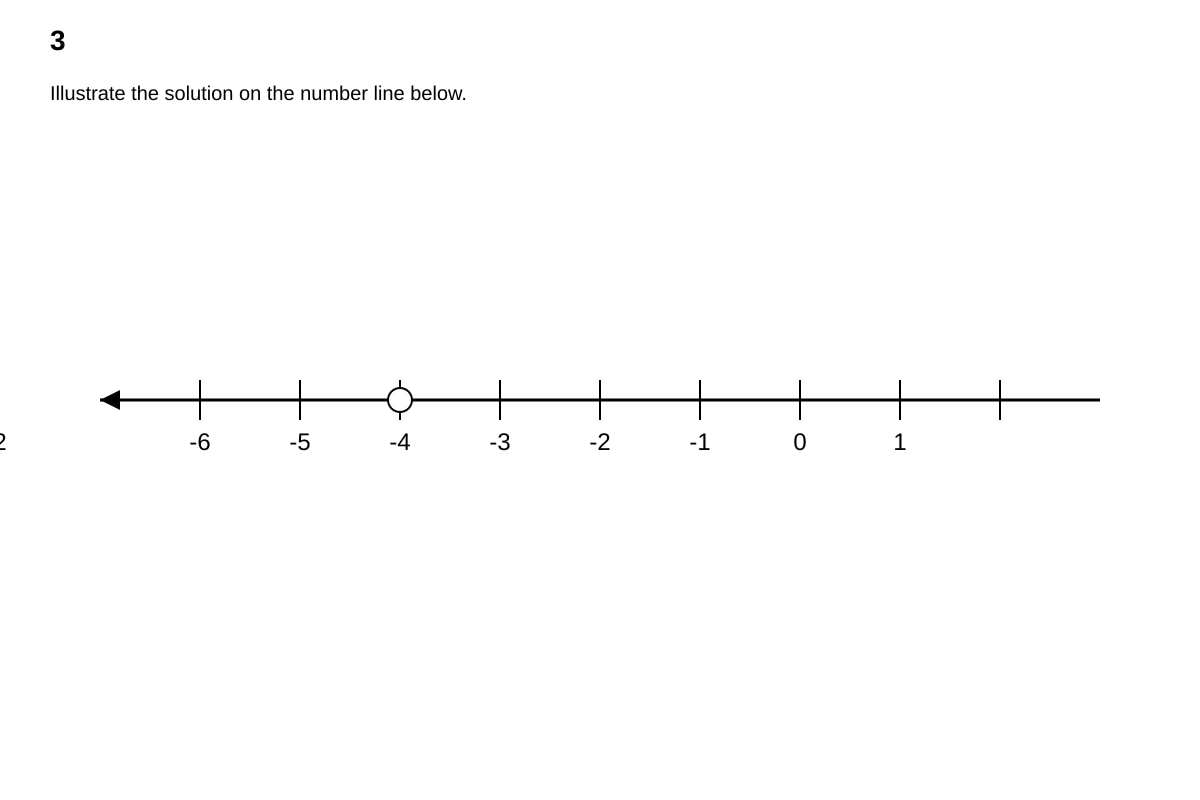
Solve the inequality 3x>12-3x > 12 and illustrate the solution on the number line below.

<image_placeholder> id: Q3-fig1 type: diagram linked_question: Q3 description: Number line from -6 to 2 with integer markings, space for open/closed circle and arrow shading labels: integers -6, -5, -4, -3, -2, -1, 0, 1, 2 values: none must_show: open circle at -4, arrow pointing left towards negative infinity </image_placeholder>

[2]

4

yy is inversely proportional to the square of xx. When x=4x = 4, y=9y = 9. Find the value of yy when x=6x = 6.
Answer: ________________________ [2]

5

A car travels 180180 km in 22 hours 3030 minutes. Calculate its average speed in km/h.
Answer: ________________________ km/h [2]

6

The ratio of boys to girls in a class is 3:53 : 5. If there are 2424 boys, how many students are there in total?
Answer: ________________________ [2]

7

Simplify the ratio 0.75:1.5:2.250.75 : 1.5 : 2.25.
Answer: ________________________ [2]

8

It takes 66 workers 88 days to complete a job. How many days will it take 44 workers to complete the same job, assuming they work at the same rate?
Answer: ________________________ days [2]

9

A recipe uses flour and sugar in the ratio 5:25 : 2. If 350350 g of flour is used, how much sugar is needed?
Answer: ________________________ g [2]

10

The scale of a floor plan is 1:1001 : 100. A rectangular room measures 4.54.5 cm by 3.23.2 cm on the plan. Find the actual area of the room in m2\text{m}^2.
Answer: ________________________ m2\text{m}^2 [3]


Section B: Structured Questions [25 marks]

Answer all questions in this section.

11

A sum of money is shared among Ali, Bala, and Charlie in the ratio 2:3:52 : 3 : 5.

(a) What fraction of the total sum does Bala receive?
Answer: ________________________ [1]

(b) If Charlie receives 120120 more than Ali, find the total sum of money.
Answer: ________________________ [2]

(c) If the total sum is 600600, how much more does Charlie receive than Bala?
Answer: ________________________ [2]

12

The pressure PP of a gas is inversely proportional to its volume VV. When V=200 cm3V = 200\ \text{cm}^3, P=150 kPaP = 150\ \text{kPa}.

(a) Write down an equation connecting PP and VV.
Answer: ________________________ [1]

(b) Find the pressure when the volume is 120 cm3120\ \text{cm}^3.
Answer: ________________________ kPa [2]

(c) Find the volume when the pressure is 200 kPa200\ \text{kPa}.
Answer: ________________________ cm3\text{cm}^3 [2]

13

A map is drawn to a scale of 1:500001 : 50\,000.

(a) Express this scale in the form 1 cm1\ \text{cm} represents ______ km.
Answer: ________________________ km [1]

(b) Two towns are 8.58.5 cm apart on the map. Find the actual distance between them in kilometres.
Answer: ________________________ km [2]

(c) A forest reserve has an actual area of 12 km212\ \text{km}^2. Find its area on the map in cm2\text{cm}^2.
Answer: ________________________ cm2\text{cm}^2 [2]

14

A factory produces widgets. The number of widgets produced is directly proportional to the number of machines operating. When 88 machines operate, 480480 widgets are produced per hour.

(a) Find the number of widgets produced per hour when 1212 machines operate.
Answer: ________________________ [2]

(b) How many machines are needed to produce 900900 widgets per hour?
Answer: ________________________ [2]

(c) If each machine consumes 2.52.5 kWh of electricity per hour, find the total electricity consumption for producing 900900 widgets per hour.
Answer: ________________________ kWh [2]

15

The time TT taken to complete a task is inversely proportional to the number of people nn working on it. A team of 55 people takes 1818 hours to complete the task.

(a) Write down an equation connecting TT and nn.
Answer: ________________________ [1]

(b) How long will it take a team of 99 people to complete the same task?
Answer: ________________________ hours [2]

(c) The task must be completed in 66 hours. What is the minimum number of people required?
Answer: ________________________ [2]


Section C: Application and Problem Solving [15 marks]

Answer all questions in this section.

16

A paint mixture is made by mixing red, blue, and yellow paint in the ratio 3:4:53 : 4 : 5 by volume.

(a) What percentage of the mixture is blue paint?
Answer: ________________________ % [2]

(b) If 2.42.4 litres of red paint is used, find the total volume of the mixture in litres.
Answer: ________________________ litres [2]

(c) The mixture is sold in 500 ml500\ \text{ml} tins. How many full tins can be filled from the mixture in (b)?
Answer: ________________________ [2]

17

Two gears are connected. Gear A has 2424 teeth and Gear B has 3636 teeth. When Gear A makes 1515 revolutions, Gear B makes 1010 revolutions.

(a) Explain why the number of revolutions is inversely proportional to the number of teeth.
Answer: ________________________ [1]

(b) If Gear A makes 4545 revolutions, how many revolutions does Gear B make?
Answer: ________________________ [2]

(c) A third gear C with 4848 teeth is connected to Gear B. If Gear A makes 6060 revolutions, how many revolutions does Gear C make?
Answer: ________________________ [3]

18

A rectangular tank measures 80 cm80\ \text{cm} by 50 cm50\ \text{cm} by 40 cm40\ \text{cm}. It is filled with water to a height of 25 cm25\ \text{cm}. Water flows into the tank at a rate of 44 litres per minute.

(a) Find the volume of water already in the tank in litres.
Answer: ________________________ litres [2]

(b) How many more minutes are needed to fill the tank completely?
Answer: ________________________ minutes [3]

19

The cost CC of producing xx units of a product is given by C=500+12xC = 500 + 12x, where CC is in dollars. The selling price per unit is 2020.

(a) Write down an expression for the revenue RR from selling xx units.
Answer: ________________________ [1]

(b) Find the break-even point (number of units where revenue equals cost).
Answer: ________________________ units [2]

(c) If the company wants to make a profit of at least 10001000, what is the minimum number of units that must be sold?
Answer: ________________________ units [2]

20

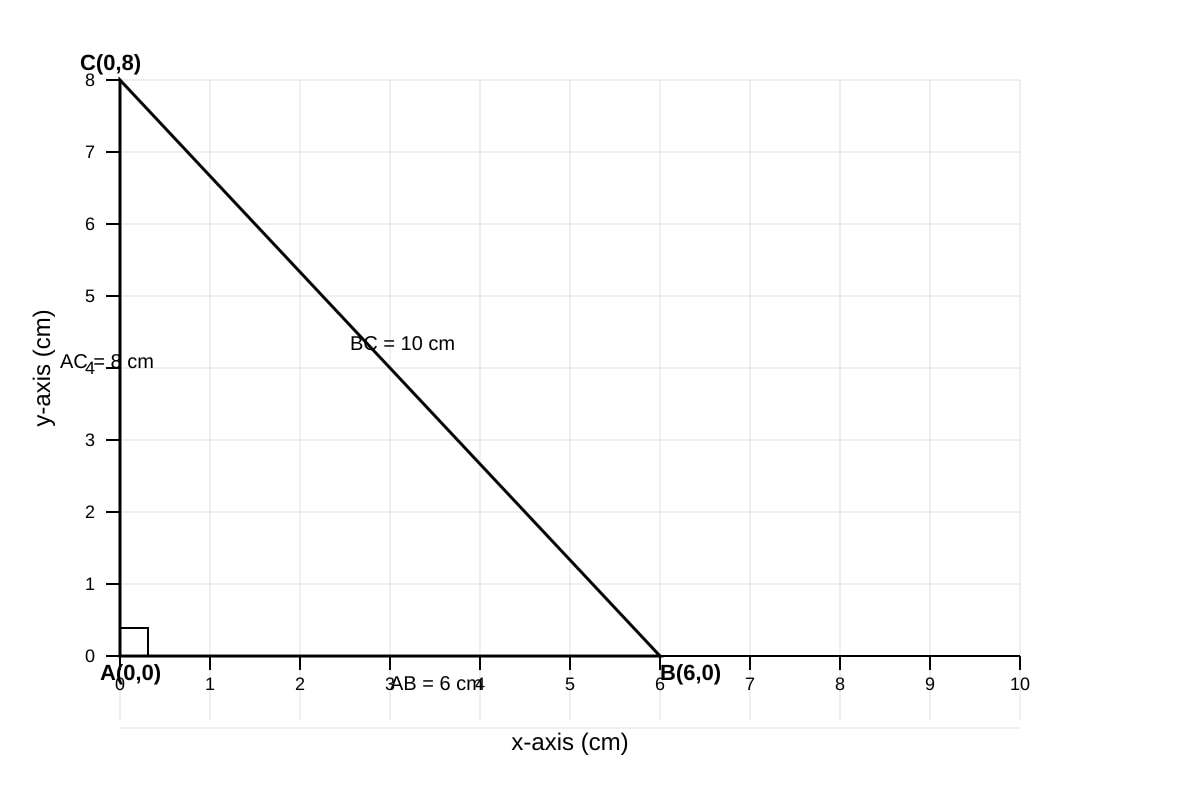
A map has a scale of 1:400001 : 40\,000. A triangular plot of land has vertices at coordinates (0,0)(0,0), (6,0)(6,0), and (0,8)(0,8) on the map, where units are in cm.

<image_placeholder> id: Q20-fig1 type: diagram linked_question: Q20 description: Right-angled triangle on coordinate grid with vertices at (0,0), (6,0), (0,8). Axes labelled 0-10 cm. Right angle at origin. labels: x-axis (cm), y-axis (cm), vertices A(0,0), B(6,0), C(0,8) values: AB = 6 cm, AC = 8 cm, BC = 10 cm (by Pythagoras) must_show: right-angled triangle with labelled vertices and side lengths on map </image_placeholder>

(a) Find the actual lengths of the three sides of the plot in kilometres.
Answer: ________________________ km, ________________________ km, ________________________ km [3]

(b) Find the actual area of the plot in km2\text{km}^2.
Answer: ________________________ km2\text{km}^2 [2]


END OF PAPER

Answers

<!-- TuitionGoWhere generation metadata: stage=3-1; model=nvidia/nemotron-3-ultra-550b-a55b:free; model_label=NVIDIA Nemotron 3 Ultra 550B A55B Free; generated=2026-06-14; Sources: Stage 2-1 real exam-derived templates and Stage 2-2 exam-enriched syllabus. -->

TuitionGoWhere Practice Paper - Mathematics Secondary 1

SA2 Version 4 - Answer Key and Marking Scheme

Total Marks: 60


Section A: Short Answer Questions [20 marks]

1

Answer: 2:32 : 3
Marks: [1]
Working:
48:72=4824:7224=2:348 : 72 = \frac{48}{24} : \frac{72}{24} = 2 : 3
(HCF of 48 and 72 is 24)


2

Answer: 1.61.6 km
Marks: [2]
Working:
Scale 1:250001 : 25\,000 means 11 cm on map = 2500025\,000 cm actual
6.46.4 cm on map = 6.4×25000=1600006.4 \times 25\,000 = 160\,000 cm
160000160\,000 cm = 160000÷100000=1.6160\,000 \div 100\,000 = 1.6 km
Mark breakdown: 1 mark for correct multiplication, 1 mark for correct unit conversion to km


3

Answer: x<4x < -4 with open circle at 4-4, arrow pointing left
Marks: [2]
Working:
3x>12-3x > 12
Divide both sides by 3-3 (reverse inequality sign):
x<4x < -4
Number line: Open circle at 4-4, arrow/shading extending left towards negative infinity.
Mark breakdown: 1 mark for correct algebraic solution, 1 mark for correct number line illustration (open circle + correct direction)
Common mistake: Forgetting to reverse inequality sign when dividing by negative number.


4

Answer: 44
Marks: [2]
Working:
y1x2y=kx2y \propto \frac{1}{x^2} \Rightarrow y = \frac{k}{x^2}
When x=4x = 4, y=9y = 9: 9=k16k=1449 = \frac{k}{16} \Rightarrow k = 144
Equation: y=144x2y = \frac{144}{x^2}
When x=6x = 6: y=14436=4y = \frac{144}{36} = 4
Mark breakdown: 1 mark for finding k=144k = 144, 1 mark for correct final answer


5

Answer: 7272 km/h
Marks: [2]
Working:
Time = 22 h 3030 min = 2.52.5 h
Average speed = distancetime=1802.5=72\frac{\text{distance}}{\text{time}} = \frac{180}{2.5} = 72 km/h
Mark breakdown: 1 mark for correct time conversion, 1 mark for correct calculation


6

Answer: 6464
Marks: [2]
Working:
Ratio boys : girls = 3:53 : 5
33 units = 2424 boys 1\Rightarrow 1 unit = 88
Total units = 3+5=83 + 5 = 8 units
Total students = 8×8=648 \times 8 = 64
Mark breakdown: 1 mark for finding value of 1 unit, 1 mark for correct total


7

Answer: 1:2:31 : 2 : 3
Marks: [2]
Working:
0.75:1.5:2.250.75 : 1.5 : 2.25
Multiply by 100100: 75:150:22575 : 150 : 225
Divide by 7575: 1:2:31 : 2 : 3
Mark breakdown: 1 mark for clearing decimals correctly, 1 mark for simplest form


8

Answer: 1212 days
Marks: [2]
Working:
Inverse proportion: workers ×\times days = constant
6×8=4×d6 \times 8 = 4 \times d
48=4dd=1248 = 4d \Rightarrow d = 12 days
Mark breakdown: 1 mark for setting up inverse proportion, 1 mark for correct answer


9

Answer: 140140 g
Marks: [2]
Working:
Flour : Sugar = 5:25 : 2
55 units = 350350 g 1\Rightarrow 1 unit = 7070 g
Sugar = 2×70=1402 \times 70 = 140 g
Mark breakdown: 1 mark for finding 1 unit, 1 mark for correct answer


10

Answer: 14.4 m214.4\ \text{m}^2
Marks: [3]
Working:
Scale 1:1001 : 100 \Rightarrow actual length = plan length ×100\times 100
Actual length = 4.5×100=4504.5 \times 100 = 450 cm = 4.54.5 m
Actual width = 3.2×100=3203.2 \times 100 = 320 cm = 3.23.2 m
Actual area = 4.5×3.2=14.4 m24.5 \times 3.2 = 14.4\ \text{m}^2
Mark breakdown: 1 mark for converting length, 1 mark for converting width, 1 mark for correct area in m2\text{m}^2
Alternative: Area on plan = 4.5×3.2=14.4 cm24.5 \times 3.2 = 14.4\ \text{cm}^2, actual area = 14.4×1002=144000 cm2=14.4 m214.4 \times 100^2 = 144\,000\ \text{cm}^2 = 14.4\ \text{m}^2


Section B: Structured Questions [25 marks]

11

(a) Answer: 310\frac{3}{10}
Marks: [1]
Working: Total parts = 2+3+5=102 + 3 + 5 = 10. Bala's share = 310\frac{3}{10}.

(b) Answer: 600600
Marks: [2]
Working:
Difference between Charlie and Ali = 52=35 - 2 = 3 units
33 units = 1201120 \Rightarrow 1 unit = 4040
Total = 10×40=60010 \times 40 = 600
Mark breakdown: 1 mark for finding 1 unit, 1 mark for total

(c) Answer: 120120
Marks: [2]
Working:
Total = 6001600 \Rightarrow 1 unit = 6060
Charlie = 5×60=3005 \times 60 = 300, Bala = 3×60=1803 \times 60 = 180
Difference = 300180=120300 - 180 = 120
Mark breakdown: 1 mark for finding 1 unit, 1 mark for difference


12

(a) Answer: P=30000VP = \frac{30\,000}{V} or PV=30000PV = 30\,000
Marks: [1]
Working: P1VP=kVP \propto \frac{1}{V} \Rightarrow P = \frac{k}{V}. 150=k200k=30000150 = \frac{k}{200} \Rightarrow k = 30\,000.

(b) Answer: 250250 kPa
Marks: [2]
Working: P=30000120=250P = \frac{30\,000}{120} = 250 kPa
Mark breakdown: 1 mark for substitution, 1 mark for answer

(c) Answer: 150 cm3150\ \text{cm}^3
Marks: [2]
Working: 200=30000VV=30000200=150 cm3200 = \frac{30\,000}{V} \Rightarrow V = \frac{30\,000}{200} = 150\ \text{cm}^3
Mark breakdown: 1 mark for rearrangement, 1 mark for answer


13

(a) Answer: 0.50.5 km
Marks: [1]
Working: 1:5000011 : 50\,000 \Rightarrow 1 cm = 5000050\,000 cm = 0.50.5 km

(b) Answer: 4.254.25 km
Marks: [2]
Working: 8.5×0.5=4.258.5 \times 0.5 = 4.25 km
Mark breakdown: 1 mark for using scale correctly, 1 mark for answer

(c) Answer: 4.8 cm24.8\ \text{cm}^2
Marks: [2]
Working:
Area scale factor = (50000)2(50\,000)^2
12 km2=12×(100000)2 cm2=1.2×1011 cm212\ \text{km}^2 = 12 \times (100\,000)^2\ \text{cm}^2 = 1.2 \times 10^{11}\ \text{cm}^2
Map area = 1.2×10¹¹(50000)2=1.2×10112.5×109=48 cm2\frac{1.2 \times 10^{11}}{(50\,000)^2} = \frac{1.2 \times 10^{11}}{2.5 \times 10^9} = 48\ \text{cm}^2
Wait, recalculate: 12 km2=12×1010 cm2=1.2×1011 cm212\ \text{km}^2 = 12 \times 10^{10}\ \text{cm}^2 = 1.2 \times 10^{11}\ \text{cm}^2
Map area = 1.2×10112.5×109=48 cm2\frac{1.2 \times 10^{11}}{2.5 \times 10^9} = 48\ \text{cm}^2
Correction: 1 km=1000001\ \text{km} = 100\,000 cm, so 1 km2=1010 cm21\ \text{km}^2 = 10^{10}\ \text{cm}^2
12 km2=12×1010=1.2×1011 cm212\ \text{km}^2 = 12 \times 10^{10} = 1.2 \times 10^{11}\ \text{cm}^2
Scale factor for area = 500002=2.5×10950\,000^2 = 2.5 \times 10^9
Map area = 1.2×10¹¹÷2.5×109=48 cm21.2 \times 10^{11} \div 2.5 \times 10^9 = 48\ \text{cm}^2
Answer: 48 cm248\ \text{cm}^2
Mark breakdown: 1 mark for correct area scale factor, 1 mark for correct calculation


14

(a) Answer: 720720
Marks: [2]
Working:
Direct proportion: widgets \propto machines
88 machines 480\to 480 widgets 1\Rightarrow 1 machine 60\to 60 widgets/hour
1212 machines 12×60=720\to 12 \times 60 = 720 widgets/hour
Mark breakdown: 1 mark for rate per machine, 1 mark for answer

(b) Answer: 1515
Marks: [2]
Working: 900÷60=15900 \div 60 = 15 machines
Mark breakdown: 1 mark for using rate, 1 mark for answer

(c) Answer: 37.537.5 kWh
Marks: [2]
Working: 1515 machines ×2.5\times 2.5 kWh = 37.537.5 kWh
Mark breakdown: 1 mark for number of machines, 1 mark for total consumption


15

(a) Answer: T=90nT = \frac{90}{n} or Tn=90Tn = 90
Marks: [1]
Working: T1nT=knT \propto \frac{1}{n} \Rightarrow T = \frac{k}{n}. 18=k5k=9018 = \frac{k}{5} \Rightarrow k = 90.

(b) Answer: 1010 hours
Marks: [2]
Working: T=909=10T = \frac{90}{9} = 10 hours
Mark breakdown: 1 mark for substitution, 1 mark for answer

(c) Answer: 1515 people
Marks: [2]
Working: 6=90nn=906=156 = \frac{90}{n} \Rightarrow n = \frac{90}{6} = 15
Mark breakdown: 1 mark for rearrangement, 1 mark for answer (must be whole number)


Section C: Application and Problem Solving [15 marks]

16

(a) Answer: 3313%33\frac{1}{3}\% or 33.3%33.3\%
Marks: [2]
Working:
Total parts = 3+4+5=123 + 4 + 5 = 12
Blue = 412=13=3313%\frac{4}{12} = \frac{1}{3} = 33\frac{1}{3}\%
Mark breakdown: 1 mark for fraction, 1 mark for percentage

(b) Answer: 9.69.6 litres
Marks: [2]
Working:
Red = 33 units = 2.42.4 L 1\Rightarrow 1 unit = 0.80.8 L
Total = 12×0.8=9.612 \times 0.8 = 9.6 L
Mark breakdown: 1 mark for 1 unit, 1 mark for total

(c) Answer: 1919 tins
Marks: [2]
Working:
9.69.6 L = 96009600 ml
9600÷500=19.2199600 \div 500 = 19.2 \Rightarrow 19 full tins
Mark breakdown: 1 mark for unit conversion, 1 mark for integer answer (round down)


17

(a) Answer: The number of teeth that mesh per revolution is constant. Gear A has 24 teeth, so 1 revolution moves 24 teeth. Gear B must also move 24 teeth per revolution of A, so its revolutions = 24/36 = 2/3 per revolution of A. Thus revolutions are inversely proportional to teeth.
Marks: [1]
Key idea: For meshed gears, teeth passing per unit time is equal. Revolutions ×\times Teeth = constant.

(b) Answer: 3030 revolutions
Marks: [2]
Working:
RA×TA=RB×TBR_A \times T_A = R_B \times T_B (constant teeth meshed)
15×24=10×36=36015 \times 24 = 10 \times 36 = 360 (constant)
45×24=RB×3645 \times 24 = R_B \times 36
RB=45×2436=30R_B = \frac{45 \times 24}{36} = 30
Mark breakdown: 1 mark for using inverse proportion, 1 mark for answer

(c) Answer: 22.522.5 revolutions
Marks: [3]
Working:
A to B: RA×24=RB×36RB=2436RA=23RAR_A \times 24 = R_B \times 36 \Rightarrow R_B = \frac{24}{36} R_A = \frac{2}{3} R_A
B to C: RB×36=RC×48RC=3648RB=34RBR_B \times 36 = R_C \times 48 \Rightarrow R_C = \frac{36}{48} R_B = \frac{3}{4} R_B
Combined: RC=34×23RA=12RAR_C = \frac{3}{4} \times \frac{2}{3} R_A = \frac{1}{2} R_A
When RA=60R_A = 60, RC=12×60=30R_C = \frac{1}{2} \times 60 = 30
Wait, recalculate:
RA=60R_A = 60
RB=23×60=40R_B = \frac{2}{3} \times 60 = 40
RC=34×40=30R_C = \frac{3}{4} \times 40 = 30
Answer: 3030 revolutions
Mark breakdown: 1 mark for A→B ratio, 1 mark for B→C ratio, 1 mark for final answer


18

(a) Answer: 100100 litres
Marks: [2]
Working:
Volume = 80×50×25=100000 cm3=10080 \times 50 \times 25 = 100\,000\ \text{cm}^3 = 100 litres
Mark breakdown: 1 mark for volume in cm3\text{cm}^3, 1 mark for conversion to litres

(b) Answer: 5050 minutes
Marks: [3]
Working:
Total tank volume = 80×50×40=160000 cm3=16080 \times 50 \times 40 = 160\,000\ \text{cm}^3 = 160 litres
Remaining volume = 160100=60160 - 100 = 60 litres
Time = 60÷4=1560 \div 4 = 15 minutes
Wait, recalculate: 160100=60160 - 100 = 60 litres, 60÷4=1560 \div 4 = 15 minutes
Answer: 1515 minutes
Mark breakdown: 1 mark for total capacity, 1 mark for remaining volume, 1 mark for time


19

(a) Answer: R=20xR = 20x
Marks: [1]
Working: Revenue = price ×\times quantity = 20×x=20x20 \times x = 20x

(b) Answer: 62.562.5 units \to 6363 units (must be whole number)
Marks: [2]
Working:
Break-even: R=CR = C
20x=500+12x20x = 500 + 12x
8x=5008x = 500
x=62.5x = 62.5
Since units must be whole, minimum 6363 units to break even (at 62 units, still loss)
Mark breakdown: 1 mark for equation, 1 mark for answer with interpretation

(c) Answer: 188188 units
Marks: [2]
Working:
Profit = RC=20x(500+12x)=8x500R - C = 20x - (500 + 12x) = 8x - 500
Want profit 1000\geq 1000: 8x50010008x - 500 \geq 1000
8x15008x \geq 1500
x187.5188x \geq 187.5 \Rightarrow 188 units (minimum whole number)
Mark breakdown: 1 mark for profit expression/inequality, 1 mark for answer


20

(a) Answer: 2.42.4 km, 3.23.2 km, 4.04.0 km
Marks: [3]
Working:
Scale 1:4000011 : 40\,000 \Rightarrow 1 cm = 4000040\,000 cm = 0.40.4 km
Map lengths: AB=6AB = 6 cm, AC=8AC = 8 cm, BC=10BC = 10 cm (3-4-5 triangle)
Actual: AB=6×0.4=2.4AB = 6 \times 0.4 = 2.4 km
AC=8×0.4=3.2AC = 8 \times 0.4 = 3.2 km
BC=10×0.4=4.0BC = 10 \times 0.4 = 4.0 km
Mark breakdown: 1 mark for scale conversion factor, 1 mark for three map lengths (including Pythagoras for BC), 1 mark for three actual lengths

(b) Answer: 3.84 km23.84\ \text{km}^2
Marks: [2]
Working:
Map area = 12×6×8=24 cm2\frac{1}{2} \times 6 \times 8 = 24\ \text{cm}^2
Area scale factor = (40000)2=1.6×10⁹(40\,000)^2 = 1.6 \times 10^9
Actual area = 24×1.6×109=3.84×1010 cm224 \times 1.6 \times 10^9 = 3.84 \times 10^{10}\ \text{cm}^2
=3.84 km2= 3.84\ \text{km}^2 (since 1 km2=1010 cm21\ \text{km}^2 = 10^{10}\ \text{cm}^2)
Alternative: Actual legs = 2.42.4 km and 3.23.2 km, area = 12×2.4×3.2=3.84 km2\frac{1}{2} \times 2.4 \times 3.2 = 3.84\ \text{km}^2
Mark breakdown: 1 mark for map area or actual legs, 1 mark for correct actual area


END OF ANSWER KEY