From Real Exams Exam Paper

Secondary 1 Mathematics Semestral Assessment 2 (End of Year) Paper 3

Free Kimi AI-generated Sec 1 Maths SA2 Paper 3 with questions, answers, and syllabus-aligned practice for Singapore students preparing for exams.

These static practice materials are generated from the site's syllabus and paper-generation workflow, with source and model context shown so students and parents can evaluate the material before use.

Secondary 1 Mathematics From Real Exams Generated by Kimi K2.6 Free Updated 2026-06-09

Questions

<!-- TuitionGoWhere generation metadata: stage=3-1; model=moonshotai/kimi-k2.6:free; model_label=Kimi K2.6 Free; generated=2026-06-07; Sources: Stage 2-1 real exam-derived templates and Stage 2-2 exam-enriched syllabus. -->

TuitionGoWhere Practice Paper - Mathematics Secondary 1

TuitionGoWhere Secondary School (AI)

Subject:Mathematics
Level:Secondary 1 (G3)
Paper:SA2 End-of-Year Practice
Version:3 of 5
Duration:1 hour 15 minutes
Total Marks:60
Name:_________________________
Class:_________________________
Date:_________________________

Instructions to Candidates

  • Write your name, class, and date in the spaces provided above.
  • This paper consists of THREE sections: Section A, Section B, and Section C.
  • Answer all questions.
  • Show all your working clearly. Marks will be awarded for correct method even if the final answer is wrong.
  • Write your answers in the spaces provided. If the space is insufficient, continue on the next page.
  • Non-exact numerical answers should be given correct to 3 significant figures, or 1 decimal place for angles in degrees, unless stated otherwise.
  • The use of calculators is allowed.
  • The number of marks available is shown in brackets [ ] at the end of each question or part question.

Section A: Short Answer Questions [20 marks]

Answer all questions. Show your working clearly.


1. Evaluate 5+8×(3)(7)-5 + 8 \times (-3) - (-7). [2]

\vspace2cm\vspace{2cm}


2. Express 252 as a product of its prime factors, in index notation. [2]

\vspace2cm\vspace{2cm}


3. Find the highest common factor (HCF) of 84 and 126. [2]

\vspace2cm\vspace{2cm}


4. Find the lowest common multiple (LCM) of 18, 24, and 30. [2]

\vspace2cm\vspace{2cm}


5. Simplify 2534÷910\frac{2}{5} - \frac{3}{4} \div \frac{9}{10}. [2]

\vspace2cm\vspace{2cm}


6. Write the following numbers in ascending order: 34-\frac{3}{4}, 0.7-0.7, 23-\frac{2}{3}, 0.65-0.65 [2]

\vspace2cm\vspace{2cm}


7. Evaluate 643+(3)25\sqrt[3]{-64} + (-3)^2 - | -5 |. [2]

\vspace2cm\vspace{2cm}


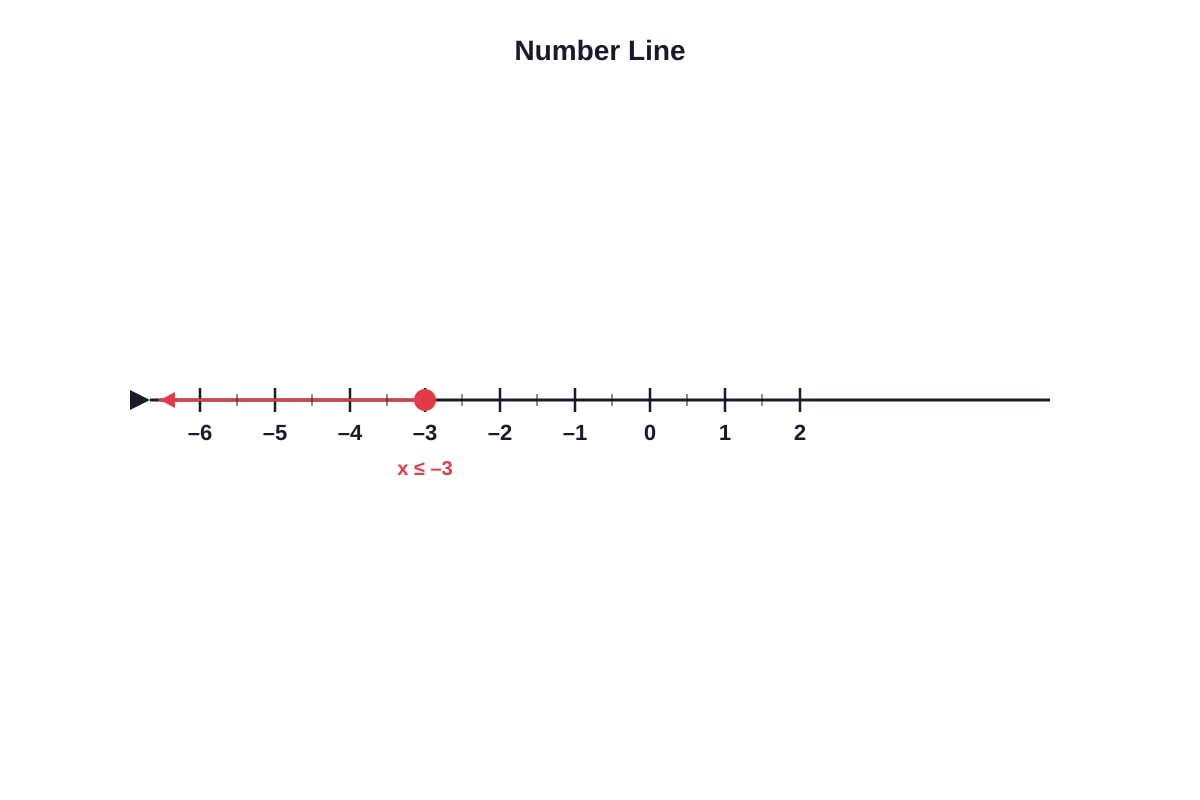
8. Solve the inequality 4x+719-4x + 7 \geq 19 and illustrate the solution on the number line in the space below. [2]

\vspace2cm\vspace{2cm}

<image_placeholder> id: Q8-fig1 type: number_line linked_question: Q8 description: A horizontal number line from -6 to 2 with evenly spaced tick marks at integer values, labeled appropriately labels: integers from -6 to 2 values: solution interval x ≤ -3 must_show: open or closed circle at -3, arrow pointing left, clear scale markings </image_placeholder>


9. The ratio of the number of apples to oranges in a basket is 5:85:8. If there are 24 more oranges than apples, how many fruits are there in the basket? [2]

\vspace2cm\vspace{2cm}


10. A map has a scale of 1:25 0001 : 25\ 000. Find the actual distance, in kilometres, represented by 8.4 cm on the map. [2]

\vspace2cm\vspace{2cm}


Section B: Structured Questions [24 marks]

Answer all questions. Show your working clearly.


11. (a) Using a calculator, evaluate 7.29×4.531.820.96\frac{\sqrt{7.29} \times 4.5^3}{1.8^2 - 0.96}. [2]

\vspace2cm\vspace{2cm}

(b) Express your answer in part (a) correct to 3 significant figures. [1]

\vspace2cm\vspace{2cm}


12. (a) Find the value of (2)4(2)3(-2)^4 - (-2)^3. [1]

\vspace2cm\vspace{2cm}

(b) Evaluate 38+(56)×910\frac{3}{8} + \left(-\frac{5}{6}\right) \times \frac{9}{10}. [2]

\vspace2cm\vspace{2cm}


13. A rectangular field has length 78\frac{7}{8} m and width 45\frac{4}{5} m.

(a) Find the perimeter of the field, giving your answer as a fraction in its simplest form. [2]

\vspace2cm\vspace{2cm}

(b) Find the area of the field, giving your answer as a fraction in its simplest form. [2]

\vspace2cm\vspace{2cm}


14. Simplify the following, leaving your answer in index notation where appropriate.

(a) 35×37(32)3\frac{3^5 \times 3^7}{(3^2)^3} [2]

\vspace2cm\vspace{2cm}

(b) 24×54103\frac{2^4 \times 5^4}{10^3} [2]

\vspace2cm\vspace{2cm}


15. Three people, Ali, Beth, and Carl, share $480 in the ratio 2:3:52:3:5.

(a) Calculate the amount each person receives. [2]

\vspace2cm\vspace{2cm}

(b) Ali gives 14\frac{1}{4} of his share to Beth. Find the new ratio of Ali's money to Beth's money to Carl's money. Give your ratio in its simplest form. [3]

\vspace2cm\vspace{2cm}


16. The temperatures recorded at a weather station over 5 days were: 3.5C-3.5^\circ\text{C}, 2.8C2.8^\circ\text{C}, 1.2C-1.2^\circ\text{C}, 0.6C0.6^\circ\text{C}, 4.9C-4.9^\circ\text{C}.

(a) Arrange the temperatures in ascending order. [1]

\vspace2cm\vspace{2cm}

(b) Find the difference between the highest and lowest temperatures. [2]

\vspace2cm\vspace{2cm}


Section C: Problem Solving [16 marks]

Answer all questions. Show your working clearly.


17. A recipe for 6 people requires 450 g of flour and 300 g of sugar.

(a) Find the ratio of flour to sugar in its simplest form. [1]

\vspace2cm\vspace{2cm}

(b) If the recipe is scaled up to serve 15 people, calculate the mass of flour needed. [2]

\vspace2cm\vspace{2cm}

(c) A chef has 2 kg of flour and 1.2 kg of sugar. What is the maximum number of people he can serve if he must use whole recipe quantities? [3]

\vspace3cm\vspace{3cm}


18. The mass of 8 identical metal cubes and 5 identical metal spheres is 3.7 kg. The mass of 4 identical metal cubes and 3 identical metal spheres is 1.9 kg. Let the mass of each cube be cc kg and the mass of each sphere be ss kg.

(a) Write down two equations in terms of cc and ss. [2]

\vspace2cm\vspace{2cm}

(b) By solving these equations simultaneously, find the mass of each cube and each sphere. [3]

\vspace3cm\vspace{3cm}


19. A shop sells three types of fruit juice: apple, orange, and mixed. The ratio of bottles sold was apple : orange : mixed = 4:5:34:5:3. The shop sold 36 bottles of mixed juice.

(a) How many bottles of apple juice were sold? [2]

\vspace2cm\vspace{2cm}

(b) The price of each bottle is: apple $2.40, orange $2.80, mixed $3.20. Calculate the total revenue from all juice sold. [3]

\vspace3cm\vspace{3cm}


20. A number NN is written as 23×32×52^3 \times 3^2 \times 5.

(a) Find the value of NN. [1]

\vspace2cm\vspace{2cm}

(b) Find the smallest positive integer kk such that N×kN \times k is a perfect square. [2]

\vspace2cm\vspace{2cm}

(c) Find the smallest positive integer mm such that N×mN \times m is a perfect cube. [2]

\vspace2cm\vspace{2cm}

(d) Hence, find the smallest positive integer pp such that N×p3\sqrt[3]{N \times p} is an integer and N×p\sqrt{N \times p} is also an integer. [3]

\vspace3cm\vspace{3cm}


END OF PAPER


Section A Total: 20 marks
Section B Total: 24 marks
Section C Total: 16 marks
Grand Total: 60 marks

Answers

<!-- TuitionGoWhere generation metadata: stage=3-1; model=moonshotai/kimi-k2.6:free; model_label=Kimi K2.6 Free; generated=2026-06-07; Sources: Stage 2-1 real exam-derived templates and Stage 2-2 exam-enriched syllabus. -->

TuitionGoWhere Practice Paper - Mathematics Secondary 1

Answer Key and Marking Scheme

Version: 3 of 5


Section A: Short Answer Questions [20 marks]


1. Evaluate 5+8×(3)(7)-5 + 8 \times (-3) - (-7). [2]

Working: Using BODMAS/PEMDAS, multiplication comes before addition and subtraction.

  • First: 8×(3)=248 \times (-3) = -24 [½]
  • Then: 5+(24)(7)-5 + (-24) - (-7) [½]
  • =524+7= -5 - 24 + 7 [½]
  • =29+7=22= -29 + 7 = -22 [½]

Answer: 22-22

Common mistake: Working left to right without priority: 5+8=3-5 + 8 = 3, then 3×(3)=93 \times (-3) = -9, etc. Multiplication must be done first.


2. Express 252 as a product of its prime factors, in index notation. [2]

Working:

  • 252÷2=126252 \div 2 = 126 [½]
  • 126÷2=63126 \div 2 = 63
  • 63÷3=2163 \div 3 = 21
  • 21÷3=721 \div 3 = 7
  • 7÷7=17 \div 7 = 1 [½ for complete factor tree or continuous division]

So 252=2×2×3×3×7252 = 2 \times 2 \times 3 \times 3 \times 7 [½]

Answer: 22×32×72^2 \times 3^2 \times 7 [½]


3. Find the highest common factor (HCF) of 84 and 126. [2]

Working: Prime factorisation:

  • 84=22×3×784 = 2^2 \times 3 \times 7 [½]
  • 126=2×32×7126 = 2 \times 3^2 \times 7 [½]

HCF uses the lowest power of each common prime factor:

  • Common primes: 212^1, 313^1, 717^1 [½]

Answer: HCF=2×3×7=42\text{HCF} = 2 \times 3 \times 7 = 42 [½]


4. Find the lowest common multiple (LCM) of 18, 24, and 30. [2]

Working: Prime factorisation:

  • 18=2×3218 = 2 \times 3^2 [½]
  • 24=23×324 = 2^3 \times 3
  • 30=2×3×530 = 2 \times 3 \times 5

LCM uses the highest power of each prime present:

  • 232^3, 323^2, 515^1 [½]

LCM =8×9×5=360= 8 \times 9 \times 5 = 360 [1]

Answer: 360360


5. Simplify 2534÷910\frac{2}{5} - \frac{3}{4} \div \frac{9}{10}. [2]

Working: Division first (BODMAS):

  • 34÷910=34×109\frac{3}{4} \div \frac{9}{10} = \frac{3}{4} \times \frac{10}{9} [½]
  • =3036=56= \frac{30}{36} = \frac{5}{6} [½]

Then subtraction:

  • 2556=12302530\frac{2}{5} - \frac{5}{6} = \frac{12}{30} - \frac{25}{30} [½]
  • =1330= \frac{-13}{30} [½]

Answer: 1330-\frac{13}{30}


6. Write the following numbers in ascending order: 34-\frac{3}{4}, 0.7-0.7, 23-\frac{2}{3}, 0.65-0.65 [2]

Working: Convert all to decimals:

  • 34=0.75-\frac{3}{4} = -0.75 [½]
  • 23=0.666...-\frac{2}{3} = -0.666... [½]

For negative numbers, the one with larger absolute value is smaller:

  • 0.75<0.7<0.666...<0.65-0.75 < -0.7 < -0.666... < -0.65 [½]

Answer: 34-\frac{3}{4}, 0.7-0.7, 23-\frac{2}{3}, 0.65-0.65 [½]

Concept: On the number line, numbers to the left are smaller. For negatives, closer to zero means larger.


7. Evaluate 643+(3)25\sqrt[3]{-64} + (-3)^2 - | -5 |. [2]

Working:

  • 643=4\sqrt[3]{-64} = -4 (since (4)3=64(-4)^3 = -64) [½]
  • (3)2=9(-3)^2 = 9 (note: brackets mean the negative is squared, giving positive) [½]
  • 5=5| -5 | = 5 [½]

So: 4+95=0-4 + 9 - 5 = 0 [½]

Answer: 00

Common mistake: 643=4\sqrt[3]{-64} = 4 (forgetting cube root of negative is negative) or (3)2=9(-3)^2 = -9 (thinking only the 3 is squared).


8. Solve the inequality 4x+719-4x + 7 \geq 19 and illustrate the solution on the number line. [2]

Working:

  • 4x+719-4x + 7 \geq 19 [½]
  • 4x12-4x \geq 12 (subtract 7 from both sides) [½]
  • x3x \leq -3 (divide by negative 4, so reverse the inequality sign) [½]

Expected number line features:

  • Closed (filled) circle at 3-3 (since \leq includes equality)
  • Arrow pointing to the left (towards smaller numbers)
  • Clear labeling with integers marked

<image_placeholder> id: Q8-fig1 type: number_line linked_question: Q8 description: Horizontal number line showing solution to x ≤ -3 labels: -6, -5, -4, -3, -2, -1, 0, 1, 2 values: closed circle at -3, shading/arrow extending left must_show: closed (filled) circle at -3, left-pointing arrow or shading, evenly spaced integer tick marks with labels </image_placeholder>

Answer: x3x \leq -3

Critical concept: When multiplying or dividing both sides of an inequality by a negative number, always reverse the inequality direction. This is a major exam trap.


9. The ratio of apples to oranges is 5:85:8. There are 24 more oranges than apples. How many fruits in the basket? [2]

Working:

  • Difference in ratio parts: 85=38 - 5 = 3 parts [½]
  • These 3 parts represent 24 fruits
  • So 1 part = 24÷3=824 \div 3 = 8 fruits [½]
  • Total parts = 5+8=135 + 8 = 13 parts
  • Total fruits = 13×8=10413 \times 8 = 104 [1]

Answer: 104104 fruits


10. Map scale 1:25 0001 : 25\ 000. Find actual distance in km for 8.4 cm on map. [2]

Working:

  • Actual distance = 8.4×25 0008.4 \times 25\ 000 cm [½]
  • =210 000= 210\ 000 cm [½]
  • Convert to km: 210 000÷100 000=2.1210\ 000 \div 100\ 000 = 2.1 km [1]

Answer: 2.12.1 km

Method note: Scale 1:25 0001:25\ 000 means 1 cm on map = 25 000 cm actual = 0.25 km actual. So 8.4×0.25=2.18.4 \times 0.25 = 2.1 km is an alternative valid method.


Section B: Structured Questions [24 marks]


11. (a) Using a calculator, evaluate 7.29×4.531.820.96\frac{\sqrt{7.29} \times 4.5^3}{1.8^2 - 0.96}. [2]

Working:

  • 7.29=2.7\sqrt{7.29} = 2.7 [½]
  • 4.53=91.1254.5^3 = 91.125 [½]
  • 1.82=3.241.8^2 = 3.24; so denominator =3.240.96=2.28= 3.24 - 0.96 = 2.28 [½]
  • Numerator: 2.7×91.125=246.03752.7 \times 91.125 = 246.0375
  • Final: 246.03752.28=107.911...\frac{246.0375}{2.28} = 107.911... [½]

Accept calculator value: 107.9111842...107.9111842...

(b) Express to 3 significant figures. [1]

Answer: 108108 (or 107.9107.9 if they truncated instead of rounding—award if correctly rounded to 3 s.f. from their (a))


12. (a) Find the value of (2)4(2)3(-2)^4 - (-2)^3. [1]

Working:

  • (2)4=16(-2)^4 = 16 (even power, positive) [½]
  • (2)3=8(-2)^3 = -8 (odd power, negative) [½]
  • 16(8)=16+8=2416 - (-8) = 16 + 8 = 24

Answer: 2424

(b) Evaluate 38+(56)×910\frac{3}{8} + \left(-\frac{5}{6}\right) \times \frac{9}{10}. [2]

Working: Multiplication first:

  • (56)×910=4560=34\left(-\frac{5}{6}\right) \times \frac{9}{10} = -\frac{45}{60} = -\frac{3}{4} [1]

Then addition:

  • 38+(34)=3868=38\frac{3}{8} + \left(-\frac{3}{4}\right) = \frac{3}{8} - \frac{6}{8} = -\frac{3}{8} [1]

Answer: 38-\frac{3}{8}


13. Rectangle: length 78\frac{7}{8} m, width 45\frac{4}{5} m.

(a) Perimeter [2]

Working:

  • Perimeter =2×(78+45)= 2 \times \left(\frac{7}{8} + \frac{4}{5}\right) [½]
  • =2×(3540+3240)= 2 \times \left(\frac{35}{40} + \frac{32}{40}\right) [½]
  • =2×6740= 2 \times \frac{67}{40} [½]
  • =6720= \frac{67}{20} m or 37203\frac{7}{20} m [½]

Answer: 6720\frac{67}{20} m (or 3.353.35 m)

(b) Area [2]

Working:

  • Area =78×45= \frac{7}{8} \times \frac{4}{5} [½]
  • =2840= \frac{28}{40} [½]
  • =710= \frac{7}{10} m² [1]

Answer: 710\frac{7}{10}


14. Simplify in index notation:

(a) 35×37(32)3\frac{3^5 \times 3^7}{(3^2)^3} [2]

Working:

  • Numerator: 35×37=3123^5 \times 3^7 = 3^{12} (add indices: am×an=am+na^m \times a^n = a^{m+n}) [½]
  • Denominator: (32)3=36(3^2)^3 = 3^6 (multiply indices: (am)n=amn(a^m)^n = a^{mn}) [½]
  • Division: 312÷36=363^{12} \div 3^6 = 3^6 (subtract indices: am÷an=amna^m \div a^n = a^{m-n}) [1]

Answer: 363^6 (or 729729)

(b) 24×54103\frac{2^4 \times 5^4}{10^3} [2]

Working:

  • 24×54=(2×5)4=1042^4 \times 5^4 = (2 \times 5)^4 = 10^4 (using an×bn=(ab)na^n \times b^n = (ab)^n) [1]
  • 104103=101=10\frac{10^4}{10^3} = 10^1 = 10 [1]

Answer: 1010


15. Ali, Beth, Carl share $480 in ratio 2:3:52:3:5.

(a) Amount each receives. [2]

Working:

  • Total parts = 2+3+5=102 + 3 + 5 = 10 parts [½]
  • Value of 1 part = 480 \div 10 = \48$ [½]
  • Ali: 2 \times \48 = $96$ [½]
  • Beth: 3 \times \48 = $144$
  • Carl: 5 \times \48 = $240$ [½]

Answers: Ali $96, Beth $144, Carl $240

(b) Ali gives 14\frac{1}{4} of his share to Beth. New ratio. [3]

Working:

  • Ali gives away: \frac{1}{4} \times 96 = \24$ [1]
  • Ali now has: 96 - 24 = \72$ [½]
  • Beth now has: 144 + 24 = \168$ [½]
  • Carl unchanged: $240

New amounts: 72:168:24072 : 168 : 240 [½]

Simplify by dividing by 24:

  • 72÷24=372 \div 24 = 3
  • 168÷24=7168 \div 24 = 7
  • 240÷24=10240 \div 24 = 10 [½]

Answer: 3:7:103 : 7 : 10 [½]


16. Temperatures: 3.5C-3.5^\circ\text{C}, 2.8C2.8^\circ\text{C}, 1.2C-1.2^\circ\text{C}, 0.6C0.6^\circ\text{C}, 4.9C-4.9^\circ\text{C}

(a) Ascending order. [1]

Answer: 4.9C-4.9^\circ\text{C}, 3.5C-3.5^\circ\text{C}, 1.2C-1.2^\circ\text{C}, 0.6C0.6^\circ\text{C}, 2.8C2.8^\circ\text{C}

(b) Difference between highest and lowest. [2]

Working:

  • Highest: 2.8C2.8^\circ\text{C} [½]
  • Lowest: 4.9C-4.9^\circ\text{C} [½]
  • Difference = 2.8(4.9)2.8 - (-4.9) [½]
  • =2.8+4.9=7.7C= 2.8 + 4.9 = 7.7^\circ\text{C} [½]

Answer: 7.7C7.7^\circ\text{C}

Concept: "Difference" always means the positive gap between two values. Subtracting a negative is equivalent to adding its absolute value.


Section C: Problem Solving [16 marks]


17. Recipe: 450 g flour, 300 g sugar for 6 people.

(a) Ratio flour : sugar in simplest form. [1]

Working:

  • 450:300=45:30=3:2450 : 300 = 45 : 30 = 3 : 2 [1]

Answer: 3:23 : 2

(b) Flour for 15 people. [2]

Working:

  • Flour per person = 450÷6=75450 \div 6 = 75 g [½]
  • For 15 people: 75×15=112575 \times 15 = 1125 g [½]

Or using ratio: 156=52\frac{15}{6} = \frac{5}{2}, so 450×52=1125450 \times \frac{5}{2} = 1125 g [1]

Answer: 11251125 g (or 1.1251.125 kg)

(c) Maximum people with 2 kg flour and 1.2 kg sugar. [3]

Working:

  • Flour per person: 450÷6=75450 \div 6 = 75 g [½]

  • From flour: 2000÷75=26.666...2000 \div 75 = 26.666... So maximum 26 people from flour constraint [½]

  • Sugar per person: 300÷6=50300 \div 6 = 50 g [½]

  • From sugar: 1200÷50=241200 \div 50 = 24 people exactly [½]

The limiting ingredient is sugar. [½]

Answer: 24 people [½]

Key concept: Must check BOTH constraints and take the minimum. Whole number of people required.


18. 8 cubes + 5 spheres = 3.7 kg; 4 cubes + 3 spheres = 1.9 kg.

(a) Two equations. [2]

Answers:

  • 8c+5s=3.78c + 5s = 3.7 [1]
  • 4c+3s=1.94c + 3s = 1.9 [1]

(b) Solve simultaneously. [3]

Working: Elimination method:

  • Multiply second equation by 2: 8c+6s=3.88c + 6s = 3.8 [½]
  • Subtract first equation: (8c+6s)(8c+5s)=3.83.7(8c + 6s) - (8c + 5s) = 3.8 - 3.7 [½]
  • So s=0.1s = 0.1 kg [½]

Substitute back:

  • 4c+3(0.1)=1.94c + 3(0.1) = 1.9 [½]
  • 4c+0.3=1.94c + 0.3 = 1.9
  • 4c=1.64c = 1.6
  • c=0.4c = 0.4 kg [½]

Answers: Each cube = 0.40.4 kg, each sphere = 0.10.1 kg [½]

Verification: 8(0.4)+5(0.1)=3.2+0.5=3.78(0.4) + 5(0.1) = 3.2 + 0.5 = 3.7


19. Apple : orange : mixed = 4:5:34:5:3. Mixed = 36 bottles.

(a) Apple bottles sold. [2]

Working:

  • 3 parts (mixed) = 36 [½]
  • 1 part = 36÷3=1236 \div 3 = 12 bottles [½]
  • Apple (4 parts) = 4×12=484 \times 12 = 48 bottles [1]

Answer: 48 bottles

(b) Total revenue. [3]

Working:

  • Orange: 5 parts = 5×12=605 \times 12 = 60 bottles [½]
  • Total bottles: 48+60+36=14448 + 60 + 36 = 144 bottles (or use parts: 4+5+3=124+5+3=12 parts = 144) [½]

Revenue calculation:

  • Apple: 48 \times \2.40 = $115.20$ [½]
  • Orange: 60 \times \2.80 = $168.00$ [½]
  • Mixed: 36 \times \3.20 = $115.20$ [½]

Total: 115.20 + 168.00 + 115.20 = \398.40$ [½]

Answer: $398.40


20. N=23×32×5N = 2^3 \times 3^2 \times 5

(a) Value of NN. [1]

Working:

  • N=8×9×5=360N = 8 \times 9 \times 5 = 360

Answer: 360360

(b) Smallest kk such that N×kN \times k is perfect square. [2]

Working: For perfect square, all prime exponents must be even:

  • Current: 232^3, 323^2, 515^1 [½]
  • Need: 242^4 (need one more 2), 323^2 (already even), 525^2 (need one more 5) [½]

So k=21×51=10k = 2^1 \times 5^1 = 10 [1]

Answer: k=10k = 10

(c) Smallest mm such that N×mN \times m is perfect cube. [2]

Working: For perfect cube, all prime exponents must be multiples of 3:

  • Current: 232^3 (good), 323^2 (need one more 3), 515^1 (need two more 5s) [½]
  • Need: 333^3, 535^3 [½]

So m=31×52=3×25=75m = 3^1 \times 5^2 = 3 \times 25 = 75 [1]

Answer: m=75m = 75

(d) Smallest pp such that both N×p3\sqrt[3]{N \times p} and N×p\sqrt{N \times p} are integers. [3]

Working: Need N×pN \times p to be both a perfect square AND perfect cube, i.e., a perfect sixth power (LCM of 2 and 3 is 6). [1]

Exponents in N×pN \times p must be multiples of 6:

  • For 2: need exponent 3\geq 3 and multiple of 6, so need 232^3 (to make 262^6) [½]
  • For 3: need exponent 2\geq 2 and multiple of 6, so need 343^4 (to make 363^6) [½]
  • For 5: need exponent 1\geq 1 and multiple of 6, so need 555^5 (to make 565^6) [½]

So p=23×34×55p = 2^3 \times 3^4 \times 5^5 [½]

Calculate: 8×81×3125=8×253125=2 025 0008 \times 81 \times 3125 = 8 \times 253125 = 2\ 025\ 000

Answer: p=2 025 000p = 2\ 025\ 000 (or 23×34×552^3 \times 3^4 \times 5^5)

Verification: N×p=26×36×56=(2×3×5)6=306=(303)2=(302)3=27 0002=9003N \times p = 2^6 \times 3^6 \times 5^6 = (2 \times 3 \times 5)^6 = 30^6 = (30^3)^2 = (30^2)^3 = 27\ 000^2 = 900^3


Mark Allocation Summary

SectionMarks
Section A (Questions 1-10)20
Section B (Questions 11-16)24
Section C (Questions 17-20)16
Grand Total60

End of Answer Key