AI Generated Quiz
Secondary 1 History Source Based Skills Quiz
Free Sec 1 History Source Based Skills quiz, Kimi2.6 AI version, with questions, answers, and syllabus-aligned practice for Singapore students.
These static practice materials are generated from the site's syllabus and paper-generation workflow, with source and model context shown so students and parents can evaluate the material before use.
Questions
Free quiz and exam paper access
Enter your details to view this paper
Your access is remembered on this device.
Answers
Secondary 1 History Quiz - Source Based Skills: ANSWER KEY
Total Marks: 40
Section A: Source Comprehension and Inference (16 marks)
Question 1
Answer: Raffles believed Singapore occupied "a position of unrivalled advantage at the extremity of the Strait of Malacca" / had an excellent geographical location for trade. [1]
Teaching note: Raffles explicitly praises the location; students should quote or paraphrase this specific phrase. The key concept is understanding that primary sources reveal contemporaneous assessments of geographical significance.
Question 2
Answer: Any two from: the British / Raffles and his associates; the Dutch; the native inhabitants / local people; Temenggong Abdul Rahman (and his followers). [2]
Teaching note: Identifying actors in sources is a foundational source skill. Students must distinguish between different groups with interests in Singapore—colonial powers, local elites, and indigenous populations.
Common mistake: Listing "merchants" who are not mentioned in Source A; confusing Temenggong with Sultan Hussein Shah (not named in this source).
Question 3
Answer: This suggests the Dutch were protective/possessive of their trading interests in the region / they monitored shipping and trade jealously to maintain their monopoly / they would be unhappy about British presence. [2]
Teaching note: "Jealous supervision" implies possessive, watchful control. The word "hitherto" (until now) signals Raffles believes British presence may change this pattern. Inference requires reading beyond literal meaning to understand power dynamics.
Mark breakdown: Identify "jealous" as protective/possessive [1]; explain what this reveals about Dutch commercial interests or their likely reaction to British presence [1].
Question 4
Answer: Source A is useful because: it was written at the time of founding (contemporaneous); Raffles was directly involved (eyewitness); reveals British strategic thinking and Raffles' ambitions. [2] However: it is a private letter to a friend glorifying Raffles' achievements; may exaggerate prospects to justify his actions; only gives British perspective. [1]
Teaching note: The "how useful" question requires balanced evaluation. Every source is useful for something but limited for everything. The OWL method (Origin, What it says, Limitations) helps structure responses.
Mark breakdown: Identify usefulness (contemporary, eyewitness, strategic insights) [2]; identify limitations (bias, one-sidedness, possible exaggeration) [1].
Question 5
Answer: Raffles may want to impress his friend / present his actions positively / exaggerate his success; private letters may contain candid opinions not meant for official record; however, friends may also be unskeptical recipients of self-promotion. [2]
Teaching note: Nature of source (private letter to friend) affects reliability. Could be more candid than official reports, but also more prone to personal boasting. The key concept is that all sources have provenance affecting their reliability.
Mark breakdown: Identify one way audience affects content (impression management, candidness) [1]; add nuance or second point [1].
Question 6
Answer: British imperial policy sought to counter Dutch commercial dominance / the decline of Malacca and Riau-Lingga created an opportunity / British traders wanted to exploit commercial opportunities. [1]
Teaching note: Source B provides broader context missing from Raffles' personal letter. This illustrates how secondary sources synthesise multiple primary sources to provide richer explanations.
Question 7
Answer: Source A emphasises Raffles' personal role and Singapore's excellent harbour as reasons for founding—it is an individual, somewhat spontaneous decision. [1] Source B emphasises broader British imperial strategy against Dutch dominance, the decline of alternative ports, and policy-level factors. [1] Source A sees Raffles as driving force; Source B sees structural forces (empire, economics, geography) as more important. [1]
Teaching note: Comparison requires identifying what differs and how, not just describing each source separately. The command word "compare" demands active linking of differences.
Mark breakdown: Identify A's emphasis (personal/Raffles) [1]; identify B's emphasis (structural/imperial) [1]; explain the contrast between individual vs. structural causation [1].
Question 8
Answer: Source B is more useful for international context [1] because it explicitly discusses British-Dutch rivalry, the Anglo-Dutch Treaty context, and regional trade patterns, while Source A focuses on Raffles' personal experience without mentioning the broader geopolitical competition. [1]
Teaching note: Suitability depends on what the historian wants to know. Source B was written with historical hindsight to explain causes; Source A was not trying to explain international context.
Question 9
Answer: The Anglo-Dutch Treaty of 1824 / Treaty of London (1824) which settled territorial disputes between Britain and the Netherlands in Southeast Asia. [1]
Teaching note: The Anglo-Dutch Treaty divided spheres of influence—British territories north of Singapore Strait, Dutch territories south. This is foundational knowledge for understanding colonial Southeast Asian geopolitics.
Question 10
Answer: British traders now commanded the Strait of Malacca; Dutch merchants had to seek alternative trade routes; Dutch commercial position was weakened. [1]
Teaching note: Students must identify Dutch perspective—what they lost, not what Britain gained.
Question 11
Answer: Both sources agree the treaty had significant territorial and commercial effects. [1] Source C (British) presents the treaty positively: "commerce will now flourish," "clearer regulations," removal of "interference." [1] Source D (Dutch) presents it negatively: "considerable commercial cost," British command of "vital chokepoint," need to "compensate" for losses. [1] The sources differ because they represent opposing national interests—Britain gained what Dutch lost. [1]
Teaching note: Similarity comparison requires identifying comparable elements, then differences. The similarity here is both recognise significant effects; the difference is evaluative direction (positive vs. negative) due to contrasting national perspectives.
Mark breakdown: Identify area of agreement (significant effects) [1]; describe C's positive view with evidence [1]; describe D's negative view with evidence [1]; explain why they differ (national perspective/position) [1].
Question 12
Answer: Not surprising. [1] National perspective affects interpretation—British newspaper serves British readers celebrating success; Dutch report serves colonial administration assessing losses. Each source reflects its creators' interests. [1]
Teaching note: "Surprising" questions test understanding that sources are products of their creators' circumstances. Expected bias is not surprising; unexpected agreement across enemies would be.
Question 13
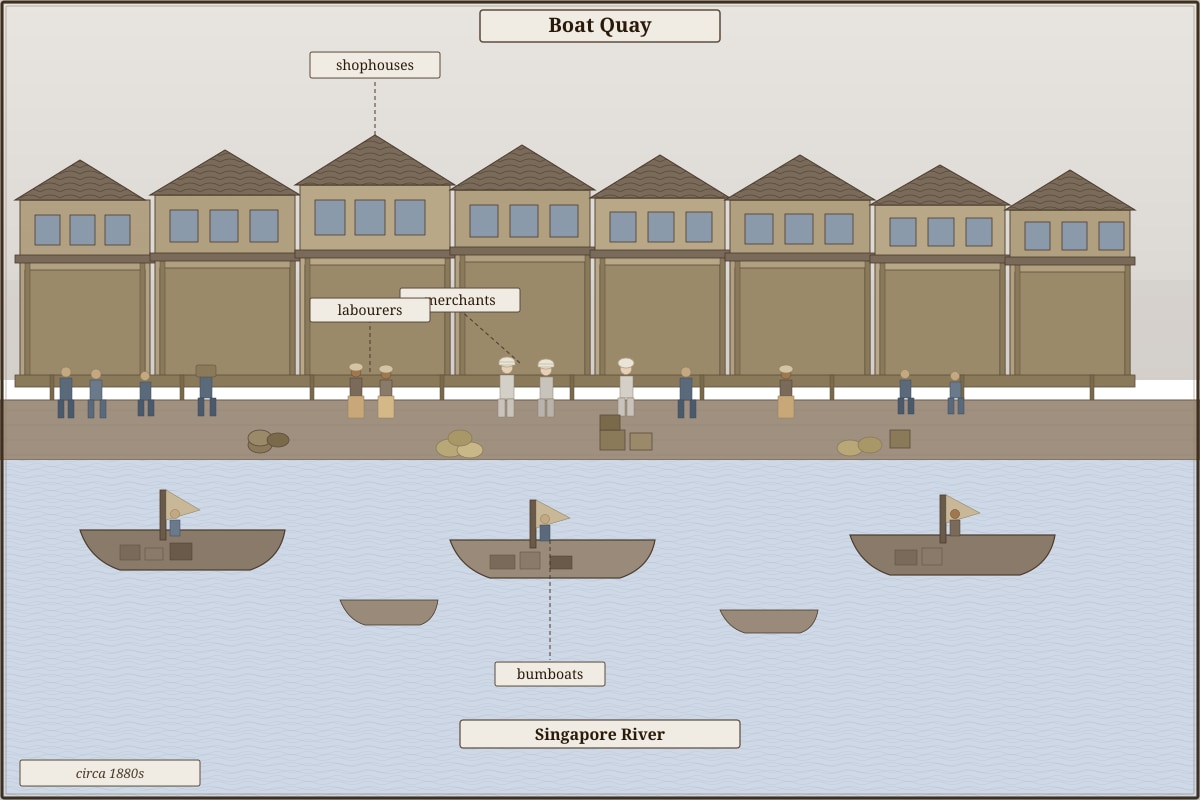
Answer: Any two from: trade/commercial activity was centred on waterfront/river; multi-ethnic workforce engaged in labour and commerce; use of bumboats for cargo transport; shophouses with verandahs lined the quay; mixed European and Asian economic roles visible. [2]
Teaching note: Description from visual sources requires extracting specific observable details. Students should connect visual evidence to historical understanding of colonial port economy.
Question 14
Answer: Singapore had a diverse/multi-ethnic population [1] including Chinese, Indian, and Malay people alongside Europeans, engaged in different economic roles [1].
Teaching note: The caption explicitly states this, but students should also infer from visual details in the image description.
Section C: Source Evaluation and Synthesis (10 marks)
Question 15
Answer: European merchants / the colonial official's audience / "your enterprise" / British commercial interests. [1]
Teaching note: Note the paternalistic "we govern"—the official claims credit for order while attributing economic success to merchants.
Question 16
Answer: The source reveals paternalistic attitudes—labourers are acknowledged as necessary but not equal partners. [1] Their contributions are recognised ("their toil builds our fortunes") but framed as subordinate to British governance and European "enterprise." [1]
Teaching note: This is a more advanced inference question. The official speaks about Asian workers in the third person, to Europeans, while claiming "shared prosperity." Students should identify the hierarchical relationship masked by apparently generous language.
Question 17
Answer: Content reveals British self-justification: claims rule rests on consent and shared prosperity, admits dependence on Asian labour. [1] However, the speech was delivered to European merchants—he would emphasise British benevolence and commercial success, not admit exploitation or inequality. [1] It is reliable for understanding British colonial ideology but less reliable for actual conditions of Asian workers. [1]
Teaching note: Evaluation must consider both what the source says and the circumstances of its creation (audience, purpose, speaker's position). The TAP model (Tone, Audience, Purpose) supplements OWL here.
Mark breakdown: Content analysis (ideology, self-justification) [1]; nature analysis (audience bias) [1]; balanced conclusion about what it can/cannot reliably show [1].
Question 18
Answer: Economic reasons—to escape poverty/starvation in China / to earn better wages / because the "Nanyang feeds us when China could not." [1]
Teaching note: "Push-pull" migration factors: poor conditions in China (push), economic opportunity in Singapore (pull). The personal letter format reveals individual motivation.
Question 19
Answer: Source G portrays kongsi positively—as mutual aid organisations providing work, financial support, and community protection ("looks after us," "finds work," "lends money"). [1] Source H portrays them negatively—as obstacles to public health reform, resisting government inspection and sanitation improvements. [1] They differ because Source G is written by a member experiencing benefits; Source H is written by officials frustrated by administrative challenges. [1]
Teaching note: Same organisations, opposing evaluations—this illustrates how source perspective shapes interpretation. Students must identify whose viewpoint produces each portrayal.
Question 20
Answer: [6 marks—synthesis with evaluation]
Partially supports:
- Source F: Official admits prosperity depends on Asian labour but frames it as British-given "opportunity"; paternalism masks exploitation. "Shared prosperity" is rhetorical—fortunes go to Europeans.
- Source G: Shows hard labour ("twelve hours daily"), low wages, exploitation—British "do not interfere much" as long as work is done.
- Source H: Explicitly states "Revenue concerns constrain our willingness to enforce regulations"—health sacrificed for commerce; "disrupt the labour supply upon which commerce depends."
Limits support/Nuance:
- Source F does show some concern for legitimacy ("consent," "shared prosperity"), not purely extractive.
- Source F recognises Asian contributions, however paternalistically.
- The sources show multiple British concerns, not solely profit.
Conclusion: The conclusion has strong support but oversimplifies—British rule was primarily commercial but not exclusively so; order, legitimacy, and long-term stability were also strategic concerns.
Mark breakdown:
- Identifies support from F (exploitative framing, paternalism) [1]
- Identifies support from G (labour conditions, non-interference) [1]
- Identifies support from H (revenue over welfare, labour supply priority) [1]
- Identifies limits/nuance (multiple concerns, not purely profit) [1]
- Cross-references between sources [1]
- Balanced judgement on the conclusion [1]
Teaching note: "How far" questions require weighing evidence, not simple agreement/disagreement. Stronger students recognise the historian's conclusion is partially true but overstated. The key skill is balancing evidence across multiple sources against the specific claim.