AI Generated Quiz
Secondary 1 History Source Based Skills Quiz
Free Sec 1 History Source Based Skills quiz, HY3 AI version, with questions, answers, and syllabus-aligned practice for Singapore students.
These static practice materials are generated from the site's syllabus and paper-generation workflow, with source and model context shown so students and parents can evaluate the material before use.
Questions
Secondary 1 History Quiz - Source Based Skills
Name: ___________________________
Class: ___________________________
Date: ___________________________
Score: ___________ / 40
Duration: 50 minutes
Total Marks: 40
Topic: Source Based Skills (Practice Quiz 1 of 5)
Instructions:
- This quiz tests your source-based skills using Secondary 1 History topics.
- Read each source carefully before answering.
- Write your answers in the spaces provided.
- Section A: 10 short source questions (1 mark each). Section B: 6 source analysis questions (2 marks each). Section C: 4 extended source questions (5 marks each).
Section A: Source Identification and Basic Inference (Questions 1–10, 1 mark each)
Q1. Study the source below:
"I arrived in Singapore in 1880 after leaving my village in Fujian because of poverty. I worked at the docks to send money home." — Letter from a Chinese migrant, 1880.
What type of source is this?
____ (A) Primary source (B) Secondary source (C) Textbook
Answer: ________________
Q2. A history book written in 2020 about Raffles' arrival in Singapore is a:
____ (A) Primary source (B) Secondary source (C) Artefact
Answer: ________________
Q3. Study Source: A British government report from 1824 describing Singapore's free port policy.
The origin of this source is:
____ (A) A migrant (B) British government (C) A newspaper
Answer: ________________
Q4. What is the purpose of a source that lists goods traded in Singapore in 1900 for tax records?
____ (A) To entertain (B) To record information (C) To protest
Answer: ________________
Q5. A photograph of Singapore's harbour in 1930 is best described as:
____ (A) Written source (B) Visual source (C) Oral source
Answer: ________________
Q6. Study Source: "The Japanese attacked because they wanted resources." — A student's essay, 2024.
This source is:
____ (A) Primary (B) Secondary (C) Artefact
Answer: ________________
Q7. The author of a source is also called the:
____ (A) Audience (B) Originator (C) Editor
Answer: ________________
Q8. A source created during the event it describes is:
____ (A) Primary (B) Secondary (C) Tertiary
Answer: ________________
Q9. Study Source: An interview with a former coolie in 1980 about life in 1920.
This is a:
____ (A) Primary source from 1920 (B) Secondary source from 1980 (C) Primary source from 1980
Answer: ________________
Q10. Why might a British official's report be biased?
____ (A) They were not there (B) They may support British rule (C) They used old books
Answer: ________________
Section B: Source Analysis (Questions 11–16, 2 marks each)
Q11. Study Source A:
"Singapore is a small island but its location makes it the key to Eastern trade." — British merchant, 1820.
What can you infer about the British view of Singapore's location? Explain in one sentence.
Answer: ___________________________________________________________
Q12. Study Source B:
"Many Indians came to Singapore to build roads and railways under British contracts." — History textbook, 2010.
Is this a primary or secondary source? Give one reason.
Answer: ___________________________________________________________
Q13. Study Sources C and D:
Source C: "The free port brought ships from many nations." — Diary of trader, 1830.
Source D: "Our harbour was filled with vessels from India and China." — Letter, 1832.
How are the two sources similar about trade? Explain.
Answer: ___________________________________________________________
Q14. Study Source E:
"Life was hard; we slept on the streets and ate little." — Migrant's memoir, 1890.
What does this source tell you about migrant living conditions? Explain.
Answer: ___________________________________________________________
Q15. Study Source F:
"The Suez Canal opened in 1869, boosting Singapore's trade." — Encyclopaedia, 2000.
State one strength and one limitation of this source for a historian.
Answer: ___________________________________________________________
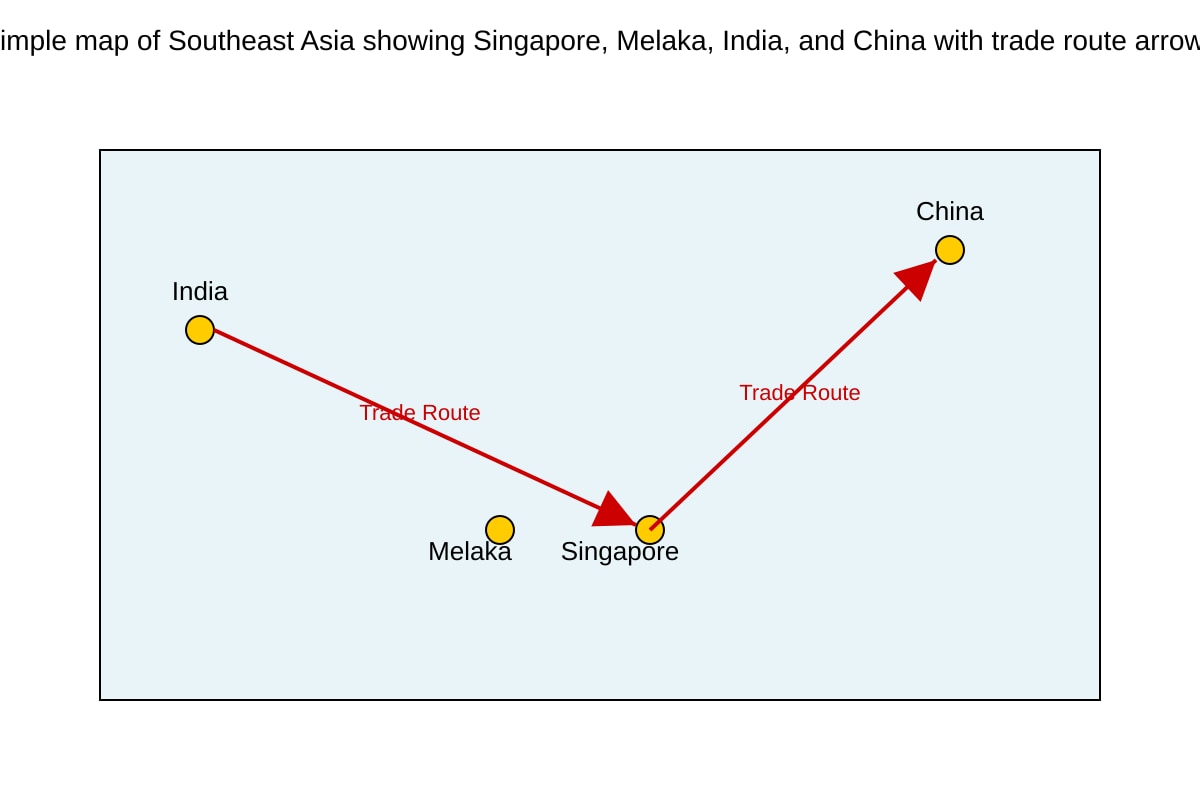
Q16. Study the map below.
Image pending generation: map for Q16.
What does the map show about Singapore's position? Explain.
Answer: ___________________________________________________________
Section C: Extended Source Questions (Questions 17–20, 5 marks each)
Q17. Study Sources G and H:
Source G: "Raffles chose Singapore for its deep harbour and strategic spot." — Biography, 1900.
Source H: "The island was empty and useless before the British came." — Colonial letter, 1825.
How similar are these sources about Singapore before 1819? Explain your answer using both sources. [5m]
Answer:
Q18. Study Source I:
"As a clerk in 1910, I saw how the British controlled trade and punished dissent. Their laws favoured merchants." — Memoir, 1910.
How reliable is this source for understanding British control in Singapore? Explain your answer. [5m]
Answer:
Q19. Study Source J:
"The fall of Singapore in 1942 shocked the world; the British were unprepared." — Newspaper, 1942.
What is the viewpoint of the source about the British? Explain using evidence. [5m]
Answer:
Q20. Study Sources K and L:
Source K: "Migrants built the economy with their labour." — Speech by minister, 1980.
Source L: "They came desperate, taking low wages and living in crowded shophouses." — Novel, 1995.
How do these sources differ in their view of migrants? Explain your answer. [5m]
Answer:
Answers
Secondary 1 History Quiz - Source Based Skills (Answer Key)
Topic: Source Based Skills
Version: 1 of 5
Total Marks: 40
Section A: Answers (1 mark each)
Q1. (A) Primary source
Teaching note: A letter written in 1880 by a person who experienced migration is a primary source because it was created during the time studied. Common mistake: choosing secondary because it is old; but primary means made at the time.
Q2. (B) Secondary source
Teaching note: A book from 2020 about 1819 is secondary; it was written after the event by someone not present.
Q3. (B) British government
Teaching note: Origin = who created it. Report from 1824 by British govt = origin is British government.
Q4. (B) To record information
Teaching note: Tax records list goods for administration, not entertainment or protest.
Q5. (B) Visual source
Teaching note: Photograph = visual/iconic source.
Q6. (B) Secondary
Teaching note: 2024 student essay about past event = secondary.
Q7. (B) Originator
Teaching note: Author = originator (creator) of source.
Q8. (A) Primary
Teaching note: Created during event = primary.
Q9. (C) Primary source from 1980
Teaching note: Interview given in 1980 is primary for 1980 memory, but recalls 1920; still primary as oral history created in 1980.
Q10. (B) They may support British rule
Teaching note: Officials may be biased to show benefit of empire.
Section B: Answers (2 marks each)
Q11. [2m]
Answer: The British viewed Singapore's location as strategically vital for Eastern trade.
Marking: 1m for inference (location important), 1m for using source phrase "key to Eastern trade".
Q12. [2m]
Answer: Secondary source; because it was written in 2010, long after the events, by a textbook author not present.
Marking: 1m type, 1m reason.
Q13. [2m]
Answer: Both show Singapore attracted many foreign ships; Source C says "many nations", Source D says vessels from India and China.
Marking: 1m similarity, 1m evidence from both.
Q14. [2m]
Answer: Migrants faced poor living conditions (hard life, little food, streets).
Marking: 1m condition stated, 1m reference to source.
Q15. [2m]
Answer: Strength: gives clear date and fact; Limitation: secondary, may omit local views.
Marking: 1m each.
Q16. [2m]
Answer: Map shows Singapore on trade route between India and China, so strategically placed.
Marking: 1m position, 1m explanation using arrows/labels.
Section C: Answers (5 marks each)
Q17. [5m]
Answer: Sources are NOT similar. Source G says Singapore had deep harbour and strategic spot (valued), Source H says "empty and useless" (negative). They differ in view of value before 1819.
Marking: 2m identify difference, 3m explain with both sources (1m G evidence, 1m H evidence, 1m contrast).
Q18. [5m]
Answer: Partly reliable: clerk witnessed 1910 (primary, direct), but may be limited to his view, and memoir may forget.
Marking: 2m reliability judgement, 3m reasoning (1m primary, 1m bias limit, 1m context).
Q19. [5m]
Answer: Viewpoint: British were unprepared and weak. Evidence: "shocked", "unprepared".
Marking: 2m viewpoint, 3m evidence + explain (1m quote, 1m link, 1m inference).
Q20. [5m]
Answer: K sees migrants as builders (positive), L sees them as desperate/poor (negative condition). Differ in tone.
Marking: 2m difference, 3m use both (1m K, 1m L, 1m compare).
Free quiz and exam paper access
Enter your details to view this paper
Your access is remembered on this device.