AI Generated Quiz
Secondary 1 History Singapore Southeast Asia Quiz
Free Sec 1 History Singapore SEA quiz, LongCat AI version, with questions, answers, and syllabus-aligned practice for Singapore students.
These static practice materials are generated from the site's syllabus and paper-generation workflow, with source and model context shown so students and parents can evaluate the material before use.
Questions
Free quiz and exam paper access
Enter your details to view this paper
Your access is remembered on this device.
Answers
Secondary 1 History Quiz — Answer Key
Topic: Singapore Southeast Asia
Total Marks: 50
Section A: Short Answer Questions (Questions 1–10)
1. Name the two main reasons why the British chose to establish a trading post in Singapore in 1819.
[2 marks]
Answer:
- Singapore's strategic geographical location at the southern tip of the Malay Peninsula, along major trade routes between India and China.
- The need for a British naval and trading base in Southeast Asia to counter Dutch dominance in the region.
Marking Notes:
- 1 mark for each correct reason, up to 2 marks.
- Accept equivalent phrasing (e.g., "good location for trade," "to compete with the Dutch").
- Common mistake: Students may only give one reason or confuse the British with other colonial powers.
2. What is meant by the term entrepôt trade? Give one example of how Singapore benefited from this type of trade.
[2 marks]
Answer:
- Entrepôt trade refers to the importing, storing, and re-exporting of goods from one country to another without the goods being significantly processed.
- Example: Singapore imported spices from the Malay Archipelago and re-exported them to Europe and China, earning revenue from handling and trading these goods.
Marking Notes:
- 1 mark for a correct definition.
- 1 mark for a valid example.
- Common mistake: Students may confuse entrepôt trade with manufacturing or describe only one side of the process.
3. Study Source A. What does Source A tell us about why the British valued Singapore?
[2 marks]
Answer:
Source A tells us that the British valued Singapore because of its strategic location — it was situated where the Indian Ocean meets the South China Sea, making it a key point for controlling trade and naval movement in the East. Raffles called it "the most important station in the East," showing that the British saw Singapore as essential for maintaining their power and trade in Asia.
Marking Notes:
- 1 mark for identifying the strategic location.
- 1 mark for explaining its importance (trade control, naval power, or empire).
- Students must refer to the source — answers without source reference lose 1 mark.
4. Name two groups of migrants who came to Singapore during the 19th century and state one reason why each group came.
[2 marks]
Answer:
- Chinese migrants — came to find work as labourers and traders, escaping poverty and unrest in southern China.
- Indian migrants — came to work as coolies, in trade, or as convict labour, seeking economic opportunities.
Marking Notes:
- ½ mark for naming each group (up to 1 mark).
- ½ mark for each valid reason (up to 1 mark).
- Accept other valid groups: Malays (from surrounding islands), Arabs (for trade).
- Common mistake: Students may name groups without giving reasons.
5. What was the role of the Kapitan Cina in early colonial Singapore?
[2 marks]
Answer:
The Kapitan Cina was a community leader appointed by the British to oversee the Chinese population. The Kapitan was responsible for maintaining law and order within the Chinese community, settling disputes, and collecting taxes. This system allowed the British to govern the large Chinese population indirectly.
Marking Notes:
- 1 mark for identifying the Kapitan as a community leader or intermediary.
- 1 mark for describing the role (maintaining order, settling disputes, tax collection, or indirect rule).
- Common mistake: Students may confuse the Kapitan Cina with other officials or describe only one function.
6. Study Source B. What can you infer about Singapore's development from Source B?
[2 marks]
Answer:
From Source B, we can infer that Singapore had grown rapidly since the British arrived, becoming a busy and prosperous trading port. The harbour was filled with ships from many regions (China, India, Malay Archipelago), showing that Singapore had become an important hub for international trade. The merchant's mention of "profits are good" suggests that the economy was thriving.
Marking Notes:
- 1 mark for inferring rapid growth or prosperity.
- 1 mark for supporting the inference with detail from the source.
- Common mistake: Students may only quote the source without making an inference.
7. Give two ways in which the opening of the Suez Canal in 1869 affected Singapore's trade.
[2 marks]
Answer:
- The Suez Canal shortened the travel distance between Europe and Asia, leading to more ships passing through Singapore, which increased trade volume.
- Singapore became an even more important refuelling and supply stop for steamships travelling through the canal, boosting its economy.
Marking Notes:
- 1 mark for each valid way, up to 2 marks.
- Accept: increased shipping, growth of port activities, more trade with Europe.
- Common mistake: Students may describe the Suez Canal's general effect without linking it specifically to Singapore.
8. What is the difference between a push factor and a pull factor? Give one example of each in the context of migration to Singapore.
[2 marks]
Answer:
- A push factor is something that forces or encourages people to leave their homeland (e.g., famine, poverty, or war in southern China).
- A pull factor is something that attracts people to a new place (e.g., job opportunities and the promise of a better life in Singapore).
Marking Notes:
- 1 mark for correctly defining both terms.
- 1 mark for a valid example of each in context.
- Common mistake: Students may confuse the two terms or give examples that are not specific to Singapore.
9. Why was Singapore known as a cosmopolitan society by the late 19th century?
[2 marks]
Answer:
Singapore was called cosmopolitan because it was home to many different ethnic and cultural groups — including Chinese, Malays, Indians, Arabs, and Europeans — who lived and worked together in the same town. Each group brought its own language, religion, customs, and traditions, creating a diverse and multicultural society.
Marking Notes:
- 1 mark for identifying the presence of multiple ethnic/cultural groups.
- 1 mark for explaining what made it diverse (languages, religions, customs, or traditions).
- Common mistake: Students may only list ethnic groups without explaining what "cosmopolitan" means.
10. Name one Southeast Asian kingdom that had connections with Singapore before the arrival of the British, and describe one way in which they interacted.
[2 marks]
Answer:
- Kingdom: Srivijaya (or Majapahit, or the Malacca Sultanate — accept any valid kingdom).
- Interaction: Singapore was part of the Srivijayan maritime trading network, and archaeological evidence (such as artefacts found at Fort Canning) shows that Singapore was a trading settlement where goods like ceramics and beads were exchanged.
Marking Notes:
- 1 mark for naming a valid kingdom.
- 1 mark for describing a valid interaction (trade, political ties, cultural influence).
- Common mistake: Students may name a kingdom without describing the interaction, or name a non-Southeast Asian power.
Section B: Source-Based Questions (Questions 11–15)
11. What is the main idea in both Sources C and D?
[2 marks]
Answer:
Both sources share the main idea that Singapore grew rapidly after the British established their settlement, attracting people from many different places and becoming a busy, thriving town.
Marking Notes:
- 2 marks for identifying the shared main idea clearly.
- 1 mark for a partial or vague answer (e.g., "both talk about Singapore" without mentioning growth or diversity).
- Common mistake: Students may describe each source separately instead of identifying the shared idea.
12. How are Sources C and D similar in their description of Singapore's early growth? Explain your answer using details from both sources.
[4 marks]
Answer:
Both sources are similar in the following ways:
-
Both describe rapid population growth. Source C states that "the population of Singapore has increased remarkably," while Source D says "the town grew quickly."
-
Both mention the arrival of diverse migrant groups. Source C lists "Chinese settlers... Malays... Arabs, and Indians," and Source D notes that "people of many races lived side by side."
-
Both highlight Singapore's development as a trading centre. Source C calls it "a place of considerable commerce," and Source D describes ships arriving from many lands and the Chinese coming "to trade and to find work."
Marking Scheme:
- 1 mark for identifying a valid similarity.
- 1 mark for supporting that similarity with a detail from each source.
- Maximum 4 marks (two well-developed similarities with source references, or three similarities with at least one well-supported).
- Common mistake: Students may describe the sources separately without comparing them, or may not use details from both sources.
13. Study Source C. Why might the British colonial report have been written? How does this affect how reliable the source is as evidence of Singapore's early development?
[4 marks]
Answer:
Source C was likely written as an official report to the British colonial administration to inform them about the progress and conditions in Singapore. It may have been intended to justify the decision to establish Singapore and to show that the settlement was successful.
This affects reliability because:
- As an official government document, it is likely to contain factual information about population figures and administrative arrangements, making it fairly reliable for those details.
- However, the report may also be biased — the British would want to present Singapore in a positive light to justify their investment and policies. Therefore, it may downplay problems such as crime, disease, or tensions between communities.
Marking Scheme:
- 1–2 marks for explaining the purpose of the source (official report, informing administration, justifying colonial policy).
- 1–2 marks for evaluating reliability (factual but potentially biased; may present a one-sided positive view).
- Common mistake: Students may only describe what the source says without considering purpose or reliability.
14. How far do Sources E and F support each other about the experience of migrants in Singapore? Explain your answer.
[4 marks]
Answer:
Sources E and F support each other to a large extent. Both sources describe the hardworking conditions and economic motivations of migrants in Singapore.
-
Source E shows coolies unloading cargo at the Singapore River, indicating that migrants performed physically demanding manual labour.
-
Source F confirms this, stating that the interviewee's great-grandfather "worked long hours at the docks."
-
Both sources also suggest that migrants came to Singapore seeking a better life. Source E notes that Chinese immigrants came "seeking a better life," and Source F says the great-grandfather "heard that Singapore was a place where you could find work and send money home."
However, Source F adds personal and emotional detail (the hope for children's future) that Source E, as a photograph caption, does not provide.
Marking Scheme:
- 1 mark for stating that the sources support each other.
- 1–2 marks for identifying specific points of support with reference to both sources.
- 1 mark for noting a difference or limitation (e.g., Source F provides personal perspective; Source E is more general).
- Common mistake: Students may only describe each source without explaining how they support each other.
15. Which source, E or F, is more useful for understanding what life was like for migrants in 19th-century Singapore? Explain your answer.
[4 marks]
Answer:
Source F is more useful for understanding migrants' daily lives and personal experiences.
-
Source F is an oral history account from a descendant, providing first-hand family testimony about why migrants came, the hardships they faced (long hours at the docks), and their hopes for the future. This gives us insight into the human experience of migration — something that official records often miss.
-
Source E (the photograph caption) is useful because it provides visual evidence of the type of work migrants did (unloading cargo), but it is limited because a caption is a secondary description and does not tell us about the migrants' feelings, motivations, or living conditions.
However, Source E is valuable as it provides contemporary visual evidence from the 1890s, whereas Source F was recorded in 2020 and relies on memory passed down through generations, which may be less accurate in some details.
Marking Scheme:
- 1 mark for choosing a source and giving a clear reason.
- 1–2 marks for explaining why the chosen source is more useful (personal perspective, emotional detail, human experience).
- 1 mark for acknowledging the value or limitation of the other source.
- Accept either source as the answer if the explanation is well-reasoned.
- Common mistake: Students may only describe the sources without evaluating their usefulness.
Section C: Structured Response Questions (Questions 16–20)
16. Explain how Singapore's geographical location helped it become an important trading port in the 19th century.
[4 marks]
Answer:
Singapore's geographical location was a key factor in its development as an important trading port:
-
Strategic position along major trade routes: Singapore is located at the southern tip of the Malay Peninsula, where the Strait of Malacca meets the South China Sea. This placed it directly on the main shipping route between India and China, two of the largest trading regions in Asia. Ships travelling between Europe and East Asia had to pass near Singapore.
-
Natural harbour: Singapore has a sheltered deep-water harbour that could accommodate many ships, making it an ideal stopover for vessels to refuel, restock supplies, and trade goods.
-
Central position in Southeast Asia: Singapore's location made it a convenient meeting point for traders from China, India, the Malay Archipelago, and beyond. Goods such as spices, textiles, porcelain, and tin could be exchanged there.
-
Free port policy: The British declared Singapore a free port, meaning no taxes were charged on traded goods. Combined with its location, this attracted merchants from all over the world.
Marking Scheme:
- 1 mark for each valid point, up to 4 marks.
- Points must be explained, not just stated.
- Common mistake: Students may state that Singapore had a "good location" without explaining why or how it helped trade.
17. Describe the system of divide and rule used by the British in colonial Singapore. Why did the British use this approach, and what were its effects on society?
[6 marks]
Answer:
Description of the system:
The British practised divide and rule by separating the different ethnic communities and governing them through their own leaders. For example, the Chinese community was overseen by the Kapitan Cina, the Malay community by a Temenggong, and the Indian community by its own headmen. Each group was assigned different residential areas (e.g., Chinatown, Kampong Glam, Little India) and was largely responsible for its own affairs.
Why the British used this approach:
- The British had a small number of officials and could not directly govern the large, diverse population. Using community leaders was a practical way to maintain order without a large colonial administration.
- By keeping communities separate, the British prevented different groups from uniting against colonial rule. This made it easier for the British to maintain control.
Effects on society:
- Positive (from the British perspective): The system helped maintain law and order and allowed the colonial government to manage the population efficiently.
- Negative: It created racial segregation and limited interaction between communities. This led to stereotypes and misunderstandings between ethnic groups. These divisions had long-term effects on Singapore's society, even after independence.
Marking Scheme:
- 1–2 marks for describing the system (separate leaders, residential areas, indirect rule).
- 1–2 marks for explaining why the British used it (small administration, prevent unity).
- 1–2 marks for describing effects (segregation, stereotypes, long-term divisions).
- Common mistake: Students may describe the system without explaining the reasons or effects.
18. Explain two challenges faced by the British in governing early colonial Singapore, and describe how they tried to overcome each challenge.
[6 marks]
Answer:
Challenge 1: Lawlessness and crime
Early Singapore faced serious problems with piracy, secret society violence, and gambling. The large influx of migrants, many of whom were poor and desperate, led to social disorder. Chinese secret societies (kongsi) often fought each other and extorted money from new arrivals.
How the British responded: The British established a police force and introduced laws and courts to maintain order. They also appointed community leaders (such as the Kapitan Cina) to help manage their own people and settle disputes within communities.
Challenge 2: Health and sanitation
The rapid growth of the population led to overcrowding, poor sanitation, and the spread of diseases such as cholera and malaria. The lack of clean water and proper waste disposal made conditions dangerous.
How the British responded: The British introduced public health measures, including the construction of drains and sewage systems, and attempted to improve water supply. They also introduced building regulations to reduce overcrowding.
Marking Scheme:
- 1 mark for identifying each challenge (up to 2 marks).
- 1 mark for explaining how the British responded to each challenge (up to 2 marks).
- 1 mark for depth and detail in each explanation (up to 2 marks).
- Accept other valid challenges: ethnic tensions, labour shortages, infrastructure needs.
- Common mistake: Students may describe challenges without explaining the British response.
19. "The arrival of the British in 1819 was the most important turning point in Singapore's history." How far do you agree with this statement? Explain your answer.
[6 marks]
Answer:
Agree:
The arrival of the British in 1819 was indeed a major turning point because:
- It transformed Singapore from a small fishing village into a major international trading port within a few decades.
- The British established Singapore as a free port, which attracted traders and migrants from all over the world, leading to rapid economic growth and population increase.
- The British introduced modern infrastructure (roads, harbour, administrative systems) and laws that shaped Singapore's development.
- The multi-ethnic society that exists in Singapore today was largely a result of migration patterns that began under British rule.
Disagree / Other turning points:
- Singapore had a significant history before 1819 — archaeological evidence shows it was a trading settlement as early as the 14th century, connected to the Srivijaya and Majapahit empires.
- Other turning points could be considered equally or more important, such as independence in 1965, which marked Singapore's transformation into a sovereign nation, or World War II and the Japanese Occupation, which changed Singaporeans' attitudes towards colonial rule and self-governance.
Conclusion:
While the arrival of the British was undoubtedly a major turning point that set Singapore on a path of rapid development, whether it was the most important depends on what aspect of history one considers. For economic and urban development, it was crucial; for national identity and self-determination, later events may be more significant.
Marking Scheme:
- 1–2 marks for arguments agreeing with the statement (with evidence).
- 1–2 marks for arguments disagreeing or presenting alternative turning points (with evidence).
- 1–2 marks for a clear, balanced conclusion.
- Common mistake: Students may only present one side of the argument without considering alternatives.
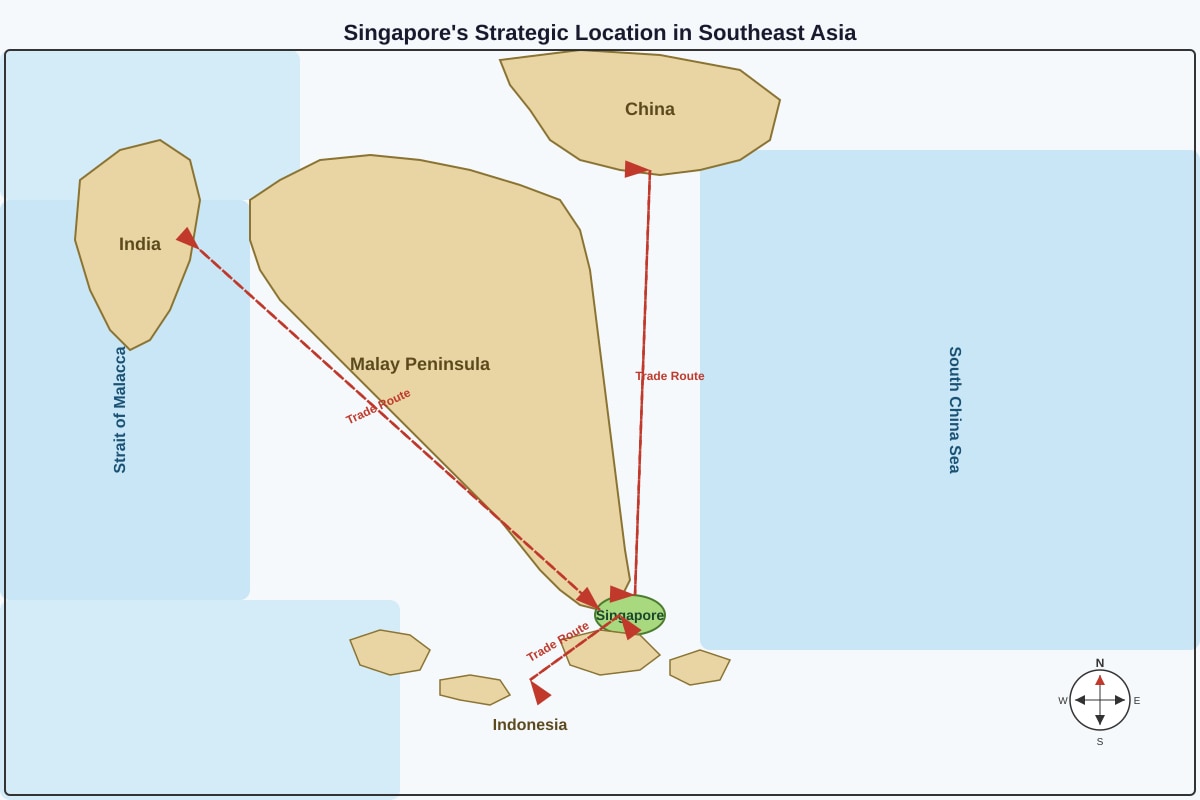
20. Using the map and your own knowledge, explain why Singapore's location made it attractive to traders from different parts of Asia.
[4 marks]
Answer:
The map shows that Singapore is located at a crossroads of major maritime trade routes.
-
Between India and China: Singapore sits along the main shipping route connecting India (to the west) and China (to the north). Traders travelling between these two great trading regions would naturally stop at Singapore to rest, refuel, and exchange goods.
-
Gateway to the Malay Archipelago: Singapore is positioned at the entrance to the Strait of Malacca, which provides access to the Indonesian archipelago (to the south). Traders seeking spices, tin, and other resources from the region would pass through Singapore.
-
Natural meeting point: Because of its central location, Singapore served as a convenient meeting point for merchants from different parts of Asia. Goods from India (textiles), China (porcelain, tea), and the Malay world (spices, gold) could all be traded there.
-
Sheltered harbour: The map shows Singapore's position on the coast, and its natural deep-water harbour made it a safe and practical stopover for ships.
Marking Scheme:
- 1 mark for each valid point, up to 4 marks.
- Students must refer to both the map and their own knowledge.
- Common mistake: Students may only describe the map without adding own knowledge, or vice versa.
Image Placeholder Note:
The map (Q20-fig1) must clearly show Singapore at the southern tip of the Malay Peninsula, with the Strait of Malacca to the west, the South China Sea to the east, and trade route arrows connecting Singapore to India, China, and Indonesia. All labels must be legible. The answer key assumes students can see Singapore's position at the intersection of these routes.
End of Answer Key