AI Generated Quiz
Secondary 1 History Singapore Southeast Asia Quiz
Free Sec 1 History Singapore SEA quiz, Kimi2.6 AI version, with questions, answers, and syllabus-aligned practice for Singapore students.
These static practice materials are generated from the site's syllabus and paper-generation workflow, with source and model context shown so students and parents can evaluate the material before use.
Questions
Free quiz and exam paper access
Enter your details to view this paper
Your access is remembered on this device.
Answers
Secondary 1 History Quiz - Singapore Southeast Asia: Answer Key
Total Marks: 40
Section A: Source-Based Skills (Questions 1–10)
Question 1 [2 marks]
Answer: Any two from:
- Singapore's position at the southern entrance of the Strait of Malacca made it invaluable for trade with China and the archipelago [1]
- The harbour could shelter any number of ships [1]
- Provisions were available at reasonable rates [1]
- Local rulers were weak and divided, making it easier to establish control [1]
- It gave Britain a commanding position over eastern trade routes [1]
Marking note: Accept paraphrased answers that convey the same meaning. Must be clearly attributed to reasons in Source A.
Question 2 [3 marks]
Answer:
- The Dutch official is clearly critical or concerned about British expansion [1]
- He describes British actions as happening "without proper negotiation" [L1] [1]
- He notes that the British threaten the existing balance the Dutch maintained [L1] [1]
- However, he grudgingly acknowledges British commercial success in attracting trade and merchants [L1] [1]
Marking breakdown:
- Identified attitude (critical/concerned/resentful): 1 mark
- Two pieces of supporting evidence from Source B with explicit links: 2 marks
Teaching note: The Dutch reaction reveals inter-European rivalry in Southeast Asia. The phrase "once again" suggests this was not the first British expansion the Dutch had observed. Students should note the tension between political criticism and economic acknowledgment.
Question 3 [4 marks]
Answer: Level 1 (1–2 marks): Identifies one or two similarities with basic or partial explanation.
Level 2 (3–4 marks): Identifies valid similarities with clear explanation of what they reveal about European trade interests.
Expected similarities:
- Both sources show Europeans viewed Southeast Asia as economically valuable for trade [1]
- Both mention competition between European powers for commercial advantage [1]
- Both refer to the importance of trade routes and merchant activity [1]
Developed explanation:
- Source A explicitly values Singapore for its position controlling "eastern trade routes" and trade with China, showing British commercial strategic thinking [1]
- Source B acknowledges that British Singapore "has already attracted considerable trade," showing Dutch recognition of economic vitality even while criticising the method [1]
- Together, the similarity reveals that both British and Dutch primarily evaluated Southeast Asian territories through their commercial potential, despite their political rivalry [1]
Common mistake: Students may say both sources "agree" — similarity is about what sources have in common in content or approach, not whether they agree on evaluation.
Question 4 [4 marks]
Answer: Level 1 (1–2 marks): Simple answer – supports or does not support, with limited or no evidence.
Level 2 (3–4 marks): Balanced answer considering both what supports and what limits this interpretation, with explicit source use.
Supports:
- States British extended influence "without proper negotiation" [1]
- Describes British actions as threatening, implying illegitimate method [1]
- "Once again" suggests pattern of British disregard for proper procedures [1]
Limits/Does not fully support:
- The Dutch official may be biased as a rival European power with own interests to protect [1]
- Does not provide evidence of what "proper negotiation" would look like or whether local rulers actually objected [1]
- Acknowledges British commercial success, which may suggest their methods were effective even if not unfair [1]
Teaching note: This tests evaluation of provenance as well as content. Dutch perspective is suspect due to rivalry; however, the criticism itself reveals contemporary European norms about how expansion should proceed.
Question 5 [1 mark]
Answer: Any one valid trend:
- Singapore's shipping numbers increased significantly/faster than other ports [1]
- Batavia's shipping numbers grew much more slowly [1]
- The gap between Singapore and other ports widened over time [1]
- Penang also grew but not as dramatically as Singapore [1]
Question 6 [2 marks]
Answer:
- Singapore was a free port with no customs duties, while Batavia had Dutch monopoly restrictions [1]
- British merchants and international traders preferred Singapore's lower costs and open trading policies [1]
- Singapore's location at the chokepoint of the Strait of Malacca was more convenient for ships travelling between Europe and China [1]
- Britain actively promoted Singapore as an alternative to Dutch-controlled ports [1]
Teaching note: Connect to syllabus concept of causation — multiple factors combined to produce Singapore's rapid growth. The free port policy was a deliberate government decision that interacted with geographic advantage.
Question 7 [4 marks]
Answer: Useful:
- Provides quantitative evidence of shipping growth showing Singapore's rising commercial importance [1]
- Enables comparison with specific rival ports (Batavia, Penang) over time [1]
- The pattern supports claims about Singapore's growing dominance [1]
Limitations:
- Only shows shipping numbers, not what was traded or profits made [1]
- Does not explain why the trend occurred — causes must be inferred or found elsewhere [1]
- Dutch shipping to Batavia may include different types of trade not captured by simple ship counts [1]
- We do not know what "ship" means – tonnage, frequency, or origin may differ [1]
Balanced conclusion: Useful for showing the pattern of growth and relative position, but limited for understanding causes without additional sources [1]
Question 8 [2 marks]
Answer:
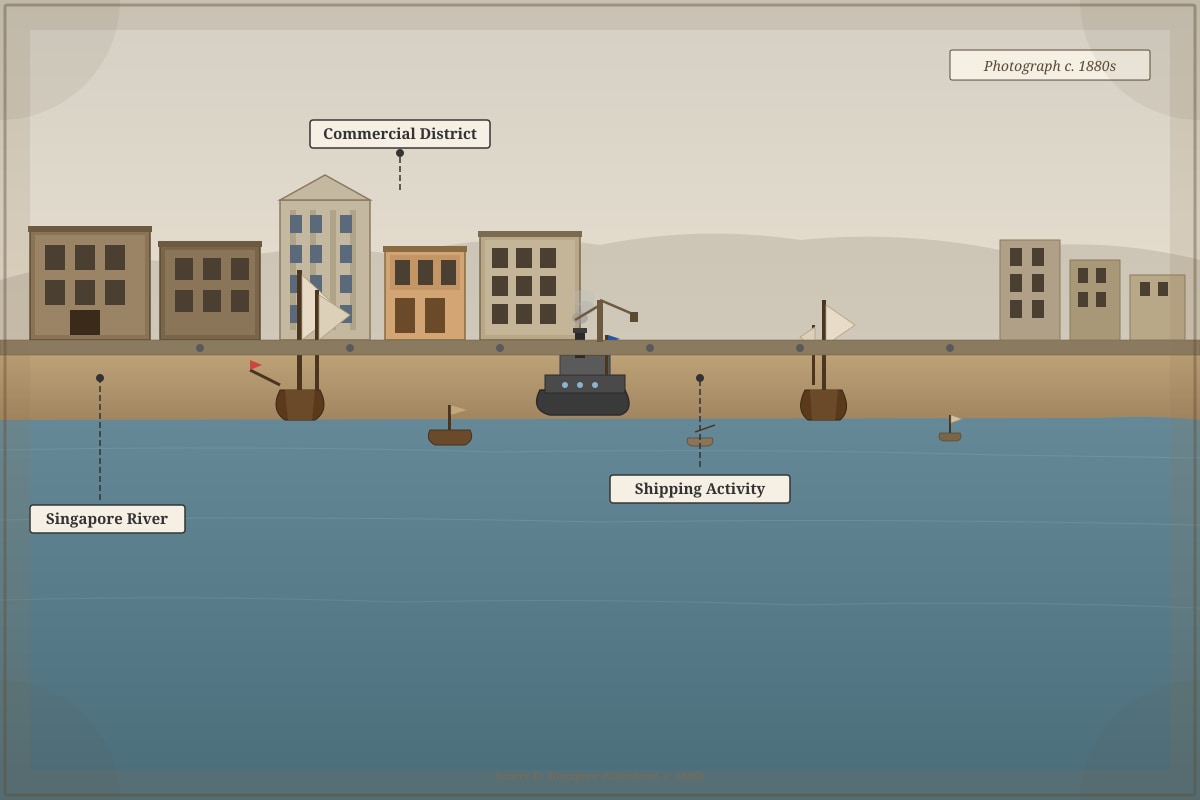
- Shows Singapore had developed into a busy, thriving commercial port by the 1880s [1]
- Evidence of mixed shipping (sailing and steam) indicating modernisation and continued relevance [1]
- Warehouses and commercial buildings show permanent settlement and investment [1]
- Dense waterfront activity indicates high volume of trade [1]
Question 9 [2 marks]
Answer: Reliable because:
- It is a photograph from the period, showing actual conditions [1]
- Visual evidence of physical infrastructure is hard to fabricate [1]
Less reliable because:
- Single photograph may show best/selected area, not typical conditions [1]
- Photographer may have chosen angle to emphasise prosperity [1]
- Does not show who controlled trade or economic relationships [1]
Teaching note: All sources have value and limitations. Reliability depends on what question is being asked. For physical appearance of port, highly reliable; for economic significance of Singapore to British Empire, needs supplementation.
Question 10 [6 marks]
Answer: Level 1 (1–2 marks): Lists factors with limited use of sources or own knowledge.
Level 2 (3–4 marks): Explains factors with some source use and basic own knowledge.
Level 3 (5–6 marks): Well-reasoned explanation combining sources with specific own knowledge, showing how factors interacted.
From Source C:
- Data shows dramatic shipping growth, especially compared to rivals, indicating Singapore became preferred port [1]
From Source D:
- Visual evidence of developed infrastructure and busy port confirms commercial success [1]
Own knowledge to include:
- Free port policy attracted merchants away from Dutch ports with monopoly restrictions [1]
- Strategic location at southern tip of Malay Peninsula controlled narrowest point of Strait of Malacca [1]
- Natural deep harbour allowed large ships to anchor close to shore [1]
- British naval protection and government investment in docks, roads, and communications [1]
- Chinese and Indian labour and entrepreneurship developed trade networks throughout region [1]
- Opening of Suez Canal (1869) increased European-Asia trade, funnelling more shipping through Singapore [1]
Synthesis: Singapore's success resulted from interaction of geographic advantage (location, harbour), government policy (free port, infrastructure investment), and historical circumstance (British-Dutch rivalry, technological change like steam and Suez Canal). Sources show outcome; own knowledge explains causes.
Section B: Knowledge and Understanding (Questions 11–20)
Question 11 [1 mark]
Answer: The Temasek/Singapura kingdom / Johor Sultanate / Malacca Sultanate (after fall) / Sultanate of Johor
Teaching note: Students may know it as "Temasek" from earlier periods or as having been controlled by the Sultan of Johor in 1819. Either acceptable; "Melaka" alone insufficient as Malacca fell in 1511.
Question 12 [1 mark]
Answer: The Dutch / Portuguese / Spanish / French
Question 13 [1 mark]
Answer:
- To recognise Hussein Shah as Sultan of Johor / formalise British relations with local ruler [1]
- To allow British to establish trading post / factory at Singapore [1]
- To exclude Dutch influence from the island [1]
Question 14 [2 marks]
Answer:
- A "free port" means traders did not have to pay customs duties or tariffs on goods passing through [1]
- This attracted more merchants to Singapore compared to ports with taxes or monopoly restrictions (like Dutch ports), increasing trade volume and making Singapore competitive [1]
Question 15 [2 marks]
Answer: Any two from:
- Building a deep-water harbour / docks / wharves [1]
- Constructing roads throughout the settlement [1]
- Developing telegraph connections [1]
- Building government buildings and housing [1]
- Extending the port facilities for steamships [1]
Question 16 [3 marks]
Answer:
- Chinese migrants provided commercial networks throughout Southeast Asia, linking Singapore to Malaya, Indonesia, and China [1]
- Indian migrants provided labour for construction and port work, as well as commercial connections to India [1]
- Both groups contributed to population growth, making Singapore a larger market and providing diverse services and skills [1]
- Their combined presence made Singapore attractive as an entrepôt where different regional traders could meet [1]
Question 17 [3 marks]
Answer: Any three from:
- Overcrowding in city centre with poor housing conditions [1]
- Health problems including disease outbreaks (cholera, typhoid) due to inadequate sanitation [1]
- Social problems including secret societies and violence among rival communities [1]
- Lack of clean water supply and proper waste disposal [1]
- Tensions between different migrant groups competing for jobs and resources [1]
Question 18 [3 marks]
Answer:
- The Suez Canal shortened the sea route between Europe and Asia, reducing travel time significantly [1]
- More ships therefore passed through Southeast Asian waters, many stopping at Singapore [1]
- Steamships became more practical, and Singapore developed coaling stations to service them [1]
- Overall trade volume between Europe and Asia increased, benefiting Singapore as the main regional entrepôt [1]
Question 19 [2 marks]
Answer: Any two from:
- Singapore became headquarters for British expansion into Malaya's tin and rubber industries [1]
- The naval base development made it strategically vital for imperial defence [1]
- As trade grew with industrialisation, Singapore's role as regional distribution centre expanded [1]
Question 20 [4 marks]
Answer: Level 1 (1–2 marks): One-sided answer with limited explanation.
Level 2 (3–4 marks): Balanced consideration with clear explanation and conclusion.
Agree – good government mattered:
- Free port policy was deliberate government choice that attracted trade [1]
- Investment in infrastructure (docks, roads, communications) made Singapore functional [1]
- British legal system and relative stability attracted merchants [1]
- Government addressed problems like secret societies and sanitation to maintain order [1]
Disagree – geography was main factor:
- Singapore sits at narrowest point of Strait of Malacca, the main route between Indian Ocean and South China Sea [1]
- Natural deep harbour allowed largest ships to anchor safely [1]
- Location on sea routes to China and archipelago made it unavoidable for regional trade [1]
- Without geographic position, government policy could not have succeeded elsewhere [1]
Conclusion judgement: Both mattered, but geography provided the foundation while government developed the opportunity [1]; or strong government was necessary to exploit geographic advantage that other places also partially possessed [1].
END OF ANSWER KEY