AI Generated Quiz
Secondary 1 History Conflict International Relations Quiz
Free Sec 1 History Conflict IR quiz, AI version, with questions, answers, and syllabus-aligned practice for Singapore students.
These static practice materials are generated from the site's syllabus and paper-generation workflow, with source and model context shown so students and parents can evaluate the material before use.
Questions
Free quiz and exam paper access
Enter your details to view this paper
Your access is remembered on this device.
Answers
Secondary 1 History Quiz - Conflict International Relations: ANSWER KEY
Section A: Multiple Choice and Short Answer (Questions 1–5)
Question 1
Correct Answer: (b) The United States and the Soviet Union
Explanation (2 marks):
- 1 mark for selecting the correct answer.
- The Cold War (c. 1947–1991) was a period of geopolitical tension between the United States (leading the capitalist West) and the Soviet Union (leading the communist East). While other powers were involved, these two were the primary rivals.
Common Mistakes:
- Option (a) Britain and France – both were allied with the US and not the primary rivals.
- Option (c) Germany and Japan – both were defeated in WWII and not the superpowers of the Cold War.
- Option (d) China and India – China was communist but a secondary player initially; India was non-aligned.
Question 2
Correct Answer: (b) The Berlin Blockade of 1948–1949
Explanation (2 marks):
- 1 mark for selecting the correct answer.
- The Berlin Blockade (June 1948–May 1949) was the first major crisis of the Cold War. The Soviet Union blocked all land routes into West Berlin, prompting the Western Allies to organise the Berlin Airlift. This event demonstrated the direct confrontation between the superpowers.
Common Mistakes:
- Option (a) The atomic bomb – while significant, it ended WWII, not started the Cold War.
- Option (c) Treaty of Versailles – ended WWI (1919), far too early to be relevant.
- Option (d) Russian Revolution – 1917, too early.
Question 3
Correct Answer: (b) To provide collective defence against Soviet aggression
Explanation (2 marks):
- 1 mark for selecting the correct answer.
- NATO was formed in 1949 by the US, Canada, and Western European nations. Article 5 of the North Atlantic Treaty states that an armed attack against one member is an attack against all. Its purpose was to deter Soviet expansion in Europe through collective defence.
Common Mistakes:
- Option (a) Free trade – that was more the role of the European Economic Community/EU.
- Option (c) Rebuilding Europe – that was the role of the Marshall Plan.
- Option (d) Single currency – that came much later with the EU.
Question 4
Correct Answer: (b) A war where superpowers support opposing sides in a smaller conflict
Explanation (2 marks):
- 1 mark for selecting the correct answer.
- A proxy war occurs when the two main superpowers (US and USSR) avoid direct military confrontation with each other but instead support opposing sides in a smaller, regional conflict. Examples include the Korean War (1950–1953) and the Vietnam War (1955–1975).
Common Mistakes:
- The key is the indirect nature of the conflict – superpowers fight through intermediaries.
Question 5
Correct Answer: (b) The division between communist Eastern Europe and capitalist Western Europe
Explanation (2 marks):
- 1 mark for selecting the correct answer.
- The term "Iron Curtain" was popularised by Winston Churchill in a 1946 speech. It described the ideological and physical division of Europe into communist East (controlled by the Soviet Union) and capitalist West (allied with the US).
Common Mistakes:
- It was not a single physical wall (the Berlin Wall was built later in 1961 and was part of the Iron Curtain, but not the whole thing).
Section B: Source-Based Questions (Questions 6–12)
Question 6
Correct Answer (1 mark): The Truman Doctrine.
Explanation:
- 1 mark for correctly naming the policy.
- In Source A, President Truman articulated a policy of "containment" – stopping the spread of communism. This became known as the Truman Doctrine.
Question 7
Correct Answer (3 marks):
-
Mark Breakdown:
- 1 mark: Identifies the policy as the Truman Doctrine/containment.
- 1 mark: Explains that the US provided military and economic aid to Greece and Turkey.
- 1 mark: Explains that this aid was to prevent them from falling under communist/Soviet control.
-
Sample Answer: The policy described by President Truman was the Truman Doctrine. It meant that the United States would actively support countries like Greece and Turkey to prevent them from becoming communist. In 1947, the US provided significant military and economic aid to Greece (fighting a communist rebellion) and Turkey (under Soviet pressure for access to the Mediterranean). This showed the US was abandoning its pre-war isolationism and would actively intervene to contain Soviet influence.
-
Common Mistakes:
- Explaining the policy without applying it to the specific countries mentioned.
- Not making the connection to containing communism.
Question 8
Correct Answer (2 marks):
-
Mark Breakdown:
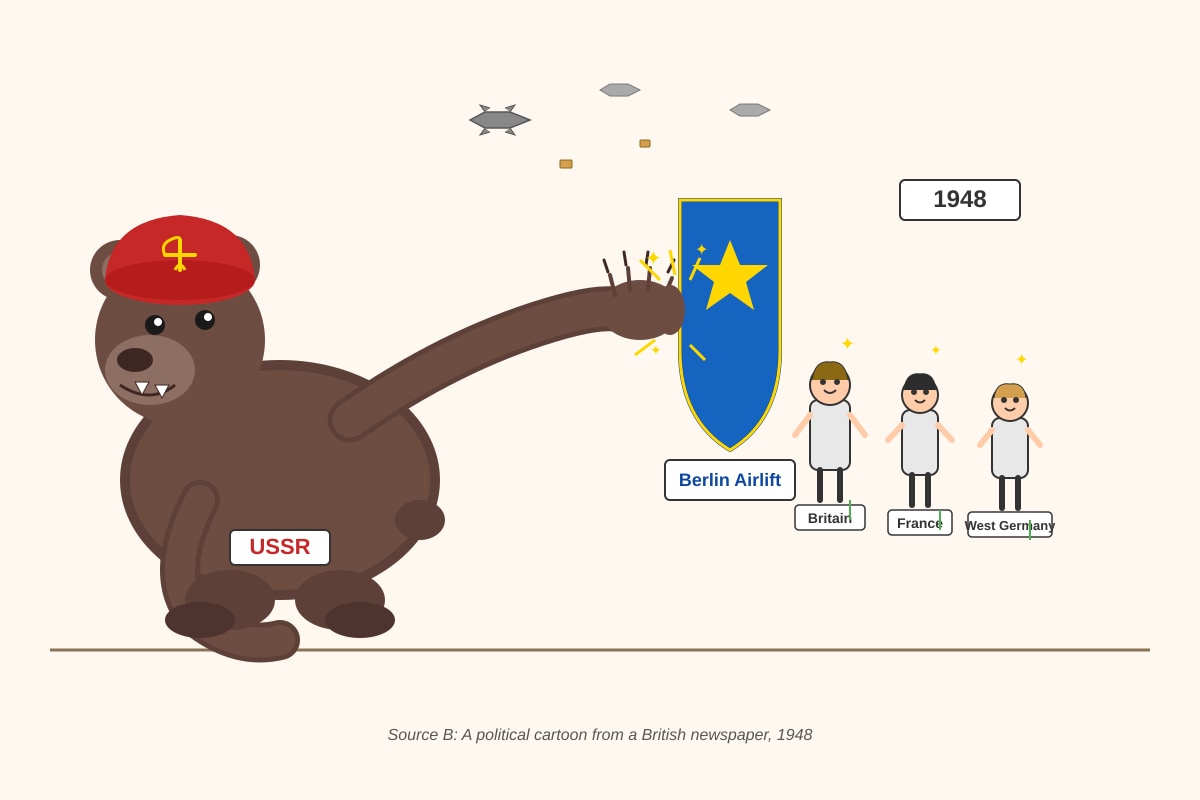
- 1 mark: Identifies the message (e.g., the Berlin Airlift successfully blocked Soviet expansion).
- 1 mark: Explains using evidence from the cartoon (e.g., the shield blocks the bear's paw, the Western nations are protected).
-
Sample Answer: The cartoon's message is that the Berlin Airlift was a successful Western effort that stopped Soviet expansion into Western Europe. The Soviet Union (represented by the aggressive bear) is trying to reach into Western Europe, but the shield labelled 'Berlin Airlift' blocks its path. The relieved figures behind the shield suggest that the Airlift protected Western Europe from Soviet domination.
Question 9
Correct Answer (3 marks):
-
Mark Breakdown:
- 1 mark: Identifies a strength (e.g., shows Western perspective as a primary source from the time).
- 1 mark: Identifies a limitation (e.g., biased, created by the British, a political cartoon is an opinion, not a neutral fact).
- 1 mark: Makes a judgement on reliability for the specific purpose.
-
Sample Answer: Source B has some limitations as evidence. Political cartoons are opinion pieces designed to persuade, not neutral records. As a British source, it likely reflects the Western, anti-Soviet viewpoint. However, it is valuable because it captures the contemporary Western perception of the crisis. It shows the fear of Soviet expansion and the pride in the Berlin Airlift as a successful response. A historian can use it to understand Western attitudes, but not for a balanced Soviet perspective.
Question 10
Correct Answer (2 marks):
- 1 mark for each correct country.
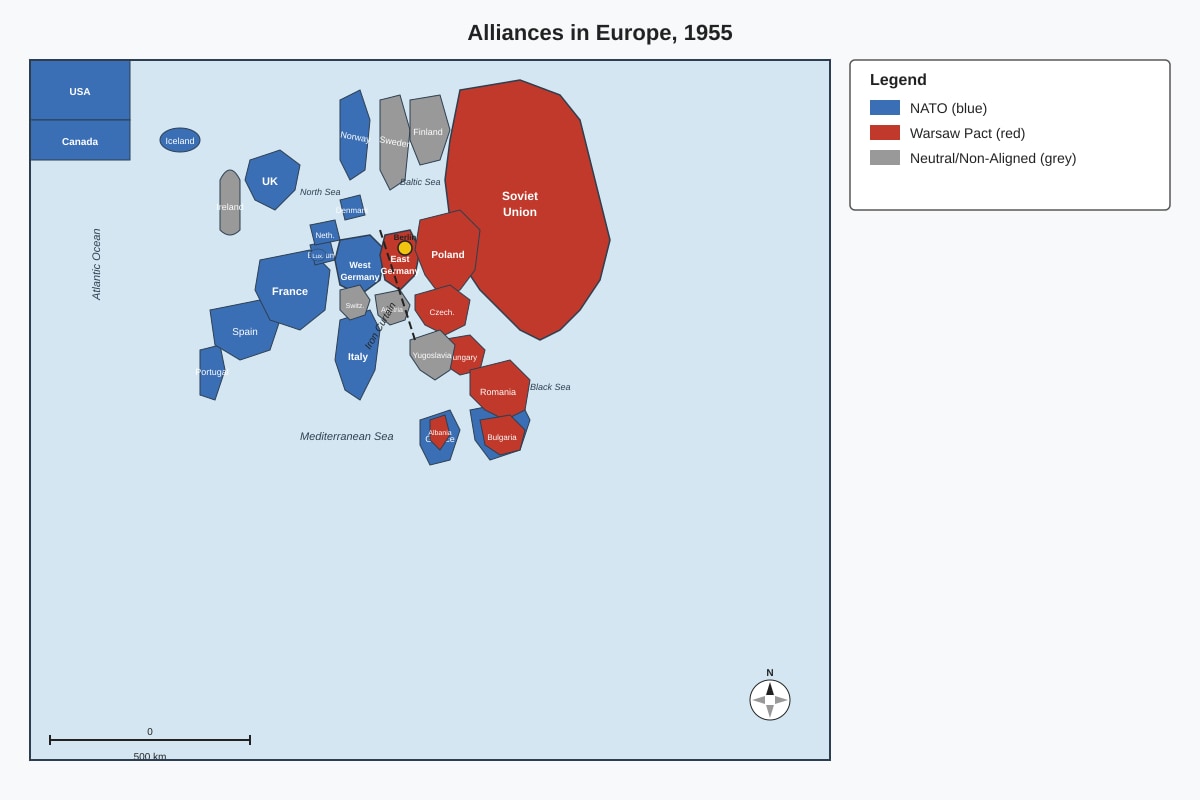
- Any two from: Soviet Union, East Germany, Poland, Czechoslovakia, Hungary, Romania, Bulgaria, Albania (Albania left the pact in 1968, but was a member in 1955).
Question 11
Correct Answer (3 marks):
-
Mark Breakdown:
- 1 mark: Recognises West Berlin was an island of capitalism within communist territory.
- 1 mark: Explains the vulnerability (surrounded by East Germany, part of the Warsaw Pact).
- 1 mark: Explains the strategic significance (a symbol of Western commitment, a potential flashpoint).
-
Sample Answer: The map suggests West Berlin was in a very isolated and strategically vulnerable position. It was a Western-aligned, capitalist city located deep inside communist East Germany, which was a member of the Warsaw Pact. This made it difficult to supply and defend. Its location made it a constant source of tension, as the Western Allies relied on access routes through Soviet-controlled territory, which could be blocked (as happened in 1948).
Question 12
Correct Answer (4 marks):
-
Mark Breakdown:
- 1 mark: Identifies a similarity (both show a divided Europe).
- 1 mark: Provides specific evidence from Source C (the map showing the two blocs).
- 1 mark: Provides specific evidence from Source D ("iron curtain has descended").
- 1 mark: Explains the significance (the division was a core feature of the Cold War).
-
Sample Answer: Both sources are similar in that they clearly show a divided Europe. Source C is a map that shows the official military alliance blocs – NATO in blue and the Warsaw Pact in red – creating a visual line of division down the middle of Europe. Source D describes this same division by Churchill's "Iron Curtain" phrase, describing a line separating the Soviet sphere of influence from the West. Both sources demonstrate that the division of Europe into communist and capitalist spheres was a fundamental feature of the post-WWII world and the Cold War. The similarity confirms that the split was not just a political idea but a physical and military reality.
Section C: Structured Response Questions (Questions 13–20)
Question 13
Correct Answer (3 marks):
-
Mark Breakdown:
- 1 mark: Identifies the first cause with a brief explanation.
- 1 mark: Identifies the second cause with a brief explanation.
- 1 mark: Provides sufficient historical detail/elaboration on one or both causes.
-
Sample Answer: Two causes of the Cold War were:
- Ideological differences: The US believed in capitalism and democracy, while the USSR promoted communism and a one-party state. These opposing worldviews created deep mistrust and suspicion.
- Disagreements over post-war Europe: At the Yalta and Potsdam Conferences (1945), the Allies disagreed about the future of Germany and Eastern Europe. Stalin wanted a buffer zone of communist states, while the US and Britain wanted free elections and democratic governments. This led to the division of Europe.
Question 14
Correct Answer (3 marks):
-
Mark Breakdown:
- 1 mark: Identifies the Marshall Plan.
- 1 mark: Explains its economic purpose (rebuilding Western Europe).
- 1 mark: Explains its Cold War role (containing communism by reducing poverty & instability).
-
Sample Answer: The Marshall Plan was a US program (1948–1951) that provided over $12 billion in economic aid to rebuild Western European economies. Its official purpose was to prevent economic collapse, but its Cold War role was crucial. By stabilising these economies, the US aimed to make them less vulnerable to communist influence. The plan deepened the division of Europe as the Soviet Union rejected the aid and forced its satellite states to do the same, viewing it as a tool of American imperialism.
Question 15
Correct Answer (3 marks):
-
Mark Breakdown:
- 1 mark: States that it worsened the relationship.
- 1 mark: Explains how (Soviet aggression vs. Western resolve).
- 1 mark: Explains a consequence (formalised the division of Germany/Europe, led to NATO).
-
Sample Answer: The Berlin Blockade significantly worsened the relationship between the US and the USSR. The Soviet blockade of West Berlin was an aggressive act, but the Western response (the Berlin Airlift) showed their determination to stand firm. The crisis hardened the division of Europe. It shattered any remaining trust and led directly to the formation of NATO in 1949, as Western nations formally allied for collective defence. The blockade made the Cold War a permanent reality.
Question 16
Correct Answer (3 marks):
-
Mark Breakdown:
- 1 mark: States that it formalised the military division of Europe.
- 1 mark: Explains it was a response to West Germany joining NATO.
- 1 mark: Explains the consequence (deepened the arms race/alliance system).
-
Sample Answer: The founding of the Warsaw Pact in 1955 was significant because it formally completed the military division of Europe. It was a direct response to West Germany joining NATO earlier that year. The Warsaw Pact united the Soviet Union and its Eastern European satellite states in a single military command. This created two opposing military blocs in Europe, making the Cold War structure permanent and increasing the risk of a direct confrontation. It also intensified the arms race.
Question 17
Correct Answer (3 marks):
-
Mark Breakdown:
- 1 mark: States that the Cold War influenced decolonisation.
- 1 mark: Provides a valid example (e.g., Vietnam, Korea, Malaya).
- 1 mark: Explains how the superpowers became involved in the specific example.
-
Sample Answer: The Cold War significantly impacted decolonisation in Asia by turning independence struggles into proxy wars. The superpowers often backed different sides to gain influence. For example, in Vietnam, the Vietnamese fought for independence from France. The US supported France and later the anti-communist South, fearing a "domino effect" of communist takeovers. The Soviet Union and China supported the communist Viet Minh in the North. This turned the Vietnamese struggle for independence into a major Cold War conflict.
Question 18
Correct Answer (3 marks):
-
Mark Breakdown:
- 1 mark: Identifies the UN's main role (peacekeeping/diplomatic forum).
- 1 mark: Gives a specific example of UN action (e.g., during the Korean War, UN mediation efforts).
- 1 mark: Explains a limitation (veto power of the Security Council, superpower influence).
-
Sample Answer: The United Nations played a role as a diplomatic forum where the superpowers could discuss tensions without resorting to war. During the Korean War, the UN authorised a military force to support South Korea. However, the UN's effectiveness was often limited because the US and USSR both held permanent veto power in the Security Council. This meant the UN could not take action against a superpower's interests. Despite this, it provided a crucial channel for negotiation and a platform for smaller nations.
Question 19
Correct Answer (3 marks):
-
Mark Breakdown:
- 1 mark: Defines the nuclear arms race.
- 1 mark: Explains the concept of Mutually Assured Destruction (MAD).
- 1 mark: Explains the impact (made direct war too risky but increased proxy wars).
-
Sample Answer: The nuclear arms race was the competition between the US and USSR to build more and better nuclear weapons. This shaped the Cold War because it led to the concept of Mutually Assured Destruction (MAD). Both sides had enough weapons to destroy the other, so a direct war would be suicidal. This paradox made direct superpower war unlikely, but it also created constant fear and tension. It shifted the conflict to proxy wars, espionage, and a space race, as neither side could risk a direct, total war.
Question 20
Correct Answer (3 marks):
-
Mark Breakdown:
- 1 mark: Describes the US/capitalist ideology.
- 1 mark: Describes the Soviet/communist ideology.
- 1 mark: Explains how these differences were incompatible and caused conflict.
-
Sample Answer: The key ideological differences were:
- United States (Capitalism/Democracy): Believed in free markets, private property, individual rights, and multi-party elections. It aimed for a world open to trade and Western influence.
- Soviet Union (Communism/Totalitarianism): Believed in state ownership of all property, a one-party state led by the Communist Party, and the goal of a worldwide communist revolution to overthrow capitalism.
These ideologies were fundamentally incompatible. Each side viewed the other as a direct threat to its way of life and security. The US saw communism as a repressive system that needed to be contained, while the USSR saw capitalism as an imperialist system destined to be overthrown. This mutual hostility was the central driver of the Cold War.