AI Generated Quiz
Secondary 1 History Ancient Civilisations Quiz
Free Sec 1 History Ancient Civilisations quiz, Qwen3.7 AI version, with questions, answers, and syllabus-aligned practice for Singapore students.
These static practice materials are generated from the site's syllabus and paper-generation workflow, with source and model context shown so students and parents can evaluate the material before use.
Questions
Free quiz and exam paper access
Enter your details to view this paper
Your access is remembered on this device.
Answers
Secondary 1 History Quiz - Ancient Civilisations: Answer Key
Total Marks: 40
Section A: Knowledge and Understanding (10 Marks)
1. Indus River
[1 mark]
Note: Accept "Indus".
2. Baked bricks
[1 mark]
Note: Accept "burnt bricks". Do not accept "stone" or "mud" alone as the primary distinctive feature of major structures.
3. Chandragupta Maurya
[1 mark]
4. Buddhism
[1 mark]
5. Chang’an
[1 mark]
6. Civil Service Examination System
[1 mark]
Note: Accept "Imperial Examinations".
7. Silk OR Porcelain OR Tea
[1 mark]
Note: Any one of these is acceptable.
8. Transporting grain (rice) and goods from the south to the north (capital).
[1 mark]
Note: Accept "transporting supplies" or "linking north and south".
9. Ritual purification / Religious ceremonies
[1 mark]
Note: Accept "bathing for religious purposes".
10. Himalayas
[1 mark]
Section B: Source-Based and Structured Questions (20 Marks)
11. The Kalinga War
[1 mark]
12. Any two of the following:
[2 marks: 1 mark for each point]
- Erecting stone pillars with edicts.
- Promoting non-violence (ahimsa).
- Encouraging respect for elders.
- Showing kindness to animals.
- Sending missionaries to other regions.
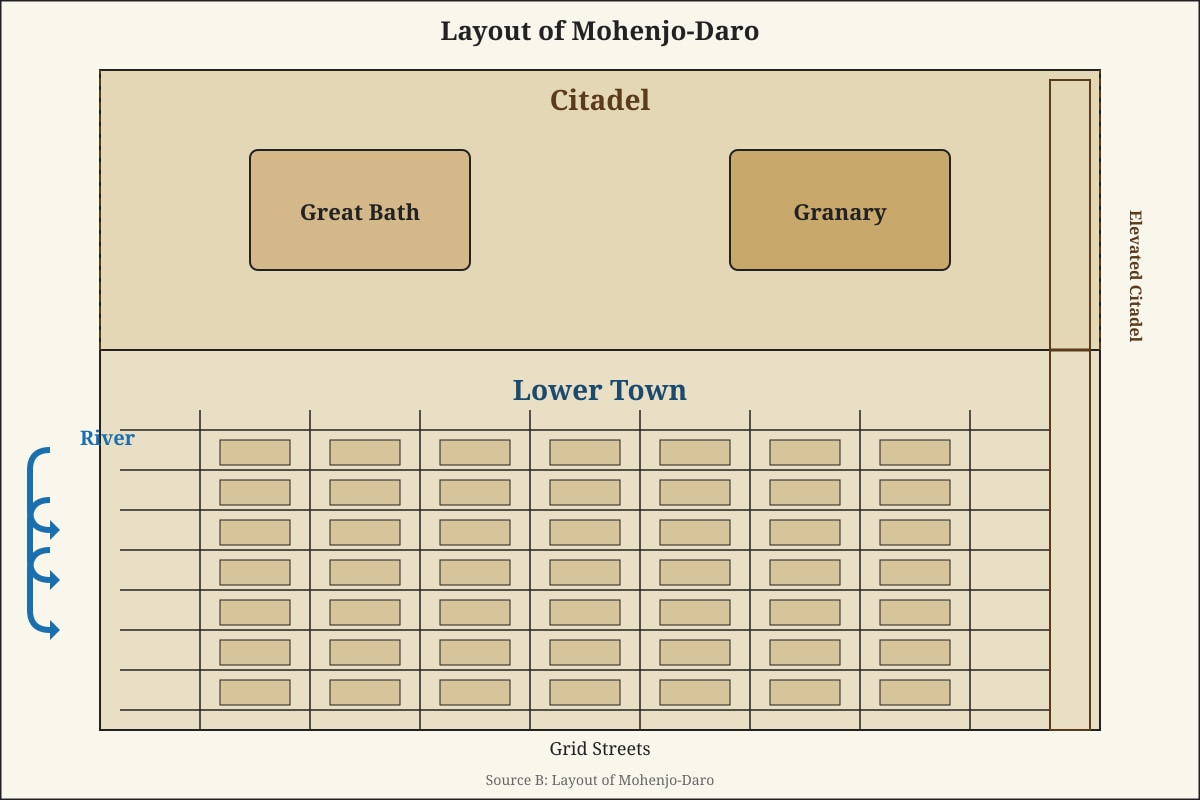
13. The layout suggests that the city was planned and organised.
[2 marks]
- Point 1: The grid pattern of streets shows careful urban planning. [1]
- Point 2: The separation into Citadel (public/religious) and Lower Town (residential) shows social or functional organisation. [1]
Teaching Note: Students must infer "planning" from the visual evidence of the grid and distinct zones.
14. Spices OR Timber OR Gold OR Ivory
[1 mark]
Note: Any one from the "Goods Exported to China" column for Southeast Asia.
15. Porcelain was likely valued because:
[2 marks]
- It was a high-quality luxury item not easily produced locally in Southeast Asia at that time. [1]
- It was durable and aesthetically pleasing, making it desirable for trade or status. [1]
Teaching Note: Students should infer value from the fact that it was a specific import item listed alongside Silk.
16. The sources show connections in two ways:
[3 marks]
- Source A shows religious/cultural connection: Ashoka sent Buddhist missionaries to Southeast Asia. [1]
- Source C shows economic connection: There was active trade of goods (spices, silk, porcelain) between China/India and Southeast Asia. [1]
- Synthesis: Together, they show that ancient civilisations influenced Southeast Asia through both religion and trade. [1]
17. Any two valid reasons with explanation:
[4 marks: 2 marks per reason (1 for point, 1 for explanation)]
- Political Stability/Strong Government: The Civil Service Examination ensured capable officials ran the government, leading to efficient administration.
- Economic Prosperity: The Grand Canal and Silk Road facilitated trade, bringing wealth and goods from across Asia.
- Cultural Flourishing: Poetry, art, and technology (like woodblock printing) thrived during this period.
- Cosmopolitan Society: Chang’an was a global city where people from different cultures and religions lived together.
18. Standardisation was important because:
[3 marks]
- It facilitated trade across the vast empire by ensuring everyone used the same measurements and money. [1]
- It improved tax collection efficiency, as the central government could accurately assess taxes. [1]
- It strengthened central control and unity, making it easier to administer distant provinces. [1]
Section C: Extended Response (10 Marks)
19. "Strong leadership was the most important factor in the success of ancient civilisations." Do you agree?
Marking Rubric:
- Level 3 (7-10 marks): Clear stance (agree/disagree/qualified). Well-developed arguments with specific historical examples from the Mauryan Empire OR Tang Dynasty. Acknowledges other factors (e.g., geography, trade) but explains why leadership was more/less important.
- Level 2 (4-6 marks): Some relevant points with examples. May lack depth in explanation or balance.
- Level 1 (1-3 marks): Simple statements, limited examples, or no clear argument.
Sample Answer Structure (Agreeing with reference to Mauryan Empire):
- Introduction: State agreement. Strong leadership was crucial for unifying diverse regions and maintaining order.
- Point 1 (Leadership): Chandragupta Maurya and Ashoka provided strong centralised rule. Ashoka’s shift to Dhamma reduced internal conflict and created social harmony.
- Point 2 (Leadership/Administration): The Mauryan bureaucracy, directed by the Emperor, ensured law and order, collected taxes, and maintained infrastructure (roads).
- Counter-point (Other Factors): Geography (natural barriers) and trade (economic wealth) were also important.
- Rebuttal/Synthesis: However, without strong leaders to manage these resources and defend borders, the empire might have fragmented like earlier smaller kingdoms. Therefore, leadership was the most important factor in sustaining the empire's size and stability.
Sample Answer Structure (Agreeing with reference to Tang Dynasty):
- Introduction: Agree. Tang emperors like Taizong and Xuanzong created policies that led to prosperity.
- Point 1 (Leadership): The establishment of the Civil Service Exam by Tang leaders ensured meritocracy, reducing corruption and improving governance.
- Point 2 (Leadership/Policy): Emperors invested in infrastructure like the Grand Canal, which boosted the economy and food supply.
- Counter-point: The Silk Road’s existence (geography/global context) brought wealth regardless of leadership.
- Rebuttal: But it was Tang leadership that secured the Silk Road routes and maintained the peace necessary for trade to flourish. Thus, leadership was key.
[10 marks]
20. Compare the role of religion in the Mauryan Empire under Ashoka with the role of the Civil Service Examination in the Tang Dynasty. How did each contribute to the stability of their respective empires?
Marking Rubric:
- Level 3 (7-10 marks): Clear comparison. Explains how religion (Mauryan) and examinations (Tang) served similar functions (unity/control) through different means. Specific historical details provided for both.
- Level 2 (4-6 marks): Describes both systems but lacks direct comparison or depth in explaining their contribution to stability.
- Level 1 (1-3 marks): Mentions one or both systems with little explanation or relevance to stability.
Sample Answer Structure:
- Introduction: Both Ashoka’s use of religion and the Tang Civil Service Exams were tools for centralising power and maintaining social order, though they operated differently.
- Mauryan Empire (Religion): Ashoka used Buddhism and 'Dhamma' to create a moral code that transcended local tribal loyalties. By promoting non-violence and respect, he reduced internal conflict and unified a diverse empire under a shared ethical framework. Missionaries helped spread this unity to border regions.
- Tang Dynasty (Civil Service Exams): The Tang used the examination system to create a loyal, meritocratic bureaucracy. This reduced the power of hereditary aristocrats who might challenge the Emperor. It ensured that officials were competent and loyal to the state, leading to efficient administration and stability.
- Comparison: While Ashoka relied on moral/religious unity to bind people, the Tang relied on administrative/structural unity. Both methods effectively reduced dissent: Ashoka by changing hearts/minds, the Tang by controlling the government apparatus.
- Conclusion: Both were crucial for stability. Religion provided social cohesion in the Mauryan Empire, while the examination system provided political cohesion in the Tang Dynasty.
[10 marks]