AI Generated Quiz
Secondary 1 History Ancient Civilisations Quiz
Free Sec 1 History Ancient Civilisations quiz, AI version, with questions, answers, and syllabus-aligned practice for Singapore students.
These static practice materials are generated from the site's syllabus and paper-generation workflow, with source and model context shown so students and parents can evaluate the material before use.
Questions
Free quiz and exam paper access
Enter your details to view this paper
Your access is remembered on this device.
Answers
Answer Key: Secondary 1 History Quiz - Ancient Civilisations
Total Marks: 50
Section A: Multiple Choice Questions (10 marks)
1. B — A grid-like street system with covered drains [1 mark]
Teaching Note: The Indus Valley cities like Mohenjo-Daro and Harappa are famous for their advanced urban planning. The grid street system and covered drains show that they had a well-organised government that could plan and build complex infrastructure. The other options are incorrect because we have little evidence of large palaces, temples, or a focus on military conquest.
2. B — They were located near the Indus River, which supported farming and trade [1 mark]
Teaching Note: The Indus River provided water for irrigation, which allowed farmers to grow surplus food. This surplus supported a large population and freed some people to become traders, craftsmen, and government officials. The river also served as a transport route for trade.
3. B — Chandragupta Maurya [1 mark]
Teaching Note: Chandragupta Maurya founded the Mauryan Empire around 321 BCE with the help of his advisor Kautilya (Chanakya). Ashoka was his grandson and became the most famous Mauryan ruler, but he did not found the empire.
4. A — He gave up war and adopted a policy of peace and non-violence (Dhamma) [1 mark]
Teaching Note: The Kalinga War was a bloody conflict that caused massive casualties. Ashoka was deeply affected by the suffering and decided to give up military conquest. He instead promoted Dhamma, a set of moral principles that encouraged peace, tolerance, and respect for all living things.
5. B — The trade routes between India and China [1 mark]
Teaching Note: Funan and Srivijaya were located along the maritime trade routes that connected India and China. They controlled the Strait of Melaka and other key waterways. By controlling these routes, they could tax passing ships, provide services to traders, and become wealthy and powerful.
Section B: Short Answer Questions (20 marks)
6. Any two of the following: [2 marks — 1 mark each]
- Located near the Indus River, which provided water for farming and daily use.
- The river flooded regularly, leaving behind fertile soil (silt) that was good for growing crops.
- The location allowed for trade with other regions (e.g., Mesopotamia) via the river and the sea.
Teaching Note: Students should focus on geographical advantages, not cultural or political ones. The river was the single most important factor for the civilisation's development.
7. Any two of the following: [2 marks — 1 mark each]
- Seals (carved stone seals with pictures and writing)
- Pottery
- Tools and weapons (made of stone, copper, and bronze)
- Remains of buildings (houses, the Great Bath, granaries)
- Jewellery and ornaments
- Toys and games
Teaching Note: Archaeologists study physical remains. These objects tell us about trade, religion, daily life, technology, and social structure.
8. [3 marks]
- Difference: A primary source is a source that was created at the time of the event by someone who was there. A secondary source is a source that was created later, usually by someone who was not present at the event. [1 mark]
- Primary source example: A clay seal from Mohenjo-Daro / a stone pillar inscription from Ashoka's reign / a coin from the Mauryan Empire. [1 mark]
- Secondary source example: A modern history textbook / a historian's book about the Indus Valley / a documentary made in 2020 about Ashoka. [1 mark]
Teaching Note: The key idea is time and presence. A primary source is contemporary with the event; a secondary source is created afterwards and often interprets primary sources.
9. Any one of the following: [2 marks]
- Srivijaya was located on the Strait of Melaka, which was a major shipping route between India and China. [1 mark] This meant that all ships passing between these two trading regions had to go through Srivijaya's waters, allowing the empire to control and tax this trade. [1 mark]
- Srivijaya was located in maritime Southeast Asia (on Sumatra and the Malay Peninsula). [1 mark] This allowed it to control the sea routes and become a centre for the exchange of goods from both the Indian Ocean and the South China Sea. [1 mark]
Teaching Note: Award 1 mark for stating the location and 1 mark for explaining how it helped trade. The key concept is the control of a strategic choke point.
10. Any one of the following: [2 marks]
- Chandragupta ruled through military power and a strong, centrally controlled government with spies and a large army. [1 mark] Ashoka, after the Kalinga War, gave up military conquest and instead ruled through moral principles (Dhamma), promoting peace and religious tolerance. [1 mark]
- Chandragupta expanded the empire through conquest. [1 mark] Ashoka focused on governing his existing empire justly and spreading moral teachings rather than expanding it by force. [1 mark]
Teaching Note: The key difference is the shift from conquest and force to peaceful and moral governance.
11. Any one of the following: [1 mark]
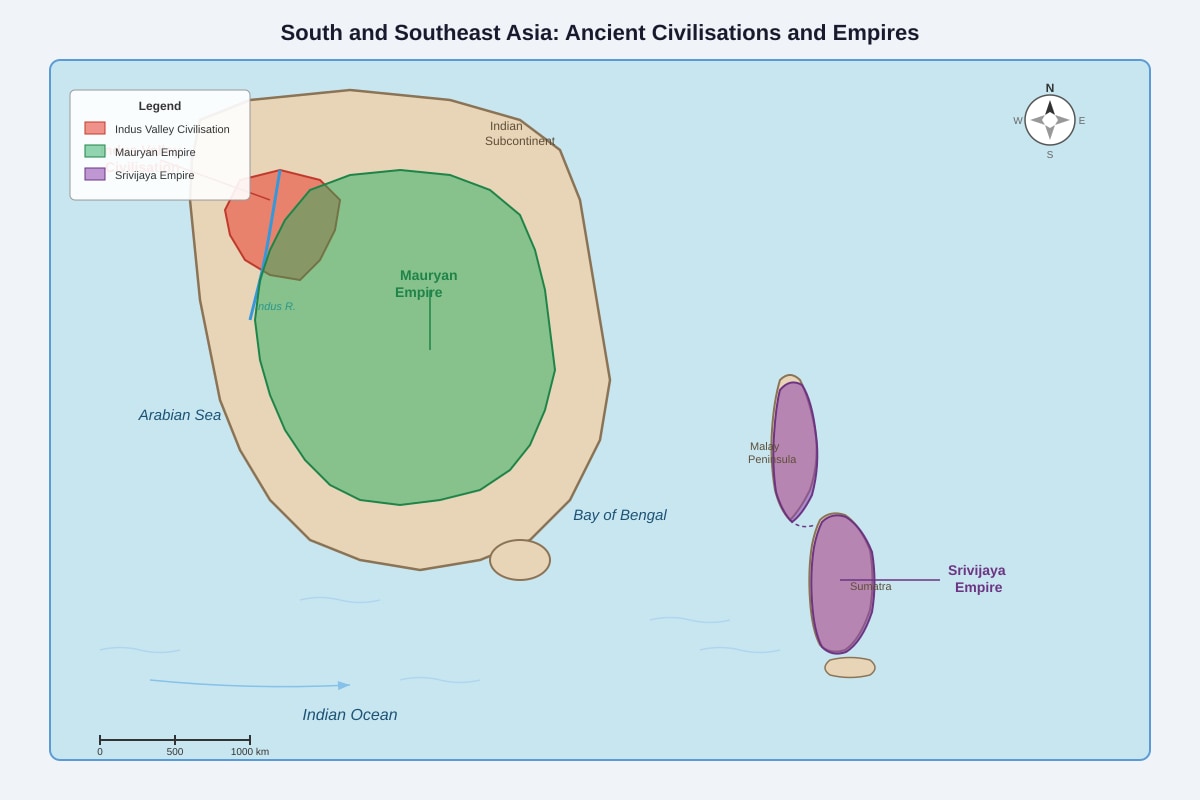
- Srivijaya was located in Southeast Asia (on islands and a peninsula), while the Indus Valley was located in South Asia (on the Indian subcontinent).
- Srivijaya was a maritime empire located near the sea, while the Indus Valley was located inland, along a river.
- Srivijaya was located to the south-east of the Indian subcontinent, while the Indus Valley was in the north-west.
Teaching Note: The map should clearly show these two regions. Students should be able to identify a simple geographical difference based on the map.
12. Any two of the following: [2 marks — 1 mark each]
- Ancient civilisations in the region (like Funan and Srivijaya) established trade networks that Singapore later became part of.
- Understanding ancient Southeast Asia helps us see that Singapore's role as a trading port has deep historical roots.
- The spread of religions, cultures, and ideas from ancient India and China shaped the cultures of Southeast Asia, including Singapore.
- Studying ancient civilisations helps us understand how human societies develop and change over time.
Teaching Note: The question asks for the importance of studying ancient civilisations for understanding Singapore and Southeast Asia. Answers should connect the ancient past to the region's later history.
13. Any one of the following: [2 marks]
- The empire was divided into provinces, each governed by an official appointed by the emperor. [1 mark] This allowed the emperor to control a large territory effectively. [1 mark]
- The emperor had a large army and a network of spies to maintain control. [1 mark] This helped him to keep the empire united and prevent rebellions. [1 mark]
- There was a central government headed by the emperor, who made all major decisions. [1 mark] He was advised by a council of ministers. [1 mark]
Teaching Note: Award 1 mark for describing a feature of the government and 1 mark for explaining its purpose or function.
14. [2 marks]
- Meaning: Dhamma (or Dharma) refers to a set of moral principles or a code of conduct that promotes righteous living, peace, and respect for all. [1 mark]
- Policy (any one): [1 mark]
- Building hospitals for people and animals
- Planting trees and digging wells along roads for travellers
- Appointing officials (Dhamma Mahamattas) to spread Dhamma and look after the welfare of the people
- Promoting religious tolerance and respect for all sects
Teaching Note: Dhamma was not a religion, but a moral code. Ashoka wanted to rule his empire through goodness rather than fear.
15. Any two of the following: [2 marks — 1 mark each]
- Flooding or changes in the course of the Indus River
- Climate change (e.g., a period of drought)
- Overuse of resources / deforestation
- Invasion or attack by other groups
- Decline in trade with other regions
- A combination of these factors
Teaching Note: Historians are not certain why the civilisation declined. Students should be aware that it was likely a combination of factors, not a single cause.
Section C: Source-Based and Structured Questions (20 marks)
16. Any two of the following: [2 marks — 1 mark each]
- They were well-organised and had a strong government that could plan and build a city in an orderly way (grid streets).
- They valued cleanliness and public health (covered drains, bathrooms in homes).
- They had advanced engineering and building skills (uniform bricks, complex drainage).
- They valued community life and public spaces (the Great Bath).
Teaching Note: Students must make an inference from the source, not just copy it. For each point, they should link the evidence from the source to what it tells us about the people.
17. [2 marks]
- It is a secondary source. [1 mark]
- Because it was written by a modern historian who was not alive at the time of the Indus Valley civilisation. It is a later interpretation of evidence from the past. [1 mark]
Teaching Note: The source is introduced as "A modern historian's description," which clearly makes it a secondary source. The author is interpreting primary evidence (the ruins of Mohenjo-Daro).
18. [2 marks]
- Ashoka had a tolerant and respectful attitude towards different religions. [1 mark]
- He honoured all religious sects and said that people should not disparage or criticise other sects. He believed that all religions shared a common core of good conduct. [1 mark]
Teaching Note: Students should use the source to support their answer. The key phrases are "honoured all religious sects" and "not honour one's own sect and disparage another's without cause."
19. [4 marks]
Level 1 (1 mark): Simple statement about usefulness. E.g., "It is useful because it tells us about Ashoka."
Level 2 (2-3 marks): States a reason for usefulness or limitation with some explanation. E.g., "It is useful because it is a primary source from Ashoka's own time, so it shows what he wanted people to believe about his policy." OR "It is limited because it is a royal inscription, so it may be propaganda to make Ashoka look good."
Level 3 (4 marks): Evaluates both usefulness and limitations. E.g., "The source is useful because it is a primary source created during Ashoka's reign, giving us direct evidence of his official policy of religious tolerance. However, its usefulness is limited because it is a royal proclamation. Ashoka may have used these pillars to project a positive image of himself and to maintain control over his diverse empire, so it may not fully reflect the reality of religious relations in the empire."
Teaching Note: For full marks, students should consider the origin (royal inscription), purpose (propaganda/communication), and content of the source. They should weigh both its strengths and limitations as evidence.
20. [10 marks]
Level 1 (1-3 marks): States one or two simple reasons without explanation. E.g., "Srivijaya was powerful because of trade."
Level 2 (4-6 marks): Explains one reason in detail, OR gives two reasons with only basic explanation. Uses some relevant knowledge.
Level 3 (7-8 marks): Explains two reasons clearly, using specific historical knowledge. The answer is well-organised.
Level 4 (9-10 marks): Explains two reasons in detail, showing a clear understanding of cause and effect. Uses specific examples and historical terms (e.g., Strait of Melaka, tributary system, naval power, entrepot). The answer is well-structured and analytical.
Possible content points:
Reason 1: Strategic Location
- Srivijaya controlled the Strait of Melaka, the main sea route between India and China. [1 mark]
- All ships passing between these two major trading regions had to pass through Srivijayan waters. [1 mark]
- Srivijaya could tax these ships, provide them with supplies and services, and control the flow of trade. This made it a wealthy entrepot. [1-2 marks]
Reason 2: Control of Trade and Naval Power
- Srivijaya built a powerful navy to patrol the seas and protect its trade routes. [1 mark]
- This navy could attack rival ports and force them to recognise Srivijayan authority. [1 mark]
- It also forced passing ships to stop and trade at Srivijayan ports, ensuring that the empire profited from all regional trade. [1-2 marks]
Reason 3: Wealth from Trade
- Srivijaya was an entrepot, a centre where goods from different regions were collected, stored, and exchanged. [1 mark]
- It traded in valuable goods like spices, gold, and Chinese porcelain. [1 mark]
- The wealth from trade allowed Srivijaya to maintain its navy, support its government, and spread its influence. [1 mark]
Reason 4: Tribute System
- Srivijaya established a tributary system where smaller kingdoms in the region paid tribute to the Srivijayan king. [1 mark]
- This brought in additional wealth and resources, and also gave Srivijaya political control over a large area. [1 mark]
Marking Note: Award marks based on the quality of the explanation, not just the number of points. A student who explains two reasons in detail can score higher than a student who lists four reasons without explanation. Use the level descriptors to guide the overall mark.
END OF ANSWER KEY