AI Generated Quiz
Secondary 1 History Ancient Civilisations Quiz
Free Sec 1 History Ancient Civilisations quiz, AI version, with questions, answers, and syllabus-aligned practice for Singapore students.
These static practice materials are generated from the site's syllabus and paper-generation workflow, with source and model context shown so students and parents can evaluate the material before use.
Questions
Free quiz and exam paper access
Enter your details to view this paper
Your access is remembered on this device.
Answers
Secondary 1 History Quiz - Ancient Civilisations: Answer Key
Total Marks: 40
Section A: Multiple Choice and Short Answer (Questions 1–5)
1. Which of the following is a key feature of the Indus Valley civilisation?
- Correct Answer: B) Advanced urban planning with grid-like streets
- Marks: 1
- Explanation: The Indus Valley civilisation, particularly at sites like Mohenjo-Daro and Harappa, is famous for its advanced city planning. Streets were laid out in a grid pattern, which is a sign of organised urban development. Pyramids (A) are associated with ancient Egypt, the Great Wall (C) with ancient China, and a unified empire under one emperor (D) is more typical of the Mauryan or Roman empires.
- Common Mistake: Students may confuse the Indus Valley with other civilisations. Remember that the Indus Valley is best known for its urban planning and drainage systems.
2. The Mauryan Empire was located in which modern-day region?
- Correct Answer: B) India
- Marks: 1
- Explanation: The Mauryan Empire (c. 322–185 BCE) was the first major empire to unify most of the Indian subcontinent. It was centred in modern-day India, with its capital at Pataliputra (modern Patna). China (A) had its own dynasties, Egypt (C) had the Pharaohs, and Mesopotamia (D) was in the Middle East.
- Common Mistake: Students may confuse the Mauryan Empire with the Gupta Empire (also in India, but later) or think it was in a different region.
3. What was the main purpose of the Great Bath in Mohenjo-Daro?
- Correct Answer: B) A religious or ritual cleansing site
- Marks: 1
- Explanation: The Great Bath is a large, brick-lined tank found at Mohenjo-Daro. Most historians believe it was used for ritual purification or religious ceremonies, as water played an important role in many ancient cultures. There is no evidence it was a swimming pool (A), a market (C), or a grain storage facility (D).
- Common Mistake: Students might guess "storage" because other ancient sites had granaries, but the Great Bath's structure clearly indicates it was a water tank.
4. Name one major river associated with the Indus Valley civilisation.
- Correct Answer: Indus River (also accept: Ravi, Sutlej, or Ghaggar-Hakra, though the Indus is the most famous)
- Marks: 1
- Explanation: The Indus Valley civilisation was named after the Indus River, which flows through modern-day Pakistan and northwest India. The civilisation's major cities, Harappa and Mohenjo-Daro, were located along the Indus and its tributaries.
- Common Mistake: Students may name the Ganges, which is in eastern India and was more important for later Indian civilisations.
5. The ancient civilisation of Mesopotamia developed between which two rivers?
- Correct Answer: B) Tigris and Euphrates
- Marks: 1
- Explanation: The word "Mesopotamia" comes from Greek, meaning "land between two rivers." These rivers are the Tigris and the Euphrates, which flow through modern-day Iraq. The Nile (A) is in Egypt, the Indus (C) is in South Asia, and the Yellow and Yangtze (D) are in China.
- Common Mistake: Students may confuse the rivers of Mesopotamia with those of other civilisations. Remember: Mesopotamia = Tigris + Euphrates.
Section B: Source-Based Questions (Questions 6–10)
6. According to Source A, what evidence suggests that the Indus Valley cities were well-planned? Give two pieces of evidence.
- Correct Answer: Any two of the following:
- Streets were laid out in a grid pattern.
- Houses were built with baked bricks of uniform size.
- Most homes had access to wells and drainage systems.
- Marks: 2 (1 mark for each correct piece of evidence, up to 2)
- Explanation: The source explicitly states these features. A grid pattern shows deliberate city planning, uniform bricks suggest standardisation and organisation, and wells and drainage systems indicate advanced engineering and concern for public health.
- Common Mistake: Students may give general answers like "they were advanced" without quoting specific evidence from the source. Always use details from the source.
7. Do you think Source A is a reliable source for learning about the Indus Valley civilisation? Explain your answer.
- Sample Answer: Yes, Source A is likely reliable because it is from a modern textbook, which is usually written by experts based on archaeological evidence. Textbooks are designed to be accurate for educational purposes. However, it may be less reliable if the textbook is outdated or oversimplifies complex information.
- Marks: 2 (1 mark for a clear judgement, 1 mark for a reasonable explanation)
- Explanation: Reliability in history means how trustworthy a source is. Modern textbooks are generally reliable because they are based on research, but students should also consider that textbooks can become outdated as new discoveries are made.
- Common Mistake: Students may say "yes" or "no" without explaining why. Always give a reason linked to the type of source and its purpose.
8. According to Source B, what event caused Ashoka to change his approach to ruling?
- Correct Answer: The bloody war with Kalinga.
- Marks: 1
- Explanation: Source B states that after the war with Kalinga, Ashoka was deeply affected by the suffering he had caused. This led him to convert to Buddhism and adopt a more peaceful approach to ruling.
- Common Mistake: Students may say "he became Buddhist" without mentioning the war. The question asks for the event that caused the change.
9. How does Source B suggest Ashoka tried to spread his new beliefs across the empire? Give one example from the source.
- Correct Answer: Any one of the following:
- He carved edicts on pillars and rocks across his empire.
- He built hospitals.
- He taught his people about moral living.
- Marks: 1
- Explanation: The source mentions several methods. Edicts on pillars and rocks were a key way Ashoka communicated his policies and Buddhist values to people across the vast empire.
- Common Mistake: Students may give an answer not directly from the source, such as "he sent missionaries." While this is historically true, the question specifically asks for evidence from the source.
10. Compare the Indus Valley civilisation and the Mauryan Empire. State one similarity and one difference between them.
- Sample Answer:
- Similarity: Both were located in the Indian subcontinent and developed along major rivers (Indus Valley along the Indus River, Mauryan Empire along the Ganges).
- Difference: The Indus Valley civilisation was a collection of city-states with no clear central ruler, while the Mauryan Empire was a unified empire under a single emperor.
- Marks: 2 (1 mark for a valid similarity, 1 mark for a valid difference)
- Explanation: A comparison requires identifying both what is the same and what is different. The similarity should be a genuine common feature, while the difference should highlight a key contrast.
- Common Mistake: Students may list two similarities or two differences instead of one of each. Read the question carefully.
Section C: Structured Questions (Questions 11–15)
11. Describe two features of the government of the Mauryan Empire under Chandragupta Maurya.
- Sample Answer:
- Centralised administration: Chandragupta established a strong central government with a bureaucracy to manage the empire. He had ministers and officials who helped him govern different regions.
- Large standing army: Chandragupta maintained a large and well-organised army to defend the empire and expand its territory. This army included infantry, cavalry, chariots, and elephants.
- Marks: 4 (2 marks for each feature: 1 mark for naming the feature, 1 mark for a brief description)
- Explanation: Chandragupta Maurya founded the Mauryan Empire around 322 BCE. His government was known for being highly organised, with a detailed administrative system described in the text Arthashastra (traditionally attributed to his advisor Kautilya).
- Common Mistake: Students may describe features of Ashoka's reign instead of Chandragupta's. Make sure you are answering about the correct ruler.
12. Explain two reasons why the Indus Valley civilisation is considered an advanced civilisation for its time.
- Sample Answer:
- Advanced urban planning: The cities had grid-like street layouts, uniform brick sizes, and sophisticated drainage systems. This shows a high level of engineering and organisation that was rare in other ancient civilisations.
- Trade networks: Archaeological evidence shows that the Indus Valley people traded with Mesopotamia and other regions. They traded goods like cotton, beads, and timber, which indicates they had a developed economy and long-distance trade routes.
- Marks: 4 (2 marks for each reason: 1 mark for naming the reason, 1 mark for explanation)
- Explanation: "Advanced" means having complex systems and technologies for the time period. The Indus Valley civilisation (c. 2600–1900 BCE) was contemporary with ancient Egypt and Mesopotamia, and in some ways (like drainage) was more advanced.
- Common Mistake: Students may give vague answers like "they were smart" without specific evidence. Always support your reasons with concrete examples.
13. How did the geography of Mesopotamia influence the development of its civilisation? Explain your answer.
- Sample Answer: The geography of Mesopotamia greatly influenced its development. The Tigris and Euphrates rivers provided water for irrigation, which allowed farming in an otherwise dry region. This led to surplus food production, which supported population growth and the rise of cities. However, the rivers also flooded unpredictably, which may have led to the development of organised irrigation systems and a strong central government to manage them.
- Marks: 3 (1 mark for identifying a geographical feature, 2 marks for explaining its influence)
- Explanation: Geography is a key factor in how civilisations develop. The "Fertile Crescent" in Mesopotamia had rich soil but unpredictable flooding, which required cooperation and organisation.
- Common Mistake: Students may only describe the geography without explaining how it affected the civilisation. Always connect the geography to its impact on people's lives.
14. What role did religion play in the daily life of people in ancient Egypt? Give two examples.
- Sample Answer:
- Building temples and monuments: People built massive temples and pyramids to honour their gods and pharaohs (who were considered divine). This required huge amounts of labour and resources, showing how central religion was.
- Mummification and burial practices: Egyptians believed in an afterlife, so they mummified bodies and buried them with goods for the journey to the next world. This affected daily life as people prepared for death throughout their lives.
- Marks: 3 (1 mark for each example, 1 mark for explaining how it affected daily life)
- Explanation: Religion in ancient Egypt was not separate from daily life; it was woven into everything from government to farming. The pharaoh was both a political and religious leader.
- Common Mistake: Students may list religious beliefs without explaining how they affected daily activities. The question asks for the role in daily life.
15. Explain one way in which the decline of the Indus Valley civilisation is still a mystery to historians.
- Sample Answer: One mystery is the exact cause of the civilisation's decline. Historians have proposed several theories, such as climate change causing droughts, rivers changing course, or invasions by nomadic groups. However, there is no single agreed-upon explanation, and the evidence is incomplete. This means the decline remains a topic of debate among historians.
- Marks: 2 (1 mark for identifying the mystery, 1 mark for explaining why it remains unclear)
- Explanation: The Indus Valley civilisation declined around 1900 BCE, but unlike other civilisations, there is no clear record of war, conquest, or natural disaster. The writing system has not been fully deciphered, so we cannot read their own accounts.
- Common Mistake: Students may state a single theory as fact. The key is to explain that it is a mystery because there are multiple theories and no consensus.
Section D: Extended Response (Questions 16–20)
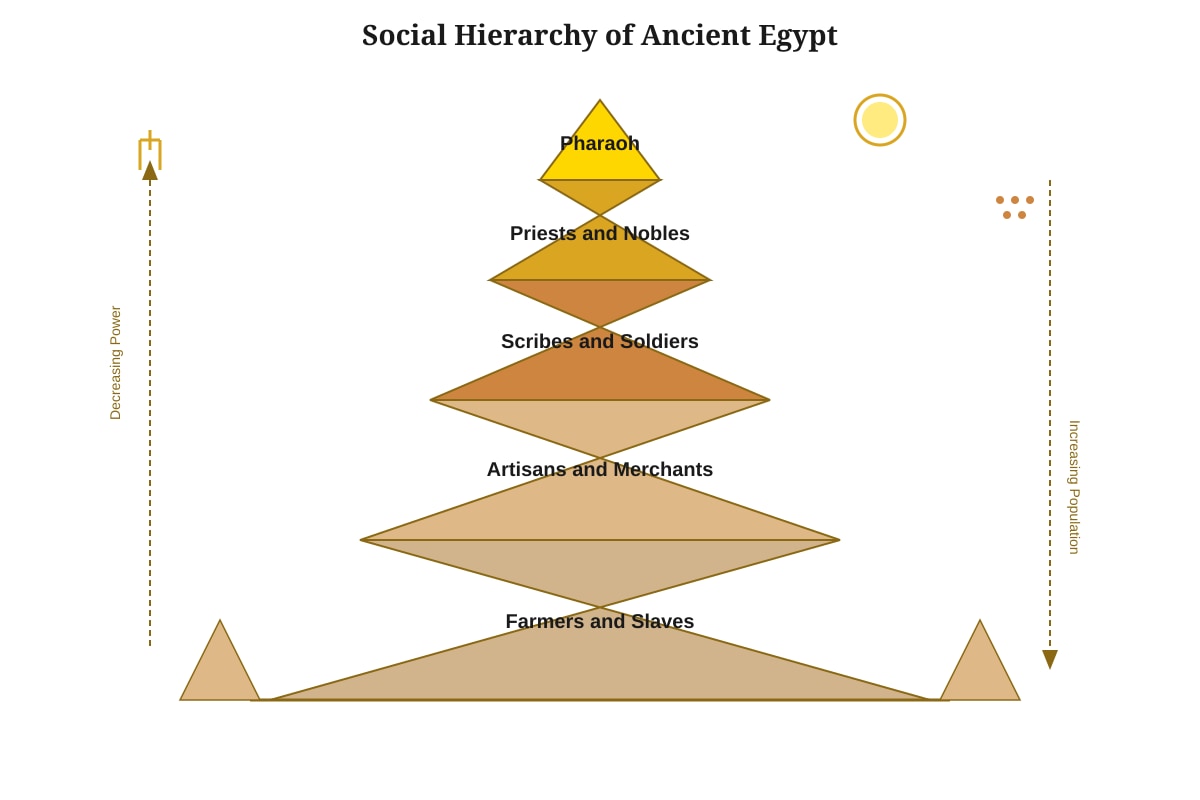
16. Based on the diagram, explain what the social structure of ancient Egypt reveals about the importance of the Pharaoh in their society.
- Sample Answer: The diagram shows the Pharaoh at the very top of the social pyramid, alone and above all other groups. This reveals that the Pharaoh was the most important and powerful person in Egyptian society. The Pharaoh was believed to be a living god and had absolute authority over the government, religion, and military. The pyramid shape also shows that the Pharaoh had the smallest group (just one person) but the most power, while the largest group (farmers and slaves) had the least power.
- Marks: 2 (1 mark for identifying the Pharaoh's position, 1 mark for explaining what it reveals about his importance)
- Explanation: Social pyramids are a common way to show hierarchy. The top is the smallest but most powerful group, and the bottom is the largest but least powerful. The Pharaoh's position at the very top shows his supreme status.
- Common Mistake: Students may simply describe the diagram without explaining what it reveals about importance. Always connect the visual to its historical meaning.
17. The development of writing was a major achievement of ancient civilisations. Explain two ways in which the invention of writing helped these civilisations grow.
- Sample Answer:
- Record-keeping and administration: Writing allowed governments to keep records of taxes, trade, and laws. This helped empires manage their economies and administer large territories more effectively. For example, Mesopotamian scribes used cuneiform to record grain storage and trade transactions.
- Preserving knowledge and culture: Writing allowed people to record their history, religious beliefs, and scientific knowledge. This knowledge could be passed down to future generations, allowing civilisations to build on past achievements. For example, Egyptian hieroglyphs recorded medical knowledge and religious texts.
- Marks: 4 (2 marks for each way: 1 mark for identifying the way, 1 mark for explanation with an example)
- Explanation: Writing was a transformative invention. It allowed information to be stored and shared across time and space, which was essential for managing complex societies.
- Common Mistake: Students may say writing was "important" without explaining how it helped civilisations grow. Always explain the cause-and-effect relationship.
18. How did the ancient Chinese civilisation's location along the Yellow River contribute to its early development? Explain your answer.
- Sample Answer: The Yellow River (Huang He) provided water for irrigation, which allowed early Chinese farmers to grow crops like millet and wheat. The river's fertile loess soil (blown in by winds from the desert) was rich in nutrients, which supported agriculture. However, the river also flooded destructively, earning it the nickname "China's Sorrow." This may have led to the development of organised flood control projects, which required cooperation and a strong central government, contributing to the rise of early Chinese states.
- Marks: 3 (1 mark for identifying a geographical feature, 2 marks for explaining its contribution)
- Explanation: The Yellow River valley is considered the cradle of Chinese civilisation. The river provided water and fertile soil, but its floods also presented challenges that spurred technological and political development.
- Common Mistake: Students may focus only on the positive aspects. A balanced answer that acknowledges both benefits and challenges shows deeper understanding.
19. Imagine you are a trader travelling from the Indus Valley to Mesopotamia. Describe two goods you might trade and explain why these goods would be valuable in each civilisation.
- Sample Answer:
- Cotton cloth: The Indus Valley was one of the first places to grow and weave cotton. Cotton cloth would be valuable in Mesopotamia, where wool and linen were more common. It would be a luxury item for the wealthy.
- Lapis lazuli: This blue gemstone was mined in Afghanistan and traded through the Indus Valley. It was highly prized in Mesopotamia for jewellery and decorative art. In return, the trader might bring back wool, silver, or food products from Mesopotamia.
- Marks: 4 (2 marks for each good: 1 mark for naming the good, 1 mark for explaining its value)
- Explanation: Archaeological evidence shows that the Indus Valley and Mesopotamia had active trade networks. Goods like cotton, beads, timber, and gemstones were traded across long distances.
- Common Mistake: Students may name goods that were not historically traded between these regions. Stick to goods with archaeological evidence, such as cotton, carnelian beads, and lapis lazuli.
20. "Ancient civilisations were more similar than they were different." To what extent do you agree with this statement? Use examples from at least two ancient civilisations to support your answer.
- Sample Answer: I agree to a large extent that ancient civilisations were more similar than they were different, but there were also important differences.
- Similarities: Most ancient civilisations developed along major rivers (Indus Valley along the Indus, Egypt along the Nile, Mesopotamia between the Tigris and Euphrates, China along the Yellow River). They all developed writing systems (Indus script, Egyptian hieroglyphs, Mesopotamian cuneiform, Chinese oracle bone script). They all had social hierarchies with a ruler at the top and workers at the bottom. They all built monumental architecture (pyramids in Egypt, ziggurats in Mesopotamia, great baths in the Indus Valley).
- Differences: However, there were also differences. For example, the Indus Valley civilisation had advanced urban planning and drainage systems that were not seen in other civilisations at the same time. Egyptian civilisation was more focused on the afterlife and mummification, while Mesopotamian civilisation had a more pessimistic view of the afterlife. The political systems also differed: Egypt was unified under a pharaoh, while Mesopotamia had competing city-states.
- Conclusion: Overall, I think the similarities are more striking because all these civilisations faced similar challenges (food production, trade, organisation) and developed similar solutions (writing, government, social hierarchy). However, the differences show that each civilisation adapted to its unique environment and culture.
- Marks: 5 (1 mark for a clear judgement/position, 2 marks for similarities with examples from at least two civilisations, 2 marks for differences with examples from at least two civilisations)
- Explanation: This is an "extent" question, which means you need to take a position (agree, disagree, or partially agree) and support it with evidence. A strong answer will discuss both sides before reaching a conclusion.
- Marking Descriptors:
- 5 marks: Clear judgement, well-developed argument with specific examples from multiple civilisations, balanced consideration of both similarities and differences.
- 3-4 marks: Clear judgement, some examples, but may be less developed or one-sided.
- 1-2 marks: Vague judgement, few or no specific examples, may simply list facts without argument.
- 0 marks: No relevant response.
- Common Mistake: Students may only list similarities or only differences without taking a clear position. The question asks "to what extent do you agree," so you must state your level of agreement.
End of Answer Key