From Real Exams Quiz
Secondary 1 History Source Based Skills Quiz
Free Sec 1 History Source Based Skills quiz, HY3 Exam version, with questions, answers, and syllabus-aligned practice for Singapore students.
These static practice materials are generated from the site's syllabus and paper-generation workflow, with source and model context shown so students and parents can evaluate the material before use.
Questions
Secondary 1 History Quiz - Source Based Skills
Name: ___________________________
Class: ___________________________
Date: ___________________________
Score: ___________ / 40
Duration: 60 minutes
Total Marks: 40
Instructions:
- This quiz tests your source-based skills using historical sources about Singapore and Southeast Asia.
- Section A: Source Identification (Questions 1–5)
- Section B: Single Source Inference (Questions 6–10)
- Section C: Multi-Source Comparison & Reliability (Questions 11–20)
- Write your answers in the spaces provided. Use evidence from the sources to support your answers.
Section A: Source Identification (5 questions, 1 mark each)
1. Study the source below.
"Letter from William Farquhar to Lord Hastings, 1820: 'The harbour is most excellent and the trade with the Malay states most promising.'"
What type of source is this?
2. Read the extract.
"A textbook published in 2023 states that Singapore became a British trading post in 1819."
Is this a primary or secondary source?
3. Look at the source.
"Diary entry of a Chinese migrant, 1852: 'We sailed from Xiamen after the floods destroyed our crops.'"
Who is the author of this source?
4. Study the source.
"British Parliament report, 1867: 'The Straits Settlements are now under direct Crown control.'"
What is the purpose of this source?
5. Read the source.
"Photograph of Singapore River, 1900, taken by a commercial studio."
What is the medium of this source?
Section B: Single Source Inference (5 questions, 4 marks each)
6. Study Source A.
Source A: Journal of a British merchant, 1830 — "The free port draws ships from all over. No customs duties mean we buy pepper cheaply and sell in Europe for high profit."
What can you infer about the reason why British merchants favoured Singapore? Explain your answer. [4m]
7. Study Source B.
Source B: Letter from an Indian labourer, 1880 — "I came because the landlord took our land. In Singapore the harbour needs strong arms to load cargo."
What can you infer about the push factor for Indian migration? Explain your answer. [4m]
8. Study Source C.
Source C: Dutch official report, 1615 — "The Portuguese still hold Melaka and block our spice route. We seek a new base to the south."
What can you infer about the Dutch attitude towards Portuguese control? Explain your answer. [4m]
9. Study Source D.
Source D: Oral account of a Malay fisherman, 1946 — "During the Japanese time, we hid our boats so they would not take them. Food was scarce."
What can you infer about life under Japanese Occupation? Explain your answer. [4m]
10. Study Source E.
Source E: Straits Times article, 1920 — "The opening of the Suez Canal has brought steamers weekly from London, boosting our trade fourfold."
What can you infer about the effect of external developments on Singapore? Explain your answer. [4m]
Section C: Multi-Source Comparison & Reliability (10 questions)
11. Study Sources F and G.
Source F: Raffles' dispatch, 1819 — "I found the island uninhabited save a few fishermen and chose it for our settlement."
Source G: Malay annals, recorded 1840 — "Temasek was a flourishing port before the white man came; our chiefs ruled the river."
How are the sources different about the state of Singapore before 1819? Explain your answer. [5m]
12. Study Sources H and I.
Source H: British colonial office letter, 1865 — "Education in Singapore is sufficient for clerical needs."
Source I: Chinese clan association record, 1885 — "We built schools so our children keep language and trade skills."
How are the sources similar in showing community involvement? Explain your answer. [5m]
13. Study Sources J and K.
Source J: Japanese military bulletin, 1942 — "Our victorious troops liberated Asia from Western rule."
Source K: British survivor memoir, 1950 — "The surrender was a humiliation; we were marched at bayonet point."
How similar are these sources about the fall of Singapore? Explain your answer. [5m]
14. Study Source L and the textbook.
Source L: Archaeological report, 2022 — "Items from China and India found at Fort Canning show trade from 1300s."
Textbook, 2023: "Temasek was a trading port connected to regional networks before Raffles."
How reliable is Source L for showing early Singapore trade? Explain using the textbook. [6m]
15. Study Sources M and N.
Source M: Company record, 1825 — "Free trade brings 200 ships a year; no tax collected."
Source N: Merchant complaint, 1830 — "Without tax the government cannot build roads; port is muddy."
How are the sources different about the impact of free port policy? Explain your answer. [5m]
16. Study Sources O and P.
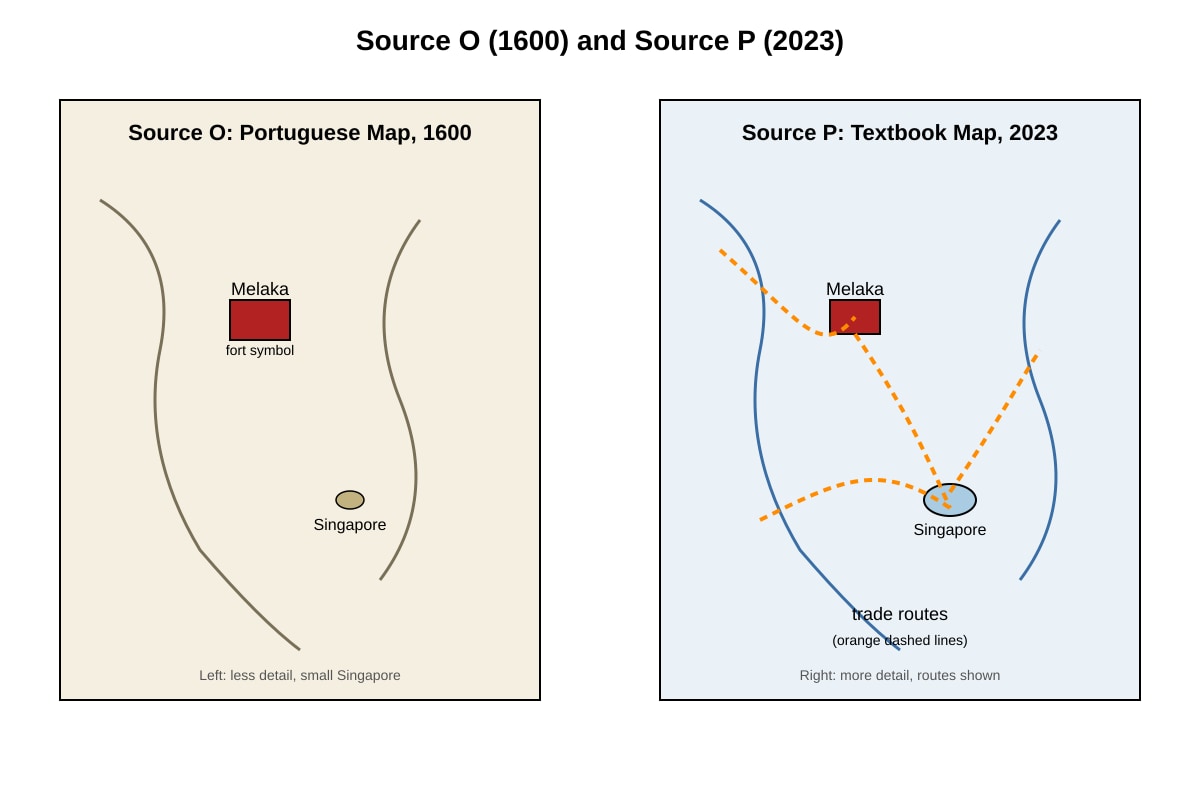
Source O: Map drawn by Portuguese, 1600 — shows Melaka as fortified, Singapore as small island.
Source P: Modern textbook map, 2023 — shows trade routes through Singapore and Melaka.

Generated map for Q16.
How are the maps similar in showing Southeast Asian trade? Explain your answer. [5m]
17. Study Sources Q and R.
Source Q: Diary of a Peranakan woman, 1900 — "We celebrate both Chinese New Year and Hari Raya; my mother wears sarong kebaya."
Source R: Government census, 1911 — "Mixed communities listed as 'Other' show blend of customs."
How similar are the sources about cultural blending? Explain your answer. [5m]
18. Study Source S and a historian's view.
Source S: Speech by Lee Kuan Yew, 1961 — "Self-government is the step to full independence; we must stand on our own."
Historian, 2024: "Local leaders used the legislative council to push for merger and independence."
How reliable is Source S for understanding the independence struggle? Explain. [6m]
19. Study Sources T and U.
Source T: Dutch trading log, 1640 — "We avoid the shallow strait near Singapore to escape pirates."
Source U: British naval report, 1820 — "The strait is safe now; our patrols keep pirates away."
How are the sources different about safety of the waters? Explain your answer. [5m]
20. Study Sources V and W.
Source V: Postcard, 1930 — "Beautiful Singapore, clean streets and happy people."
Source W: Worker's letter, 1932 — "Wages are low and we live ten to a room above the shop."
How similar are these sources about living conditions? Explain your answer. [5m]
Answers
Secondary 1 History Quiz - Source Based Skills (Answer Key)
Total Marks: 40
Topic: Source Based Skills
Section A: Source Identification (Q1–5, 1m each)
Q1. [1m] Primary source (it is a letter written at the time by a participant).
Teaching note: A primary source is produced during the period studied. Farquhar wrote in 1820, close to the event.
Q2. [1m] Secondary source.
Teaching note: A secondary source is created later by someone not present; a 2023 textbook analyses past events.
Q3. [1m] A Chinese migrant (or the diary writer).
Teaching note: The author is the person who wrote the diary entry in 1852.
Q4. [1m] To inform / report to the government (administrative purpose).
Teaching note: Parliament reports are official documents meant to record and explain policy.
Q5. [1m] Photograph (visual/image medium).
Teaching note: Medium means the form — here a photo, not text.
Section B: Single Source Inference (Q6–10, 4m each)
Q6. [4m]
- Inference: British merchants favoured Singapore because the free port gave them high profits (no customs duties). [1m]
- Evidence: Source says "No customs duties mean we buy pepper cheaply and sell in Europe for high profit." [1m]
- Explanation: This suggests merchants could maximise earnings without tax, making Singapore attractive. [2m]
Common mistake: Restating "ships come" without linking to profit motive.
Q7. [4m]
- Inference: The push factor was loss of land (economic hardship at home). [1m]
- Evidence: "landlord took our land" and "floods destroyed crops". [1m]
- Explanation: He was forced to leave India due to poverty, and came for harbour work. [2m]
Q8. [4m]
- Inference: The Dutch viewed Portuguese control as an obstacle to be bypassed. [1m]
- Evidence: "block our spice route" and "seek a new base to the south". [1m]
- Explanation: They wanted their own base (like Singapore later) to avoid Portuguese power. [2m]
Q9. [4m]
- Inference: Life was fearful and scarce in Japanese Occupation. [1m]
- Evidence: "hid our boats", "food was scarce". [1m]
- Explanation: Civilians protected property and faced shortages under military rule. [2m]
Q10. [4m]
- Inference: External developments (Suez Canal) greatly increased Singapore trade. [1m]
- Evidence: "steamers weekly from London, trade fourfold". [1m]
- Explanation: Global links shortened travel, boosting port growth. [2m]
Section C: Multi-Source Comparison & Reliability (Q11–20)
Q11. [5m]
- Difference: Raffles says uninhabited; Malay annals say flourishing port. [2m]
- Evidence F: "uninhabited save a few fishermen"; G: "flourishing port… chiefs ruled". [1m]
- Explanation: Different perspectives — colonial vs local memory; Raffles downplays local society. [2m]
Q12. [5m]
- Similarity: Both show groups providing education. [2m]
- Evidence H: colonial "sufficient for clerical"; I: clan "built schools". [1m]
- Explanation: Both recognise need for schooling, though different providers. [2m]
Q13. [5m]
- Not similar: Japanese call it liberation; British call it humiliation. [2m]
- Evidence J: "liberated Asia"; K: "humiliation… bayonet". [1m]
- Explanation: Opposite views due to side in war. [2m]
Marking: If say "similar in describing event" only 1m; need contrast.
Q14. [6m]
- Reliable: Archaeology supports textbook claim. [2m]
- Evidence L: items from China/India 1300s; Textbook: Temasek trading port. [2m]
- Explanation: Two independent sources agree → high reliability. [2m]
Q15. [5m]
- Difference: M sees benefit (ships, no tax); N sees problem (no funds for roads). [2m]
- Evidence M: "200 ships, no tax"; N: "cannot build roads, muddy". [1m]
- Explanation: Free trade helped commerce but hurt infrastructure. [2m]
Q16. [5m]
- Similarity: Both show Melaka and Singapore as trade points. [2m]
- From image: left map shows both places; right map shows routes through both. [1m]
- Explanation: Both acknowledge regional trade geography across time. [2m]
Q17. [5m]
- Similarity: Both show mixed customs. [2m]
- Evidence Q: celebrate both festivals; R: "blend of customs". [1m]
- Explanation: Communities culturally blended in SG. [2m]
Q18. [6m]
- Reliable: Speech shows leader's aim for independence. [2m]
- Evidence S: "self-government step to independence"; Historian: used council for merger. [2m]
- Explanation: Primary voice matches later analysis → reliable for intent. [2m]
Q19. [5m]
- Difference: T says unsafe (pirates); U says safe (patrols). [2m]
- Evidence T: "avoid… pirates"; U: "safe… patrols". [1m]
- Explanation: British control changed security by 1820. [2m]
Q20. [5m]
- Not similar: V shows happy/clean; W shows poor/crowded. [2m]
- Evidence V: "clean streets happy"; W: "low wages ten to room". [1m]
- Explanation: Postcard is promotional, letter is worker reality. [2m]
Free quiz and exam paper access
Enter your details to view this paper
Your access is remembered on this device.