From Real Exams Quiz
Secondary 1 History Singapore Southeast Asia Quiz
Free Sec 1 History Singapore SEA quiz, Exam version, with questions, answers, and syllabus-aligned practice for Singapore students.
These static practice materials are generated from the site's syllabus and paper-generation workflow, with source and model context shown so students and parents can evaluate the material before use.
Questions
Free quiz and exam paper access
Enter your details to view this paper
Your access is remembered on this device.
Answers
Secondary 1 History Quiz - Singapore Southeast Asia: Answer Key
Total Marks: 50
Section A: Source-Based Questions (20 marks)
Question 1 (4 marks)
Study Source A. What does the source tell you about Singapore's development as a trading port in 1823? Explain your answer using details from the source.
Answer: Source A tells us that Singapore was developing rapidly as a trading port by 1823. The source mentions that "ships from China, India, and the Malay Archipelago crowd our harbour," which shows that Singapore was attracting ships from many different regions, indicating it was becoming an important trading hub. The source also mentions the "free port policy" which "attracted traders from all nations," showing that the British policy of not charging taxes on trade was a key reason for Singapore's growth. The merchant's statement that the settlement "grows daily in importance" suggests that Singapore's development was happening quickly and continuously.
Marking Scheme:
- 1 mark for identifying that Singapore was growing/developing rapidly
- 1 mark for citing evidence about ships from different regions
- 1 mark for explaining the importance of the free port policy
- 1 mark for explaining the significance of the merchant's observation about daily growth
Common Mistake: Students may simply restate the source without explaining what it tells us about development. The key is to move from "the source says X" to "this tells us that Y about Singapore's development."
Question 2 (4 marks)
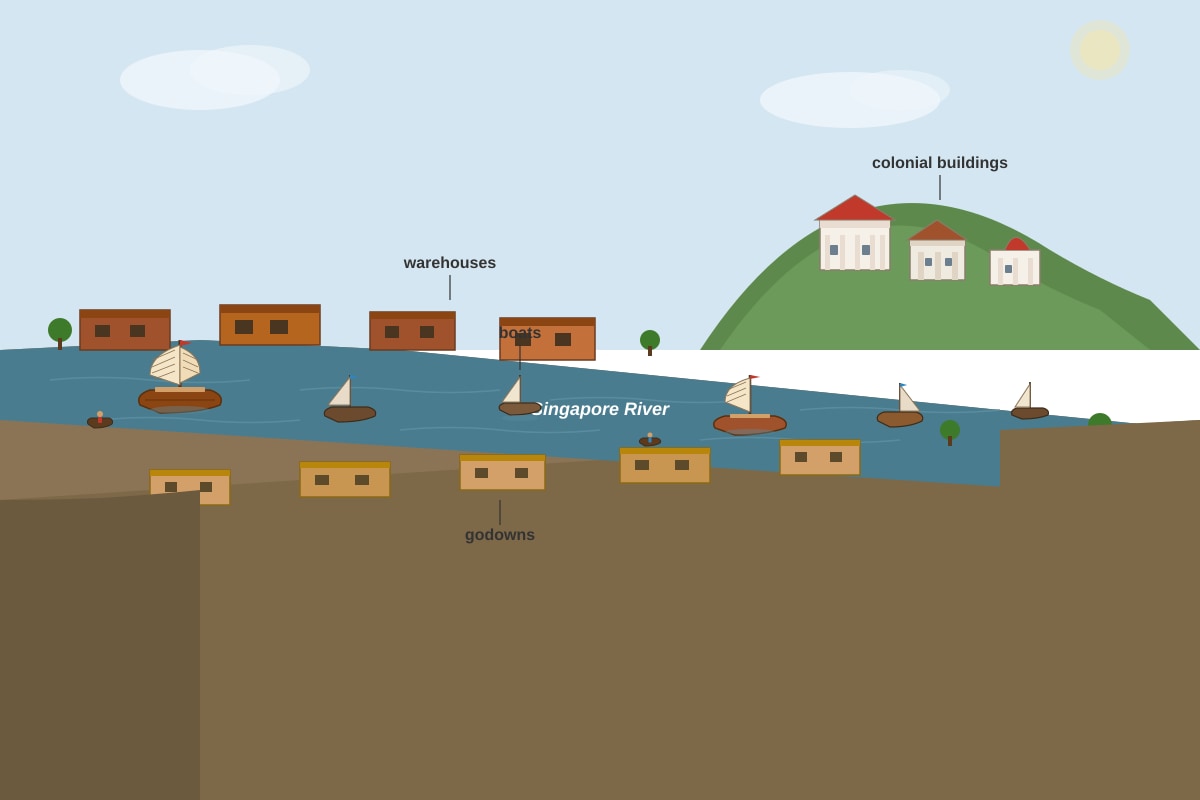
Study Source B. What can you infer about the economic activities in Singapore around 1830? Explain your answer.
Answer: From Source B, we can infer that Singapore's economy was heavily based on trade and port-related activities. The presence of boats and junks on the Singapore River suggests that goods were being transported by water, and the warehouses/godowns along the riverbanks indicate that goods were being stored before being traded or shipped elsewhere. The colonial buildings on the hill suggest that the British were establishing administrative control, which would have supported trade by providing law and order. The busy scene with multiple vessels suggests that trade was active and that the port was handling significant volumes of goods.
Marking Scheme:
- 1 mark for inferring that trade was the main economic activity
- 1 mark for citing evidence about boats/ships on the river
- 1 mark for citing evidence about warehouses/godowns
- 1 mark for explaining what the colonial buildings suggest about British administration supporting trade
Common Mistake: Students may describe what they see in the painting without making inferences. The question asks "what can you infer" – students must go beyond description to explain what the evidence suggests.
Question 3 (5 marks)
Study Sources A and B. How are the sources similar in what they show about Singapore's early development? Explain your answer.
Answer: Sources A and B are similar in that both show Singapore as a busy and growing trading port in the early 1800s. Source A describes ships from China, India, and the Malay Archipelago crowding the harbour, while Source B shows multiple boats and junks on the Singapore River, indicating busy maritime activity. Both sources also suggest that trade was the main driver of Singapore's development – Source A mentions the free port policy attracting traders, while Source B shows warehouses/godowns along the riverbanks where goods would have been stored for trade. Additionally, both sources suggest that Singapore was attracting people and business from many different places, with Source A mentioning traders from "all nations" and Source B showing a variety of vessels that would have come from different regions.
Marking Scheme:
- 1 mark for identifying a similarity (e.g., both show busy trade activity)
- 1 mark for citing evidence from Source A to support the similarity
- 1 mark for citing evidence from Source B to support the similarity
- 1 mark for explaining what the similarity reveals about Singapore's development
- 1 mark for a second similarity with supporting evidence from both sources
Common Mistake: Students may list similarities without explaining why they matter. The question asks "how are the sources similar" – students should identify specific similarities and support each with evidence from both sources.
Question 4 (3 marks)
Study Source A only. What is the view of the British merchant about Singapore's potential as a trading port? Explain your answer.
Answer: The British merchant has a very positive view of Singapore's potential as a trading port. He describes the settlement as growing "daily in importance" and says he has "never seen such a bustling place." He attributes this success to the free port policy, which attracted traders from all nations. The merchant's view is enthusiastic and optimistic, suggesting that he believes Singapore has great potential to become a major trading centre. However, we must remember that as a British merchant, he may have been biased in favour of British colonial expansion and trade, so his view might be overly positive.
Marking Scheme:
- 1 mark for identifying the view as positive/optimistic
- 1 mark for citing evidence from the source (e.g., "daily in importance," "bustling place")
- 1 mark for acknowledging the merchant's potential bias as a British merchant
Common Mistake: Students may state the merchant's view without explaining why he held that view or acknowledging that it is a perspective, not an objective fact.
Question 5 (4 marks)
Which source, A or B, is more useful for understanding the growth of Singapore as a port city in the early 1800s? Explain your answer using details from both sources.
Answer: Both sources are useful, but Source A may be more useful for understanding why Singapore grew, while Source B is more useful for understanding what the growth looked like. Source A provides direct information about the free port policy and the range of traders attracted to Singapore, which helps explain the reasons for growth. Source B provides visual evidence of the physical development – the boats, warehouses, and buildings that show the actual scale of trade activity. However, Source A is a personal letter from a British merchant, so it may be biased and only shows one perspective. Source B is a painting, which may have been created to show Singapore in a positive light. Ideally, both sources should be used together to get a more complete understanding.
Marking Scheme:
- 1 mark for identifying which source is more useful (either is acceptable with good reasoning)
- 1 mark for explaining what the chosen source reveals
- 1 mark for acknowledging the limitations of the chosen source
- 1 mark for explaining how the other source could complement the understanding
Common Mistake: Students may simply state which source is "better" without explaining why it is more useful for understanding growth. The key is to evaluate usefulness based on what each source can tell us.
Section B: Structured Response Questions (18 marks)
Question 6 (4 marks)
Explain two reasons why Singapore's location was important for its growth as a trading port in the 19th century.
Answer: Reason 1: Singapore was located at the southern tip of the Malay Peninsula, along the main shipping route between India and China. This strategic location meant that ships travelling between these two major trading regions would naturally pass by Singapore, making it an ideal stopping point for trade. Ships could take on fresh water and supplies, and exchange goods.
Reason 2: Singapore had a deep-water harbour and was sheltered by nearby islands, making it a safe natural harbour for ships. The Singapore River provided a calm waterway where boats could dock and unload goods directly at the warehouses along the riverbanks. This natural advantage meant that Singapore could accommodate many ships safely, unlike other ports that might have shallow waters or be exposed to storms.
Marking Scheme:
- 1 mark for each reason explained with clear link to growth (2 marks)
- 1 mark for each supporting detail or example (2 marks)
Common Mistake: Students may state a reason (e.g., "it was strategic") without explaining how that helped Singapore grow.
Question 7 (4 marks)
Describe two ways in which the British developed Singapore's port facilities from the mid-1800s onwards.
Answer: Way 1: The British built deep-water wharves and docks to accommodate larger steamships. This was important because steamships were bigger and required deeper berths, and these new facilities allowed Singapore to handle more cargo and serve the growing shipping lines.
Way 2: The British improved warehousing and storage facilities along the Singapore River and at new port areas. They built more godowns (warehouses) to store goods like tin, rubber, spices, and textiles, ensuring that goods could be kept safe and dry while awaiting transshipment. This made Singapore an efficient centre for the storage and redistribution of goods.
Marking Scheme:
- 1 mark for each way described (2 marks)
- 1 mark for each explanation of how it contributed to development (2 marks)
Common Mistake: Students may list a facility (e.g., "wharves") without describing how it was built or why it helped.
Question 8 (5 marks)
Explain how the opening of the Suez Canal in 1869 affected Singapore's growth as a port city.
Answer: The opening of the Suez Canal in 1869 greatly reduced the sea distance between Europe and Asia. Ships could now sail directly through the canal instead of going around the Cape of Good Hope, cutting the travel time from Europe to Singapore significantly. This made trade between Europe and Southeast Asia much faster and cheaper. As a result, more European ships began calling at Singapore, bringing manufactured goods and collecting raw materials like tin and rubber. The increased shipping traffic boosted Singapore's role as a major port for refuelling (especially coal for steamships) and for transshipment of goods. More goods were handled, more jobs were created, and the port expanded further. However, it also meant that Singapore faced more competition from other ports that could now be reached more easily.
Marking Scheme:
- 1 mark for identifying the canal's location and function
- 1 mark for explaining the reduction in travel distance/time
- 1 mark for explaining how this increased shipping traffic to Singapore
- 1 mark for explaining how this boosted port activities (refuelling, transshipment)
- 1 mark for acknowledging competition or other consequences
Common Mistake: Students may simply state "it made travel shorter" without explaining how that specifically helped Singapore's port.
Question 9 (5 marks)
Explain one reason why the British introduced a free port policy in Singapore. How did this policy help Singapore's development?
Answer: Reason: The British introduced the free port policy to attract traders from many different countries to Singapore. By not charging taxes (tariffs) on goods brought into the port, Singapore became a very attractive place for merchants to trade, as they could buy and sell goods without paying extra costs. This was especially important because Singapore did not have a large local population or a big manufacturing base – it needed to attract trade from elsewhere.
How it helped: The free port policy helped Singapore's development by turning it into a major trading hub. Traders from China, India, the Malay Archipelago, Europe, and elsewhere were drawn to Singapore because they could trade freely and cheaply. This brought a huge volume of goods through the port, creating jobs (for dockworkers, warehouse keepers, clerks, etc.) and generating wealth. It also attracted immigrants from China, India, and the region, who contributed to Singapore's growth as a multicultural society. The policy gave Singapore a key competitive advantage over other ports in the region that charged taxes.
Marking Scheme:
- 1 mark for stating the reason (to attract traders)
- 1 mark for explaining why this was necessary
- 1 mark for explaining the effect of no taxes
- 1 mark for explaining how it brought traders and goods
- 1 mark for explaining the wider impact on jobs, immigration, or growth
Common Mistake: Students may describe the policy without explaining the reason behind it or the mechanism by which it helped development.
Question 10 (1 mark)
What was the name of the early settlement on the island of Singapore before 1819?
Answer: Temasek
Marking Scheme:
- 1 mark for "Temasek" (also accept "Singapura" but "Temasek" is more specific for the early name)
Common Mistake: Students may write "Singapura" which is also correct but "Temasek" is the earlier name.
Section C: Short Answer Questions (12 marks)
Question 11 (1 mark)
Name the British official who founded a trading post in Singapore in 1819.
Answer: Sir Stamford Raffles
Marking Scheme:
- 1 mark for "Sir Stamford Raffles" (accept "Stamford Raffles" or "Raffles")
Common Mistake: Students may write "James Brooke" (who founded Sarawak) or "William Farquhar" (who was the first resident). Farquhar was the first resident but Raffles founded the trading post.
Question 12 (2 marks)
What is a "free port"?
Answer: A free port is a port where no taxes or duties are charged on goods that are brought in and out for trade. Ships can unload, store, and reload goods without paying customs fees, which encourages trade.
Marking Scheme:
- 1 mark for defining free port as a port without taxes on trade
- 1 mark for explaining the purpose (to encourage trade)
Common Mistake: Students may confuse "free port" with "free trade" in a general sense. The key is the specific absence of port duties/tariffs.
Question 13 (2 marks)
State two goods that were traded through Singapore in the 19th century.
Answer: Any two from: tin, rubber, spices (pepper, nutmeg, cloves), opium, textiles (cotton, silk), tea, coffee, sugar, rice, copra, coconut oil, gambier, pepper, or other tropical produce. Common answers: tin and rubber, or spices and textiles.
Marking Scheme:
- 1 mark for each correct good (2 marks)
Common Mistake: Students may list goods that were not majorly traded through Singapore in the 19th century (e.g., electronics or petroleum – those are 20th/21st century).
Question 14 (2 marks)
Name the two local rulers who signed the 1819 treaty with the British allowing them to set up a trading post in Singapore.
Answer: Sultan Hussein (or Sultan Hussain) of Johor and the Temenggong (or Temenggong Abdul Rahman).
Marking Scheme:
- 1 mark for Sultan Hussein/Hussain
- 1 mark for Temenggong
Common Mistake: Students may only name one ruler or confuse them with other Malay rulers. The treaty involved a Sultan and the Temenggong.
Question 15 (2 marks)
What was the main reason why many immigrants from China and India came to Singapore in the 19th century?
Answer: They came to seek economic opportunities, such as jobs and a better livelihood. Push factors included poverty, famine, and lack of land in their home countries. Pull factors included the promise of work in Singapore's growing port and trading economy.
Marking Scheme:
- 1 mark for identifying economic opportunities as the main reason
- 1 mark for providing either a push factor or a pull factor
Common Mistake: Students may give only a push factor or only a pull factor. The question asks for the main reason (economic opportunities) and students should explain what that means.
Question 16 (2 marks)
State one way in which the British improved law and order in Singapore in the 19th century.
Answer: Any one from:
- Established a police force (including Indian sepoy troops)
- Introduced laws and a legal system (English common law)
- Set up courts to handle disputes and crimes
- Appointed magistrates to enforce the law
- Built a prison to hold criminals
Marking Scheme:
- 1 mark for stating a specific measure (e.g., "established a police force")
- 1 mark for a brief explanation of how it improved law and order
Common Mistake: Students may give a general answer like "they made laws" without specifying how this improved law and order or without naming a concrete measure.
Question 17 (2 marks)
What was the Singapore Stone, and why is it important for understanding Singapore's early history?
Answer: The Singapore Stone was a large sandstone slab with an ancient inscription found at the mouth of the Singapore River. It is important because it provides evidence of a pre-colonial settlement on the island, possibly from the Majapahit or Siamese periods, showing that Singapore had a history before the British arrival.
Marking Scheme:
- 1 mark for identifying the stone as an ancient inscribed slab
- 1 mark for explaining its importance as evidence of pre-colonial history
Common Mistake: Students may confuse the Singapore Stone with the Merlion or other monuments. The key is that it is an ancient inscription.
Question 18 (2 marks)
Name the European power that controlled Melaka before the British, and explain why this affected Singapore's development.
Answer: The Dutch controlled Melaka before the British. This affected Singapore's development because the Dutch controlled the main trading port in the region (Melaka) and restricted British trade there. This pushed the British to seek an alternative port, leading them to establish Singapore as a new trading post in 1819.
Marking Scheme:
- 1 mark for naming the Dutch
- 1 mark for explaining the effect (pushed British to Singapore)
Common Mistake: Students may name the Portuguese (who controlled Melaka before the Dutch) or the British as the first European power in Melaka. The Dutch ruled Melaka from 1641 to 1824.
Question 19 (2 marks)
State one pull factor and one push factor that caused Chinese immigrants to come to Singapore in the 1800s.
Answer:
- Pull factor: Economic opportunities in Singapore, such as jobs in the port, plantations, or trading sector; higher wages; potential for social mobility.
- Push factor: Poverty, famine, overcrowding, political instability, or lack of land in China (especially in southern provinces like Fujian and Guangdong).
Marking Scheme:
- 1 mark for a correct pull factor
- 1 mark for a correct push factor
Common Mistake: Students may confuse push and pull factors. Pull factors attract immigrants to Singapore; push factors drive them away from their home country.
Question 20 (2 marks)
Explain one way in which the British policy of free trade helped different ethnic communities in Singapore contribute to its development.
Answer: The British policy of free trade allowed various ethnic communities to set up businesses and engage in trade without heavy restrictions. For example, Chinese merchants could import goods from China and Southeast Asia, Indian traders could bring textiles and spices, and European merchants could export rubber and tin to Europe. This created an interdependent economy where each community contributed their skills and networks, making Singapore a vibrant and prosperous trading hub. The policy also encouraged trust and cooperation as different groups had to work together in business.
Marking Scheme:
- 1 mark for explaining how free trade permitted business activities
- 1 mark for giving a specific example of how an ethnic group contributed
Common Mistake: Students may describe the policy but not explain how it helped communities contribute. The key is to show the link between policy and community contribution.
Total Marks: 50