From Real Exams Quiz
Secondary 1 History Conflict International Relations Quiz
Free Sec 1 History Conflict IR quiz, Kimi2.6 Exam version, with questions, answers, and syllabus-aligned practice for Singapore students.
These static practice materials are generated from the site's syllabus and paper-generation workflow, with source and model context shown so students and parents can evaluate the material before use.
Questions
Free quiz and exam paper access
Enter your details to view this paper
Your access is remembered on this device.
Answers
Answer Key: Secondary 1 History Quiz - Conflict International Relations
Total Marks: 40 marks
Section A: Source-Based Questions [20 marks]
Question 1 [2 marks]
Answer: Source A suggests the British were overconfident / believed their naval base made Singapore secure / thought they could protect their colonies [1]. The surrender in "mere two weeks" shows this confidence was misplaced / the British underestimated Japanese military capability [1].
Teaching note: The phrase "we claimed to protect" indicates the British made public assurances. The shock expressed in "forever change" confirms their earlier confidence was high. Common mistake: students often describe what happened without identifying the prior attitude.
Question 2 [2 marks]
Answer: Any two from:
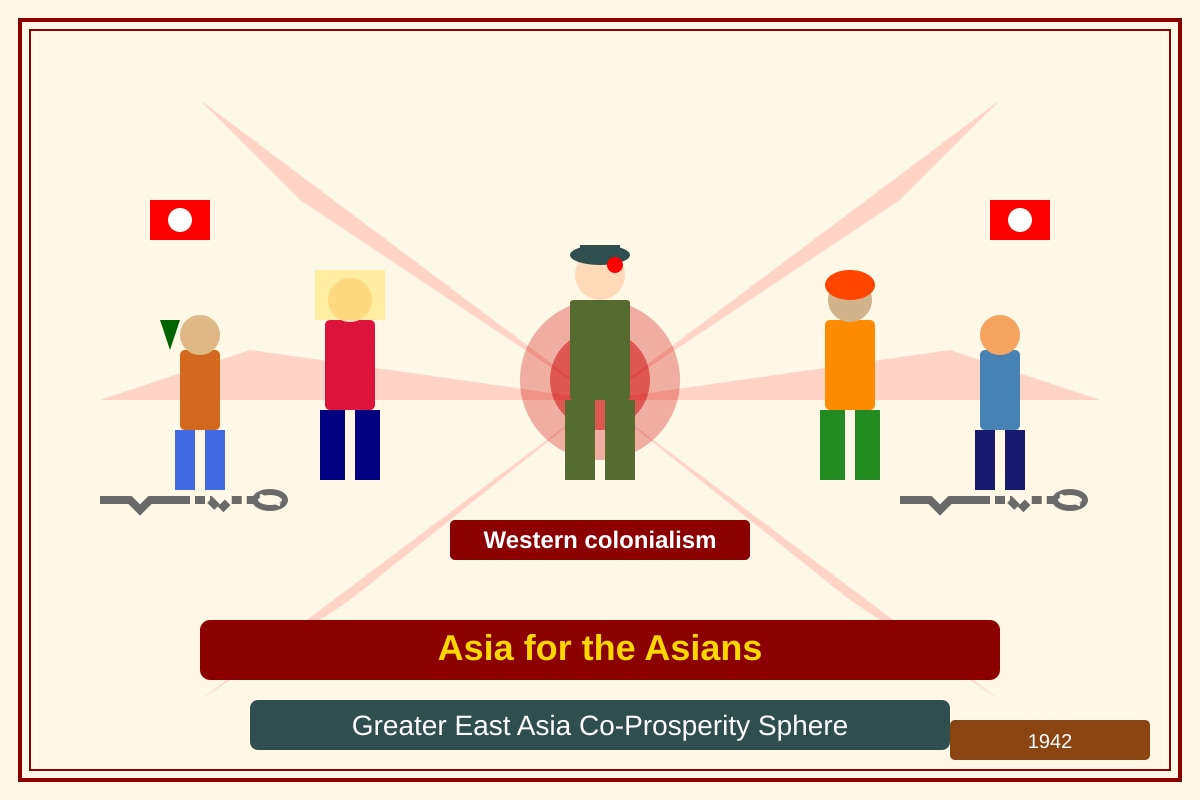
- Promotes idea of Asian unity / racial solidarity / "Asia for the Asians" [1]
- Offers liberation / freedom from Western colonialism / breaking chains imagery [1]
- Promises economic prosperity / "Co-Prosperity Sphere" [1]
- Uses inclusive imagery of different Asian ethnicities together [1]
Teaching note: Propaganda posters use visual and textual techniques. Students should identify both explicit techniques and their intended emotional appeal. The broken chains symbolise freedom; diverse figures suggest universal benefit.
Question 3 [5 marks]
Marking descriptors:
| Level | Marks | Description |
|---|---|---|
| 3 | 4–5 | Identifies valid similarity PLUS explains significance; uses evidence from both sources; may note limitation or nuance |
| 2 | 2–3 | Identifies similarity with some evidence from both sources; explanation is partial or one-sided |
| 1 | 1 | Lists point(s) with little or no explanation |
| 0 | 0 | No valid similarity identified |
Expected answer structure:
Similarity: Both sources show European colonial power as weak / oppressive / destined to end [1].
Evidence from Source A: British official admits European power was "fragile," surrender was humiliating, authority was undermined [1].
Evidence from Source B: Chains labelled "Western colonialism" being broken; colonialism presented as something to be destroyed [1].
Explanation of significance: Both recognise that European colonial rule had lost legitimacy / its military credibility was shattered [1 for development]. This similarity is significant because it shows both sides (British self-criticism and Japanese propaganda) reached same conclusion about colonial vulnerability, though for different purposes [1 for cross-reference/nuance].
Teaching note: Sources can be similar in conclusion while differing in purpose. Source A is regretful analysis; Source B is celebratory propaganda. Students who note this distinction access top band.
Question 4 [6 marks]
Marking descriptors:
| Level | Marks | Description |
|---|---|---|
| 3 | 5–6 | Evaluates both sources; weighs usefulness with criteria (purpose, reliability, coverage); reaches reasoned judgement |
| 2 | 3–4 | Addresses usefulness of both; some criteria; partial evaluation; judgement may be asserted |
| 1 | 1–2 | Describes sources or asserts usefulness with little support |
| 0 | 0 | No valid evaluation |
Expected answer structure:
Source B is useful because:
- It shows Japanese propaganda strategy / how occupiers tried to shape local opinion [1]
- Visual propaganda reaches wide audience including illiterate populations [1]
- Reveals official Japanese ideology of "liberation" [1]
However, limitations:
- Propaganda purpose = biased, exaggerates Japanese benevolence [1]
- No evidence it actually changed local attitudes / may have been met with scepticism [1]
Source A is useful because:
- Written at time of event / immediate reaction [1]
- British official has no reason to exaggerate British failure [1]
- Acknowledges impact on "local populations" specifically [1]
However, limitations:
- Single perspective / British colonial viewpoint [1]
- Written for official purposes, may downplay British errors [1]
Judgement: Reasoned conclusion on which is more useful for specific aspect of local attitudes [1–2]. For understanding Japanese attempts to influence attitudes, B is more useful; for understanding actual impact on perceptions of British weakness, A may be more direct evidence.
Teaching note: "More useful" requires defining what we want to know. The question invites evaluation of utility for specific historical enquiry, not overall "better/worse." Students should name their criteria explicitly.
Question 5 [5 marks]
Marking descriptors:
| Level | Marks | Description |
|---|---|---|
| 3 | 4–5 | Assesses reliability using provenance AND content; cross-references; recognises value despite limitations; reaches balanced conclusion |
| 2 | 2–3 | Some assessment of provenance or content; partial evaluation |
| 1 | 1 | Describes source or asserts reliability with little support |
| 0 | 0 | No valid assessment |
Expected answer structure:
Provenance strengths:
- Eye-witness / personal experience of occupation [1]
- Written long after event (1985) = time for reflection, possible memory fading [1]
Provenance limitations:
- One person's experience = may not represent all groups / classes [1]
- Written 40 years later = memories may be distorted by later events / nostalgia [1]
- Personal stake in narrative (survivor) = may emphasise suffering [1]
Content strengths:
- Specific details (bowing, rice shortage) corroborate known historical facts [1]
- Balanced tone—admits British return was also difficult ("did not become much better") [1]
- This balance suggests honesty / not simply anti-Japanese [1]
Content limitations:
- Vague on dates, specific locations, or numbers [1]
- "Many people suffered" is generalisation [1]
Judgement: Reliable for understanding personal experience and general conditions but less reliable for precise statistics or representative claims [1–2].
Teaching note: Reliability is variable depending on enquiry. The balanced comment about British return is particularly valuable—suggests critical reflection rather than simple bias.
Section B: Structured Response Questions [20 marks]
Question 6 [3 marks]
Answer: Any one cause with explanation:
- Japanese expansionist policy / desire for resources (oil, rubber) [1]
- US trade embargo / oil sanctions on Japan [1]
- Japan's alliance with Germany and Italy (Tripartite Pact) [1]
- Weakness of European colonial powers (France, Netherlands) occupied by Germany [1]
Developed example: Japan needed raw materials for its industries and military [1]. The US embargo threatened Japan's ability to continue expansion [1]. Attacking European colonies in Southeast Asia provided access to oil (Dutch East Indies) and other resources [1].
Teaching note: Causation requires linking factor to outcome. The Pacific War began specifically with Pearl Harbor (December 1941) and simultaneous attacks on Southeast Asia. Students should show mechanism, not just list factor.
Question 7 [4 marks]
Answer: Any two from, with development:
- Food shortages / rationing: Japanese military took rice supplies; locals suffered malnutrition; "Sook Ching" screening disrupted food distribution [2]
- Forced labour: Use of "romusha" labourers on Death Railway; dangerous conditions; separated from families [2]
- Violence / massacres: Sook Ching massacre of Chinese Singaporeans suspected of anti-Japanese activity; created climate of fear [2]
- Cultural changes: Replacement of English with Japanese language; use of "Japanese time" (Tokyo time); bowing to sentries [2]
- Economic disruption: British currency banned; "banana money" issued; hyperinflation; loss of trade links [2]
Teaching note: Daily life means ordinary people's experiences, not just military events. Students should specify how people were affected, not just name policy.
Question 8 [6 marks]
Marking descriptors:
| Level | Marks | Description |
|---|---|---|
| 3 | 5–6 | Analyses both factors; explains mechanism; reasoned judgement with criteria |
| 2 | 3–4 | Describes both; some explanation; judgement may be partial |
| 1 | 1–2 | Lists points; little analysis; assertion without support |
| 0 | 0 | No valid response |
Expected approach:
Japanese occupation as more important:
- Showed Asians could defeat Europeans / ended "white superiority" myth [1]
- Japanese trained local military forces (INA, youth corps) giving organisational experience [1]
- Harsh occupation also created anti-colonial resentment, not just anti-Japanese [1]
- Promised "independence" (even if false) raised expectations impossible to lower [1]
European weakness as more important:
- Without WWII devastation, colonial powers would have resources to suppress nationalism [1]
- Britain, France, Netherlands financially ruined; could not afford empire [1]
- US pressure for decolonisation (Atlantic Charter principles) [1]
- New Labour government in Britain less committed to empire than Conservatives [1]
Judgement: Japanese occupation was the catalyst that created demand and expectation; European weakness was the condition that made success possible [2 for synthesis]. Both necessary, but occupation changed minds while weakness changed circumstances.
Teaching note: This is classic "change in ideas vs. change in circumstances" causation. Strong answers show interaction between factors rather than treating as independent.
Question 9 [2 marks]
Answer: Any one from:
- Largest surrender in British military history [1]—shocked British prestige globally [1]
- Showed Japanese military effectiveness / ended myth of European invincibility [1]
- Strategic—gave Japan access to resources and naval base [1]
- Symbolic—"impregnable fortress" fell quickly [1]
Teaching note: The table explicitly gives "largest surrender" as a clue. Students should explain why this mattered, not just repeat.
Question 10 [2 marks]
Answer: Malayan Union proposed (1946) [1]. This attempted to remove traditional Malay rulers' powers and ease citizenship rules for non-Malays, directly provoking Malay nationalist opposition / formation of UMNO [1].
Teaching note: The Japanese invasion itself caused disruption, but the Malayan Union was the specific post-war British policy that triggered organised political response. Students sometimes confuse "opposition to Japanese" with "opposition to British return."
Question 11 [3 marks]
Answer:
- British preparedness was flawed / misconceptions about jungle terrain [1]
- British expected attack from sea; Japanese advanced through jungle on bicycles [1]
- British forces were inexperienced / many were Indian or Australian troops with limited training for Malayan conditions [1]
- Japanese had air superiority / sank Prince of Wales and Repulse [1]
Developed answer: British defence plans assumed any attack would come by sea against Singapore island [1]. Japanese forces moved swiftly down the Malay peninsula using bicycles on plantation roads through jungle the British considered impassable [1]. This tactical surprise meant British forces were constantly retreating towards Singapore rather than defending positions [1].
Teaching note: The bicycle infantry is a memorable and significant detail. British psychological unpreparedness ("Singapore cannot fall") was as important as material factors.
Question 12 [6 marks]
Marking descriptors:
| Level | Marks | Description |
|---|---|---|
| 3 | 5–6 | Balanced argument with evidence; weighs positive/negative; reasoned judgement |
| 2 | 3–4 | Some balance; mostly one-sided; some evidence |
| 1 | 1–2 | Assertion; limited evidence; description |
| 0 | 0 | Invalid or no response |
Negative effects:
- Human suffering: massacres (Sook Ching), forced labour, starvation [1]
- Economic destruction: mines, plantations neglected; infrastructure damaged [1]
- Social disruption: families separated; education interrupted [1]
Positive effects (or unintended consequences):
- End of colonial illusion: Asians saw Europeans could be defeated [1]
- Political awakening: occupation raised consciousness of shared Asian identity [1]
- Organisational experience: Japanese-created militias, administrative training [1]
- Post-war nationalism stronger: impossible for British to restore pre-war colonial relationship [1]
Judgement: Predominantly negative in immediate human cost [1], but long-term political consequences included accelerated decolonisation [1]. Whether these count as "positive" depends on perspective—nationalist leaders welcomed outcome; ordinary sufferers did not choose this path [2 for nuance].
Teaching note: Historians debate whether any "positive" effects can be attributed to such a brutal occupation. Strong answers acknowledge the moral problem of finding "benefits" in suffering, while recognising historical consequences.
Question 13 [1 mark]
Answer: Nationalism is the belief that a group of people with shared identity (language, culture, history) should govern themselves in their own independent state [1].
Teaching note: The "state" element is crucial—patriotism or cultural pride alone is not nationalism in the political sense relevant to decolonisation.
Question 14 [1 mark]
Answer: Any one: Sukarno (Indonesia) / Tunku Abdul Rahman (Malaya) / Ho Chi Minh (Vietnam) / Aung San (Burma) / Sutan Sjahrir (Indonesia) [1].
Teaching note: Tunku Abdul Rahman is most contextually appropriate given Singapore-Malaya connections, but any valid Southeast Asian nationalist leader accepted.
Question 15 [1 mark]
Answer: United States and Soviet Union (USSR) [1 for both; ½ each if incorrect pairing].
Teaching note: "America and Russia" accepted if clear. The term "superpowers" was specifically applied to these two post-1945.
Question 16 [2 marks]
Answer:
- Proxy war: superpowers fought indirectly through Korean forces [1]
- Ideological conflict: US supported capitalist South, USSR supported communist North [1]
- Armed demonstration of containment policy: US sought to prevent spread of communism [1]
- UN involvement under US leadership showed institutionalisation of rivalry [1]
Developed: Korea was divided after WWII into Soviet-backed North and US-backed South [1]. When North invaded in 1950, US-led UN forces intervened to prevent communist expansion, making this a "hot war" expression of Cold War ideological rivalry [1].
Question 17 [2 marks]
Answer:
- Not joining either US or Soviet bloc / maintaining independence from superpower alliances [1]
- Focus on neutral development path / non-interference in others' affairs [1]
- Example: Indonesia under Sukarno initially; India as model; later formalised in Non-Aligned Movement [1]
Question 18 [3 marks]
Answer:
- Domino theory: if Vietnam fell to communism, other Southeast Asian states would follow [1]
- Containment policy: US commitment to stopping communist expansion globally [1]
- French defeat at Dien Bien Phu (1954) left vacuum US felt compelled to fill [1]
- Support for ally: South Vietnamese government requested assistance [1]
Developed: The US feared communist victory in Vietnam would cause neighbouring countries (Thailand, Malaysia, Philippines) to become communist, like falling dominoes [1]. This was linked to broader Cold War strategy of "containment" [1]. After French colonial forces were defeated, US increased involvement to prevent perceived Soviet-Chinese expansion [1].
Question 19 [4 marks]
Answer: Any two aims with explanation:
- Economic cooperation: Reduced competition; shared development; trade preferential arrangements [2]
- Peaceful settlement of disputes: Renunciation of force; conflict mediation mechanisms; building trust through dialogue [2]
- Non-interference in internal affairs: Respected sovereignty; prevented superpower manipulation of local conflicts [2]
- Collective regional identity: Reduced post-colonial suspicions; "ASEAN way" of consensus [2]
Developed example: The ASEAN Declaration 1967 specifically called for collaboration in economic, social, cultural, technical, scientific and administrative fields [1]. By creating regular forums, potential conflicts (e.g., territorial disputes) could be discussed before escalating to violence [1].
Question 20 [6 marks]
Marking descriptors:
| Level | Marks | Description |
|---|---|---|
| 3 | 5–6 | Evaluates both types; uses Southeast Asian evidence; reasoned judgement with criteria (effectiveness, sustainability, scope) |
| 2 | 3–4 | Describes both; some evaluation; limited evidence |
| 1 | 1–2 | Assertion; generic; little Southeast Asian reference |
| 0 | 0 | Invalid or no response |
International organisations (ASEAN, UN):
- ASEAN successfully mediated Indonesia-Malaysia "Konfrontasi" 1966; transformed relationship [1]
- ASEAN prevented major interstate war in Southeast Asia since 1967 [1]
- Regional ownership: locals design solutions appropriate to context [1]
- Limitations: slow consensus; human rights issues deferred (Myanmar) [1]
Military alliances (SEATO, US bilateral):
- SEATO (1954–1977) aimed to contain communism but failed: Laos, Cambodia, Vietnam fell [1]
- Vietnam War showed military intervention prolonged conflict, caused destruction [1]
- US alliances with Philippines, Thailand brought some stability but also superpower entanglement [1]
- ANZUK, Five Power Defence Arrangements: limited ongoing relevance [1]
Judgement: ASEAN's non-military approach has proven more sustainable for interstate peace, though military alliances claimed short-term deterrence [1–2]. Effectiveness depends on goal: preventing war between ASEAN states (organisations better) versus resisting external threat (alliances claimed but often failed).
Teaching note: SEATO is crucial—designed as "NATO for Asia" but failed because Asian members had divergent interests. ASEAN's success is historically remarkable given region's conflicts 1945–1965.
END OF ANSWER KEY