Secondary 1 History Quiz - Conflict International Relations
Name: ___________________________
Class: ___________________________
Date: ___________________________
Score: ___________ / 40
Duration: 60 minutes
Total Marks: 40
Topic: Conflict & International Relations
Instructions:
- This quiz has 20 questions on Conflict & International Relations.
- Section A: 10 short questions (1 mark each).
- Section B: 6 source-based questions (2–4 marks each).
- Section C: 4 structured response questions (3–5 marks each).
- Write your answers in the spaces provided. Use full sentences where asked.
Section A: Short Recall (Questions 1–10, 1 mark each)
-
What was the name of the rivalry between Britain and the Netherlands for control of trade in Southeast Asia in the 1700s–1800s?
-
In what year did Raffles establish a British trading post in Singapore?
-
Which waterway, opened in 1869, reduced travel time between Europe and Asia and increased Singapore’s trade?
-
Name one European power that controlled Melaka before the British rose in the region.
-
What global conflict began in Europe in 1939 and later affected Asia, including Singapore?
-
Which country attacked and captured Singapore in 1942?
-
What term describes a port where goods can be traded without paying import taxes?
-
Which empire’s fall in the 1400s helped create space for new trading ports like Temasek?
-
Name one push factor that caused migrants to leave their home countries for Singapore in the 1800s.
-
What was the strategic value of Singapore’s location for international trade?
Section B: Source-Based Questions (Questions 11–16)
Study Source A below (a letter from a British merchant in 1819):
"The Dutch have long blocked our ships from the spice islands. Now with Raffles’ new post at Singapore, we can trade freely and the native rulers welcome our protection against Dutch raids."
-
(a) What does Source A tell you about the British view of the Dutch? [2m]
(b) What can you infer about why local rulers accepted British presence? [2m]
Study Source B below (a textbook extract, 2023):
"The Anglo-Dutch rivalry was not only commercial but also military. Both sides built forts and sailed warships to guard their ports. Singapore became a chess piece in their global contest."
-
How is Source B similar to Source A about the Anglo-Dutch rivalry? Explain your answer. [3m]
-
Study Source A again. What is the viewpoint of the British merchant about Raffles’ action in Singapore? [2m]
Study Sources C and D below:
Source C (Dutch officer’s report, 1820): "The British at Singapore steal our trade. Their free port draws away our merchants and weakens our hold on the archipelago."
Source D (British newspaper, 1821): "Singapore flourishes because it is open to all nations, unlike the Dutch who keep trade for themselves."
-
How are Sources C and D similar about the effect of Singapore’s free port? Explain. [3m]
-
Study Source C. What can you infer about Dutch fears after 1819? [2m]
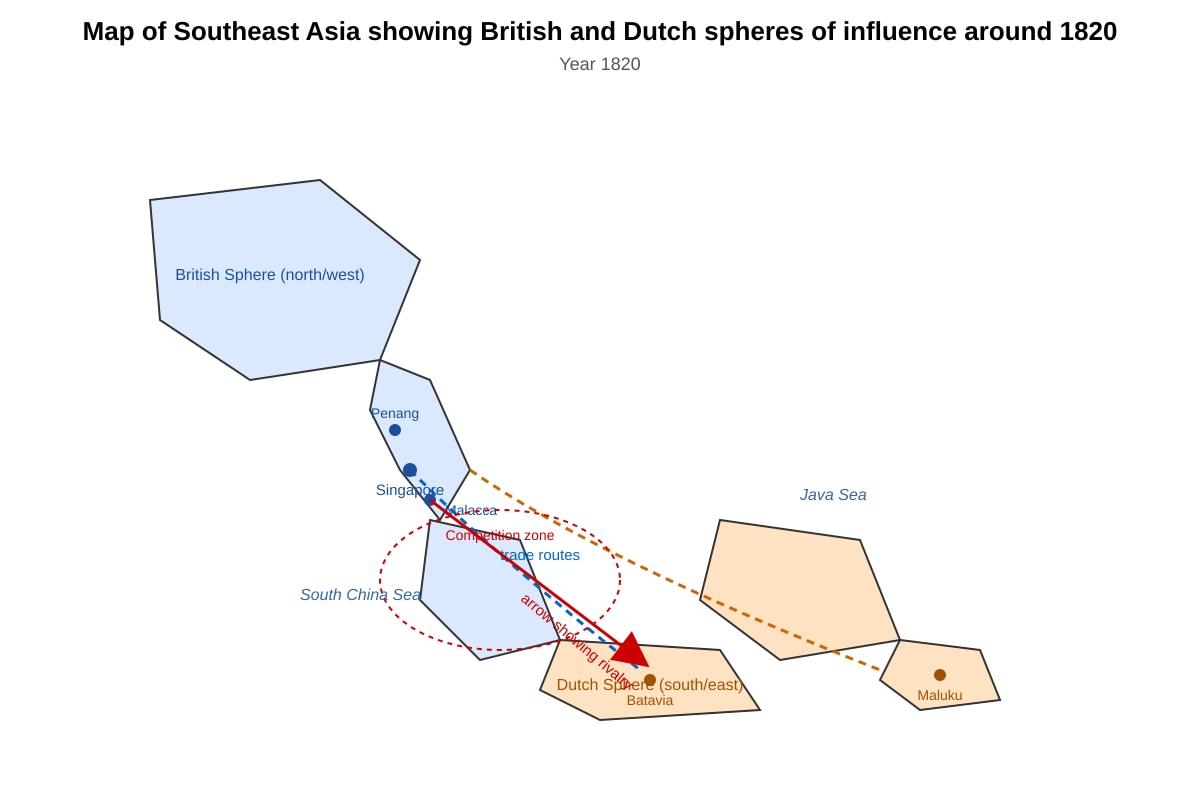
Generated map for 16.
- Study the map (Q16-fig1). What does the map show about international conflict in the region? [3m]
Section C: Structured Response (Questions 17–20)
-
Explain two reasons why the Anglo-Dutch rivalry led to the founding of Singapore in 1819. [4m]
-
Describe two ways in which the opening of the Suez Canal in 1869 affected international trade and Singapore’s port growth. [4m]
-
Explain how the rise of Japan as a military power in Asia contributed to conflict that led to the fall of Singapore in 1942. [5m]
-
"External conflicts in Europe always shaped Singapore’s development." Do you agree? Explain your answer using two examples. [5m]
</stage3_quiz_answers_md>
Secondary 1 History Quiz - Answer Key
Topic: Conflict & International Relations
Total Marks: 40
Section A: Short Recall (1 mark each)
Q1. Anglo-Dutch rivalry
Teaching note: The competition between Britain and the Netherlands for trade and territory in Southeast Asia was a long contest. Accept "Anglo-Dutch competition" or "Anglo-Dutch struggle".
Common mistake: Writing "World War II" (wrong period).
Q2. 1819
Teaching note: Stamford Raffles established the British trading post in Singapore in 1819. This is a key date in our syllabus.
Q3. Suez Canal
Teaching note: Opened in 1869, it linked the Mediterranean to the Red Sea, shortening the Europe–Asia sea route and boosting Singapore’s port.
Q4. Portugal (or Dutch)
Teaching note: Portugal captured Melaka in 1511; later the Dutch took it in 1641. Either is acceptable as a European power controlling Melaka before British rise.
Q5. World War II (or Second World War)
Teaching note: Began 1939 in Europe; Japan’s expansion brought it to Asia and Singapore by 1942.
Q6. Japan
Teaching note: Japanese forces captured Singapore in February 1942.
Q7. Free port
Teaching note: A free port allows goods to be imported/exported without customs duties, attracting trade.
Q8. Srivijaya (or Melaka’s rise ending Temasek’s role)
Teaching note: The fall of Srivijaya (~1400s) opened space for new ports. Accept "Srivijaya empire".
Q9. Poverty / war / famine (any one push factor)
Teaching note: Push factors are conditions that drive people away from home. Examples: poverty, conflict, natural disaster.
Q10. It was on the trade route between India and China (strategic location)
Teaching note: Singapore’s location made it valuable for international trade across the Indian and Pacific oceans.
Section B: Source-Based (Marked)
Q11. (a) [2m]
Answer: Source A shows the British viewed the Dutch as blockers of trade / rivals who raided and restricted British ships.
Marking: 1m for identifying negative view; 1m for evidence "blocked our ships from spice islands".
Teaching: The merchant sees Dutch as obstacle; this is a perspective from a British source.
(b) [2m]
Answer: Local rulers accepted British because they wanted protection against Dutch raids.
Marking: 1m for "protection"; 1m for linking to "against Dutch raids" from source.
Teaching: Inference = reading between lines: they welcomed British as shield.
Q12. [3m]
Answer: Both sources say Anglo-Dutch rivalry was a contest. Source A shows it through trade blocking; Source B says it was commercial and military with forts and warships. Both show it was a conflict over control.
Marking: 1m both mention rivalry; 1m evidence from A; 1m evidence from B.
Teaching: Similarity is in topic (rivalry) not agreement on who is right.
Q13. [2m]
Answer: The merchant views Raffles’ action positively as it allowed free trade and local welcome.
Marking: 1m positive view; 1m evidence "trade freely".
Teaching: Viewpoint = opinion of author, not fact.
Q14. [3m]
Answer: Both C and D say Singapore’s free port changed trade flow. C says it drew merchants from Dutch; D says it flourished by being open. Both show free port weakened Dutch monopoly.
Marking: 1m both mention effect on trade; 1m from C; 1m from D.
Teaching: Similar in describing impact, different in who benefits.
Q15. [2m]
Answer: Dutch feared loss of trade and weakened hold on archipelago after 1819.
Marking: 1m fear of trade loss; 1m weakened control.
Teaching: Inference from "steal our trade" and "weakens our hold".
Q16. [3m]
Answer: Map shows British and Dutch had separate zones with Singapore in British area, and rivalry over region. It visualises international conflict through labelled spheres and arrow.
Marking: 1m British/Dutch split; 1m Singapore in British; 1m arrow/competition label.
Teaching: Map is a source; read labels to answer.
Section C: Structured Response
Q17. [4m]
Answer:
- Reason 1: Dutch blocked British trade; Britain needed a post to bypass them (2m: reason + explain).
- Reason 2: Rivalry pushed Raffles to choose Singapore for its location to counter Dutch (2m).
Teaching: Causation – rivalry caused action.
Q18. [4m]
Answer:
- Way 1: Shorter route brought more ships to Singapore, growing port (2m).
- Way 2: Global trade expanded, increasing goods handled at free port (2m).
Teaching: External development → local growth.
Q19. [5m]
Answer:
- Japan expanded military in Asia, threatening colonies (1m).
- Took Malaya, then Singapore (1m).
- British focused on Europe, weak defence here (1m).
- Japan’s strategy used speed and air power (1m).
- Result: conflict ended British rule 1942 (1m).
Teaching: Link external power rise to local fall.
Q20. [5m]
Answer: Agree/Disagree with 2 examples:
- Example 1: WW2 (Europe) led to Japanese attack (2m).
- Example 2: Anglo-Dutch rivalry (Europe) led to Singapore founding (2m).
- Conclusion (1m).
Teaching: Use evidence; balanced answer gets full marks.
</stage3_quiz_answers_md>
<stage3_quiz_md>
Secondary 1 History Quiz - Conflict International Relations
Name: ___________________________
Class: ___________________________
Date: ___________________________
Score: ___________ / 40
Duration: 60 minutes
Total Marks: 40
Topic: Conflict & International Relations
Instructions:
- This quiz has 20 questions on Conflict & International Relations.
- Section A: 10 short questions (1 mark each).
- Section B: 6 source-based questions (2–4 marks each).
- Section C: 4 structured response questions (3–5 marks each).
- Write your answers in the spaces provided. Use full sentences where asked.
Section A: Short Recall (Questions 1–10, 1 mark each)
-
What was the name of the rivalry between Britain and the Netherlands for control of trade in Southeast Asia in the 1700s–1800s?
-
In what year did Raffles establish a British trading post in Singapore?
-
Which waterway, opened in 1869, reduced travel time between Europe and Asia and increased Singapore’s trade?
-
Name one European power that controlled Melaka before the British rose in the region.
-
What global conflict began in Europe in 1939 and later affected Asia, including Singapore?
-
Which country attacked and captured Singapore in 1942?
-
What term describes a port where goods can be traded without paying import taxes?
-
Which empire’s fall in the 1400s helped create space for new trading ports like Temasek?
-
Name one push factor that caused migrants to leave their home countries for Singapore in the 1800s.
-
What was the strategic value of Singapore’s location for international trade?
Section B: Source-Based Questions (Questions 11–16)
Study Source A below (a letter from a British merchant in 1819):
"The Dutch have long blocked our ships from the spice islands. Now with Raffles’ new post at Singapore, we can trade freely and the native rulers welcome our protection against Dutch raids."
-
(a) What does Source A tell you about the British view of the Dutch? [2m]
(b) What can you infer about why local rulers accepted British presence? [2m]
Study Source B below (a textbook extract, 2023):
"The Anglo-Dutch rivalry was not only commercial but also military. Both sides built forts and sailed warships to guard their ports. Singapore became a chess piece in their global contest."
-
How is Source B similar to Source A about the Anglo-Dutch rivalry? Explain your answer. [3m]
-
Study Source A again. What is the viewpoint of the British merchant about Raffles’ action in Singapore? [2m]
Study Sources C and D below:
Source C (Dutch officer’s report, 1820): "The British at Singapore steal our trade. Their free port draws away our merchants and weakens our hold on the archipelago."
Source D (British newspaper, 1821): "Singapore flourishes because it is open to all nations, unlike the Dutch who keep trade for themselves."
-
How are Sources C and D similar about the effect of Singapore’s free port? Explain. [3m]
-
Study Source C. What can you infer about Dutch fears after 1819? [2m]
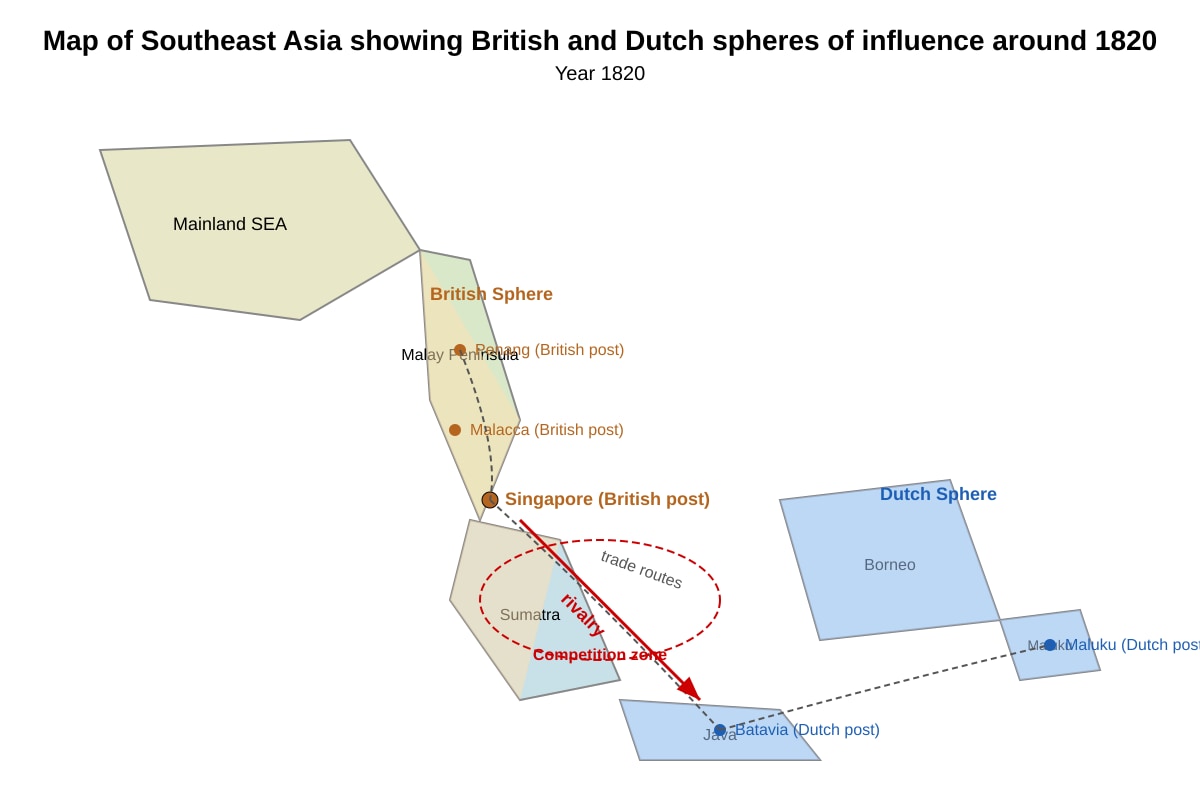
Generated map for 16.
- Study the map (Q16-fig1). What does the map show about international conflict in the region? [3m]
Section C: Structured Response (Questions 17–20)
-
Explain two reasons why the Anglo-Dutch rivalry led to the founding of Singapore in 1819. [4m]
-
Describe two ways in which the opening of the Suez Canal in 1869 affected international trade and Singapore’s port growth. [4m]
-
Explain how the rise of Japan as a military power in Asia contributed to conflict that led to the fall of Singapore in 1942. [5m]
-
"External conflicts in Europe always shaped Singapore’s development." Do you agree? Explain your answer using two examples. [5m]